
Art Lovers discussion
About Art
>
3 Types of Relief sculpture
date newest »
newest »
 History of Relief Sculpture
In simple terms, the development of relief sculpture was marked by swings between pictorial and sculptural dominance. For instance in Greek art, reliefs are more like contracted sculpture than expanded pictures. Figures inhabit a space which is defined by the solid forms of the figures themselves and is limited by the background plane. This background plane is not used to create a receding perspective but rather as a finite impenetrable barrier in front of which the figures exist. By comparison, Renaissance relief sculpture makes full use of perspective, which is a pictorial method of representing 3-D spatial relationships on a 2-D surface, and thus has much in common with fine art painting.
Prehistoric Relief Sculpture
The earliest reliefs date back to the cave art of the Upper Paleolithic, around 25,000 BCE. The oldest relief sculptures in France are: the Venus of Laussel (23,000 BCE), a limestone bas-relief of a female figure, found in the Dordogne; the rare Abri du Poisson Cave Salmon Carving (23,000 BCE) at Les Eyzies de Tayac, Perigord; the Solutrean Roc-de-Sers Cave Frieze (17,200 BCE) in the Charente; the Magdalenian era Cap Blanc Frieze (15,000 BCE); the Tuc d'Audoubert Bison (13,500 BCE); and the outstanding limestone frieze at Roc-aux-Sorciers (12,000 BCE) found in the Vienne. Outside France there are the badly preserved clay reliefs in the Kapova Cave in Russia. Other reliefs have been found incised on numerous megaliths from the Neolithic era.
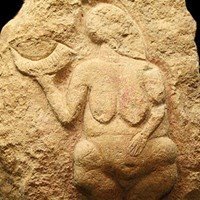
Venus of Laussel
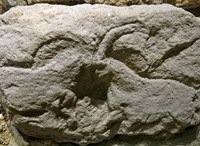
Roc-de-Sers Cave Frieze
Ancient Relief Sculpture
During the civilizations of the Ancient World (c.3,500-600 BCE), reliefs were commonly seen on the surfaces of stone buildings in ancient Egypt, Assyria and other Middle Eastern cultures. An example of Mesopotamian sculpture is the set of lions and dragons from the Ishtar Gate, Babylon, executed in low relief. See also the alabaster carvings of lion-hunts featuring Ashurnasirpal II and Ashurbanipal, a typical example of Assyrian art (c.1500-612 BCE). Egyptian sculptors tended to employ sunken relief. Figures are depicted standing sideways and are contained within a sharply insized outline: see for instance the many sunken reliefs at the Temple of Karnak in Egypt. Low reliefs were especially common in Chinese sculpture. For a guide to the principles behind Oriental arts, see: Traditional Chinese Art: Characteristics.
High reliefs did not become common until Classical Antiquity (c.500 BCE onwards), when Ancient Greek sculptors began to explore the genre more thoroughly. Attic tomb relief sculpture dating from the 4th century BCE are notable examples, as are the sculptured friezes used in the decoration of the Parthenon and other classical temples. For details of Hellenistic reliefs, like the Altar of Zeus, see: Pergamene School of Hellenistic Sculpture (241-133 BCE).
Relief sculptures were prominent in early Christian sculpture - notably in the sarcophagi of wealthy Christians during the 2nd and 3rd centuries CE (see also Relief Sculpture of Ancient Rome). See also: early Christian art (150 onwards).
During the period 600-1100, abstract reliefs appeared in numerous cultures around the world, as disparate as the Mixtec culture in Mexico, the Norse/Viking culture and Islamic environments across the Middle East.

Lioness Devouring a Boy (800 BCE)
British Museum.
Ivory carving gilded with gold leaf,
and decorated with lapis lazuli and
carnelian.

The Column of Antoninus
Pius (161 CE)
Relief sculpture on the base
of the monument, in the
Campus Martius
Medieval Relief Sculpture
In Europe during the period 1000-1200, Christian art mostly took the form of architecture, notably the building program of cathedrals, abbeys and churches financed by the Christian Church of Rome. Although statuary was a feature of this religious art, the main emphasis was on relief sculpture, as exemplified by the wonderful reliefs which decorate the portals (tympana) of Romanesque cathedrals in France, Germany, England and other countries. The Gothic period maintained this tradition though Gothic sculptors typically preferred a higher relief, in accordance with the renewed interest in statuary that characterized the fourteenth century.
The Renaissance Onwards
The Italian Renaissance (c.1400-1600) brought a noticeable change, as illustrated by the famous bronze doors that Lorenzo Ghiberti made for the Baptistry of Florence Cathedral. In order to exploit the full potential for perspective, figures in the foreground of the composition were done in high relief, making them appear close at hand, while background features were done in low relief, thus depicting distance. In his sculpture, Donatello further developed this approach by adding textural contrasts between rough and smooth surfaces. Thus in general Renaissance relief sculptors tended to make maximum use of the pictorial possibilities of the 2-D background, although there were exceptions. Two such trends were: the delicate and low reliefs in marble and terracotta of Desiderio da Settignano, and the more robust and sculptural relief style employed by Michelangelo.
The first Fontainebleau School (c.1530-70), a style of French Mannerist art named after the royal palace of the French King Francis I (1494-1547), was famous for its intricate relief sculpture in stucco, in which the stucco was cut into strips, rolled at the ends then intertwined to form fantastic shapes. Key artists at Fontainebleau included Francesco Primaticcio (1504-70) and Rosso Fiorentino (1494-1540).
Baroque relief sculptors further developed the pictorial approach used in Renaissance art, often on a very large scale. Sometimes their large relief compositions actually became a kind of painting in marble, as exemplified by Ecstasy of Saint Teresa by Bernini, which included figures carved almost fully in the round but encased in a marble altar. A few exponents of Neoclassical sculpture, like Antonio Canova and Bertel Thorvaldsen, temporarily revived the use of low reliefs in pursuit of what they saw as classical rigour and purity, but on the whole the Renaissance concept of "pictorial-style" relief prevailed, reaching a high point in the work of nineteenth century sculptors such as Francois Rude (Arc de Triomph) and Auguste Rodin (Gates of Hell).
The greatest and most famous relief sculpture of the 20th century is the Mount Rushmore National Memorial (1927-41), produced under Gutzon Borglum. This unique work features high relief granite portraits of American Presidents George Washington, Thomas Jefferson, Abraham Lincoln and Theodore Roosevelt.

Gates of Hell
Auguste Rodin

Mount Rushmore
bas-reliefa kind of sculpture in which shapes are carved so that they are only slightly higher than the flat background
'bas' French for 'low' relief
First known bas relief was in 1667
High reliefwhere the sculpture projects at least half or more of its natural circumference from the background, and may in parts be wholly disengaged from the ground, thus approximating sculpture in the round.
Sunken Reliefsunken relief, (incised, coelanaglyphic or intaglio relief), where the carving is sunk below the level of the surrounding surface and is contained within a sharpely incised contour line that frames it with a powerful line of shadow. The surrounding surface remains untouched, with no projections.
-found almost exclusively in ancient Egyptian art, although it has also been used in some beautiful small-scale ivory reliefs from India.
http://www.visual-arts-cork.com/sculp...


There are three basic types of relief sculpture: (1) low relief (basso-relievo, or bas-relief), where the sculpture projects only slightly from the background surface; (2) high relief (alto-relievo, or alto-relief), where the sculpture projects at least half or more of its natural circumference from the background, and may in parts be wholly disengaged from the ground, thus approximating sculpture in the round. [Sculptors may also employ middle-relief (mezzo-relievo), a style which falls roughly between the high and low forms]; (3) sunken relief, (incised, coelanaglyphic or intaglio relief), where the carving is sunk below the level of the surrounding surface and is contained within a sharpely incised contour line that frames it with a powerful line of shadow. The surrounding surface remains untouched, with no projections. Sunken relief carving is found almost exclusively in ancient Egyptian art, although it has also been used in some beautiful small-scale ivory reliefs from India.
In addition to the basic types listed above, there is an extremely subtle type of flat low relief carving, known as Statiacciato relief (rilievo schiacciato), that is particularly associated with the 15th century sculptor Donatello. This statiacciato design is partly rendered with finely engraved chiselled lines and partly carved in relief. It depends for its effect on the way in which pale-coloured materials, like white marble, react to light and show up the most delicate lines and changes of texture.
Reliefs may be abstract in style as well as representational or figurative. Abstract reliefs, both geometric and curvilinear, have been found in many different cultures, including those of Ancient Greece, the Celts, Mexico, the Vikings, and Islam. Representational and figurative relief sculpture is strongly associated with the Greeks, the Romans, Romanesque and Gothic architecture, and European sculpture from the Renaissance onwards.
http://www.visual-arts-cork.com/sculp...