
Art Lovers discussion
Movements in Art
>
Neoclassicism
date newest »
newest »
 Thank you Heather. While I would not call myself very educated in art history and movements, I love to follow lineages as an art student. In my childhood, I was deeply moved by the renaissance artists, especially Leonardo. I had seen only one or two documentaries on him in passing on TV, but that, to me was the epitome of artistic mastery. I was very strongly moved by how he was an innovator. I really like how Leonardo set the highest standards as a thinker, a standard that was high yet attainable, because it was really logical.
 In 2017 I decided to change my career to fine arts. That's when my real education began as an artist, at the age of 27. I found a teacher I really connected with, Matt, and he introduced me to Bouguereau, and my life was never the same. The more my teacher taught me about Bouguereau the more I fell in love with his art.
In many ways Bouguereau was Da Vinci to me. He was like my new Da Vinci. He painted only what he loved, he was number 1, he had an almost perfect run as an artist, super successful in his lifetime. Not only did he paint his ideal female but he himself stood as an ideal to the way a number 1 artist should be like. I would open up his Wiki page all the time. I learned that he was the father of this movement, Academic Classicism, which is a subset of Neoclassicism.
I just adore the terms 'academic' and 'classical'. I realized at that age that the only way I would want to make money in my life was through these two terms because just the two years before that, I kind of had won a scholarship in university(not in art but in science), and I was being paid solely because I could think! I really want to stress that. If you can think deeply, that could convert to so many professions! Thinking is innovation.
So coming back to Neoclassicism, I am a member of the website Art Renewal Center. I spent this year 2019 going through every painting by every neoclassical artist. If you asked me what neoclassical means, I would just say it is being the new Leonardo Da Vinci. Some amazing sculptures were produced in this movement, beautiful, ideal, aesthetic. The ateliers of today are really reviving this beautiful tradition and I want to be a part of this genre. The technical mastery, the study of anatomy, the nude figure and everything it stands for, it's something I'm passionate about. 2 years of art education is nothing and I know that. But if there is a fire in me burning, I don't think it ever burned more brightly than when I thought about the neoclassical heroes. Neoclassical for me is very close to Olympian Classical Revival, Victorian Classicism, Academic Classicism, Pre Raphaelite. Everytime I loved an artist, they belonged to one of these classifications. That was my little story of Neoclassicism.
Coming back to lineages, I follow two.
1. Bouguereau>Gerome>Bridgman>Norman Rockwell, Loomis, Robert Beverly Hale>Me
2. Ted Seth Jacobs>Anthony Ryder>My teacher Matthew Archambault> Me
I'm sure you could trace upwards from Bouguereau too, to Poussin to Da Vinci.
I believe that if you like an artist deeply, it's worth searching for what their teacher had to teach. Usually it narrows down to subset of a subset of a subset as we approach the modern times and yet the newest person in the lineage is a universe in himself or herself.
 Neoclassicism is a cultural movement that really interests me, (thank you, Winckelmann!) especially with the part it plays in the reception of myth. Most of my knowledge comes from the painting side of the movement, so I'll be focusing on that field in my response below!
I think unlike Arjun, rather than seeing Neoclassic painters as being the new Da Vinci, I like to see how the artists of the movement competed with and opposed the ideals of other movements and art styles, from Rococo to Romanticism, and became a unique and individual movement despite it's influences. The Renaissance, to me, defined a period of culmination between Classical Antiquity and the Medieval period with its financial/political influences in Florence.
On the other hand, I think when the pre-Socratic Protagoras stated "the saving principle of life" is not "the power of appearance," but the "art of measurement" (Plato's Protagoras), it defines the roots of Neoclassicism quite well for me. Where Romanticism at it's base focused on emotion and glorification, Neoclassicism embraced the simplicity and symmetry of original Greek and Roman art at a time where the developments of technique founded in the Renaissance were being utilised. (Of course I think that whilst this was the 'birth place' of Neoclassicism ideals, the way the movement developed is interesting too, but I'll leave that discussion for another time.)
In terms of various artists that best represent the movement, I think it goes without saying that Angelica Kauffman's history paintings are incredibly iconic, as are the works of Jacques-Louis David and Jean-Auguste-Dominique Ingres (I'll try to attach some well known works below - you should be able to open them in a new window to view full sized).

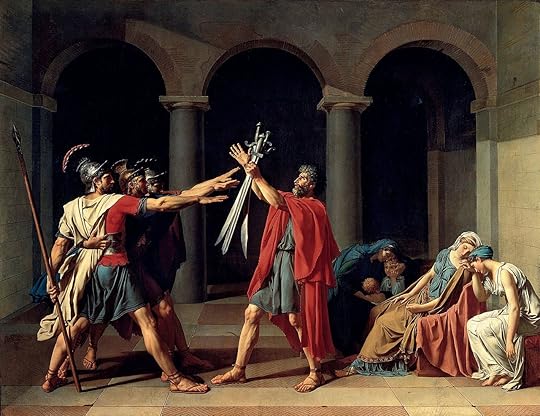

From left to right: 'Ariadne Abandoned by Theseus', Kauffman, 1774 - 'Oath of the Horatii', Jaques-Louis David, 1784 - 'Oedipus and the Sphynx', Ingres, 1808
I also love the progressive link to the Pre-Raphaelites that Neoclassicism has, and whilst this does digress from the subject at hand, I pose a question:
Winckelmann recommended Raphael as a model for Neoclassicism in the absence of ancient examples, however the later Pre-Raphaelites specifically rejected the mechanistic (as opposed to organic) approach that was the "corrupting influence" of Raphael.
Comparing the works of Raphael (I'll try to add below) to the Neoclassic work above, what links can you see? Can you find any 'corrupting influence' that the Pre-Raphaelites might have been on about?
And finally, what complications (if any) do you see this having for the ideals that Neoclassic artists strived to follow?

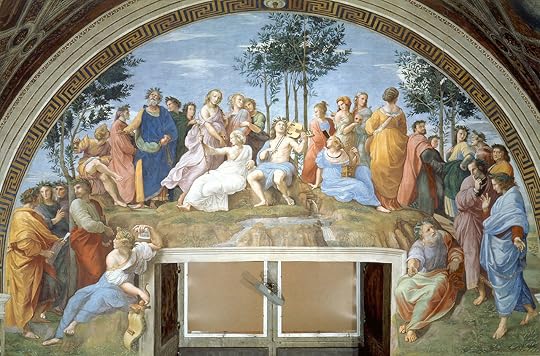
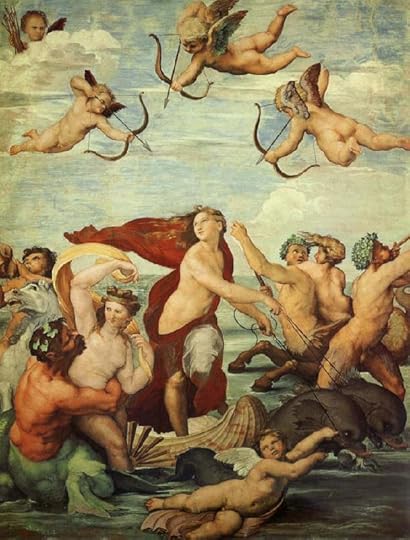
From left to right: 'The Three Graces', c.1503-05 - 'The Parnassus fresco', 1509-11 - 'The Triumph of Galatea', 1512
I look forward to hearing some responses and visual analysis of the two! :)


I looked it up and there is so much information! It is different in different parts of the world and spans several centuries also in various parts of the world. It also covers not only painting, but sculpture, architecture, literature, and other of the arts. For this reason, I delegate Arjun the responsibility to introduce this topic to us.
Take it away, Arjun, the floor is yours!