
Art Lovers discussion
Psychology of Art
>
Body Language
date newest »
newest »
 This young man's serene beauty resides in the balanced arrangement of his gently muscled limbs and torso. His anxiety is communicated through details: the tense forefinger of his right hand, his open mouth revealing his teeth, and his eyes turned to heaven. Tullio Lombardo's Adam encapsulates the Genesis story of the Creation of Man and his Fall. Made in God's image, Adam had to be perfect, and Tullio combined features of several ancient Roman sculptures—the pinnacle of sculptural achievement in the Renaissance mind—in an attempt to improve upon them. But by eating the fruit from the Tree of Knowledge, Adam admitted sin into the world and became ashamed of his own nakedness. From the front, Adam is shown about to bite into the apple. But if you move to the right, the apple is concealed, and we cannot see whether or not he has eaten. Thus Adam's open mouth might also suggest his fearful prayers to God.
https://www.metmuseum.org/metmedia/vi...
This young man's serene beauty resides in the balanced arrangement of his gently muscled limbs and torso. His anxiety is communicated through details: the tense forefinger of his right hand, his open mouth revealing his teeth, and his eyes turned to heaven. Tullio Lombardo's Adam encapsulates the Genesis story of the Creation of Man and his Fall. Made in God's image, Adam had to be perfect, and Tullio combined features of several ancient Roman sculptures—the pinnacle of sculptural achievement in the Renaissance mind—in an attempt to improve upon them. But by eating the fruit from the Tree of Knowledge, Adam admitted sin into the world and became ashamed of his own nakedness. From the front, Adam is shown about to bite into the apple. But if you move to the right, the apple is concealed, and we cannot see whether or not he has eaten. Thus Adam's open mouth might also suggest his fearful prayers to God.
https://www.metmuseum.org/metmedia/vi...To Bite or Not to Bite
Video
"Adam should be off-balance; he's about to take a bite from that terrible apple."—Luke Syson, curator
Tullio Lombardo (Italian, ca. 1455–1532). Adam, ca. 1490–95. Marble. The Metropolitan Museum of Art, New York, Fletcher Fund, 1936 (36.163).
How does the sculpted body communicate? Hear from Met experts, leading authorities, and rising stars, each with a unique viewpoint on the language of gesture, facial expression, and pose.
Bacchanal: A Faun Teased by Children
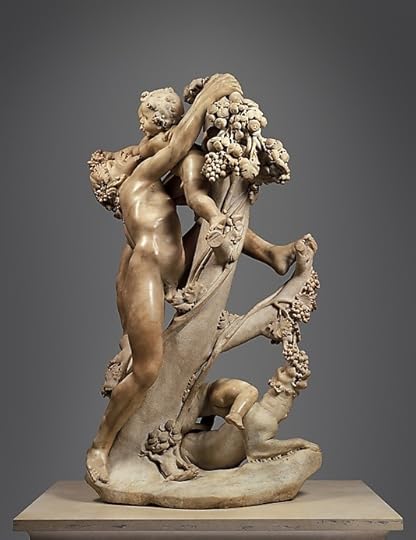
Bacchanal: A Faun Teased by Children,
Gian Lorenzo Bernini
1562–1629
The action unfolds as you encircle the piece. A drunken satyr, follower of Bacchus, the wine god, lunges forward to pick grapes as naked sprites, or putti, playfully push him back, while stuffing their own mouths full of fruit. Appropriately, the figures appear precariously balanced, but through brilliant engineering, the sculpture supports its own weight. The squared marble block remains an important ingredient in disciplining the anarchic diagonal movements within the piece. Gian Lorenzo Bernini was only about eighteen when he carved this work in the Roman studio of his Florence-born father, Pietro, and he seems to be showing off all he could do.
"It's done in a very elevated way, but there's a great deal of humor here."—Luke Syson, curator
"The fiction of the anatomy, it tickles me."
—Bill T. Jones, choreographer and director
"How does an artist take a piece of stone and make it feel like its flying?"
—Jackie Terrassa, educator
Beauty and Laughter Entwinedvideo
https://www.metmuseum.org/metmedia/vi...
How does the sculpted body communicate? Hear from Met experts, leading authorities, and rising stars, each with a unique viewpoint on the language of gesture, facial expression, and pose.
Art or Fiction?"The fiction of the anatomy, it tickles me."—Bill T. Jones, choreographer and director
Bacchanal: A Faun Teased by Children, 1562–1629.
https://www.metmuseum.org/metmedia/vi...
video
How does the sculpted body communicate? Hear from Met experts, leading authorities, and rising stars, each with a unique viewpoint on the language of gesture, facial expression, and pose.
This is really interesting! Especially if you know ASL, or American Sign Language, which I don't, but I still found this interesting and it taught me a little bit about sign language and body language in general used throughout the world just...because we're human! This is a presentation from the Met
Check out this short video where he explains
" Sorrow's Universal Language"
https://www.metmuseum.org/metmedia/vi...
""Mary's hands crossed over her heart . . . this same gesture is found in American Sign Language."—Emmanuel von Schack, educator and ASL user
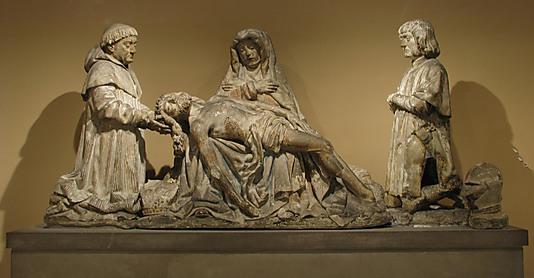
Pietà with Donors, ca. 1515. French. Limestone, traces of polychromy. The Metropolitan Museum of Art, New York
"How does the sculpted body communicate?" Hear from Met experts, leading authorities, and rising stars, each with a unique viewpoint on the language of gesture, facial expression, and pose.


Adam
Tullio Lombardo
1490-1495