
The Old Curiosity Club discussion

This topic is about
Little Dorrit
Little Dorrit
>
Little Dorrit, Book 1, Chp. 19-22

 Mod
Mod
October 1875 THE ETIQUETTE OF THE BILLIARD ROOM
"When two gentlemen are playing at billiards, they are supposed to hire, not only the table, but the room, and the services of the marker. They pay a certain sum per game, or per hour, for these items, and they are, for the time being, fairly entitled to the uninterrupted use or each and all. The marker is their especial servant, and his duty is to mark the game, hand the rest, take the balls out of the pocket when a hazard is made, and act as referee if required. A marker who attends to the game can do nothing else at the same time. This being the case, we yet find in many billiard-rooms, and even in some clubs, that a gentleman will enter the room, at once call off the marker's attention from the game, and order him to get a brandy-and-soda, or beer, or change for a sovereign, and be quite unaware that he is committing as great a breach of etiquette as though he entered your dining-room and ordered your attending servant to run a message for him.
If you are compelled to employ the marker in any way, you should first ask the players if they have any objection to your marking the game whilst the marker does this or that for you; you then mark with care, hand the rest, &c., just as would the marker whose services the players are paying for. Such a proceeding is not only etiquette, it is justice.
It is the marker's duty, at the slightest hint from the players that noise or chaff is objectionable, to strike his rest on the floor so as to attract the attention of the visitors, and call, "Order, if you please, gentlemen." Such a proceeding will in almost every case produce the desired result, unless there are roughs in the room, or those who ignore all courtesy or etiquette; and when such should be present, the sooner they are taught manners the better for them, and the more agreeable for the law-loving company."
Billiards must have been quite the game if it gets its own rules of etiquette, so perhaps Tip will make a good living as a billiard marker, in the case of Tip though, I doubt it. And now we know how to be billiard markers should we ever want to give it a try. We are told of Tip that "he had troubled himself so little as to the means of his release, that Clennam scarcely needed to have been at the pains of impressing the mind of Mr Plornish on that subject." He does respect and admire his sister Amy, but not enough to change any of his behavior even knowing how it worries her. We're told:
"The same rank Marshalsea flavour was to be recognised in his distinctly perceiving that she sacrificed her life to her father, and in his having no idea that she had done anything for himself."
So much for billiard marking, now we are all able to go and be one if we so desire. One morning Little Dorrit goes on a visit to her sister. She finds that both Fanny and her uncle have already gone to the theater where they are both working, something unknown to William, how to do it anyway. Little Dorrit follows them to the theater and once there is directed to her sister by some men standing at the door:
"On her applying to them, reassured by this resemblance, for a direction to Miss Dorrit, they made way for her to enter a dark hall—it was more like a great grim lamp gone out than anything else—where she could hear the distant playing of music and the sound of dancing feet. A man so much in want of airing that he had a blue mould upon him, sat watching this dark place from a hole in a corner, like a spider; and he told her that he would send a message up to Miss Dorrit by the first lady or gentleman who went through. The first lady who went through had a roll of music, half in her muff and half out of it, and was in such a tumbled condition altogether, that it seemed as if it would be an act of kindness to iron her. But as she was very good-natured, and said, 'Come with me; I'll soon find Miss Dorrit for you,' Miss Dorrit's sister went with her, drawing nearer and nearer at every step she took in the darkness to the sound of music and the sound of dancing feet.
At last they came into a maze of dust, where a quantity of people were tumbling over one another, and where there was such a confusion of unaccountable shapes of beams, bulkheads, brick walls, ropes, and rollers, and such a mixing of gaslight and daylight, that they seemed to have got on the wrong side of the pattern of the universe."
Fanny is astonished to see Amy there asking her how she had found her way there and saying it was so strange seeing her here among the professionals. She goes on to say that little quiet things like Amy can find there way any place and that she would have never been able to do it even though she knew so much more of the world. The narrator tells us:
"It was the family custom to lay it down as family law, that she was a plain domestic little creature, without the great and sage experience of the rest. This family fiction was the family assertion of itself against her services. Not to make too much of them."
Amy tells her sister she has come because she wants to know more about the lady who gave Fanny a bracelet, she has not been quite easy since Fanny told her. They are interrupted as Fanny is called to a dance rehearsal but finally the girls involved in the dance return and begin to get ready to go home. As Fanny and Amy leave they must call to their uncle who is waiting for them in an obscure corner. We're told that even though he is waiting for his niece she still must call for him three or four times before he knows they are there. I want to know more about their uncle, how he got the way he is. I wonder if he was like Amy when he was young. They leave their uncle at a restaurant for his dinner and Fanny then takes her sister to meet Mrs. Merdle, the woman who gave her the bracelet. The woman lives at Harley Street, Cavendish Square in the grandest house on the street. When Fanny knocks on the door it is opened by a footman with powder on his head, backed up by two more footmen with powder on their heads. This gets us to bird reference for Peter:
"Fanny walked in, taking her sister with her; and they went up-stairs with powder going before and powder stopping behind, and were left in a spacious semicircular drawing-room, one of several drawing-rooms, where there was a parrot on the outside of a golden cage holding on by its beak, with its scaly legs in the air, and putting itself into many strange upside-down postures. This peculiarity has been observed in birds of quite another feather, climbing upon golden wires."
I think having a pet bird would drive me insane. Little Dorrit finds them in a room much more splendid than she ever imagined before. Mrs. Merdle enters the room and is described this way:
"The lady was not young and fresh from the hand of Nature, but was young and fresh from the hand of her maid. She had large unfeeling handsome eyes, and dark unfeeling handsome hair, and a broad unfeeling handsome bosom, and was made the most of in every particular. Either because she had a cold, or because it suited her face, she wore a rich white fillet tied over her head and under her chin. And if ever there were an unfeeling handsome chin that looked as if, for certain, it had never been, in familiar parlance, 'chucked' by the hand of man, it was the chin curbed up so tight and close by that laced bridle."
Fanny tells Mrs. Merdle that Amy is curious about her, so she decided to bring her and asks Mrs. Merdle to tell Amy how they happened to know each other. Mrs. Merdle agrees and explains that her husband is very wealthy and his influence is very great and she also has a twenty-three year old son. Her son is a gay little thing, very impressionable and had a fascination with the stage. Because of this he became fascinated by Fanny and even wanted to marry her. This distressed his mother, who went to Fanny to try to end the relationship but found that Fanny had already refused to marry him. Fanny had told Mrs. Merdle that her family's standings in the society in which her father moves is superior to the Merdle's and is acknowledged by everyone. She doesn't bother to tell her where this society her father moves in is or why it is superior. I wish she'd tell me. Mrs. Merdle who is still very concerned about their society’s prejudices had then made it clear to Fanny that any marriage between Fanny and the Merdle's son would cause them to have nothing to do with their son and would leave him a beggar. She had then given Fanny the bracelet as a mark of her appreciation. She also puts something into Fanny's hand as they leave.
As they leave Fanny asks Amy what she thinks and Amy says she is very sorry Fanny took any gifts from Mrs. Merdle. Fanny scorns Amy’s lack of self respect saying she would let herself and her family be trodden on. Mrs. Merdle looks down on them and the least they can do is to make her pay for it. Fanny then goes on to tell Amy that if she despises her sister for being a dancer than why did she make her one? It is Amy's fault she is a dancer in the first place and looked down upon by Mrs. Merdle and people like her. I suppose she does have a point there. Fanny tells her that while she has been shut up, Fanny has been out in society and has become proud and spirited and that while Amy has been thinking of dinner and clothing she has been thinking of the family's honor. Here is our ending:
'Especially as we know,' said Fanny, 'that there certainly is a tone in the place to which you have been so true, which does belong to it, and which does make it different from other aspects of Society. So kiss me once again, Amy dear, and we will agree that we may both be right, and that you are a tranquil, domestic, home-loving, good girl.'
The clarionet had been lamenting most pathetically during this dialogue, but was cut short now by Fanny's announcement that it was time to go; which she conveyed to her uncle by shutting up his scrap of music, and taking the clarionet out of his mouth.
Little Dorrit parted from them at the door, and hastened back to the Marshalsea. It fell dark there sooner than elsewhere, and going into it that evening was like going into a deep trench. The shadow of the wall was on every object. Not least upon the figure in the old grey gown and the black velvet cap, as it turned towards her when she opened the door of the dim room.
'Why not upon me too!' thought Little Dorrit, with the door yet in her hand. 'It was not unreasonable in Fanny.'
Mod
"Mr Merdle was immensely rich; a man of prodigious enterprise; a Midas without the ears, who turned all he touched to gold. He was in everything good, from banking to building. He was in Parliament, of course. He was in the City, necessarily. He was Chairman of this, Trustee of that, President of the other. The weightiest of men had said to projectors, 'Now, what name have you got? Have you got Merdle?' And, the reply being in the negative, had said, 'Then I won't look at you.'
This great and fortunate man had provided that extensive bosom which required so much room to be unfeeling enough in, with a nest of crimson and gold some fifteen years before. It was not a bosom to repose upon, but it was a capital bosom to hang jewels upon. Mr Merdle wanted something to hang jewels upon, and he bought it for the purpose. Storr and Mortimer might have married on the same speculation.
Like all his other speculations, it was sound and successful. The jewels showed to the richest advantage. The bosom moving in Society with the jewels displayed upon it, attracted general admiration. Society approving, Mr Merdle was satisfied. He was the most disinterested of men,—did everything for Society, and got as little for himself out of all his gain and care, as a man might.
That is to say, it may be supposed that he got all he wanted, otherwise with unlimited wealth he would have got it. But his desire was to the utmost to satisfy Society (whatever that was), and take up all its drafts upon him for tribute. He did not shine in company; he had not very much to say for himself; he was a reserved man, with a broad, overhanging, watchful head, that particular kind of dull red colour in his cheeks which is rather stale than fresh, and a somewhat uneasy expression about his coat-cuffs, as if they were in his confidence, and had reasons for being anxious to hide his hands. In the little he said, he was a pleasant man enough; plain, emphatic about public and private confidence, and tenacious of the utmost deference being shown by every one, in all things, to Society. In this same Society (if that were it which came to his dinners, and to Mrs Merdle's receptions and concerts), he hardly seemed to enjoy himself much, and was mostly to be found against walls and behind doors. Also when he went out to it, instead of its coming home to him, he seemed a little fatigued, and upon the whole rather more disposed for bed; but he was always cultivating it nevertheless, and always moving in it—and always laying out money on it with the greatest liberality."
Mrs. Merdle we already met in the last chapter, one thing I was just thinking about her is that I wouldn't blame her at all for trying to keep her son from marrying a woman who didn't love her son and in fact thought he was an idiot, so if she knew Fanny felt that way and was marrying him for his money and society position (I'm guessing) I wouldn't blame her at all, but she never even met Fanny before she went to her to break off the engagement so it seems that it is Fanny's being a dancer she objected to. So she would have done her best to stop the wedding between her son and a dancer even if the woman loved him deeply. We also find that Mrs. Merdle's son is from her first marriage and he is described as "a chuckle-headed, high-shouldered make, with a general appearance of being, not so much a young man as a swelled boy." We're told that some say his brain was frozen in "in a mighty frost which prevailed at St John's, New Brunswick, at the period of his birth there, and had never thawed from that hour" and another story about him says that he fell out of a window as a child and that his head had been heard to crack. Whatever the stories were Mr. Merdle didn't mind at all he wanted a son for society and Mr. Sparkler (the son's name) did very well in society.
"A son-in-law with these limited talents, might have been a clog upon another man; but Mr Merdle did not want a son-in-law for himself; he wanted a son-in-law for Society. Mr Sparkler having been in the Guards, and being in the habit of frequenting all the races, and all the lounges, and all the parties, and being well known, Society was satisfied with its son-in-law. This happy result Mr Merdle would have considered well attained, though Mr Sparkler had been a more expensive article. And he did not get Mr Sparkler by any means cheap for Society, even as it was."
I am assuming that son-in-law was used in Dicken's day the same way step-son is used now. Around here anyway. That night - the night after Fanny and Amy visit Mrs. Merdle I suppose they mean, the Merdle's have a dinner party, as for the guests they are:
"magnates from the Court and magnates from the City, magnates from the Commons and magnates from the Lords, magnates from the bench and magnates from the bar, Bishop magnates, Treasury magnates, Horse Guard magnates, Admiralty magnates,—all the magnates that keep us going, and sometimes trip us up".
These guests, who Dickens gives names like Treasury, Bar, Horse Guards, and Bishop, are discussing how Mr. Merdle has had another successful deal that has earned him lots of money. Mr. Merdle shows up late as usual, he is the last to arrive. Treasury congratulates Mr. Merdle on a new achievement, Bar comes up and mentions that Merdle is one of the greatest converters of the root of all evil into the root of all good, or some such thing, and so on and on it goes.
A physician at the party - "a famous physician, who knew everybody, and whom everybody knew" inquires after Mr. Merdle’s health, and Merdle says that he is no better. The physician tells him to come see him next day. Bar and Bishop overhear and when Mr. Merdle walks away ask after Merdle's health. The physician tells them that Mr. Merdle is as healthy as a rhinoceros, has the digestion of an ostrich, and the concentration of an oyster - I suppose these are all good things although I'm not sure how an oyster concentrates. The doctor goes on to say that Merdle may have a deep-seated recondite complaint that he hasn't found yet - remember that for later - and that has finally brought us both to the name and the end of the chapter:
"Mr Merdle's complaint. Society and he had so much to do with one another in all things else, that it is hard to imagine his complaint, if he had one, being solely his own affair. Had he that deep-seated recondite complaint, and did any doctor find it out? Patience, in the meantime, the shadow of the Marshalsea wall was a real darkening influence, and could be seen on the Dorrit Family at any stage of the sun's course."
Mod
"Mr Clennam did not increase in favour with the Father of the Marshalsea in the ratio of his increasing visits. His obtuseness on the great Testimonial question was not calculated to awaken admiration in the paternal breast, but had rather a tendency to give offence in that sensitive quarter, and to be regarded as a positive shortcoming in point of gentlemanly feeling. An impression of disappointment, occasioned by the discovery that Mr Clennam scarcely possessed that delicacy for which, in the confidence of his nature, he had been inclined to give him credit, began to darken the fatherly mind in connection with that gentleman. The father went so far as to say, in his private family circle, that he feared Mr Clennam was not a man of high instincts. He was happy, he observed, in his public capacity as leader and representative of the College, to receive Mr Clennam when he called to pay his respects; but he didn't find that he got on with him personally. There appeared to be something (he didn't know what it was) wanting in him. Howbeit, the father did not fail in any outward show of politeness, but, on the contrary, honoured him with much attention; perhaps cherishing the hope that, although not a man of a sufficiently brilliant and spontaneous turn of mind to repeat his former testimonial unsolicited, it might still be within the compass of his nature to bear the part of a responsive gentleman, in any correspondence that way tending."
I'm not exactly sure why Arthur keeps visiting in the first place, he must be able to tell that Mr. Dorrit doesn't like him and wants him to leave him money when he leaves, he also must know that this hurts Amy every time it happens, and if his reason is to visit Amy why doesn't he do that at his mother's home or her uncle's? Mr. Chivery approaches Mr. Clennam one day as he leaves from one of these visits and asks if he could drop into his wife’s tobacco shop. She wishes to discuss Amy Dorrit with him and Arthur immediately agrees. When he arrives, Mrs. Chivery takes him to the parlor with a little window looking out at a dull little back yard and shows him a very despondent John. She tells Arthur that her son is pining away for Amy Dorrit and sits out in the yard for hours. She blames the family, certain that Amy herself loves her son telling Arthur that the brother and sister are against him, their views are "too high". Also Amy's father wants her all to himself and is against sharing her with anyone.
Arthur is bothered when he hears this, he finds it disappointing and disagreeable to think of her in love with young Mr Chivery. However, he promises to do anything that will add to the happiness of Amy Dorrit. He tells Mrs. Chivery that first he wants to make sure that Amy does love John Chivery and asks her to ask her son and make sure that this is indeed how Amy feels. Mrs. Chivery doesn’t think there is any doubt about this, but still they part good friends.
When Arthur leaves he takes the Iron Bridge it being much quieter than the London Bridge and sees Amy walking on the bridge. She waits for him and as they walk they talk about her worry about her father and Arthur tells her what a comfort she is to him. As they walk Maggy arrives. Little Dorrit asks why Maggy isn't with her father and Maggy informs her that she was, but that both Mr. Dorrit and Tip have sent her on an errand to the same address to deliver letters they had written. As it turns out, the letters are for Arthur Clennam although Amy was never to know of them. Both of them are asking for money although why a man who has been in prison for debt for 22 years would suddenly ask someone for money is beyond me, as for Tip, I believe he'd ask money from anyone although I'm not sure what brought Arthur to his mind, I wouldn't think they would see each other very often. Arthur agrees to Mr. Dorrit's request but refuses Tip. Good for him. And the chapter ends with this, could it give us a clue to what may be coming?:
"When he rejoined Little Dorrit, and they had begun walking as before, she said all at once:
'I think I had better go. I had better go home.'
'Don't be distressed,' said Clennam, 'I have answered the letters. They were nothing. You know what they were. They were nothing.'
'But I am afraid,' she returned, 'to leave him, I am afraid to leave any of them. When I am gone, they pervert—but they don't mean it—even Maggy.'
'It was a very innocent commission that she undertook, poor thing. And in keeping it secret from you, she supposed, no doubt, that she was only saving you uneasiness.'
'Yes, I hope so, I hope so. But I had better go home! It was but the other day that my sister told me I had become so used to the prison that I had its tone and character. It must be so. I am sure it must be when I see these things. My place is there. I am better there, it is unfeeling in me to be here, when I can do the least thing there. Good-bye. I had far better stay at home!'
The agonized way in which she poured this out, as if it burst of itself from her suppressed heart, made it difficult for Clennam to keep the tears from his eyes as he saw and heard her.
'Don't call it home, my child!' he entreated. 'It is always painful to me to hear you call it home.'
'But it is home! What else can I call home? Why should I ever forget it for a single moment?'
'You never do, dear Little Dorrit, in any good and true service.'
'I hope not, O I hope not! But it is better for me to stay there; much better, much more dutiful, much happier. Please don't go with me, let me go by myself. Good-bye, God bless you. Thank you, thank you.'
He felt that it was better to respect her entreaty, and did not move while her slight form went quickly away from him. When it had fluttered out of sight, he turned his face towards the water and stood thinking.
She would have been distressed at any time by this discovery of the letters; but so much so, and in that unrestrainable way?
No.
When she had seen her father begging with his threadbare disguise on, when she had entreated him not to give her father money, she had been distressed, but not like this. Something had made her keenly and additionally sensitive just now. Now, was there some one in the hopeless unattainable distance? Or had the suspicion been brought into his mind, by his own associations of the troubled river running beneath the bridge with the same river higher up, its changeless tune upon the prow of the ferry-boat, so many miles an hour the peaceful flowing of the stream, here the rushes, there the lilies, nothing uncertain or unquiet?
He thought of his poor child, Little Dorrit, for a long time there; he thought of her going home; he thought of her in the night; he thought of her when the day came round again. And the poor child Little Dorrit thought of him—too faithfully, ah, too faithfully!—in the shadow of the Marshalsea wall."
And with that I hand the book back to Tristram for the next installment. Hopefully my next turn won't be filled with so many Dorrits.
 Kim wrote: "The next chapter is titled "Mr. Merdle's Complaint" and here in the twenty first chapter we are still finding new characters. We begin the chapter at the "Merdle establishment", one of a row of hom..."
I think my favorite part of this chapter is how Mrs. Merdle is reduced to "the bosom," and we get to hear all about the bosom's past and its social activities.
I was a bit surprised to have a whole new family introduced in this installment though (the Merdles). There seems to be no end to this book's expansion!
Kim wrote: "Chapter 20 is titled "Moving in Society" and we find Tip still out of debtors prison - barely I'm guessing - and working as a billiard marker. Now since this didn't sound like much of a job to me, ..."Thank you for the billiard research, Kim! I read it twice in case I was missing any particular way that Tip could get himself into trouble (helping someone cheat at billiards, for instance?)--and nothing jumped out at me, but I'm sure he will be resourceful.
Fanny's workplace seems so grim that I am wondering if it's veered into prostitution yet, but so far I don't see her looking all remorseful and tragic and referring to horrifying things she can't name, so I guess she's just at the low-budget end of the entertainment industry.
Curious what people make of the distinction between Fanny being a "professional" and Amy not, even though they both work for a living.
 Mod
Mod
This week, I was most struck by Arthur Clennam's strange reaction to Mrs. Chivery's revelation: Is he jealous of young John, or does it not suit his image of Amy on a pedestal that there might be someone who is in love with her and whom she might even be in love with? And why is that so? Be that as it may, Arthur is definitely disenchanted to a certain extent, and I find this very dismaying: Does this not show that Arthur's interest in Amy is anything but entirely selfless? That, on the contrary, he, in exchange for his help, expects a certain angel-like purity from her, which cannot be made compatible with her having the same interests as most women her age? Does Amy have to be an asexual being to suit his picture of her? This is utterly bewildering to me, and to make matters even more so, Amy's rather snobbish treatment of young John seems to imply that the author (or narrator) himself is applying the same standard to Amy. How eerie!
Mod
As to Fanny, her shady bargain with Mrs. Merdle is amounting to blackmail, or even to some kind of passive prostitution, isn't it? And then there is her crazy reasoning of extorting the money and the bracelet for the family honour. What I really cannot get my head around is how Amy can see all this and not speak out about it. I've never had a lot of sympathy for her, but even that little amount is dwindling away.
I really loved how the narrator kept pointing out that Mrs. Merdle needed her large bosom to have enough room to be unfeeling in. What do you think about her husband?
 Julie wrote: " my favorite part of this chapter is how Mrs. Merdle is reduced to "the bosom," and we get to hear all about the bosom's past and its social activities...."
I usually don't care for these dinner party scenes in which Dickens introduces us to representatives of whatever institution he's railing against - the Boodles, et al, in Bleak House, the magnates here in Dorrit, etc. - but either I'm getting used to them, or this chapter was more entertaining than similar ones in other books. I really enjoyed reading about Treasury, Bar, etc. - and, yes, "the bosom". Can't we all just picture Mrs. Merdle, with her brooches and necklaces drawing attention to her decolletage (or vice versa)?
Mrs. Merdle's interactions with Fanny were quite delicious, and I love how Dickens managed to make them both feel as if they were somehow superior to the other. As for Amy's reaction - again, I can't quite figure her out. She's got pride, but it's misplaced. And she's obviously intimidated by her older siblings, still, perhaps, thinking they have some knowledge and wisdom that she hasn't yet gained.
I always have the same confusion as Kim mentioned when Dickens refers to an in-law, where we would say, "step child". Throws me off every time. I wonder if it's still the same in the UK, or if they have changed the meaning over the years. At any rate, Sparkler is bound to provide some diversions for us as we go forward. Interesting name.
Is the bird also just an amusing way to give some depth to the scenes at the Merdle home, or do you think he is symbolic of something?
Isn't it interesting how much Arthur has insinuated himself into the Dorrits' lives? So much so that Mrs. Chivery, whom we (and presumably Arthur) had never met before, summons him to her home/shop to request his assistance in convincing Amy to accept John. What the... ?? In previous readings of the book, I was just trying to follow the plot, and went with it. This time, though, it occurs to me how bizarre that is. The whole relationship seems weird and kind of creepy to me. What's our timeline here? How long has it been since Arthur got off the boat? Seems like 3-4 weeks to me, but maybe it's been longer? Why on Earth is he so wrapped up in this family? The only thing I can come up with is that he's got an attraction to Amy that he's not yet willing to recognize or admit. Can you think of any other reason? And, if this theory is valid, are his attentions romantic or somewhat controlling and stalker-like? If Amy had the balls to tell him to go away, would he do it, or would he keep finding excuses to be hanging around? But she won't. It's obvious from the exchange when he helped Tip "anonymously" that she's delighted with his attentions, despite her humility. Is this really any better than Fanny's taking the bracelet from Mrs. Merdle? I'm seeing this novel in a whole different light than I have in the past, and it's kind of fascinating. Reading Dickens is like what they say about rivers - you never step in the same one twice.
 Mod
Mod
Hi Julie
Yes, it’s great to see how Mrs Merdle is reduced to “the bosom.” Or perhaps we should say she is expanded into “the bosom.” Did it remind you of the prow of an old time sailing ship?
Is it me or is there an over abundance of names that Dickens gives to characters in this book to telegraph their habits, weaknesses or remarkable characteristics? We have a Bosom, a Father of the Marshalsea, Barnacles, a Pet, a Little Mother, a Tattycoram, a Wobbler, a John Baptist, a Sparkler and, could it be the surname Merdle is tied to the French word that means, well, “poop?”
Mod
Thanks for the reference to the bird. Not just any bird, but a big bird with scales on its legs, hanging upside down from a golden cage. Now, the sirens went off in my head. Hmmm … cage, and we have seen many previous forms of imprisonment in the novel so far. A golden cage. Now why would Dickens draw our attention to that fact? Hanging upside down. Why would Dickens draw our attention to that detail? Scales on legs. A rather unpleasant detail. So what’s up with this bird?
Golden cage, upside down. Could it be that this bird and its cage signals a transition between the rather threadbare and shoddy world of the theatre and the entry into an opulent house that is filled with the servants’ powder and the richly adorned bosom of Mrs Merdle.
The contrast of those two establishments is striking. I don’t think Dickens put the contrast of these two places in the same chapter by mistake. Poverty vs apparent riches, separated by the fulcrum of an upside down bird and a golden cage.
What great symbolism and foreshadowing.
Mod
Hi Mary Lou
You are so right. Never the same book. As I read the comments on Amy I am torn as to how to perceive her. I still have more sympathy for what she is enduring. Yes, at her age it is her choice to tragically overindulge her father, enable her siblings and mother Maggy. These flaws in her character are, I believe, balanced out by her maturity. She is a person who shows responsibility, she learns a skill and gets a job, she is calm, insightful (she knows a marriage proposal is coming) and obviously very responsible.
I think by rejecting John’s interest Amy shows an emotional maturity and an awareness of how important mature emotional attachments are, or could be, given the right person. I think when we see Amy with her sister at the Merdle’s she gets a further insight into how courtships and emotions work. I think the Sparkler - Fanny attachment is a step towards Amy’s own emotional awareness.
Unlike our poor Little Nell, I think Dickens let’s us see how Little Dorrit will grow up emotionally, and perhaps even physically.
Mod
I never thought of that before. Is he there so often that people now go to him for advice on the Dorrit's? My word, he must practically live there. Why would he want to?
Mod
Thanks for the reference to the bird. Not just any bird, but a big bird with scales on its legs, hanging upside down from a golden cage. Now, the sirens went off in my head. Hmmm … cage, and w..."
Now that you pointed that out I'm wondering, do birds ever really hang upside down any where at all?
Mod
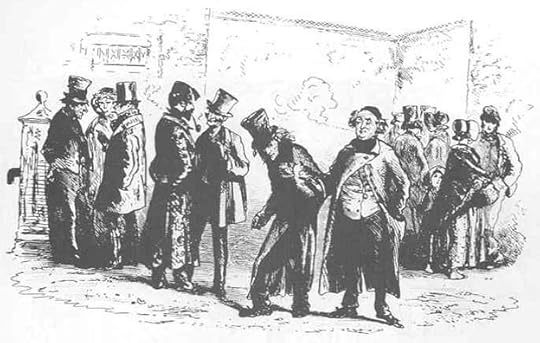
The Brothers
Chapter 19, Book 1
Phiz
Text Illustrated:
The brothers William and Frederick Dorrit, walking up and down the College-yard — of course on the aristocratic or Pump side, for the Father made it a point of his state to be chary of going among his children on the Poor side, except on Sunday mornings, Christmas Days, and other occasions of ceremony, in the observance whereof he was very punctual, and at which times he laid his hand upon the heads of their infants, and blessed those young insolvents with a benignity that was highly edifying — the brothers, walking up and down the College-yard together, were a memorable sight. Frederick the free, was so humbled, bowed, withered, and faded; William the bond, was so courtly, condescending, and benevolently conscious of a position; that in this regard only, if in no other, the brothers were a spectacle to wonder at.
They walked up and down the yard on the evening of Little Dorrit's Sunday interview with her lover on the Iron Bridge. The cares of state were over for that day, the Drawing Room had been well attended, several new presentations had taken place, the three-and- sixpence accidentally left on the table had accidentally increased to twelve shillings, and the Father of the Marshalsea refreshed himself with a whiff of cigar. As he walked up and down, affably accommodating his step to the shuffle of his brother, not proud in his superiority, but considerate of that poor creature, bearing with him, and breathing toleration of his infirmities in every little puff of smoke that issued from his lips and aspired to get over the spiked wall, he was a sight to wonder at. — Book the First, "Poverty," Chapter 19.
Commentary:
His more conventional etching techniques allow Browne to do justice to the prison identity of the Dorrit family in at least three illustrations. The technique of parallel and contrast between plates is evident, even in the captions alone, in "The Brothers" (Bk. 1, ch. 19) and "Miss Dorrit and Little Dorrit" (Bk. 1, ch. 20). In the first, a well-fed, supercilious man strolls patronizingly in the Marshalsea yard with "his brother Frederick of the dim eye, palsied hand, bent form, and groping mind," as though it were indeed a "College-yard," the man in the dressing gown and the disreputable characters near the pump were not there, and the woman at the gate with her small child were not taking leave of "a new Collegian" (Bk. 1, ch. 19). This horizontal etching takes full advantage of its available space, the figures in the background being serviceable and no more — though creating no feeling of slackness on the artist's part. The smoke which William is blowing out over his brother's head resembles a speechballoon (a device going back to earlier graphic satire), implying that this puff on a cigar represents an utterance of the condescending, self-assumed superiority of the prisoner brother. — Michael Steig, "Chapter 6: Bleak House and Little Dorrit: Iconography of Darkness".
As Steig has noted, Phiz makes the brothers flip sides of the same coin: Frederick, the broken-down, shabby musician with ragged hair, is bowed over with care; William, the pater familias, is casually commanding, puffing on a cigar, his erect posture a sharp contrast to his brother's. Further, the artist has positioned the Dorrit brothers between two very different groups: to the left, men and a woman apparently without families are conversing confidentially, the man in dressing-gown and fez smoking a pipe, his hands behind his back, relaxed, sophisticated, and even (apparently) affluent, or at least well-provided for under such circumstances. To the right, however, are six somewhat younger adults (two women and three men) and a child in a bonnet. William, then, participates in the characteristics of both groups: although the head of an extended family and attended by a daughter, he strikes a sophisticated pose, smoking and striking a casually sophisticated pose, like the inmate in the floral dressing-gown who is (apparently) not weighed down by family responsibilities. The dividing line between the "fashionable" and plebeian sides of the yard, the center of the community, the pump, is immediately to the left, so that the viewer must assume that all fourteen characters in the vignetted illustration are sophisticates rather than misfits - at least, in their own minds.
Mod
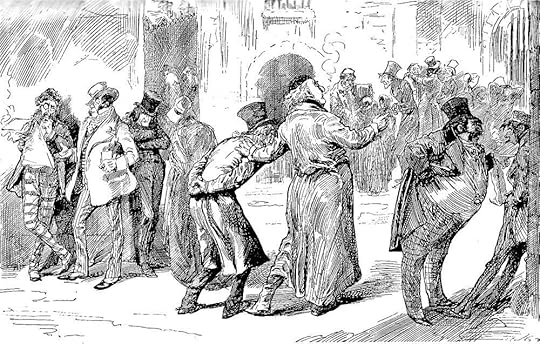
The Dorrit Brothers in the Marshalsea
Chapter 19, Book 1
Harry Furniss
Text Illustrated:
The brothers William and Frederick Dorrit, walking up and down the College-yard — of course on the aristocratic or Pump side, for the Father made it a point of his state to be chary of going among his children on the Poor side, except on Sunday mornings, Christmas Days, and other occasions of ceremony, in the observance whereof he was very punctual, and at which times he laid his hand upon the heads of their infants, and blessed those young insolvents with a benignity that was highly edifying — the brothers, walking up and down the College-yard together, were a memorable sight. Frederick the free, was so humbled, bowed, withered, and faded; William the bond, was so courtly, condescending, and benevolently conscious of a position; that in this regard only, if in no other, the brothers were a spectacle to wonder at.
Commentary:
Furniss's re-interpretation of the Dorrit brothers in the scenes leading up to William Dorrit's apotheosis is based less on both Mahoney's scene of Marshalsea yard, and more on the Phiz original, "The Brothers" for Book 1, Ch. 19. Avoiding the same scene of departure drafted so effectively by Phiz and redrafted by James Mahoney to focus on the contrasting figures of the brothers, Furniss sets the Dorrit brothers against a detailed backdrop of the College Yard and in the context of purposeless, tawdry insolvent debtors, still attempting to dress as members of the middle class, but clearly lacking bourgeois work ethic and sense of propriety. Furniss lavishes his attention and satirical pen upon those who gave the place its unsavory reputation. The elder Dorrit, knowledgeable about the place and its inmates, acts as his brother Frederick tour-guide, pointing out features of the Marshalsea and various characters with interesting backgrounds. All the figures in the scene are charged with Furniss's powers of humorous observation and kinetic energy, and yet all are caricatures in contrast to Mahoney's quiet, almost mundane realism.
Mod
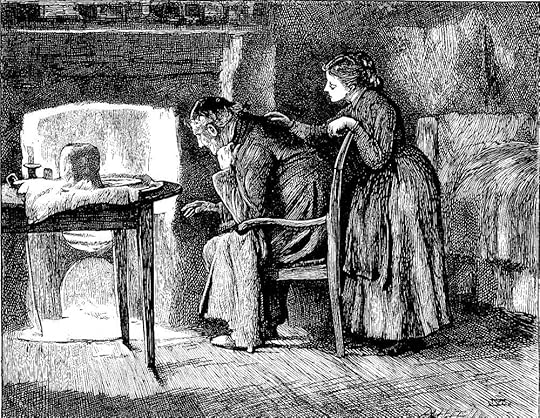
As she stood behind him, leaning over his chair so lovingly, he looked with downcast eyes at the fire.
Chapter 19, Book 1
James Mahoney
Text Illustrated:
There, the table was laid for his supper, and his old grey gown was ready for him on his chair-back at the fire. His daughter put her little prayer-book in her pocket — had she been praying for pity on all prisoners and captives! — and rose to welcome him.
Uncle had gone home, then? she asked him as she changed his coat and gave him his black velvet cap. Yes, uncle had gone home. Had her father enjoyed his walk? Why, not much, Amy; not much. No! Did he not feel quite well?
As she stood behind him, leaning over his chair so lovingly, he looked with downcast eyes at the fire. An uneasiness stole over him that was like a touch of shame; and when he spoke, as he presently did, it was in an unconnected and embarrassed manner.
"Something, I — hem! — I don't know what, has gone wrong with Chivery. He is not — ha! — not nearly so obliging and attentive as usual to-night. It — hem! — it's a little thing, but it puts me out, my love. It's impossible to forget," turning his hands over and over and looking closely at them, "that — hem! — that in such a life as mine, I am unfortunately dependent on these men for something every hour in the day."
Her arm was on his shoulder, but she did not look in his face while he spoke. Bending her head she looked another way.. — Book the First, "Poverty," Chapter 19.
Commentary:
The title is somewhat longer in the New York (Harper and Brothers) printing: As she stood behind him, leaning over his chair so lovingly, he looked with downcast eyes at the fire. An uneasiness stole over him that was like a touch of shame; and when he spoke, as he presently did, it was in an unconnected and embarrassed manner — Book 1, chap. 19. The chapter emphasizes Amy's self-sacrificing nature as she ministers to her aged father both night and day, again placing her hand gently on his back to comfort him as she had done for Maggy when they were locked out of the Marshalsea in The gate was so familiar, and so like a companion, that they put down Maggy's basket in a corner to serve for a seat (Book I, chap. 14). The almost sacramental nature of scene is emphasized by the highlighting of the uncut loaf on the table before the Patriarch, the identity suggested by the head-covering of Mr. Dorrit. As is customary for older, middle-class males of the late 1820s, William Dorrit wears a respectable skull-cap (as in the Phiz illustrations of Old Martin in Martin Chuzzlewit, such as Martin Chuzzlewit Suspects The Landlady Without Any Reason). Despite his despondency at having been a prisoner for so long, ironically William Dorrit is comfortably ensconced before a roaring coal-fire, has a dressing-gown, and a dutiful daughter to tend him. In pitying himself, the self-centered father never gives a thought to the cloistered life he has imposed upon his daughter, whose love and affection he quite undervalues.
Although Mahoney does not offer a clue to Amy's especial solicitousness here, she knows the cause of Young Chivery's recent coldness towards her father, for she has without reservation broken off her relationship with that self-styled "lover" in the previous chapter, an incident which Mahoney has realized in "O don't cry!" said Little Dorrit piteously. "Don't, don't! Good-bye, John. God bless you!" "Good-bye, Miss Amy. Good-bye!" And so he left her. Thus, sacrificing herself to her father's comforts commendably has its limits, and she asserts herself sufficiently for the reader to admire her deft handling of the enamored John.
Mod
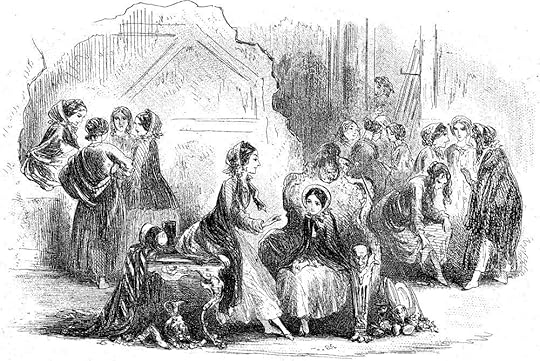
Miss Dorrit and Little Dorrit
Chapter 20
Phiz
Text Illustrated:
"Well! And what have you got on your mind, Amy? Of course you have got something on your mind about me?" said Fanny. She spoke as if her sister, between two and three years her junior, were her prejudiced grandmother.
"It is not much; but since you told me of the lady who gave you the bracelet, Fanny —"
The monotonous boy put his head round the beam on the left, and said, "Look out there, ladies!" and disappeared. The sprightly gentleman with the black hair as suddenly put his head round the beam on the right, and said, "Look out there, darlings!" and also disappeared. Thereupon all the young ladies rose and began shaking their skirts out behind.
"Well, Amy?" said Fanny, doing as the rest did; "what were you going to say?"
"Since you told me a lady had given you the bracelet you showed me, Fanny, I have not been quite easy on your account, and indeed want to know a little more if you will confide more to me."
"Now, ladies!" said the boy in the Scotch cap. "Now, darlings!" said the gentleman with the black hair. They were every one gone in a moment, and the music and the dancing feet were heard again.
Little Dorrit sat down in a golden chair, made quite giddy by these rapid interruptions. — Book the First, "Poverty," Chapter 20.
Commentary:
In the original Phiz illustration for Chapter 20, "Moving in Society," Little Dorrit seems to sit in moral judgment of her actress sister, Fanny, backstage, after their visit to their uncle and to Mrs. Merdle. A more pertinent and interesting scene would have been that of the other stratum of society in which Fanny moves, that of the newly-rich Merdles of Harley Street, Cavendish Square, whom the sisters visit after the theatre. Phiz had to wait until the final double number in June 1857 to provide such illustration of the Dorrit sisters' entering the Harley Street mansion as the frontispiece, "Fanny and Little Dorrit call on Mrs. Merdle". The backstage dialogue between the sisters accompanying the Phiz engraving conveys the stark differences between the older "experienced" Fanny, the "professional" dancer, and the somewhat isolated, child-like, virtuous Amy, her father's constant companion in the debtors' prison. Rarely out of the Marshalsea except to attend Mrs. Clennam, Amy is a complete stranger to this world that her sister and uncle inhabit, a world of tawdry realties and entertaining surfaces. Here we see the stage from behind the scenes as the sisters discuss Fanny's exploiting her relationship with Edmund Sparkler, the doltish son of the wealthy Mrs. Merdle.
The issue with which Phiz here and Harry Furniss in the Charles Dickens Library Edition's Little Dorrit among the Professionals (Book 1, Ch. 20) engage themselves is the jewelry and clothing that Fanny is extorting from Mrs. Merdle in exchange for not becoming romantically involved with her dull-witted, socialite son Edmund Sparkler. Amy is particularly concerned about a bracelet that Fanny now wears, and Fanny is equally concerned about the unsavory reputation that theatrical people have acquired in respectable, upper-middle-class society — and about Amy's behaving as if they are paupers. Mrs. Merdle has objected to a match between her dissolute son and the daughter of an insolvent debtor (indeed, in chapter 20 of the first book she had actually bribed the young dancer to discourage her son's attentions). The Dorrit sisters discuss the issue of the bracelet when Amy is seated in a stage throne at the theatre in the Phiz original — the gilded chair in both the Phiz and Furniss illustrations suggesting moral authority and superior judgment. Although the Furniss re-interpretation and the Phiz original have superficial similarities, including the backstage setting and the young dancers about to perform, significantly Furniss has shifted who is sitting on the throne, so that, in his pen-and-ink drawing, Fanny condescendingly treats Amy as if she were a senor, out of touch with reality. Amy is entranced (perhaps by this strange situation) rather than, as in Phiz, attentive and timid as she struggles to raise the issue of the bracelet.
Mod
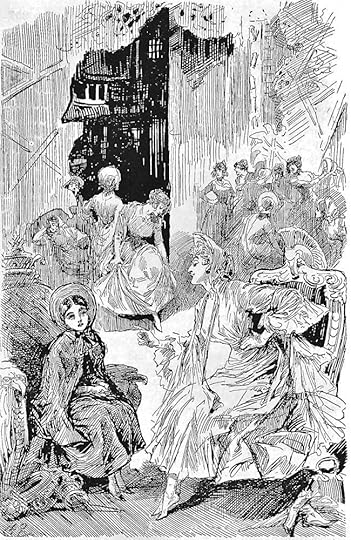
Little Dorrit among the Professionals
Chapter 20, Book 1
Harry Furniss
Text Illustrated:
"The notion of you among professionals, Amy, is really the last thing I could have conceived!" said her sister. "Why, how did you ever get here?"
"I don't know. The lady who told you I was here, was so good as to bring me in."
"Like you quiet little things! You can make your way anywhere, I believe. I couldn't have managed it, Amy, though I know so much more of the world."
It was the family custom to lay it down as family law, that she was a plain domestic little creature, without the great and sage experience of the rest. This family fiction was the family assertion of itself against her services. Not to make too much of them.
"Well! And what have you got on your mind, Amy? Of course you have got something on your mind about me?" said Fanny. She spoke as if her sister, between two and three years her junior, were her prejudiced grandmother."Of course you have something on your mind, about me?"
Commentary:
Harry Furniss would certainly have consulted the James Mahoney portrait of Frederick playing the clarionet as his nieces silently watch in the 1873 Household Edition volume; however, Furniss opted instead to revise the 1856 serial illustration by Phiz). The backstage dialogue between the sisters conveys the stark differences between the older Fanny, the "professional" dancer, and the somewhat isolated, child-like Amy, her father's constant companion in the debtors' prison. Amy is a complete stranger to the theatrical world that her sister and uncle inhabit, a world of tawdry realties and entertaining surfaces. Here we see the stage from behind the scenes as the sisters discuss Fanny's exploiting her relationship with Edmund Sparkler, the doltish son of the wealthy Mrs. Merdle.
A more pertinent and interesting scene that none of these illustrators considered was that of the other stratum of society in which Fanny moves, that of the Merdles of Harley Street, Cavendish Square. The issue with which Phiz and Furniss engage themselves is the jewelry and clothing that Fanny is extorting from Mrs. Merdle in exchange for not becoming romantically involved with her dull-witted, socialite son Edmund Sparkler. Amy is particularly concerned about a bracelet that Fanny now wears, and Fanny is equally concerned about the unsavory reputation that theatrical people have acquired in respectable, upper-middle-class society — and about Amy's behaving as if they are paupers. The Dorrit sisters discuss the issue of the bracelet when Amy is seated in a stage throne at the theatre — the gilded chair in both the Phiz and Furniss illustrations suggesting her moral authority and superior judgment.
Although the Furniss re-interpretation and the Phiz original have superficial similarities, including the backstage setting and the young dancers about to perform, significantly Furniss has shifted who is sitting on the throne, so that, in his pen-and-ink drawing, Fanny condescendingly treats Amy as if she were a senior, out of touch with reality. Amy is entranced (perhaps by this strange situation) rather than, as in Phiz, attentive and timid as she struggles to raise the issue of the bracelet. In both, Amy is still very much a child, whereas Fanny is physically a mature woman — although her judgment may not be so mature. Certainly Furniss's depiction of the backstage area is more dynamic, and his Fanny a more stunning beauty, with the wasp-waist that he gives many of his young women in his fin-de-siecle compositions.
Mod
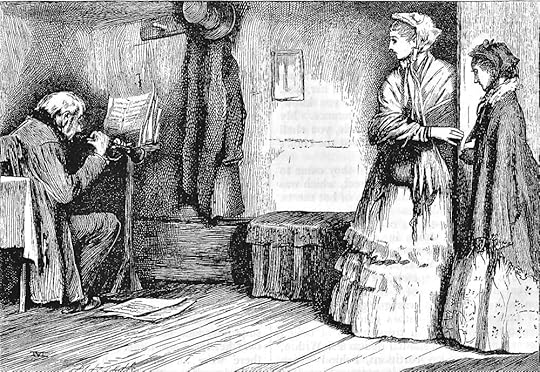
When they arrived there, they found the old man practising his clarionet
Chapter 20, Book 1
James Mahoney
Text Illustrated:
They spoke no more all the way back to the lodging where Fanny and her uncle lived. When they arrived there, they found the old man practising his clarionet in the dolefullest manner in a corner of the room. Fanny had a composite meal to make, of chops, and porter, and tea; and indignantly pretended to prepare it for herself, though her sister did all that in quiet reality. When at last Fanny sat down to eat and drink, she threw the table implements about and was angry with her bread, much as her father had been last night.
"If you despise me," she said, bursting into vehement tears, "because I am a dancer, why did you put me in the way of being one? It was your doing. You would have me stoop as low as the ground before this Mrs. Merdle, and let her say what she liked and do what she liked, and hold us all in contempt, and tell me so to my face. Because I am a dancer!"
"O Fanny!" — Book the First, "Poverty," Chapter 20.
Commentary:
The Chapman and Hall (British) Household Edition composite wood-engraving is identical to that in the New York (Harper and Brothers) edition; however, the American volume, in spite of its positioning the plate much closer to the text realized, has a much longer caption: They spoke no more, all the way back to the lodging where Fanny and her uncle lived. When they arrived there they found the old man practicing his clarionet in the dolefullest manner in a corner of the room — Book 1, chap. xx.
In the original serial illustrations, in the sixth monthly number (May 1856), Phiz depicts Little Dorrit and her older sister, Fanny, backstage at the theatre where Amy's sister is a professional dancer, a scene that is the basis for Harry Furniss's much later illustration, Little Dorrit among the Professionals. In avoiding these crowd scenes to focus on the three Dorrits in the little room which Fanny shares with her uncle, Mahoney has selected a subject lacking visual appeal, but has accurately characterized Frederick Dorrit as a social isolate, unlike his gregarious brother, William, the self-styled "Father of the Marshalsea."
Although Amy is the sister of a dancer, she is untainted by the early Victorian theatre and its tawdry denizens. This illustration, although realizing the moment when the sisters discover their uncle in his lodging, practicing his instrument, the illustration is situated in an earlier part of the chapter, where Dickens describes Frederick Dorrit as a musical drudge, eking out a living by playing six nights a week in the theatre, suggesting that the action of the early part of the book is set in the days before matinees:
The old man looked as if the remote high gallery windows, with their little strip of sky, might have been the point of his better fortunes, from which he had descended, until he had gradually sunk down below there to the bottom. He had been in that place six nights a week for many years, but had never been observed to raise his eyes above his music-book, and was confidently believed to have never seen a play. There were legends in the place that he did not so much as know the popular heroes and heroines by sight, and that the low comedian had 'mugged' at him in his richest manner fifty nights for a wager, and he had shown no trace of consciousness. The carpenters had a joke to the effect that he was dead without being aware of it; and the frequenters of the pit supposed him to pass his whole life, night and day, and Sunday and all, in the orchestra. They had tried him a few times with pinches of snuff offered over the rails, and he had always responded to this attention with a momentary waking up of manner that had the pale phantom of a gentleman in it: beyond this he never, on any occasion, had any other part in what was going on than the part written out for the clarionet; in private life, where there was no part for the clarionet, he had no part at all. — Book One, Chapter 20.
In his portrait of the clarionet player, Mahoney conveys the old musician's becoming so engrossed in his art that he is oblivious to the presence of his nieces, who have just arrived for dinner. A more pertinent and interesting scene would have been that of the other stratum of society in which Fanny moves, that of the newly-rich Merdles of Harley Street, Cavendish Square. In the Mahoney illustration, we cannot see Amy's face, but her diminutive stature, in contrast to her sister's height, certainly suggests why she bears the nickname "Little Dorrit."
Mod
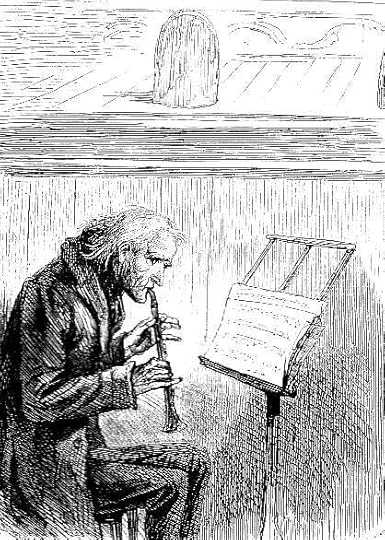
Frederick Dorrit
Chapter 20, Book 1
Sol Eytinge Jr.
Commentary:
The eighth illustration, like seventh, presents the study of a single, alienated character, in this case the broken-down clarinet-player Frederick Dorrit, brother of William ("Father of the Marshalsea") and uncle of Edward ("Tip"), Amy, and Fanny. This last niece is a dancer at the small theatre where Frederick is employed. Decidedly a minor character, Dickens uses Frederick to reveal his brother William's short-comings, particularly his aristocratic haughtiness and utterly impractical nature. At the opening of chapter 19 of Book One, "Poverty," the novelist contrasts the aristocratic and condescending William with his unprepossessing sibling: "His brother Frederick of the dim eye, palsied hand, bent form, and groping mind, submissively shuffled at his side, accepting his patronage as he accepted every incident of the labyrinthian world in which he had got lost". A musician earning a modest living, Frederick is constantly criticized by his brother for failing to uphold the family honor. In his study of Frederick, Eytinge shows him practicing his art rather than walking by his brother's side in the "College-yard" of the Marshalsea prison. The American illustrator conveys his subject's gentle and melancholic nature, the description accompanied by this illustration of Frederick playing musical accompaniment for a stage play, as suggested by the stage and footlights above him and his music stand. The reader's understanding of the wizened musician in Chapter 20, "Moving in Society," is likely to have been conditioned by this earlier, ironic passage narrated by the patronizing William himself:
His brother Frederick was much broken, no doubt, and it might be more comfortable to himself (the Father of the Marshalsea) to know that he was safe within the walls. Still, it must be remembered that to support an existence there during many years, required a certain combination of qualities he did not say high qualities, but qualities — moral qualities. Now, had his brother Frederick that peculiar union of qualities? Gentlemen, he was a most excellent man, a most gentle, tender, and estimable man, with the simplicity of a child; but would he, though unsuited for most other places, do for that place? No; he said confidently, no! And, he said, Heaven forbid that Frederick should be there in any other character than in his present voluntary character! Gentlemen, whoever came to that College, to remain there a length of time, must have strength of character to go through a good deal and to come out of a good deal. Was his beloved brother Frederick that man? No. They saw him, even as it was, crushed. Misfortune crushed him. He had not power of recoil enough, not elasticity enough, to be a long time in such a place, and yet preserve his self-respect and feel conscious that he was a gentleman. Frederick had not (if he might use the expression) Power enough to see in any delicate little attentions and — and — Testimonials that he might under such circumstances receive, the goodness of human nature, the fine spirit animating the Collegians as a community, and at the same time no degradation to himself, and no depreciation of his claims as a gentleman. Gentlemen, God bless you! Book One, Chapter 19
Played convincingly by veteran Irish actor and former Royal Shakespeare Company member Cyril Cusack in the 1987 adaptation, directed and written by Christine Edzard and starring then fifty-year-old Derek Jacobi as Arthur Clennam, "the most ambitious cinematic adaptation of any Dickens novel" had to run some 360 minutes to manage the complex plot and include the host of Dickensian originals, some twenty-three in all, headed by the "Father of British Cinema and Theatre," Alec Guinness, seventy-four at the time the film was made. In the more recent BBC One television adaptation (2008), Frederick Dorrit as played by James Fleet of Three Weddings and a Funeral (1994) fame has rougher edges, but his subtle characterization benefits from Fleet's familiarity with similar characters from the Dickens canon:
He is one of a panoply of weak men in Dickens that people find charming — think of Newman Noggs in Nicholas Nickleby. Their hearts have often been broken in the past, and that has turned them into these men who can't fight their own corner. [BBC One interview with James Fleet]
After the scene in the Marshalsea, Dickens shows Frederick in his native element, the orchestra pit of the little theatre:
The old man looked as if the remote high gallery windows, with their little strip of sky, might have been the point of his better fortunes, from which he had descended, until he had gradually sunk down below there to the bottom. He had been in that place six nights a week for many years, but had never been observed to raise his eyes above his music-book, and was confidently believed to have never seen a play. There were legends in the place that he did not so much as know the popular heroes and heroines by sight, and that the low comedian had 'mugged' at him in his richest manner fifty nights for a wager, and he had shown no trace of consciousness. The carpenters had a joke to the effect that he was dead without being aware of it; and the frequenters of the pit supposed him to pass his whole life, night and day, and Sunday and all, in the orchestra. They had tried him a few times with pinches of snuff offered over the rails, and he had always responded to this attention with a momentary waking up of manner that had the pale phantom of a gentleman in it: beyond this he never, on any occasion, had any other part in what was going on than the part written out for the clarionet; in private life, where there was no part for the clarionet, he had no part at all. Some said he was poor, some said he was a wealthy miser; but he said nothing, never lifted up his bowed head, never varied his shuffling gait by getting his springless foot from the ground. Though expecting now to be summoned by his niece, he did not hear her until she had spoken to him three or four times; nor was he at all surprised by the presence of two nieces instead of one, but merely said in his tremulous voice, "I am coming, I am coming!" and crept forth by some underground way which emitted a cellarous smell. Chapter 20, Book 1
Mod
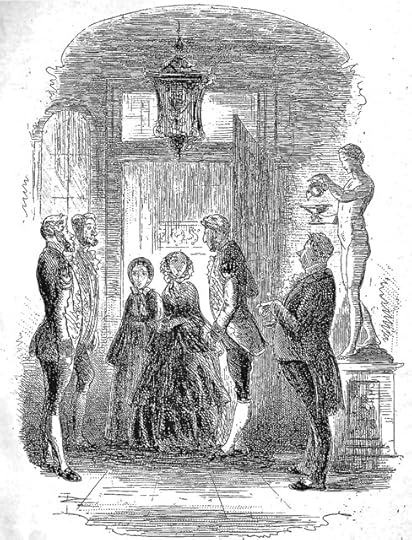
Fanny and Little Dorrit call on Mrs. Merdle
Chapter 20
Phiz
Text Illustrated:
"Now, Amy," said her sister, "come with me, if you are not too tired to walk to Harley Street, Cavendish Square."
The air with which she threw off this distinguished address and the toss she gave to her new bonnet (which was more gauzy than serviceable), made her sister wonder; however, she expressed her readiness to go to Harley Street, and thither they directed their steps. Arrived at that grand destination, Fanny singled out the handsomest house, and knocking at the door, inquired for Mrs. Merdle. The footman who opened the door, although he had powder on his head and was backed up by two other footmen likewise powdered, not only admitted Mrs. Merdle to be at home, but asked Fanny to walk in. Fanny walked in, taking her sister with her; and they went up-stairs with powder going before and powder stopping behind, and were left in a spacious semicircular drawing-room, one of several drawing-rooms, where there was a parrot on the outside of a golden cage holding on by its beak, with its scaly legs in the air, and putting itself into many strange upside-down postures. This peculiarity has been observed in birds of quite another feather, climbing upon golden wires.
The room was far more splendid than anything Little Dorrit had ever imagined, and would have been splendid and costly in any eyes. She looked in amazement at her sister and would have asked a question, but that Fanny with a warning frown pointed to a curtained doorway of communication with another room. The curtain shook next moment, and a lady, raising it with a heavily ringed hand, dropped it behind her again as she entered. — Book the First, "Poverty," Chapter 20.
Commentary:
Similar evidence of concern with illustrations is to be found in a note to Browne regarding the last two illustrations for a novel, possibly Little Dorrit (it is undated): "I hope the Frontispiece and Vignette will come out thoroughly well from the plate, and make a handsome opening to the book." (There is no direct evidence that this in fact refers to Little Dorrit, but it is printed in the Nonesuch Letters with other correspondence of the Little Dorrit period.) In this novel they do, the title page echoing the central motif of the wrapper. The implication that the world outside the prison is darker than that within is borne out by the frontispiece, in which the figure of Amy is a virtual mirror image of that on the title; but here she is entering the Merdle mansion with Fanny, and from what we have learned of both Mrs. Merdle and her views on "Society," as well as Mr. Merdle, this world is indeed more sinister than that of the prison. Yet in line with Dickens' text, Phiz has portrayed Amy in such a way that she conveys the sense of an innocence so strong as to be impervious to the corruptions of either the Marshalsea or Society; this is less true of her figure in the cover design, where her character has not yet been established and she looks as if she is bowed down with resignation.
Phiz continues his role as emblematizer of the novelist's intentions in the chain-and-brick lettering of the title, and in an amusing touch in the frontispiece. The portly man at the right, behind the footman, is the Merdle chief butler, whom Dickens describes as doing nothing (like the government), and yet who is the terror of Merdle's life. He holds his hands so as to appear to be occupied, but he is no more useful than is the neoclassical statue behind him, which parodies his gestures in pouring an imaginary substance out of an imitation pitcher into an imitation bowl, The butler, in other words, functions as a piece of mobile sculpture for the conspicuously consuming Merdles — he is there for show and performs no real work, which is consistent with the theme of How Not To Do It.
Mod
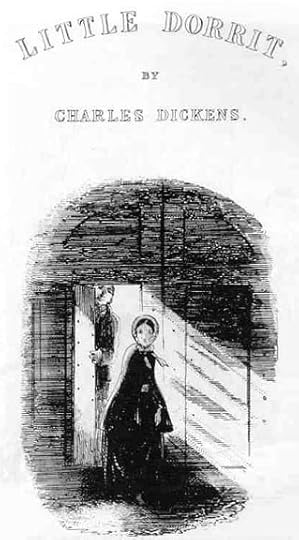
Title Page
Phiz
Mod
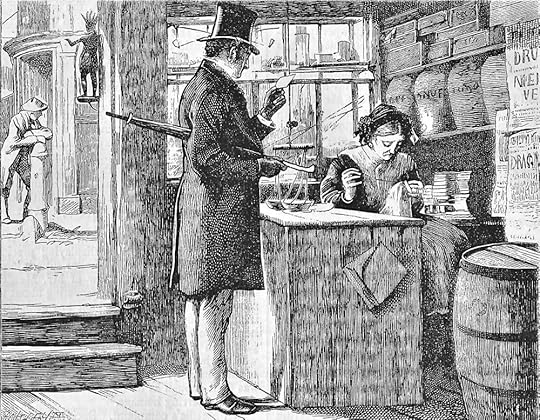
Arthur Clennam, with the card in his hand, betook himself to the address set forth upon it.
Chapter 22, Book 1
James Mahoney
Text Illustrated:
"I ask your pardon again," said Mr. Chivery, "but could you go round by Horsemonger Lane? Could you by any means find time to look in at that address?" handing him a little card, printed for circulation among the connection of Chivery and Co., Tobacconists, Importers of pure Havannah Cigars, Bengal Cheroots, and fine-flavoured Cubas, Dealers in Fancy Snuffs, &C. &C.
"It an't tobacco business," said Mr. Chivery. "The truth is, it's my wife. She's wishful to say a word to you, sir, upon a point respecting — yes," said Mr. Chivery, answering Clennam's look of apprehension with a nod, "respecting her."
"I will make a point of seeing your wife directly."
"Thank you, sir. Much obliged. It an't above ten minutes out of your way. Please to ask for Mrs Chivery!" These instructions, Mr. Chivery, who had already let him out, cautiously called through a little slide in the outer door, which he could draw back from within for the inspection of visitors when it pleased him.
Arthur Clennam, with the card in his hand, betook himself to the address set forth upon it, and speedily arrived there. It was a very small establishment, wherein a decent woman sat behind the counter working at her needle. Little jars of tobacco, little boxes of cigars, a little assortment of pipes, a little jar or two of snuff, and a little instrument like a shoeing horn for serving it out, composed the retail stock in trade.
Arthur mentioned his name, and his having promised to call, on the solicitation of Mr. Chivery. About something relating to Miss Dorrit, he believed. Mrs. Chivery at once laid aside her work, rose up from her seat behind the counter, and deploringly shook her head. — Book the First, "Poverty," Chapter 22.
Commentary:
As a piece of genre art devoted to the mundane and commonplace, in the manner of the seventeenth-century Dutch masters such as Johannes Vermeer, the Mahoney wood-engraving of a nineteenth-century London tobacconist's shop (two steps down from Horsemonger Lane) has much to recommend it as the illustrator describes his commercial subject in considerable detail, including the small statue of an aboriginal chief mounted outside the shop door (as a business "sign" for the illiterate), the jars labelled with their contents behind the vendor, Mrs. Chivery, and broadsheets posted (right).
Compare this commonplace scene to that by Phiz for A Tale of Two Cities, the Defarges' local business in the Parisian suburb of St. Antoine, The Wine Shop (September 1859), in which the shop is at least one step up from the street, as opposed to this London shop, which is two steps down. The well-dressed middle-class customer at the counter does not reveal his face to the viewer in the Mahoney illustration as he studies the card he was given, but, as he is tall and impeccably dressed, his form is entirely consistent with that of Arthur Clennam seen elsewhere. The excessive amount of cross-hatching seems to be intended to suggest the darkness of the little shop's interior, as the front of the counter, the rear of Clennam's coat, and his trousers pick up the light from open door; the window, crowded with bric-a-brac admits far less illumination. Mrs. Chivery is sewing with her back to the window and door to take advantage of whatever natural light is available.
As it turns out, the mysterious engagement at the tobacconist's in Horsemonger Lane results in Clennam's acquiring through his conversation with the proprietress a deeper insight into the self-sacrificing Amy Dorrit. In the back yard, Arthur Clennam observes the disconsolate lover, John Chivery, suffering from unrequited love for Little Dorrit because she has said that she can be nobody's wife as long as she has tend her father. Formerly, Arthur has thought of her as a dutiful child; however, young John Chivery's "pining" in the "groves" of linen hanging on the clotheslines behind the shop forces the middle-class observer to regard Little Dorrit as a young woman capable of inspiring infatuation and romantic devotion in young men — and perhaps even of returning such warm feelings. The peculiar summons to the Chiverys' shop and Arthur's subsequent conversation with Mrs. Chivery, then, mark a turning point in his conception of Amy Dorrit, although he continues to apply the term "child" to her in his thoughts when he meets her on the Iron Bridge, the reference suggesting a temporal setting some time in the early 1820s. Southwark Bridge, originally a "tolled" bridge, was popularly known as "Iron Bridge." Built by John Rennie in 1819, Southwark Bridge leads directly to the Borough High Street, off which the Marshalsea was located.
Phiz's illustrations for the early chapters (Book One, Ch. 19-22) involve studies of the Dorrits, but none involving Arthur Clennam: Fanny and Little Dorrit call on Mrs. Merdle (Frontispiece: Book One, Ch. 20); The Brothers (Book One, Ch. 19); Miss Dorrit and Little Dorrit. To address this deficit since Arthur is, in essence, co-protagonist, Mahoney created a frontispiece relating Arthur Clennam to Amy Dorrit. Furthermore, in characterizing Arthur Clennam here, Mahoney had to consult Phiz's illustrations for other chapters (originally in other monthly parts) for pertinent 1856-57 illustrations in order to provide a credible figure consistent with the image of the male engenue in the original series. In Mr. Flintwich mediates as a friend of the family (Book One, Ch. 5), for example, Phiz has drawn a respectably dressed, bourgeois slightly balding but rather undistinguished middle-aged man — hardly a romantic lead, whereas in Little Mother (Book One, Chapter 9) Mahoney would have found a useful model, a middle-class, thirty-year-old male with a handsome profile and mutton chop sideburns whose height and breadth of shoulder clearly distinguish him from the story's other young men.
Here is the illustration from ATTC the commentary talks about:
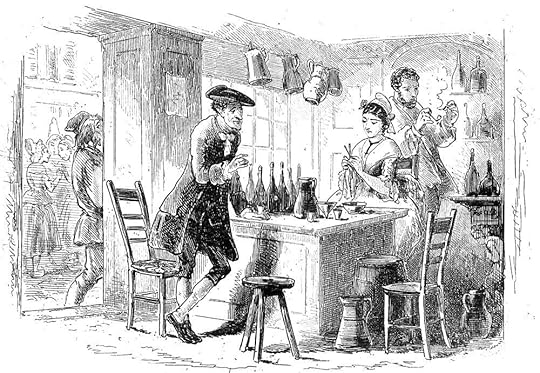
The Wine Shop
A Tale of Two Cities
Phiz
Mod
Dickens is always brilliant in naming his characters. I had the same associations with "Merdle" but up to the present I cannot see why Mr. Merdle should evoke so negative feelings. All we know about him is that he is an extremely successful business, that he does not feel comfortable in society whereas Society makes a lot of demands upon him, and that he is suffering from a mysterious ailment. His wife is clearly the more dislikeable character so far, isn't she?
Mod
Plot-wise, Arthur's obsessive interest in the Dorrit family, or rather in Little Dorrit, is explained by Arthur's inkling that his family might have somehow wronged the Dorrits or else his mother would not show such consideration for Amy. This is a not too flattering, but still realistic reading of his mother's character, as far as we know. And yet, the reasoning is spurious and probably fuelled by wishful thinking: Arthur only has two bits of "evidence" to go by, namely his father's sending his mother the clock and his mother's employing Amy in her house.
No 1 is not really a piece of evidence at all but rather an incoherent feeling on the part of Arthur. His father might have sent that watch for a thousand reasons, none of which might lead back to his family having wronged anyone and his wishing for this wrong to be redressed. Maybe, the father meant the watch as a sign of forgiveness to his wife, or a wish to let her have a keepsake. The idea of a moral or even financial debt that has to be paid is entirely a figment of Arthur's imagination.
No 2, Amy in the Clennam household, is also something that Arthur puts a construction on. Mrs. Clennam might not have singled Amy out at all but she might have acted merely on a remark made by Mr. Casby. And then, putting those threadbare bits of evidence together is also something that Arthur does on his own - simply because he feels guilty for his parents' way of doing business.
We also learn that Dorrit stands indebted to the Barnacle family, and nowhere does the name of Clennam appear.
Therefore, I'd say that Arthur's interest in Amy and her family, but mainly in Amy, may indeed be motivated by something he sees in Amy, and I think that her not showing any more resistance, as she did in the case of Young John, just encourages him.
Mod
A very good question! I think that Fanny's entanglement with Mr. Sparkler - his obviously haven taken a fancy to her and wanting to marry her might be a prim and proper Victorian allusion to something else that might have actually happened or was about to happen - is still a little bit more mercantile than Amy's reliance on Arthur, but this is just a matter of degress, if you ask me.
Mod
The Brothers
Chapter 19, Book 1
Phiz
Text Illustrated:
The brothers William and Frederick Dorrit, walking up and down the College-yard — of course on the aristocratic or Pump side, for the Fa..."
Kim
What a rich serving of illustrations you provide us this week. The best place to start is, of course, our friend Hablot Browne. The commentary points out how Browne shows both the differences between the Dorrit brothers and the division of the general population within the Marshalsea. The visual contrast of the Dorrit brothers complements and projects both what occurs within the jail and, by extension, what happens on the streets, buildings, and within the parlours of London.
Dorrit’s uncle is poor, bent over, and dressed raggedly. He reflects what a theatre is like and the state of the actors. In contrast, William Dorrit’s dress and posture, and his source of funds and attitude are constructs of status and success he has been able to construct within the walls of the Marshalsea.
Outside the walls of the Marshalsea is Merdle world. This world is one of money, mystery, and status. Mrs Merdle’s attempt to buy off Fanny is not that different from the alms that Mr Dorrit receives. An item of monetary value exchanges hands. In each case, there are implicit expectations from both the giver and the receiver.
Contrasts. Dickens incorporated so many contrasts in this week’s chapters. Here we see that Browne worked in concert with Dickens. Together, they present the reader with contrasts in both the appearance of people and places.
Through reading the illustrations we are able to better read the text. Let’s remember that for the Victorian reader the two illustrations per monthly part appeared before the text.Thus, the readers “read” the chapter in pictures before the text.
Mod
What a great illustration to show how we can can read an illustration. The last paragraph tells us so much about how Phiz constructed his work. How perfect! The short Dorrit sisters towered over by the grand servants. The classic statue. And the door, let’s not forget our doors and windows. The door in this illustration is open, but the body language of Amy and Fanny is suggestive of their status. The door is a transition point from one social class to another, one economic status and another, one world of apparent success and failure. And talking about doors …let's look at message 24.
Mod
Title Page
Phiz"
In my opinion, this is one of the great illustrations of Browne. It is deceptively simple. As the title page it has no need to be filled with emblematic detail. All we have is one character, Amy, coming out the door of the Marshalsea. Another door. The door is open and Amy emerges. Is she going to work? Is there more suggested? When leaving the Marshalsea, is Amy entering a place of freedom, or is the world just as much a prison to her?
The light is coming from inside the prison in this illustration. What does that suggest? When we think back a few chapters we recall when this prison door was closed to Amy and Maggy during the night. Night and day. The illustrations are not only meant to complement the chapter. There is a complete narrative within them as well.
In an upcoming chapter we will find Amy at a window. Windows and doors. Let’s keep our eyes on both.
Mod
Arthur Clennam, with the card in his hand, betook himself to the address set forth upon it.
Chapter 22, Book 1
James Mahoney
Text Illustrated:
"I ask your pardon again," said Mr. Chivery, "bu..."
Well, I’m taking too much space with this week’s illustrations so I’ll be brief. I think this Mahoney illustration is really fine. To be compared to a Vermeer is certainly high praise. And yes, I compared a Phiz illustration to a Constable painting earlier in our study of Little Dorrit. :-) There is a structured clarity to it. The characters are clearly defined, the extra touches of the posters and especially the Indian statuette outside a perfect touch to identify who the characters are as well as remind us where we are.
Looking at this Mahoney illustration reminds me of the Phiz illustration of the Wooden Midshipman in D&S.
Mod
Title Page
Phiz"
In my opinion, this is one of the great illustrations of Browne. It ..."
What a brilliant interpretation of the title picture, Peter! The light coming from out of the prison clearly suggests that for Amy, the prison world is more of a home than the outside world because it holds the purpose of her life, her father and the idea of serving his needs. The outside world is therefore merely a means to an end, which is to be found in the prison world. Therefore, we don't really get any details as to what the outside world looks like on the right and the left of the picture - it is all centred on Amy and the prison door, and all in all, it looks quite bleak.
I did not know that in the weekly instalments the illustrations were not included in the chapters but came in front of the chapters. This would have aroused the reader's curiosity and encouraged him to anticipate things that might happen in the text. Maybe, the pictures were shown to the listeners in advance - I imagine that instalments might have been read aloud in the family circle or a circle of friends, just as we watch TV at nights - and then everyone was exchanging ideas about what was going to come. What nice way of spending an evening!
Mod
Title Page
Phiz"
In my opinion, this is one of the great illustrations ..."
Hi Tristram
I’m thinking it might be a good idea for the Curiosities to reflect upon how the individual “Parts” of the complete novels formed and informed the first readers of the novel.
For the majority of Dickens’s novels, and Little Dorrit is among these, there was a “part” that was published once a month for 19 months. The last month was a double “part.” The parts were then all collected and bound into a novel which was then sold to the public. Thus, like a soap opera or other such tv show with an ongoing narrative, the public got to read a new episode each month, or weekly for the shorter novels, such as HT and GE.
Each part had a green paper cover. Dickens’s covers were green, Thackeray’s were yellow. Each part had a cover illustration and each part had several pages of advertisements that preceded the text. What fun to read these 19c ads for clothes, medicines and other items. Then came two illustrations for each part. For Dickens, these are the delightful illustrations from Hablot Browne. After TTC Dickens had other illustrators.
The illustrations were produced on a thicker grade of paper than the text of each part. The reason for this is the fact that the majority of illustrations were made from steel engravings, and thus could not be included on the same page as the setting of the text. There were illustrations made from wood blocks, but they too appear at the beginning of the month’s chapters rather than within the body of the chapter at the appropriate place. The exceptions to the location of the illustrations can be seen in some of the Christmas books. There, smaller illustrations will be seen at the end of the story. These illustrations are called “end blocks.” Those illustrations were done in wood and and thus the printing process allowed the wood block to be fit into the page with the type.
When the parts were displayed to the public it created great interest because the public got to “read” the picture. Naturally, this was an aid to the selling of each of the parts. Thus, if we borrow a cliché, a picture was indeed worth a 1000 words.
I don’t mean to be a salesperson for a book but The Plot Thickens: Illustrated Victorian Serial Fiction from Dickens to du Maurier by Mary Elizabeth Leighton and Lisa Surridge is wonderful. It is a study of how the text illustrations and the text interact and support each other. The chapters on Dickens are especially instructive. Full disclosure … I had the pleasure to meet both Mary Elizabeth and Lisa. They are both scholars and wonderful people.
If there is any interest among the Curiosities I would be very glad to supply a list of other texts I have also found helpful.
Tristram wrote: "I did not know that in the weekly instalments the illustrations were not included in the chapters but came in front of the chapters. This would have aroused the reader's curiosity and encouraged him to anticipate things that might happen in the text..."This was news to me, too. The original teasers! Love that. Thanks for sharing that, Peter.
Kim wrote: "do birds ever really hang upside down any where at all?..."Yeah - parrots, budgies, cockatoos, etc. - all those Southern hemisphere birds people like to keep as pets - often hang upside down.
Wild birds (in our area, at least) can reach down for some food, or go down a twig head first, but I don't see them hanging that way for the heck of it, the nuthatch being the exception that proves the rule - they're easily identifiable because they walk down tree trunks head first.
Mod
I really enjoyed your excursion into the technical side of the world of serial fiction in the 19th century. Also the green-and-yellow distinction was new to me.
I'd appreciate your supplying a list of some titles you found helpful. I have just opened an extra-thread for book recommendations so that whoever finds themselves in need of reading supply knows where they can look.
Mod
I really enjoyed your excursion into the technical side of the world of serial fiction in the 19th century. Also the green-and-yellow distinction was new to me.
I'd appreciate your supplyi..."
Tristram
What a great idea. I will put together a list with a very short description of books related to Dickens and his illustrators.
 Very interesting, especially the information regarding the illustrations. I have been late again with these chapters, not for a lack of interest but again for a lack of time so I will not be making a lot of comments, I fear. We have made a decision this week to sell our house and look for a one story house, due to a lack of a downstairs bedroom and full bath. I am more and more fearful of my husband falling on the stairs. He has continued to fall but so far none on the stairs so we want to prevent that. I have been debating this in my mind and now decided this is about the only solution and our grown children agree and my husband agrees. So, I will be here but mostly in the background.
Off Topic
Very interesting, especially the information regarding the illustrations. I have been late again with these chapters, not for a lack of interest but again for a lack of time so I will not be making a lot of comments, I fear. We have made a decision this week to sell our house and look for a one story house, due to a lack of a downstairs bedroom and full bath. I am more and more fearful of my husband falling on the stairs. He has continued to fall but so far none on the stairs so we want to prevent that. I have been debating this in my mind and now decided this is about the only solution and our grown children agree and my husband agrees. So, I will be here but mostly in the background.
Off TopicBobbie - While I'm sorry your husband is suffering from falls, it's great that everyone is on board with the decision to move. I've been trying to convince my husband to move for several months now, so we can do it while we're still able to manage, and hopefully prolong or independence. He sees things differently and says we'll have to carry him out of this house in a box. So I envy you, and hope you'll have many years of independent living wherever you go! But yes, you have a lot of work ahead of you, so we'll miss you when you're to exhausted to post.
Mod
My father did almost the same thing. It got to where he couldn't use the stairs anymore. Not safely anyway, but he wouldn't leave his house. So my husband, who built houses for a living most of his life turned the laundry room next to the kitchen into a bathroom, we put a bed in the living room, and he stayed downstairs. For the last few years of his life he never went upstairs. It was the only way we could get him to do it.
Mod
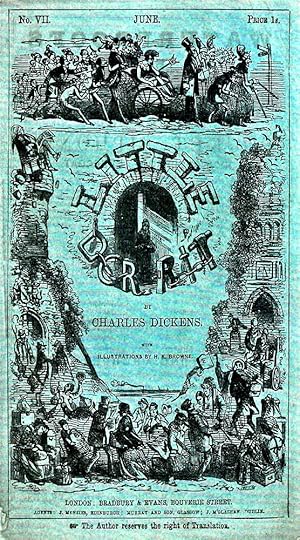

They look more blue than green to my eyes, but it's the only one I can find....so far.
Mod
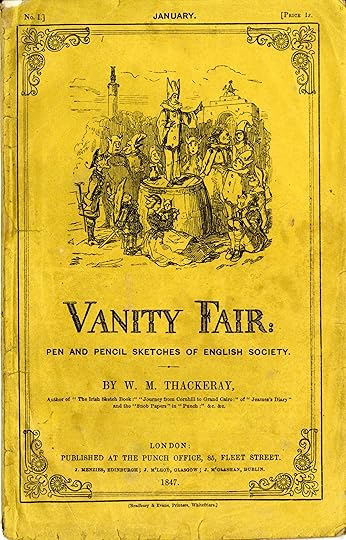 Thanks both of you. We had been considering something like that, Kim, but just could not decide where to put a bathroom.
Mod
Thanks both of you. We had been considering something like that, Kim, but just could not decide where to put a bathroom.
Mod
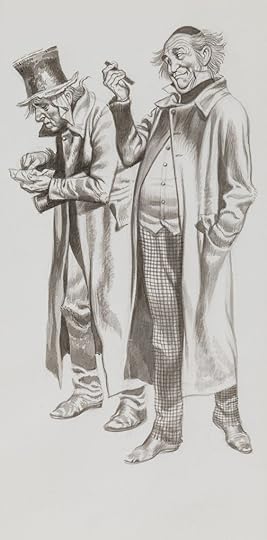
A Fine Cigar
The Dorrit Brothers
Ron Embleton
About the artist:
Ronald Sydney Embleton (6 October 1930 - 13 February 1988; London, UK)
Born in Limehouse, London in 1930, Embleton began drawing as a young boy, submitting a cartoon to the "News of the World" at the age of 9 and, at 12, winning a national poster competition.
In 1946 Embleton went to the South-East Essex Technical College and School of Art. There he had the incredible good fortune to be taught by David Bomberg, one of the greatest – though at that time sadly under-appreciated – British artists of the twentieth century.
At 17 he earned himself a place in a commercial studio but soon left to work freelance, drawing comic strips for many of the small publishers who sprang up shortly after the war.
He was soon drawing for the major publishers. His most fondly remembered strips include Strongbow the Mighty in Mickey Mouse Weekly, Wulf the Briton in Express Weekly, Wrath of the Gods in Boys' World, Tales of the Trigan Empire and Johnny Frog in Eagle and Stingray in TV Century 21.
Embleton also provided the illustrations that appeared in the title credits for the Captain Scarlet TV series, and dozens of paintings for prints and newspaper strips. A meticulous artist, his illustrations appeared in Look and Learn for many years, amongst them the historical series Roger’s Rangers.
Oh, Wicked Wanda! was a British full-color satirical and saucy adult comic strip, written by Frederic Mullally and drawn by Ron Embleton. The strip regularly appeared in Penthouse magazine from 1973 to 1980 and was followed by Embleton's equally saucy dark humored Merry Widow strip, written by Penthouse founder Bob Guccione.
Less well known, however, was his equally energetic career as an oil painter. In fact, being a painter had been his life's ambition – his 'driving force', according to his daughter Gillian. It was only his remarkable success as an illustrator that in the end permanently diverted him from the painter's path.
Embleton died on February 13, 1988 at the relatively young age of 57 after a lifetime of truly prodigious artistic output of remarkable quality and astounding quantity.
Oh, Wicked Wanda!? That DOES sound saucy!
Mod
"
Kim
Thanks for posting examples of the parts, examples of the advertisements included in the parts and the distinction of the parts of Dickens and Thackeray.
The reading experience of the Victorians was vastly different from ours. I think it is important to keep their experience in mind as we read the novel in a form that was vastly different from the original publication.
Mod
Hi Bobbie
Moving home is a major decision. We too experienced the decision to stay or move. While I enjoyed gardening it got to be a chore. In Canada one can’t hide from snow in winter. I no longer wanted to shovel snow. The children had left the nest. The stairs somehow seemed to multiply in height.
We decided our quality of life needed to be reimagined and then to move. Take care my friend. We will be thinking of you.
Peter, your post makes me think about a discussion my daughter and I had about audiobooks v. hard copies. Her contention is that if you've listened to a book, you haven't actually read it. Technically, it's true, I suppose. But it's as you say - the experience is vastly different.
Mod
I wonder what a female wafer was. This was also from David Copperfield. This next one I can't find what book it was from, but it certainly is the strangest. Of course maybe not if I could figure out what female wafers were, I suppose they could be even stranger.


"The brothers William and Frederick Dorrit, walking up and down the College-yard—of course on the aristocratic or Pump side, for the Father made it a point of his state to be chary of going among his children on the Poor side, except on Sunday mornings, Christmas Days, and other occasions of ceremony, in the observance whereof he was very punctual, and at which times he laid his hand upon the heads of their infants, and blessed those young insolvents with a benignity that was highly edifying—the brothers, walking up and down the College-yard together, were a memorable sight. Frederick the free, was so humbled, bowed, withered, and faded; William the bond, was so courtly, condescending, and benevolently conscious of a position; that in this regard only, if in no other, the brothers were a spectacle to wonder at."
This got me wondering how many prisoners there were on the aristocratic side and how many on the common side, and for that matter how did William Dorrit manage to get on the aristocratic side. He doesn't seem all that aristocratic to me, just delusional. And while I understand - sort of - why William is so courtly, condescending and benevolent, I don't know why Frederick is so humbled, bowed, withered and faded. I would think of them as the opposite, Frederick plays in an orchestra after all, William, well I don't know what William does, blesses people as he walks by I guess. As they walk in the yard, William comments that his brother seems a little low and asks him why. His brother claims that nothing is the matter he is merely tired and he thinks he will go home to bed saying that the late hours and heated atmosphere have tired him. The great man reproaches him for not taking care of himself and saying that his brother should be more like him, as if anyone could be. He says he doubts that Frederick's habits are as precise and methodical as his are and believes in a strict schedule and exercise, walking in the yard, eating and reading at certain times of the day and of course receiving visitors at certain hours. On and on and on. He says these are values he has ingrained into his daughter Amy who is a good girl because of it.
When William finally stops talking and Frederick finally manages to get away from his brother and go home, although he doesn't seem to mind his brother's talk near as much as I do, William stops to talk with the turnkey Chivery, but this evening Chivery seems not to be as respectful as usual although William can't find the reason for it. I wonder what I would be like towards the dear Father if I was even less respectful than usual. As he turns to go back to his room he stops to give the prisoners who were still in the yard the reasons why his brother, who according to him is infirm and feeble, would never be able to live in the Marshalsea:
"His brother Frederick was much broken, no doubt, and it might be more comfortable to himself (the Father of the Marshalsea) to know that he was safe within the walls. Still, it must be remembered that to support an existence there during many years, required a certain combination of qualities—he did not say high qualities, but qualities—moral qualities. Now, had his brother Frederick that peculiar union of qualities? Gentlemen, he was a most excellent man, a most gentle, tender, and estimable man, with the simplicity of a child; but would he, though unsuited for most other places, do for that place? No; he said confidently, no! And, he said, Heaven forbid that Frederick should be there in any other character than in his present voluntary character! Gentlemen, whoever came to that College, to remain there a length of time, must have strength of character to go through a good deal and to come out of a good deal. Was his beloved brother Frederick that man? No. They saw him, even as it was, crushed. Misfortune crushed him. He had not power of recoil enough, not elasticity enough, to be a long time in such a place, and yet preserve his self-respect and feel conscious that he was a gentleman. Frederick had not (if he might use the expression) Power enough to see in any delicate little attentions and—and—Testimonials that he might under such circumstances receive, the goodness of human nature, the fine spirit animating the Collegians as a community, and at the same time no degradation to himself, and no depreciation of his claims as a gentleman. Gentlemen, God bless you!"
I was wondering during this what the men listening really thought of the Father of the Marshalsea. Do they find him as annoying as I do? He now returns to his room where Amy is making his supper of course, as far as I can tell she doesn't eat. He seems downcast and tells Amy that Mr. Chivery is not as obliging and attentive tonight as he usually is. He fears he will lose the support of the officers, which would decrease his status even saying that without their support he would starve to death, I suppose he doesn't think of what would happen to her eating habits which so far as I've seen she doesn't have any. Unable to endure the subject, Amy puts her hands on his lips and her arm around his neck and for a while he sits quietly.
He finally tells her that he wishes he had a younger picture of himself as her mother had seen him. If this next part is true I finally have an idea why is shining above all others. He had been young, independent, good-looking and accomplished. People had envied him. His children will never see the man he had been and be able to be proud of him. Yet, he maintains some respect at the Marshalsea, here he is the chief person of the place and not quite down-trodden.
Amy comforts him. He never considers the needs of his daughter although he seems to think he does everything he can for her. He tells her that what little he could do for her, he has done:
'I am in the twenty-third year of my life here,' he said, with a catch in his breath that was not so much a sob as an irrepressible sound of self-approval, the momentary outburst of a noble consciousness. 'It is all I could do for my children—I have done it. Amy, my love, you are by far the best loved of the three; I have had you principally in my mind—whatever I have done for your sake, my dear child, I have done freely and without murmuring.'
Well that's true I suppose. Amy tells him that she realizes all he has done for her and I suppose I agree that all he has done for her has been done freely and without murmuring since he has done nothing for her at all. She asks him if she can sit with him until morning and he says yes. The chapter ends with this:
"She never left him all that night. As if she had done him a wrong which her tenderness could hardly repair, she sat by him in his sleep, at times softly kissing him with suspended breath, and calling him in a whisper by some endearing name. At times she stood aside so as not to intercept the low fire-light, and, watching him when it fell upon his sleeping face, wondered did he look now at all as he had looked when he was prosperous and happy; as he had so touched her by imagining that he might look once more in that awful time. At the thought of that time, she kneeled beside his bed again, and prayed, 'O spare his life! O save him to me! O look down upon my dear, long-suffering, unfortunate, much-changed, dear dear father!'
Not until the morning came to protect him and encourage him, did she give him a last kiss and leave the small room. When she had stolen down-stairs, and along the empty yard, and had crept up to her own high garret, the smokeless housetops and the distant country hills were discernible over the wall in the clear morning. As she gently opened the window, and looked eastward down the prison yard, the spikes upon the wall were tipped with red, then made a sullen purple pattern on the sun as it came flaming up into the heavens. The spikes had never looked so sharp and cruel, nor the bars so heavy, nor the prison space so gloomy and contracted. She thought of the sunrise on rolling rivers, of the sunrise on wide seas, of the sunrise on rich landscapes, of the sunrise on great forests where the birds were waking and the trees were rustling; and she looked down into the living grave on which the sun had risen, with her father in it three-and-twenty years, and said, in a burst of sorrow and compassion, 'No, no, I have never seen him in my life!'