
The Old Curiosity Club discussion

This topic is about
Little Dorrit
Little Dorrit
>
Little Dorrit, Book 1, Chp. 33-36

 Mod
Mod
"There was to be a convocation of Barnacles on the occasion, in order that that very high and very large family might shed as much lustre on the marriage as so dim an event was capable of receiving."
Even though a large number of the Barnacles will be at the wedding not all Barnacles will be there, they are just too numerous to be contained in a building. Also, being public servants, they are dispersed all over the world, "wherever there was a square yard of ground in British occupation under the sun or moon" there was a Barnacle." We're told that during this time Mrs. Gowan makes frequent visits to Mr. Meagles to add names to the guest list and that Mr. Meagles is usually busy examining and paying the debts of his future son-in-law. Arthur has promised to come to the wedding because of his vow of never failing to do Minnie a service, but Daniel Doyce does not want to attend. He so wants to avoid the wedding that he even goes to talk to Mr. Meagles about it:
"he begged, with the freedom of an old friend, and as a favour to one, that he might not be invited. 'For,' said he, 'as my business with this set of gentlemen was to do a public duty and a public service, and as their business with me was to prevent it by wearing my soul out, I think we had better not eat and drink together with a show of being of one mind.'"
Meanwhile, Gowen tells Arthur that he is a disappointed man, he belongs to a family that could have provided for him but hadn't done it. Of course he knows he is fortunate in having Minnie love him and of having such a wealthly father-in-law, but still the Barnacles disappointed him. Also, Gowan doesn't think he will be able to keep at his profession, it takes too much dedication and takes too much time away from leisure activites, this guy is a jerk:
"I hope I may not break down in that; but there, my being a disappointed man may show itself. I may not be able to face it out gravely enough. Between you and me, I think there is some danger of my being just enough soured not to be able to do that.'
'To do what?' asked Clennam.
'To keep it up. To help myself in my turn, as the man before me helps himself in his, and pass the bottle of smoke. To keep up the pretence as to labour, and study, and patience, and being devoted to my art, and giving up many solitary days to it, and abandoning many pleasures for it, and living in it, and all the rest of it—in short, to pass the bottle of smoke according to rule.'
Oh, and he's lazy too, When the marriage day arrives we get a rather lengthy description of the wedding guests, almost all of them Barnacles, I think Arthur may have been the only one present who wasn't a Barnacle, him and the ones paying for all this. There were all sorts of Barnacles, such as Lord Decimus Tite Barnacle who had risen to official heights on the wings of one indignant idea which was:
"to set bounds to the philanthropy, to cramp the charity, to fetter the public spirit, to contract the enterprise, to damp the independent self-reliance, of its people."
There was a young Barnacle, a lively one, Barnacle Junior, William Barnacle, Mr. Tite Barnacle, all sorts of Barnacles, and to tell the truth I got tired of reading about them and since so much of the chapter was reading about them I got tired of reading the chapter. But as I said, the wedding does come to an end and with the departure of Minnie/Pet and Henry comes the departure of all the Barnacles. Although I was bored spending the entire chapter with the Barnacles, Mr. Meagles wasn't, at least he was cheered up by the thought of them being there. Uh, okay. The chapter ends:
'It's very gratifying, Arthur,' he said, 'after all, to look back upon.'
'The past?' said Clennam.
'Yes—but I mean the company.'
It had made him much more low and unhappy at the time, but now it really did him good. 'It's very gratifying,' he said, often repeating the remark in the course of the evening. 'Such high company!'
Mod
"It was at this time that Mr Pancks, in discharge of his compact with Clennam, revealed to him the whole of his gipsy story, and told him Little Dorrit's fortune. Her father was heir-at-law to a great estate that had long lain unknown of, unclaimed, and accumulating. His right was now clear, nothing interposed in his way, the Marshalsea gates stood open, the Marshalsea walls were down, a few flourishes of his pen, and he was extremely rich."
Pancks says he "moles it out" with the help of his landlord, Mr. Rugg and John Chivery, knowing his devotion to Amy. Now all the paperwork is done and he is ready for the secret to be made known, he came to Arthur first as he had promised. It is during this conversation I find that, although I am a fan of Flora's, at least if she doesn't talk to much, her father - the fine, old fellow - is another story:
'Clennam, who had been almost incessantly shaking hands with him throughout the narrative, was reminded by this to say, in an amazement which even the preparation he had had for the main disclosure smoothed down, 'My dear Mr Pancks, this must have cost you a great sum of money.'
'Pretty well, sir,' said the triumphant Pancks. 'No trifle, though we did it as cheap as it could be done. And the outlay was a difficulty, let me tell you.'
'A difficulty!' repeated Clennam. 'But the difficulties you have so wonderfully conquered in the whole business!' shaking his hand again.
'I'll tell you how I did it,' said the delighted Pancks, putting his hair into a condition as elevated as himself. 'First, I spent all I had of my own. That wasn't much.'
'I am sorry for it,' said Clennam: 'not that it matters now, though. Then, what did you do?'
'Then,' answered Pancks, 'I borrowed a sum of my proprietor.'
'Of Mr Casby?' said Clennam. 'He's a fine old fellow.'
'Noble old boy; an't he?' said Mr Pancks, entering on a series of the dryest snorts. 'Generous old buck. Confiding old boy. Philanthropic old buck. Benevolent old boy! Twenty per cent. I engaged to pay him, sir. But we never do business for less at our shop.'
Arthur felt an awkward consciousness of having, in his exultant condition, been a little premature.
'I said to that boiling-over old Christian,' Mr Pancks pursued, appearing greatly to relish this descriptive epithet, 'that I had got a little project on hand; a hopeful one; I told him a hopeful one; which wanted a certain small capital. I proposed to him to lend me the money on my note. Which he did, at twenty; sticking the twenty on in a business-like way, and putting it into the note, to look like a part of the principal. If I had broken down after that, I should have been his grubber for the next seven years at half wages and double grind. But he's a perfect Patriarch; and it would do a man good to serve him on such terms—on any terms.'
Arthur for his life could not have said with confidence whether Pancks really thought so or not."
And now Arthur goes to the house of Mr. Casby where Little Dorrit will be, although how Arthur knows this I'm not sure, perhaps it is a regular thing for her to be there at the same time each week, I can't remember. When he tells Little Dorrit that her father will be free and will be a rich man she faints. Flora comes in the room to take care of her as only Flora could:
"Upon which Flora returned to take care of her, and hovered about her on a sofa, intermingling kind offices and incoherent scraps of conversation in a manner so confounding, that whether she pressed the Marshalsea to take a spoonful of unclaimed dividends, for it would do her good; or whether she congratulated Little Dorrit's father on coming into possession of a hundred thousand smelling-bottles; or whether she explained that she put seventy-five thousand drops of spirits of lavender on fifty thousand pounds of lump sugar, and that she entreated Little Dorrit to take that gentle restorative; or whether she bathed the foreheads of Doyce and Clennam in vinegar, and gave the late Mr F. more air; no one with any sense of responsibility could have undertaken to decide."
When Amy awakes, she thinks only of her father, of course. We're told that she wants to get to her father to give him the good new and not leave him in jail a moment more than he has to be. She seems uncomfortable and frightened with the idea of being wealthy for herself, but she sheds tears of joy about it for her father’s sake. She certainly likes her father more than I do, but I suppose she would, he is her father after all.
They go to the Marshalsea and tell Mr. Dorrit the news. He is stunned and doesn't say a word until Arthur fetches some wine, Arthur tells the gathering crowd outside that Mr. Dorrit has succeeded to a fortune.
Arthur tells Mr. Dorrit what Mr. Pancks had done on his behalf. Mr. Dorrit agrees to not only reward him generously but everyone else concerned. He then appears at the window and the people in the yard cheer for the Father of the Marshalsea, which is just what he expected they would do. Finally he lays down and falls asleep and Amy asks Arthur to stay and talk, I found her thoughts interesting when she asks Arthur whether her father will pay all his debts before he leaves:
'It seems to me hard,' said Little Dorrit, 'that he should have lost so many years and suffered so much, and at last pay all the debts as well. It seems to me hard that he should pay in life and money both.'
Looking at it from her point of view, I find it seems hard to me too and I can't stand the guy. Shortly after this Amy lays her head on her father's pillow and falls asleep and Clennam quietly leaves the room and the prison.
Mod
We're told that the Collegians aren't envious, some had a regard for the Dorrits, others felt that it could someday also happen to them, and others were pleased that the event and the Marshalsea had made it into the newspapers. I would have just been glad to get rid of him, but that's just me. They even get him a parting gift, which we're told, was never displayed in the family mansion or found among the family papers. He assured them in a "royal manner" of course that he believed they were sincere and that they should all try to follow his example. Oh please, spare me that.
He even gives them a "comprehensive entertainment" which he doesn't attend because his dinners are brought from the hotel now, but Tip represents the family and the Father shows up to drink a toast with them at the end. And now the day arrives and they are leaving the Marshalsea, all the collegians and turnkeys are present wearing their best clothing, whatever that may be. Mr. Dorrit and his brother Frederick walk out arm in arm and Mr. Dorrit asks his brother to try to put a little polish in his demeanor. When Frederick asks him how he should do it Mr. Dorrit tells him to think of what he himself is thinking, and when Frederick asks what he is thinking I could almost hear Tristram grumbling at the answer:
"'Oh! my dear Frederick, how can I answer you? I can only say what, in leaving these good people, I think myself.'
'That's it!' cried his brother. 'That will help me.'
'I find that I think, my dear Frederick, and with mixed emotions in which a softened compassion predominates, What will they do without me!'
'True,' returned his brother. 'Yes, yes, yes, yes. I'll think that as we go, What will they do without my brother! Poor things! What will they do without him!'
And now we are almost out the door, William and Frederick in the lead followed by Edward (Tip) and Fanny, then Mr. Plornish and Maggy who are carrying all the family's goods they had decided to bring with them. And every collegian, and every turnkey, and every family of every collegian, and lots of other people are there to watch the big event:
"There, were the people who were always going out to-morrow, and always putting it off; there, were the people who had come in yesterday, and who were much more jealous and resentful of this freak of fortune than the seasoned birds. There, were some who, in pure meanness of spirit, cringed and bowed before the enriched Collegian and his family; there, were others who did so really because their eyes, accustomed to the gloom of their imprisonment and poverty, could not support the light of such bright sunshine. There, were many whose shillings had gone into his pocket to buy him meat and drink; but none who were now obtrusively Hail fellow well met! with him, on the strength of that assistance. It was rather to be remarked of the caged birds, that they were a little shy of the bird about to be so grandly free, and that they had a tendency to withdraw themselves towards the bars, and seem a little fluttered as he passed."
It is only when they are all in the carriage that they realize Amy is not with them. The chapter ends with this:
'I do say,' she repeated, 'this is perfectly infamous! Really almost enough, even at such a time as this, to make one wish one was dead! Here is that child Amy, in her ugly old shabby dress, which she was so obstinate about, Pa, which I over and over again begged and prayed her to change, and which she over and over again objected to, and promised to change to-day, saying she wished to wear it as long as ever she remained in there with you—which was absolutely romantic nonsense of the lowest kind—here is that child Amy disgracing us to the last moment and at the last moment, by being carried out in that dress after all. And by that Mr Clennam too!'
The offence was proved, as she delivered the indictment. Clennam appeared at the carriage-door, bearing the little insensible figure in his arms.
'She has been forgotten,' he said, in a tone of pity not free from reproach. 'I ran up to her room (which Mr Chivery showed me) and found the door open, and that she had fainted on the floor, dear child. She appeared to have gone to change her dress, and to have sunk down overpowered. It may have been the cheering, or it may have happened sooner. Take care of this poor cold hand, Miss Dorrit. Don't let it fall.'
'Thank you, sir,' returned Miss Dorrit, bursting into tears. 'I believe I know what to do, if you will give me leave. Dear Amy, open your eyes, that's a love! Oh, Amy, Amy, I really am so vexed and ashamed! Do rouse yourself, darling! Oh, why are they not driving on! Pray, Pa, do drive on!'
The attendant, getting between Clennam and the carriage-door, with a sharp 'By your leave, sir!' bundled up the steps, and they drove away."
Good riddance.
 Kim wrote: "Although I was bored spending the entire chapter with the Barnacles, Mr. Meagles wasn't, at least he was cheered up by the thought of them being there."
I skimmed the Barnacles section. I find the plot cooks along just fine without them, and they became an overdone joke pretty fast for me.
But I wonder if the quote you pulled above is my answer to the question of why on earth did Meagles ever consent to this marriage? Maybe because he's impressed by nobility?
It still makes no sense though, because if he actually thought it was a good match he should be happier about it. His consent seems like a significant logical flaw in the story.
Kim wrote: "To keep it up. To help myself in my turn, as the man before me helps himself in his, and pass the bottle of smoke. To keep up the pretence as to labour, and study, and patience, and being devoted to my art, and giving up many solitary days to it, and abandoning many pleasures for it, and living in it, and all the rest of it—in short, to pass the bottle of smoke according to rule."I'm very intrigued by this expression "pass the bottle of smoke." I take it to be some sort of corruption of the idea that we should do our best to take what previous generations left to us and pass it on to the next generation: do our work, pass along the benefits. Except in this case it's pass the bottle--which might be a nice sharing thing to do or might be passing on a drinking habit, not so nice; but then it's pass the bottle of smoke--so there's not even drink there. It's just passing on an illusion that we ought to be useful, when that's nonsense. Or at least Gowan finds it nonsense.
Kim wrote: "Give these people names like Merdle and Meagles, then have Mrs. Gowen refer to the Meagles as Miggleses, and I'm confused. "It's true. I was thrown by the beginning of the chapter and could not remember who the Miggleses were.
Mrs. Gowen and Mrs. Merdle the bosom made me laugh, however:
‘From what I can make out,’ said Mrs Gowan, ‘I believe I may say that Henry will be relieved from debt—’
‘Much in debt?’ asked Mrs Merdle through her eyeglass.
‘Why tolerably, I should think,’ said Mrs Gowan.
I also enjoyed, regarding the Minipet wedding, how Doyce's position was "how 'bout I just pass on this one, anybody mind?" He does stand out in this book as a sensible person.
Yes, he does stand out to be very sensible.
And I will repeat what I already mentioned in the previous thread: what if Amy had said 'yes' to John? Would she then have been berated because she brings the family down about that now they are rich? Or would they just conveniently have forgotten that she belongs to the family too, just like they almost forgot her anyway, now that they have other servants to take care of their basic needs?
I wonder if this all ends well. I can't imagine Mr. Dorrit will be good with money after being in the Marshalsea and not showing any sign of knowing where even his food comes from for more than 20 years. And then there are Fanny and Tip who have never learned to be smart with their money, and who have always put the emphasis on keeping up appearances.
And I will repeat what I already mentioned in the previous thread: what if Amy had said 'yes' to John? Would she then have been berated because she brings the family down about that now they are rich? Or would they just conveniently have forgotten that she belongs to the family too, just like they almost forgot her anyway, now that they have other servants to take care of their basic needs?
I wonder if this all ends well. I can't imagine Mr. Dorrit will be good with money after being in the Marshalsea and not showing any sign of knowing where even his food comes from for more than 20 years. And then there are Fanny and Tip who have never learned to be smart with their money, and who have always put the emphasis on keeping up appearances.
 Mod
Mod
And I will repeat what I already mentioned in the previous thread: what if Amy had said 'yes' to John? Would she then have been berated because she brin..."
Hi Jantine
Yes. I could see the family turning on Amy if she accepted John’s proposal. They seem unable to look beyond their own noses in the best of times.
But then we must remember that Amy said a clear no herself. Is this the first time we have seen Amy take a clear and unequivocal position on anything pertaining to her own needs and wants? By saying no to one offer of marriage she is keeping the door open for another … ;-)
 Along the same line of what-ifs, I wonder if Amy would have accepted John's proposal had she not yet met Arthur, or would she has been equally as adamant in her refusal?
Mod
Along the same line of what-ifs, I wonder if Amy would have accepted John's proposal had she not yet met Arthur, or would she has been equally as adamant in her refusal?
Mod
Mary Lou
Good point. Without Arthur in the picture a marriage to John would be advantageous. Amy would have her own matrimonial home with a view in the Marshalsea, her husband’s future in the Marshalsea would be seen as an advantage to Mr Dorrit and if she became a housewife she would never need to leave the Marshalsea. What a charmed life. Yikes!
Just think if Mr Dorrit did receive his good fortune. Poor Little Dorrit. Thanks for the “what-if.” Speculation is fun.
I'm back to hating the Barnacle (Oodle, Toodle...) chapters, and wondering what was different about the first one in this book, which I enjoyed. I think I've figured it out. Most of the chapters in which Dickens personifies systems are generally written as commentary by the narrator. They can be boring and sermonizing (is that a word?), despite Dickens attempts to make them humorous. But when we first met the Barnacles, it was through Arthur's direct interactions, and we experience the bureaucracy alongside him. Being flies on the wall as he meets one-on-one with the Barnacles, and having had our own similar experiences, not only incorporates these symbolic characters into the story more effectively, but makes the narrative much more engaging.
In this week's chapters, Dickens went back to telling, instead of showing. We never really see the Barnacles converse with the other wedding guests (just as the interactions with the Merdles and their guests - Treasury, Bishop, etc. - are described to us rather than witnessed by us) The most we get is a quick glimpse of them complaining to one another about Arthur's "wanting to know, you know." As representations of government bureaucracy and nepotism, they are two dimensional. When they were interacting directly with Arthur, they - for a moment - became actual, three-dimensional characters. I guess Dickens was worried that if they became individuals in their own right, it might somehow water down his bigger message.
Mary Lou wrote: "I'm back to hating the Barnacle (Oodle, Toodle...) chapters, and wondering what was different about the first one in this book, which I enjoyed. I think I've figured it out. Most of the chapters ..."
I think you're right, but I also think it's just overkill, since we already met them before and how much do we need more of the same thing?
Mary Lou wrote: "Along the same line of what-ifs, I wonder if Amy would have accepted John's proposal had she not yet met Arthur, or would she has been equally as adamant in her refusal?"I figured the whole John storyline was there just to foreshadow that Amy has Given Her Heart via her refusal. I find John entertaining and I'm glad he's there, but he doesn't serve any other plot purpose. Pancks is perfectly capable of tracking down the Dorrits' inheritance on his own. And the John proposal scene comes while Arthur is still pining over Minipet, so readers need a little hint that the story will come back around to Amy just to keep them going. And it would be her job to keep them going, since a Dickens hero can fall in love (if that's what it is) repeatedly, but a heroine only once.
Mod
I figure..."
Hi Julie
Thanks for the insight that a hero can fall in love many times but a heroine only once.
Such a plot repetition throughout Dickens’s novels tells us much both about the times and the author.
 Mod
Mod
Like Peter, I really love this sentence and find that there is a lot of truth in it, not only as far as Dickens is concerned but also in connection with many other Victorian writers (often male ones), who tend to put the heroine on a pedestal, whose inscriptions read, "Forbearance, patience, and self-denial". I think we see this kind of thinking at work even today, when it is quite often assumed that a young man has to sow his wild oats before he settles down, whereas a girl who wants to sow her wild oats is often given a bad name.
Did any of you find it strange that when Pancks had found out all those things about the Dorrits and their claim to a large fortune, it was not the man himself who went to tell the family, and, first of all, Amy - but Arthur, who did not lift a finger in the entire affair? What business did Arthur have to do this? Our narrator remarks that when the Dorrits leave the prison, there is Mr. Casby, spreading benevolence, and being credited, by many people, with having made it all possible. Clearly, the narrator means us to be indignant at the old humbug for harvesting where he did not sow, but frankly speaking, Arthur is doing the same thing. In this context, I must once again express my admiration for Mr F.'s aunt, who, with reference to Arthur and the discovery made by Pancks, gives vent to sarcasms like, "Don't believe it's his doing!" or "He needn't take no credit to himself for it!" Now, whereas the vehemence with which the old lady utters this obloquy makes it all quite funny and absurd, I could not help thinking that she was very, very right in saying so. Three cheers for Mr F.'s aunt then!
Mod
Similarly, this contrast between really doing something that you dedicate your mind and soul to and social appearances applies to Mr. Gowan, who has another job-related conversation with Arthur. Gowan, however, does not even think of being a carpenter, but clings to his own pretensions.
Another example in this context is Mr Dorrit, who soon begins to treat Mr Rugg and Mr Pancks - the two men who went to great lengths in order to substantiate his claim to the fortune that gets him out of the prison - as his employees, treating them in a very impatient and high-handed manner. And let us not forget that Pancks laid out all his savings in the service of Dorrit - he would have been standing there empty-handed, if his endeavours had come to nothing, and therefore he might have deserved a better treatment by Mr Dorrit.
Tristram wrote: "And let us not forget that Pancks laid out all his savings in the service of Dorrit - he would have been standing there empty-handed, if his endeavours had come to nothing, and therefore he might have deserved a better treatment by Mr Dorrit. "I can't quite make Pancks out! Hoping to learn more.
Mod
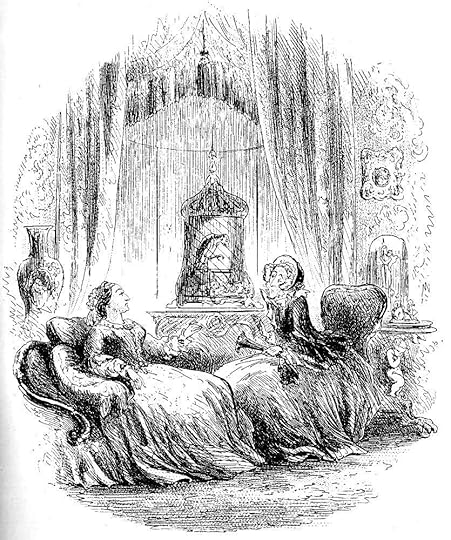
Society Expresses its Views on a Question of Marriage
Chapter 33, Book 1
Phiz
Text Illustrated:
Mrs. Merdle was at home, and was in her nest of crimson and gold, with the parrot on a neighbouring stem watching her with his head on one side, as if he took her for another splendid parrot of a larger species. To whom entered Mrs. Gowan, with her favourite green fan, which softened the light on the spots of bloom.
"My dear soul," said Mrs Gowan, tapping the back of her friend's hand with this fan after a little indifferent conversation, "you are my only comfort. That affair of Henry's that I told you of, is to take place. Now, how does it strike you? I am dying to know, because you represent and express Society so well."
Mrs. Merdle reviewed the bosom which Society was accustomed to review; and having ascertained that show-window of Mr Merdle's and the London jewellers' to be in good order, replied:
"As to marriage on the part of a man, my dear, Society requires that he should retrieve his fortunes by marriage. Society requires that he should gain by marriage. Society requires that he should found a handsome establishment by marriage. Society does not see, otherwise, what he has to do with marriage. Bird, be quiet!"
For the parrot on his cage above them, presiding over the conference as if he were a judge (and indeed he looked rather like one), had wound up the exposition with a shriek.
"Cases there are," said Mrs. Merdle, delicately crooking the little finger of her favourite hand, and making her remarks neater by that neat action; "cases there are where a man is not young or elegant, and is rich, and has a handsome establishment already. Those are of a different kind. In such cases —"
Mrs. Merdle shrugged her snowy shoulders and put her hand upon the jewel-stand, checking a little cough, as though to add, "why, a man looks out for this sort of thing, my dear." Then the parrot shrieked again, and she put up her glass to look at him, and said, "Bird! Do be quiet!"
"But, young men," resumed Mrs. Merdle, "and by young men you know what I mean, my love — I mean people's sons who have the world before them — they must place themselves in a better position towards Society by marriage, or Society really will not have any patience with their making fools of themselves. Dreadfully worldly all this sounds," said Mrs. Merdle, leaning back in her nest and putting up her glass again, "does itnot?"
"But it is true," said Mrs. Gowan, with a highly moral air. — Book the First, "Poverty," Chapter 33, "Mrs. Merdle's Complaint".
Commentary:
The master-touch is the unsettling presence of the parrot, whose shrieking acts as a counterpoint to Mrs. Merdle's magisterial pronouncements about marriage, as if her own experience somehow renders her an expert. Enshrined in a canopy not unlike that which one sees in the bedroom scenes in the homes of Dickens's more affluent characters, the gilded cage implies the imprisoning nature of society marriage, mocking the conception underlying the supporting cupidon (right) as a god of love, for affection has no part in Mrs. Merdle's marriage calculations, which are entirely premised on property and social acceptability. The specific marriage about which Mrs. Gowan is soliciting Mrs. Merdle's advice is her son's marriage to Pet Meagles, which should have the desired result of enabling the aristocratic Henry Gowan to "retrieve his fortunes" — that is, to be "relieved from debt", of which the profligate amateur artist has no shortage and against which both ladies expect Mr. Meagles to make considerable outlay prior to the wedding. Mrs. Gowan seems not entirely reconciled to Henry's "marrying down," but acknowledges the necessity of his acquiring the additional income, "an allowance of three hundred a year" or more from the bride's father, a middle-class businessman, and therefore (rather like Mr. Merdle) not a person "in Society". Discretely both women are thoroughly aware that, at least financially (and Society is nothing if not mercenary), this is a very good match for spendthrift Henry Gowan.
Once the devious Mrs. Gowan has left, her mission of seeming (as far as Society goes) to having objected mightily to her son's marrying Pet, the nature of the chapter title becomes clear. The banker husband, having returned from the office to wander his mansion aimlessly, stumbles upon the ladies as Mrs. Gowan is leaving. Mrs. Merdle then delivers her famous "complaint" that her feckless husband is not fit for Society because he is utterly lacking in manners and sophistication. This indictment she delivers from her "ottoman," rather than the padded throne in which she is regally ensconced in the illustration, but in other respects the illustration is almost entirely consistent with the text. The other significant discrepancy is the depiction of a thin, elderly Mrs. Gowan, a Hampton Court "grace-and-favour" pensioner with (caustically remarks Dickens) one-and-a-half chins, whereas Phiz's aging widow is thin and has a pointed face. Aside from a cameo in Phiz's "The Family Dignity is Affronted" (October 1856), this the original serial's sole portrait of the epitome of Society and her ample, jewel-bedecked bosom. The curtains in the background imply not so much theatricality as acting or disguising one's true emotions, for Mrs. Gowan (nowhere else depicted in the series) is merely going through the motions of protesting the marriage, and for her part Mrs. Merdle is thoroughly aware that Pet Meagles is a good catch.
Mod

Joyful Tidings
Book I Chapter 35
Felix Octavius Carr Darley
Household Edition (1863)
Text Illustrated:
"Compose yourself, sir," said Clennam, "and take a little time to think. To think of the brightest and most fortunate accidents of life. We have all heard of great surprises of joy. They are not at an end, sir. They are rare, but not at an end."
"Mr. Clennam? Not at an end? Not at an end for —" He touched himself upon the breast, instead of saying "me."
"No," returned Clennam.
"What surprise," he asked, keeping his left hand over his heart, and there stopping in his speech, while with his right hand he put his glasses exactly level on the table: "what such surprise can be in store for me?"
"Let me answer with another question. Tell me, Mr Dorrit, what surprise would be the most unlooked for and the most acceptable to you. Do not be afraid to imagine it, or to say what it would be."
He looked steadfastly at Clennam, and, so looking at him, seemed to change into a very old haggard man. The sun was bright upon the wall beyond the window, and on the spikes at top. He slowly stretched out the hand that had been upon his heart, and pointed at the wall.
"It is down," said Clennam. "Gone!"
He remained in the same attitude, looking steadfastly at him.
"And in its place," said Clennam, slowly and distinctly, "are the means to possess and enjoy the utmost that they have so long shut out. Mr Dorrit, there is not the smallest doubt that within a few days you will be free, and highly prosperous. I congratulate you with all my soul on this change of fortune, and on the happy future into which you are soon to carry the treasure you have been blest with here — the best of all the riches you can have elsewhere — the treasure at your side."
With those words, he pressed his hand and released it; and his daughter, laying her face against his, encircled him in the hour of his prosperity with her arms, as she had in the long years of his adversity encircled him with her love and toil and truth; and poured out her full heart in gratitude, hope, joy, blissful ecstasy, and all for him.
"I shall see him as I never saw him yet. I shall see my dear love, with the dark cloud cleared away. I shall see him, as my poor mother saw him long ago. O my dear, my dear! O father, father! O thank God, thank God!"
Commentary:
The scene is the Marshalsea and is the culmination of the novel's first movement, "Poverty." Here, Arthur Clennam, having already broken the news of the inheritance to Amy Dorrit, now imparts to a stunned Father of the Marshalsea, William Dorrit, that (like the novelist's own father, John Dickens) he has come into a bequest to will result in his immediate release from debtors' prison. Whereas Amy's initial response had been to faint, Mr. Dorrit has an involuntary shaking fit because he has become so acclimatized to prison life and has, indeed, built his entire identity on the length of his incarceration. Now, thanks to Pancks's detective work, William Dorrit will be able to adopt the life-style to which he had always aspired. Darley's image of the stunned heir implies that he will always be haunted by the shades of the prison house.
Phiz's The Marshalsea becomes an Orphan (Book One, Chapter 36), realizes the aftermath of the baronial feast that William Dorrit throws for the collegians and the heroic procession out of the prison yard of the Dorrit family; Phiz's preference for showing the group exodus over the intimate scene in which William Dorrit learns of his good fortune in the previous chapter may have been occasioned by the illustrator's already having shown the Dorrit brothers in Chapter 19, The Brothers. Certainly the moving scene that Darley elected to illustrate has no precedent in the original serial, and Darley would not have had access to Sol Eytinge, Junior's 1867 Diamond Edition illustration Little Dorrit and Her Father (frontispiece). Although James Mahoney provided an Illustration for Chapter 35 in the 1873 Household Edition, he shows the aftermath of their reception of the good news, when Amy and her father, exhausted, fall asleep, and Arthur Clennam discretely leaves the room. Darley's treatment is particularly effective because of the triangular arrangement of the figures, with the fashionably dressed Clennam at the apex, left, and Amy's skirt leading the eye downward to the base, right. In their emotional throes William Dorrit has dropped his newspaper and Amy her bonnet as her father struggles to understand the great change that providence has wrought upon him and his family.
Mod

Little Dorrit and her Father
Sol Eytinge Jr.
"Little Dorrit and Her Father, Diamond edition by Sol Eytinge, Jr. Charles Dickens's Little Dorrit (Boston: Ticknor and Fields, 1871)
Commentary:
The dual character study is different from others in Eytinge's Diamond Edition sequences of sixteen for each volume in that it post-dates Eytinge's 1869 visit to London and Gadshill. As is typical of these studies, Eytinge appears to have in mind no particular moment in the narrative. William Dorrit, Amy's father, known as "The Father of the Marshalsea" because he has been incarcerated in that debtors' prison for so many years — twenty-five, in fact — is an amiable but utterly impractical middle-aged gentleman whom Dickens based in part upon his own father, John Dickens. Like the elder Dickens, William Dorrit is providentially released from the debtors' prison by an inheritance, although the Dorrit windfall is considerably larger than that which John Dickens received. Amy, William's youngest child, born in the prison, has acquired the nickname "Little Dorrit." At the time that the story opens, the industrious, self-denying Amy is about twenty-two, even though Eytinge's plate makes her look much younger.
Mod
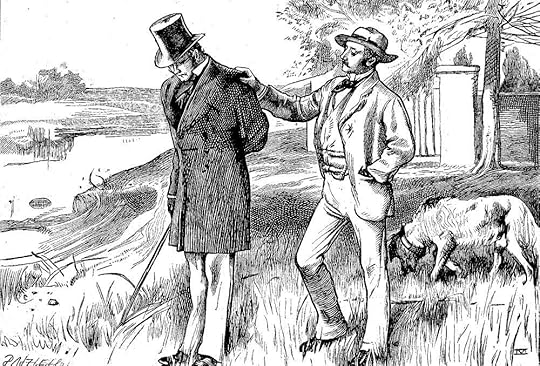
"What a good fellow you are, Clennam!"
Chaptr 34, Book 1
James Mahoney
Text Illustrated:
Said Henry Gowan, the dilettante, socialite-artist and Minnie's fiané] . . . .Between you and me, I think there is some danger of my being just enough soured not to be able to do that."
"To do what?" asked Clennam.
"To keep it up. To help myself in my turn, as the man before me helps himself in his, and pass the bottle of smoke. To keep up the pretence as to labour, and study, and patience, and being devoted to my art, and giving up many solitary days to it, and abandoning many pleasures for it, and living in it, and all the rest of it — in short, to pass the bottle of smoke according to rule."
"But it is well for a man to respect his own vocation, whatever it is; and to think himself bound to uphold it, and to claim for it the respect it deserves; is it not?" Arthur reasoned. "And your vocation, Gowan, may really demand this suit and service. I confess I should have thought that all Art did."
"What a good fellow you are, Clennam!" exclaimed the other, stopping to look at him, as if with irrepressible admiration. "What a capital fellow! You have never been disappointed. That's easy to see."
It would have been so cruel if he had meant it, that Clennam firmly resolved to believe he did not mean it. — Book the First, "Poverty," Chapter 34.
Commentary:
The title is somewhat longer in the New York (Harper and Brothers) printing: "What a good fellow you are, Clennam!" exclaimed the other stopping to look at him, as if with irrepressible admiration. "What a capital fellow! You have never been disappointed. That's easy to see." — Book 1, chap. xxxiv. In the original serial illustrations by Phiz provided, the previous chapter had an engraving which illustrated Mrs. Gowan's seeking the counsel of Mrs. Merdle about her son's forthcoming marriage to the daughter of a rich bourgeois, Mr. Meagles — "Society Expresses its Views on a Question of Marriage" (Part 10: September 1856). Instead, Mahoney shows Arthur's apparent despondency occasioned by the marriage and Henry Gowan's lack of perceptiveness as to what is responsible for his friend's depression. Henry Gowan protests that in his profession and in his art he is a disappointed man, and that, although his father-in-law will pay all his debts, he does not feel one whit less disappointed even as his wedding approaches. Nevertheless, in the illustration he seems serene and cheerful when placed alongside Arthur Clennam, who had thought to marry Pet Meagles himself, and who has grave doubts about Henry's being the right sort of man for her. The illustration is interestingly juxtaposed against the text of Chapter 33, when Henry's mother in her visit to Mrs. Merdle expresses her intention, despite the discrepancy socially between the class of the bride and the class of the groom, to "resign herself to inevitable fate, by making the best of those people the Miggleses". Henry exhibits here what Dickens terms "his usual ease, and with his usual show of confidence, which was no confidence at all". Does Henry, Clennam wonders silently, have the capacity to love anyone but himself? The full title of the illustration, therefore, underscores the irony of Henry's failing to see that Arthur Clennam is the genuinely disappointed man, and that he, Henry Gowan, is a mere poser.
In Mahoney's illustration, set near the Cottage within a week of the wedding, Arthur Clennam is still wearing the same respectable, dark business suit (with tail-coat) and top-hat seen in his parting from Minnie (Pet Meagles), Minnie was there, alone (Ch. 28), whereas prospective bridegroom Henry Gowan in white from head to foot is much more fashionably bohemian (as becomes his status as an artist) in clothing quite different from his rather more formal attire as seen in "As Arthur Came over the stile and down to the water's edge, the lounger glanced at him for a moment" (Ch. 17), although Henry is still attended by his dog and the setting is still the banks of the Thames at Twickenham in the summer, as depicted in several of Phiz's atmospheric landscapes, notably the scene in which Gowan and Clennam first meet, "The Ferry" (Part 5: April 1856).
Mod
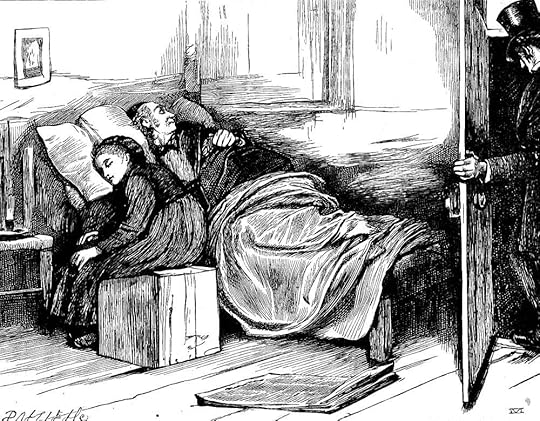
Clennam rose softly, opened and closed the door without a sound.
Chapter 35, Book 1
James Mahoney
Text Illustrated:
The prison, which could spoil so many things, had tainted Little Dorrit's mind no more than this. Engendered as the confusion was, in compassion for the poor prisoner, her father, it was the first speck Clennam had ever seen, it was the last speck Clennam ever saw, of the prison atmosphere upon her.
He thought this, and forbore to say another word. With the thought, her purity and goodness came before him in their brightest light. The little spot made them the more beautiful.
Worn out with her own emotions, and yielding to the silence of the room, her hand slowly slackened and failed in its fanning movement, and her head dropped down on the pillow at her father's side. Clennam rose softly, opened and closed the door without a sound, and passed from the prison, carrying the quiet with him into the turbulent streets. — Book the First, "Poverty," Chapter 35, "What Was Behind Mr. Pancks on Little Dorrit's Hand".
Commentary:
In the original serial illustrations by Phiz, the narrative-pictorial sequence moves directly from the discussion of the forthcoming wedding of Henry Gowan and Pet Meagles in the previous chapter's steel-engraving, "Society Expresses its Views on a Question of Marriage" (Part 10: September 1856), to the final illustration of Book the First, Poverty, the triumphal exit of the Dorrit clan from the debtors' prison, "The Marshalsea becomes an orphan" (Part 10: September 1856). This mid-point serial installment ended with the architect of the Dorrit renaissance, Arthur Clennam, standing in the street outside the Marshalsea as he watches the entourage drive off.
Instead, Mahoney shows an intermediate scene in which, having delivered the good news, Arthur Clennam sensitively leaves the daughter to cope with her father's shock at the news of his release and sudden fortune, a scene which Felix Octavius Carr Darley tenderly realised in one of his engraved title-pages for the 1863 Household Edition produced as a piracy in New York, Joyful Tidings — Book I, Ch. XXXV, a study that Mahoney is not likely to have seen.
In James Mahoney's low-key illustration (the penultimate for the first book), set near the mid-point of the four-hundred-and-twenty-three-page volume, discretely the messenger of glad tidings, Arthur Clennam, with his hat on and ready to enter "the turbulent streets" which are about to receive the long-consigned William Dorrit, is caught in the act of closing the door to William Dorrit's bedroom. On the narrow bed with large pillows, the Father of the Marshalsea, still wearing his clothes and velvet skullcap, and his dutiful daughter are now both asleep, their faces betraying neither agitation nor doubt as to the veracity of Clennam's announcement.
The engaged reader, awaiting this climax in the Dorrit fortunes, scrutinizes the illustration proleptically, encountering the moment realised in the text some seven pages later, already having read that Pancks has resolved Mr. Dorrit's case and that "He will be a rich man. He is a rich man. A great sum of money is waiting to be paid over to him as his inheritance" (chapter 35). Such a windfall, although not entirely unexpected, effected the release of John Dickens from the Marshalsea after his incarceration for non-payment of tradesmen's accounts of forty pounds in 1824 for a mere three months that must have seemed like an eternity to his son, working at the blacking factory, the twelve-year-old Charles, whose purgatorial class descent is partly reflected in the tribulations of the sensitive and dutiful Amy Dorrit, faithful guardian of her father in in repose.
Mod
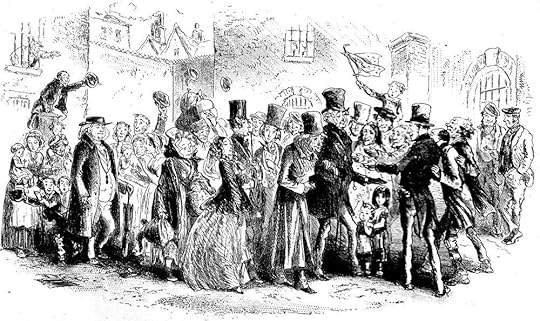
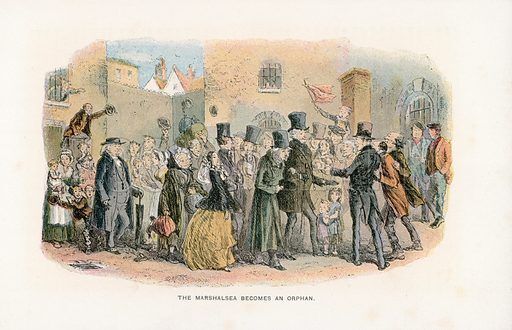
The Marshalsea becomes an orphan
Chapter 36, Book 1
Phiz
Text Illustrated:
"In the yard, were the Collegians and turnkeys. In the yard, were Mr Pancks and Mr Rugg, come to see the last touch given to their work. In the yard, was Young John making a new epitaph for himself, on the occasion of his dying of a broken heart. In the yard, was the Patriarchal Casby, looking so tremendously benevolent that many enthusiastic Collegians grasped him fervently by the hand, and the wives and female relatives of many more Collegians kissed his hand, nothing doubting that he had done it all. In the yard, was the man with the shadowy grievance respecting the Fund which the Marshal embezzled, who had got up at five in the morning to complete the copying of a perfectly unintelligible history of that transaction, which he had committed to Mr Dorrit's care, as a document of the last importance, calculated to stun the Government and effect the Marshal's downfall. In the yard, was the insolvent whose utmost energies were always set on getting into debt, who broke into prison with as much pains as other men have broken out of it, and who was always being cleared and complimented; while the insolvent at his elbow—a mere little, sniveling, striving tradesman, half dead of anxious efforts to keep out of debt—found it a hard matter, indeed, to get a Commissioner to release him with much reproof and reproach. In the yard, was the man of many children and many burdens, whose failure astonished everybody; in the yard, was the man of no children and large resources, whose failure astonished nobody. There, were the people who were always going out to-morrow, and always putting it off; there, were the people who had come in yesterday, and who were much more jealous and resentful of this freak of fortune than the seasoned birds. There, were some who, in pure meanness of spirit, cringed and bowed before the enriched Collegian and his family; there, were others who did so really because their eyes, accustomed to the gloom of their imprisonment and poverty, could not support the light of such bright sunshine. There, were many whose shillings had gone into his pocket to buy him meat and drink; but none who were now obtrusively Hail fellow well met! with him, on the strength of that assistance. It was rather to be remarked of the caged birds, that they were a little shy of the bird about to be so grandly free, and that they had a tendency to withdraw themselves towards the bars, and seem a little fluttered as he passed.
Through these spectators the little procession, headed by the two brothers, moved slowly to the gate. Mr Dorrit, yielding to the vast speculation how the poor creatures were to get on without him, was great, and sad, but not absorbed. He patted children on the head like Sir Roger de Coverley going to church, he spoke to people in the background by their Christian names, he condescended to all present, and seemed for their consolation to walk encircled by the legend in golden characters, 'Be comforted, my people! Bear it!'
At last three honest cheers announced that he had passed the gate, and that the Marshalsea was an orphan."
Mod
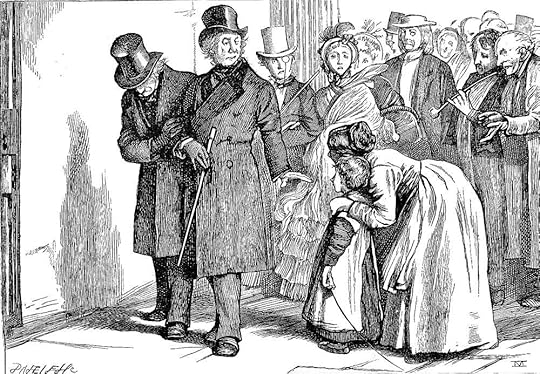
Through these spectators, the little procession, headed by the two brothers, moved slowly to the gate.
Chapter 36, Book 1
James Mahoney
Text Illustrated:
In the yard, were the Collegians and turnkeys. In the yard, were Mr. Pancks and Mr. Rugg, come to see the last touch given to their work. In the yard, was Young John making a new epitaph for himself, on the occasion of his dying of a broken heart. In the yard, was the Patriarchal Casby, looking so tremendously benevolent that many enthusiastic Collegians grasped him fervently by the hand, and the wives and female relatives of many more Collegians kissed his hand, nothing doubting that he had done it all. In the yard, was the man with the shadowy grievance respecting the Fund which the Marshal embezzled, who had got up at five in the morning to complete the copying of a perfectly unintelligible history of that transaction, which he had committed to Mr. Dorrit's care, as a document of the last importance, calculated to stun the Government and effect the Marshal's downfall. In the yard, was the insolvent whose utmost energies were always set on getting into debt, who broke into prison with as much pains as other men have broken out of it, and who was always being cleared and complimented; while the insolvent at his elbow--a mere little, snivelling, striving tradesman, half dead of anxious efforts to keep out of debt--found it a hard matter, indeed, to get a Commissioner to release him with much reproof and reproach. In the yard, was the man of many children and many burdens, whose failure astonished everybody; in the yard, was the man of no children and large resources, whose failure astonished nobody. There, were the people who were always going out to-morrow, and always putting it off; there, were the people who had come in yesterday, and who were much more jealous and resentful of this freak of fortune than the seasoned birds. There, were some who, in pure meanness of spirit, cringed and bowed before the enriched Collegian and his family; there, were others who did so really because their eyes, accustomed to the gloom of their imprisonment and poverty, could not support the light of such bright sunshine. There, were many whose shillings had gone into his pocket to buy him meat and drink; but none who were now obtrusively Hail fellow well met! with him, on the strength of that assistance. It was rather to be remarked of the caged birds, that they were a little shy of the bird about to be so grandly free, and that they had a tendency to withdraw themselves towards the bars, and seem a little fluttered as he passed.
Through these spectators the little procession, headed by the two brothers, moved slowly to the gate. Mr. Dorrit, yielding to the vast speculation how the poor creatures were to get on without him, was great, and sad, but not absorbed. He patted children on the head like Sir Roger de Coverley going to church, he spoke to people in the background by their Christian names, he condescended to all present, and seemed for their consolation to walk encircled by the legend in golden characters, "Be comforted, my people! Bear it!"
At last three honest cheers announced that he had passed the gate, and that the Marshalsea was an orphan. Before they had ceased to ring in the echoes of the prison walls, the family had got into their carriage, and the attendant had the steps in his hand. — Book The First, "Poverty," conclusion of Chapter 36, "The Marshalsea becomes an Orphan".
Commentary:
Having received news of their good fortune, as in Darley's 1863 engraving Joyful Tidings, the Dorrits make a grand exit from the Marshalsea yard attended by a host of "collegians," incarcerated debtors. Phiz also shows the brothers making an earlier circuit of the exercise yard (for Frederick is not a prisoner of the Marshalsea, and is unfamiliar with its precincts) in The Brothers, so that, in essence, Mahoney had two models from which to work.
Whereas Phiz had treated the moment as a crowd scene, with all the Dorrits except Amy surrounded by the Collegians, Mahoney focuses on the distinguished, tailored figure of William Dorrit in stylish topcoat and beaver, deigning to pat upon the head ("like Sir Roger de Coverly going to church" in the celebrated Addison and Steele Spectator No. 2 essay) a pinafore child presented to him by her mother for a blessing, as if Mr. Dorrit were a visiting dignitary — or Christ in the leper colony. With his brother Frederick on his arm, apparently reluctant to be an active participant in the farewell procession, the Father of the Marshalsea at the hour of noon appointed for the family's departure by carriage leads the party composed of a monocled Edward ('Tip') and the vain Fanny. Again, as in Phiz's panoramic treatment, Amy is nowhere to be seen, for she has fainted in her room from all the excitement. In the Mahoney illustration one receives no impression of the scene's context (the prison yard), and Plornish and Maggy are absent. Although the dilapidated prison was closed in 1842 and subsequently demolished, Phiz and Dickens would have had little trouble reconstructing from memory the walled yard overlooked by barred windows, James Mahoney, although born in 1810, had moved to London only in 1859, and therefore had little sense of what the prison yard must have looked like in the period when John Dickens was incarcerated there. Thus, Mahoney concentrates on William Dorrit's apotheosis rather than on the crowd and the architectural setting.
 Tristram wrote: "Julie wrote: "since a Dickens hero can fall in love (if that's what it is) repeatedly, but a heroine only once."
Like Peter, I really love this sentence and find that there is a lot of truth in it..."
How do we know that Arthur did not fund the search for the Dorrit wealth? I assumed he did. Pancks certainly was not rich. And it must have been an expensive search since it took so long.
Or did the Dorrits never even look for the money? I am still with Arthur here, he finally got to sit beside Amy and held her hand. peace, janz
 Julie wrote: "Kim wrote: "Although I was bored spending the entire chapter with the Barnacles, Mr. Meagles wasn't, at least he was cheered up by the thought of them being there."
I skimmed the Barnacles section..."
I find that the Barnacles improve dramatically with a very sarcastic reader to over enunciate them, but I know I would also be skimming them otherwise.
I do think that Mr. Meagles got just one to many puppy dog eye treatments from Pet. That is the only answer that makes sense, unless further machinations are a work. Which does seem plausible at this point.
Jantine wrote: "Yes, he does stand out to be very sensible.And I will repeat what I already mentioned in the previous thread: what if Amy had said 'yes' to John? Would she then have been berated because she brin..."
My thoughts exactly. I don't know if I should wish the family so rich that they can't mess it up, or swiftly back into the prison. But the members of 'Society' honestly seem to deserve the Dorrits more that the poor folk of Bleeding Heart Yard.
I would think that if she had married John, it would have been a terrible mess. Fanny would have had even more of field day. I cannot remember wanting to slap a book character more than her. Your sister has passed out and been left unconscious for who knows how long and all you can do is slap her cheek and chide her? This is a narcissist. Plain and simple. Mr. Dickens is quite good are writing people who seem real even as he presents them as caricatures.
Mary Lou wrote: "I'm back to hating the Barnacle (Oodle, Toodle...) chapters, and wondering what was different about the first one in this book, which I enjoyed. I think I've figured it out. Most of the chapters ..."
I do think that I agree with you on this point. having that sense of participation in the ongoing (or lack there of) does make it more palatable. I wonder if its anything like taking the long way around driving to avoid traffic, or the self checkout. They feel fasters because you are more active in the process.
Avery wrote: "I wonder if its anything like taking the long way around driving to avoid traffic, or the self checkout. They feel fasters because you are more active in the process. Fitting comparison!
Peacejanz wrote: "THow do we know that Arthur did not fund the search for the Dorrit wealth? I assumed he did. Pancks certainly was not rich. And it must have been an expensive search since it took so long.It's frustrating to me (but, I suppose, irrelevant to the overall plot) that Dickens doesn't go into some detail regarding this estate -- who died, and why didn't the Dorrits know about it, or why couldn't they be found? (Barnacle interference, no doubt.)
But as to the costs associated with Pancks' efforts, here you go:
'My dear Mr Pancks, this must have cost
you a great sum of money.'
'Pretty well, sir,' said the triumphant Pancks. 'No trifle, though
we did it as cheap as it could be done. And the outlay was a
difficulty, let me tell you.'
'A difficulty!' repeated Clennam. 'But the difficulties you have
so wonderfully conquered in the whole business!' shaking his hand again.
'I'll tell you how I did it,' said the delighted Pancks, putting
his hair into a condition as elevated as himself. 'First, I spent
all I had of my own. That wasn't much.'
'I am sorry for it,' said Clennam: 'not that it matters now,
though. Then, what did you do?'
'Then,' answered Pancks, 'I borrowed a sum of my proprietor.'
'Of Mr Casby?' said Clennam. 'He's a fine old fellow.'
'Noble old boy; an't he?' said Mr Pancks, entering on a series of
the dryest snorts. 'Generous old buck. Confiding old boy.
Philanthropic old buck. Benevolent old boy! Twenty per cent. I
engaged to pay him, sir. But we never do business for less at our
shop.'
Arthur felt an awkward consciousness of having, in his exultant
condition, been a little premature.
'I said to that boiling-over old Christian,' Mr Pancks pursued,
appearing greatly to relish this descriptive epithet, 'that I had
got a little project on hand; a hopeful one; I told him a hopeful
one; which wanted a certain small capital. I proposed to him to
lend me the money on my note. Which he did, at twenty; sticking
the twenty on in a business-like way, and putting it into the note,
to look like a part of the principal. If I had broken down after
that, I should have been his grubber for the next seven years at
half wages and double grind. But he's a perfect Patriarch; and it
would do a man good to serve him on such terms--on any terms.'
Arthur for his life could not have said with confidence whether
Pancks really thought so or not.
'When that was gone, sir,' resumed Pancks, 'and it did go, though
I dribbled it out like so much blood, I had taken Mr Rugg into the
secret. I proposed to borrow of Mr Rugg (or of Miss Rugg; it's the
same thing; she made a little money by a speculation in the Common Pleas once). He lent it at ten, and thought that pretty high. But Mr Rugg's a red-haired man, sir, and gets his hair cut. And as to the crown of his hat, it's high. And as to the brim of his hat, it's narrow. And there's no more benevolence bubbling out of him, than out of a ninepin.'
'Your own recompense for all this, Mr Pancks,' said Clennam, 'ought to be a large one.'
'I don't mistrust getting it, sir,' said Pancks. 'I have made no
bargain. I owed you one on that score; now I have paid it. Money
out of pocket made good, time fairly allowed for, and Mr Rugg's
bill settled, a thousand pounds would be a fortune to me. That
matter I place in your hands. I authorize you now to break all
this to the family in any way you think best.
Mod
Clennam rose softly, opened and closed the door without a sound.
Chapter 35, Book 1
James Mahoney
Text Illustrated:
The prison, which could spoil so many things, had tainted Little Dorrit's m..."
Kim, as always, a great selection of illustrations. I find this Mahoney very touching. Arthur leaves Amy and Mr Dorrit. Arthur is able to leave the Marshalsea, and here we see Amy resting/sleeping bent over from a box with her head resting on her father’s bed. Of course, Dorrit is confortable and asleep. Amy is with her father.
What will the change in fortune bring to the Dorrit family? I think we can anticipate that Mr Dorrit will continue he regal ways and Amy will still be humble. Can money change a person? We are about to see.
Can money change a person? I'd like the opportunity to find out. :-)
Mod
Society Expresses its Views on a Question of Marriage
Chapter 33, Book 1
Phiz
Text Illustrated:
Mrs. Merdle was at home, and was in her nest of crimson and gold, with the parrot on a neighbou..."
The confines of marriage are clearly evident in this Phiz illustration. As the commentary notes the colourful parrot in its cage offers a wonderful backdrop to both the coming marriage of Gowan and the waning marriage of the Merdle’s.
Marriage is not presented as a positive enterprise in the eyes of these women. We need to look for other markers of successful marriages in the novel. It appears that, for the most part, the happy marriages exist within the lower classes. The Meagles’ appear to also be happily married. I doubt if Arthur can take much inspiration from his mother.
There is, of course, one marriage that may be on our horizon. Will the lessons from the engagements and marriages to date help any prospective couple in the future?
Has anyone else noticed how Phiz seems less and less inclined to incorporate emblematic details like the parrot in his illustrations? The illustrations of Mahoney and Darley are examples of how the manner of illustrations was shifting from the early emblematic style of Hogarth down through Browne to a much more stylized and less adorned presentation.
And Kim, I did look at the coloured Phiz :-). As always, thumbs down.
Mod
Mod
Mod
If I ever find out what publishing house or colourist dared to alter a Browne illustration I will let them know what a mistake it was. ;-)
I felt the same way when Ted Turner was colorizing old black and white films, Peter.
Mod
I'd submit myself most readily to this experiment, too. But then, I'm no alien to self-sacrifice! ;-)
Mod
Probably, money can change a person the same degree that a lack of money can, i.e. by increasing or decreasing certain traits of their personality, but maybe not so much by adding completely new characteristics? We know that Mr. Dorrit is conceited, pompous and at the same time utterly helpless when faced with a real challenge. We know that Fanny and Tip share a sense of entitlement and that Tip has not been able to settle down in any decent job. I'm pretty sure that now with that cornucopia of wealth above their heads, all these faults will find more room to sprawl in, and we might have ample opportunity to get angry about those Dorrits. Just wait and see ...
Mod
Thanks, Mary Lou, for going back and finding that quotation. I had it in mind but could not remember in which chapter it was to be found. When reading it, I wondered, however, about two things: First that Pancks should incur such a high personal financial risk and even run up debts with his employer, who seems to be a usurer if ever there was one, and second, why he did not ask Mr. Clennam to support him in that enterprise. Especially with this last detail in my mind, it seems extremely annoying to me that now that everything is settled, it is Mr. Clennam who pushes himself into the fore, seeming to claim all the merit to himself (just like Mr. Casby does on most occasions). I do like Mr F.'s aunt for pointing out that behaviour of Clennam's.
Mod
I never even noticed the expression, but here it is:
Pass the bottle of smoke
1. To acquiesce in some falsehood
2. To make pretence
pass the bottle of smoke (third-person singular simple present *es, present participle *ing, simple past and past participle *ed)
(rare) To acquiesce in some falsehood; to make pretence.
1855-1857, Charles Dickens, Little Dorrit:
To help myself in my turn, as the man before me helps himself in his, and pass the bottle of smoke. To keep up the pretence as to labour, and study, and patience, and being devoted to my art, and giving up many solitary days to it, and abandoning many pleasures for it, and living in it, and all the rest of it—in short, to pass the bottle of smoke, according to rule.
2000, Pradip Biswas, Sandip Ray: Take One (page 8)
The special streak of the young talent that fascinates me more is the strong impulse to stand against standardized cunning ploy of passing the bottle of smoke in the name of cinema.
Then there is:
https://www.youtube.com/watch?v=csdCM...
Good luck understanding it.
Mod
Fascinating. I’m going to use the expression as soon as possible.
Kim wrote: "Julie wrote: "I'm very intrigued by this expression "pass the bottle of smoke.."I never even noticed the expression, but here it is:
Pass the bottle of smoke
1. To acquiesce in some falsehood
2..."
Thank you, Kim!
It sounds like it's "bottle of smoke" as in "smoke and mirrors."
Mod
I googled the lyrics to the song you posted, Kim. They're not G-rated. And while we're traveling down that road, there's a quaint American way of saying you lied to someone, namely: you blew smoke up his a$$. No idea what the origin of that little gem is, but I guess it all has to do with deception.
Mod
When someone is "blowing smoke up your ass" today, it is a figure of speech that means that one person is complimenting another, insincerely most of the time, in order to inflate the ego of the individual being flattered.
Back in the late 1700s, however, doctors literally blew smoke up people's rectums. Believe it or not, it was a general mainstream medical procedure used to, among many other things, resuscitate people who were otherwise presumed dead. In fact, it was such a commonly used resuscitation method for drowning victims particularly, that the equipment used in this procedure was hung alongside certain major waterways, such as along the River Thames (equipment courtesy of the Royal Humane Society). People frequenting waterways were expected to know the location of this equipment similar to modern times concerning the location of defibrillators.
Smoke was blown up the rectum by inserting a tube. This tube was connected to a fumigator and a bellows which when compressed forced smoke into the rectum. Sometimes a more direct route to the lungs was taken by forcing the smoke into the nose and mouth, but most physicians felt the rectal method was more effective. The nicotine in the tobacco was thought to stimulate the heart to beat stronger and faster, thus encouraging respiration. The smoke was also thought to warm the victim and dry out the person's insides, removing excessive moisture.
So how did this all get started? The Native Americans were known to have used tobacco in a variety of ways, including treating various medical ailments, and the European doctors soon picked up on this and began advocating it for treatments for everything from headaches to cancer.
In 1745, Richard Mead was among the first known Westerners to suggest that administering tobacco via an enema was an effective way to resuscitate drowning victims.
By 1774, Doctors William Hawes and Thomas Cogan, who practiced medicine in London, formed The Institution for Affording Immediate Relief to Persons Apparently Dead From Drowning. This group later became the Royal Humane Society. Back in the 18th century, the society promoted the resuscitation of drowning people by paying four guineas (about £450 today by purchasing power, or $756) to anyone who was able to successfully revive a drowning victim.
Volunteers within the society soon began using the latest and greatest method of reviving such half-drowned individuals, via tobacco smoke enemas. Artificial respiration was used if the tobacco enema did not successfully revive them. In order that people could easily remember what to do in these cases, in 1774 Dr. Houlston published a helpful little rhyme:
Tobacco glyster (enema), breathe and bleed.
Keep warm and rub till you succeed.
And spare no pains for what you do;
May one day be repaid to you.
The practice of using tobacco smoke enemas on drowning victims quickly spread as a popular way to introduce tobacco into the body to treat an array of other medical conditions including: headaches, hernias, respiratory ailments and abdominal cramps, among many other things. Tobacco enemas were even used to treat typhoid fever and during cholera outbreaks when patients were in the final stages of the illnesses.
In their most rudimentary form, tobacco smoke enemas were not always administered with the aide of bellows. Originally, the smoke was blown up the victim's rectum with whatever was handy, such as a smoking pipe. Of course, such close contact wasn't ideal and if the rescuer accidentally inhaled instead of blew, let's just say things that one should not aspirate could be inhaled. If the person jerked around, mouth contact was also a risk, even more risky considering the person being administered too was sometimes diseased.
In fact, one of the earliest documented references of using such a tobacco enema to resuscitate someone came from someone using a smoking pipe in 1746. In this case, the man's wife had nearly drowned and was unconscious. It was suggested that an emergency tobacco enema might revive her, at which point the husband of the woman took a pipe filled with burning tobacco, shoved the stem into his wife's rectum and then covered the other end of the pipe with his mouth and blew. As one would imagine, hot embers of tobacco being blown up her rectum had the intended effect and she was, indeed, revived.
This practice quickly spread, reaching its peak in the early 20th century before, in 1811, English scientist Ben Brodie via animal testing discovered that nicotine was toxic to the cardiac system. Over the next several decades, the popularity of literally "blowing smoke up someone's arse" gradually became a thing of the past. Figuratively, though, this practice is still alive and well.
Mod


I almost forgot to do this, it just popped into my head now as I was sitting here watching the snow fall! Anyway, here we go. This week's installment begins with Chapter 33 titled "Mrs. Merdle's Complaint" an interesting title name, and we begin with Mrs. Gowan deciding to making the best of these "Miggleses". We're told that there are three reasons she came to her decision of allowing the marriage of her son and Pet, and here they are:
1. That her son had never signified the smallest intention to ask her consent, or any mistrust of his ability to dispense with it.
2. that the pension bestowed upon her by a grateful country (and a Barnacle) would be freed from any little filial inroads, when her Henry should be married to the darling only child of a man in very easy circumstances, and finally,
3. that Henry's debts must clearly be paid down upon the altar-railing by his father-in-law.
I wasn't so clear as to that last one. So because of these reasons as soon as Mr. Meagles gives his consent she does also. Among her friends and acquaintances, however, she maintains that it was her, not the Meagles who had opposed the marriage and it was Mrs. Gowan who finally gave way; and that the sacrifice was hers, not the Meagles. She goes on a visit to Mrs. Merdle to ask her thoughts on the marriage.
Mrs. Gowan wants to know what "Society" will think of the marriage. Mrs. Merdle is described as a "Priestess of Society" and therefore the best one to advise Mrs. Gowan.
'As to marriage on the part of a man, my dear, Society requires that he should retrieve his fortunes by marriage. Society requires that he should gain by marriage. Society requires that he should found a handsome establishment by marriage. Society does not see, otherwise, what he has to do with marriage. Bird, be quiet!'........."
I will never get a pet bird, by the way. Mrs. Merdle assures her that Society will not blame her for being unable to prevent the marriage, in fact she will be highly commended and sympathized with. At this point Mr. Merdle arrives home and Mrs. Gowan leaves. As Mr. Merdle stands looking out the window his wife becomes upset with him and says he is so moody and distraught, and should not even go into Society until he is fit for it. He replies by telling her no one does more for society than he does.
'Why, in the name of all the infernal powers, Mrs Merdle, who does more for Society than I do? Do you see these premises, Mrs Merdle? Do you see this furniture, Mrs Merdle? Do you look in the glass and see yourself, Mrs Merdle? Do you know the cost of all this, and who it's all provided for? And yet will you tell me that I oughtn't to go into Society? I, who shower money upon it in this way? I, who might always be said—to—to—to harness myself to a watering-cart full of money, and go about saturating Society every day of my life.'
But Mrs. Merdle isn't talking about what he "gives" to Society (I wonder why we are always capitalizing society, I mean Society?) she knows he receives the best Society in the land and moves the entire Society of the land, but he carries his business about him and appears preoccupied. She says:
'I don't expect you,' said Mrs Merdle, reposing easily among her cushions, 'to captivate people. I don't want you to take any trouble upon yourself, or to try to be fascinating. I simply request you to care about nothing—or seem to care about nothing—as everybody else does.'
'Do I ever say I care about anything?' asked Mr Merdle.
'Say? No! Nobody would attend to you if you did. But you show it.'
'Show what? What do I show?' demanded Mr Merdle hurriedly.
'I have already told you. You show that you carry your business cares an projects about, instead of leaving them in the City, or wherever else they belong to,' said Mrs Merdle. 'Or seeming to. Seeming would be quite enough: I ask no more. Whereas you couldn't be more occupied with your day's calculations and combinations than you habitually show yourself to be, if you were a carpenter.'
'A carpenter!' repeated Mr Merdle, checking something like a groan. 'I shouldn't so much mind being a carpenter, Mrs Merdle.'
Edmund arrives and agrees with his mother that yes, even though people say that Mr. Merdle is very rich and very knowing, still business seems to sit heavily on him. He is said to carry his business around with him "like Jew clothesmen with too much business.'" And this is the end of the chapter for poor Mr. Merdle:
"At last he met the chief butler, the sight of which splendid retainer always finished him. Extinguished by this great creature, he sneaked to his dressing-room, and there remained shut up until he rode out to dinner, with Mrs Merdle, in her own handsome chariot. At dinner, he was envied and flattered as a being of might, was Treasuried, Barred, and Bishoped, as much as he would; and an hour after midnight came home alone, and being instantly put out again in his own hall, like a rushlight, by the chief butler, went sighing to bed."
One more thing about this chapter, someone needs to change their name, and their activities so they stop confusing me. We have two mothers who each have one son, and neither mother wants her son to marry the choice he seems to be making. In both cases the girl isn't good enough for society. Then I have the mother with the one daughter, and she doesn't want her daughter to marry her choice either. Give these people names like Merdle and Meagles, then have Mrs. Gowen refer to the Meagles as Miggleses, and I'm confused.