
Reading the 20th Century discussion
Archive
>
Group Reads -> June 2022 -> Nomination thread (Youth Culture won by Fire and Rain: The Beatles, Simon and Garfunkel, James Taylor, CSNY, and the Lost Story of 1970)

 Mod
Mod
From Flappers to Ravers....
https://www.theguardian.com/culture/g...
Mod
I'm also very attracted by Baron's Court, All Change by Terry Taylor which I have never read but which sounds seminal.
I also have an unread copy of Teenage: The Creation of Youth Culture by Jon Savage which sounds fascinating. One reviewer states "Jon Savage cunningly tracks the Tortured Teen from Young Werther, Dorian Gray, and Peter Pan to Robert Brooke, Dada, and jitterbugs, handily proving there were many, many rebels before James Dean. He also imparts a deep sense of horror and outrage at how over a century a complacent establishment routinely sent and sends the young out to die." It's a chunky tome though, c600 pages.
What about you?
Any initial thoughts? Perhaps you're ready to nominate?
 Mod
Mod
Mod
Mod
Vile Bodies is the only one that immediately leaps to mind however, and as I observe in my three star review, whilsst....
https://www.goodreads.com/review/show...
....there is much to admire and enjoy in Vile Bodies, this is one of Evelyn Waugh's less successful novels (measured against his exceptionally high standards). It's probably of most interest to Waugh completists (of whom I am definitely one) or anyone interested in gaining eye witness insights into the world of the Bright Young Things.
Vile Bodies captures the world of the "Bright Young Things", a privileged and wealthy elite in the 1920s, and their associated misspent youth, self indulgence, anarchic behaviour, and easy attitudes to sex and drugs. In the late 1920s and early 1930s, the Bright Young Things's were a staple of newspaper gossip columns, who seized upon their adventures and reported them with a mixture of reverence and glee. There was plenty to report: practical jokes, treasure hunts, fancy dress parties, stealing policemen's helmets, dancing all night at the Ritz and so on. In a sense this is what the 1920s is best remembered for, and for some it must have felt right, after the trauma of World War One, and with Victorian values in decline, for young people to enjoy themselves.
https://www.goodreads.com/review/show...

 Both Absolute Beginners and Baron's Court sound good to me and would fill gaps in my London knowledge.
Other than possibly the flappers, was there a youth culture before the 50's postwar prosperity?
Mod
"Both Absolute Beginners and Baron's Court sound good to me and would fill gaps in my London knowledge."
Encouraging words Ben - thanks
"Other than possibly the flappers, was there a youth culture before the 50's postwar prosperity?"
If I was talking off the top of my head I'd say not however, according to the blurb of Teenage: The Creation of Youth Culture, the Jon Savage book I mention above...
Teenagers —as we have come to define them —were not born in the 1950s of rockers and Beatniks, when most histories would begin. Rather, the teenager as icon can be traced back to the 1890s, when the foundations for the new century were laid in urban youth culture.
I can talk more authoritatively when I finally get round to reading the Jon Savage teenage tome
Come to think of it, I do remember my mother telling me about the "bobby soxers" who screamed for Frank Sinatra almost two decades before Beatlemania. And in the years before that, there must have been someone jitterbugging?
Mod
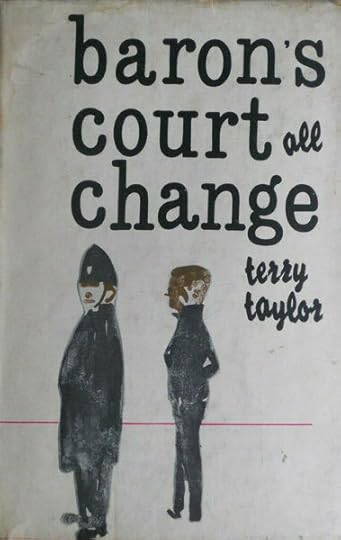
Baron's Court, All Change (1961) by Terry Taylor
Baron’s Court, All Change was the Holy Grail for all collectors of beatnik, mod and hippie ephemera until it was republished twice in the 21st century. Terry Taylor's only published book, unavailable for decades, documents one summer in the life of the unnamed sixteen year-old narrator. Leaving his home and job he dabbles with spiritualism, is seduced by an older woman and moves into dealing dope.
His London is sharp suits, jazz, drugs, nightclubs, and sex. Rare secondhand copies of the first edition have sold for in excess of £300 .
Terry Taylor was born in 1933 and inspired the novel Absolute Beginners by Colin MacInnes.
Aside from being an assistant to noted photographer Ida Kar (and her lover, despite the age difference between them), Terry was also a hustler; so he knew a thing or three about drugs. He died in 2014.
More information here:
https://www.londonfictions.com/terry-...
https://www.modculture.co.uk/barons-c...
https://www.modculture.co.uk/barons-c...

 The "swing kids" of the 40s were interesting too. Don't know offhand of any books about them.
Mod
The "swing kids" of the 40s were interesting too. Don't know offhand of any books about them.
Mod
Do the Beats count as youth culture? There are some books about Beat women that look fascinating, or possibly another Kerouac who, rather surprisingly given Beat misogyny, I love ;)
 Ben wrote: "Come to think of it, I do remember my mother telling me about the "bobby soxers" who screamed for Frank Sinatra almost two decades before Beatlemania.
 And in the years before that, there must hav..."
Before Frank there was Rudy Vallee. After him it was Elvis, the Beatles and Michael Jackson. Not sure of any crazes after that.
 I remember Bill Haley and the Comets, and the film Rock around the Clock in 1956, which led to disorderly behaviour in London cinemas. The expectation (if not the reality) of further disturbances kept the police on alert. At home, we listened (illicitly) to the police messages over the radio and cars being called to 'rock and roll riots'.
 Mod
Mod
The Green Hat

‘In her eyes you saw the landscape of England, spacious and brave.’
When The Green Hat was published in 1924 it caused a sensation, selling millions of copies. With much of the action taking place in the nightclubs and grand houses of London’s Mayfair, it soon came to be seen as the quintessential roaring twenties novel, absolutely capturing the spirit of the era.
Iris Storm, a beautiful, doomed young widow, races around Europe and London in her yellow Hispano Suiza. One night, in the early hours, she parks outside a building in Shepherd Market. She has come to visit Gerald, her alcoholic twin brother. The narrator, who occupies the flat below his, lets her in. Her face is shaded by a jaunty green hat, but eventually it is removed and veiled language alludes to a sexual encounter.
The author, Michael Arlen, was born in Armenia. In this glittering novel he reflects on the manners and sexual mores of the upper class in his adopted country. There are hints of homosexuality and venereal disease. Gerald drinks, and Iris breaks all the Victorian feminine taboos in her pursuit of love. The ultimate femme fatale, she leaves a trail of havoc and broken hearts in her wake. Under her spell, the narrator follows her to Paris, where she is being treated in a convent for a mysterious ailment. A social outlaw, Iris will be punished for her transgressions.
As a portrait of a generation traumatized by the first world war, this is a dazzling and beautifully written novel. Its great success led to a film adaptation starring Greta Garbo as Iris.
Mod
"I really like the sound of Teenage: The Creation of Youth: 1875-1945... but 600 pages when non-fiction tends not to be a winner here means I'm hesitatant about nominating it."
All sadly true
I will be reading it at some stage
"Do the Beats count as youth culture? "
Yes
Mod
Mod
Mod
 There's The Electric Kool-Aid Acid Test by Tom Wolfe about Ken Kesey and the Merry Pranksters, who were central to late-60s LSD culture. I read it ages ago and remember enjoying it. Wolfe was an amazing writer, but may not be everyone's cup of Kool-Aid.
Or Hunter S. Thompson's Fear and Loathing in Las Vegas, also an amazingly written account of drug culture of that time.
Just a thought; not sure whether either is a nomination yet.
Mod
There's also the seminal Hell's Angels by Hunter S. Thompson, another fascinating read
Mod
Anyway, that's another conversation for another day
Mod
It's included in 1001 Books You Must Read Before You Die by Peter Boxall.
The rationale...
"Arlen's writing style, with its ambiguous, elliptical descriptions, is clearly influenced by modernism, while the imagery offers some particularly stark, oddly dislocated depictions resembling imagism."
Now you know
Nominations so far....
Baron's Court, All Change (1961) by Terry Taylor (Nigeyb)
The Green Hat by Michael Arlen (Susan)
Mod
Mod
Mod
Not read any HM since I was a kid
I wonder how they've aged? Quite hard work for a teen as I recall (but with the odd bit of sex)
Which of his books deal with youth cults?
Mod
Mod
Consider it done
Mod
I was looking for a true crime book set in the Fifties, perhaps about Derek Bentley, but I failed. True Crime would also be an excellent addition to our themes I feel, if it isn't already there.
Mod
I'm a bit wary of being told which books I must read whilst I'm alive however its inclusion also suggests it has many merits.
Whatever the outcome, never apologise for a nomination!
All nominations are very welcome and, of course, we've all picked up a book with low expecatations only to be completely confounded. As you probably noticed I had that experience this very week with Olive Kitteridge
Yes, let's do true crime
Mod
Henry Miller: I was thinking of him in terms of youthful counterculture rather than cults but might be a bit of a stretch.
Mod
Mod
I felt as though I stopped being a "Youth" when I started working as a lawyer ... so 24!
Mod
Susan wrote: "Ah, my husband too, Ben. I like lawyers, even if they tend to be generally unpopular ;)"I can't imagine why we're not more popular! We're so agreeable and friendly. And cuddly.
Mod
All that said, I stopped participating in youth cults (punk rocker & Blitz kid) when I was 18.
Mod
It sounds so wrong.....
.....it must be right
:-)
 Mod
Mod
The reason I'm hesitating to nominate is that I suspect this is not really about youth culture, but about the lurid portrayals in popular fiction, often by people who knew little about the reality (like when Dorothy Sayers writes about drug addicts, not that I would ever compare her to pulp fiction!) But definitely worth a "look inside" at Amazon to see some of the amazing book covers.
Mod
I’d love to read it
Only book I noticed here was Fire and Rain: The Beatles, Simon and Garfunkel, James Taylor, CSNY, and the Lost Story of 1970 by David Browne. It was kind of a rough year, had some good music, the year of Kent State/Jackson State, the year Janis/Jimi/Morrison all joined the 27 Club.Written in 2012 and I have had it on my shelf since 2017. Time I got to it.
So I'll nominate Fire and Rain if it meets the qualifications and I think 1970 had a major effect on the youth culture of the time.
Mod
Nominations....
Baron's Court, All Change (1961) by Terry Taylor (Nigeyb)
The Green Hat by Michael Arlen (Susan)
Fire and Rain: The Beatles, Simon and Garfunkel, James Taylor, CSNY, and the Lost Story of 1970 by David Browne (Jan)
Mod
Mod
It's got a 4.05 rating on here and 4.5 on Amazon from 71 ratings. It's now available on Audible and there are two listings for paperbacks on Amazon.
Amazon blurb:
Named one of the 50 best memoirs of the past 50 years by The New York Times
Winner of the National Book Critics Circle Award
“Among the great American literary memoirs of the past century...a riveting portrait of an era...Johnson captures this period with deep clarity and moving insight.” (Dwight Garner, The New York Times)
In 1954, Joyce Johnson’s Barnard professor told his class that most women could never have the kinds of experiences that would be worth writing about. Attitudes like that were not at all unusual at a time when “good” women didn’t leave home or have sex before they married; even those who broke the rules could merely expect to be minor characters in the dramas played by men. But secret rebels, like Joyce and her classmate Elise Cowen, refused to accept things as they were.
As a teenager, Johnson stole down to Greenwich Village to sing folksongs in Washington Square. She was 21 and had started her first novel when Allen Ginsberg introduced her to Jack Kerouac; nine months later she was with Kerouac when the publication of On the Road made him famous overnight. Joyce had longed to go on the road with him; instead she got a front seat at a cultural revolution under attack from all sides, made new friends like Hettie and LeRoi Jones, and found herself fighting to keep the shy, charismatic, tormented Kerouac from destroying himself. It was a woman’s adventure and a fast education in life. What Johnson and other Beat Generation women would discover were the risks, the heartache and the heady excitement of trying to live as freely as the rebels they loved.
 Mod
Mod
Spoilt for choice
Mod
Baron's Court, All Change (1961) by Terry Taylor (Nigeyb)
The Green Hat by Michael Arlen (Susan)
Fire and Rain: The Beatles, Simon and Garfunkel, James Taylor, CSNY, and the Lost Story of 1970 by David Browne (Jan)
Girl Gangs, Biker Boys, and Real Cool Cats: Pulp Fiction and Youth Culture, 1950 to 1980 by Iain McIntyre (Judy)
Minor Characters: A Beat Memoir by Joyce Johnson (Roman Clodia)
Who else is nominating?
Or are we ready to publish the poll?
Last call for nominations

Reading the 20th Century
Books mentioned in this topic
Baron's Court, All Change (other topics)Baron's Court, All Change (other topics)
Fire and Rain: The Beatles, Simon and Garfunkel, James Taylor, CSNY, and the Lost Story of 1970 (other topics)
Fire and Rain: The Beatles, Simon and Garfunkel, James Taylor, CSNY, and the Lost Story of 1970 (other topics)
Girl Gangs, Biker Boys, and Real Cool Cats: Pulp Fiction and Youth Culture, 1950 to 1980 (other topics)
More...
Authors mentioned in this topic
David Browne (other topics)David Browne (other topics)
Terry Taylor (other topics)
Joyce Johnson (other topics)
Michael Arlen (other topics)
More...

Our June 2022 theme is Youth Culture
Please nominate a 20th century book (either written in the 20th century or set in it) that is centred around the world of Youth Culture, and that you would like to read and discuss. It could be fiction or non-fiction
Please supply the title, author, a brief synopsis, and anything else you'd like to mention about the book, and why you think it might make a good book to discuss.
Happy nominating.