
The Pickwick Club discussion

This topic is about
David Copperfield
David Copperfield
>
Copperfield, Chapters 13 - 15

 In Chapter 14, we learn more about Mr. Dick’s story and we also witness an encounter between Aunt Betsey and the dreadful Murdstones, whose name sounds like Murderer to Aunt Betsey’s ears. This is what we learn about Mr. Dick:
”'I suppose,' said my aunt, eyeing me as narrowly as she had eyed the needle in threading it, 'you think Mr. Dick a short name, eh?'
'I thought it was rather a short name, yesterday,' I confessed.
'You are not to suppose that he hasn't got a longer name, if he chose to use it,' said my aunt, with a loftier air. 'Babley—Mr. Richard Babley—that's the gentleman's true name.'
I was going to suggest, with a modest sense of my youth and the familiarity I had been already guilty of, that I had better give him the full benefit of that name, when my aunt went on to say:
'But don't you call him by it, whatever you do. He can't bear his name. That's a peculiarity of his. Though I don't know that it's much of a peculiarity, either; for he has been ill-used enough, by some that bear it, to have a mortal antipathy for it, Heaven knows. Mr. Dick is his name here, and everywhere else, now—if he ever went anywhere else, which he don't. So take care, child, you don't call him anything BUT Mr. Dick.'”
And also this:
”'He has been CALLED mad,' said my aunt. 'I have a selfish pleasure in saying he has been called mad, or I should not have had the benefit of his society and advice for these last ten years and upwards—in fact, ever since your sister, Betsey Trotwood, disappointed me.'
'So long as that?' I said.
'And nice people they were, who had the audacity to call him mad,' pursued my aunt. 'Mr. Dick is a sort of distant connexion of mine—it doesn't matter how; I needn't enter into that. If it hadn't been for me, his own brother would have shut him up for life. That's all.'
I am afraid it was hypocritical in me, but seeing that my aunt felt strongly on the subject, I tried to look as if I felt strongly too.
'A proud fool!' said my aunt. 'Because his brother was a little eccentric—though he is not half so eccentric as a good many people—he didn't like to have him visible about his house, and sent him away to some private asylum-place: though he had been left to his particular care by their deceased father, who thought him almost a natural. And a wise man he must have been to think so! Mad himself, no doubt.'
Again, as my aunt looked quite convinced, I endeavoured to look quite convinced also.
'So I stepped in,' said my aunt, 'and made him an offer. I said, "Your brother's sane—a great deal more sane than you are, or ever will be, it is to be hoped. Let him have his little income, and come and live with me. I am not afraid of him, I am not proud, I am ready to take care of him, and shall not ill-treat him as some people (besides the asylum-folks) have done." After a good deal of squabbling,' said my aunt, 'I got him; and he has been here ever since. He is the most friendly and amenable creature in existence; and as for advice!—But nobody knows what that man's mind is, except myself.'”
This not only tells us a lot about Mr. Dick but also about Aunt Betsey: namely that behind her rough façade there is a lot of kindness, and likewise that she has a peculiar way of looking at things. Not quite unlike Mr. Peggotty, Aunt Betsey has established a patchwork family of her own – interestingly, not that it had anything to do with the novel, this is also a recurring motif in some of Clint Eastwood’s films, like in The Outlaw Josey Wales –, and it is also interesting that she started taking care of Mr. Dick about the same time she was disappointed with regard to the outcome of Clara Copperfield’s pregnancy. I think that Aunt Betsey’s motive may lie in the bad experience she had with her own marriage, which made her distrustful of men in general – there are abundant examples of her skeptical view on marriage in her talk – but could not stifle her desire for company around her.
I also stumbled across this little sentence here: “’ Be as like your sister as you can, and speak out!’” I think it was Ami who pointed out earlier that Steerforth by making David his personal Sheherazad actually attributes David with female qualities, and here the pattern is apparently continued.
I really enjoyed the way Aunt Betsey had it out with the Murdstones. Not only does she completely ignore Miss Murdstone, thus driving her crazy, but she also gives Mr. Murdstone a good dressing-down, and she really hits a sore point here:
”'It was clear enough, as I have told you, years before YOU ever saw her—and why, in the mysterious dispensations of Providence, you ever did see her, is more than humanity can comprehend—it was clear enough that the poor soft little thing would marry somebody, at some time or other; but I did hope it wouldn't have been as bad as it has turned out. That was the time, Mr. Murdstone, when she gave birth to her boy here,' said my aunt; 'to the poor child you sometimes tormented her through afterwards, which is a disagreeable remembrance and makes the sight of him odious now. Aye, aye! you needn't wince!' said my aunt. 'I know it's true without that.'
He had stood by the door, all this while, observant of her with a smile upon his face, though his black eyebrows were heavily contracted. I remarked now, that, though the smile was on his face still, his colour had gone in a moment, and he seemed to breathe as if he had been running.”
During their conversation I could not help thinking that all in all, Murdstone seemed quite glad to wash his hands of his responsibility for David and that he was actually relieved to be able to get rid of him. If he had insisted on having David restored into his care, I do not doubt he would have succeeded by appealing to the law.
At the end of the chapter, I have the impression of Dickens speaking himself through his narrator when he admits how difficult it was for him to raise the curtain that had covered his time in the factory:
”and that a curtain had for ever fallen on my life at Murdstone and Grinby's. No one has ever raised that curtain since. I have lifted it for a moment, even in this narrative, with a reluctant hand, and dropped it gladly. The remembrance of that life is fraught with so much pain to me, with so much mental suffering and want of hope, that I have never had the courage even to examine how long I was doomed to lead it. Whether it lasted for a year, or more, or less, I do not know. I only know that it was, and ceased to be; and that I have written, and there I leave it.”
Chapter 15 prepares the scence for a new stage in David’s life and leads us on to Canterbury. Aunt Betsey, much to David’s relief, becomes aware of the fact that David is still in need of proper education and to provide it for him, she sends him to boarding school in Canterbury. Here we get to know Mr. Wickfield, Aunt Betsey’s family lawyer, and his daughter Agnes, the apple of his eye. There seems to be a mystery connected with Mr. Wickfield in some way because not only is he given to despondency but also to a rather excessive consumption of port wine in the evenings. I hope that this mystery will be unveiled in the course of the novel.Agnes seems to be one of the typical female paragons – gentle, understanding, a good housewife, and rather colourless. One of the more promising characters is definitely Uriah Heep – what a name! –, who is described like this:
”The low arched door then opened, and the face came out. It was quite as cadaverous as it had looked in the window, though in the grain of it there was that tinge of red which is sometimes to be observed in the skins of red-haired people. It belonged to a red-haired person—a youth of fifteen, as I take it now, but looking much older—whose hair was cropped as close as the closest stubble; who had hardly any eyebrows, and no eyelashes, and eyes of a red-brown, so unsheltered and unshaded, that I remember wondering how he went to sleep. He was high-shouldered and bony; dressed in decent black, with a white wisp of a neckcloth; buttoned up to the throat; and had a long, lank, skeleton hand, which particularly attracted my attention, as he stood at the pony's head, rubbing his chin with it, and looking up at us in the chaise.”
As David shudders at the touch of Uriah Heep’s hand, it is to be concluded that this creepy guy is going to mean trouble.
After some websurfing I actually found a very interesting bit of information, namely that Uriah Heep's outward appearance seems to be largely based on that of the lank and cadaverous Danish writer Hans Christian Andersen, whose lack of beauty can be seen from the picture going with the wikipedia article. Dickens and Andersen seemed to have hit it off rather well at the beginning, but then Dickens made the mistake of inviting Andersen over to Gad's Hill for a fortnight. Andersen, who was actually used to staying at other people's houses and who in fact did not have a household of his own - what a scrounger! -, soon displayed Bartlebyesque qualities and extended his stay to five weeks during which time he never got the various hints dropped by Dickens that he had rather see his back. He even wanted one of Dickens's younger sons to shave him in the morning, but Dickens indignantly refused him this creepy request. One of Dickens's daughters eventually came up with an endearing and apt sobriquet for their clingy house guest: "the bony bore".For all those who can speak a bit of German, here is what the humorist Wilhelm Busch wrote about guests outstaying their welcome:
Es ist halt schön...
Es ist halt schön,
Wenn wir die Freunde kommen sehn. –
Schön ist es ferner, wenn sie bleiben
Und sich mit uns die Zeit vertreiben. –
Doch wenn sie schließlich wieder gehn,
Ist's auch recht schön. –
 Tristram wrote: "After some websurfing I actually found a very interesting bit of information, namely that Uriah Heep's outward appearance seems to be largely based on that of the lank and cadaverous Danish writer ..."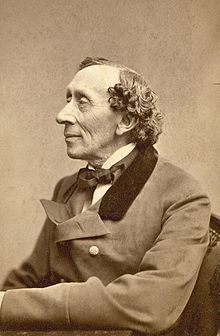
Hans Christian Anderson
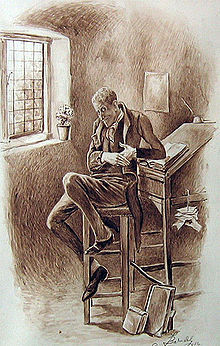
Uriah Heep illustration by Fred Barnard
What do you think?
 Kim wrote: "Uriah Heep illustration by Fred Barnard
What do you think?"
Uriah Heep reminded me of Riff Raff from Rocky Horror Picture Show. Cadaverous indeed.
This Fred Barnard illustration doesn't make him look quite as treacherous as I had imagined, but his lanky and angular-faced appearance look right to me.
I wanted to hug Aunt Betsy right along with young David after she gave Mr. and Miss Murdestone what-for. That was an awesome scene! I especially loved their introduction to her as she stormed out to the yard to shoo away their donkeys, gave no notice to them at all, and then went back inside to be properly presented to her company by Jane. ha ha! And then as they left, I liked David's image of Aunt Betsy watching out the window just waiting for the opportunity to go storming out at them again if the donkeys happened to trample her yard again. My favorite scene from this week's reading.
 Tristram wrote: "Dear Fellow Pickwickians,
this week’s three chapters have seen a considerable change in the affairs of our little hero – let’s hope for the better – as well as they have witnessed some new charact..."
"I should wash him." What a classic line to end a long, rambling, but, of course, delightful scene when David finally ends his epic journey to find his aunt.
David is certainly well traveled, and hopefully he has found a more stable and loving environment at last.
Kim wrote: "I make myself known to my Aunt
Chapter 13"
Thanks again for the illustrations Kim. The illustration of David with his aunt is interesting. As he stands with head bowed, we have in the background a donkey being hit with a stick and one being ridden. Thinking back to the earlier illustration where the broken chain could have been seen as representing broken love/ marriage, is it too much of a leap to say that the donkeys are symbolic of David's earlier life. Hit, beaten and humiliated by both his father and his school, David has been driven to find shelter with someone who might care for him. As aunt Betsey constantly drives the donkeys from her door, perhaps it is suggestive of her also attempting to drive what might harm David ( and even Mr. Dick) from her doorstep.
 Tristram wrote: "One might probably discuss what Aunt Betsey would have done with David, had it not been for Mr. Dick. We she have shut her doors on David, or would she have taken care of him, anyway?"
Oh, she would have taken care of him anyhow. For sure.
Tristram wrote: "It’s also quite interesting that Aunt Betsey has this donkey problem of hers and that she interrupts whatever she happens to be doing just to scare off the ubiquitous boys who lead their donkeys across a patch of green in front of her house. "Amusing, yes. Interesting? Not really for me. And it quickly became a distraction wondering how many paragraphs Dickens would get through before another "Janet! donkeys!" And they are a distraction for David, too: "I thoroughly believe that but for those unfortunate donkeys, we should have come to a good understanding; for my aunt had laid her hand on my shoulder, and the impulse was upon me, thus emboldened, to embrace her and beseech her protection. But the interruption, and the disorder she was thrown into by the struggle outside, put an end to all softer ideas for the present, and kept my aunt indignantly declaiming to Mr. Dick about her determination to appeal for redress to the laws of her country, and to bring actions for trespass against the whole donkey proprietorship of Dover, until tea-time. "
Tristram wrote: "This not only tells us a lot about Mr. Dick but also about Aunt Betsey: namely that behind her rough façade there is a lot of kindness, and likewise that she has a peculiar way of looking at things. Not quite unlike Mr. Peggotty, Aunt Betsey has established a patchwork family of her own "Which is why I say that she would certainly have taken David in even without Mr. Dick. There is indeed kindness there, though hidden under a rough exterior. (Quite a contract between Peggoty and Aunt Betsey. Both are kind, but physically and emotionally they are otherwise almost complete opposites.)
Tristram wrote: "If he had insisted on having David restored into his care, I do not doubt he would have succeeded by appealing to the law."I'm not so sure about that. Murdstone was no blood relation of David's, only a step-father. Aunt Betsey was a blood relation, and so I suspect might well in those times (as she would certainly today) have the greater right had she pressed it.
Kim wrote: "Here is the second working drawing."
Who were those figures in the right foreground supposed to be?
Everyman wrote: "Kim wrote: "Here is the second working drawing."
Who were those figures in the right foreground supposed to be?"
I wondered that myself, it doesn't say anything about them in the on the site with the drawing and I couldn't find it anywhere else. Looking at it for awhile I thought it might have been practice for Aunt Betsey and David it reminds me of them.
Oh, as to the illustration that Dickens then approved from what I've read he did have a problem with the donkeys in the background, especially because they aren't even mentioned in the text for another four pages, but he let it go.
Kim wrote: "Everyman wrote: "Kim wrote: "Here is the second working drawing."
Who were those figures in the right foreground supposed to be?"
ok
I wondered that myself, it doesn't say anything about them in t..."
Great insights and information Kim. I am looking much more closely and carefully at the illustrations because of your posts. They really are a part of the story. For those people who were unable to read the novels themselves the illustrations must have been a wonderful way to be part of the novel's experience.
Kim wrote: "What do you think?"If I told you which of the two pictures looks more creepy to me, this would not be too much of a flattery for Mr. Andersen. - Later in the novel there is going to be a scene which, so I think, might really support the idea that Dickens was thinking of Andersen when he described Uriah Heep, but for the moment, I am not going to go into it for fear of spoilers.
So why did Tristram mention it here then?
Hmm, as a reminder, because I know that otherwise it might slip from my memory.
Peter wrote: ""I should wash him." What a classic line to end a long, rambling, but, of course, delightful scene when David finally ends his epic journey to find his aunt."I really enjoy this kind of anticlimactic humour a lot - it's one of the qualities I associate with British humour.
Everyman wrote: "I'm not so sure about that. Murdstone was no blood relation of David's, only a step-father. Aunt Betsey was a blood relation, and so I suspect might well in those times (as she would certainly today) have the greater right had she pressed it. "I would never contradict a lawyer - but wait until another lawyer did so ;-)
However I would have thought that as Murdstone had a legal right to all of Clara's property when he married her, he would also have been responsible for all the children coming out of her first marriage.
Everyman wrote: "Amusing, yes. Interesting?"It's not so much the donkey mania I found interesting - in fact I remember that I found it quite annoying when I read the novel first because it is a recurrent feature of Aunt Betsey's, but what I find interesting is that so many characters in the book seem to have one peculiar whim that exerts considerable power over their minds: Aunt Betsey has her donkeys, Miss Murdstone has her suspicion about the hidden man, Mr. Dick seems to be over-fascinated with King Charles I., Mrs. Micawber is spell-bound by her intention never to desert Mr. Micawber, Barkis has his hidden money, and Mrs. Gummidge her conviction of feeling sorrow more keenly than any other person. I have never noticed such a collection of individual whims in any other Dickens novel up to now. My question would be whether there was some idea behind it all.
Tristram wrote: "Everyman wrote: "Amusing, yes. Interesting?"It's not so much the donkey mania I found interesting - in fact I remember that I found it quite annoying when I read the novel first because it is a r..."
Just imagine the wealth in mining all these whims and eccentricities on a psychiatrist's couch.
 Tristram wrote: "Aunt Betsey has established a patchwork family of her own – interestingly, not that it had anything to do with the novel, this is also a recurring motif in some of Clint Eastwood’s films, like in The Outlaw Josey Wales – ..."
I don't remember the story line of that one, but there's certainly plenty of the Good, the Bad, and the Ugly in Dickens' characters!
I also stumbled across this little sentence here: “’ Be as like your sister as you can, and speak out!’” I think it was Ami who pointed out earlier that Steerforth by making David his personal Sheherazad actually attributes David with female qualities, and here the pattern is apparently continued.
It's a funny twist that most girls would not have been encouraged to speak out. Betsey is a classic eccentric aunt :)
Tristram wrote: "Everyman wrote: "I'm not so sure about that. Murdstone was no blood relation of David's, only a step-father. Aunt Betsey was a blood relation, and so I suspect might well in those times (as she wou..."I'm curious about this too. I noticed that Aunt Betsey refers to Murdstone as David's "father-in-law", and I wonder if, in that era, that's just what he was -- David's father, in the eyes of the law.
Linda wrote: "Kim wrote: "Uriah Heep illustration by Fred BarnardWhat do you think?"
Uriah Heep reminded me of Riff Raff from Rocky Horror Picture Show. Cadaverous indeed.
This Fred Barnard illustration do..."
So creepy when he trapped his breath in the pony's nostrils. And later, his red sun eyes, setting or rising, staring at David from under the writing... I'm trying to imagine these illustrations in colour.
Tristram wrote: "We she have shut her doors on David, or would she have taken care of him, anyway? Is her asking Mr. Dick just an excuse in order to hide, maybe to herself, that she already feels responsible for and interested in David?"I assumed Aunt Betsey would have taken care of David even if Mr. Dick had not been there.
Because we find out that Mr. Dick is not quite there in the head and that she saved him from an institution, I took her asking Mr. Dick's advice as a way to show others, and perhaps herself and Mr. Dick himself, that Mr. Dick does have good sense in various practical matters. That he is worth more than being put away in an institution.
Tristram wrote: "At the end of the chapter, I have the impression of Dickens speaking himself through his narrator when he admits how difficult it was for him to raise the curtain that had covered his time in the factory:"I didn't think of Dickens immediately, but of course you must be right if DC is modeled after his own life. I did think how awful it was to David, though, to have to shut out so much of his childhood because of all the horrible people and what he had to endure. People should be able to look back upon their childhood with fondness and filled with happy memories, and it's shameful that there are those people who are either willing to cause such harm or couldn't care to realize the impact that their actions are going to have on a child.
Tristram wrote: " Dickens and Andersen seemed to have hit it off rather well at the beginning, but then Dickens made the mistake of inviting Andersen over to Gad's Hill for a fortnight. Andersen, who was actually used to staying at other people's houses and who in fact did not have a household of his own - what a scrounger! -, soon displayed Bartlebyesque qualities and extended his stay to five weeks during which time he never got the various hints dropped by Dickens that he had rather see his back."Thanks for that juicy bit of history, Tristram! Dickens sure has a lot of material to pull from for his novels.
Peter wrote: " is it too much of a leap to say that the donkeys are symbolic of David's earlier life. Hit, beaten and humiliated by both his father and his school, David has been driven to find shelter with someone who might care for him. As aunt Betsey constantly drives the donkeys from her door, perhaps it is suggestive of her also attempting to drive what might harm David ( and even Mr. Dick) from her doorstep."I had not thought of the donkeys in that way, but I think that you illustrated a perfect analogy there, Peter. Especially as the Murdestones left and Aunt Betsey stood there watching, almost daring their donkeys (and the Murdestones) to turn back so she could charge back outside and shoo them away again.
Everyman wrote: "Amusing, yes. Interesting? Not really for me. And it quickly became a distraction wondering how many paragraphs Dickens would get through before another "Janet! donkeys!""Yes, I can see that it did become a bit distracting. Maybe Dickens really wanted to illustrate the donkey point so that at the end of the chapter there would be more of an impact as we watch Aunt Betsey glaring at the Murdstones and their donkeys as they left?
Personally, the donkey scenes hit home with me in that they reminded me of our hens which we let out of the chicken run in our backyard periodically. If I spot them from the house making their way to the front yard or going towards one of my "good" flower beds, I fly out of the house to wrangle them up and shoo them to the backyard. So I totally sympathized with Aunt Betsey in that regard. And yes, wrangling the hens does become distracting. :)
Tristram wrote: "Peter wrote: ""I should wash him." What a classic line to end a long, rambling, but, of course, delightful scene when David finally ends his epic journey to find his aunt."I really enjoy this kind of anticlimactic humour a lot - it's one of the qualities I associate with British humour. "
Totally. I love that type of humor too.
I just realized I had started misspelling Murdstone as "Murdestone". It appears I'm subconsciously really trying to fit the word "murder" in there.
Vanessa wrote: "So creepy when he trapped his breath in the pony's nostrils."Oh yes! Creepy indeed. I had to reread that part just to fully understand what he had done because I thought I had read it wrong. What an odd and definitely creepy thing to do.
 Hi Vanessa, I had always assumed that father-in-law was simply the term used in that era for step-father, but now your comment has made me wonder.
The Miss Murdstone/Miss Trotwood head-to-head is delightful. Both ladies have similar characteristics in their severe exteriors, but Miss Trotwood has a heart of gold under all her eccentricities. Go Betsey!
I love how she recognised the goodness in Mr Dick and was prepare to protect him. He reminds me of a bird with a broken wing in his vulnerability. Aunt Betsey constantly sees the best in him, overlooking his foibles. I know that she's not 'the full shilling' herself referring as she does to David's non-existent sister, but better 20 Miss Trotwoods than one Uriah Heep. He makes my toes curl.
Tristram wrote: "I would never contradict a lawyer -"I would.
Linda wrote: "I just realized I had started misspelling Murdstone as "Murdestone". It appears I'm subconsciously really trying to fit the word "murder" in there."Hi Linda
You subconscious mind is working just fine. Aunt Betsey points out how the name Murdstone is very close to the word murderer. No doubt David Copperfield himself would see the brother and sister Murdstones as murderers, if only on a symbolic level, of his mother, his home and even, to a degree, as attempted murderers of his close friendship with the pillowy Peggotty.
I found chapter 13 to have a feeling of an evil nursery story, with a brothers' Grimm sort of darkness. and perhaps a dash of Hans Christian Anderson? David's lonely travel is to his aunt's home is full of painful experience, the slow stripping of his hope, money, clothes and dignity. The tinker says "I'll rip your body open" and "I'll knock your brains out." These phrases are wicked and evil to be sure, and perhaps even touch and suggest the fringes of some of Ulysses' encounters on the way home to Penelope.
Chapter 14 finds David in a new home, with new hopes and expectations for the future. While his aunt Betsey may be a bit eccentric, she does, nevertheless, offer David a new beginning. She has earlier offered Mr. Dick a new start at life as well. Dickens signals these new beginnings by giving both David and Mr. Dick new names. Richard Babley becomes Mr. Dick and David is renamed Trotwood. David comments "[t]hus I began my new life, in a new name, and with everything new about me." David is thus released from his old life and re-named and born into a new life. The shedding of his clothes in the previous chapter and his getting a bath and a new name is suggestive of a Christian baptism.
In chapter 15 David/Trotwood's new beginning is quickly signaled by a return to school, but rather than the horrors of his previous experience at Salem House, David's new school is a positive experience. Names again preview and reflect the new characters. Dickens continues with the references to nature/personality. The new schoolmaster's name is Strong, a much more positive and assertive name than Treckle. Is it chance or design that where David is boarding the owner's name is Wickfield, thus sharing the same last syllable as Copperfield? Mr. Wickfield's daughter is named Agnes, and David compares her to "a stain glass window in a church" and notes further that both Agnes and the church window have a "tranquil brightness." The fact that Agnes, when introduced to David, has a "basket-trifle hanging at her side, with keys in it" create a very comforting, safe, domestic and secure first impression to David. By connecting Dickens's reference of Agnes to a church window it is a small step to wonder if Dickens is reflecting on the original meaning of Agnes which was "chaste." The early church also connected the name Agnes to a lamb, and thus her good Christian qualities are further enhanced.
With the introduction of a rather unsavoury character by name of Uriah Heep, Dickens creates a delightful contrast in names within this chapter, and may well initiate more conflict and crisis to come. The fact that David rubs his hands clean after shaking hands with Uriah Heep suggests that ill winds may well be encountered in the future .
I like your idea, Peter, of the bath, renaming and new life having echoes of Christian baptism. I hadn't thought of Mr Dick's having received a new name also. Again, your take on the name Agnes is, I think, spot on. Agnes, I knew, was from the French 'agneau' meaning lamb, but I hadn't made the connections with church history. Thanks for that.
Kim, your "I would" actually made me guffaw. :)
Peter wrote: "Names again preview and reflect the new characters."Your comment on names reminds me of what John Forster wrote about the original title of the book and how the name of David changed and also the title of the book underwent a few changes. He writes:
"It was not until the 23rd of February he got to anything like the shape of a feasible title. "I should like to know how the enclosed (one of those I have been thinking of) strikes you, on a first acquaintance with it. It is odd, I think, and new; but it may have A's difficulty of being 'too comic, my boy.' I suppose I should have to add, though, by way of motto, 'And in short it led to the very Mag's Diversions. Old Saying.' Or would it be better, there being equal authority for either, 'And in short they all played Mag's Diversions. Old Saying?'
"Mag's Diversions. Being the personal history of
Mr. Thomas Mag the Younger, Of Blunderstone House."
This was hardly satisfactory, I thought; and it soon became apparent that he thought so too, although within the next three days I had it in three other forms. "Mag's Diversions, being the Personal History, Adventures, Experience and Observation of Mr. David Mag the Younger, of Blunderstone House." The second omitted Adventures, and called his hero Mr. David Mag the Younger, of Copperfield House. The third made nearer approach to what the destinies were leading him to, and transformed Mr. David Mag into Mr. David Copperfield the Younger and his great-aunt Margaret; retaining still as his leading title, Mag's Diversions.
It is singular that it should never have occurred to him, while the name was thus strangely as by accident bringing itself together, that the initials were but his own reversed; but he was much startled when I pointed this out, and protested it was just in keeping with the fates and chances which were always befalling him. "Why else," he said, "should I so obstinately have kept to that name when once it turned up?"
"I wish," he wrote on the 26th of February, "you would look over carefully the titles now enclosed, and tell me to which you most incline. You will see that they give up Mag altogether, and refer exclusively to one name—that which I last sent you. I doubt whether I could, on the whole, get a better name.
"1. The Copperfield Disclosures. Being the personal history, experience, and observation, of Mr. David Copperfield the Younger, of Blunderstone House.
"2. The Copperfield Records. Being the personal history, experience, and observation, of Mr. David Copperfield the Younger, of Copperfield Cottage.
"3. The Last Living Speech and Confession of David Copperfield Junior, of Blunderstone Lodge, who was never executed at the Old Bailey. Being his personal history found among his papers.
"4. The Copperfield Survey of the World as it Rolled. Being the personal history, experience, and observation, of David Copperfield the Younger, of Blunderstone Rookery.
"5. The Last Will and Testament of Mr. David Copperfield. Being his personal history left as a legacy.
"6. Copperfield, Complete. Being the whole personal history and experience of Mr. David Copperfield of Blunderstone House, which he never meant to be published on any account.
Or, the opening words of No. 6 might be Copperfield's Entire; and The Copperfield Confessions might open Nos. 1 and 2. Now, what say you?"
What I said is to be inferred from what he wrote back on the 28th. "The Survey has been my favourite from the first. Kate picked it out from the rest, without my saying anything about it. Georgy too. You hit upon it, on the first glance. Therefore I have no doubt that it is indisputably the best title; and I will stick to it." There was a change nevertheless. His completion of the second chapter defined to himself, more clearly than before, the character of the book; and the propriety of rejecting everything not strictly personal from the name given to it. The words proposed, therefore, became ultimately these only: "The Personal History, Adventures, Experience, and Observation of David Copperfield the Younger, of Blunderstone Rookery, which he never meant to be published on any account."
Peter wrote: "Dickens signals these new beginnings by giving both David and Mr. Dick new names. Richard Babley becomes Mr. Dick and David is renamed Trotwood."According to what I've read Mr. Dick may have been based on a real person:
"The full name of the eccentric character Mr. Dick in David Copperfield by Charles Dickens is Richard Babley, which echoes the name of Dickens' contemporary Richard Dadd.
Dadd was an English painter of the Victorian era. Most of the works for which he is best known were created while he was a patient in a psychiatric hospital.
In July 1842, Sir Thomas Phillips, the former mayor of Newport, chose Dadd to accompany him as his draftsman on an expedition through the Middle East. Toward the end of December, while traveling up the Nile by boat, Dadd underwent a dramatic personality change, becoming delusional, increasingly violent, and believing himself to be under the influence of the Egyptian god Osiris. His condition was initially thought to be sunstroke.
On his return in 1843, he was diagnosed to be of unsound mind and was taken by his family to recuperate in the countryside village of Cobham, Kent. There he killed his father with a knife and fled to France. On the way to Paris he attempted to kill another tourist with a razor but was stopped and arrested by police. He was returned to England, where he was committed to the criminal department of Bethlem psychiatric hospital (also known as Bedlam) and later at the newly created Broadmoor Hospital. In the hospital he was allowed to continue to paint, and it was here that many of his masterpieces were created, including his most celebrated painting, The Fairy Feller's Master-Stroke."
He doesn't seem particularly like Mr. Dick to me, but others seem to think so. Here is the painting:
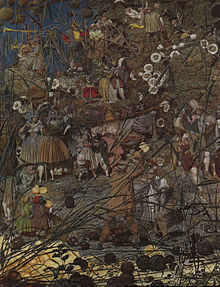
Oh, this was interesting:
"His brother George was admitted to Bethlem when Richard was fleeing after killing their father. His sister Maria married in 1844 but was insane by 1853, and in an asylum by 1859. Another brother was said to have a private attendant."
Kim wrote: "Peter wrote: "Dickens signals these new beginnings by giving both David and Mr. Dick new names. Richard Babley becomes Mr. Dick and David is renamed Trotwood."According to what I've read Mr. Dick..."
Kim
You find the most wonderful items to complement our reading. What a family! Makes mine seem strangely normal ;-)
 I absolutely love this section of the book--Miss Betsey, Janet and the donkeys, and kite-flying Mr. Dick (a classic literary fool, in the best sense of the type), and then the intro to Mr. Wickfield, lovely Agnes, and horrible Uriah Heep.
 I really enjoyed reading everyone's comments and notes and looking at the pictures.
I particularly loved how David said that seeing a stained glass window in a church reminded him of Agnes. I thought this was a particularly effective bit of writing by Dickens. Writers use analogies and metaphors to excess, but Dickens didn't do that here--he didn't compare Agnes to a stained glass window, but said that seeing it reminded him of her. That's lovely.
I finally finished Dombey and Son two nights ago, and I couldn't help but remember the relationship between Mr. D and poor Florence when I read about that between Mr. W and dear Agnes. Isn't Agnes leading just the life that Florence dreamed of?
Jane wrote: "I absolutely love this section of the book--Miss Betsey, Janet and the donkeys, and kite-flying Mr. Dick (a classic literary fool, in the best sense of the type), and then the intro to Mr. Wickfiel..."Jane
Yes. Mr. D and Florence and Mr. W and Agnes. What different worlds Dickens gave those two young ladies to inhabit.
I too found the phrasing Dickens employed to align Agnes with the stain glass window to be very effective. When we then consider that the meaning of her name may offer a further insight into her character the reader is treated to an exceptionally fine piece of writing.
Fascinating information, Kim, about the possible connection between the real Richard and Mr Dick. Thank you. I can only see a very small representation of the painting on my phone, but it looks very beautiful. It makes me think of the out workings of a scrambled mind. So it ever was with many great artists; literary artists were no exception. Certain types of mental illness have been associated with heightened creativity.Jane, your father/daughter comparisons are so true and so sad, for Florence at least. Agnes does seem to have an ideal relationship with her father based on deep love and respect.
Ahhhhhh, Dickens ...
 In England we still use the word Bedlam, metaphorically. It's not unusual to hear people comment that "this is Bedlam", or something along those lines. Basically they're saying that something is a madhouse or people are being crazy. Come to think of it, it's often what I think during last period on a Friday! LOL.
Just thought I'd share.
Yep, Kate it's always bedlam in our house!
One of the reasons we moved to Victoria was to escape the bedlam of Toronto. Too many cars, too much noise, too much frenetic movement.Is there a city anywhere today that is not its own special Bedlam?
Nope, I don't think so, Peter! Some, it is true, are worse than others. Thankfully there are those that have lovely parks where it almost seems as though the city has disappeared for a while. When I was young I lived in London, stayed with family in the beautiful Toronto etc. and found the business to my liking, but as I've grown more 'mature' I appreciate more and more the serenity of the countryside, the dawn chorus and being able to see the stars at night. It's not ideal where we live, outside a market town, but it's reasonably non-bedlamesque.


this week’s three chapters have seen a considerable change in the affairs of our little hero – let’s hope for the better – as well as they have witnessed some new characters enter the stage of David’s life. It was certainly a very interesting instalment.
In Chapter 13 Dickens has David give an account of how he fared during his six-day journey from London to Dover – I actually felt reminded of Oliver Twist’s travelling on foot to London, although in DC the narrator gives a lot more details. Little David meets various people on his way most of whom are quite ready to take an advantage of the little boy – such as Mr. Dolloby, who to David’s fancy is sitting in front of a room full of his hanged enemies, smoking a pipe, and the nasty tinker, who manages to rob David of his neckerchief only and whose treatment of his wife suggests another unhappily married couple. David also meets a very strange old man, who is probably both out of his mind and in liquor and who also takes him for a ride when it comes to buying his jacket. We can really share his sense of utter loneliness when in his first night of travelling he sleeps in a hayrick near his old school and when he says,
”Sleep came upon me as it came on many other outcasts, against whom house-doors were locked, and house-dogs barked, that night—and I dreamed of lying on my old school-bed, talking to the boys in my room; and found myself sitting upright, with Steerforth's name upon my lips, looking wildly at the stars that were glistening and glimmering above me. When I remembered where I was at that untimely hour, a feeling stole upon me that made me get up, afraid of I don't know what, and walk about. But the fainter glimmering of the stars, and the pale light in the sky where the day was coming, reassured me: and my eyes being very heavy, I lay down again and slept—though with a knowledge in my sleep that it was cold—until the warm beams of the sun, and the ringing of the getting-up bell at Salem House, awoke me. If I could have hoped that Steerforth was there, I would have lurked about until he came out alone; but I knew he must have left long since. Traddles still remained, perhaps, but it was very doubtful; and I had not sufficient confidence in his discretion or good luck, however strong my reliance was on his good nature, to wish to trust him with my situation. So I crept away from the wall as Mr. Creakle's boys were getting up, and struck into the long dusty track which I had first known to be the Dover Road when I was one of them, and when I little expected that any eyes would ever see me the wayfarer I was now, upon it.”
This sense of loneliness is counterbalanced, however, by the memory of his mother, who accompanies him on his desperate journey in the quality of something of a guardian angel:
”But under this difficulty, as under all the other difficulties of my journey, I seemed to be sustained and led on by my fanciful picture of my mother in her youth, before I came into the world. It always kept me company. It was there, among the hops, when I lay down to sleep; it was with me on my waking in the morning; it went before me all day. I have associated it, ever since, with the sunny street of Canterbury, dozing as it were in the hot light; and with the sight of its old houses and gateways, and the stately, grey Cathedral, with the rooks sailing round the towers. When I came, at last, upon the bare, wide downs near Dover, it relieved the solitary aspect of the scene with hope; and not until I reached that first great aim of my journey, and actually set foot in the town itself, on the sixth day of my flight, did it desert me. But then, strange to say, when I stood with my ragged shoes, and my dusty, sunburnt, half-clothed figure, in the place so long desired, it seemed to vanish like a dream, and to leave me helpless and dispirited.”
I found it very strange that the boatmen and the fly-drivers should not have considered it below themselves to play cheap little pranks on the poor and worn-out boy who enquired about his aunt but luckily, David chances upon an honest man who tells him where his aunt lives. Considering that he did not have any address and was not even sure whether Aunt Betsey lived in Dover or just in its vicinity, this was a very rare instance of good luck.
David’s first encounter with Aunt Betsey is not all too encouraging since she cannot find it in herself to forgive him being a boy and she still compares him with his sister Betsey Trotwood as though the latter girl actually existed. Luckily, there is Mr. Dick, who is obviously not quite sane by most people’s standards, but who proves, ironically, extremely clear-sighted in the following situation:
”'Well then,' returned my aunt, softened by the reply, 'how can you pretend to be wool-gathering, Dick, when you are as sharp as a surgeon's lancet? Now, here you see young David Copperfield, and the question I put to you is, what shall I do with him?'
'What shall you do with him?' said Mr. Dick, feebly, scratching his head. 'Oh! do with him?'
'Yes,' said my aunt, with a grave look, and her forefinger held up. 'Come! I want some very sound advice.'
'Why, if I was you,' said Mr. Dick, considering, and looking vacantly at me, 'I should—' The contemplation of me seemed to inspire him with a sudden idea, and he added, briskly, 'I should wash him!'
'Janet,' said my aunt, turning round with a quiet triumph, which I did not then understand, 'Mr. Dick sets us all right. Heat the bath!'“
One might probably discuss what Aunt Betsey would have done with David, had it not been for Mr. Dick. We she have shut her doors on David, or would she have taken care of him, anyway? Is her asking Mr. Dick just an excuse in order to hide, maybe to herself, that she already feels responsible for and interested in David?
It’s also quite interesting that Aunt Betsey has this donkey problem of hers and that she interrupts whatever she happens to be doing just to scare off the ubiquitous boys who lead their donkeys across a patch of green in front of her house. Mr. Mell and his tics, Miss Murdstone and her suspicions about the men hidden somewhere in the house, and now Aunt Betsey and her donkey feud – is there actually any character without a whim in this novel?
And then just read how the narrator finishes this chapter, with what rapture and gratefulness he experiences the comforts of having a clean bed and a roof for shelter eventually:
”The room was a pleasant one, at the top of the house, overlooking the sea, on which the moon was shining brilliantly. After I had said my prayers, and the candle had burnt out, I remember how I still sat looking at the moonlight on the water, as if I could hope to read my fortune in it, as in a bright book; or to see my mother with her child, coming from Heaven, along that shining path, to look upon me as she had looked when I last saw her sweet face. I remember how the solemn feeling with which at length I turned my eyes away, yielded to the sensation of gratitude and rest which the sight of the white-curtained bed—and how much more the lying softly down upon it, nestling in the snow-white sheets!—inspired. I remember how I thought of all the solitary places under the night sky where I had slept, and how I prayed that I never might be houseless any more, and never might forget the houseless. I remember how I seemed to float, then, down the melancholy glory of that track upon the sea, away into the world of dreams.”