
Works of Thomas Hardy discussion
Currently Reading
>
Zermatt to the Matterhorn
date newest »
newest »
 I think this week and next week are the ones where I'm supposed to be posting? Just now, I noticed that last week didn't have a poem; so hopefully I have the dates right!
Anyway, things have been busy with work again so I haven't been here lately, and I have a lot of back poems to look at! I hope everyone in the group has been doing well!
All of Hardy's poems that I already knew have been posted by now; so I had to search farther afield. This one interested me because it's a little different in subject matter than many of the others. This poem feels straightforward to me, but I like the idea of Hardy looking up at the mountain, lost in wonder at all it has seen.
The poem refers to Edward Whymper's feat as the first man to climb the Matterhorn in 1865. Tragically, four members of his climbing party died on the way back down.
 Mod
Mod
(Just by the way, you have the right first date, but I'll move it to currently reading, where last week's poem also is. They stay there for a fortnight to allow everyone to see them first. I'll link it to the list too.)
Mod
I had to look up "atomies" (the plural of atomy) which means a skeleton or emaciated body. What a mental image we now have of the seven skeletal people hungry and cold, 4 near death, but still toiling up the heights. The Matterhorn is a iconic pyramidal peak with a distinctive shape:
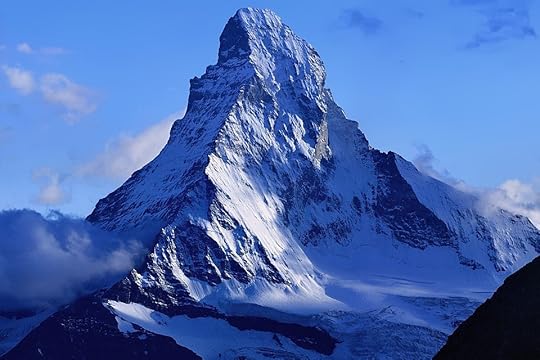
photo by Zacharie Grossen
It is in the Alps on the border of Switzerland and Italy.
So we have a formal structure: the first 2 stanzas being four lines and the 3rd 6. In the first two, the 1st and 4th lines rhyme, and also the middle two, but in the 3rd stanza, the rhymes alternate.
I find this simplicity pleasing, allowing me to concentrate on the language.
Bionic Jean wrote: "Now you have explained that four mountaineers died, Greg I see how tragic this poem is, right from its first stanza. This peak seems almost unconquerable, and climbing it unimaginable to me 🫢I ha..."
Thanks for moving the poem to the proper place Jean, and what an arresting picture of the mountain! I love that picture!
I had looked up "atomies" too when I read it; at first, I had guessed the word had something to do with being small, I suppose from mentally crossing it with "atom" in my mind. But the actual meaning is much more evocative . . . and a little disturbing too, as it should be given the events.
Mod
 This poem sent chills through me as I thought of all those tragic deaths on the Matterhorn. The mountain has been solidly standing there through history, including Caesar's wars and Biblical events.
I looked up the story online about Joshua pausing the sun and the moon (Joshua 10:12-13). Scientists have found that there was an eclipse around that time which would account for the Biblical story of the sun being stopped. It's so fascinating how people interpreted a real astronomical event with the intervention of God so the Israelites won the battle.
https://www.timesofisrael.com/3224-ye...
Thanks for posting this interesting poem, Greg.
 My husband and I were in Zermatt a couple of years ago and as we walked along the main street I noticed that embedded into the cobblestones are markers with the names of those who died on the mountain. People there don't forget.
Connie wrote: "This poem sent chills through me as I thought of all those tragic deaths on the Matterhorn. The mountain has been solidly standing there through history, including Caesar's wars and Biblical events..."
My husband and I were in Zermatt a couple of years ago and as we walked along the main street I noticed that embedded into the cobblestones are markers with the names of those who died on the mountain. People there don't forget.
Connie wrote: "This poem sent chills through me as I thought of all those tragic deaths on the Matterhorn. The mountain has been solidly standing there through history, including Caesar's wars and Biblical events..."Thanks for posting that about the eclipse Connie. So fascinating! It makes me think of how different cultures have different descriptions and explanations for the great flood, an event that appears to have some real basis.
And as I think about the tragic deaths of the climbers, who are climbing really just to prove that they can, I suppose . . . it's a complex question. On one hand, it's an incredible achievement, what Hardy calls a "feat of manly might." But on the other hand, it it a tempting of fate? Is it spurred in part by the human impulse to do things that are dangerous just to feel alive? There's a yearning for adventure somewhere in the heart of it, certainly.
As I read the last stanza with the mountain that has seen age after successive age pass by, nature's perspective is there. It will outlast all of us, era after era. And we are so small in relation to that. But still we strive against it and try to achieve. There's something to admire in that impossibly impractical striving, but there's a little bit of foolishness in there too.
Rosemarie wrote: "My husband and I were in Zermatt a couple of years ago and as we walked along the main street I noticed that embedded into the cobblestones are markers with the names of those who died on the mount..."I think it's nice for those people to be remembered Rosemarie, and I wonder how the locals feel about the climbers? Do they admire the attempts, or appreciate the tourism dollars, or do they find it all a bit foolish, like outsiders who have gotten in over their heads? Or maybe all of those at once?
There's a real climbing culture there. There's a museum dedicated to the Matterhorn and a sense of pride in the early climbers' achievements. I don't know what they think about people who don't prepare properly, but if it's anything our attitude in Canada to those who go to our areas without due preparation, they don't approve because it could be very dangerous.
Rosemarie wrote: "There's a real climbing culture there. There's a museum dedicated to the Matterhorn and a sense of pride in the early climbers' achievements. "That's good to hear Rosemarie!
 Mod
Mod
This poem is a perfect example of what draws me to Thomas Hardy's poetry. He must have thought about the immortality of nature often, because he's so adept at describing it.
Btw - thank you, Greg, for posting this poem. I hope works slows down for you soon. My life too has become much busier than I want or thought. I'm so grateful to have these poems to keep me connected to the group while I'm up to my eyeballs in projects!!
Mod
I found a fact that might be interesting for Rosemaire. Whymper went on to climb more mountains in Switzerland, South America and Canada. There is a mountain in the Canadian Rockies named after him. I've copied the Wikipedia paragraph about Whymper and Canada, and here it is:
"In the early 1900s, Whymper visited the Canadian Rockies several times and made arrangements with the Canadian Pacific Railway (CPR) to promote the Canadian Rockies and the railway in his talks in Europe and Asia. In exchange, the CPR agreed to pay transportation costs for him and his four guides. According to the surveyor and mountaineer A. O. Wheeler, Whymper was hired to “conduct explorations and surveys in the interests of the Canadian Pacific railway company” (Wheeler, 1905). In 1901, Whymper and his four guides (Joseph Bossoney, Christian Kaufmann, Christian Klucker and Joseph Pollinger) made the first ascents of Mount Whymper and Stanley Peak in the Vermilion Pass area of the Canadian Rockies.
His brother Frederick also has a mountain in British Columbia named after him, from his days as artist illustrator with the Robert Brown's Vancouver Island Exploring Expedition in 1864."
Thanks for the info, Bridget. Many Swiss guides came to the Rockies to work, and there is a statue dedicated to them in Lake Louise. There are Swiss restaurants, where you can get a Fondue, in Banff and probably other places run by the descendants of the guides who stayed in Canada.I've never climbed a mountain but I have been up high by gondola, train of chair lifts, in the summer. I love mountains!


(June-July, 1897)
Thirty-two years since, up against the sun,
Seven shapes, thin atomies to lower sight,
Labouringly leapt and gained thy gabled height,
And four lives paid for what the seven had won.
They were the first by whom the deed was done,
And when I look at thee, my mind takes flight
To that day's tragic feat of manly might,
As though, till then, of history thou hadst none.
Yet ages ere men topped thee, late and soon
Thou watch'dst each night the planets lift and lower;
Thou gleam'dst to Joshua's pausing sun and moon,
And brav'dst the tokening sky when Caesar's power
Approached its bloody end: yea, saw'st that Noon
When darkness filled the earth till the ninth hour.