
Shakespeare Fans discussion
note: This topic has been closed to new comments.
Group Readings
>
The Winter's Tale

 I'll read Winter's Tale. When are we starting the discussion?
 Candy wrote: "Hello folks!
So far, a few of us have planned to read A Winter's Tale together. Hopefully a few more folks will join in with us. We'd like to consider the idea of reading one act per week and that..."
I'm in. damn the students!
 I'll read it, too. I love that play.
 Candy wrote: "Hello folks!
So far, a few of us have planned to read A Winter's Tale together. Hopefully a few more folks will join in with us. We'd like to consider the idea of reading one act per week and that..."
I'm in! This is one of my favorite plays.
 Mod
Mod
I'll put this out there...what if we begin Act 1 on November 11th?
If that is a problem...let me know...
Um...hey do we want/need a group leader? Would anyone like to volunteer? Leslie? Gabrielle? Ray? Laurele?
The timeline is fine with me, Candy, but I don't think I'm a very good group leader.
Mod
?
looking forward to the discussion...yippppeee!
:)
 Candy, starting Act 1 on Nov. 11 sounds good to me. And I'm all for jumping in with reckless abandon...
 Candy wrote: "Hello folks!
So far, a few of us have planned to read A Winter's Tale together. Hopefully a few more folks will join in with us. We'd like to consider the idea of reading one act per week and that..."
I'll read it, too. One of my favorite play. Interesting materials online, Candy.
 'The Winter's Tale' is a tragicomedy. Readers new to TWT enter the play, thinking they are reading what amounts to a tragedy because Leontes resembles Othello in spousal jealousy. Polixenes seems more a friend than does Cassio. In Act I, everything cheery is doubted or contraverted save the pastoral poetry and the short-lived allusions to childlike innocence. Also, Leontes wants both to murder his wife Hermione and her newborn. Surely, can events turn for the worse?
Isn't the play classified by scholars as a romance, even though it does contain elements of both tragedy and comedy?
'The Winter's Tale' is a tragicomedy. Readers new to TWT enter the play, thinking they are reading what amounts to a tragedy because Leontes resembles Othello in spousal jealousy. Polixenes seems more a friend than does Cassio. In Act I, everything cheery is doubted or contraverted save the pastoral poetry and the short-lived allusions to childlike innocence. Also, Leontes wants both to murder his wife Hermione and her newborn. Surely, can events turn for the worse?
Isn't the play classified by scholars as a romance, even though it does contain elements of both tragedy and comedy?I like this quote from Act I in which Polixenes talks of his youthful friendship with Leontes to Hermione:
"We were as twinn'd lambs that did frisk i'the sun,/
And bleat the one at the other: what we chang'd/
Was innocence for innocence; we knew not/
The doctrine of ill-doing, no, nor dream'd/
That any did." (Act 1, scene 2, lines 67-71)
Gabrielle wrote: "...I like this quote from Act I in which Polixenes talks of his youthful friendshi..." Shepherds, nature, and flowers are pastoral rather than noble. This play combines both pastoral and palatial in the plot. And, characters disguise themselves alternately as both. The frolicking lambs surely lighten up the 'play'.
Mod
Michelle, looking forwrd to hearing your perspectives. Glad you found some of the links handy.
Asmah, I will be interested in reading this play especially with your thoughts here in mind. I didn't know thaat this play combines comedy and tragedy...I can see how that might be a challenge for some audiences.
Gabrielle, wow that is an intense section you've quoted. One of my very very dear plays of Shakespeare's is Anthony and Cleopatra. I find something new all the time and something that fascinates me every reading...and like The Winter's Tale some critics have labeled it a "problem play".
The quote about the friendship between the children is really lovely. It gathers all the freshness and energy. In the first two scenes the contrasts in the metaphors already hint at time and age... youth and fresh...age and tired ideas. Although I could be reading into that. There is a fair bit of opposites used right off the start of the play. Hard to tell if that is going to continue...but interesting to think that maybe the reason this play is a "problem play" is because even the structure of the plot has tragedy...then comedy. There is an opposite form of metaphor embedded in the plots!?
I found that the opening of "nine changes of the watery star" to capture my attention. What a beautiful coded way to speak.
I am finding some of the names and characters difficult to place...but I am sure I will get familiar with them shortly. I hope...
:)
Nine changes of the watery star hath been
The shepherd's note since we have left our throne
Without a burthen: time as long again
Would be find up, my brother, with our thanks;
And yet we should, for perpetuity,
Go hence in debt: and therefore, like a cipher,
Yet standing in rich place, I multiply
With one 'We thank you' many thousands moe
That go before it.
 One big difference between this play and Othello is that Othello is tricked into his jealousy. Leontes plunges in headlong under his own steam. I'm not entirely satisfied with this. It all happens so quickly. In addition, it jars with the friendship that exists (or existed) between Polixenes and Leontes. I wonder if anyone else felt the same.
Is it possible that Leontes is jealous before the start of the play? He's not exactly the life and soul of the party even before he first gives expression to his jealousy. And Polixenes has been in Sicilia for nine months. Pity, we do not learn how far into her pregnancy Hermione is?
Paul wrote: "Is it possible that Leontes is jealous before the start of the play? He's not exactly the life and soul of the party even before he first gives expression to his jealousy. And Polixenes has been in..."
One big difference between this play and Othello is that Othello is tricked into his jealousy. Leontes plunges in headlong under his own steam. I'm not entirely satisfied with this. It all happens so quickly. In addition, it jars with the friendship that exists (or existed) between Polixenes and Leontes. I wonder if anyone else felt the same.
Is it possible that Leontes is jealous before the start of the play? He's not exactly the life and soul of the party even before he first gives expression to his jealousy. And Polixenes has been in Sicilia for nine months. Pity, we do not learn how far into her pregnancy Hermione is?
Paul wrote: "Is it possible that Leontes is jealous before the start of the play? He's not exactly the life and soul of the party even before he first gives expression to his jealousy. And Polixenes has been in..."We like Leontes don't know what happened entirely in the nine months of Polixenes's visit in Sicilia at King Leontes' palace. Polixenes's speech about the watery star opening 1.i emphasizes the time period in a beautiful, long passage to which the audience must attend. King Leontes suspects he knows what happened by his observing Pol. and Her. and assuming Hermione's guilt.
Paul wrote: "One big difference between this play and Othello is that Othello is tricked into his jealousy. Leontes plunges in headlong under his own steam. I'm not entirely satisfied with this. It all happens ..."It's good to see people jumping right into this! Candy, thanks for suggesting The Winter's Tale. I haven't read it before and so far am enjoying it a lot.
I was also struck by the passage about Polixenes' and Leontes' idyllic boyhoods together. The repeated stress on their state of innocence, when they were sinless (not even knowing what sin was), made it sound like they had been living in paradise, a pre-fall-of-man Eden. And interestingly, the "fall" here appears to be sexual. When Hermione asks about what made the men "trip" since then, Polixenes refers to "temptations" and to Hermione and his own wife (in short, to women), and Hermione jokes that in this case, Polixenes is casting their two queens as "devils."
But if sex for Polixenes (and for Leontes) is evil and a sin, Hermione seems to have a much more positive attitude towards it. She humorously says, if Polixenes and Leontes have only ever "sinn'd with us" [their queens:], then she's willing to answer for that. In other words, she's comfortable with the physical aspect of her marriage.
Later on we get to Leontes, who when he sees his wife give her hand to Polixenes, immediately becomes pathologically jealous. It is a visceral reaction, not a rational one. He instantly assumes she and his good friend are having an affair, and judges that this is the general way of the world. (Another great line: "It is a bawdy planet.")
While the jealous reaction does seem to happen very quickly, what Shakespeare does with the consequences of it is very astute. Leontes' jealousy immediately poisons every other relationship he has. It obviously affects the way he feels about his wife and friend, but it also makes him wonder if Maximillius is really his son, and makes him believe his faithful servant mocks him for being cuckolded. His jealousy ruins every aspect of his life, throwing him so low that he's willing to commit murder because of it.
My reading text is printed 'sans' commentary, so the Shakespearean vocabulary is a real mystery. "paddling palms": to stroke or pat amorously, or gently. http://onlinedictionary.datasegment.c...
"pinching fingers": to plait.
http://www.dictionary.net/pinching
[holding hands-asmah:]
"virginalling": pat or tap with fingers as on a virginal (a small legless harpsichord).
http://www.wordnik.com/words/Virginal
http://www.thefreedictionary.com/virg...
Mod
Asmah asked "I wonder whether the tone in prologues of Shakespeare's real tragedies differs from the early optimism here?" Great question.
Ray, I haven't read this play before either. Loved your observations on the women's response to Leontes and how tey asked how they came to slip...that he blames his wife. That's really helping me work through this scene. Thanks.
Candy, thanks for your welcome and for your comments. I'm in a similar situation to you. I have only read act one, so I'm not familiar with the whole play. My remarks were just based on my reading of act one, so they may be precipitative. I might change my mind later on.
Mod
:)
Cheers
I listened to the Prelude and Act I and a bit beyond of The Complete Arkangel Shakespeare the Winter's Tale last night before drifting off to sleep, and I had the impression of being told a fairy tale. Once upon a time in a land far away there were two boys who grew up together as twin lambs. . . ." I think that reading this play as a fairy tale will add to its enjoyment.
Mod
One thing that has really been interesting for me is that I have a lot of pictures enter my head when I'm reading the lines. This doesn't always happen to me when reading dialogue...but something about the way this is written with certain words seems to be inspiring images. as I read...
Candy wrote: One thing that has really been interesting for me is that I have a lot of pictures enter my head when I'm reading the lines. This doesn't always happen to me when reading dialogue...but something about the way this is written with certain words seems to be inspiring images. as I read...Shakespeare is like that. His audiences had to do the same, because the players were on a bare stage with few or no props. I think he does an especially good job of mindpainting in this play.
Gabrielle wrote: "Isn't the play classified by scholars as a romance, even though it does contain elements of both tragedy and comedy?..."Asmah replied:
Shakespeare wrote four late plays, called romances, at the end of his career: Pericles, Cymbeline, The Winter's Tale and The Tempest. TWT he created around 1610-1611 from Robert Greene's 'Pandosto or the Triumph of Time'. My source also attributes influence from John Lyly's 'Woman in the Moon' and John Marston's 'The Metamorphosis of Pygmalion's Image':
http://en.wikipedia.org/wiki/Pandosto
http://en.wikipedia.org/wiki/The_Woma...
http://www.jstor.org/pss/3817424
Also, "Reading Popular Romance in Early Modern England" by Lori Humphrey (2002) ties Greene's Pandosto to the TWT's ballad seller Autolycus.
Laurele wrote: "I listened to the Prelude and Act I and a bit beyond of The Complete Arkangel Shakespeare the Winter's Tale last night before drifting off to sleep, and I had the impression of bein..."I see your point--tales, miracles, and deception--are part and parcel in TWT. Tragedy wreaks its havoc before comedy takes its turn. Nothing is solid, neither the watery moon nor the truth. Even 'Tale' in the title indicates a fabrication.
I've only read the first act so far but I'm wondering how this is going to unravel. Will it end in tragedy or will there be some kind of fairy godmother figure to right all the wrongs? Moving on to Act Two today.
Paul wrote: "I've only read the first act so far but I'm wondering how this is going to unravel. Will it end in tragedy or will there be some kind of fairy godmother figure to right all the wrongs? Moving on ..."
The first act has done its job of catching our interest, all right.
Candy wrote: "Hello folks!...I haven't read the following essay yet (and probably won't until after I read the play/text version...but here is an interesting topic about A Winte's Tale...called "Doubles and Likenessesiw-th a difference". Which caught my eye...http://www.uni-tuebingen.de/uni/nec/GIBB...
..."
I read your e-article written by Brian Gibbons tomorrow.
 I was so pleased to see Gabrielle begin the discussion with that quote. It is so important, I think, to concentrate on the poetry, and what the poetry is doing. Polixenes' heightened lyricism when describing childhood contrasts with the harsh rhythms of Leontes as he succumbs to his jealousy.
I am surprised no one has commented on the sheer difficulty and intense compression of the language of the opening. Of all the Shakespeare I've read, I find this Act the hardest. The speech by Leontes,
Thou wantest a rough pash and the shoots that I have,
...up to...
And that to the infecting of my brains
And hardening of my brows
is intensely obscure. Even after a metaphor has been understood, the details of the language are baffling, as for instance in the lines quoted by Candy,
. . .like a cipher,
Yet standing in rich place, I multiply
With one 'We thank you' many thousands moe
That go before it.
A cipher means a zero, and if you add a zero to a number you multiply it by ten, but of course you need three zeroes to multiply it by a thousand, and also of course the repeated 'we thank you' is not an added zero, but rather the repetition of a series. Does in 'rich place' mean in the right place, and is 'rich' a reference to monetary wealth, measured by all those zeroes after the pound (or dollar) sign?
I am also hit by the sheer scale of Act 1, almost the size of Act 2 scene 2 of Hamlet. It must be a strain for performing actors. Incidentally, I think it is a mistake to see I.1 as a prologue or prelude to what follows, or in any way separate from I.2. There is nothing at the end of I.1 to suggest the characters either parting from each other, or leaving the stage, and (a golden rule in Shakespeare) a character never walks offstage to walk straight back on in the next scene. The scene break must be editorial, and Camillo clearly remains onstage while the major characters enter in front of him. Archidamus similarly, who probably leaves the stage later escorting Polixenes. It is true 1.1 is in prose and 1.2 in verse, but the opening of All's Well for example moves from prose to verse in the opening scene.
Asmah sees the complexity when she compares paddling palms/ pinching fingers/ virginalling upon his palm. I suppose the finger pinching is taking someone's finger and not letting go, but paddling palms is like the fingers of one hand becoming legs that paddle in water of another palm, and then "virginalling" seems to pull in the whole of sonnet 128 where a woman's fingers moving over a virginal become legs walking over her eager lovers,
I envie those Jacks that nimble leap,
To kiss the tender inward of thy hand,
. . .
O’er whom thy fingers walk with gentle gait,
You get a similar extraordinary compression in "hereditary",
'not guily', the imposition cleared
Hereditary ours.
The innocence of the children takes away the guilt of original sin, and adding "hereditary" suggests its whole history from the time when Eve first ate the apple.
Another example of getting lost in a poetic image, when Leontes says to Camillo that if he can't see what's going on:...your eye-glass
Is thicker than a cuckold's horn
The connection between the eye-glass (spectacles) and the symbol of the cuckold is the horn which made the rim of the eye-glass. I've tended to think of horn-rimmed spectacles as a 19th century invention, but I find on the internet that they go back to medieval times. You can see a 14th century example in this catalogue of antique domestic items for sale,
http://www.6of1.biz/page9.htm
with this picture of them,
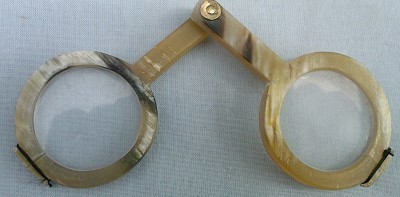
But the idea of thickness is puzzling. A thick eyeglass, one supposes, leads to greater magnification. (Of course "eyeglass" can also mean "magnifying glass", held up to the eye.) So isn't a thick eyeglass better for seeing? Or does it mean that someone who wears really thick glasses has poor vision? Obviously connected to this idea is that horn itself (when polished) is translucent, and the thicker the horn, the less light it allows through. They seem to be opposite ideas, that a thick lens enables better seeing, while thick horn leads to opacity.
Martin, that's a great picture of horn-rimmed glasses for the context! I see two ways of reading the "thicker" here. Either it means that the eyeglass wearer is so blind that he cannot see Hermione's (supposed) unfaithfulness, and hence requires outrageously thick lenses to correct his blindness; or "thicker" might refer to the lenses being opaque like cuckold's horn rather than being transparent like glass. The latter version may be something of a mixed metaphor, but the sense would be that Camillo, like the cuckold, cannot see what's going on right in front of him.
Scene One establishes characters and situation. We learn that the kings of Sicilia and Bohemia have been good friends since childhood, and that Sicilia has a young prince who shows great promise. Although Archidamus is not particularly important as a character, Camillo is one of the play's most important characters. From his praise of his king and his prince, we see that he is a faithful and patriotic courtier, full of love for his position. He is an ideal advisor, happiest when he has a good ruler to serve.A recurring theme in many of Shakespeare's plays is the conflict between marriage and friendship. In The Winter's Tale, Shakespeare continues to play with this familiar theme, although in a more oblique manner.
The themes of The Winter's Tale are similar to the themes in Shakespeare's three other plays: The Tempest, Cymbeline and Pericles. All these plays are known as romances.
http://en.wikipedia.org/wiki/Cymbeline
Youth and Age
One theme is the power of youth to regenerate age. There is a sense of human life renewing itself through the cycle of generations.
Forgiveness and Reconciliation
The importance of forgiveness and reconciliation is another theme in the last plays of Shakespeare. Hermoine forgives Leontes the wrong he inflicted on her, and they are finally reconciled. Polixenes forgives Leontes. Leontes must also try to forgive himself.
Supernatural Intervention
Supernatural or improbable events often feature in the Shakespearean romances. In The Winter's Tale, the god Apollo intervenes, through the oracle, when Leontes is blind to the truth and bent on injustice. The "resurrection" of Hermoine is also presented as a supernatural event, a miracle. Paulina is anxious to avoid any implication that she is bringing Hermoine back to life by the use of magical arts. Shakespeare's concern is not to produce a trick by magic, but to demonstrate in a symbolic way the power of life to regenerate itself.
Nobility of Woman
Another theme of the romances, prominent in The Winter's Tale, is the nobility, purity and resoluteness of woman. These qualities are embodied in Hermoine, who is not only beyond reproach in her duties as queen, but also endures false accusation and condemnation with great dignity. Paulina is steadfast, loyal and persistent, and Perdita is the embodiment of the innocent regenerative power of nature. In no other play by Shakespeare does he present as many women of such admirable qualities.
Nature and the Perpetual Renewal of Life
Perhaps the main theme is the triumph of life, as expressed through nature's perpetual powers of renewal. This is the "great creating nature" (Act 4, scene 4, line 89) that is shown in all its variety in the great sheep-shearing scene. The rhythms of nature are reflected in the structure of the play. The first three acts are tragic (decay: winter), the last two comic (rebirth and growth: summer) The structure of the play suggests that human life will be healed by nature and time, just as spring always returns to the earth. What time takes away it will ultimately restore.
Candy, here's a link with all the Shakespeare's play. The discussion' s board of "The Winter's Tale" sounds great!
http://en.wikipedia.org/wiki/Chronolo...
The Winter's Tale is classified as a romance but some have said that this classification is misleading. Do you feel the play should be classified as a tragedy and, if so, why?
Ray, yes I think as you say both reading must be accepted, and similarly at all the points where Shakespeare creates this thick confusion of imagery.I think the comments above on character are very interesting. The onset of Leontes' jealousy comes very abruptly to a reader of the play, does it not? I suppose the important thing is whether it can be staged so as to appear natural, and presumably it can. I think a difficulty for the modern reader is that it is so hard to shake off the assumptions about narrative that come from so much reading of novels. One imagines there must be a background development to Leontes jealousy, but it is impossible to learn anything about it, just as it is impossible to learn anything about the background development of Macbeth's ambition. The dramatist simply doesn't fill in the narrative in the way we expect a novelist will.
Hermione shows a certain reserve until encouraged, after which her human warmth becomes irrepressible. I suppose it must be finely judged by the Director, how far her affection for Polixenes is taken on-stage. Far enough to excite Leontes, but not far enough to make Camillo imagine anything improper has occurred.
Surely Leontes' "kissing with inside lip", is from his fevered brain, rather than a previous exhibition on-stage? He becomes increasingly coarse in his description,
As rank as any flax-wench that puts to
Before her troth-plight ...
So what is it about sex, and working with flax? In Twelfth Night you get,
"it [Sir Andrew's hair:] hangs like flax on a distaff; and I hope to see a housewife take thee between her legs and spin it off."
And of course Hermione has already identified herself with the distaff, when she says she'll thwack Polixenes hence with one.
Mod
I can not believe the riches we have among us...what a pleasure it is to arrive here this morning (okay I had a late night...) and catch up on such informative, sensitive readings here. As susal...I feel humbled.
And as susal...of course what catches my eye? Sex and food!
I immediately just now sent off an e-mail to my sister...who studies anthropology (often the history of food) with the quotes about flax seded oil and sex. One of my old dear friends owns a flax seed company (Omega Nutrition) and I'm e-mailing him to see if he has any insight regarding virility or sexuality and healing with flax seed. ha.
meanwhile...I am stumped how huge this act 1 scene 2 is...it has caught me off guard and I'm only 1/2 way through it!
I promise to finish it this afternoon!
Martin wrote: "virginalling" seems to pull in the whole of sonnet 128 where a woman's fingers moving over a virginal ..."Hi, Martin, Brian Gibbons in the tuebingen link suggests that virginalling means that Hermione is reading Polixenes' palm; they bend their heads together over the palm.
 Martin wrote: "Ray, yes I think as you say both reading must be accepted, and similarly at all the points where Shakespeare creates this thick confusion of imagery.
I think the comments above on character are ve..."
I would suggest that flax-carding and the production of Linen was just a typical working women's work ... suggesting drudgery (?) or perhaps a woman's lot. In the sense that this sex is a coarse, run of mill duty ?
There also may be classical associations between working flax, water and women and the suggestion of female slavery or bondage (although can't remember specifically).
Martin wrote: ". . .like a cipher,Yet standing in rich place, I multiply
With one 'We thank you' many thousands moe
That go before it. ..."
You are right, Martin, one cannot help but be amazed by how language-rich this opening spoken by Polixenes is in 1,ii in the presence of Leontes and Hermione. I interpreted this passage as "thanks many times over and wish I can stay nine months more as I am sure to be just as happy". He gives this speech of appreciation to his host as he prepares to return to Bohemia.
I read ahead in Act 2,i, being uncertain of which day we transition. Mamillius begins a winter's tale about sprites and goblins--ghosts; Leontes speaks a metaphor(?) about a spider; Leontes directly accuses Hermione of her indiscretion with Polixenes. He is certain that the fetus belongs to Polixenes instead of to Leontes. Hermione denies his accusation. Leontes separates her from Mamillius and casts her into prison; and Leontes sends a delegation to the Delphic oracle Apollo for proof against Hermione.
Martin wrote: I am surprised no one has commented on the sheer difficulty and intense compression of the language of the opening.Martin, I agree with what you say about the difficulty of the language. It's something that I had noticed in reading without it really coming to the fore. I think I thought it was just me not having enough Elizabethean language to fully understand, although I am fairly well read in Shakespeare.
Mod
Martin, I agree with what you say about the difficulty of the language."
I totally had a most difficult time reading this first act. Usually I may take a while to warm up reading Shakespeare...but I felt quite thick and I couldn't get a grasp. I landed up printing out all of scene 2 and taking it with me yesterday while waiting on errands with a highlighter felt pen.
Now, I'm laughing because seriously...the whole jealousy thing went past me. I saw the idea of a cup for poison, I sawthe word cuckold...but I was scratchign my head. What happened? Why all the anger? Where what?
Now I get the "nine changes of the watery star". Dud Candy...nine months. Polixenens has been visiting nine months. Hermiones is pregnant. I feel like a complete idiot...and I also realize I didn't have to even tell you folks this slow take I had on what the heck was going on in this first Act. It had gone over my head in two readings.
So... I really feel for some reason this was difficult language for me. Maybe I'm just rusty. Anyways...it has grabbed me and I'm very curious now at all the options this play will have to work out in the coming acts. I'm very excited about the rest of the play.
In message 15 Paul says how quickly Leontes is moved to his jealousy. I find this so weird myself. I've got the words highlighted where he already...before Hermiones and Polix go to the far garden...he already suspects his wife of adultery. He says these various line How she holds up the neb/the bill to him/and arms her with the boldness of a wife/to her allowing husband, go play boy play:thy mother plays/and I play too/ but so disgraced a part, now while I speak this/ holds his wife by the arm Leontes is well convinced of what he sees as evidence of a long term affair.
I wonder if this set of transitions is why shakespeare wrote such a long set of action? Looking at it as a performance and play structure it is really fascinating. I've never seen this play performed but I bet it can be done quite wonderfully because here it is that an audience can see all the body language and slight slight turns of Leontes mood and awareness. Leontes must be a role people would love to take (we've mentioned Dougray Scott fondly before here and I think he plays Leontes in the BBC version?) I can imagine while he speaks now...hermiones and Polixenes talking in the aside ina garden gesturing. I think it would wake up the audience to consider ...what were those two speaking like just moments before!?
I have the feeling that an audience might immediately feel complicit in the action and the characters because of the way it is written as such a long unfolding scene. I know that just the fact I had to unravel as a reader (and a rusty slow poke reader) what just happened feeling...it changed my perception of everything. It almost hit me as the kind of feeling one has during a really good psychological suspense film.
I also find...I want to know...did we have any clue that Leontes was capable of becoming so unhinged, so extreme with his suspicions?
Mod
SCENE I. Antechamber in LEONTES' palace.
Enter CAMILLO and ARCHIDAMUS
ARCHIDAMUS
If you shall chance, Camillo, to visit Bohemia, on
the like occasion whereon my services are now on
foot, you shall see, as I have said, great
difference betwixt our Bohemia and your Sicilia.
CAMILLO
I think, this coming summer, the King of Sicilia
means to pay Bohemia the visitation which he justly owes him.
ARCHIDAMUS
Wherein our entertainment shall shame us we will be
justified in our loves; for indeed--
CAMILLO
Beseech you,--
ARCHIDAMUS
Verily, I speak it in the freedom of my knowledge:
we cannot with such magnificence--in so rare--I know
not what to say. We will give you sleepy drinks,
that your senses, unintelligent of our insufficience,
may, though they cannot praise us, as little accuse
us.
Candy, I don't think you missed anything in Act 1. Shakespeare is carefully holding back a bunch of secrets that will only be explained later. Some of us know the secrets because we've seen or read the play before, some because we've been reading cliffnotes, or whatever. For example, Hermione's pregnancy. This is immediately clear in the next scene (I mean 2.1) where the women are talking together. Act 1 is male dominated. Act 2 begins with women talking among themselves, and the progress of the pregnancy immediately comes to the fore. Sometimes Act 1 is done with Hermione clearly pregnant, but perhaps that was not so evident in Shakespeare's day, when you think of the cut of women's dresses. So her condition is not clear until Act 2.
Although it's been a popular play for so long, there aren't many youtube examples. There's the BBC version, which I've seen before. It's okay, but a bit staid, I feel. There's bits of a version with Anthony Sher that looks much more interesting. Then there is Ethan Hawke talking about his role in it, but the one extract I saw was disappointing (the language was rewritten to be comprehensible to a modern audience.) So we're on our own.
I think spotting the sinister, or prophetic, nature of the opening words is very smart, I had not seen that. "sleepy drinks ..."
Some of Shakespeare's "hidden agenda" is surely the time of this play. Are we in a Christian world or pagan? Normally Shakespeare never mixes these. So Cymbeline and Lear are pagan, Measure for Measure and Hamlet are Christian. But Act 1 here suggests Christian, whereas (I think!) it's going to be set in the classical world.
The Greek names, Archidamus, Polixenes and so on: it's worth remembering that Sicily (Sicilia) used to be a Greek colony.
My wife gave me a history lesson on flax. Remember that flax is a source of vegetable oil today (especially in America), but was used for making linen then. There was no cotton in England in Shakespeare's day, so flax was especially important.
Mod
There also may be classical associations between working flax, water and women and the suggestion of female slavery or bondage (although can't remember specifically).
amd Martin post 44 My wife gave me a history lesson on flax. Remember that flax is a source of vegetable oil today (especially in America), but was used for making linen then. There was no cotton in England in Shakespeare's day, so flax was especially important.
I love this info on the flax seed and I am taking it into consideration...but I feel there is going to be somethign else surface about the flax seed and sex and women.
I believe it's not just going to be that women were in charge of making the linen...I suspect there may be some other folk lore or mythological connection. I just haven't found it yet. Perhaps something along the lines that the vitamins aid in female libido or something. Or associalted with childbirth etc.
Let's stay lively on this...and I alo noticed there are a number of plant and food allusions. Not just flax!
I believe that this play is going to be one of the "green world" or pastoral if you will.
The other thign Martin, you mention whether this is a Christian world or Pagan...it's not just Christian. Is it a Protestant or Catholic Christian? I would differ them because the Pagan...I believe also alludes to covet Catholocism (of course suggested by Michael Wood etc)
I am relieved to hope I wasn't complety out of it...I'm warming up to the play now and really stoked. Sometimes I just have to fight it ya know? And thanks for the geographical/political stuff...I was wondering why their names were sounding Greek...I did not know Sicily was a Greek colony. Oh why don't I study some bloody history of Europe she asks herself...ha ha
Mod
For women trying to get pregnant, the lignins found in flaxseed can promote natural ovulation and extend the progesterone dominant second half of the cycle. Consistent ovulation improves their chances of conception. For women who are experiencing pre-menopausal symptoms such as headaches, sleep difficulties, breast cysts, fluid retention, anxiety, lowered sex drive and heavy bleeding can use flaxseed to help restore normal hormonal balance.
http://www.thefreelibrary.com/Flax+Fa...
For women trying to get pregnant, the lignin's found in flaxseed can promote natural ovulation and extend the progesterone dominant second half of the cycle. Consistent ovulation improves their chances of conception.
For women who are experiencing pre-menopausal symptoms such as headaches, sleep difficulties, breast cysts, fluid retention, anxiety, lowered sex drive and heavy bleeding can use flaxseed to help restore normal hormonal balance.
http://www.streetdirectory.com/travel...
The use of flaxseed or flaxseed oil during pregnancy and breastfeeding is not recommended. Animal studies show possible harmful effects, and there is little information in humans. Flaxseed may stimulate menstruation or have other hormonal effects and could be harmful to pregnancy.
http://www.mayoclinic.com/health/flax...
A recent study in Canada studied over three thousand pregnant women, asking what natural supplements they took and then seeing what effect that had on their pregnancy. They found that those who consumed flax oil quadrupled their rates of premature labor.
http://www.eurekalert.org/pub_release...
Candy wrote: Nine changes of the watery star hath been
The shepherd's note since we have left our throne
Without a burthen:
I got intrigued by this phrase and found out that the moon is often called watery, I suppose because of its influence on the tides. Some interesting things here:
*******************
The moisture of the moon is invariably noticed by Shakespeare. In "Hamlet" (i. 1) Horatio tells how "the moist star upon whose influence Neptune's empire stands, was sick almost to doomsday with eclipse." In "A Midsummer Night's Dream" (ii. 1) Titania says—
"Therefore the moon, the governess of floods,
Pale in her anger, washes all the air,
That rheumatic diseases do abound."
p. 71
[paragraph continues:] And in "The Winter's Tale" (i. 2) Polixenes commences by saying how—
"Nine changes of the watery star hath been
The shepherd's note since we have left our throne
Without a burthen."
We may compare, too, the words of Enobarbus in "Antony and Cleopatra" (iv. 9), who, after addressing the moon, says—"The poisonous damp of night disponge upon me." And once more in "Romeo and Juliet" (i. 4) we read of the "moonshine's watery beams."
The same idea is frequently found in old writers. Thus for instance, in Newton's "Direction for the Health of Magistrates and Studentes," (1574), we are told that "the moone is ladye of moisture." Bartholomœus in "De Proprietate Rerum" describes the moon as "mother of all humours, minister and ladye of the sea." 1 In Lydgate's prologue to his "Story of Thebes" there are two lines not unlike those in "Midsummer Night's Dream" already quoted—
"Of Lucina the moone, moist and pale,
That many shoure fro heaven made availe."
Of course, the moon is thus spoken of as governing the tides, and from its supposed influence on the weather. 2 In 1 Henry IV. (i. 2) Falstaff alludes to the sea being governed "by our noble and chaste mistress the moon"; and in "Richard III." (ii. 2) Queen Elizabeth says—
"That I, being govern’d by the watery moon,
May send forth plenteous tears to drown the world."
We may compare, too, what Timon says, "Timon of Athens" (iv. 3)—
"The sea's a thief, whose liquid surge resolves The moon into salt tears."
The expression of Hecate in "Macbeth" (iii. 5)—
"Upon the corner of the moon
There hangs a vaporous drop profound,"
seems to have been meant for the same as the virus lunare of the ancients, being a foam which the moon was supposed
p. 72
to shed on particular herbs, when strongly solicited by enchantment. Lucan introduces Erictho using it (Pharsalia, book vi. 669)—"Et virus large lunare ministrat."
http://sacred-texts.com/sks/flos/flos...
Laurele, what a wonderful collection of quotations you have given us there!Measuring nine months by the "watery star" seems a very suitable way of referring to the term of a woman's pregnancy.
Empedocles and Archimedes are I suppose the most famous Sicilian Greeks, but more interesting as a link with Winter's Tale is perhaps Theocritus, who is the father of pastoral poetry. Shakespeare read Plutarch (Jul. Caes. and Ant & Cleo take their history straight from Plutarch) and in the Life of Marcellus Plutarch describes the Greek colony coming under Roman domination, and the death of Archimedes, so Shakespeare would certainly have known of the Greece-Sicily connection. Bohemia is another matter. I think Shakespeare felt he could give it a Greek King (and a seacoast) without anyone protesting too much. As for me, I'm quite happy with the idea that Bohemia has (or had) a seacoast!
Laurele wrote: "Candy wrote: Nine changes of the watery star hath been
The shepherd's note since we have left our throne
Without a burthen:
I got intrigued by this phrase and found out that the moon is often cal..."
Laurele, the e-reference to the folk-lore of Shakespeare above in SACRED TEXTS brought to mind that the sun, moon, and heavens predicted events for the early modern Elizabethans, who had a foot in myth and another in science. Writers of this period alluded to the influence of the cosmos in their plots. Explanations based upon error went along with practicality, so natural remedies like flax (above) for ailments sometimes worked. In Hermione's explanation of her predicament, she combines practical patience to weather the storm with an explanation dictated by the stars.
The e-reference from SacredTexts mentioned the lunar folklore surrounding 'calf' or 'moon-calf'. Leontes in 1.ii juxtaposes 'calf' back to back with reference to Hermione then to Mamillius (although Martin differs about whether Leontes addressed Hermione).
****
Leon.--Still virginally
[Observing Pol. and Her.:]
Upon his palm?--How now, you wanton calf!
Art thou my calf?
Mam.--Yes, if you will, my lord.
****
First, 'calf' refers to 'wanton' Hermione then to 'my' Mamillius in a play-on-words I found in Candy's e-article on folk-lore:
"we may mention the moon-calf [substitute Mamillius:], a false conception, or fœtus imperfectly formed, in consequence, as was supposed, of the influence of the moon..."
Astral superstition influenced births as well as genetic inheritance. Leontes wants to confirm his fathering Mamillius by closely observing the boy.
And, 'calf' with reference to Hermione means a pure woman who succumbs to temptation through the influence of invisible demons:
"It has been suggested that in calling Caliban [substitute Hermione:] a moon-calf , Shakespeare alluded to a superstitious belief formerly current, in the intercourse of demons and other non-human beings with mankind. In the days of witchcraft, it was supposed that a class of devils called Incubi and Succubi roamed the earth with the express purpose of tempting people to abandon their purity of life."
The misshapen child bears evidence that the mother transgressed by being influenced by demons:
"Hence, all badly deformed children were suspected of having had such an undesirable parentage."
This above passage needn't be taken with literalness with regard to Mamillius. But demonic possession corresponds with the tenor of Leontes's delusion. This myth is an apt metaphor for literary writing, making Shakespeare hard to understand sometimes. The double-meaning, or play-on-words, of calf as a baby exemplifying its inheritance and calf as a woman under the spell of demons ties mother to child. Leontes reasons that if Mamillius or the newborn doesn't resemble him, Polixenes or someone else was the father.
The Youtube video in which Mamillius sits in a wheelchair doesn't jibe because Leontes fathered Mamillius with Hermione so by mythology and genetics Mamillius was quite ordinary and shared physical features with Leontes.
Asmah wrote: "Laurele wrote: "Candy wrote: Nine changes of the watery star hath been
The shepherd's note since we have left our throne
Without a burthen:
I got intrigued by this phrase and found out that the m..."
Asmah, I did not get the impression that Maximillius was deformed in some way. I understood Leontes' rumination about the boy's nose to be a careful scrutiny of whether Maximillius' nose resembled Leontes' own, as Leontes had previously been told. It basically came down to Leontes looking for any sign that the boy might not be his own progeny.
This topic has been frozen by the moderator. No new comments can be posted.

Shakespeare Fans
Books mentioned in this topic
The Winter's Tale (other topics)The Winter's Tale (other topics)

So far, a few of us have planned to read A Winter's Tale together. Hopefully a few more folks will join in with us. We'd like to consider the idea of reading one act per week and that discussion can begin here when we decide a date.
I was slightly concerned about the holiday season coming up on Dec 11th...and about students finishing papers..but maybe I am overy concerned about nothing. It seems life always tries to get in the way of a good group discussion, no?
Could we consider beginning our reading this month? How do you feel?
Meanwhile...Here are two online versions of the play...for those who might not have a copy or time to pick a copy of the play up. I tend to read these plays online. (Most of my library is in Canada still, not here in Chicago and I don' want to buy a double)
http://www.online-literature.com/shak...
http://shakespeare.mit.edu/winters_ta...
I haven't read the following essay yet (and probably won't until after I read the play/text version...but here is an interesting topic about A Winte's Tale...called "Doubles and Likenessesiw-th a difference". Which caught my eye...
http://www.uni-tuebingen.de/uni/nec/G...