
The History Book Club discussion
BRITISH HISTORY
>
WELLINGTON AND THE BATTLE OF WATERLOO - 1815


 It would be interesting to me to read a non-fiction about Waterloo. It has come up in so many fiction books that I've read. (But I'll mention those in the historical fiction category.)
 Mod
Mod
 Can I offer a few suggestions for Wellington and Waterloo? The one book that most people quote from is "A Near Run Thing" by David Howarth (published 1968) another title that has caused a bit of controversy is “Waterloo New Perspectives: The Great Battle Reappraised” by David Hamilton-Williams.
 Two good books on Wellington would be “Wellington A Military Life” by Gordon Corrigan and “The Iron Duke: A Military Biography of Wellington” by Lawrence James.
Mod
I have already given you some tips on the "add book and author feature" we use; so I will just add them here for the readership. By adding them this way, it creates a list on the white area to the right of the comment box column on each thread so there is a list of all of the recommendations and authors made by everyone and it automatically creates links to our book club.
 David Howarth
 David Hamilton-Williams
 Gordon Corrigan
 'Aussie Rick' back again, I have dug up a few more good books covering Waterloo. The first book is a great account of the battle and has the added bonus of offering the reader a guide to the battlefield as it is today along with some B&W photos and sketches
On the Fields of Glory The Battlefields of the 1815 Campaign by Andrew Uffindell
The same author also has a decent account covering the battle of Ligny just prior to Waterloo.
The Eagle's Last Triumph Napoleon's Victory at Ligny, June 1815 by Andrew Uffindell
Another account, although one first published in 1914 and again in 1936, covers the battle from the French perspective
Napoleon and Waterloo The Emperor's Campaign With the Armee Du Nord 1815 by Archibald Frank Becke
Final book I cannot find any links to so the details are: "Men at Waterloo" by John Sutherland, published in 1966 by Prentice-Hall, Inc.
Mod
Amazon had some used copies. Looks like this book is hard to find. Men at Waterloo is not offered by ebay any longer.
 John Keegan covered Wellington in
The Mask of Command
This is especially interesting as he compares his leadership style to other generals such as Alexander and Grant within the context of the changing battlefield.
Here is one I total forgot about but its a very decent account of Wellington at Waterloo: by Jac Weller
“Wellington at Waterloo clearly charts every move and counter-move in this sweeping campaign, from Napoleon's dramatic offensive and the opening battles of Ligny and Quatre Bras to the hard pounding at Waterloo itself.”
One new book that may interest people interested in Wellington at Waterloo might like this account of The Battle of Quatre Bras by Mike Robinson: (no cover) by Mike Robinson
Publishers blurb:
"Major Richard Llewellyn, who fought at Quatre Bras, wrote in 1837 that, 'Had it not been so closely followed by the... victory of Waterloo, perhaps the gallant exploits and unexampled bravery that marked that day would... have excited even more admiration than was actually associated with it.' This book stands out from the wealth of Napoleonic literature in that it is the first English-language account to focus solely on the battle of Quatre Bras. It is based upon extensive research and in many cases unpublished personal accounts from all participating countries, as well as a detailed topographic, aerial survey of the battlefield. These combine to provide a highly personal, balanced and authoritative work. The author unravels the controversies of a battle where commanders made errors of omission and commission and where cowardice rubbed shoulders with heroism. This is the story of a battle that turned a campaign; of triumph and disaster. It is a story of two great generals, but more importantly, of the intense human experience of those that they led. It is a book that will appeal to both the scholar and the generalist."
For those who want 'the' definitive book on Waterloo I would suggest this book by Mark Adkin: by Mark Adkin
Publishers blurb:
"There have been many books about Waterloo, but never one to rival this in scale or authority. The text, based upon extensive research, describes both the battle and the campaign that preceded it in detail, drawing upon the firsthand accounts of participants on all sides in order to give the reader a vivid feeling for the experiences of those who fought upon this most celebrated of all battlefields. The many full color maps, all specially commissioned for the book, and the numerous diagrams and photographs, the majority in color, as well as sixteen pages of original paintings, make the book a feast for the eyes and a collector's dream."
If you want something a little lighter than the massive volume above you can try this short book of 130 pages: by Andrew Roberts
Review:
"This summary narrative supplies basic data about Waterloo and evaluates mistakes by both Wellington and Napoleon that make the historic battle one of the most worked-over topics for speculation in military history. A Saturday Night Live skit once parodied the phenomenon by wondering, What if Napoleon had a B-52 at the Battle of Waterloo? Roberts' original contribution to historical contingency--for such an exhaustively studied battle, his research, amazingly enough, turned up new evidence--is that a cavalry charge by Marshal Ney, possibly the gravest error the French made during the battle, was a spontaneous assault rather than an intended one. Smoothly integrating the what-ifs into the chronology, Roberts joins the essential facts about Waterloo, such as its area and relief, to the morale of individual units involved. Emphasizing the courage and fear that rippled over the battlefield during its daylong course, Roberts instills an appreciation for Waterloo as a horrific experience saturated with alternative possible outcomes. A must for the military shelf." - Booklist
Here is a new book, hot off the press (May 2010): by Jeremy Black
Publishers blurb:
This is a masterly and concise reinterpretation of one of the seminal events in modern history, by one of the world's foremost military historians. The battle on Sunday 18th June 1815, near Waterloo, Belgium was to be Napoleon's greatest triumph - but it ended in one of the greatest military upsets of all time. Waterloo became a legend overnight and remains one of the most argued-over battles in history. Lord Wellington immortally dubbed it 'the nearest-run thing you ever saw in your life', but the British victory became iconic, a triumph of endurance that ensured a 19th century world in which Britain played the key role; it was also a defining moment for the French, bringing Napoleon I's reign to an end and closing the second Hundred Years' War. Alongside the great drama and powerful characters, Jeremy Black gives readers a fascinating look at where this battle belongs in the larger story of the tectonic power shifts in Europe, and the story of military modernisation. The result is a revelatory view of Waterloo's place in the broader historical arc. Black sets this battle in the context of warfare in the period, and not only that of Napoleonic Europe. He also uses Waterloo to explore the changing nature of war, the rise and fall of Napoleon's empire, and the influence of the French Revolutionary and Napoleonic Wars on the 19th century. Drawing on all the latest scholarship, Jeremy Black brings this thrilling story - and the world in which it is set - vividly to life.
 If the publisher's blurb lives up to the content, it should be amazing!
Hi Harvey, the author, Jeremy Black is a very good author but can be a bit dry sometimes, fingers crossed the 'blurb' is accurate :)
Hi Aussie! As long as he is not wet all should be well :)
Here is a new release due out in September for those who enjoy accounts of Wellington:
If the publisher's blurb lives up to the content, it should be amazing!
Hi Harvey, the author, Jeremy Black is a very good author but can be a bit dry sometimes, fingers crossed the 'blurb' is accurate :)
Hi Aussie! As long as he is not wet all should be well :)
Here is a new release due out in September for those who enjoy accounts of Wellington: by Peter Snow
Publishers blurb:
The seven-year campaign that saved Europe from Napoleon told by those who were there. What made Arthur Duke of Wellington the military genius who was never defeated in battle? In the vivid narrative style that is his trademark, Peter Snow recalls how Wellington evolved from a backward, sensitive schoolboy into the aloof but brilliant commander. He tracks the development of Wellington's leadership and his relationship with the extraordinary band of men he led from Portugal in 1808 to their final destruction of Napoleon at the Battle of Waterloo seven years. Having described his soldiers as the 'scum of the earth' Wellington transformed them into the finest fighting force of their time. Digging deep into the rich treasure house of diaries and journals that make this war the first in history to be so well recorded, Snow examines how Wellington won the devotion of generals such as the irascible Thomas Picton and the starry but reckless 'Black Bob' Crauford and soldiers like Rifleman Benjamin Harris and Irishman Ned Costello. Through many first-hand accounts, Snow brings to life the horrors and all of the humanity of life in and out of battle, as well as shows the way that Wellington mastered the battlefield to outsmart the French and change the future of Europe. To War with Wellington is the gripping account of a very human story about a remarkable leader and his men.
Today I found a lovely second hand edition (1925) of John Fortescue's "Wellington". I'm afraid there are no links to this book but here is the author's link:John Fortescue
'Aussie Rick' wrote: "Today I found a lovely second hand edition (1925) of John Fortescue's "Wellington". I'm afraid there are no links to this book but here..."Maybe you should add it to goodreads' database. If you have the book and can scan the cover then you can even put in the cover image.
Hi Elizabeth, I didn't know I could do that! Well that opens all sorts of possibilities in regards to some classic books I have :)
I've finally managed to obtain a copy of Sir John Fortescue's account of the Waterloo Campaign.
(no cover) Campaign of Waterloo by John W. Fortescue
Here are two books from the British perspective of the Battle of Waterloo and Wellington: by Ian Fletcher (with some great colour prints)
Publishers blurb:
Not just another story of the Waterloo Campaign of 1815, 'A Desperate Business' concentrates solely on the British Army, beginning with the mustering of the army following Napoleon's escape from Elba, through to the build up to the campaign, to the battles of Quatre Bras and Waterloo, and continues through to the advance to and occupation of Paris.
 by Philip J. Haythornthwaite
Publishers blurb:
Waterloo has a claim to be the most discussed battle of all time. It was the battle which finished the career of one of history's handful of indisputable military geniuses; it brought to a close a 20-year-old war; and it altered the destinies of the great powers for nearly 100 years. In 1815 the outcome of battles could still turn on the personalities and behaviour of individual men and this account is told through the words of Wellington's redcoats. With a colour plate section and over 100 paintings, prints and maps, this work studies the Battle of Waterloo and the men who fought in it.
 Dancing Into Battle
 by Nick Foulkes
Synopsis
Examining a battle that has become one of the most famous in history, this definitive volume chronicles Napoleon's defeat by British, Dutch, Belgian, and German forces on June 18, 1815, in Waterloo, Belgium. Battles were then localized affairs: Waterloo was fought on a piece of land approximately the size of Central Park. For a good many of the men who fought there, in fact, war was something of a sport—a feeling reinforced by the image of the Duke of Richmond cheering on his sons in battle. There are few sporting events, however, that end with 56,000 dead, dying, and wounded men and at least 10,000 horses in a similar state. Nick Foulkes' brilliantly realized portrait of the eve of battle brings a fresh perspective to this turning point in European history
Although this book concentrates more on Napoleon's 100 days after his escape from Elba, it also provides much information about Wellington and the Battle of Waterloo.Waterloo: The Hundred Days
 by David Chandler
Synopsis
The Battle of Waterloo is one of the most decisive encounters in history. Wellington's victory marked the end of the career of one of the greatest leaders of all time, Napoleon Bonaparte: it also signalled a crucial change in the balance of power in Europe that was to have critical consequences for the rest of the world. Yet the story of Napoleon's return from Elba and his dramatic seizure of power - even if for a mere 'hundred days' - is more than just the dry bones of history; it is a great adventure story. The author provides a blow-by-blow account of the battle itself and examines key aspects such as the organisation of both the French and the Allied armies, their tactics, strategy and weaponry, and their commanders' personalities.
The iconic picture by Lady Butler, entitled Scotland Forever. It depicts the charge of the Royal Scots Greys at Waterloo.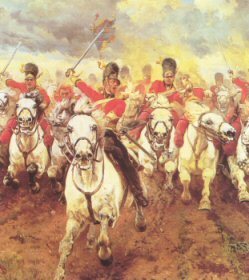 My favourite is this depiction of the Battle of Waterloo, I have a framed copy in my hallway and love it:
 Terrific picture, AR. I love some of the art work that sprang from the battle of Waterloo.
The Duke of Wellington found his place in military history as a result of the Battle of Waterloo. But another player on that stage also covered himself with glory, the Prussian Generalfeldmarschall Count Gebhard von Blucher. This is a short summary of his role at the battle.
Terrific picture, AR. I love some of the art work that sprang from the battle of Waterloo.
The Duke of Wellington found his place in military history as a result of the Battle of Waterloo. But another player on that stage also covered himself with glory, the Prussian Generalfeldmarschall Count Gebhard von Blucher. This is a short summary of his role at the battle.Generalfeldsmarschall Count Gebhard von Blucher
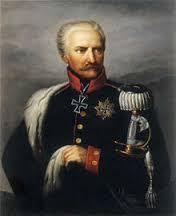
The return of Napoleon from Elba brought von Blucher out of retirement in Silesia and he was put in command of the Army of the Lower Rhine, with General August von Gneisenau as his chief of staff. In the campaign of 1815, the Prussians sustained a serious defeat at the outset at Ligny (June 16), in the course of which the old field marshal was repeatedly ridden over by cavalry and lay trapped under his dead horse for several hours, his life saved only by the devotion of his aide-de-camp, Count Nostitz. He was unable to resume command for some hours, and Gneisenau drew off the defeated army and rallied it. After bathing his wounds in brandy, and fortified by liberal internal application of the same, Blücher rejoined his army. Gneisenau feared that the British had reneged on their earlier agreements and favored a withdrawal, but Blücher convinced him to send two Corps to join Wellington at Waterloo. He then led his army on a tortuous march along muddy paths, arriving on the field of Waterloo in the late afternoon. With the battle hanging in the balance Blücher's army intervened with decisive and crushing effect, his vanguard drawing off Napoleon's badly needed reserves, and his main body being instrumental in crushing French resistance. This victory led the way to a decisive victory through the relentless pursuit of the French by the Prussians. The allies re-entered Paris on July 7.
Prince Blücher remained in the French capital for a few months, but his age and infirmities compelled him to retire to his Silesian residence at Krieblowitz, where he died on September 12, 1819, aged 76. After his death, an imposing mausoleum was built for his remains. Blücher retained to the end of his life the wildness and tendency to excesses which had caused his dismissal from the army in his youth, but these faults sprang from an ardent and vivid temperament which made him a leader of people. While by no means a military genius, his sheer determination and ability to spring back from errors made him a competent leader.
Since we couldn't be there, sometimes a filmed recreation will have to do. This clip is of the French Cavalry attack from the 1970 Soviet/Italian production of "Waterloo".http://www.youtube.com/watch?v=97dBfd...
The plan map for the Battle of Waterloo.
 I'm told that thanks to the large amount of recently unearthed and re-discovered source material, there will be a lot of new information and re-appraisals of Waterloo coming out in time for the bicentennial in 2015.
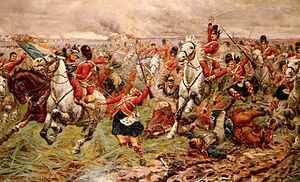
For example, the Scots Grey's eagle may not actually have been taken by Sergeant Ewart. Eeek!
Aficionados could try this one for starters
 Andrew Field
Thanks, Jonathan. Eeek is right!!!
Andrew Field
Thanks, Jonathan. Eeek is right!!!The taking of the eagle....painted by Berkeley
 Thanks for mentioning; Waterloo: The French Perspective Jonathan, I have a copy but am yet to read it, soon I hope!
by Andrew Field
Thanks for mentioning; Waterloo: The French Perspective Jonathan, I have a copy but am yet to read it, soon I hope!
by Andrew Field
 On Wellington: A Critique of Waterloo
 Carl von Clausewitz
Synopsis
The Battle of Waterloo has been studied and dissected so extensively that one might assume little more on the subject could be discovered. Now historian Peter Hofschröer brings forward a long-repressed commentary written by Carl von Clausewitz, the author of On War.
Clausewitz, the Western world's most renowned military theorist, participated in the Waterloo campaign as a senior staff officer in the Prussian army. His appraisal, offered here in an up-to-date and readable translation, criticized the Duke of Wellington's actions. Lord Liverpool sent his translation of the manuscript to Wellington, who pronounced it a "lying work." The translated commentary was quickly buried in Wellington's private papers, where it languished for a century and a half. Now published for the first time in English, Hofschröer brings Clausewitz's critique back into view with thorough annotation and contextual explanation.
Peter Hofschröer, long recognized as a leading scholar of the Napoleonic Wars, shows how the Duke prevented the account's publication during his lifetime--a manipulation of history so successful that almost two centuries passed before Clausewitz's work reemerged, finally permitting a reappraisal of key events in the campaign. In addition to translating and annotating Clausewitz's critique, Hofschröer also includes an order of battle and an extensive bibliography.
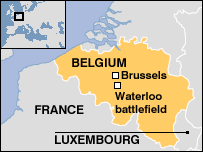
Where exactly is Waterloo?.......we all know the famous battle but geographic position may be not as familiar. Here is a quick reference.Waterloo (French pronunciation: [watɛʁˈlo][2]) (Walloon: Waterlô) is a Walloon municipality located in the province of Walloon Brabant, Belgium. On 30 September 2011, Waterloo had a total population of 29,706. The total area is 21.03 km² which gives a population density of 1,413 inhabitants per km². Nearly one fifth of the current registered population (5,640 inhabitants) are non-Belgian, many of whom work for institutions or companies in Brussels, a political centre of the European Union. These numbers were released by the municipality of Waterloo. The top five of non Belgians is as follows : French (1,237 people), Italians (537), British (503), Americans (445) and Swedish (425). (Source: http://en.wikipedia.org/wiki/Waterloo...)
 This author has written other books on Waterloo and he doesn't disappoint with this one which is slightly revisionist in comparison to some of the other histories of the battle.
Napoleon and Wellington: The Long Duel
 by Andrew Roberts (no photo)
Synopsis:
An award-winning historian offers an eye-opening view of the relationship between Napoleon Bonaparte and the Duke of Wellington, whose lives moved inexorably to their meeting at Waterloo, one of the most famous battles of all time."
At breakfast on the morning of the battle of Waterloo, the Emperor Napoleon declared that the Duke of Wellington was a bad general, the British were bad soldiers and that France could not fail to win an easy victory. Forever afterwards, historians have accused him of gross overconfidence and massively underestimating the caliber of the British commander opposite him. Now Andrew Roberts presents an original, highly revisionist view of the relationship between the two greatest captains of their age and of the great battle that determined European history in the nineteenth century.
Napoleon, who was born in the same year as Wellington -- 1769 -- fought Wellington by proxy years earlier in the Peninsular War, praising his ruthlessness in private while publicly deriding him as a mere "general of sepoys." In contrast, Wellington publicly lauded Napoleon, saying that his presence on a battlefield was worth forty thousand men, but privately he wrote long memoranda lambasting Napoleon's campaigning techniques.
Although Wellington saved Napoleon from execution after Waterloo, the emperor left money in his will to the man who had tried to assassinate the duke. Wellington in turn amassed a series of Napoleonic trophies of his great victory, even sleeping with two of the emperor's mistresses.
The fascinating, constantly changing relationship between these two historical giants forms the basis of Andrew Roberts's compelling study in pride, rivalry, propaganda, nostalgia and posthumous revenge. It is at once a brilliant work of military history and a triumphant biography.
Featuring a cast of fascinating supporting characters -- including the empress Josephine, the Prince Regent and Talleyrand -- "Napoleon and Wellington" provides the definitive account of the most decisive battle of the nineteenth century.
A very in-depth look at the battle tactics and strategies that made the Battle of Waterloo so important to the history of Europe.Waterloo: The Hundred Days
 by
by
 David G. Chandler
Synopsis:
The Battle of Waterloo is one of the most decisive encounters in history. Wellington's victory marked the end of the career of one of the greatest leaders of all time, Napoleon Bonaparte: it also signalled a crucial change in the balance of power in Europe that was to have critical consequences for the rest of the world. Yet the story of Napoleon's return from Elba and his dramatic seizure of power - even if for a mere 'hundred days' - is more than just the dry bones of history; it is a great adventure story. The author provides a blow-by-blow account of the battle itself and examines key aspects such as the organisation of both the French and the Allied armies, their tactics, strategy and weaponry, and their commanders' personalities.
A closer look at Elba and Napoleon's escape to meet his fate at the Battle of Waterloo.The Escape from Elba: The Fall and Flight of Napoleon 1814-1815
 by Norman Ian MacKenzie (no photo)
Synopsis
The year is 1814. The Allies have driven Napoleon's once-mighty armies back to Paris. Trapped, forced to abdicate after two decades of triumphant rule, the Emperor takes leave of his comrades-in-arms and sets sail for his new domain - the tiny, poverty-stricken, pestilential island of Elba. Yet within ten months Napoleon will enter Paris once again, at the heels of the fleeing Bourbon king, flushed with victory and cheered by the masses. The Escape From Elba tells the heroic story of Napoleon's exile and phoenix-like return. In this classic account, now republished in paperback, Norman MacKenzie chronicles this extraordinary year: the tense last hours of Napoleon's empire, his humiliating exile, his midnight escape and his whirlwind march over snowbound mountains to Grenoble where, in a dramatic confrontation with the French army, he became a reigning prince again. Described in vivid detail are Napoleon's adventures as the head of Elba. He brought society, splendor, organization and political intrigue to this run-down backwater. And he displayed on this small stage the many sides of his charismatic personality
 Mod
Mod
 by Andrew Roberts (no photo)
Synopsis:
June 18, 1815, was one of the most momentous days in world history, marking the end of twenty-two years of French Revolutionary and Napoleonic Wars. On the bloody battlefield of Waterloo, the Emperor Napoleon and his hastily formed legions clashed with the Anglo-Allied armies led by the Duke of Wellington -- the only time the two greatest military strategists of their age faced each other in combat.
With precision and elegance, Andrew Roberts sets the political, strategic, and historical scene, providing a breathtaking account of each successive stage of the battle while also examining new evidence that reveals exactly how Napoleon was defeated. Illuminating, authoritative, and engrossing, Waterloo is a masterful work of history.
Mod
 by Peter Hofschroer (no photo)
Synopsis:
In this masterly study of 1815, Peter Hofschroer challenges the accepted version of events at the battle of Waterloo. He demonstrates convincingly that Allied victory hinged on the contribution of German soldiers. Drawing on previously unpublished accounts, Hofschroer gives not only the Prussian perspective of their march to Waterloo and decisive attack on Napoleon's flank, but also details of the actions fought by some of the 25,000 Germans in Wellington's µBritish' army v more than a third of the Duke's force. A gripping narrative of astonishing detail captures such key episodes of Waterloo as La Haye Sainte, Papelotte, Hougoumont and the Prussian struggle with the Imperial Guard for Plancenoit. In addition, Hofschrer examines the battle at Wavre, the Allied offensive into France, the taking of Paris and the sieges across northern France.
Mod
 by
by
 Alessandro Barbero
Synopsis:
At Waterloo, some 70,000 men under Napoleon and an equal number under Wellington faced one another in a titanic and bloody struggle. In the end, as John Keegan notes, contemporaries felt that Napoleon's defeat had "reversed the tide of European history." Even 190 years later, the name Waterloo resounds.
Italian historian Alessandro Barbero's majestic new account stands apart from previous British and French histories by giving voice to all the nationalities that took part. Invoking the memories of British, French, and Prussian soldiers, Barbero meticulously re-creates the conflict as it unfolded, from General Reille's early afternoon assault on the chateau of Hougoumont, to the desperate last charge of Napoleon's Imperial Guard as evening settled in. From privates to generals, Barbero recounts individual miracles and tragedies, moments of courage and foolhardiness, skillfully blending them into the larger narrative of the battle's extraordinary ebb and flow. One is left with indelible images: cavalry charges against soldiers formed in squares; the hand-to-hand combat around farmhouses; endless cannon balls and smoke. And, finally, a powerful appreciation of the inevitability and futility of war.
Thanks for those additions, Jerome. They look interesting.
Here is an interesting look at Napoleon's defeat from the standpoint of the French.A French view of the reasons for Napoleon's defeat
General Antoine-Henri, Baron of Jomini one of the leading military writers on the Napoleonic art of war, had a number of very cogent explanations of the reasons behind Napoleon's defeat at Waterloo.
"In my opinion, four principal causes led to this disaster:
The first, and most influential, was the arrival, skilfully combined, of Blücher, and the false movement that favoured this arrival; the second, was the admirable firmness of the British infantry, joined to the sang-froid and aplomb of its chiefs; the third, was the horrible weather, that had softened the ground, and rendered the offensive movements so toilsome, and retarded till one o'clock the attack that should have been made in the morning; the fourth, was the inconceivable formation of the first corps, in masses very much too deep for the first grand attack." (Source: http://en.wikipedia.org/wiki/Battle_o...)
The "go to" book for an in depth overview of the Battle of Waterloo, complete with art work.The Waterloo Companion: The Complete Guide to History's Most Famous Land Battle
 by Mark Adkin(no photo)
Synopsis:
There have been many books about Waterloo, but never one to rival this in scale or authority. The text, based upon extensive research, describes both the battle and the campaign that preceded it in detail, drawing upon the first-hand accounts of participants on all sides in order to give the reader a vivid feeling for the experiences of those who fought upon this most celebrated of all battlefields. The many full-color maps, all specially commissioned for the book, and the numerous diagrams and photographs, the majority in color, as well as sixteen pages of original paintings, make the book a feast for the eyes and a collector's dream.
Mod

The History Book Club
Books mentioned in this topic
The Battle: A New History of Waterloo (other topics)Assaye 1803: Wellington's Bloodiest Battle (other topics)
The Battle: A New History of Waterloo (other topics)
The armies of Wellington (other topics)
Wellington: The Years of the Sword (other topics)
More...
Authors mentioned in this topic
Alessandro Barbero (other topics)Simon Millar (other topics)
Philip J. Haythornthwaite (other topics)
Elizabeth Longford (other topics)
Philip J. Haythornthwaite (other topics)
More...

http://www.bbc.co.uk/history/british/...