
Art Lovers discussion
Works with Emotion
>
Why is art found in human societies? What basic needs does it meet?
date newest »
newest »
 Well said, Stacey. I think you're right...communication.
 I think different people have access to all kinds of different thought-worlds that can't be shared or communicated well in a narrative or logical way, but that they can point to these worlds for other people indirectly by creating something that evokes them in such a way as to communicate them indirectly.
Georgia O'Keefe once said that she painted the thoughts she "didn't have words for."
Obviously writing is an art too, even though it uses words. I am not quite sure why this is so, exactly. Clearly in poetry the words take on a music of their own, but this is less clear in prose.I think this goes for literature as well, because, a novel is not just its plot synopsis. Literature is communicates as much through being an independent aesthetic creation as through the single event descriptions or word images.
 I have read that early man used art as a practical thing, as a way to control events--be successful in the hunt, ward away illness, bring fertility, etc. It had the power of magic.
Thus art was a useful thing in a very real way, like clothing to keep away the cold, or a roof to keep out the rain.
Interesting, Ruth. I didn't know that. I don't really understand the concept of it being 'magic', but times change, too.
 Art seems to be like a canary in the coal mind shaft as often art communicates what is going on in the here and now even though often the people alive at that time don't realize what is happening at their here and now.
I like what Ruth communicated.
it makes a lot of sense as a lot of human endeavors are a result of evolutionary forces.
However, often the reason that propelled the evolutionary development in the 1st place no longer exist or their power is diminished to the point that they are no longer part of the evolutionary process that results in certain outcomes.
Heather wrote: "Interesting, Ruth. I didn't know that. I don't really understand the concept of it being 'magic', but times change, too."By magic, I mean it was thought to have supernatural powers.
Jim wrote: "However, often the reason that propelled the evolutionary development in the 1st place no longer exist or their power is diminished to the point that they are no longer part of the evolutionary process that results in certain outcomes...."Absolutely.
I used to begin my Art History classes with this very question. Here's a copy of my handout.FIVE REASONS FOR MAKING ART
Art is a visual language and as such is used for many purposes. Some of these are listed below. It is important to understand that a single piece of art may have more than one purpose.
Beautification
This is the desire to make a beautiful object that visually enhances the place it is in. The work of the French artists from the Impressionists through Bonnard, Vuillard, Matisse, etc., is a good example. It is also the basis of some abstract art. This category also includes the decorative arts such as tapestries, gold and silver work, etc., and the decoration of useful objects.
Reflection of what is
This is a way of showing us what the world is like. Like the real world, this art may be beautiful or terrifying, ugly or marvelous, or any other word that describes the world about us. It may or may not express an opinion or try to make us think about our world. (If it does, then it also fits under the category of Transformation.) It's what the photorealists do when they show us a row of telephone booths shattered into a glory of reflections, and it's what much photography does. The Dutch and Flemish still-life painters did it to perfection. It's an important element in the multiple purpose of any art that is the tool of a civilization (such as ours) emphasizing the joys and sorrows of the physical world.
Transformation
This is art that tries to change a situation, a society or an individual. It doesn't use magic, but appeals to the emotions and/or the intellect to try to change a person's mind about something, or to confirm and strengthen ideas or beliefs that a person may already hold. It is the purpose of all political, social, religious and commercial art.
Self-Expression
This art shows the artist's feelings, thoughts and innermost emotions. It speaks to all of us because human emotions are universal. It has become very important in Western Europe and the Americas since the late 19th century. It is important almost nowhere else and at no other time. A society that considers self-expression as a purpose of art must believe in the idea of the individual as distinct from the social mass. There must be a certain level of income available so that artists can pursue a purpose not immediately related to economic or social gain.
Magic
This is almost entirely absent from our present idea of art. It tries to intervene in and to change a natural situation by supernatural means. It doesn't appeal to our intellect or emotions like art for transformation, but the art object itself is actually considered to have magical powers. It was an important purpose of most Prehistoric and much tribal art.
Adapted from a column by Fred Martin, in Artweek
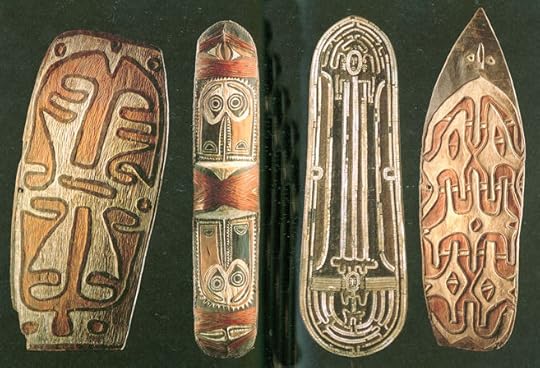
It's interesting about self expression. I read about the men who make shields in Papua New Guinea. Primitive people often have one particular style that everybody works in in each ethnic group. But there seems to be an aspect of expression in it. Obviously, no tradition of anybody inventing their own unique style, but certainly an idea that there is something in the maker that is particular.
There is an enormous effort using the simplest of tools and natural materials, and there is great prestige in making a fine mask. Often masks are based on a face built out of an abstracted tribal totem. The illustrations showed the work of different makers and you could tell their personalities apart.
I was able to find a link to a few examples:
Asmat tribesmen posing with their shields (note the variations on a theme.)
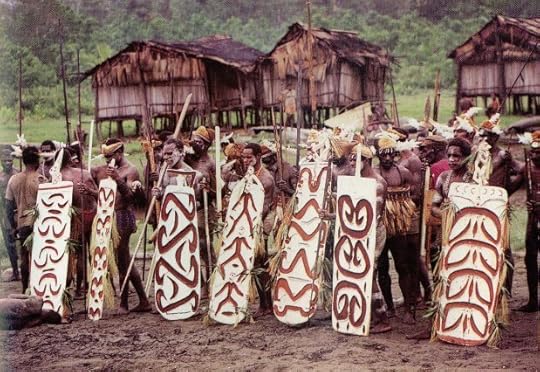 These peoples are working within a tradition with limited room for variation. I wouldn't be surprised to find that each of those marks has a special purpose or meaning. I very much doubt that individual self-expression is the goal here.
Heather -- kudos for a great topic question
These peoples are working within a tradition with limited room for variation. I wouldn't be surprised to find that each of those marks has a special purpose or meaning. I very much doubt that individual self-expression is the goal here.
Heather -- kudos for a great topic questionit seems to me that whether the individual's art is an expression of the individual or an expression of a collective that both require THE OTHER and so neither can have much effect regardless of why the individual creates the work of art.
Thanks, Jim!This is a great discussion. I can see both Ruth's and Ed's points about self-expression. Yes, there is probably a specific 'purpose or meaning' to each mark on the shields, but maybe the certain 'marks' the maker chooses could represent something about that person.
Good example, Ed.
Thanks for sharing your handout for your Art History class, Ruth. I would love to be your student!
 There is a couple from our church who are missionaries in Papua, New Guinea. They just returned for a short stay and shared an amazing video presentation.
their website -http://missionpng.com/
tribal face painting -- http://triggerpit.com/2011/06/12/trib...
Upper Sepik River Shields, Papua New Guinea -- http://www.art-pacific.com/artifacts/...
Heather wrote: "Thanks, Jim!This is a great discussion. I can see both Ruth's and Ed's points about self-expression. Yes, there is probably a specific 'purpose or meaning' to each mark on the shields, but maybe t..."
Great points Jim.
Yes Jim, you are right that they generally have a symbol system.
I didn't mean to say that the marks didn't have specific meaning, I meant that the individual choices to make the same motif "bouncy" or "calm", even or variable in thickness and the like often differ between individuals, and have an expressive effect. A particular form might be a cassowary or a victoria leaf, say, which might be a tribal patron or have a mythological story, but the mark making of two individuals can have different personalities.
In a tribal society, the creators are often not full time artisans, and also see themselves as part of the whole society, so they don't have a concept of "individual expression" or artistic "alienation" in the Western sense. That on the other hand, doesn't make them clones of each other. (Not to mean that was your position, just stating a slightly oversimplified view that some people have about primitive societies.)
I've got to find that book in the library again, as it tracked some cases where individuals from a primitive society went off and made different shield-masks. (They would even shout out teasing banter to each other, each bragging about how their shield was better.) It can take a month or more, so this is a significant investment of time. Even though they were all done in a single society, each one had individual differences.
Ed wrote: "the creators are often not full time artisans, and also see themselves as part of the whole society, so they don't have a concept of "individual expression" or artistic "alienation" in the Western sense. That on the other hand, doesn't make them clones of each other."
I think we agree, Ed. The individual can't help letting something of himself sneak into the art, even if he is unaware of it.
But art made for the purpose of self-expression would be foreign to his concept of art.
 I've read where everything can be described with words, and if not, the writer has not done the job. That may be true, but admittedly words take time to digest, and may often fall short of the immediate impact the visual arts have. Words succeed in longer form, imo.
John wrote: "I've read where everything can be described with words, and if not, the writer has not done the job. That may be true, but admittedly words take time to digest, and may often fall short of the imme..."
I've read where everything can be described with words, and if not, the writer has not done the job. That may be true, but admittedly words take time to digest, and may often fall short of the immediate impact the visual arts have. Words succeed in longer form, imo.
John wrote: "I've read where everything can be described with words, and if not, the writer has not done the job. That may be true, but admittedly words take time to digest, and may often fall short of the imme..."Georgia O'Keefe said that she painted what she didn't have words for.
I think that one of the things that is interesting about art is what can't quite be put into words.
I suppose that in some very long winded and prosaic way you could explain fairly literally in words what music or painting meant, but it'd be sort of like explaining a joke, all the parts are there, but it's no longer funny.
Good analogy, Ed. I think in explaining the painting, there is on one hand, explaining what we think the artist meant in his or her work, and also how we feel while experiencing a painting, or any other work of art. Somehow those verbal explanations seem too diminish the true feelings, as you said, they cannot be adequately expressed.
This topic was discuss almost 4 years ago. But we have since had many new members of the group and I just happened to be interested in reading the posts again.I want to go back to the subject Ed began It's interesting about self expression. I read about the men who make shields in Papua New Guinea.
Primitive people often have one particular style that everybody works in in each ethnic group. But there seems to be an aspect of expression in it. Obviously, no tradition of anybody inventing their own unique style, but certainly an idea that there is something in the maker that is particular.
I lived in New Mexico at one point in time. There the Kachina Dolls are prevalent but I never knew the significance of any one, let alone each Indian tribe symbolism or character. I found this interesting website:
"Kachina dolls are objects made in human or humanlike
shape, and they are common in Native American ritual,
often referred to in mythology. Perhaps most common
are the great variety of Pueblo kachina dolls. Navajos
carve ritual kachina dolls for secret use in some
healing rites. Native American Iroquois have also
taken to carving similar dolls in the False Face image.
Although sold as objects of art, the spectacular
kachina dolls retain a valued religious role, particularly
in educating children. Hopi Native Americans use
kachina dolls to instruct their children in the ways of
Hopi tradition and belief. Kachina dolls are important
during ceremonies when they are passed out to
children.
Native Americans, in addition to the southwestern tribes, utilize kachina dolls to a lesser extent. The Seneca use dolls in divination (Dream Divining). The Nooksack consider a person's
soul to look like a doll (sitec) image of him or her. Wanagemeswak (Penobscot) are dwarfs that leave lucky dolls to be found by people. A Pequot woman used a doll to overcome a giant. The
Tlingit hold that sickness is caused by witches, who use dolls to inflict it.
I thought this was particularly interesting:
The Seminole of Oklahoma and Florida used clay human effigies to avenge murders. Four male relatives of a homicide victim participated in this ritual. The doll maker, joined by the other three men, placed the doll in the center of a hot fire. If the clay figure fell over as it turned red, the murderer would die in four days. If the effigy remained erect, the murderer had
strong counter-powers and would probably become ill but not die.
More... http://americanindianoriginals.com/ka...
Antelope Dancer Kachina Doll: Dances to increase its numbers, brings rain.
Black Nataska Ogre: Nata-aska, the Black Ogre usually carry a saw or knife, as well as a bow and arrows for hunting. Their most noticable feature is their long, chomping jaws. These Ogres will accompany Soyoko on her trip to collect food from the children and make certain they help with chores and growing corn.
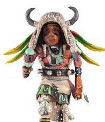
Buffalo Dancer Kachina Doll: Buffalo Kachina is the most powerful among all kachina dolls, who protects and can rid the bad of evil thoughts.
I think there's a way that art taps the unconscious, and takes us out of the every day world. That liminal aspect in some way hooks up with magic, religion, mythology, and personal and cosmic consciousness. Picasso was very interested in how the aesthetic and the uncanny or magical is connected to creation of art objects, in non-Western societies.
I didn't know that about Picasso. Thanks, Ed!


What basic needs does it meet?
I just found this basic question browsing the net. I'm curious as to your answers.
Here is an answer by one of the posts on Yahoo!Answers
"Abraham Maslow, later in his career, added "aesthetics" to his hierarchy of basic human needs. So, as they used to say in Walter Pater's time, "art for art's sake"--it serves as its own need.
Then, there's the notion that human beings are the most sentient of all living things, and we spend a lot of energy in self-expression. We define our place in space and time through vivid imagination and communication. As social animals, it's important for us to receive those messages as well as to send them.
Art seems to tap into our emotions through rhythmic patterns that evoke important events in our lives. The interplay of stable and precarious elements (harmony-dissonance; climax-denouement; symmetry-imbalance) emerges from the artist's memory (probably subconsciously) of important moments in life, and the audience relates to the work as it speaks to their own subconscious recognition of those patterns in their own lives.
And finally, it sometimes meets the basic need of survival--for many, it's an income. As Mickey Spillane noted, he'd never have written a single Mike Hammer novel if it weren't for the money."