
Classics and the Western Canon discussion
Virgil - Aeneid
>
Historical and Background Information

message 1:
by
Thomas
(new)
Jul 25, 2012 01:16PM
 Here's your thread for background information and the historical context of the Aeneid. The life of Virgil, Roman mythology, the influence of Augustus, and any other supplemental type stuff.
reply
|
flag
 There's not a lot known about Virgil's life. Here's part of the Wikipedia entry on his early years, for example. Pretty sparse!
Virgil's biographical tradition is thought to depend on a lost biography by Varius, Virgil's editor, which was incorporated into the biography by Suetonius and the commentaries of Servius and Donatus, the two great commentators on Virgil's poetry. Although the commentaries no doubt record much factual information about Virgil, some of their evidence can be shown to rely on inferences made from his poetry and allegorizing; thus, Virgil's biographical tradition remains problematic.
The tradition holds that Virgil was born in the village of Andes, near Mantua[3] in Cisalpine Gaul. Scholars suggest Etruscan, Umbrian or even Celtic descent by examining the linguistic or ethnic markers of the region. Analysis of his name has led to beliefs that he descended from earlier Roman colonists. Modern speculation ultimately is not supported by narrative evidence either from his own writings or his later biographers. Macrobius says that Virgil's father was of a humble background; however, scholars generally believe that Virgil was from an equestrian landowning family which could afford to give him an education. He attended schools in Cremona, Mediolanum, Rome and Naples. After considering briefly a career in rhetoric and law, the young Virgil turned his talents to poetry.
Perkell's Reading Vergil's Aeneid: An Interpretative Guide, which I referred to in the Book 1 thread, is only able to muster two pages on "The Life of Vergil." She contends that the earliest extant biography of Virgil is by Aelius Donatus, who wrote four hundred years after Virgil's death. Thus he was clearly relying on other sources, none of which exists, and apparently there are no original records of his life or family. A few items adapted from Percell: He was born in 70 BC and died in 19 BC. Through patrons (of his poetry?), he eventually met Octavian, later Caesar Augustus. He was a slow writer (maybe deliberative or cautious or careful would be a better term). It took him three years to write the Eclogues, seven to write Georgics, and eleven to write the Aeneid, which he was still tinkering with at his death. He urged that it be burnt, since it wasn't perfect enough for him, but fortunately these instructions were ignored. Perkell comments that at his death fifty or so half-lines awaited completion, and there were small discrepancies in matters of detail. But these, she notes, "seem insufficient cause for the poet to destroy his life's major work. Was the poem, then, fundamentally incomplete? Lacking, as some scholars have suggested,the ending it's author would have written, had he lived?"

 Carthage Must Be Destroyed: The Rise and Fall of an Ancient Civilization by Richard Miles is a great resource for the story of Carthage and the love/hate relationship with Rome. There is even a paragraph or two that explains Virgil's attitude towards Carthage.
David wrote: "[bookcover:Carthage Must Be Destroyed: The Rise and Fall of an Ancient Civilization] Carthage Must Be Destroyed: The Rise and Fall of an Ancient Civilization by Richard Miles is a great resource f..."
Carthage Must Be Destroyed: The Rise and Fall of an Ancient Civilization by Richard Miles is a great resource for the story of Carthage and the love/hate relationship with Rome. There is even a paragraph or two that explains Virgil's attitude towards Carthage.
David wrote: "[bookcover:Carthage Must Be Destroyed: The Rise and Fall of an Ancient Civilization] Carthage Must Be Destroyed: The Rise and Fall of an Ancient Civilization by Richard Miles is a great resource f..."Got it at Costco a few weeks ago, but haven't started it yet. I should!
 Has anyone heard of or read a Zionist interpretation/reading of the Aeneid?
Edit, I found one: http://www.commentarymagazine.com/art...
 More on Tyche from here: http://www.theoi.com/Daimon/Tykhe.html (See site for sources and depiction on Greek vase.)
"TYKHE was the goddess or spirit of fortune, chance, providence and fate. She was usually honoured in a more favourable light as Eutykhia, goddess of good fortune, luck, success and prosperity.
"Tykhe was represented with different attributes. Holding a rudder, she was conceived as the divinity guiding and conducting the affairs of the world, and in this respect she was called one of the Moirai (Fates); with a ball she represented the varying unsteadiness of fortune--unsteady and capable of rolling in any direction; with Ploutos or the horn of Amalthea, she was the symbol of the plentiful gifts of fortune.
"Nemesis (Fair Distribution) was cautiously regarded as the downside of Tykhe, one who provided a check on extravagant favours conferred by fortune. The pair were often depicted as companions in Greek vase painting. In the vase (right) Nemesis (Indignation) with her arm around Tykhe (Fortune) points an accusing finger at Helene, who Aphrodite has persuaded to elope with Paris."
Regarding Book II, Fitzergald II: 22:
"That was the end
Of Priam's age, the doom that took hm off, Headlong fallen--he that in other days
Had ruled in pride so many lands and peoples,
The power of Asia.
On the distant shore
The vast trunk headless lies without a name."
I like knowing background facts.
(I read the parts that refer to sections that we've already read. But I know I'll never have time to read background if I don't read it more or less as I read the literature.)
I ran across this passage:
Sub-conscious association…..”After describing, in the second book of The Aeneid, the death of Priam, the poet dwells on the contrast between the old king’s squalid and miserable end and the glories of his former state, ‘proud master of so many peoples and so many kings, lord of all Asia’. Then he proceeds: ‘there lies the mighty trunk upon the shore, the head torn from the shoulders, a nameless corpse.’ The word ‘shore’ is strange in this context, for the setting of the scene is Priam’s own palace; it has surely come into the poet’s mind from the memory of another scene which it at once recalls, one which had made a profound impression on Virgil’s generation. This was the end of Pompey, once the greatest general in the world, conqueror of Asia for the Roman Republic, and later leader of the Republic’s army against Caesar, turned by his defeat at Pharsalus nto a helpless fugitive, and murdered by treachery as he was about to land n Egypt as suppliant of the Egyptian king. The words of Plutarch’s account of this are themselves a commentary on the end of Virgil’s description of the death of Priam: ‘so they cut off Pompey’[s head and threw the rest of his body overboard, leaving it naked upon the shore’(Camps 97-98).
I realize that Priam was a Trojan (and therefore "on the side of/revered" by the Romans) and Pompey had fought against Caesar in the end (and therefore not "on the side of" Augustus).
But it did seem to me that since the Roman readers would have been knowledgable about what had happened to Pompey, and somewhat in horror about the disrepect shown him, (if I remember correctly, even Caesar himself had said that it was wrong for Pompey to have been so dishonored...that Caesar cried)...and the beheading of Pompey was so relatively recent...that people--in thinking of Pompey-- would be able to strongly feel the horror and wrongness of Priam's death.
http://www.livius.org/caa-can/caesar/...
[book:An Introduction to Virgil's Aeneid|1001004]
"That was the end
Of Priam's age, the doom that took hm off, Headlong fallen--he that in other days
Had ruled in pride so many lands and peoples,
The power of Asia.
On the distant shore
The vast trunk headless lies without a name."
I like knowing background facts.
(I read the parts that refer to sections that we've already read. But I know I'll never have time to read background if I don't read it more or less as I read the literature.)
I ran across this passage:
Sub-conscious association…..”After describing, in the second book of The Aeneid, the death of Priam, the poet dwells on the contrast between the old king’s squalid and miserable end and the glories of his former state, ‘proud master of so many peoples and so many kings, lord of all Asia’. Then he proceeds: ‘there lies the mighty trunk upon the shore, the head torn from the shoulders, a nameless corpse.’ The word ‘shore’ is strange in this context, for the setting of the scene is Priam’s own palace; it has surely come into the poet’s mind from the memory of another scene which it at once recalls, one which had made a profound impression on Virgil’s generation. This was the end of Pompey, once the greatest general in the world, conqueror of Asia for the Roman Republic, and later leader of the Republic’s army against Caesar, turned by his defeat at Pharsalus nto a helpless fugitive, and murdered by treachery as he was about to land n Egypt as suppliant of the Egyptian king. The words of Plutarch’s account of this are themselves a commentary on the end of Virgil’s description of the death of Priam: ‘so they cut off Pompey’[s head and threw the rest of his body overboard, leaving it naked upon the shore’(Camps 97-98).
I realize that Priam was a Trojan (and therefore "on the side of/revered" by the Romans) and Pompey had fought against Caesar in the end (and therefore not "on the side of" Augustus).
But it did seem to me that since the Roman readers would have been knowledgable about what had happened to Pompey, and somewhat in horror about the disrepect shown him, (if I remember correctly, even Caesar himself had said that it was wrong for Pompey to have been so dishonored...that Caesar cried)...and the beheading of Pompey was so relatively recent...that people--in thinking of Pompey-- would be able to strongly feel the horror and wrongness of Priam's death.
http://www.livius.org/caa-can/caesar/...
[book:An Introduction to Virgil's Aeneid|1001004]
I think someone earlier mentioned that the Aeneid is propaganda. And that is true, to some extent. It's no mere coincidence that Aeneas stops at Actium to celebrate the "Trojan Games."
Thomas wrote: "I think someone earlier mentioned that the Aeneid is propaganda. And that is true, to some extent. It's no mere coincidence that Aeneas stops at Actium to celebrate the "Trojan Games.""
But propaganda for which position, eh?
Ok, i had thought that Virgil inluded allusions that would be positive towards Augstus. But then I read (didn't jot dwn the source) that over the centuries SOME hold that Virgil is making positive llusions to Augustus; but others have put forward that Virgil included subtle criticisms of Augustus.
But propaganda for which position, eh?
Ok, i had thought that Virgil inluded allusions that would be positive towards Augstus. But then I read (didn't jot dwn the source) that over the centuries SOME hold that Virgil is making positive llusions to Augustus; but others have put forward that Virgil included subtle criticisms of Augustus.
I often get the feeling when reading Homer, and now Virgil, that the line between history and mythology and religion was very fine and sometimes fuzzy. This was a culture in which men like Julius Caesar were deified, raised to the heavens as an actual god to be worshipped. (Deified by the Senate, no less.) Belief was far more flexible then.
Patrice wrote: "That would be really sneaky of him! Augustus hired him to write this. Put him up in luxury, etc. Do you remember what the criticisms were?
..."
Sorry, no. The passage "just said"....and there were no examples given. But since you asked, i have googled. 1) virgil writes synpathetically of the losers, 2) and 3) well...apparently there are possible anti-augustus allusions in Book 6 and Book 12... i don't want to read those yet.
http://www.impalapublications.com/blo...
Mmm...but then again, as you suggest, would Virgil have been able to say no to Augustus? Maybe Augustus was like the Godfather. ("I'll make him an offer he can't refuse.)
..."
Sorry, no. The passage "just said"....and there were no examples given. But since you asked, i have googled. 1) virgil writes synpathetically of the losers, 2) and 3) well...apparently there are possible anti-augustus allusions in Book 6 and Book 12... i don't want to read those yet.
http://www.impalapublications.com/blo...
Mmm...but then again, as you suggest, would Virgil have been able to say no to Augustus? Maybe Augustus was like the Godfather. ("I'll make him an offer he can't refuse.)
Thomas wrote: "I often get the feeling when reading Homer, and now Virgil, that the line between history and mythology and religion was very fine and sometimes fuzzy. This was a culture in which men like Julius C..."
Pretty large liberties taken with history. (writing it "as it should have been.". Lol..there was a photo of a relative standing with my mother-in-law's son and grandsons. My m-i-l had the photo the photo altered....had her face inserted where that woman's face had been. I said, "but you weren't there!,". She said, " But I should have been.")
Pretty large liberties taken with history. (writing it "as it should have been.". Lol..there was a photo of a relative standing with my mother-in-law's son and grandsons. My m-i-l had the photo the photo altered....had her face inserted where that woman's face had been. I said, "but you weren't there!,". She said, " But I should have been.")
Adelle wrote: "Pretty large liberties tken with history. "We should read Herodotus sometime. Talk about liberties!
Historical fiction?
Or fictional history?
Or fictional history?
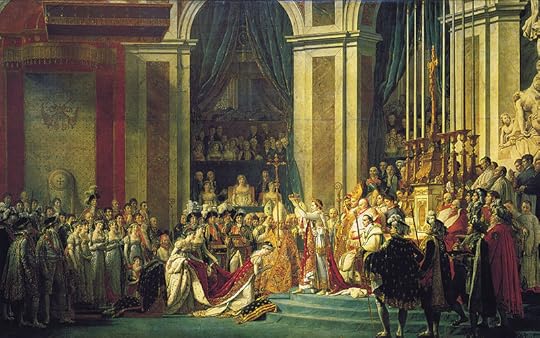
Adelle wrote: "had her face inserted where that woman's face had been. I said, "but you weren't there!,". She said, " But I should have been.""David did similarly for Napoleon's mother in this one (center gallery):
http://en.wikipedia.org/wiki/File:Jac...
http://en.wikipedia.org/wiki/The_Coro...
 Thomas wrote: "Adelle wrote: "Pretty large liberties tken with history. "
We should read Herodotus sometime. Talk about liberties!"
Definitely. It should go on the list, particularly since there's a very good fairly recent edition of it published recently and available quite affordably.
Patrice wrote: "I know he [Herodotus] had the reputation of being a liar..."I'm not aware of his being a deliberate liar, but he did report almost everything he heard, sometimes even saying that he didn't really believe this but this is what they say. He seems to have tossed everything he heard up on his Facebook page.
Everyman wrote: "...He seems to have tossed everything he heard up on his Facebook page."LOL!
;) I like that Facebook analogy too!
David wrote: "[bookcover:Carthage Must Be Destroyed: The Rise and Fall of an Ancient Civilization] Carthage Must Be Destroyed: The Rise and Fall of an Ancient Civilization by Richard Miles is a great resource f..."
I went to Costco.
I saw that book.
I came. I saw. I purchased.
(I hope to add one more verb ["read"] by the close of the year.)
Thanks for the recommendzation,
I went to Costco.
I saw that book.
I came. I saw. I purchased.
(I hope to add one more verb ["read"] by the close of the year.)
Thanks for the recommendzation,
Patrice wrote: "I bought it too. Thanks."Me three. It doesn't qualify for a major read, not being a classic, but if enough people are interested it might qualify for a side read/discussion. But I haven't started it yet.
Lies/Truth:
I read the introductory chapter of the book David had recommended (Carthage Must Be Destroyed; Richard Miles).
No spoiler. (view spoiler)
I read the introductory chapter of the book David had recommended (Carthage Must Be Destroyed; Richard Miles).
No spoiler. (view spoiler)
I have considered, too, that lying--well, anyway lying for your own side.... Aeneas came down pretty hard on that lying, "that well-accomplished liar," Sidon.
But even if the morality is that it's not bad to lie for your own side, for your own position, still!! How in the world, then, can you get the facts? If you can't believe anyone because everyone lies, how can you wisely plan? How difficult to go forward.
But even if the morality is that it's not bad to lie for your own side, for your own position, still!! How in the world, then, can you get the facts? If you can't believe anyone because everyone lies, how can you wisely plan? How difficult to go forward.
As a fan of subversive readings (however wrong-headed) I'm looking forward to hearing about Virgil's subtext. But from what we've read so far it appears that Virgil had primarily poetic aims, rather than historical ones, and it seems perfectly normal that if he shows a bias it would be toward his sponsor. I have to wonder if the "historical truth" as moderns understand it -- as an unbiased perspective based on the best evidence available -- was even relevant to his audience. Would they have preferred a lecture on Punic migration to the tale of Dido and Aeneas? Even today, how many people are more interested in facts than drama? (Especially during election season...)
Adelle wrote: "Lies/Truth:I read the introductory chapter of the book David had recommended (Carthage Must Be Destroyed; Richard Miles).
No spoiler. Miles writes of an epic poem on the Rome/Carthage subject ..."
We can't forget that the deception and guile and "lying" we see in the poem are all dramatic devices. The fact that we can recognize the deception is evidence that Virgil is not deceiving us -- these devices actually allow us to see events more clearly, more completely than the characters themselves do.
Interesting. Mmmm. Maybe Virgil hoped that by painting the Aenaes/Augustus character as pious....putting god, country, family above all else...that that might be a role model for the Romans???
Gotta tell you though, from a couple of the introductions that I had read, regarding the definition of piety, ... at least one that I read specifically held that compassion was NOT a part of piety...that Aenaes had to put aside his compassion in order to achieve his goal (very Book 4). He feels, oh yes, there are tears... but god, country, family... anything else can and must be sacrificed to the greater goal.
But if you look at those three: god, country, family....then wouldn't that actually fit well with the Roman empire?
(1) The gods themselves wanted Rome.
(2) In supporting Rome and the Roman empire---at almost any cost---one is supporting the gods.
(3) The gods bless one with children---maybe many children....to support the gods, one must raise those children to support Roman and the Roman Empire and Roman ideals.....which includes sacrifice of almost anything else for that greater good.
Gotta tell you though, from a couple of the introductions that I had read, regarding the definition of piety, ... at least one that I read specifically held that compassion was NOT a part of piety...that Aenaes had to put aside his compassion in order to achieve his goal (very Book 4). He feels, oh yes, there are tears... but god, country, family... anything else can and must be sacrificed to the greater goal.
But if you look at those three: god, country, family....then wouldn't that actually fit well with the Roman empire?
(1) The gods themselves wanted Rome.
(2) In supporting Rome and the Roman empire---at almost any cost---one is supporting the gods.
(3) The gods bless one with children---maybe many children....to support the gods, one must raise those children to support Roman and the Roman Empire and Roman ideals.....which includes sacrifice of almost anything else for that greater good.
Patrice wrote: "That's good! Gods are the basis of everything else.
Don't you find it hard, though, to understand this?
When you have so many gods, jealous angry feuding gods, how can you be "pious" to them? Yo..."
Except...to be truthful...my impression is that by the close of the Roman Republic--if not before--the Romans were using the gods as an excuse to empire... That Rome, not the gods, took first place on that list...
But i could be wrong. I'm no expert on Roman history.
Don't you find it hard, though, to understand this?
When you have so many gods, jealous angry feuding gods, how can you be "pious" to them? Yo..."
Except...to be truthful...my impression is that by the close of the Roman Republic--if not before--the Romans were using the gods as an excuse to empire... That Rome, not the gods, took first place on that list...
But i could be wrong. I'm no expert on Roman history.
At 38 Thomas wrote: ".We can't forget that the deception and guile and "lying" we see in the poem are all dramatic devices. The fact that we can recognize the deception is evidence that Virgil is not deceiving us -- these devices actually allow us to see events more clearly, more completely than the characters themselves do.
"
Well, yes, some of the lies and deceptions were dramatic devices, but surely not all of them. Some of them the characters WERE aware of: it WAS brought home to the people of Troy that Sinon had lied to them; Aeneas did call his mother out on her always deceiving him and asked her...or asked the spot where she had been standing...why there was never any truth between them. So sometimes the characters were aware of the deceptions and lies.
"
Well, yes, some of the lies and deceptions were dramatic devices, but surely not all of them. Some of them the characters WERE aware of: it WAS brought home to the people of Troy that Sinon had lied to them; Aeneas did call his mother out on her always deceiving him and asked her...or asked the spot where she had been standing...why there was never any truth between them. So sometimes the characters were aware of the deceptions and lies.
Adelle wrote: "Miles goes on to say providing examples--that much of the Roman writings regarding Carthage were often predictably negative and clichd..and Carthage, having been destroyed, couldnt put forward an alternative version of events "He also has more to say about Roman attitudes towards Carthage. I came away feeling that even then for the Romans themselves there was a strong sense that the Roman "high tide" was reached with the destruction of Carthage. For a long time, Roman sentiment toward Carthage was most assuredly negative and cliched. However, the destruction of Carthage was a trial that provided a great sense of Roman pride. Eventually the negative cliche's were replaced with honorable praise (Virgil praises the construction of Carthage as a great city ruled by a great queen) and even sympathy for Carthage (Aeneas leaving Dido) so Rome could claim a greater victory over a great and equal adversary instead of an immoral and unworthy enemy.
I get the sense that Roman attitudes towards Carthage evolved along lines and reasons very similar to Union attitudes towards the Confederacy, before, during, and well after the conflict that turned hate into a nostalgic reverence. One should keep in mind among the many differences though that Carthage was completely destroyed and thus completely voiceless afterwards.
Adelle wrote: "Well, yes, some of the lies and deceptions were dramatic devices, but surely not all of them. Some of them the characters WERE aware of: it WAS brought home to the people of Troy that Sinon... "They become aware of it after the fact, of course. If they were aware of it before, then it wouldn't work as a narrative device, or on any level for that matter. The same is true of the whole poem, I think, or any great story. My point (or my opinion, rather) is that Virgil is here engaged in story-telling rather than history. If Augustus was flattered by the Aeneid it was because Virgil skillfully convinced him, as a reader or listener, that the poem was about him. Clearly it's about much more than that, but it speaks to Virgil's art that he was (supposedly) able to do that.
Patrice wrote: "Maybe this reflects something about human nature? We can always find a good reason to do whatever we wanted to do anyway!"I would add that maybe "fate" is something applied in hindsight to not only explain, but more importantly to justify those things we did anyway. That is more interesting when you remember the Aeneid was presented as a history
Adelle wrote: "Miles goes on to say providing examples--that much of the Roman writings regarding Carthage were often predictably negative and clichd..and Carthage, having been destroyed, couldn't p..."Which is pretty normal, isn't it? History is written by the winners.
What, for example, would historians be writing about Lincoln, now lauded as one of our best Presidents, if the South had won the war?
Patrice wrote: "The history is not very solid. Carthage was founded hundreds of years after Aeneas lived so there is no way he and Dido could have gotten together. "Oh, dear. Indeed, it seems to be the case, based on modern scholarship, that Carthage was founded at least several centuries after the Trojan war.
OTOH, the Phoenicians had been colonizing around the Mediterranean for a long time before the Trojan war, so it may well be that there was a trading center or lesser city where Carthage was and Aeneas stopped off there and Virgil just called it Carthage a few centuries before it got that name.
But it does seem that Virgil made up the love story, or at least scholars don't seem to have found any earlier works that allude to it (though it's always possible that they existed and were subsequently lost). But the existence of a city, or at least a colony, on or near that site that Aeneas could have traveled to seems at least plausible.
 Patrice wrote: "Did anyone notice that Dido had blond hair? ..."
Where does Vergil say that Dido is a blonde?
Thanks for pointing this out. I had overlooked the word and it really makes me think of Dido with a different mental picture! In Latin (4.590) she has "flāventīs ... comās." the adj. means "yellow" or "golden," so blond is a good translation. Menelaus is often described in Homer with the epithet "xanthos" which has a similar meaning in Greek to the Latin "flavus" or "flavēns." Sometimes this is translated as "red haired."Cleopatra was a Macedonian -- but this race, from north of Greece proper, may have had a higher incidence of blond people.
Patrice wrote: "One of my daughters lives near Elche, Spain. There is a bust called the lady of Elche. If you google it you can see lots of views of it. They aren't sure of its origin but they think that it may..."http://www.nytimes.com/1997/01/23/wor...
News about her going back to 1997!
Everyman wrote: "Perkell's Reading Vergil's Aeneid: An Interpretive Guide, which I referred to in the Book 1 thread, is only able to muster two pages on "The Life of Vergil." She contends that the earliest extan..."This book seems very good, but slow going. I don't know that I am going to make it through Aeneid this discussion cycle, but I am enjoying toying with it.
Those interested in translation issues might want to take a look at the last chapter. It has some close comparisons and general observations on 500 years(!) of English translations.
I do not particularly like Simon Callow's reading of Robert Fagles's translation of the Aeneid itself. It is just overly dramatic, almost bombastic, for my preferences. I listened to the Fitzgerald translation the last time I pursued the Aeneid. (I can be certain because that is how I ended up with a hardcover Everyman edition of the book itself in my library -- this is a book where the differences were too great to do a crossover. My library must have gotten the Callow reading later.)
Patrice wrote: "I agree Lily! I am amazed by how dramatic the reading is and it distorts my understanding so much!Right now I'm watching a DVD I got from netflix, "Rome: Rise and Fall of an Empire" Disc 1, and..."
But the articles in the collection pulled together by Perkell seem very good.
Lily wrote: "I do not particularly like Simon Callow's reading of Robert Fagles's translation of the Aeneid itself. It is just overly dramatic, almost bombastic, for my preferences...."Agreed. I tried to listen to it during my commute (in a rather noisy old truck) and the dynamic fluctuations made it almost impossible to listen to. One moment the narrator was screaming, the next I couldn't hear him at all.
I don't know much about Hindu theology, except that they say that there are 330 million gods, 330 gods, 3 gods, and 1 god. (Or something like that.) I don't recall ever reading about a Cerberus-like god, but it seems possible!The similarity that strikes me though, is between the Aeneid and The Bhagavad Gita. Both Aeneas and Arjuna have duty and destiny as their primary burden and objective, and they both have divine assistance. You might want to look into the Bhagavad Gita if you're interested in finding a tie-in.
 Patrice wrote: "I discovered a few things in my class notes. Maecenus ordered his men to find him a poet who could write about how great Rome was. There were only 3 poets who were considered.
l. Ovid. Ovid love..."
Patrice, your post in Message 5 of this thread is fascinating!! Thank you for sharing this!!
I ran across a nice paragraph on Virgil's influence.
“Virgil’s influence on Rome and all the lands touched by Roman civilization is something beyond all telling. His Aeneid shaped the verse of Ovid and Lucan, the prose of Livy and Tacitus, and in unforeseen ways the very lives of some important Romans: the emperor Hadrian was not the first, and certainly not the last, to consult Virgil’s poem as a book of prophecy and to act as it instructed.
For centuries, Vigil was thought a seer and wonder-worker; one of the foremost Virgilians of this century, Jackson Knight, claimed seriously to be in mystical communion with him. One book of Virgil moved Saint Augustine to tears, and one single line sent Savonarola into monastic orders.
Alcuin preferred Virgil to his holy books; Pope Gelasius, revising the canon of Sacred Scripture itself, found several cantos composed entirely of Virgilian lines. Centuries later, Virgil’s half-lines caused Cardinal Newman to exclaim over their pathos. To Dante, Virgil was maestro and autore, a kindred spirit because he too loved Italy, believed in providence, explored inferno, purgatorio, and paradiso, and mastered lo bello stilo.
Milton and Spenser, Tasso and Camoes fashioned their epics after Virgil’s, and Michelangelo, painting the Pope’s private chapel, balanced his row of prophets with a row of sibyls, giving Virgil’s world a parallel place with Isaiah’s in the undoing of man’s original failure. Young Bernini, helped by his father, sculpted Aeneas bearing Anchises on his back.
Young Berlioz, helped by his father, trembled with emotion when he first read of the death of Dido. Voltaire quipped that if it was true that Homer made Virgil, then Virgil was the best thing he ever made. T.S. Eliot called the Aeneid “the classic of Europe” and confidently declared it more civilizing a poem than any other that ever had been, ever would be, and ever could be” (168-69).
From Fathers and Sons in Virgil's 'Aeneid'
Fathers and Sons in Virgil's Aeneid;M. Owen Lee
“Virgil’s influence on Rome and all the lands touched by Roman civilization is something beyond all telling. His Aeneid shaped the verse of Ovid and Lucan, the prose of Livy and Tacitus, and in unforeseen ways the very lives of some important Romans: the emperor Hadrian was not the first, and certainly not the last, to consult Virgil’s poem as a book of prophecy and to act as it instructed.
For centuries, Vigil was thought a seer and wonder-worker; one of the foremost Virgilians of this century, Jackson Knight, claimed seriously to be in mystical communion with him. One book of Virgil moved Saint Augustine to tears, and one single line sent Savonarola into monastic orders.
Alcuin preferred Virgil to his holy books; Pope Gelasius, revising the canon of Sacred Scripture itself, found several cantos composed entirely of Virgilian lines. Centuries later, Virgil’s half-lines caused Cardinal Newman to exclaim over their pathos. To Dante, Virgil was maestro and autore, a kindred spirit because he too loved Italy, believed in providence, explored inferno, purgatorio, and paradiso, and mastered lo bello stilo.
Milton and Spenser, Tasso and Camoes fashioned their epics after Virgil’s, and Michelangelo, painting the Pope’s private chapel, balanced his row of prophets with a row of sibyls, giving Virgil’s world a parallel place with Isaiah’s in the undoing of man’s original failure. Young Bernini, helped by his father, sculpted Aeneas bearing Anchises on his back.
Young Berlioz, helped by his father, trembled with emotion when he first read of the death of Dido. Voltaire quipped that if it was true that Homer made Virgil, then Virgil was the best thing he ever made. T.S. Eliot called the Aeneid “the classic of Europe” and confidently declared it more civilizing a poem than any other that ever had been, ever would be, and ever could be” (168-69).
From Fathers and Sons in Virgil's 'Aeneid'
Fathers and Sons in Virgil's Aeneid;M. Owen Lee
Thanks, Adelle.Tonight I read some of Fagles's notes. He suggests that Pope transmitted the view that Homer is to be heard, whereas Virgil is to be read. However, he went on to say that in early days to read, was to read aloud!
It was fun to encounter because for the previous half hour I had been reading along, over, or under or some such combination of Chapter 3 to the audio recording. Somehow it was as if the words, phrase, and ideas begged to be heard and felt aloud.
Sounds an excellent way to go. After I read your post here, I thought I would read occasional bits aloud.
Some book--sorry Lily, this month I have been sub-standard about tracking sources--some author as writing about the scene in which Sleep was sent to make Palinurus drowzy. And he included the lines in Latin. And pointed out that as Palinurus DID become sleepier and sleepier...that Virgil had chosen to use words with "softer and softer" sounding consonants.
I mean, I don't even know Latin, and these were print words, but it was cool. You just KNEW those words would be making Palinurus fall asleep.
Some book--sorry Lily, this month I have been sub-standard about tracking sources--some author as writing about the scene in which Sleep was sent to make Palinurus drowzy. And he included the lines in Latin. And pointed out that as Palinurus DID become sleepier and sleepier...that Virgil had chosen to use words with "softer and softer" sounding consonants.
I mean, I don't even know Latin, and these were print words, but it was cool. You just KNEW those words would be making Palinurus fall asleep.
But it's in LATIN. Do you have a copy wirh Latin?
Ok. Found it. It was in Fathers and Sons in Virgil's Aeneid. It's nothing I noticed myself.
Palinuris is fighting off Sleep and fighting off Sleep. But at last Sleep overcomes him. The author wrote:
"it is a passage full of music, as a texture of liquid m's gives way to one of whispering s's and p's."
And when I read that, oh, how I wished that I coud read Latin.
And then there were the lines in Latin, sure enough, and I could imagine Sleep whispering and whispering, softer and softer, into the ear of Palinurus. And it's such a quiet peaceful seeming night there on the empty ocean.
Didn't you just love that description of Sleep coming:
"The sailors were sprawled on their hard benches by the oars below deck, their limbs softened and still, when filmy Sleep came gliding down from the ancestral stars, parted the airy darkness, and pushed the shadows aside. He was looking for you, Palinurus..."
Ok. Found it. It was in Fathers and Sons in Virgil's Aeneid. It's nothing I noticed myself.
Palinuris is fighting off Sleep and fighting off Sleep. But at last Sleep overcomes him. The author wrote:
"it is a passage full of music, as a texture of liquid m's gives way to one of whispering s's and p's."
And when I read that, oh, how I wished that I coud read Latin.
And then there were the lines in Latin, sure enough, and I could imagine Sleep whispering and whispering, softer and softer, into the ear of Palinurus. And it's such a quiet peaceful seeming night there on the empty ocean.
Didn't you just love that description of Sleep coming:
"The sailors were sprawled on their hard benches by the oars below deck, their limbs softened and still, when filmy Sleep came gliding down from the ancestral stars, parted the airy darkness, and pushed the shadows aside. He was looking for you, Palinurus..."
So I'm researching for Book 9.
Here's are some lovely images of Iris ( I like, in particular,the 2nd from the left on the top row):
http://www.google.com/search?q=iris+g...
from theoi.com: "Her name contains a double meaning, being connected both with iris, 'the rainbow, and eiris, 'messenger.'"
"In the Homeric poems she appears as the minister of the Olympian gods, who carries messaegs from Ida to Olympus, from gods to gods, and from gods to men......In later poets.....she occurs gradually more amd more exclusively in the service of Hera (Juno)....
Evander. "brought the Greek pantheon, laws and alphabet to Italy"
http://en.wikipedia.org/wiki/Evander_...
Pilumnus An ancestor of Turnus
http://en.wikipedia.org/wiki/Pilumnus
Here's are some lovely images of Iris ( I like, in particular,the 2nd from the left on the top row):
http://www.google.com/search?q=iris+g...
from theoi.com: "Her name contains a double meaning, being connected both with iris, 'the rainbow, and eiris, 'messenger.'"
"In the Homeric poems she appears as the minister of the Olympian gods, who carries messaegs from Ida to Olympus, from gods to gods, and from gods to men......In later poets.....she occurs gradually more amd more exclusively in the service of Hera (Juno)....
Evander. "brought the Greek pantheon, laws and alphabet to Italy"
http://en.wikipedia.org/wiki/Evander_...
Pilumnus An ancestor of Turnus
http://en.wikipedia.org/wiki/Pilumnus

Aeneas Introducing Cupid Dressed as Ascanius to Dido
Giovanni Domenico Tiepolo (1727-1804), Italian Baroque painter
http://www.mythindex.com/roman-mythol...
Author : LIONELLO SPADADate :c. 1615
Technique :Oil on canvas, 195 x 132 cm
Type :mythological
Form :painting
Location :Musée du Louvre, Paris
http://www.lib-art.com/artgallery/391...
This one showing the family group escaping from Troy is quite beautiful. Try the full size image.

Classics and the Western Canon
Books mentioned in this topic
Fathers and Sons in Virgil's Aeneid: Tum Genitor Natum (other topics)The Bhagavad Gita (other topics)
Reading Vergils Aeneid: An Interpretive Guide (other topics)
Carthage Must Be Destroyed: The Rise and Fall of an Ancient Civilization (other topics)
