
Discover new books on Goodreads
Meet your next favorite book
 Sign in with Facebook

Steven Mayoff
Add friend
Block Steven Mayoff?
This will prevent Steven from sending you messages, friend request or from viewing your profile. They will not be notified. Comments on discussion boards from them will be hidden by default.
Steven Mayoff
is currently reading
Reading for the 3rd time
read in July 2025
Error rating book. Refresh and try again.
Rate this book
Clear rating
 Steven Mayoff said:
"
It is ten years now since my first novel Our Lady of Steerage was published. With some trepidation, I decided to read it again after all these years to see how it stands up. There have been a couple of instances where I’ve read early published writin
It is ten years now since my first novel Our Lady of Steerage was published. With some trepidation, I decided to read it again after all these years to see how it stands up. There have been a couple of instances where I’ve read early published writings many years later and was embarrassed by them, so I had some reason to be wary. What follows is a review of a sort with added reminiscences and the occasional grievance for good measure. It does beg the question of whether writers should review their books and if I have the objectivity to give an honest appraisal of my own work. It’s a ridiculous question as far as I’m concerned.
Steven Mayoff said:
"
It is ten years now since my first novel Our Lady of Steerage was published. With some trepidation, I decided to read it again after all these years to see how it stands up. There have been a couple of instances where I’ve read early published writin
It is ten years now since my first novel Our Lady of Steerage was published. With some trepidation, I decided to read it again after all these years to see how it stands up. There have been a couple of instances where I’ve read early published writings many years later and was embarrassed by them, so I had some reason to be wary. What follows is a review of a sort with added reminiscences and the occasional grievance for good measure. It does beg the question of whether writers should review their books and if I have the objectivity to give an honest appraisal of my own work. It’s a ridiculous question as far as I’m concerned. My reviews of other books have rarely been objective since I don’t consider myself a critic, or even a reviewer for that matter. I consider my reviews to be more like letters of support. I set down my honest opinions, but with an eye toward giving readers a sense of why the book in question might interest them. If I don’t like anything about the book, I don’t see any point in reviewing it, although that hasn’t happened yet. As for my own book, I think a decade is enough time to give a semblance of objectivity, if that’s possible. Besides, I don’t see anyone else jumping at the chance to review it after all this time, so why not me.
I’m happy to say that on the whole, I think the novel holds up quite well and I actually enjoyed, for the most part, rereading this early work. That said, I was somewhat disappointed in discovering a few typos and inconsistencies, sometimes with spelling, sometimes in the use of italics, and in one instance an error within the story. I have to take sole responsibility for all of these, since I was ultimately the final editor of the manuscript. Not the ideal situation for a writer. I believe wholeheartedly in the editorial process and the collaborative relationship between writer and editor. My publisher, the late James Munves, did hire a university professor to edit a draft but was unhappy with the job he did, as was I.
I thought that maybe my publisher would take on the task himself, but in the end all he did was talk with me for half an hour about what he liked and some problems he had with the main character, while also making some story suggestions. Then he asked me to write one more draft. None of his suggestions sat well with me, but one led me to rethink what became an important aspect of the story, namely the song lyric that I ended up developing into a kind of connective tissue that helped fuse together the narrative’s non-linear structure (more about that later). It was this lyric that gave the book its title. I also ended up cutting somewhere between 30 and 40 pages, which I’m sure pleased my publisher.
I enlisted my wife, Thelma, to do a first copy edit, because she has a good eye. The problems, I think, came later when my publisher and I also went through the manuscript separately. Due to him being American (a native New Yorker who moved to PEI with his wife to get away from George W. Bush), we didn’t always see eye to eye. At that time, I favoured Canadian spelling that leaned toward standard British practice, such as the suffix “ise” instead of “ize,” which my publisher preferred. Unfortunately, this resulted in inconsistencies. I have to take responsibility for not ultimately catching them before the manuscript went to the printer.
Anyone reading this who is a writer will know the anguish I felt, being confronted by these errors many years later. I’ve recently been fortunate enough to have had a poetry book that went out of print last year reprinted in the form of a revised edition with another publisher. This kind of second chance is rare in the publishing world. Bunim & Bannigan, who put out Our Lady of Steerage, is still in business, with my late publisher’s assistant now running the show. My novel is still featured on their web site. But if it were possible, I’d love a chance to go back and try to fix all the typos and other errors, ideally working with a good editor.
Our Lady of Steerage deals with the relationship between two women, Mariasse and Dora, who are a generation apart in age. They meet on a ship sailing from Cherbourg, France to Halifax, Nova Scotia in 1923, when Mariasse is 19 and Dora a mere infant belonging to a young Jewish couple, Betye and Shulim, who are mourning the loss of their young son Bereshul from diphtheria. Mariasse takes care of Dora on the ship and they all end up living in the same neighbourhood in Montreal. The novel chronicles how Mariasse and Dora are in and out of each other’s lives over four decades, using four specific timelines: 1923, 1936, 1949, and 1962. Mariasse’s main story arc is her conversion from Catholicism to Judaism as a young woman and her return to Catholicism later in life. Dora’s main arc is her struggle with manic-depression. Matters of the spirit and the psyche intertwine and we often see one reflected in the other. This is most evident in the cycles of rescue and betrayal (in various forms) that pattern their relationship throughout the years.
The narrative’s overall structure is non-linear, with the story moving back and forth between the aforementioned timelines. Some people have told me that they like this challenging form of storytelling, while others found it difficult to follow, giving them a kind of literary seasickness, as apropos as that is with an ocean voyage at the centre of the story. But it is important to note that while the timelines are presented in a random order, the events in each timeline move ahead in a linear fashion. So, there is a measure of order coursing through what seems overall to be chaotic. I feel this is very much in sync with the forward motion of the characters’ lives, even as they continuously lose each other, only to later show up in their respective orbits once again. In this way, style and content mesh seamlessly. I should also mention that many works of literature play with timelines in a similar fashion and two major works that directly influenced my book, structure-wise, were Slaughterhouse Five by Kurt Vonnegut and Underworld by Don DeLillo. Another book that influenced the visual quality of my writing style during the creation of Our Lady of Steerage was Lilian Nattel’s novel The River Midnight.
Some characters are based on real people, mostly members of my family, sometimes using their real names, and the core story is based on parts of my family history, or at least a fictionalized version. From this core I spiraled out to create an invented narrative. Because it covers four decades, the story feels epic in nature, so it is surprising that the book is only 254 pages, giving it the quality of a condensed saga. When the book first came out, people told me how much they liked it, mostly friends and family. But more often than not, I heard the same thing, that the story was so sad and brought some readers to tears. I don’t want to undervalue their opinions or reading experiences, but very few people talked to me about how intricately the ideas and themes are woven together. And I have to admit, in reading the book again a decade after it came out, I’m still struck by the complexity of it.
In many ways this is a typical first novel, dealing as it does with family, a subject most writers have to get out of their system with that first book so they can go on to other subjects later in their writing life. But in dealing with the subject of family, I was able to touch on other themes, such as the nature of faith, the fine line between history and fiction, the transformative quality of art, and most importantly I think, formal religion versus the personal myths we invent for ourselves. The belief systems people choose to guide them through life – such as religion, politics and art (my own “religion” of choice) – is a theme that shows up in most of my writing. These were not things I set out to write about, but they came about through the writing.
It reminds me of something Arthur C. Clarke was quoted as saying, how writers have to feel their way through a novel rather than think their way through it. This is why the act of writing fiction is so vital. These are themes I most likely would not have given any thought to in any other situation. But in writing novels (as many writers know), I continue to learn about myself, how I feel and what I think. You always think you’re writing about one thing, but part of what keeps you writing is wanting to discover what else is going to pop up on the journey. Another quote that comes to mind is something Phillip Roth said in an interview, that fiction is not about inventing events, but rather inventing consciousness.
I’ve already mentioned the song lyric that shows up again and again, acting as a kind of connective tissue that gives the non-linear structure some cohesion. There are many other examples of repetition and echoes throughout the novel. One striking example is the image of keys, which shows up three times. The first is when Mariasse is nineteen in her hometown of Kraków. She works part-time for Mrs. Blaustein, the owner of a dress shop in the Kazimierz district, Kraków’s Jewish area. Mrs. Blaustein, who was a girlhood friend of Mariasse’s mother, gives Mariasse a key to the shop to show her trust in her employee. When Mariasse decides to run away from home (having secretly procured traveling papers and a ticket for a ship to Canada so she can join her cousin Piotr, with whom she is in love), she sneaks out of the house while it is still dark outside. She makes her way to Mrs. Blaustein’s dress shop to hide out and wait for her employer, whom she has grown closer to than her own parents, to say goodbye. In the following excerpt we get a glimpse into her momentary doubts about the choice she’s made.
In the sewing room, with its bare electric bulb hanging from the ceiling, she built a fire in the wood stove and sat shivering at the little worktable where Mrs. Blaustein created custom orders and did all her alterations. Bolts of worsted wool, velvet and silk were piled on long shelves next to the curtained changing booth. The beginning of Mrs. Glickman’s daughter’s wedding dress was draped over the headless wire dummy, looking like a jilted bride waiting in eternity for her husband to be.
The second appearance of a key is years later in Montreal, when 13-year-old Dora works part-time for Mariasse, who owns a dry goods store. (Another echo, reflecting Mariasse’s lost youth and her desire to repeat the ersatz mother-daughter relationship she had with Mrs. Blaustein). She also entrusts Dora with a key to her shop. The key is merely useful when Mariasse begins to go off on mysterious errands, leaving Dora to close the shop. But it takes on a darker importance when Dora arrives at the shop one morning before school to find the front door locked. She lets herself in only to discover that Mariasse, despairing over her bad marriage, has attempted suicide. After Dora calls for an ambulance, she goes to wait with the unconscious Mariasse, as we see in this excerpt.
She conjures a memory that she believes is her own of the two of them – the younger Mariasse and she herself as an infant – curled up like this in a narrow bed on the S. S. Montmartre. It was the night before the ship was due to dock in Halifax. There had been a storm and the ship was rocking violently. She was crying but Mariasse sang to her and made her think the ship was a cradle. They huddled together like that all night until the sky grew brighter and the sea grew calmer and the first glimpse of land could be seen. Dora can feel them both drifting now, huddled together in the dark safety of the shop’s back room. Castaways, fated to play out again and again scenarios of betrayal and rescue. Always one and the same.
It is the third image of a key that develops the themes of youthful optimism and middle-aged despair into one of older piety. Mariasse returns to Catholicism after she is hired as a cleaner for the Catholic Parish of St. Casimir (an echo of the Kazimierz district from her youth). The priest Father Stan has given her a key so she can get in and out to clean. But as we see in this excerpt, to Mariasse it has a much more important meaning.
Mariasse turns the key in the front door of St. Casimir’s, locking it behind her. She flicks the switch and the light on the ceiling illuminates the small vestibule. The door to Father Stan’s office is closed. “Home at last,” she says in a breathy singsong. She pockets the key, taking a moment to remember the day Father Stan gave it to her. It wasn’t just a matter of entrusting the security of the church to her. There was also an inherent welcoming of her back into the fold, an unspoken promise that the church forgives all and would protect her no matter what. Now, as she runs her thumb along the key (reminding her of a slender bone calcified into a holy relic), she also knows that it is quietly bestowing on her a duty to shepherd those souls that wander lost and lonely in this world.
Also, the idea of “betrayal and rescue” being “one and the same” is amplified in this scene.
These days Mariasse wonders what the woman, whom she once considered a surrogate mother, would think of her return to the religion of her upbringing? She once expressed as much to Father Stan.
“It’s impossible to say,” he ventured tactfully at first. “It might be helpful to think of how Judas betrayed our Lord in Gethsemane.”
“I don’t understand,” said Mariasse.
“We are obliged to vilify his action and curse his name,” Father Stan explained in his carefully measured fashion. “But we must also consider that without Judas’ betrayal, although it was evil at heart, Jesus would not have been able fulfil His destiny to die on the cross for our sins.”
“Do you mean Mrs. Blaustein would have seen my return to being a Catholic as a betrayal?”
“Possibly,” said Father Stan with a paternal smile. “After all, she was a Jew. But maybe you had to become a Jew in order to find the road back to the one true way. In effect you became your own garden of Gethsemane. Forsaking your false Jewish identity was a Judas kiss to yourself, so your heart could become free to allow Christ to enter it.”
Many other echoes (a better word than repetitions) abound. For instance, Mariasse’s suicide attempt is echoed in a scene years later where Martin, Dora’s 19-year-old son, finds her unconscious with an open bottle of sleeping pills. Is it an accidental overdose or a suicide attempt? The overall effect of these echoes of scenes, images and themes, along with the non-linear structure, is to give the narrative an otherworldly sensibility – the claustrophobic confusion of an echo chamber – even as these characters try to get on with their lives. This pervasive claustrophobia is supported by the fact that most scenes throughout the novel take place in small rooms or closed-in spaces.
It is this dark complexity that I hoped (naïvely, I suppose) might make the book appeal to a broad spectrum of readers.
This is where any semblance of objectivity I’m trying to bring to this review is failing me. I worry that I’m overestimating the book’s virtues. Maybe the complexity that I see is not quite there for other readers. That the book never received a wider readership, even with its intricacies (because of them?), is a regret that I’ve struggled to tamp down over the years. But the book’s failure to find a readership wasn’t for want of trying. My publisher did his best to get the book reviewed and went so far as to take out ads that appeared onscreen in Charlottetown’s art house cinema. I myself managed to put together readings in Charlottetown, Montreal, and Toronto, as well as the usual promotion on social media. It did receive a couple of good reviews and some excellent blurbs featured on the back cover, for which I’m grateful.
Unfortunately, one of the results of rereading the book, along with the joy of rediscovering its hidden riches, is the resurrection of that disappointment in its failure to find a larger recognition. I had hoped writing this review would somehow purge me of that disappointment. But I don’t think catharsis is possible in this instance. Like all regrets, disappointments and sorrows, it will eventually fade into the background again, only to be added to the baggage we cart around and barely feel the weight of anymore.
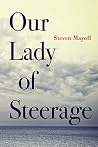
In closing, I should mention that along with the content, I was very pleased to newly appreciate the book’s design, done by Bunim & Bannigan’s then go-to designer Matthew McKay. Working with him started a long-standing friendship over the years that exists to this day.
If you have made it this far, you might be tempted to read the book yourself (typos and all). I encourage you to either order it through your local bookshop or see if your library has it on their shelves. If you want to try your luck online, the book’s page on the Bunim & Bannigan web site is https://bunimandbanniganbooks.com/fic... ...more "


Steven’s 2025 Year in Books
Take a look at Steven’s Year in Books, including some fun facts about their reading.

Polls voted on by Steven
Lists liked by Steven