
Discover new books on Goodreads
Meet your next favorite book





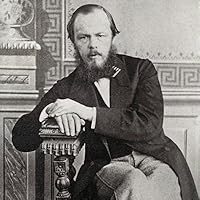
“Man is a mystery. It needs to be unravelled, and if you spend your whole life unravelling it, don't say that you've wasted time. I am studying that mystery because I want to be a human being.”
―
―
“My task is to explain to you as quickly as possible my essence, that is, what sort of man I am, what I believe in, and what I hope for, is that right? And therefore I declare that I accept God pure and simple. But this, however, needs to be noted: if God exists and if he indeed created the earth, then, as we know perfectly well, he created it in accordance with Euclidean geometry, and he created human reason with a conception of only three dimensions of space. At the same time there were and are even now geometers and philosophers, even some of the most outstanding among them, who doubt that the whole universe, or, even more broadly, the whole of being, was created purely in accordance with Euclidean geometry; they even dare to dream that two parallel lines, which according to Euclid cannot possibly meet on earth, may perhaps meet somewhere in infinity. I, my dear, have come to the conclusion that if I cannot understand even that, then it is not for me to understand about God. I humbly confess that I do not have any ability to resolve such questions, I have a Euclidean mind, an earthly mind, and therefore it is not for us to resolve things that are not of this world. And I advise you never to think about it, Alyosha my friend, and most especially about whether God exists or not. All such questions are completely unsuitable to a mind created with a concept of only three dimensions. And so, I accept God, not only willingly, but moreover I also accept his wisdom and his purpose, which are completely unknown to us; I believe in order, in the meaning of life, I believe in eternal harmony, in which we are all supposed to merge, I believe in the Word for whom the universe is yearning, and who himself was 'with God,' who himself is God, and so on and so forth, to infinity. Many words have been invented on the subject. It seems I'm already on a good path, eh? And now imagine that in the final outcome I do not accept this world of God's, created by God, that I do not accept and cannot agree to accept. With one reservation: I have a childlike conviction that the sufferings will be healed and smoothed over, that the whole offensive comedy of human contradictions will disappear like a pitiful mirage, a vile concoction of man's Euclidean mind, feeble and puny as an atom, and that ultimately, at the world's finale, in the moment of eternal harmony, there will occur and be revealed something so precious that it will suffice for all hearts, to allay all indignation, to redeem all human villainy, all bloodshed; it will suffice not only to make forgiveness possible, but also to justify everything that has happened with men--let this, let all of this come true and be revealed, but I do not accept it and do not want to accept it! Let the parallel lines even meet before my own eyes: I shall look and say, yes, they meet, and still I will not accept it.”
― The Brothers Karamazov
― The Brothers Karamazov

“You know, O friend, any meeting is surely more than parting. There is emptiness before meeting someone, just nothing, but there is no longer emptiness after parting. After having met someone once, it is impossible to part completely. A person remains in the memory, as a part of the memory. The person created that part and that part lives, sometimes coming into contact with its creator. Otherwise, how would we sense those dear to us from a distance?”
― Laurus
― Laurus
“The three men walked on and were met by ever more new saints. The saints were not exactly moving or even speaking, but the silence and immobility of the dead were not absolute. There was, under the ground, a motion that was not completely usual, and a particular sort of voices rang out without disturbing the sternness and repose. The saints spoke using words from psalms and lines from the lives of saints that Arseny remembered well from childhood. When they drew the candles closer, shadows shifted along dried faces and brown, half-bent hands. The saints seemed to raise their heads, smile, and beckon, barely perceptibly, with their hands. A city of saints, whispered Ambrogio, following the play of the shadow. They present us the illusion of life. No, objected Arseny, also in a whisper. They disprove the illusion of death.”
― Laurus
― Laurus

“Mysticism keeps men sane. As long as you have mystery you have health; when you destroy mystery you create morbidity. The ordinary man has always been sane because the ordinary man has always been a mystic. He has permitted the twilight. He has always had one foot in earth and the other in fairyland. He has always left himself free to doubt his gods; but (unlike the agnostic of to-day) free also to believe in them. He has always cared more for truth than for consistency. If he saw two truths that seemed to contradict each other, he would take the two truths and contradiction along with them. His spiritual sight is stereoscopic, like his physical sight: he sees two different pictures at once and yet sees all the better for that. Thus, he has always believed that there was such a thing as fate, but such a thing as free will also. Thus, he believes that children were indeed the kingdom of heaven, but nevertheless ought to be obedient to the kingdom of earth. He admired youth because it was young and age because it was not. It is exactly this balance of apparent contradictions that has been the whole buoyancy of the healthy man. The whole secret of mysticism is this: that man can understand everything by the help of what he does not understand. The morbid logician seeks to make everything lucid, and succeeds in making everything mysterious. The mystic allows one thing to be mysterious, and everything else becomes lucid.”
―
―


Samuel’s 2025 Year in Books
Take a look at Samuel’s Year in Books, including some fun facts about their reading.


Polls voted on by Samuel
Lists liked by Samuel