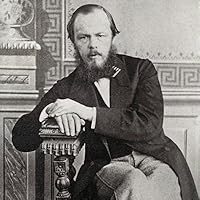
Jeff Valodine
https://www.goodreads.com/doxatheos
“Above all, don't lie to yourself. The man who lies to himself and listens to his own lie comes to a point that he cannot distinguish the truth within him, or around him, and so loses all respect for himself and for others. And having no respect he ceases to love.”
― The Brothers Karamazov
“The theological perspective of participation actually saves the appearances by exceeding them. It recognizes that materialism and spiritualism are false alternatives, since if there is only finite matter there is not even that, and that for phenomena really to be there they must be more than there. Hence, by appealing to an eternal source for bodies, their art, language, sexual and political union, one is not ethereally taking leave of their density. On the contrary, one is insisting that behind this density resides an even greater density – beyond all contrasts of density and lightness (as beyond all contrasts of definition and limitlessness). This is to say that all there is only is because it is more than it is. (...)
This perspective should in many ways be seen as undercutting some of the contrasts between theological liberals and conservatives. The former tend to validate what they see as the modern embrace of our finitude – as language, and as erotic and aesthetically delighting bodies, and so forth. Conservatives, however, seem still to embrace a sort of nominal ethereal distancing from these realities and a disdain for them. Radical orthodoxy, by contrast, sees the historic root of the celebration of these things in participatory philosophy and incarnational theology, even if it can acknowledge that premodern tradition never took this celebration far enough. The modern apparent embrace of the finite it regards as, on inspection, illusory, since in order to stop the finite vanishing modernity must construe it as a spatial edifice bound by clear laws, rules and lattices. If, on the other hand, following the postmodern options, it embraces the flux of things, this is an empty flux both concealing and revealing an ultimate void. Hence, modernity has oscillated between puritanism (sexual or otherwise) and an entirely perverse eroticism, which is in love with death and therefore wills the death also of the erotic, and does not preserve the erotic as far as an eternal consummation. In a bizarre way, it seems that modernity does not really want what it thinks it wants; but on the other hand, in order to have what it thinks it wants, it would have to recover the theological. Thereby, of course, it would discover also that that which it desires is quite other than it has supposed”
― Radical Orthodoxy: A New Theology
This perspective should in many ways be seen as undercutting some of the contrasts between theological liberals and conservatives. The former tend to validate what they see as the modern embrace of our finitude – as language, and as erotic and aesthetically delighting bodies, and so forth. Conservatives, however, seem still to embrace a sort of nominal ethereal distancing from these realities and a disdain for them. Radical orthodoxy, by contrast, sees the historic root of the celebration of these things in participatory philosophy and incarnational theology, even if it can acknowledge that premodern tradition never took this celebration far enough. The modern apparent embrace of the finite it regards as, on inspection, illusory, since in order to stop the finite vanishing modernity must construe it as a spatial edifice bound by clear laws, rules and lattices. If, on the other hand, following the postmodern options, it embraces the flux of things, this is an empty flux both concealing and revealing an ultimate void. Hence, modernity has oscillated between puritanism (sexual or otherwise) and an entirely perverse eroticism, which is in love with death and therefore wills the death also of the erotic, and does not preserve the erotic as far as an eternal consummation. In a bizarre way, it seems that modernity does not really want what it thinks it wants; but on the other hand, in order to have what it thinks it wants, it would have to recover the theological. Thereby, of course, it would discover also that that which it desires is quite other than it has supposed”
― Radical Orthodoxy: A New Theology
Worldview Institute (Seminary, Academy & Library)
— 55 members
— last activity Aug 28, 2017 11:56PM
An online Forum for promoting and discussing ideas and beliefs (Worldviews) related to the following interests within the Humanities: Theology, Philos ...more

Jeff’s 2025 Year in Books
Take a look at Jeff’s Year in Books, including some fun facts about their reading.
More friends…
Polls voted on by Jeff
Lists liked by Jeff