
Discover new books on Goodreads
Meet your next favorite book




“Interestingly, Dominus Iesus, following the Letter Communionis Notio of 1992, did, in fact, attribute the title “particular churches” to the Local Orthodox Churches. Ocáriz’s explanation of what this attribution means shows even more clearly the divergence that exists between the two views of the Church. He claims that this attribution is based not upon the real, Eucharistic presence of Christ but upon “the real presence of the Petrine Primacy (and of the Episcopal College) in of the ‘one and undivided’ episcopate—a unity that cannot exist without the Bishop of Rome.” Further, he writes:
"Where, on account of apostolic succession, a valid episcopate exists, the Episcopal College with its Head is objectively present as supreme authority ( even if, in fact, that authority is not recognized ). Furthermore, in every valid celebration of the Eucharist, there is an objective reference to the universal communion with the Successor of Peter and with the entire Church, independent of subjective convictions."
As the supreme and final criterion of full ecclesiality the Pope is seen not only to supplant the Eucharistic Presence of the Lord Himself, but to be present as “supreme authority” in the Eucharistic Synaxis of those not in communion with him, even if this is against their will. Whereas, for the Orthodox, the ever-present and existential reality manifested by the Holy Spirit at every Eucharistic gathering is dogmatic truth and a unity in truth freely espoused, for the Latins it is the “objective reference to the universal communion” with the Pope “independent of subjective convictions.”
― The Ecclesiological Renovation of Vatican II: An Orthodox Examination of Rome's Ecumenical Theology Regarding Baptism and the Church
"Where, on account of apostolic succession, a valid episcopate exists, the Episcopal College with its Head is objectively present as supreme authority ( even if, in fact, that authority is not recognized ). Furthermore, in every valid celebration of the Eucharist, there is an objective reference to the universal communion with the Successor of Peter and with the entire Church, independent of subjective convictions."
As the supreme and final criterion of full ecclesiality the Pope is seen not only to supplant the Eucharistic Presence of the Lord Himself, but to be present as “supreme authority” in the Eucharistic Synaxis of those not in communion with him, even if this is against their will. Whereas, for the Orthodox, the ever-present and existential reality manifested by the Holy Spirit at every Eucharistic gathering is dogmatic truth and a unity in truth freely espoused, for the Latins it is the “objective reference to the universal communion” with the Pope “independent of subjective convictions.”
― The Ecclesiological Renovation of Vatican II: An Orthodox Examination of Rome's Ecumenical Theology Regarding Baptism and the Church
“One is reminded of Patriarch Nicephoros (806-815), who believed that “not only Christ, but the whole universe disappears if neither circumscribability nor image exist.”
― The Art of Seeing: Paradox and Perception in Orthodox Iconography
― The Art of Seeing: Paradox and Perception in Orthodox Iconography
“The process of disintegration described earlier with regard to the rites of initiation is apparent here, again, with regard to the theology of initiation and membership. In Augustine, membership was located within the threefold unity of faith, Baptism, and “Catholic peace” or Church unity. In Suárez, who refers back to Augustine but misunderstands him, it was faith, righteousness, and baptismal character. In Benedict XIV, who refers back to Suárez, it is now only baptismal character, which—it is important to stress—depends only upon “the proper form and matter” (validity). The initial, more restrained sacramental minimalism of Augustine has undergone such a “development of doctrine” as would be unrecognizable to Augustine himself.”
― The Ecclesiological Renovation of Vatican II: An Orthodox Examination of Rome's Ecumenical Theology Regarding Baptism and the Church
― The Ecclesiological Renovation of Vatican II: An Orthodox Examination of Rome's Ecumenical Theology Regarding Baptism and the Church
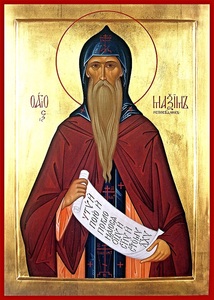
“St. Maximus the Confessor: “In no way will I say anything of my own, but what I have learned from the Fathers, altering nothing of their teaching.”
― The Ecclesiological Renovation of Vatican II: An Orthodox Examination of Rome's Ecumenical Theology Regarding Baptism and the Church
― The Ecclesiological Renovation of Vatican II: An Orthodox Examination of Rome's Ecumenical Theology Regarding Baptism and the Church
 Holy Trinity Publications
— 79 members
— last activity Sep 10, 2017 04:21AM
Holy Trinity Publications
— 79 members
— last activity Sep 10, 2017 04:21AM
A group for announcements and discussions about the publishing arm of Holy Trinity Monastery in Jordanville, NY. Formerly known as the Printshop of St ...more


Maximus’s 2025 Year in Books
Take a look at Maximus’s Year in Books, including some fun facts about their reading.

2,272 books
|
673 friends

165 books
|
144 friends

177 books
|
9 friends

340 books
|
13 friends

4 books
|
1 friend


Polls voted on by Maximus
Lists liked by Maximus