Discover new books on Goodreads
Meet your next favorite book
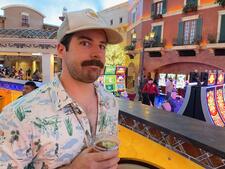
Blake Birmingham
https://www.goodreads.com/blakamiss


“I must not fear. Fear is the mind-killer. Fear is the little-death that brings total obliteration. I will face my fear. I will permit it to pass over me and through me. And when it has gone past I will turn the inner eye to see its path. Where the fear has gone there will be nothing. Only I will remain.”
― Dune
― Dune

“It's like everyone tells a story about themselves inside their own head. Always. All the time. That story makes you what you are. We build ourselves out of that story.”
― The Name of the Wind
― The Name of the Wind
“Perhaps the greatest faculty our minds possess is the ability to cope with pain. Classic thinking teaches us of the four doors of the mind, which everyone moves through according to their need.
First is the door of sleep. Sleep offers us a retreat from the world and all its pain. Sleep marks passing time, giving us distance from the things that have hurt us. When a person is wounded they will often fall unconscious. Similarly, someone who hears traumatic news will often swoon or faint. This is the mind's way of protecting itself from pain by stepping through the first door.
Second is the door of forgetting. Some wounds are too deep to heal, or too deep to heal quickly. In addition, many memories are simply painful, and there is no healing to be done. The saying 'time heals all wounds' is false. Time heals most wounds. The rest are hidden behind this door.
Third is the door of madness. There are times when the mind is dealt such a blow it hides itself in insanity. While this may not seem beneficial, it is. There are times when reality is nothing but pain, and to escape that pain the mind must leave reality behind.
Last is the door of death. The final resort. Nothing can hurt us after we are dead, or so we have been told.”
― The Name of the Wind
“You think man can destroy the planet? What intoxicating vanity. Let me tell you about our planet. Earth is four-and-a-half-billion-years-old. There's been life on it for nearly that long, 3.8 billion years. Bacteria first; later the first multicellular life, then the first complex creatures in the sea, on the land. Then finally the great sweeping ages of animals, the amphibians, the dinosaurs, at last the mammals, each one enduring millions on millions of years, great dynasties of creatures rising, flourishing, dying away -- all this against a background of continuous and violent upheaval. Mountain ranges thrust up, eroded away, cometary impacts, volcano eruptions, oceans rising and falling, whole continents moving, an endless, constant, violent change, colliding, buckling to make mountains over millions of years. Earth has survived everything in its time. It will certainly survive us. If all the nuclear weapons in the world went off at once and all the plants, all the animals died and the earth was sizzling hot for a hundred thousand years, life would survive, somewhere: under the soil, frozen in Arctic ice. Sooner or later, when the planet was no longer inhospitable, life would spread again. The evolutionary process would begin again. It might take a few billion years for life to regain its present variety. Of course, it would be very different from what it is now, but the earth would survive our folly, only we would not. If the ozone layer gets thinner, ultraviolet radiation sears the earth, so what? Ultraviolet radiation is good for life. It's powerful energy. It promotes mutation, change. Many forms of life will thrive with more UV radiation. Many others will die out. Do you think this is the first time that's happened? Think about oxygen. Necessary for life now, but oxygen is actually a metabolic poison, a corrosive glass, like fluorine. When oxygen was first produced as a waste product by certain plant cells some three billion years ago, it created a crisis for all other life on earth. Those plants were polluting the environment, exhaling a lethal gas. Earth eventually had an atmosphere incompatible with life. Nevertheless, life on earth took care of itself. In the thinking of the human being a hundred years is a long time. A hundred years ago we didn't have cars, airplanes, computers or vaccines. It was a whole different world, but to the earth, a hundred years is nothing. A million years is nothing. This planet lives and breathes on a much vaster scale. We can't imagine its slow and powerful rhythms, and we haven't got the humility to try. We've been residents here for the blink of an eye. If we're gone tomorrow, the earth will not miss us.”
― Jurassic Park / Congo
― Jurassic Park / Congo
“The older the violin, the sweeter the music.”
― Lonesome Dove
― Lonesome Dove


Blake’s 2025 Year in Books
Take a look at Blake’s Year in Books, including some fun facts about their reading.

435 books
|
2 friends

322 books
|
19 friends
21 books
|
2 friends

227 books
|
24 friends


Favorite Genres
Polls voted on by Blake
Lists liked by Blake