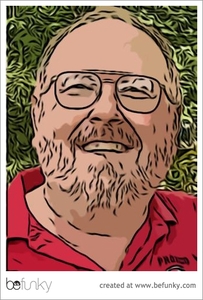
Brent Jones
https://www.goodreads.com/brentrjones

“Don't you believe in flying saucers, they ask me? Don't you believe in telepathy? — in ancient astronauts? — in the Bermuda triangle? — in life after death?
No, I reply. No, no, no, no, and again no.
One person recently, goaded into desperation by the litany of unrelieved negation, burst out "Don't you believe in anything?"
Yes", I said. "I believe in evidence. I believe in observation, measurement, and reasoning, confirmed by independent observers. I'll believe anything, no matter how wild and ridiculous, if there is evidence for it. The wilder and more ridiculous something is, however, the firmer and more solid the evidence will have to be.”
―
No, I reply. No, no, no, no, and again no.
One person recently, goaded into desperation by the litany of unrelieved negation, burst out "Don't you believe in anything?"
Yes", I said. "I believe in evidence. I believe in observation, measurement, and reasoning, confirmed by independent observers. I'll believe anything, no matter how wild and ridiculous, if there is evidence for it. The wilder and more ridiculous something is, however, the firmer and more solid the evidence will have to be.”
―
“Throw a stick, and the servile dog wheezes and pants and stumbles to bring it to you. Do the same before a cat, and he will eye you with coolly polite and somewhat bored amusement. And just as inferior people prefer the inferior animal which scampers excitedly because someone else wants something, so do superior people respect the superior animal which lives its own life and knows that the puerile stick-throwings of alien bipeds are none of its business and beneath its notice. The dog barks and begs and tumbles to amuse you when you crack the whip. That pleases a meekness-loving peasant who relishes a stimulus to his self importance. The cat, on the other hand, charms you into playing for its benefit when it wishes to be amused; making you rush about the room with a paper on a string when it feels like exercise, but refusing all your attempts to make it play when it is not in the humour. That is personality and individuality and self-respect -- the calm mastery of a being whose life is its own and not yours -- and the superior person recognises and appreciates this because he too is a free soul whose position is assured, and whose only law is his own heritage and aesthetic sense.”
―
―
“I have seen the dark universe yawning
Where the black planets roll without aim,
Where they roll in their horror unheeded,
Without knowledge, or lustre, or name.”
― Nemesis
Where the black planets roll without aim,
Where they roll in their horror unheeded,
Without knowledge, or lustre, or name.”
― Nemesis
“A number of years ago, when I was a freshly-appointed instructor, I met, for the first time, a certain eminent historian of science. At the time I could only regard him with tolerant condescension.
I was sorry of the man who, it seemed to me, was forced to hover about the edges of science. He was compelled to shiver endlessly in the outskirts, getting only feeble warmth from the distant sun of science- in-progress; while I, just beginning my research, was bathed in the heady liquid heat up at the very center of the glow.
In a lifetime of being wrong at many a point, I was never more wrong. It was I, not he, who was wandering in the periphery. It was he, not I, who lived in the blaze.
I had fallen victim to the fallacy of the 'growing edge;' the belief that only the very frontier of scientific advance counted; that everything that had been left behind by that advance was faded and dead.
But is that true? Because a tree in spring buds and comes greenly into leaf, are those leaves therefore the tree? If the newborn twigs and their leaves were all that existed, they would form a vague halo of green suspended in mid-air, but surely that is not the tree. The leaves, by themselves, are no more than trivial fluttering decoration. It is the trunk and limbs that give the tree its grandeur and the leaves themselves their meaning.
There is not a discovery in science, however revolutionary, however sparkling with insight, that does not arise out of what went before. 'If I have seen further than other men,' said Isaac Newton, 'it is because I have stood on the shoulders of giants.”
― Adding a Dimension: Seventeen Essays on the History of Science
I was sorry of the man who, it seemed to me, was forced to hover about the edges of science. He was compelled to shiver endlessly in the outskirts, getting only feeble warmth from the distant sun of science- in-progress; while I, just beginning my research, was bathed in the heady liquid heat up at the very center of the glow.
In a lifetime of being wrong at many a point, I was never more wrong. It was I, not he, who was wandering in the periphery. It was he, not I, who lived in the blaze.
I had fallen victim to the fallacy of the 'growing edge;' the belief that only the very frontier of scientific advance counted; that everything that had been left behind by that advance was faded and dead.
But is that true? Because a tree in spring buds and comes greenly into leaf, are those leaves therefore the tree? If the newborn twigs and their leaves were all that existed, they would form a vague halo of green suspended in mid-air, but surely that is not the tree. The leaves, by themselves, are no more than trivial fluttering decoration. It is the trunk and limbs that give the tree its grandeur and the leaves themselves their meaning.
There is not a discovery in science, however revolutionary, however sparkling with insight, that does not arise out of what went before. 'If I have seen further than other men,' said Isaac Newton, 'it is because I have stood on the shoulders of giants.”
― Adding a Dimension: Seventeen Essays on the History of Science
“The Earth should not be cut up into hundreds of different sections, each inhabited by a self-defined segment of humanity that considers its own welfare and its own "national security" to be paramount above all other consideration.
I am all for cultural diversity and would be willing to see each recognizable group value its cultural heritage. I am a New York patriot, for instance, and if I lived in Los Angeles, I would love to get together with other New York expatriates and sing "Give My Regards to Broadway."
This sort of thing, however, should remain cultural and benign. I'm against it if it means that each group despises others and lusts to wipe them out. I'm against arming each little self-defined group with weapons with which to enforce its own prides and prejudices.
The Earth faces environmental problems right now that threaten the imminent destruction of civilization and the end of the planet as a livable world. Humanity cannot afford to waste its financial and emotional resources on endless, meaningless quarrels between each group and all others. there must be a sense of globalism in which the world unites to solve the real problems that face all groups alike.
Can that be done? The question is equivalent to: Can humanity survive?
I am not a Zionist, then, because I don't believe in nations, and because Zionism merely sets up one more nation to trouble the world. It sets up one more nation to have "rights" and "demands" and "national security" and to feel it must guard itself against its neighbors.
There are no nations! There is only humanity. And if we don't come to understand that right soon, there will be no nations, because there will be no humanity. ”
― I. Asimov: A Memoir
I am all for cultural diversity and would be willing to see each recognizable group value its cultural heritage. I am a New York patriot, for instance, and if I lived in Los Angeles, I would love to get together with other New York expatriates and sing "Give My Regards to Broadway."
This sort of thing, however, should remain cultural and benign. I'm against it if it means that each group despises others and lusts to wipe them out. I'm against arming each little self-defined group with weapons with which to enforce its own prides and prejudices.
The Earth faces environmental problems right now that threaten the imminent destruction of civilization and the end of the planet as a livable world. Humanity cannot afford to waste its financial and emotional resources on endless, meaningless quarrels between each group and all others. there must be a sense of globalism in which the world unites to solve the real problems that face all groups alike.
Can that be done? The question is equivalent to: Can humanity survive?
I am not a Zionist, then, because I don't believe in nations, and because Zionism merely sets up one more nation to trouble the world. It sets up one more nation to have "rights" and "demands" and "national security" and to feel it must guard itself against its neighbors.
There are no nations! There is only humanity. And if we don't come to understand that right soon, there will be no nations, because there will be no humanity. ”
― I. Asimov: A Memoir
Goodreads Authors/Readers
— 56510 members
— last activity 1 hour, 10 min ago
This group is dedicated to connecting readers with Goodreads authors. It is divided by genres, and includes folders for writing resources, book websit ...more
Scandinavian Crime Fiction
— 373 members
— last activity Feb 06, 2023 05:36AM
Thanks to a tattooed, adventurous , bisexual computer hacker named Lisbeth Salander, Scandinavian crime fiction is now one of the most popular categor ...more
Apocalypse Whenever
— 13954 members
— last activity 5 hours, 24 min ago
The most active group for apocalyptic and dystopian stories! Join a monthly book discussion, get recommendations, or just tell us if you like canned p ...more

Brent’s 2025 Year in Books
Take a look at Brent’s Year in Books, including some fun facts about their reading.
More friends…
Favorite Genres
Polls voted on by Brent
Lists liked by Brent