This will prevent Krishna from sending you messages, friend request or from viewing your profile. They will not be notified. Comments on discussion boards from them will be hidden by default.
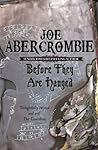
‘Shit,’ he said again. Couldn’t think of aught else to say. ‘Reckon the Union were marching up this road.’ Threetrees was frowning hard. ‘Reckon they were hurrying. Trying to catch Bethod unawares.’ ‘Seems they weren’t scouting too‘Shit,’ he said again. Couldn’t think of aught else to say. ‘Reckon the Union were marching up this road.’ Threetrees was frowning hard. ‘Reckon they were hurrying. Trying to catch Bethod unawares.’ ‘Seems they weren’t scouting too careful,’ rumbled Tul Duru. ‘Seems like it was Bethod caught them out.’ ‘Maybe it was misty,’ said Dogman, ‘like today.’ Threetrees shrugged. ‘Maybe. It’s the time of year for it. Either way they were on the road, in column, tired from a long day’s tramp. Bethod came on ’em from here, and from up there, on the ridge. Arrows first, to break ’em up, then the Carls, coming down from the tall ground, screaming and ready to go. The Union broke quick, I reckon.’ ‘Real quick,’ said Dow. ‘And then it was a slaughter. Spread out on the road. Trapped against the water. Nowhere much to run to. Men trying to pull their armour off, men trying to swim the river with their armour on. Packing in and climbing one on top o’ the other, with arrows falling down all round. Some of ’em might’ve got as far as those woods down there, but knowing Bethod he’d have had a few horsemen tucked away, ready to lick the plate.’...more
word for word description of the battle of lake trasimene (217BC)
“What kind of man would put a known criminal in charge of a major branch of government? Apart from, say, the average voter.”
―
Terry Pratchett,
Going Postal
Septon Meribald disagreed. "More less than more. There are many sorts of outlaws, just as there are many sorts of birds. A sandpiper and a sea eagle both have wings, but they are not the same. The singers love to sing of good men forced to go outside the law to fight some wicked lord, but most outlaws are more like this ravening Hound than they are the lightning lord. They are evil men, driven by greed, soured by malice, despising the gods and caring only for themselves. Broken men are more deserving of our pity, though they may be just as dangerous. Almost all are common-born, simple folk who had never been more than a mile from the house where they were born until the day some lord came round to take them off to war. Poorly shod and poorly clad, they march away beneath his banners, ofttimes with no better arms than a sickle or a sharpened hoe, or a maul they made themselves by lashing a stone to a stick with strips of hide. Brothers march with brothers, sons with fathers, friends with friends. They've heard the songs and stories, so they go off with eager hearts, dreaming of the wonders they will see, of the wealth and glory they will win. War seems a fine adventure, the greatest most of them will ever know. "Then they get a taste of battle. "For some, that one taste is enough to break them. Others go on for years, until they lose count of all the battles they have fought in, but even a man who has survived a hundred fights can break in his hundred-and-first. Brothers watch their brothers die, fathers lose their sons, friends see their friends trying to hold their entrails in after they've been gutted by an axe. "They see the lord who led them there cut down, and some other lord shouts that they are his now. They take a wound, and when that's still half-healed they take another. There is never enough to eat, their shoes fall to pieces from the marching, their clothes are torn and rotting, and half of them are shitting in their breeches from drinking bad water.
"If they want new boots or a warmer cloak or maybe a rusted iron halfhelm, they need to take them from a corpse, and before long they are stealing from the living too, from the smallfolk whose lands they're fighting in, men very like the men they used to be. They slaughter their sheep and steal their chicken's, and from there it's just a short step to carrying off their daughters too. And one day they look around and realize all their friends and kin are gone, that they are fighting beside strangers beneath a banner that they hardly recognize. They don't know where they are or how to get back home and the lord they're fighting for does not know their names, yet here he comes, shouting for them to form up, to make a line with their spears and scythes and sharpened hoes, to stand their ground. And the knights come down on them, faceless men clad all in steel, and the iron thunder of their charge seems to fill the world...
"And the man breaks.
"He turns and runs, or crawls off afterward over the corpses of the slain, or steals away in the black of night, and he finds someplace to hide. All thought of home is gone by then, and kings and lords and gods mean less to him than a haunch of spoiled meat that will let him live another day, or a skin of bad wine that might drown his fear for a few hours. The broken man lives from day to day, from meal to meal, more beast than man. Lady Brienne is not wrong. In times like these, the traveler must beware of broken men, and fear them...but he should pity them as well”
―
George R.R. Martin
“But in a solitary life, there are rare moments when another soul dips near yours, as stars once a year brush the earth. Such a constellation was he to me.”
―
Madeline Miller,
Circe
“There were plotters, there was no doubt about it. Some had been ordinary people who'd had enough. Some were young people with no money who objected to the fact that the world was run by old people who were rich. Some were in it to get girls. And some had been idiots as mad as Swing, with a view of the world just as rigid and unreal, who were on the side of what they called 'the people'. Vimes had spent his life on the streets, and had met decent men and fools and people who'd steal a penny from a blind beggar and people who performed silent miracles or desperate crimes every day behind the grubby windows of little houses, but he'd never met The People.
People on the side of The People always ended up disappointed, in any case. They found that The People tended not to be grateful or appreciative or forward-thinking or obedient. The People tended to be small-minded and conservative and not very clever and were even distrustful of cleverness. And so the children of the revolution were faced with the age-old problem: it wasn't that you had the wrong kind of government, which was obvious, but that you had the wrong kind of people. As soon as you saw people as things to be measured, they didn't measure up. What would run through the streets soon enough wouldn't be a revolution or a riot. It'd be people who were frightened and panicking. It was what happened when the machinery of city life faltered, the wheels stopped turning and all the little rules broke down. And when that happened, humans were worse than sheep. Sheep just ran; they didn't try to bite the sheep next to them.”
―
Terry Pratchett,
Night Watch

 Sign in with Facebook