
Alan (The Lone Librarian) Teder’s Reviews > 1066 : The Hidden History of the Bayeux Tapestry > Status Update

Alan (The Lone Librarian) Teder
is 31% done
Odo was certainly one of the duke’s key advisers, but no other source gives him such a prominent role in persuading his brother to take up arms and invade England. This is another clue about the tapestry’s origin. It is the first hint that the tapestry’s artist is making a special point of flattering Bishop Odo of Bayeux.
— Sep 09, 2026 06:34PM

2 likes · Like flag
Alan (The Lone Librarian)’s Previous Updates
Alan (The Lone Librarian) Teder
is 98% done
Lizzie Allen painstakingly traced the images onto a long strip of linen, in preparation for the 35 embroiderers who would employ their needles to capture the 626 human figures, 190 horses, 35 dogs and 506 other birds and animals of the original tapestry.
— Sep 13, 2026 04:58PM
Alan (The Lone Librarian) Teder
is 96% done
‘I really enjoyed that, I probably enjoyed it too much … gathering evidence, following leads. And I needed to do a lot of pondering. It was like trying to reconstruct a puzzle, where half the pieces are missing, and there’s no box either. You’re trying to sort out the pieces you have, imagine what the missing pieces are, and then work out where they all belong in the bigger picture.’
— Sep 13, 2026 04:57PM
Alan (The Lone Librarian) Teder
is 76% done
The tapestry tells us that the Norman claim to the throne was built upon a lie. It was the lie that near the end of his reign King Edward sent Harold to Normandy in order to confirm William’s status as the next king. Harold had journeyed to the continent on his own account but foolishly he swore an oath in William’s favour in order to extract himself from his prolonged and dangerous stay in Normandy.
— Sep 13, 2026 04:56PM
Alan (The Lone Librarian) Teder
is 75% done
As the grave was being dug for Bishop Jean in 1412, the crypt was rediscovered. Was it perhaps on this occasion that the Bayeux Tapestry itself came to light? The first time that the tapestry is mentioned in any surviving written document is in 1476, when it is recorded as among the possessions of the cathedral.
— Sep 13, 2026 04:54PM
Alan (The Lone Librarian) Teder
is 69% done
The tenor of this book has been to cast doubt on the idea, which has long reigned unquestioned, that Odo was the tapestry’s patron. Rather it has been argued that Count Eustace II of Boulogne may have had a much closer involvement in the making of the tapestry than has hitherto been believed and that he may, in fact, have been its patron.
— Sep 13, 2026 04:51PM
Alan (The Lone Librarian) Teder
is 67% done
The thrust of the argument of this chapter has been that the lady depicted in the Bayeux Tapestry is Ælfgifu of Northampton, whose eventful life in England, Denmark and Norway we have recalled. But why should the artist of the tapestry have broken off his tale of Harold and William in order to allude to an old scandal that had ceased to be relevant after 1040, when the last of Ælfgifu’s bastards died?
— Sep 13, 2026 09:47AM
Alan (The Lone Librarian) Teder
is 57% done
If we are right in taking Turold to be a court dwarf, he stands in the line of a long tradition. Dwarfs have found employment in wealthy households in many periods of history, stretching back to ancient Egypt and imperial Rome, and through to Renaissance times and beyond.
— Sep 12, 2026 09:56AM
Alan (The Lone Librarian) Teder
is 43% done
We have, then, a work that was probably made by English embroiderers at Canterbury, either to the designs of a long-standing French émigré or to those of an English artist who was working closely with a French colleague. Although at one level the tapestry flatters Bishop Odo of Bayeux, it is also shot through with a succession of subversive viewpoints, all inimical to Norman interests.
— Sep 11, 2026 02:28PM
Alan (The Lone Librarian) Teder
is 41% done
The closer one looks the more the Norman case evaporates before our eyes. We see the true reason for Harold’s journey to the continent; we see that in the early 1060s King Edward the Confessor did not support Duke William’s claim; and at the Battle of Hastings it is the French under Count Eustace II of Boulogne who take the starring role.
— Sep 11, 2026 06:15AM
Alan (The Lone Librarian) Teder
is 40% done
In the 1950s the art historian Francis Wormald turned his attention to the Bayeux Tapestry. He found that he was able to identify a number of stylistic affinities, narrative analogies and visual quotations which strongly suggested, as many now suspected, that the tapestry’s master artist was working within the Anglo-Saxon world, and not in Normandy at all.
— Sep 10, 2026 02:57PM
Comments Showing 1-2 of 2 (2 new)
date newest »
newest »
message 1:
by
Berengaria
(new)
Sep 09, 2026 10:31PM
 But he commissioned and paid for it, didn't he? Why wouldn't he get some good press, seeing as how Odo and William were not always on the best of terms?
reply
|
flag
Berengaria wrote: "But he commissioned and paid for it, didn't he? Why wouldn't he get some good press, seeing as how Odo and William were not always on the best of terms?"The Odo commission is the conventional story because of the tapestry ending up in Bayeux. The speculation in this book is that the commission was instead a peace-making gesture and gift by Eustace II Count of Boulogne towards Odo because they had a falling out after the invasion.
The various clues are Eustace's large presence in the tapestry alongside Odo, the overall French (Boulogne) prevalence in the tapestry over the Normans, various other tapestry characters having a tie-in to Eustace and the French, including the really wild speculation that the Tapestry's Turold the dwarf was the French writer of the contemporaneous The Song of Roland. The final line of The Song of Roland reads: "So ends the tale which Turold hath conceived." (orig. French: "Ici finit la Geste que chante Turoldus.")
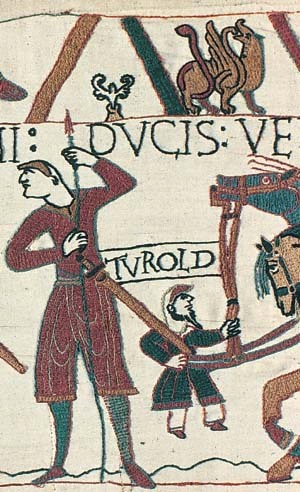
Turold in the Bayeux Tapestry
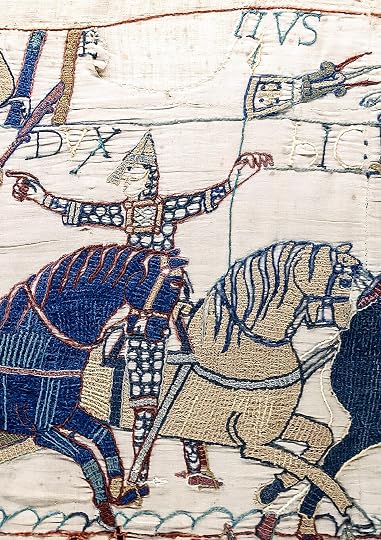
Eustace, Count of Boulogne in the Bayeux Tapestry
I know it is all pretty wild stuff going against the long accepted story of the origins and themes of the piece, but as mentioned in my other note, I am rather accepting of subversive messages in art works 😊.