
Elham’s Reviews > Sapiens: A Brief History of Humankind > Status Update

Elham
is 18% done
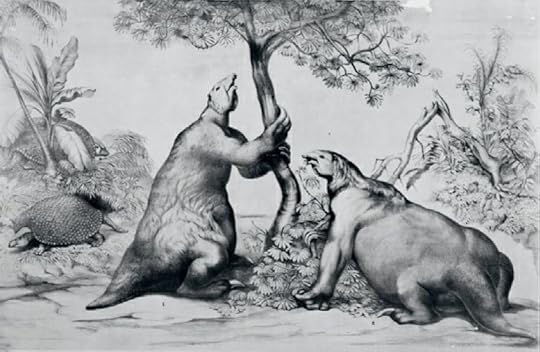
"Reconstructions of two giant ground sloths (Megatherium) and behind them two giant armadillos (Glyptodon). Now extinct, giant armadillos measured over three meters in length and weighed up to two tons, whereas giant ground sloths reached heights of up to six meters, and weighed up to eight tons."
— Mar 07, 2021 11:02PM
"Reconstructions of two giant ground sloths (Megatherium) and behind them two giant armadillos (Glyptodon). Now extinct, giant armadillos measured over three meters in length and weighed up to two tons, whereas giant ground sloths reached heights of up to six meters, and weighed up to eight tons."

10 likes · Like flag
Elham’s Previous Updates
Elham
is 75% done
After 1908, and especially after 1945, capitalist greed was somewhat reined in, not least due to the fear of Communism. Yet inequities are still rampant. The economic pie of 2014 is far larger than the pie of 1500, but it is distributed so unevenly that many African peasants and Indonesian labourers return home after a hard day’s work with less food than did their ancestors 500 years ago.
— Mar 15, 2021 09:58PM
Elham
is 70% done
It was lose-lose. Because credit was limited, people had trouble financing new businesses. Because there were few new businesses, the economy did not grow. Because it did not grow, people assumed it never would, and those who had capital were wary of extending credit. The expectation of stagnation fulfilled itself.
— Mar 14, 2021 10:13PM
Elham
is 65% done
On 20 July 1969, Neil Armstrong and Buzz Aldrin landed on the surface of the moon. In the months leading up to their expedition, the Apollo 11 astronauts trained in a remote moon-like desert in the western United States. The area is home to several Native American communities, and there is a story – or legend – describing an encounter between the astronauts and one of the locals.
...
— Mar 13, 2021 09:15PM
...
Comments Showing 1-6 of 6 (6 new)
date newest »
newest »
message 1:
by
Elham
(new)
-
rated it 5 stars
Mar 07, 2021 11:07PM
Perhaps if more people were aware of the First Wave and Second Wave extinctions, they’d be less nonchalant about the Third Wave they are part of. If we knew how many species we’ve already eradicated, we might be more motivated to protect those that still survive. This is especially relevant to the large animals of the oceans. Unlike their terrestrial counterparts, the large sea animals suffered relatively little from the Cognitive and Agricultural Revolutions. But many of them are on the brink of extinction now as a result of industrial pollution and human overuse of oceanic resources. If things continue at the present pace, it is likely that whales, sharks, tuna and dolphins will follow the diprotodons, ground sloths and mammoths to oblivion. Among all the world’s large creatures, the only survivors of the human flood will be humans themselves, and the farmyard animals that serve as galley slaves in Noah’s Ark.
reply
|
flag
 I've been watching Our Planet on Netflix, and it's too sad to see struggling animals, many whose numbers are going down by the day. I guess we have to start with the small things we can do, like recycling, not supporting products with palm oil, turning lights on only when we really need them, but it sometimes feels futile...
It's really too sad. As Harari says we are all guilty..
I've been watching Our Planet on Netflix, and it's too sad to see struggling animals, many whose numbers are going down by the day. I guess we have to start with the small things we can do, like recycling, not supporting products with palm oil, turning lights on only when we really need them, but it sometimes feels futile...
It's really too sad. As Harari says we are all guilty..I sometimes think to myself that maybe becoming a vegetarian is good but it's a difficult choice.
I agree that doing small things in personal life may seem futile and in fact if we do only small efforts we finally have only small achievement..
 You could commit to reduce meat consumption (2 times a week would be already below the average) and prioritize animal products that come from better sources (e.g. eggs from chickens coming from free-range farms, instead of cages). Small steps, but they would be enough if people started changing their outlook on things.
M wrote: "You could commit to reduce meat consumption (2 times a week would be already below the average) and prioritize animal products that come from better sources (e.g. eggs from chickens coming from fre..."
You could commit to reduce meat consumption (2 times a week would be already below the average) and prioritize animal products that come from better sources (e.g. eggs from chickens coming from free-range farms, instead of cages). Small steps, but they would be enough if people started changing their outlook on things.
M wrote: "You could commit to reduce meat consumption (2 times a week would be already below the average) and prioritize animal products that come from better sources (e.g. eggs from chickens coming from fre..."That's a very good idea! Thank you, M!
Elham wrote: "M wrote: "You could commit to reduce meat consumption (2 times a week would be already below the average) and prioritize animal products that come from better sources (e.g. eggs from chickens comin..."You're welcome!