Goodreads helps you follow your favorite authors. Be the first to learn about new releases!
Start by following Michael Krondl.

Showing 1-12 of 12
“We are so accustomed to thinking of European civilization as the vanguard of the world that we forget that for much of human history, the European peninsula was at the receiving end of the miracles of the East. Over the millennia, innovations such as Mesopotamian agriculture, the Phoenician alphabet, Greek philosophy, and Arab bookkeeping all flowed from east to west. Both Christianity and Islam followed the same route. So did wheat, olives, sugar, and spices.”
―
―
“Whereas once medieval Europe had adhered to a common Catholic religion, a common Latin language, and common well-spiced cuisine (at least, for the elite), the balkanization of the Christian world along national lines now meant that nations could no longer gather around the same table as easily as before. Even though it would take some years, the Europe-wide fashion for spices-as much as Latin-would be a casualty of Martin Luther's squabble with the bishop of Rome.”
―
―
“Needless to say, food is used to constrain as well as to unify the members of many faiths. Most religions meddle in the day-to-day culinary habits of their adherents.”
―
―
“The discipline on Dutch ships was perhaps more brutal than on other European merchant ships… The official rulebooks allowed captains to punish any seamen who injured another by pinning him to the mast with a knife through his hand.”
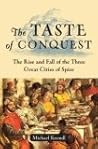
― The Taste of Conquest: The Rise and Fall of the Three Great Cities of Spice
― The Taste of Conquest: The Rise and Fall of the Three Great Cities of Spice
“Academic historians of the last hundred years or so get all stiff and tweedy when you suggest that people will go to all ends for the sake of their religion. They'll assure you that religion is just a cover for other, more "rational" motivations. They would prefer to explain the world in terms of economic self-interest, of class warfare, or of dynastic imperatives. But has not the early twenty-first century made it catastrophically clear how many people (and not just the desperate, either) are ready to leap over the brink in the name of their religion? The same was certainly true of "the age of discovery." While greed should certainly be given her due, there is no reason to think that da Gama was not perfectly sincere when he said that he came in search of Christians and spices.”
―
―
“*22Fidalgo derives from filho d’algo—literally, the “son of somebody”—though it later became a generic term for nobility.”
― The Taste of Conquest: The Rise and Fall of the Three Great Cities of Spice
― The Taste of Conquest: The Rise and Fall of the Three Great Cities of Spice
“Mostly, though, the peppercorns were just a flimsy outer layer with nothing inside. They had to be dehydrated in alcohol, then dried with a hair dryer in small batches, and impregnated with glue so that they would not turn to dust in the exhibit.”
― The Taste of Conquest: The Rise and Fall of the Three Great Cities of Spice
― The Taste of Conquest: The Rise and Fall of the Three Great Cities of Spice
“One of Rembrandt’s more famous paintings… The Anatomy Lesson of Dr. Tulp … depicts a scene that took place in the old spice weighing tower in Neomarket … The building not only served to regulate the traffic in nutraceuticals like cinnamon and nutmeg, but was also used by the Amsterdam Guild of Surgeons for their annual public dissection… The famed surgeon Nicolas Tulp looks on… Apparently he was as skilled at wooing an audience as wielding a scalpel. He later held the position of city treasurer 8 times, and of burgomaster (mayor) 4 times.”
― The Taste of Conquest: The Rise and Fall of the Three Great Cities of Spice
― The Taste of Conquest: The Rise and Fall of the Three Great Cities of Spice
“Tacitus informs us for example that after murdering his wife Poppaea in 65 AD, Nero used a year’s supply of Rome’s cinnamon to bury her.”
― The Taste of Conquest: The Rise and Fall of the Three Great Cities of Spice
― The Taste of Conquest: The Rise and Fall of the Three Great Cities of Spice
“First, you had to get a badger drunk on wine filtered through camphor and blended with a compound of gold, seed pearls, and coral.”
― The Taste of Conquest: The Rise and Fall of the Three Great Cities of Spice
― The Taste of Conquest: The Rise and Fall of the Three Great Cities of Spice
“The introduction of oranges, lemons, eggplant, and other fruits and vegetables to the West is generally ascribed to Arab intervention. Pasta as we know it seems to have been invented in Moorish Sicily.”
― The Taste of Conquest: The Rise and Fall of the Three Great Cities of Spice
― The Taste of Conquest: The Rise and Fall of the Three Great Cities of Spice
“Once people no longer fear starvation, they choose to eat for a whole variety of reasons, and these were not so different at the court of the Medici than they are at the food courts of Beverly Hills. Food is much more than a fuel; it is packed with meaning and symbolism. That”
― The Taste of Conquest: The Rise and Fall of the Three Great Cities of Spice
― The Taste of Conquest: The Rise and Fall of the Three Great Cities of Spice