
Library of Congress's Blog
July 23, 2026
The Tombstone Edition that Helped Galvanize American Independence
It’s known as the Tombstone Edition, a lightning-strike newspaper image that presages the American Revolution — and 261 years after it electrified readers in Colonial-era Philadelphia, a rare, fragile copy now rests at the Library.
Pennsylvania Journal editor and printer William Bradford, livid at Britain’s imposition of the Stamp Act on the Colonies, laid out the front page of his Oct. 31, 1765, newspaper as if it were the paper’s grave marker, complete with a skull and crossbones set at the top in heavy black type. His furious editorial said the Stamp Act’s tax on paper, a rare and expensive commodity, would kill his newspaper, others like it and therefore choke off a free press.
“EXPIRING,” read the headline, describing the paper’s fate.
“The Liberty of the Press has been very justly one of the main Pillars of the Liberty of the People,” read the front-page editorial, blasting the act as “insupportable Slavery.”
The bare-knuckled defiance, the over-the-top imagery — the paper’s tombstone-looking front page became an iconic symbol of the Colonies’ awakening sense of independence and their united future. Along with Benjamin Franklin’s 1754 “Join, or Die” political cartoon in his Pennsylvania Gazette, showing separated colonies as a dismembered snake, the Tombstone Edition became one of the first symbols of a uniquely American identity.
“One of the most famous and recognizable eighteenth-century newspapers,” says the Journal of the American Revolution.
The Library’s copy, one of the few known to still exist, is a complete four-page edition and was obtained from a dealer earlier this year. It’s now undergoing conservation treatment.
“It will be one of the top treasures in our division,” said Megan Halsband, head of physical collections services in the Serial and Government Publications Division. “What it represents for the Revolution and the opinion of the American public at the time regarding the Stamp Act is pretty significant.”
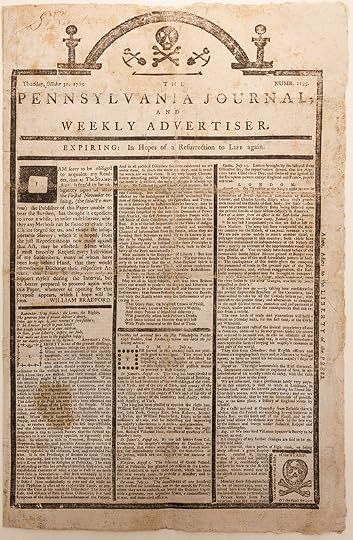 The Library’s copy of the Pennsylvania Journal’s Tombstone Edition is in delicate shape, some 265 years after it was published. Serial & Government Publications Division. Photo: Shawn Miller.
Bradford founded The Pennsylvania Journal and Weekly Advertiser in 1742, devoting much of its tiny print to shipping news (Philadelphia was a major port city). Such publications were not intended to last and the paper quality was never high, meaning most copies were thrown out, deteriorated or fell apart.
On a recent day in one of the Conservation Division’s workrooms, the Library’s Tombstone Edition of the paper was temporarily out of its new housing — a custom-made conservation box — but under a protective mylar cover, resting on a well-lit lab table.
It’s sepia-toned, thin and brittle, a little bigger than a modern tabloid, with uneven edges. There are well-worn creases, fading print and some dark spots, likely oxidized oil stains.
The heavy black borders and stark death symbols — the skull and crossbones, a coffin, the grave-marker outline — are still striking. One can only imagine how eye-catching it must have looked coming off Bradford’s printing press in the fall of 1765, when “the United States of America” was a name that did not yet exist.
“Mostly we’re dealing with wear-and-tear issues,” says Heather Wanser, a conservator who’s been working on the paper. “You can see where it’s been folded and creased, and there are some small losses at the crease points. We understand that it will probably often be brought out for display and show-and-tell sessions, so we’re getting it into housing where people can appreciate seeing the original without any need to handle it.”
In late 18th-century Philadelphia, it was no surprise that Bradford would have been the printer behind such a confrontational edition or that his opinion carried weight.
His grandfather, also named William Bradford, brought one of the first printing presses to the region, published an almanac by 1686 and ultimately settled in New York as a profitable printer for six decades. He printed New York’s first newspaper and was a partner in founding the nation’s first paper mill.
William Bradford, his grandson, was born in 1719 in New York, but moved to Philadelphia, learning the printing trade from his uncle. He started the Journal when he was in his early 20s and came to abhor British domination.
For all his fiery predictions of the Stamp Act snuffing out free speech, though, the act was never truly enforced (largely because of mass resistance) and Bradford’s weekly never missed an edition.
When the Revolutionary War broke out in April 1775, Bradford, then in his 50s, soon enlisted as an officer and fought in several battles.
In December 1776, when the war was going badly, he published the first pamphlet of Thomas Paine’s “The American Crisis” which famously began, “These are the times that try men’s souls …”
“He was a warm defender, with both pen and sword, of the rights of his country,” noted historian Samuel S. Purple, writing about Bradford in an 1873 edition of The New York Genealogical and Biographical Record.
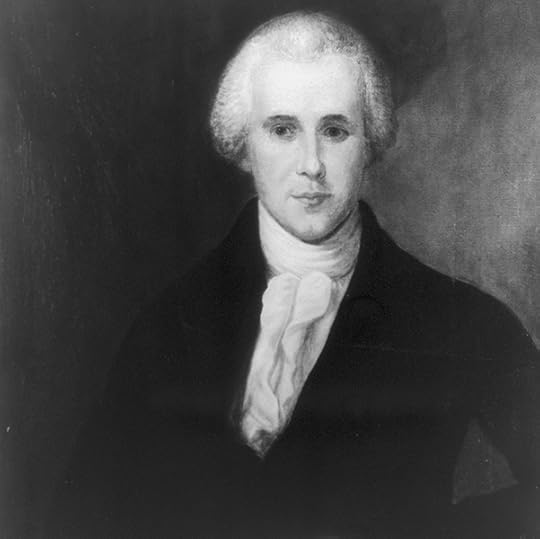 William Bradford, the Philadelphia printer and editor. Painting by Charles St. Mémin. Photograph of the painting: Independence National Historic Park Collection. Prints and Photographs Division.
After the British capture and eventual retreat from Philadelphia, Bradford “left the Army, broken in health and fortune,” Purple wrote. He returned to publishing, with his oldest son joining him, but the business did not make him wealthy. Late in life, Purple notes (citing an earlier source) that Bradford often remarked to his children, “Though I bequeath you no estate, I leave you in the enjoyment of liberty.”
He died in 1791.
His children used that liberty well. His oldest son kept the family’s publishing tradition going well into the 19th century.
Another son, known as William Bradford the Younger, became one of the most prominent lawyers in the newly minted United States. He was highly educated, fought in the Revolutionary War (serving with George Washington at Valley Forge) and served as the second U.S. attorney general. As president, Washington dispatched him as a top negotiator in an attempt to quell the Whiskey Rebellion, and Bradford filed the precursor lawsuit to Marbury v. Madison, the foundational 1803 Supreme Court decision that established judicial review over Congress and the executive branch.
The Bradfords of Philadelphia endured — as did a handful of copies of the newspaper that helped galvanize a sense of American independence.
Subscribe to the blog— it’s free!


July 22, 2026
“Four Score and Seven Years Ago….” Lincoln’s Handwritten Gettysburg Address
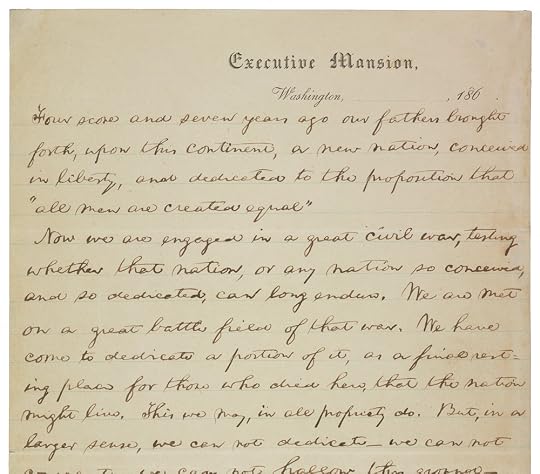 The first page of the Gettysburg Address, above, written by Abraham Lincoln in pen on Executive Mansion stationery. He wrote the second page (below) in pencil on ordinary paper. Manuscript Division.
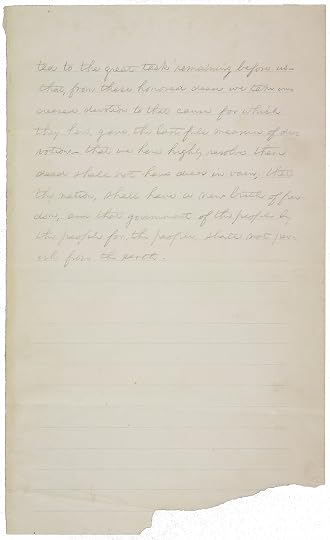
Lincoln’s “few appropriate remarks” would later become famous as the Gettysburg Address and continue to resonate with people around the world.
For a document as iconic as the Gettysburg Address now is, many details about its creation and delivery have been lost to time or clouded by conflicting memories of witnesses. Lincoln began working on the address in Washington, drafting his opening lines in ink on Executive Mansion stationery.
Harkening back to the Declaration of Independence 87 years earlier (“four score and seven years ago”), Lincoln noted that the Revolutionary generation had founded a new nation “conceived in liberty, and dedicated to the proposition that ‘all men are created equal.’” That nation was now being torn apart by civil war, Lincoln continued, and the question of “whether that nation, or any nation so conceived, and so dedicated, can long endure” remained to be answered. But at that ceremony, they gathered to dedicate a burial ground honoring those who gave their lives so that the nation would survive.
Precisely when Lincoln wrote the second page of his address is not known. Perhaps it was part of an earlier draft? Perhaps he was inspired to alter the ending of his speech after touring a portion of the nearby battlefield on the morning of the ceremony?
Regardless, after penciling connecting words on the page of Executive Mansion stationery, Lincoln put pencil to a piece of ordinary writing paper to call for his audience, and all Americans, to honor those who had given their “last full measure of devotion” by dedicating themselves to completing the unfinished work of the war. He called for them to “highly resolve these dead shall not have died in vain; that the nation, shall have a new birth of freedom, and that government of the people, by the people, for the people, shall not perish from the earth.”
Having completed his remarks, Lincoln may have folded the pages together, creating matching creases in the mismatched pieces of paper. The president then amended his address further during its delivery, invoking a higher power in “that this nation, under God, shall have a new birth of freedom …”
The Library holds two copies of the Gettysburg Address, written in Lincoln’s own hand. When either is on display, visitors often linger and carefully read Lincoln’s words. Why do the roughly 270 words of the Gettysburg Address continue to resonate?
Each guest has their own answer, but in addition to the beauty of Lincoln’s language, his address reminds us of the ideals on which the United States was founded, the unfinished nature of the experiment and that each generation must dedicate itself anew to ensuring that “government of the people, by the people, for the people, shall not perish from the earth.”
Subscribe to the blog— it’s free!
July 20, 2026
“By the Dawn’s Early Light…”
—This is a guest post by Loras Schissel, a senior music specialist in the Music Division. It also appears in the May/June issue of the Library of Congress Magazine.
It was September 1814, and British warships were unleashing a fierce bombardment on Fort McHenry, the American fortress guarding Baltimore Harbor. Rockets streaked across the night sky, shells burst in flashes of light, the city’s fate hung in the balance.
A few miles away, Francis Scott Key watched anxiously from a British ship, where he had gone to secure the release of a captured friend. Key feared the fort had fallen — until, by dawn’s light, he saw a large American flag still waving over McHenry’s ramparts.
Inspired, Key composed a poem, “Defence of Fort M‘Henry,” about what he’d witnessed — with the tune of an 18th-century British song, “Anacreon in Heaven,” in mind for it. Key’s creation, when set to that music, forever after would be known by another name: “The Star-Spangled Banner.” Though popular from its inception, it was not officially recognized as the national anthem for another 117 years, when President Herbert Hoover signed it into law on March 3, 1931.
The Library’s Music Division today stands as the principal center for research about the national anthem, thanks in large part to the visionary work of Oscar G. Sonneck.
In 1902, Librarian of Congress Herbert Putnam hired the young, New Jersey-born musicologist to establish a music department and transform it into a world-class research center. By Sonneck’s resignation in 1917, he had elevated a collection of modest parlor songs into one of the finest, most comprehensive music libraries in the world.
In 1909, Sonneck published an influential report on patriotic songs like “The Star-Spangled Banner,” “Hail Columbia,” “America” and “Yankee Doodle.” In the following years, the Library amassed a rich archive of those airs, including hundreds of items related to the national anthem.
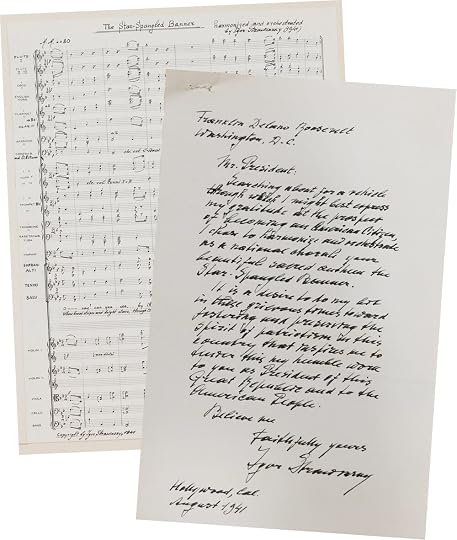 Igor Stravinsky, the famed composer, sent this 1941 letter to President Franklin D. Roosevelt, alongside his orchestral arrangement of The Star-Spangled Banner. Music Division.
 The Music Division holds, among many other things, the first printed lyrics and the first printed sheet music of “Anacreon”; Key’s own copy of that song; the first printed sheet music setting Key’s lyrics to “Anacreon” and bearing the title “The Star-Spangled Banner”; and a presentation copy of the lyrics handwritten by Key years later.
A standout treasure: the first printing of Key’s poem, one of only two copies known to survive.
Typeset in Baltimore by Samuel Sands and issued as a broadside just days after Key composed his poem, this printing of “Defence of Fort M‘Henry” vividly explains the circumstances of Key’s composition and, just below, notes the intended tune: “Anacreon in Heaven.” And then: one of the most memorable opening lines in music, followed by the four full verses of “The Star-Spangled Banner.” More than a century later, a copy was found pasted in a scrapbook, then acquired by the Library.
Another treasure: An arrangement by renowned Russian composer Igor Stravinsky. At the start of World War II, Stravinsky fled Europe for America, and he created his own heartfelt arrangement of the anthem as a gesture of thanks to his new homeland.
In a letter to President Franklin D. Roosevelt in 1941, he explained: “It is a desire to do my bit in the grievous times toward fostering and preserving the spirit of patriotism in this country that inspires me to tender this my humble work to you as President of this Great Republic and to the American People.”
Stravinsky’s stately arrangement sparked controversy before it was ever heard. A leading officer of two major music organizations contacted Roosevelt, warning against Stravinsky’s “mutilated version” of the anthem. Roosevelt ignored the plea, and the first performance was presented by the Los Angeles WPA (Works Progress Administration) Symphony and a chorus. Stravinsky and the audience joined in singing the final two verses.
In 1942, Stravinsky and the WPA gifted his draft letter and manuscript to the Library, further enriching its collection of patriotic music.
It’s a charming detail that “The Star-Spangled Banner,” in its traditional form, is the only national anthem that ends in a question mark — inviting us all to keep participating in this great American experiment of democracy.
Subscribe to the blog— it’s free!
July 14, 2026
America’s Time Capsule … for 2276
-This is a guest post by Brett Zongker and Deb Fiscella, both of the public affairs section in the Office of Communications. It also appears in slightly different form in the May/June issue of the Library of Congress Magazine.
The nation’s oldest federal cultural institution is using some of the newest technology to preserve digital copies of historical collection items for the next 250 years.
As part of America’s 250th anniversary celebrations, the Library made a trailblazing contribution to America’s Time Capsule : a tiny metal pellet holding synthetic DNA encoded with digital copies of items from the Library’s collections. The capsule itself – a 900-pound stainless steel cylinder covered by a 1,100-pound stainless steel bell jar – was ceremonially buried 10 feet underground on July 4th at Independence National Historical Park in Philadelphia.
Maintained by the park and the National Park Service, it is not to be opened until July 4, 2276. Hundreds of other items – letters, memorabilia and documents, all helping tell the story of the nation’s history and culture – were all tucked in the capsule, including from all three branches of government, the Supreme Court and all states and territories. The Library’s experts helped determine which items could survive two and and a half centuries. (A bottle of Coca-Cola, an I-Phone, and the starting lineup of the Philadelphia Phillies all made the cut.)
For the Library’s tiny, data-packed cylinder, the Library initiated a molecular data storage feasibility study in response to a request from Congress in 2024. As a result, the Library has been examining the storage capabilities of a new medium, synthetic DNA. An entirely manufactured molecule, synthetic DNA is designed to replicate the exceptional information density of nature’s best storage medium: DNA itself.
Working with the University of Washington’s Molecular Information Systems Lab, the Library has converted selected digital data into synthesized DNA strands encased in a metal vial about the length of a pencil eraser.
The synthetic DNA includes, among other Library collection items, digital copies of: Thomas Jefferson’s rough draft of the Declaration of Independence; “The Star-Spangled Banner” lyrics written in Francis Scott Key’s hand; the 1791 L’Enfant plan for Washington, D.C.; digitized 1890 Native American audio recordings in Passamaquoddy; the canvas drawing of the Blackwell’s Kinfolk family tree, depicting more than 1,500 names; and the Annals of the Congress of the United States, covering congressional proceedings, including the making of the Constitution, from 1789 to 1824.
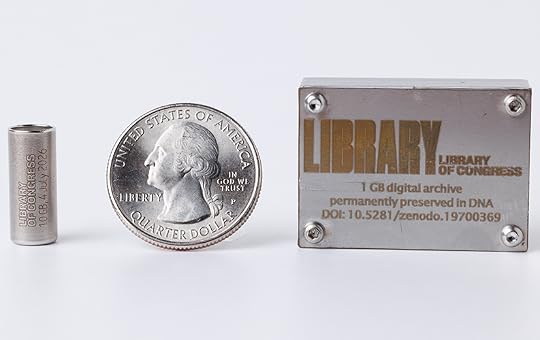 Despite its vast storage space, the metal cylinder, or pellet, is only about as tall as a U.S. quarter. Photo: Shawn MIller.
Synthetic DNA can store about nine terabytes of digital data in one cubic millimeter, approximately 1,000 to 100,000 times greater than the capacity of conventional digital storage methods like hard drives, tape drives and cloud storage. It also is highly durable, lasting thousands of years with little to no maintenance or power consumption.
The encasement includes a small chip containing decoding instructions, ensuring the synthetic DNA sequence can be reassembled into its original digital data when the time capsule is opened 250 years from now.
Subscribe to the blog— it’s free!
July 9, 2026
Napoleon, Henry VIII, Beethoven, Poe: The Amazing Autograph Collection of John D. Batchelder
In 1707, the correspondent began his letter with an elaborate salutation in French: “Monsieur Mon Cousin,” he wrote, then explaining to the recipient, in effusive and flattering terms, that a small gift was en route.
He ended the note with a simple signature in his native Cyrillic script: “Peter.”
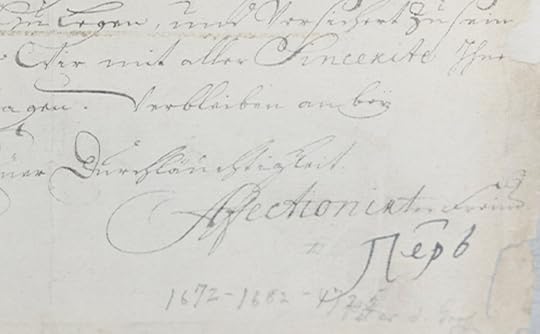 At the end of an effusive letter in French (perhaps prepared by a copyist), Peter the Great signed off in Cyrillic with a simple “Peter.” Manuscript Division. Photo: Shawn Miller.
 As in Peter I, Peter the Great, Peter the Tsar, Peter the Emperor, the polymath genius who by military and diplomatic turns, both brilliant and cruel, all but founded modern Russia. His hand, his attention, his touch all right there in a few strokes of a pen nib. He’s not the great man of history here; just Peter, signing off. You can almost hear the scratch of the pen across the parchment.
Three centuries later, this talisman from another time rests on a table in the Manuscript Division reading room, a stunning autograph in the John Davis Batchelder Collection, a litany of more than 1,800 signatures from bold-faced names who helped define Western politics, painting, philosophy, science, music and culture from the Renaissance to the mid-20th century.
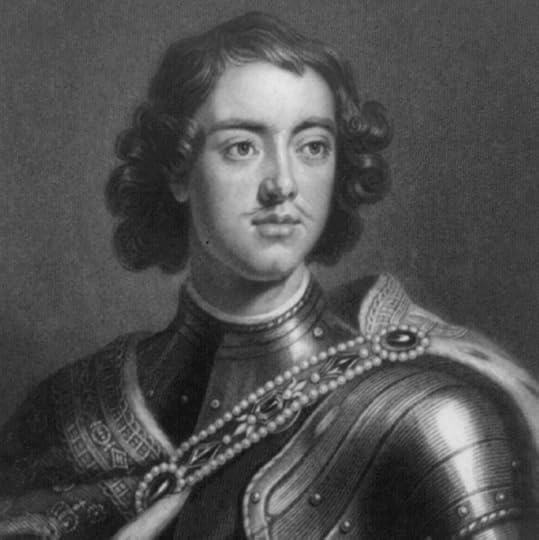 A youthful Peter the Great, in a print made from a portrait by Godfrey Kneller. Prints and Photographs Division.
Napoleon, Beethoven, Debussy, Rodin, Voltaire! Henry VIII, Catherine II (aka Catherine the Great), Louis XIV (aka The Sun King), King Frederick II of Prussia (aka Frederick the Great) José de San Martìn! Pope Pius VII, Isaac Newton, Thomas Edison, Orville Wright, Albert Einstein and an array of U.S. Founding Fathers: Washington, Jefferson, Adams — it’s a dizzying list, all in one green leather-bound volume after another.
Then writers, poets and playwrights such as Goethe, Charles Dickens, Honoré de Balzac, George Sand, Walt Whitman, Ralph Waldo Emerson, Harriet Beecher Stowe, Oscar Wilde, George Bernard Shaw, Paul Laurence Dunbar (who worked at the Library!), Sinclair Lewis and Eugene O’Neill, to name a few. There’s John D. Rockefeller Jr., the oil scion and philanthropist; Florence Nightingale, the founder of modern nursing; the actors Sarah Bernhardt, John Barrymore, Mary Pickford, Anna May Wong, dozens of opera stars … you begin to get the idea.
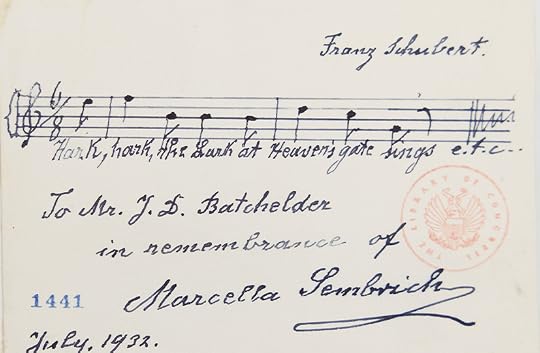 Marcella Sembrich, a Polish-born international opera star, sketched this musical autograph for Batchelder in July 1932. It’s from the opening of “Ständchen,” a short lyric composed by Franz Schubert as part of William Shakespeare’s “Cymbeline.” Manuscript Division. Photo: Shawn Miller.
Or perhaps not quite.
Batchelder, who died in 1958 at the age of 86, also had exquisite taste as an antiquarian collector. This side of his work includes more than 1,500 books, manuscripts, prints and other items that captured significant creations of Western culture. Examples: The first printed Greek editions of Aristotle, Sophocles and other ancient Greek notables; parts of the Gutenberg Bible; 35 volumes of incunabula, books printed during the first decades of printing up to 1500; and, quaintly, a lock of Beethoven’s hair.
The collection, donated to the Library in 1930s, is now spread over five divisions: Rare Book and Special Collections, Manuscript, Prints and Photographs, Music and Asian. The art of collecting autographs is as old as Western civilization itself, but Batchelder’s is one for the ages.
“The genius of the autograph collector is that they’re not necessarily after the great correspondence of history, but often just the signature itself on ordinary things,” says Jane Cross, an archivist in the Music Division who has worked with the Batchelder collection. “They often capture the human aspect of famous people that would have been lost otherwise.”
She loves that the Library’s Beethoven signature is on a note to a delivery boy — the great composer just handling a household chore, getting through another day.
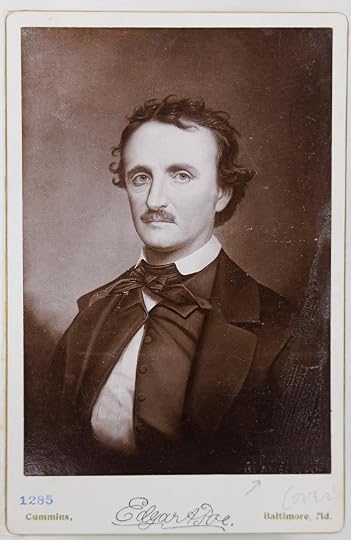 Edgar Allan Poe’s autograph on this card was certified as authentic by a relative. The penciled word “over” (and adjacent arrow) indicate to look on the back for the certification. Manuscript Division. Photo: Shawn Miller.
And here’s the editor of a small New York literary magazine, trying to drum up subscribers for his new publication in November of 1845. This tedious-but-essential one-pager begins with him complimenting the patron for subscribing to one of his previous efforts and hoping he’ll do so again:
“I venture now frankly to solicit your subscription and influence for ‘The Broadway Journal,’ of which I send you a specimen number.”
He then signs off with “Yr. Mo. Ob. St.” (Your most obedient servant), Edgar A. Poe.”
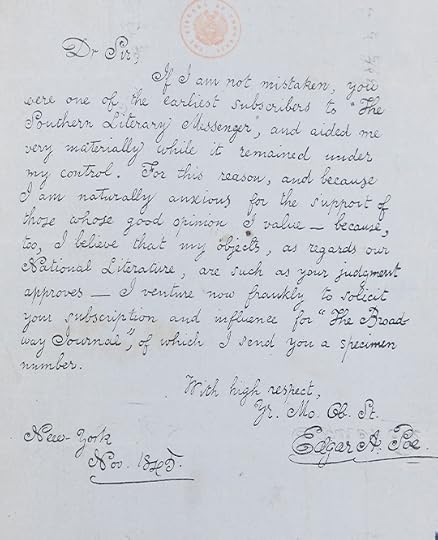 Edgar Allan Poe penned this note in November 1845, soliciting a subscriber for his new magazine. Manuscript Division. Photo: Shawn Miller.
 It’s a quotidian task that, these days, would be assigned to an intern, but I confess that the letter gave me goosebumps. The paper is so ordinary, the penmanship so careful, the name so neatly underlined that the sincerity (and maybe the quiet desperation) is palpable some 180 years later.
As Cross says, it’s just so relatable. The iconic Poe is not in the fever dream of imagination here, writing “The Raven” (he’d done that earlier in the year), or plumbing the depths of his psyche for “The Tell-Tale Heart.” No, you can reach out and touch him, the paper that was in his hand is right here before you. The man writing this please-buy-my-magazine note is a regular guy, a thirty-something editor with an ill wife at home, knocking off an item on the to-do list.
Time remembers Poe, and many of the marquee names in Batchelder’s collection, but most people today are not familiar with the short but brilliant life of Adelaide Neilson, a star of the Victorian-era stage.
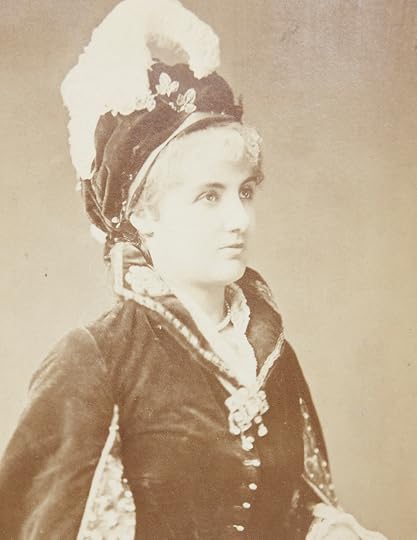 Actress Adelaide Neilson at the height of her career. Manuscript Division. Photo: Shawn Miller.
 She was born in Yorkshire, England, in 1848, to an unwed mother and grew up in bone-jarring poverty. Still, she made her way to London and, by dint of hard work, talent and beauty, evolved into the reigning actress of the British stage. She came to the U.S. in 1872, became a star all over again, lived extravagantly and divorced her husband amid scandal.
She apparently had quite the time in Boston, even in the dead of winter. On Feb. 21 (she didn’t list a year), she signed the back of a photo with an exuberant: “I like this place and willingly could waste my time in it!”
Alas, the good times did not last. Just a few years later, in 1880, she suffered an internal hemorrhage while horseback riding in Paris and died immediately. She was 32.
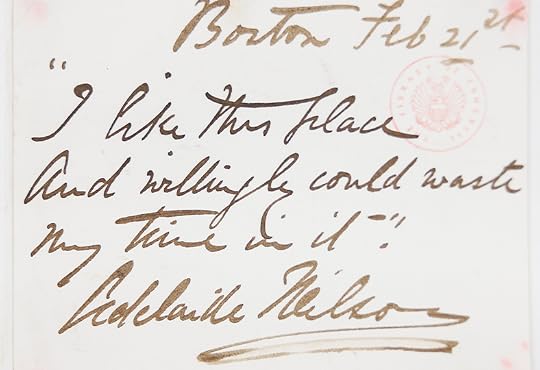 Neilson’s inscription on the back of the photo above: “I like this place and willingly could waste my time in it!” Manuscript Division. Photo: Shawn Miller.
Ironically, we know more about most of the people who are in Batchelder’s collection than the man himself.
Born in 1872 in Faribault, Minnesota (population of about 3,000 at the time), he was something of an enigma. He was the son of a prominent attorney and was educated at the University of Vermont, then Johns Hopkins University, then at some the finest universities of Europe, including the Sorbonne and Oxford. He returned to the U.S., taught briefly, settled in New York City and Washington, D.C., and devoted himself to full-time collecting shortly before turning 40.
He never married, traveled widely and apparently wrote little about his life’s work.
“He was not a flashy collector or person at all,” said Michael North, head of the Reference and Reader Services Section, who developed the Library’s guide to the collection. “I could find virtually no references to him in newspapers except when he donated some of his major pieces … I couldn’t find a photograph of him until I delved into the student yearbooks of the University of Vermont during his time there.”
In the 1930s, his donations to the Library were so profound that he was given an office on the premises for a time. He presented an exhibition of 400 items in 1936 but gave no backstory about himself or why he devoted his life to the project: “… (the catalog) does not contain a preface by Batchelder to inform us about how he chose in the items in his collection or how he went about gathering them,” the Library notes.
After he died in 1958, his body was returned to Faribault and buried in the family plot. His headstone only rises a few inches above the dirt, doesn’t spell out his middle name and includes only the years of his birth and death.
His legacy, though — the signatures and stories of people who influenced human society over hundreds of years — is preserved under his name at the world’s largest library.
Subscribe to the blog— it’s free!
July 7, 2026
Ann Patchett, Martin Scorsese, Cynthia Erivo: The 2026 National Book Festival
-This is a guest post by Deb Fiscella, a public affairs specialist in the Office of Communications.
You can watch director Martin Scorsese screen some of his favorite film clips, listen to “Wicked” star Cynthia Erivo talk about being just too much for some people and get a kick out of Ann Patchett chatting about her new bestselling book at the Library’s National Book Festival this year, coming to the Washington Convention Center on Saturday, Aug. 22.
Literary and multimedia stars such as Patrick Radden Keefe, Kate McKinnon, Tia Williams, Tayari Jones, Frank Miller and Karin Slaughter are also among more than 80 authors who will fill out the day. The festival, an annual tradition since 2001, this year is part of the Library’s series of programs, America 250: It’s Your Story, to observe the nation’s 250th birthday.
An important heads-up: Free tickets will be required for festival entry (this is a first), but not for individual programs. Tickets can be reserved at loc.gov/bookfest.
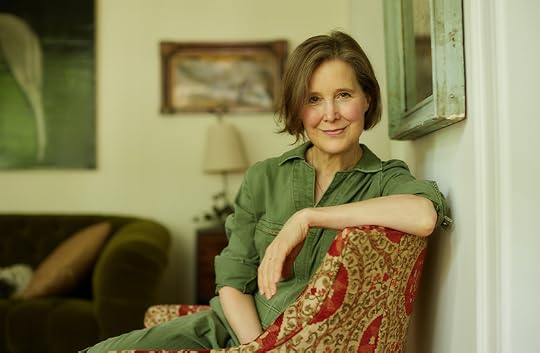 Ann Patchett, the 2026 Library of Congress Prize for American Fiction recipient, will be at the NBF to discuss her new novel, “Whistler.” Photo: Emily Dorio.
No worries if you can’t make it – events on the Main Stage will be livestreamed on loc.gov/bookfest. Videos of presentations will be made available on the Library’s website and YouTube channel in the days after the festival.
As always, there’s much to choose from, with several multiplatform events.
Historians Douglas Brinkley and Annette Gordon-Reed will discuss their contributions to National Geographic’s “1,000 Days in America: An Illustrated History of Moments That Defined a Nation,” in a special live recording of C-SPAN’s “America’s Book Club.” (C-SPAN will also livestream some events and interview authors.)
Bestselling author Max Brooks will present a radio play adaptation of his graphic novel “The Harlem Hellfighters.” And The Kitchen Sisters (Davia Nelson and Nikki Silva) will host a live podcast of their Peabody Award-winning NPR series, as well as a presenting a workshop on creating your own podcast.
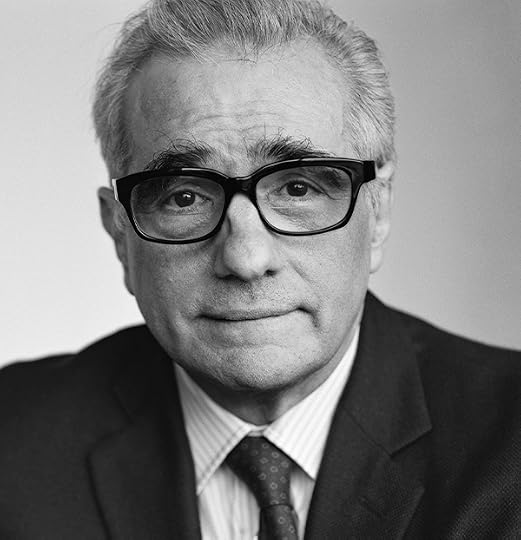 Director Martin Scorsese, who has five titles in the National Film Registry, will be at NBF this year. Photo: Brigitte Lacombe.
The complete lineup will tell you more about each author, but here’s a bit about a few of the headliners:
Cynthia Erivo – The award-winning actress, singer, author and producer shares her work and her new memoir, “Simply More: A Book for Anyone Who Has Been Told They’re Too Much.”Martin Scorsese – Award-winning movie director Scorsese, with five films in the National Film Registry, discusses his filmmaking philosophy and the importance of preserving the nation’s film heritage while screening select film clips.Kate McKinnon – McKinnon talks about “Secrets of the Purple Pearl,” her new sequel in the New York Times No. 1 bestselling series “The Millicent Quibb School of Etiquette for Young Ladies of Mad Science.”Ann Patchett – The 2026 Library of Congress Prize for American Fiction recipient provides insights into her recent New York Times No. 1 bestseller “Whistler.”Arthur Sze – U.S. Poet Laureate Sze delves into his signature project, as well as his personal guide to poetry in translation titled “Transient Worlds: On Translating Poetry.”Frank Miller – The award-winning comic book writer, artist, novelist, inker, screenwriter, film director and producer, best known for “Sin City” and “300,” his comics featuring Marvel superhero Daredevil, and his miniseries “Batman: The Dark Knight Returns,” discusses his new memoir, “Push the Wall,” which also serves as a masterclass for aspiring creators.Tia Williams – Acclaimed romance novelist Williams, whose book “The Perfect Find” is now a Netflix film starring Gabrielle Union, makes her festival debut with “The Missed Connection.”Silvia Moreno-Garcia– Award-winning Moreno-Garcia makes her second appearance at the festival with her new suspenseful noir novel “The Intrigue.”Geoff Bennett – Peabody Award-winning journalist and co-anchor and co-managing editor of “PBS NewsHour,” Bennett discusses his debut book, “Black Out Loud: The Revolutionary History of Black Comedy from Vaudeville to ’90s Sitcoms.”Isaac Fitzgerald – Bestselling author and frequent “Today” show guest, Fitzgerald makes his festival debut with “American Rambler: Walking the Trail of Johnny Appleseed.”Jenny Lawson – The award-winning humor writer and activist also known as the Bloggess shares insights from her new book “How to Be Okay When Nothing is Okay: Tips and Tricks That Kept Me Alive, Happy and Creative in Spite of Myself.”Tayari Jones – Jones returns for her third festival, this time to discuss her latest novel, “Kin,” an Oprah’s Book Club selection.Sasha Waters – The documentary director screens clips from her upcoming film “Mary Oliver: Saved by the Beauty of the World” and shares insights into the poet whose papers are held by the Library.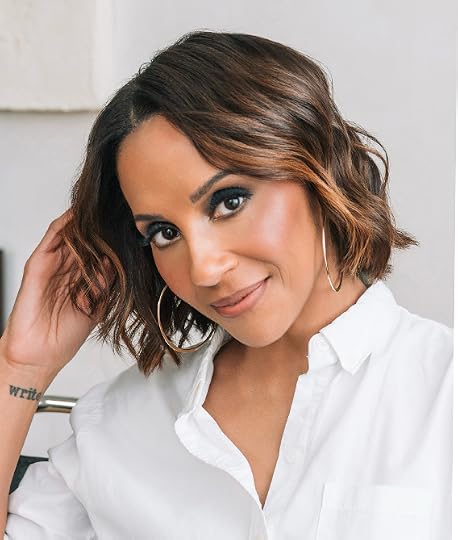 Romance novelist Tia Williams will discuss her new book, “The Missed Connection” at this year’s NBF. Photo: Chandra Wicke.
The festival will also offer a wide range of family-friendly activities. These include storytelling at the Story District; hands-on activities that connect science and storytelling at the STEM District; learning opportunities in the Workshop Space; presentations from Library experts about innovative work happening at the nation’s Library; and a literary trip around the country in the Roadmap to Reading area.
Doors will open at 8:30 a.m. and the first programs start at 9 a.m. We close at 8 p.m.
Subscribe to the blog— it’s free!
July 2, 2026
A250: The Declaration’s Promise
-This is a guest post by Ryan Reft, a historian in the Manuscript Division. It also appears in the May/June issue of the Library of Congress Magazine.
Following the trauma of the American Civil War, Walt Whitman published “Democratic Vistas,” a tough but ultimately optimistic appraisal of America’s democratic promise. In it, Whitman reminisced about the nation’s founding and the echoes of the past from his youth: “The old men, I remember as a boy, were always talking of American independence. What is independence?”
Throughout the work, Whitman explores this question as well as the social and political fissures that needed to be traversed after the war. Amidst that wreckage, Whitman held firm to his belief in the United States’ adherence to a democratic ideal and to the principles of the Declaration of Independence.
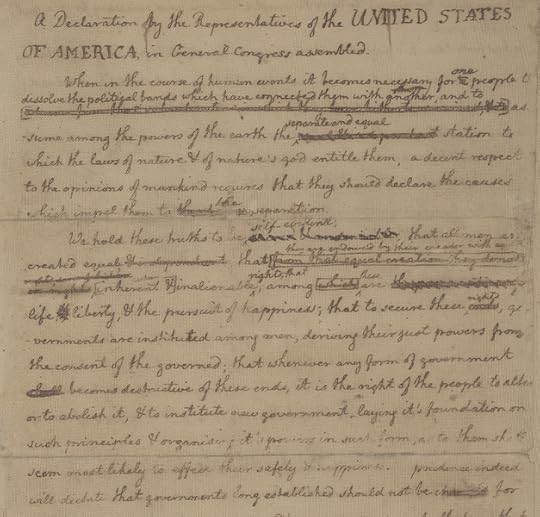 The first lines of Thomas Jefferson’s rough draft of The Declaration of Independence. Manuscript Division.
The Declaration gathers the political thought borne of the Enlightenment and combines it with the activism of the American revolutionaries. It emphasizes ideas such as freedom of speech and religion and equality between people. Those principles redounded in surprising ways throughout the nation’s history from the 18th century to the 21st. This is the major theme of the Library’s new exhibit, opening tomorrow, based on the language and ideals of the document itself: “The Declaration’s Promise: A Revolutionary Idea.”
The American Revolution served as the crucible and the Declaration the deliberate expression through which British colonists transformed themselves into American citizens. The Declaration was at once within the tradition of English subjects submitting petitions of grievance toward the British crown and Parliament and without it, since it went beyond demands for reform and instead declared independence.
The new nation’s government established its foundation upon John Locke’s ideas regarding political legitimacy: “consent of the governed” and “unalienable” natural rights, “life, liberty,” and in the American interpretation, “the pursuit of happiness” rather than “property,” which had rounded out Locke’s trio of liberties. Locke had borrowed, too, the idea of “pursuit of happiness” from the work of Swiss philosopher Jean-Jacques Burlamaqui, “Natural liberty is the right nature gives to all mankind … most convenient to their happiness,” and others.
In addition to channeling Enlightenment philosophy through an American lens, some members of the Continental Congress conveyed the political ideas of their constituents and drew upon declarations passed by localities. As Danielle Allen has noted in her reading of the document, it took “rivers of talk for Jefferson’s words to become the ‘unanimous’ Declaration of the colonies.” Through the Declaration, the nation enacted a real political movement and the modern world’s first democracy, thereby serving as a collective expression, not simply a treatise by elites.
Moving from the crown’s subjects to the nation’s citizens, as demonstrated by Jefferson’s original draft of the Declaration on display in the exhibit, marked only one aspect of the Declaration’s revolutionary nature.
The idea of religious freedom permeated debates for many Americans. Moses Seixas, writing in August 1790 on behalf of his Rhode Island Hebrew congregation, appealed to President George Washington to ensure a “Government, which to bigotry gives no sanction, to persecution no assistance … .” Washington’s response, that all Americans possess “liberty of conscience and immunities of citizenship,” furthered the nation’s devotion to religious liberty, emphasizing the need to move beyond “toleration … as if it was by the indulgence of one class of people, that another enjoyed the exercise of their inherent natural rights.”
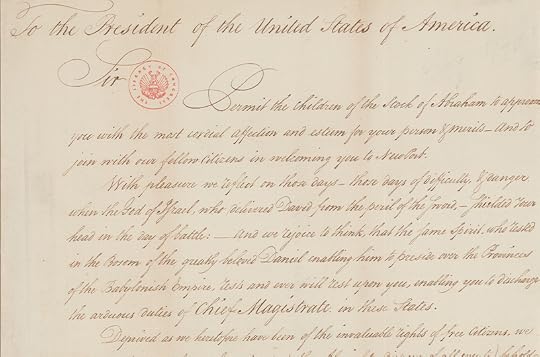 The beginning of the Moses Seixas letter to George Washington. Manuscript Division.
Jefferson’s copy of the Quran and an 1830 copy of the Book of Mormon, also on display, serve as further evidence of this American tradition established by the Declaration.
Yet promises made must be promises kept; the failure to uphold such agreements leads to disillusion and conflict. The nation’s failure to stamp out its most obvious violation of the Declaration’s ideals, the enslavement of Africans, stands as a stark example of this tension.
In their opposition to slavery, abolitionists vigorously adopted the Declaration’s ideals. Though not a radical abolitionist, former president and then congressman John Quincy Adams also opposed slavery. His argument before the Supreme Court in the 1841 Amistad case embodies the Declaration’s importance in abolitionism.
Over three dozen Mende people from what today is Sierra Leone mutinied against their Spanish enslavers aboard the ship Amistad, off the Connecticut coast. They appealed to U.S. officials for their freedom. In his oral arguments before the court, Adams wielded the document’s language and ideals as a rhetorical cudgel. He referenced the Declaration of Independence over a half dozen times and stopped at least twice to point to a copy of the Declaration displayed in the courtroom. The Declaration served as the North Star of the nation’s creed: “The moment you come, to the Declaration of Independence, that every man has a right to life and liberty, an inalienable right, this case is decided,” Adams told the court. The justices agreed, ruling 7-1 in favor of the captives.
The ways Americans used the Declaration as a framework for demanding rights and liberties is explored throughout the exhibit. In addition to abolitionism, this includes the push for women’s suffrage. The two movements were in dialogue in the 19th century — many suffragists worked in the abolitionist cause sharpening their rhetorical skills and organizing principles.
In her 1861 speech “What is American Slavery?” Susan B. Anthony cites the Declaration in her demand to abolish the “peculiar institution”: “It is the depriving four Million of native-born citizens of these United States, of their inalienable right to Life, Liberty and the pursuit of happiness.”
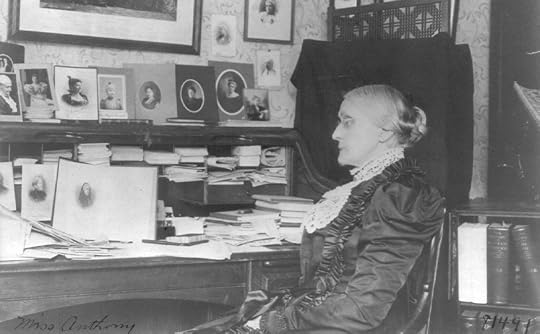 Susan B. Anthony, photographed late in life at her working desk, in about 1905. Photo: Frances Benjamin Johnston. Prints and Photographs Division.
Abolitionists joined the suffrage cause as well, as demonstrated by Frederick Douglass, who campaigned for women’s right to the franchise and drew upon the language of the Declaration. In an 1886 speech, Douglass asserted that the “American doctrine of liberty is that governments derive their right to govern from the just consent of the governed; that taxation without representation is tyranny; and the founders of the Republic went so far as to say that resistance to tyrants is obedience to God. On these principles, woman, not less than man, has a right to vote.” Drawn from Anthony’s and Douglass’ papers, the speeches capture the pervasive nature of the Declaration’s ideals and those that sought to see them fulfilled.
Whitman also functions as a proverbial inflection and departure point in “The Declaration’s Promise.” Describing post-Civil War America as “canker’d,” Whitman reminds readers that the American people “of their own choice” fought and died for their own idea of a more just America. President Abraham Lincoln manifested a new vision of the Declaration’s promises of liberty and equality through his famous Gettysburg Address, given at the dedication of the military cemetery in Pennsylvania amidst the Civil War. The Nicolay copy of the speech also will be on view in the exhibit.
Lincoln’s oration served as philosophical inspiration, but it took the actions of abolitionists, freedmen and freedwomen, and all those who sacrificed their lives in the war to ensure a more just nation.
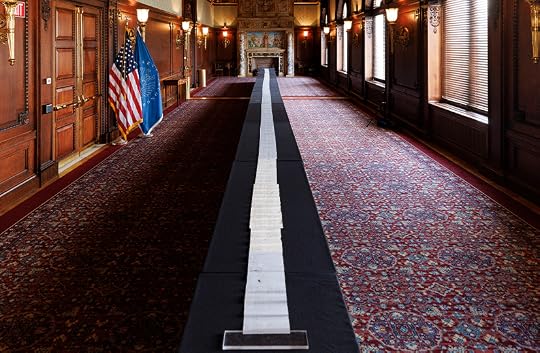 The 55-foot long petition from Black South Carolina residents unfurled at the Library. Photo: Shawn Miller.
The Petition of Citizens of South Carolina, preserved in the Justin Morrell Papers and displayed in the exhibit, is a nearly 55-foot document signed in 1865 by over 3,000 Black South Carolinians, including many freedmen and freedwomen. They appealed to the U.S. Congress for voting rights to secure other fundamental liberties. Citing their loyalty during the war, they requested in writing that Congress not “sanction any state government which refused to grant the franchise to citizens otherwise qualified in common course of American law, without distinction of Color — Without this political privilege we will have no security for our personal rights and no means to secure the blessings of education to our children.”
While Lincoln’s message was transformative over time — aided by the passage of the 13th, 14th and 15th amendments —Reconstruction failed to ensure equality for African Americans. Jim Crow and Black Codes passed by Southern legislatures after Reconstruction descended upon them across the South while the North imposed less codified but nonetheless racially discriminatory policies.
What to make of such discrepancies? Turning to Whitman again, his poem “Song of Myself” from his classic work “Leaves of Grass,” unintentionally captures this tension, which he explored in greater detail in “Democratic Vistas:” “Do I contradict myself? Very well then I contradict myself. (I am large, I contain multitudes.)” The Declaration and American history, though intertwined, remain as contradictory and multitudinous as Whitman.
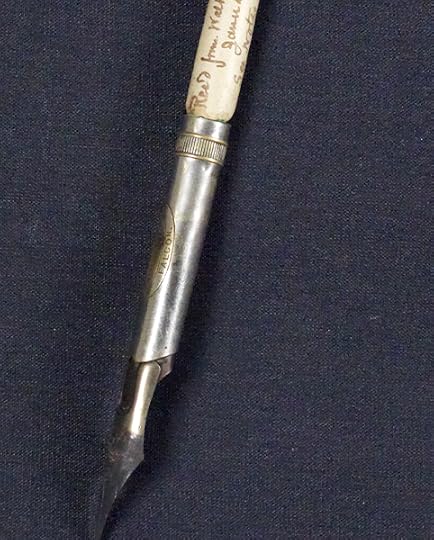 One of Walt Whitman’s pens. Photo: Shawn Miller Manuscript Division.
Although the exhibit focuses primarily on the 18th and 19th centuries, it does explore aspects of the Declaration’s influence in the 20th, most notably during the Civil Rights Movement and the 1963 March on Washington. In speeches that day, John Lewis appealed to the crowd to “get into this great revolution that is sweeping this nation … until the Revolution of 1776 is complete,” and Martin Luther King Jr. directly referenced the Declaration’s “creed:” “We hold these truths to be self-evident, that all men are created equal.”
If the 19th-century abolitionist movement raised the consciousness of women toward their promised rights, the civil rights movement inspired feminist, Native American, environmental, disability rights and LGBTQ+ activists in the 20th. For example, beginning in 1964, homophile leader Frank Kameny began holding “Reminder Day” demonstrations in Philadelphia on July 4 to remind Americans that LGBT rights were included within the Declaration’s promise. Citizens, he wrote, were entitled to their own “pursuit of happiness” yet “upon pain of severe punishment by the criminal law and the harshest sanctions by society around him, the homosexual American citizen finds himself denied this ‘unalienable right.’”
Kameny’s demands seemed audacious at the time, perhaps even haughty to some, but today are largely acknowledged as just. The movement’s demands represent the influence the Declaration has projected throughout American history. Much as Whitman celebrated “the haughty defiance of ’76,” at the nation’s 250th anniversary, Americans still honor the Declaration’s spirited promises of liberty.
Subscribe to the blog— it’s free!
July 1, 2026
Remembering Victor Willis: How He Wrote the Disco Anthem “Y.M.C.A.”
–Victor Willis, the lead vocalist and primary songwriter for the Village People, died yesterday at the age of 74, his wife announced in a statement this morning. The Library inducted “Y.M.C.A.” into the National Recording Registry in 2020 and I caught up with him for a delightful phone interview. He politely recounted, in detail, how he had written one of the most iconic songs in American pop music history. We reprint it below in honor of his passing.
Victor Willis, Mr. “Y.M.C.A.” himself, has just come upstairs from his home gym in San Diego and grabbed the telephone. Couple miles on the treadmill, pushups, weights. He’s 68, the founder and lead songwriter of the Village People and, until the coronavirus shutdowns, had 50 or 60 shows lined up this year.
“We were booked all through the year, all over the world,” Willis says.
The voice coming down the line is energetic, upbeat. Despite the postponed gigs, he’s in a good place after decades of turmoil. He’s happily married, wealthy and won a landmark copyright case a few years ago to obtain 50% royalties on the Village People hits that he co-wrote, which is all of them. He also regained control of the group’s name and performing rights.
But the cherry on top? “Y.M.C.A.” is a member of this year’s class of the National Recording Registry. That’s right, kids – that infectious stand-up-and-boogie disco classic, complete with a singalong chorus and over-the-top enthusiasm for a single-sex gym and fraternal living facility – is now in the official time capsule of American history.
”I had no idea when we wrote ‘Y.M.C.A.’ that it would become one of the most iconic songs in the world and a fixture at almost every wedding, birthday party, bar mitzvah and sporting event,” goes his official statement.
But where did the song come from? How did a giddy tribute to the Young Men’s Christian Association, a religious non-profit founded in 19th-century London, become one of the most instantly recognizable songs in late 20th-century America?
For this, we need to go to the disco-crazed days of winter 1978-79, specifically to New York City’s nightclub and bar scene. “Saturday Night Fever,” set in Brooklyn, had rocked the world year before. Studio 54 reigned supreme for the city’s celebrities. Donna Summer and the Bee Gees ruled pop music. Manhattan’s Greenwich Village was a hotbed of gay life and fashion.
Willis was a singer in the city’s theater scene. A native of San Francisco, the son of a Baptist preacher, he’d come to the Big Apple in the early ’70s. He didn’t live in the Village but at 63rd and Broadway, in the old Empire Hotel, just a couple of blocks west of Central Park and north of Columbus Circle. This was around 1972. Money was tight.
Over the next few years, he joined the prestigious Negro Ensemble Company and was an original Broadway cast member of “The Wiz,” playing lead roles as an understudy.
By the late ’70s, he agreed to sing lead and background vocals for an unnamed concept band that was the brainchild of Jacques Morali, a French record producer. Morali was gay and loved the flamboyant personalities he’d see at Village nightclubs. He eventually called his project the “Village People,” although Willis was the only person in the group, wasn’t gay and still didn’t live in the Village. (It’s show biz, people!)
Session musicians played on the recordings in lieu of an actual band. But “San Francisco,” one of the first songs, was a club hit. To boost the stage show, Willis and Morali rounded up dancers to play send-ups of the gay New York club scene – the biker, the cowboy, the soldier, the construction worker, the Native American chief. Willis began writing lyrics for new songs, including “Macho Man,” a parody of male sexuality. Morali did the music.
Onstage, Willis played the cop or, sometimes, the Navy officer. Offstage, he’d just married a young actress he’d met while they were both in “The Wiz.” Her name was Phylicia Ayers-Allen. Six years later, after they divorced, she would marry football star Ahmad Rashad, star as Clair Huxtable in “The Cosby Show” and become a pop-culture icon all her own.
But in 1978, Willis and Morali were churning out material for a third album. They needed a hit. Willis found his mind wandering back to his youth.
Growing up in San Francisco, his family’s modest home was just a few blocks from the Buchanan Street Y, in the northern part of the city. Willis and his friends went there to work out, goof around and play in basketball leagues. They had a lot of fun.
He had leaned on the Y again in New York. The West Side Y – 5 West 63rd — was two blocks from his old place at the Empire Hotel.
So he put pen to paper. He imagined a kid, not much different than himself, maybe 20, 21 years old, sitting on the corner of 63rd and Broadway, in front of the Empire. He saw it now from a slightly older perspective, as a guy who could offer advice to a kid like that.
“I imagined somebody coming in town and, you know, maybe having blown all their money or couldn’t afford to go to the five-star hotels,” he says. “They were just sitting there not knowing which way to go with their life. So that was the first line.”
Young man, there’s no need to feel down
I said, young man, pick yourself off the ground
I said, young man, cause you’re in a new town
There’s no need to be unhappy
The hard times for a young actor in New York were no joke. Though the song would later be seen as camp gay comedy, he was not intentionally writing double entendres.
“There were times that I felt, you know — the expression was being ‘down and out with the blues.’ And so I would go to the Y to pick myself up. I’d go back home and get ready to get back to my life.”
Thus, in the song taking shape in front of him over the course of a few weeks, he wrote:
Young man, I was once in your shoes
I said I was down and out with the blues
I felt no man cared if I were alive
I felt the whole world was so tight
This thing wasn’t supposed to be a downer, though. This was glitter-ball dance music. And so, remembering his teenage years in San Francisco, he jotted down a simple truth:
It’s fun to stay at the YMCA
It was so much fun, in fact, that he repeated the line. Suddenly, a chorus.
Willis, remembering it now: “I would write one draft and then, when I was on the road, I can’t tell you exactly where, I would right another draft. The final draft that I did I remember was in Vancouver just before going to do a concert.”
Morali added the music. Horace Ott, a music-industry veteran with a long resume of hits, added the horn and string arrangements, giving the song the punchy blasts that heralded the chorus. It was done.
“Y.M.C.A” dropped on Nov. 13, 1978. It blew up in January and February of 1979. But for all we remember it today, it never hit No. 1 – it stayed stuck at No. 2, at first behind “Le Freak,” by Chic, and then was leap-frogged by Rod Stewart’s “Da Ya Think I’m Sexy?”
That year, seven of the top 10 songs of the year were disco. Two years later, at the end of 1981, none were.
Disco was dead, baby, but “Y.M.C.A.” was just getting started.
Subscribe to the blog— it’s free! — and the largest library in world history will send cool stories straight to your inbox.
June 29, 2026
A250: America’s pop culture, a worldwide export
This story also appears in the May/June issue of the Library of Congress Magazine, which focuses on America 250.
Baseball, basketball, football, blues, jazz, rock, Hollywood, Broadway, comic books — what would the planet look like without the great spewing fountain of American pop culture?
Never mind the economic, dance floor and movie theater impact of America’s entertainment industry. When the Cold War came down to it, the United States had what Soviet kids wanted most: blue jeans and rock ’n’ roll. Who could compete with Levi’s and Elvis?
Likewise baseball, first codified in New York in 1845, was America’s much beloved national pastime — but then became a cultural mainstay in nations as diverse as Castro’s Cuba and post-World War II Japan.
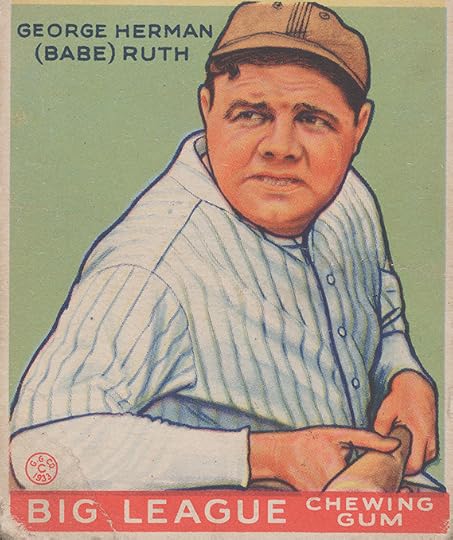 A 1933 baseball card of Babe Ruth, one of the stars who helped make baseball “America’s Game.”
The Library’s collections preserve much of this history in multiple formats. In the early 20th century, once modern recording and film technologies took hold and broadcast and mass distribution outlets proliferated, American creativity rocketed not just from Key West to Honolulu but around the world. The global impact of American films, television, theater, music (blues, jazz, rock, rap), comic books and even fast food can’t be quantified — but much of it can be catalogued.
The Library’s baseball holdings are exhaustive. The National Audio-Visual Conservation Center holds millions of items documenting film, music, television and radio history, perhaps best recognized in the National Film Registry and the National Recording Registry.
The Stephen A. Geppi Collection of Comics and Graphic Arts is home to iconic editions of heroes such as Spider-Man, Wonder Woman, Batman, Superman and so many more. The Music Division holds the entire collections of titans such as George and Ira Gershwin, Leonard Bernstein, Stephen Sondheim, Oscar Hammerstein II and Billy Strayhorn.
But it’s always the individual items that take the breath away.
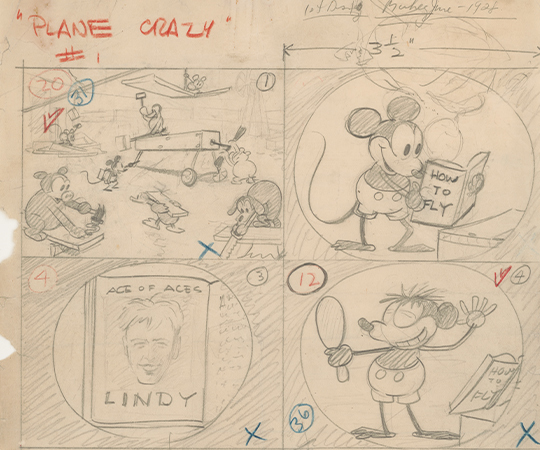 The first storyboards featuring Mickey Mouse, in “Plane Crazy,” from 1928. From The Stephen A. Geppi Collection of Comics and Graphic Arts. Prints and Photographs Division.
 The first storyboard of a Mickey Mouse cartoon, before anyone had seen anything by Walt Disney. The 1899 sheet music of Scott Joplin’s “Maple Leaf Rag,” sent in for copyright deposit, before “ragtime” was the name of an era or before the word “jazz” even existed. And there’s Ruth Graves Wakefield’s 1939 recipe for a little creation she served at her restaurant in Whitman, Massachusetts.
You, and the rest of the world, now know it as the chocolate chip cookie. Sometimes American history can be just that sweet.
Subscribe to the blog— it’s free!
June 25, 2026
The wedding that inspired “Save the Last Dance for Me”
Given that June is the most popular month for couples to say, “I do,” you won’t be surprised to learn that “Save the Last Dance for Me,” that staple of weddings everywhere, got its start at a June wedding reception in 1957 New York.
But you will likely be surprised — and touched — by its bittersweet backstory, probably because the songwriter, Jerome Felder, who went by the professional name of Doc Pomus, didn’t whisper a word about it to anyone.
“Good songs have good stories behind them,” says Matthew Barton, curator of the Library’s Recorded Sound Section, “and it’s hard to beat the story for ‘Save the Last Dance for Me.’ ”
The Library recently acquired Doc’s (everyone seemed to call him Doc) vast collection of musical scores and other papers. This includes all his major hits, the early ones often put together with composer Mort Shuman — “Viva Las Vegas,” “A Teenager in Love,” “This Magic Moment” — and, of course, “Dance,” which struck a chord in American life like few other songs ever have.
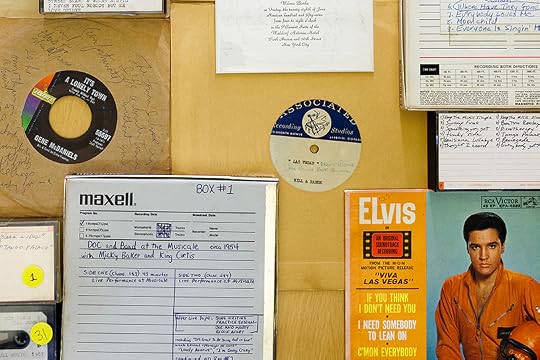 A collage of Doc Pomus’ papers and mementos from his collection, now preserved at the Library. Recorded Sound Section. Photo: Shawn Miller.
But don’t forget who’s taking you home
And in whose arms you’re gonna be
So darling — save the last dance for me
The lyrics are that of a man singing to his beloved that she is free to dance with suitors at a party, but to always remember she is pledged to (and leaving with) him. It’s imbued with a teasing, playful sense of affection and devotion.
“It’s the longing, desire and commitment,” says Sharyn Felder, the daughter of Doc and Wilma (Willi) Burke, the couple whose romance sparked the ballad, of the song’s enduring appeal. She co-produced a 2012 documentary, “A.K.A. Doc Pomus,” about her father’s career, a segment of which captures the magic of the song.
“Dance” hit No. 1 when released by the Drifters in 1960 and has been recorded by more than 500 artists, all around in the world, in multiple languages, in almost every conceivable genre, and has long been part of the pop music canon.
Doc’s friend John Lennon loved it; Dolly Parton and Emmylou Harris each had country hits with it. The DeFranco Family had a pop hit with it in the ‘70s. Bruce Willis crooned it on an album in the ’80s, and rock legend Bruce Springsteen has done it in concert. Michael Bublé did a jazzy cover in the early 2000s; the single never charted, but the official video has 70 million hits on YouTube alone. Leonard Cohen, the songwriter’s songwriter, closed his final concert with it.
But the backstory? Almost no one knew it until after Doc passed away in 1991.
Felder was going through her dad’s papers when she came across a stack of unused invitations to her parents’ wedding reception, the fancy one thrown for Doc by music industry bigwigs at the Waldorf Astoria Hotel in New York City on June 28, 1957.
And there, scribbled along the side of one, curling along the edge, was this: “Save the last dance for me.”
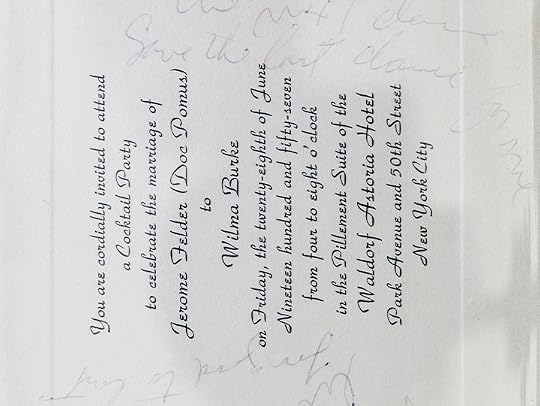 In faint pencil, Doc Pomus scribbled “Save the last dance for me” sideways on this invitation to his wedding reception. Photo: Shawn Miller.
She got goosebumps.
Doc had polio as a child. He used crutches or a wheelchair to get around as an adult. He and Willi were the perfect case of opposites attract —he was short, heavyset, charismatic, Jewish, a native New Yorker; Willi was tall, thin, blond, a Midwestern Catholic girl who had come to the Big Apple to make it as an actress and singer.
Doc could not walk unassisted, much less dance, but he insisted his bride dance at their wedding.
“The day we were married, he got the idea, because he had said, ‘Why don’t you get up and dance with all these people?’ Willi Burke said in “A.K.A Doc Pomus.” “So, then I danced with his brother, I danced with his father, his cousin, a couple of friends, but I never of course got to dance with him.”
Did he sketch out the song right then and there, sitting in the Waldorf Astoria, watching his wife swirl around the room?
No one will ever know.
There is not a single other handwritten lyric sheet for that song, Sharyn Felder says. Doc never mentioned much about the songwriting process for that hit to his wife, daughter or anyone else, but everyone at the wedding reception agrees that it was the genesis for the song, as the documentary makes clear.
The finished song, composed with music from Shuman, came out three years after the wedding.
So why wouldn’t he have set aside that invitation someplace special, as it was genesis of his biggest hit? Where are all the other handwritten lyrics?
Felder theorizes a simple answer — “Dance” was a nice hit, but her dad had lots of hits and “Dance” only became embedded in pop culture slowly, over the decades.
At the time, it wasn’t a bigger deal than, say, writing “Viva Las Vegas.” He was always onto the next thing, writing all the time, everywhere, on everything. Elvis, Ray Charles, the Beatles, Lou Reed — he was friends with all of them. He was Bette Midler’s early musical adviser. B.B. King won a 1981 Grammy for an album Doc wrote with Dr. John, “There Must Be a Better World Somewhere.” Bob Dylan sought out Doc for songwriting help in the 1980s and dedicated his 2022 book, “The Philosophy of Modern Song,” to him.
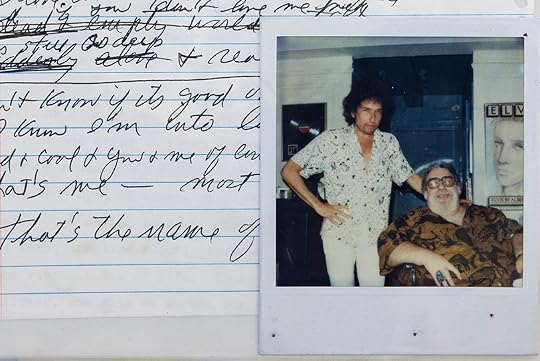 A scrapbook page holds a picture of Doc Pomus and Bob Dylan, along with a sheet of lyrics Doc was working on for Dylan. Recorded Sound Section. Photo: Shawn Miller.
In this milieu, she says, “Dance” did not glow in the dark, outshining everything else. The scrawled title on the reception invitation was just another note in a career full of them, not the magical talisman it seems today, preserved in the Library’s collections.
And there were other things, too. Doc and Willi (who went on to a successful acting career) eventually divorced. His health, never good, slowly deteriorated. He died of lung cancer, at age 65, in 1991.
Still, the magic of the song endures; nearly 70 years later, it retains its emotional immediacy with couples everywhere.
“I still can’t think of that song without feeling very sad … and very happy at the same time,” Burke remembers in that 2012 documentary, fighting back tears. “ ’Cause Doc wrote that for me. And he meant that from his heart.”
Subscribe to the blog— it’s free!
Library of Congress's Blog

- Library of Congress's profile
- 77 followers
