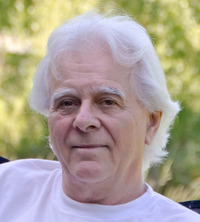
Colin D. Mallard

Colin D. Mallard’s Followers (22)

member photo
member photo
member photo
member photo
member photo
member photo
member photo
member photo
member photo
member photo
member photo
member photo
member photo
member photo
member photo
member photo
member photo
member photo
member photo
member photo
member photo
member photo
Val Walton
52 books | 9 friends

Ricky S...
80 books | 647 friends

Bennett...
138 books | 484 friends

Heather...
69 books | 20 friends

Devon O
196 books | 1 friend


Colin D. Mallard

Goodreads Author


Born
in Birmingham, The United Kingdom
Website

Genre

Influences
Zen Buddhism, Advaita Vedanta, Taoism. Sufism. Christianity.

Member Since
August 2012

URL


Colin Mallard played in bomb craters and bombed out buildings as a child in England during the Second World War. Perhaps this was the origin of his interest in peace. He attended University in Boston and was deeply involved in the Civil Rights and Anti War Movements of the 60s. In fact, the story of the sanctuary at Boston University’s Marsh Chapel, described in "Stillpoint," was written from personal experience.

He worked for a number of years at an inner city church in Providence with the local black population and was harassed, threatened and beaten by the police. Later the church was firebombed and destroyed.

Some of his many jobs have included such esoteric skills as taxi driver, magician’s assistant, tree planter, mountain guide and a
...more

To ask Colin D. Mallard questions, please sign up.

Popular Answered Questions

Colin D. Mallard Read, read, read, soak in it, marinate in it and then when the time comes notice how the writer takes you thru the various transitions, conversations …moreRead, read, read, soak in it, marinate in it and then when the time comes notice how the writer takes you thru the various transitions, conversations and so on. The readers mind does a lot of the writing for the writer. The writer suggests and the mind of the reader fills in the blanks with his or her imagination and experiences. (less)
Colin D. Mallard I've answered this question in a blog sometime ago but perhaps it bears repeating here. The most recent book was "Stillpoint," and this is how it came…moreI've answered this question in a blog sometime ago but perhaps it bears repeating here. The most recent book was "Stillpoint," and this is how it came about.


It was the eve of the Gulf War some 20 years ago and George Bush senior was preparing to attack Saddam Hussein. Saddam had promised ‘the mother of all wars.’ Saddam, it appears, didn’t realize he was poking a hornet’s nest.

As I listened to the news, Lao Tzu’s words came whispering through time. Lao Tzu, or “Old Gentleman,” as he was called, was a poet sage who lived five hundred years before the birth of Christ. We know him today as the author of the Tao Te Ching. Listening to him was like listening to a running commentary on what was happening.

"Weapons," he said, "are instruments of violence and fear.
The wise have no use for them
Except in the gravest necessity, when compelled
And, only with restraint.

"In Victory
After the slaughter of men
How can anyone rejoice?" He asked.

"That’s why the wise enter a battle gravely
With sorrow and compassion in their hearts
Like those attending a funeral."

I thought of the US military and those who lobby for war as a first response and Lao Tzu’s words answered my unasked question.

"When weapons are created, he said,
The temptation to use them
Is overwhelming."

As the buildup continued I felt a deep sense of foreboding. It seemed we were starting down a road from which it would be hard to turn back. Although we hadn’t yet realized it, that road was leading to a place of greater violence and polarization.

The commentary from Lao Tzu became more intense and I found myself wondering what he would do if he had lived today and found himself in a position to advise those in power.

Thus began Stillpoint, ‘though at the time it bore the name, Mr. President. I quit my job and went on the road to sell the book.
I flew from Hawaii, where I lived at the time, retrieved my truck from the docks in Seattle, bought a used camper and began a ten month journey. Loaded with fifteen hundred books I drove north to south and west to east.

But, as it turned out, I was from the country, and by natural inclination more solitary than social. I gradually withdrew from people and moved into remote areas of the mountains east and north east of San Diego. Needless to say I didn’t sell many books, although some are scattered all over the south west, left in bookstores on consignment and never retrieved.

Not long after my return to Hawaii, I moved to Vancouver Island to care for my mother. At the time I shared an office with a psychiatrist. We had interesting conversations over tea in the kitchen. I still lived in my camper, and paid a dollar each morning at the fish wharf for a hot shower.

Besides seeing clients I was writing a contemporary version of Lao Tzu’s Tao Te Ching. When I completed the several drafts I put them in the waiting room on the table with the magazines. The title read, Something to ponder while you wait. When it was published it became Something to Ponder, Reflections from Lao Tzu’s Tao Te Ching.

Years later a man introduced himself to me. “You don’t know me,” he said. “I read your book, Something to Ponder, while waiting for my appointments with the psychiatrist. What I found in that book stayed with me.”

In the meantime Mr. President languished in a friend’s basement. Events moved on, the war was over and the “Old Gentleman” began whispering to me again. There was an edginess to life, nasty violent clashes like boils bursting with toxicity, erupted throughout the world. It seemed to reflect the new undercurrents unleashed in human consciousness.

I re-wrote Mr. President and called it Uncommon Reason. Despite the fact that it won several awards it contained a lot of lectures and discussions and had a limited appeal.

Lao Tzu continued whispering, he wouldn’t leave me alone and Stillpoint emerged on the scene.

I wanted Stillpoint to take readers on a journey through history, into a world most knew little about. I wanted them to understand what it would be like to live through those times, not just intellectually, but emotionally as well.

In the process characters emerged that I fell in love with, others I disliked. Through it all I hoped they would give voice to the suffering and loss, the beliefs and assumptions that lead to war and have done so for as long as man has roamed the earth.

I wanted readers to be so immersed in the events they were no longer bystanders but engaged participants in an unfolding conversation about war and peace.

I hoped readers could say they learned some things and understood others and as a direct result the complexity of the events taking place in the Middle East would seem somehow, not so complex. I wanted readers to see from a different perspective, a perspective the poet, T S Elliot, identified as the still point of the turning world: a perspective quite different from the one defined by propaganda, the one with which we’re all well acquainted.

I wanted readers to have a deep sense of compassion for the suffering of those caught in the tightening spiral of violence. And most importantly, glimpse, if even faintly, a path that could eventually lead to peace in the region; and, to understand we, you and I, are part of what happens in the Middle East, either through our ignorance or through our awareness.

Lao Tzu continues whispering to me from time to time; I’ve learned to pay attention. We are friends now, well acquainted with one another. In writing Stillpoint he was always looking over my shoulder reminding me that:

"When a sage governs a nation
He does not place himself above others
Their difficulties and humiliations are his own.

"This is what makes a great leader," he added.(less)
Average rating: 4.28 · 88 ratings · 42 reviews · 10 distinct works
Stillpoint: A Novel of war,...

4.12 avg rating — 51 ratings — published 2012 — 6 editions
Rate this book
Clear rating
Something to Ponder: Reflec...

4.83 avg rating — 12 ratings — published 2009 — 4 editions
Rate this book
Clear rating
Understanding: The Simplici...

4.45 avg rating — 11 ratings — published 2010 — 3 editions
Rate this book
Clear rating
Going to Gaza: Ten Days Tha...

really liked it 4.00 avg rating — 10 ratings3 editions
Rate this book
Clear rating
Uncommon Reason - A Novel o...

really liked it 4.00 avg rating — 4 ratings — published 1995 — 5 editions
Rate this book
Clear rating
Like a Large Immovable Rock

it was amazing 5.00 avg rating — 1 rating — published 1996
Rate this book
Clear rating
Reflections from Lazo Tzu's...

0.00 avg rating — 0 ratings
Rate this book
Clear rating
Something To Ponder: A Cont...

0.00 avg rating — 0 ratings2 editions
Rate this book
Clear rating
Mr. President

0.00 avg rating — 0 ratings
Rate this book
Clear rating
Reflections

0.00 avg rating — 0 ratings
Rate this book
Clear rating
More books by Colin D. Mallard…

Does it really matter who offers help in our time of need? Who cares about the color of their skin or where they were born?

I was quite taken aback when I read Susan Abulhawa’s review of Corasanti’s book, “The Almond Tree.” I recall similar accusations and conversations taking place during the Civil Rights and Anti War Movements of the 60s. The arrogance of thinking there’s only one correct way to see things is still very much alive. This is a problem common to both ideology and theology. It can cause us to ignore fact Read more of this blog post »
1 like ·   •  0 comments  •  flag
Share on Twitter
Published on February 10, 2014 21:05 Tags: israel, palestine, palestinian-conflict, palestinian-israeli-conflict, war-and-peace
“A man was fishing and caught a fish. The fish was so small he threw it back in the water and for the first time in its life the fish realized it was swimming in something.”
Zen Story

Terry Pratchett
“The trouble with having an open mind, of course, is that people will insist on coming along and trying to put things in it.”
Terry Pratchett, Diggers

Katherine Mansfield
“The pleasure of all reading is doubled when one lives with another who shares the same books.”
Katherine Mansfield

Alexandre Dumas fils
“The difference between genius and stupidity is: genius has its limits.”
Alexandre Dumas-fils

Woody Allen
“I'm not afraid of death; I just don't want to be there when it happens.”
Woody Allen

No comments have been added yet.