Marcia Thornton Jones's Blog
November 30, 2025
Near or Far... What's Your View?
by Charlotte Bennardo
Simply put, depth of field is the range of distances in a photo, a scene, a glance.
 Photo by Misael Garcia: https://www.pexels.com/photo/close-up...
Like anything in life, this picture can be looked at in two ways.
The first is the sharp focus on the foreground. Like our lives, our work, our situations, our problems. We focus sharply on them and that directs our actions.
The second way is to while seeing what's directly in front of us, see a bit beyond. No, we can't see it clearly, but then the future, decisions we must make, what options are open-aren't always clear.
The choice becomes focus on what we can clearly see, ignoring what may be beyond, or try to see that which lays beyond, not just solely what's obvious.
What's your choice?
Charlotte writes MG, YA, NA, and adult novels in sci fi, fantasy, contemporary, paranormal and romance genres. Her latest YA fantasy novel, The Excalibur Vow, just released. She is the author of the award-winning middle grade Evolution Revolution trilogy, Simple Machines, Simple Plans, and Simple Lessons. She co-authored the YA novels Blonde OPS, Sirenz, and Sirenz Back in Fashion. She has several short stories in various anthologies. Having finished her MFA, she's applying what she learned and is working on several children's and adult novels, and other short stories. She lives in NJ with her family and floofy cat Mink, and a squirrel who insists on digging up her geraniums. The visiting pet rabbit, Bad Bunny, has vacated our back yard for his own.


Interview with ND Stevenson, Author of Scarlet Morning
 Today, we're joined by ND Stevenson, author of Scarlet Morning, a heavily illustrated novel that finds two orphaned teens joining a quirky pirate crew to sail across a magically broken sea and unravel the secrets of a world shattered by betrayal and grief.
~
In your author's note, youmention that Scarlet Morning represents over fifteen years of your life,beginning as a childhood game on a playground. How did the core themes andcharacters evolve from those early playground adventures to the final novel?
I was a very imaginative kid who usedstories as social currency, and I dragged other kids into my invented worlds asa friendship ploy…though I was also a little bit of a megalomaniac and had toassign everyone’s part and tell them how to play it. Out of these games cameChase, Viola, and Wilmur, and later (when the part of Viola was double-booked),the tragic figure of Queen Hail Meridian began to emerge. It began as a way toescape the repressive and often very boring world of ultra-religious homeschoolersby envisioning ourselves free on the wide-open sea, then grew into a serializedepic that spanned most of my teenage years, exploring my feelings of loss atgrowing up and trying to make sense of the world of adults that I was enteringinto. Fifteen years later, while very little of the original prose remains, thebackbone and the emotion of that original draft are still intact, looked backon now with adult eyes, a collaboration across time.
Worldbuilding is such a big part ofthe novel. Dickerson's Sea is richly developed with its own history, legends,and environmental phenomena like the Great Blow and the salt-covered landscape.What inspired these specific elements?
The very earliest iteration ofDickerson’s Sea was this eclectic place where all the rules of nature had gonehaywire and anything could happen, and it had been cut off from the rest of theworld for so long that no one remembered what “the rest of the world” evenlooked like. When I dusted the concept off in 2020, I liked that a lot, but Iwanted to build it out more concretely and put a unique twist on the classic“Age of Sail” setting. I came up with the idea of the ocean turning solid andthe world getting drifted over with salt because I’m obsessed withmountaineering disasters and doomed arctic expeditions; there’s something socompelling about the juxtaposition of these tiny human figures against thisvast, hostile white expanse. The image popped into my head of two barefoot kidsnavigating what looked like a polar tundra but was really a salt desert thatused to be the sea. Scarlet Morning is a story that’s all about theempty spaces left behind when something vanishes, and this all-white world madethat blankness literal. But of course the void is never really empty, so Iwanted it to be very beautiful and rich too, even in its environmental ruin.
There's a strong thread aboutstorytelling throughout, from Hestur's pirate tales to Viola's love of historybooks. I love the idea of stories within stories. I imagine this sprang fromyour own relationship with imagination and narratives (especially since thisbook is fifteen years in the making)!
I’ve always been crazy about pirates. Inhigh school I wrote all of these research papers on them, and thought I kneweverything there was to know. Then as an adult, I started revisiting thosestories, and realized that everything I thought I knew about pirates was wrong.Some of my favorites, like Jacquotte Delahaye, probably never existed, and evenBlackbeard, the most famous pirate of all, we know so little about—we aren’teven sure of his real name. Fiction devoured fact until it was impossible todisentangle. I found that so fascinating and wanted to dig deeper. What do welose when we twist truth to fit our narrative? What happens when real peopleare immortalized as characters for our amusement, often against their will? Andwhat of people who are completely whitewashed out of existence because they don’t fit ourpreconceived notions of “protagonist?”
The captain character, CadenceChase, is hard to pin down. She admits she killed someone, has this wild shipwith cannons, but shows kindness to the children. I love a character that’s inthe gray somewhere between hero and villain. What made you want to write such acharacter?
Chase is a very, very old character forme—I think her earliest iteration was a heavily scarred, cat-like, androgynouslady pirate when I was maybe eight years old. Look, I knew what I was abouteven then. She was aspirational for me as a mix of masculine and femininetropes, as well as a fantasy of the aloof, mysterious mentor character whocould kill you in a moment, but doesn’t. And yet, underneath her cool exterior,she’s a mess. She’s clumsy with emotion and sometimes you suspect she wantsViola’s approval as much as Viola wants hers…but every time you think you’vefigured her out, you learn something new about her and her specter is snatchedaway again. I’m really, really excited for the world to meet her. I love her somuch.
There's a strong theme ofidentity throughout. There’s Chase's multiple names and personas to HailMeridian's hidden existence as Tal dei Tali. What was there about a pirate’sworld that made you feel it was the perfect backdrop to explore identity and reinvention?
I mentioned Jacquotte Delahaye, theprobably-fictional pirate. Supposedly she faked her own death, lived as a manfor ten years, and then went back to presenting as a woman, so when shereturned she earned the nickname “Back From the Dead Red.” Pirate lore is rifewith stories of muddled identity like this. I am a person who has always beensurprised and a little disappointed about having a singular body and a singularlife; it just seems like there are so many experiences I’m missing out on. Sostories where people slip between identities have always been very appealing tome. In fact, I think that’s the reason I tell stories in the first place—to tryon different faces and live different lives.
The relationship between Violaand Wilmur forms the emotional core of your story. How did you approachdeveloping their friendship, and what inspired you to make this bond so centralto the narrative?
When we first meet Viola and Wilmur,their lives are thoroughly intertwined. They love each other so much, butthey’re also codependent to the point that they’ve become sort of stunted. Thensuddenly, they’re rocketed into a whole new world where they’re forced tofigure out who they are without each other for the very first time. I drew alot of inspiration from my own intense relationships with my siblings andchildhood friends. You grow around those people like two trees sharing one pot,and even when you leave to find your own path, the shape of them will always bethere in your roots. You made each other…but now you have to go and makeyourself somewhere else, and if all goes well, hopefully you find each otheragain on the other side.
You’ve lived with this story forso long. Was a a celebration to get it on the page, or was it sad to have tolet a bit of it go?
I’m not quite sure yet. I always gothrough an emotional dip when a story leaves my hands and becomes the propertyof the world, but I don’t think it’s sunk in yet. Still, there’s a big sense ofrelief, too, getting a hard-to-crack story out of you. I think it will comewith a lot of joy too.
What’s next?
Oh god. Book 2 for now. Then more,maybe? More of Dickerson’s Sea or something else, I don’t know. As soon as Ifind out I’ll let you know.
Where can we find you?
I post autobio comics on Substack atwww.www.imfineimfine.com.I’m also on Instagram and (sometimes, rarely) Twitter at @gingerhazing, Blueskyat @gingerhaze.
Snag a copy of Scarlet Morning
November 24, 2025
Main Character's Depth of Field (Holly Schindler)
I've always had floaters.
You know, those squiggles in your eyes, those pieces that kind of bounce around in the vitreous? Most of the time, eye docs will tell you they show up in middle age. I had them as a little girl. I've also always been really nearsighted, too, and figured it all went together.
Anyway...
I've spent my entire life not looking at them, but looking past them, at the objects in front of me. But a bad sinus infection has increased the pressure in my face, meaning my floaters are lately just driving me nuts. Every single time I move my eyes, the bounce past, and it just bothers me.
I mean, forty-plus years with these things, and suddenly, it's all I see.
It's all just a matter of attention and focus.

The same is true with our characters, though. They can be absolutely laser-focused on something no one else around them can even see. It can be consuming them, absorbing all of their worry or attention. As authors, it's our job to bring those things into focus for our readers, to explain our main character's mentality, aka their depth of field. (Do they see the big picture? Worry about the future? Only think about the next five minutes?) If we do this correctly, our readers will completely understand our character's behavior...even if no one else in our character's world does.
~
Holly Schindler is the author of The Junction of Sunshine and Lucky
November 23, 2025
Depth of Field--A Concentration of Wandering: Smack Dab in the Imagination by Dia Calhoun
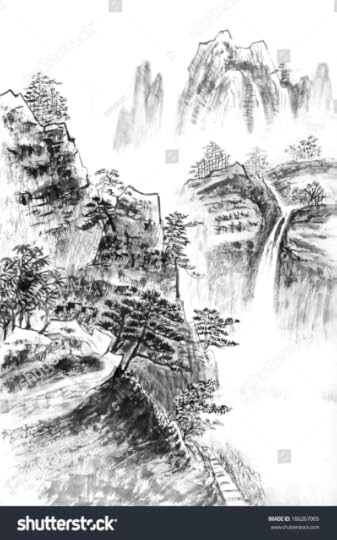
The “field,” which can be thought of as the tension created between opposites, is where movement and change happen. Imagine a black and white sumi-e painting. In the foreground, a waterfall pours down a cliff into a wooded valley. In the soft background looms the suggestion of a snowy mountain lost in fog. Here the opposites are ice—or frozen water—and flowing water. The gap that is left to the imagination is the water’s transformative journey between the two images. The snow melts, gathers into trickles and streams that gather force over distance and finally plunge down the cliff into the valley. The gap is the field where imagination fills in the story. The tension between the opposites of ice and flowing water creates a concentration of wandering (I first heard Dr. Connie Zweig, a depth psychologist, use that phrase). I think that phrase is also a wonderful way to express how the artistic imagination works.
November 15, 2025
This New State of Play

My first week of freedom of the classroom, I have been revisiting my own story, enjoying a new state of play, and contemplating what this new stage in life is meant to be, or at the very least, what it means to be me. As Longfellow once lamented,
“Act! Take Action! Be Active!
Tell me not, in mournful numbers,
Life is but an empty dream!”
And, as it happens, as once said by wiser folk than I, writers write. Everything else -- everything external -- is beyond our control. However, writing is an internal process. As such, we focus on what we can control: ourselves. Take classes. Read books about the craft. Study mentor books. Adapt, rethink, refocus. Take chances. Leave your comfort zone. Write something new. Write something different. Submit, and submit again.
Most important: Persevere.
To cite another idiom: We do our best and leave the rest to the universe.
Or, as Neil deGrasse Tyson offers much more eloquently -- and really, who else knows more about how the universe works than the mighty Tyson:
“The problem, often not discovered until late in life, is that when you look for things in life like love, meaning, motivation, it implies they are sitting behind a tree or under a rock. The most successful people in life recognize, that in life they create their own love, they manufacture their own meaning, they generate their own motivation.” -- Neil deGrasse Tyson
To this end, I’ve revisited one (of many) of my favorite reads, Story Engineering, by Larry Brooks (Writer’s Digest Books, 2011). Every creative cook understands that the “most delicious of ingredients require blending and cooking – stirring, whipping, baking, boiling, frying, and sometimes, marinating – before they qualify as edible…” It is the delicious sum of these ingredients that turns your story into a “literary feast.”
In other words, story engineering is that recipe that brings these ingredients together in a cohesive , satisfying dish. It differs from formulaic writing in that the process of story engineering serves to bring clarity to your story, but you bring the art. A pinch of this, a dash of that, stirred not shaken, and you make the story your own.
May your life be a most delectable dish of the artful!
-- Bobbi Miller
November 12, 2025
How Can We Capture Depth of Field? by Darlene Beck Jacobson
I just came back from my first trip to New Mexico. I was visiting friends who took me on a drive to the top of Sandia Peak which overlooks the city of Albuquerque. 10,000 feet and two miles above sea level, it is wondrous to behold.
 The breathtaking views can never be captured with a camera. Even by the best photographer. Because of the depth of field. Yes, the trees are close. Yes, the mountains and valley look far away.
But how can we convey such vast distance without seeing it in person.

Even standing on a road, looking up at a wall of rock, it seems that words are not enough to convey the majesty, splendor, and enormity of the space that lies before us.
The best we can do, as writers, is to maybe use our senses to talk about the smell and feel of the dry air that surrounds the place. The feel of the rocks beneath our feet. The sound of peace and quiet with no man-made intrusion of noise. The sight that leaves us open-mouthed and speechless.

All of it leaving me with the feeling that we are but a small being in a vast universe. Out of our depth in a vast field of wonder.
Darlene Beck Jacobson loves traveling to amazing places and feeling the vastness of the world.
November 11, 2025
Between Here and There
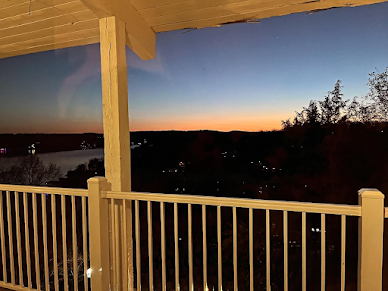 Photo from a writer's retreat, Table Rock Lake, MO
Up close, the hand-craftedrailing. In the distance, a gorgeous sunset. But what about the middle? Thelake, the lights, the life?
The imagination soars.
What's there? Who's there? Arethey...
Young? Old?
Rich? Poor?
Mean? Kind?
Complex? Simple?
Calm? Scared?
Why? Why? Why?
And the story starts.
Jody Feldman used this view, the depth of field, the space between here and there, to inspire an important scene. It's not the first time a picture like this sparked a story. it won't be the last.
November 8, 2025
Depth of Field and Circle of Confusion
Thisphrase has a very technical meaning to expert photographers with real cameras.
Iam not one. My camera is my phone. What it captures is more like an extensionof my memory than anything anyone would admire.
Butthe phrase does relate to story telling. The camera (or the writer) can focuson certain elements. Some close. Some farther away. Those that aren’t in focus residein what’s technically referred to as a circle of confusion. (Yes that’s what it’s really called!)
Whenwe write, we choose what we focus on. And what we want the reader to focus on.We should be selective. We don’t have an infinite amount of words. Maybe 40 or 50thousand? Probably less. So we must focus on the most germane things.
Butdon’t forget to include a hint of what else is there. Lurking. Under the bed. Belowthe surface. In the fog. In the mist.
Ignorethe warning. Go and see.
Jane Kelley is the author of many novels in which she imagines more danger than she would ever dare to encounter.
@font-face {font-family:"Cambria Math"; panose-1:2 4 5 3 5 4 6 3 2 4; mso-font-charset:0; mso-generic-font-family:roman; mso-font-pitch:variable; mso-font-signature:-536870145 1107305727 0 0 415 0;}@font-face {font-family:Aptos; panose-1:2 11 0 4 2 2 2 2 2 4; mso-font-charset:0; mso-generic-font-family:swiss; mso-font-pitch:variable; mso-font-signature:536871559 3 0 0 415 0;}p.MsoNormal, li.MsoNormal, div.MsoNormal {mso-style-unhide:no; mso-style-qformat:yes; mso-style-parent:""; margin:0cm; mso-pagination:widow-orphan; font-size:12.0pt; font-family:"Aptos",sans-serif; mso-ascii-font-family:Aptos; mso-ascii-theme-font:minor-latin; mso-fareast-font-family:Aptos; mso-fareast-theme-font:minor-latin; mso-hansi-font-family:Aptos; mso-hansi-theme-font:minor-latin; mso-bidi-font-family:"Times New Roman"; mso-bidi-theme-font:minor-bidi;}.MsoChpDefault {mso-style-type:export-only; mso-default-props:yes; font-family:"Aptos",sans-serif; mso-ascii-font-family:Aptos; mso-ascii-theme-font:minor-latin; mso-fareast-font-family:Aptos; mso-fareast-theme-font:minor-latin; mso-hansi-font-family:Aptos; mso-hansi-theme-font:minor-latin; mso-bidi-font-family:"Times New Roman"; mso-bidi-theme-font:minor-bidi; mso-font-kerning:0pt; mso-ligatures:none;}div.WordSection1 {page:WordSection1;}
November 4, 2025
“A Whole Bunch of Death Scenes”—How to Write Interactive Fiction (Guest Post by Ryan Jacobson)

With middle-grade fiction, we’re mostly used to endings in which everything works out great. But if writing tragic endings—over and over again—sounds like an interesting change-of-pace, I have a project for you: Write a Choose Your Path (CYP) story, where readers become the main character and make choices that affect what happens next.
Some CYP books can be lovingly described as several short stories chopped up and blended together. These books are meant to be read multiple times, and while each adventure is relatively short, every reading takes entirely different turns. My books follow what’s called a Golden Path. There is one storyline (or “path”), and the reader’s mission is to find the “golden” ending. Correct choices keep them on that path; wrong choices often lead to disaster.
My first CYP effort, Lost in the Wild (Adventure Publications), hit shelves in 2008. Since then, I’ve written or edited more than 20 such books—including adaptations of classic literature, like Can You Survive the Wonderful Wizard of Oz?
Writing a CYP story is very much like writing a traditional manuscript—but with a whole bunch of death scenes! Okay, that’s a bit of hyperbole, but the sentiment is true. A CYP book begins as a regular ol’ story—the Golden Path. Along that path, your main character makes a choice every time s/he decides to do (or not do) something. You can turn many of these moments into choices for readers. I try to incorporate a “choice moment” every 500–700 words.
To visualize the CYP concept, it might be helpful to think of your story’s Golden Path as a straight line. Along that line, every choice moment is a dot. At each dot, a line branches off the main line. The wrong choice is the branch, while the right choice continues the reader along that straight line. A branch can lead to a tragic ending or to another choice, with a chance to move back onto the Golden Path.
CYP books are typically written in second person, present tense: “You do this. You do that.” The books I write are around 160 pages, with about 20 choice moments.
Speaking of choice moments, it’s more fun when the correct choice isn’t obvious. This can be harder than it sounds! (For example, many readers know that Dorothy defeats the Wicked Witch with a bucket of water—yet that pivotal moment needs to be a choice. Leading up it, I left out any mention of buckets or water and made it a choice of whether or not to get angry at the Witch.) Try to make all options sound correct by stating a possible benefit and/or consequence that could accompany each.
Now it’s time for you to make a choice: You can write a traditional story; it’s familiar, and you know you’re good at it. Or you can write a CYP story; it’ll be more difficult at first, but it might become something you love. Plus, the more interactive fiction we can create for children, the more we can inspire them to become avid readers. What will you choose to do?
Grab a copy of Can You Survive The Wonderful World of Oz?

Ryan Jacobson is an award-winning author who has written more than 60 books. He specializes in interactive fiction and is proud to have helped create such series as Choose to Win, Detective: You, and Interactive Classic Literature.
November 2, 2025
Middle Grade Fiction for November
The clocks are back on Standard Time and we're in the midst of fall right now, so here are some new middle grade novels to read in November--the quotes come from interviews I did with the authors for my blog, Book Q&As with Deborah Kalb...
 Megan Wagner Lloyd and Michelle Mee Nutter are the creators of the new graphic novel Winging It. Lloyd said of the book, "After moving to the East Coast, I learned about thebeautiful luna moth, only found on the eastern side of the US. I wondered if Icould build a story around someone who moved across the country--like me--andreally wanted to see the elusive luna moth in person. It only made sense toname this character Luna!" She added, "Because I wanted Luna to have a really strongconnection to nature at the end of the story, I decided to make her a veryindoorsy person at the beginning of the book, so that she could have a strongcharacter arc."
 Martha Brockenbrough is the author of the new novel At the Edge of Lost. She said, "I wanted to write a book that captured how I often feelin our post-pandemic world—something that would acknowledge the anxiety of itbut also lean into the strength and hope of all the kids who made it through arough time. I didn’t want to write about Covid, though. I wanted towrite about the kids who survived it and how they would do if another pandemicscare happened. It’s the absolute last thing anyone wants to happen, andsometimes life deals us those double blows." She added, "So how do we endure? With the help of our friends. Withcourage. And on behalf of the ones we love."
 Finally, Jen Calonita's new novel is The Taylors. Calonita said, "I've always been a Swiftie, and my heart is with middleschool stories so I've been dying to write a new one. Navigating fifth and sixth grade was hard for me. I switchedfriend groups, had a fight with my best friend, wound up switching lunchtables, had my first school dance and my first overnight school trip. These areall things I remember very vividly! Things that weighed on me heavily!" She added, "I was much like [my character] Teffy--afraid to use my voice and speakup--so I wanted to create a character who learns how to navigate middle schoolwith the help of three new friends, all also named Taylor, who are alsoSwifties. I wanted Teffy to learn to be braver than I was. To takechances and be fearless and my hope is that kids will read about her and wantto take chances and be brave too. This story felt like the perfect mix of allthe things I love."
Happy reading!
--Deborah Kalb