Sharon Hughson's Blog
August 9, 2024
Three Reasons to Hire a Writing Coach
As an indie author, I’ve been guilty of thinking I couldn’t afford a writing coach. I learned if I didn’t hire a writing coach, my writing career might end.
I’m a cheapskate conscientious spender. I learned the hard way that eating ramen noodles every day doesn’t satisfy.
Do you want to be a published author? Are you consistently writing your book?
No matter how much money you aren’t making, if you need a writing coach, find a way to hire one. Working with a coach is a game changer.
Writers Struggle
Writing a book is a gargantuan undertaking. Once your brain lands on a stellar idea, there’s still a mountain of work ahead. To outline or not. What is story structure? Are my characters interesting, relatable, and likable?
Answering those questions only gets you through the first draft. For many writers (like me), that’s when the real work begins:
Rewriting the story so it flows and creates an emotional response
Revising each scene for depth and clarity
Getting reader feedback
No one truly understands our compulsion to lock ourselves in a room with imaginary friends for hours, days, weeks, and months, so we struggle in isolation.
One day we love our story. The next day, it takes every ounce of willpower not to toss the laptop across the room and burn every page we’ve written.
We’re brilliant. We’re an idiot. Our prose is poetic. Our pages suck. No one will ever read this. I hope no one ever reads this.
When can we get off this roller coaster?
Welcome to the digital age. Now we don’t have to struggle alone. We can find supportive communities of like-minded writers online. And we can connect with writing coaches and mentors who live across the country.
Information Overwhelm
When I wrote this post, I Googled “how to write a book” and got 6,300,000,000 PAGES of results. I’m not sure how long it would take to surf through six billion pages, but I can assure you I wouldn’t be writing my book while on the scroll.
Information overwhelm is a major stumbling block for a new writer. Even an experienced writer stuck in a plot hole or the muddy middle of a novel can get bogged down by the sheer magnitude of advice and resources offered on the internet.
Good information exists online. Compared to how I researched my first attempt at a novel in 1989, this information highway is an express lane to finding facts.
But easy access can become a barrier to writing the story. A writer falls down the research rabbit hole and emerges weeks later with pages of factoids in Evernote and a heady buzz of new ideas swarming her brain.
But pages written in her story? Exactly none.
The same detour can come when a writer attempts to improve her writing craft. No one ever masters writing. And we should keep striving to improve at the craft.
How does a writer know what is weak about their work? Who tells them what to improve first?
An insightful editor can be a great help here. At other times, navigating through all the information requires a regular guide. That’s where a writing coach can help.
Investment = Commitment
Well, of course you think I should hire a writing coach, Sharon. That’s what you do.
I understand the skepticism. I’ve yearned to have a mentor but couldn’t spend $100 for one hour of coaching. Who can afford that? Not me.
If you’re committed to becoming a published author, making a financial investment spurs you forward. Once I spent money to attend writing conferences and retreats, I knew I needed to produce a publishable story to “prove” that time and money was well-spent.
I told you I was a tightwad penny pincher.
Once we invest money into something, we give it priority on our schedule.
Investing in the dream renews commitment to finishing the book. With an expert to talk to, it’s possible to sift through information and determine what might work for your writing process. When motivation lags, knowing your coach will ask about your writing keeps your rear in the chair.
Finding the Perfect Coach
It might surprise you how many writers offer coaching services. Is there a writer whose books you love? Check her website to find out if she might be one who coaches writers.
Writing membership sites might help you locate a coach. As a certified hope*writers coach, writers can learn about me on the hope*writers’ site.
Coaching costs vary. The Editorial Freelancers Association lists coaching at $70 per hour but I have met few writing coaches who charge that little. The rate often depends on the coach’s experience, but it’s even more important to know if they can help you with your specific struggles.
Many coaches offer a free discovery session. This is a great way to determine whether their style fits your personality and needs.
Some coaches specialize in specific aspects of the writing process or with a certain genre. I love talking story with other writers so story coaching is one of my favorite things to do. However, a story coach is different than a book coach who reads pages and offers insights on them. (I offer manuscript critique as a separate service.) That’s why it’s important for you to know what you want from a coach before hiring one.
If you’re ready to take your writing to the next level, check out my YouTube channel, free coaching group or even schedule a discovery call where we can talk specifically about your challenges.
Investing in a writing coach is money well-spent toward reaching your publishing dreams.


July 25, 2024
A short story beginning
It’s fiction Friday here on Sharon Hughson’s blog.
Here’s the start of a short story I wrote several years ago. I recently reread it, and I liked the character voice.
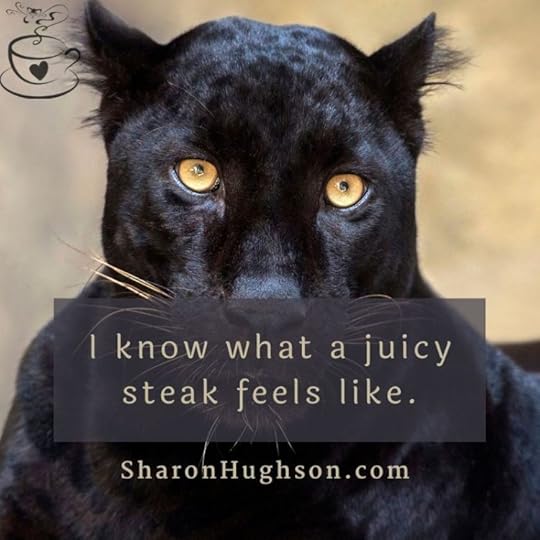
Panther and EagleI know what a juicy steak feels like.
Need a bit of context for that statement? I don’t want you to think this is a story about a meat market because that couldn’t be further from the truth.
I’m an academic. As such, I have an appreciation for classic literature. While some people might have experienced THE JUNGLE BOOK in a cinematic way, my first and favorite meeting with the story was in Rudyard Kipling’s collection of short stories with that title.
People traipsing through the jungle with Mowgli are a bit put off by Bagheera. In case you don’t recall, Bagheera is the black panther (jaguar).
“Why is he looking at me that way?” one of them asks.
“Because to him you are food.”
Mowgli’s answer is the line that popped into my head the day I came face to face with a black panther.
No one expects an academic to roam anywhere near a jaguar’s domain. Usually, I’m on the campus of Northwestern University, grading papers written by my ecology students or poring over research about climate change.
When I won a grant to pursue my research into global disbursement of the rain forest’s oxygen, it came with access to a cabin on the fringes of the rain forest in Brazil. Since Portuguese is one of four languages I speak fluently, I couldn’t have asked for a better placement.
Most people wouldn’t have liked the one bedroom cabin situated on a knoll beside a tributary of the Amazon River. Solar panels offered electricity, and a bushman arrived with supplies via boat every three weeks. If things had worked out with the last woman I proposed to, I would have agreed with most people.
But losing Amanda was strike three in my relationship attempts, so it seemed isolation on the edge of the jungle could be the perfect antidote to a broken heart. If I’d had one. Mostly I had an irritating sense of being defeated by something less technical than the pile of research I’d combed for data when proposing my scientific hypothesis.
My mind couldn’t fathom how maintaining a relationship could be more challenging that environmental science. In fact, Amanda informed me my density on that subject was the main reason we needed to part ways.
But back to the panther.
I’d lived in the hut for a few days longer than three weeks. Each day, I took two walks along the same path into the jungle. Most days this meant donning a rain slicker and covering my ginger hair with a wide-brimmed rubber hat.
Not so on the day in question.
An hour before sunset, I whistled as I approached the trees but fell silent when I strolled beneath the canopy. I enjoyed identifying the different species of birds and monkeys based on their calls. Sometimes, I glimpsed colorful wings in the branches or caught sight of a pale tail overhead. Most of the time, the only reason I knew I wasn’t the only living thing around was the noise.
That day, the forest sounded subdued. A breeze knocked limbs together. Clicking sounds indicated insects nearby. Chatters sounded far off, and not a single bird called.
Leaves rustled and a vine swung a few feet off the path. The lowest branch was nearly a foot above my seventy inches of height.
I glanced up. My feet turned to cement.
Wide, hazel eyes stared at me from a black feline face. The sleek cat crouched within easy springing distance.
I blinked. The cat didn’t. It won the staring contest I didn’t know we were having.
My brain whirred to life, searching databases for the answer to what a puny human should do when coming face to face with a big cat in the jungle. Run? Don’t run? Make yourself appear larger? Curl into the smallest possible ball?
I’m an intelligent guy. My two doctorate degrees and list of publishing credits for research articles in peer-reviewed journals prove it.
But when a guy feels like food, the gains to higher levels of Maslow’s Hierarchy of Needs disintegrate. The primal urge to survive at any cost overtakes all else.
For me that meant running.
And I wasn’t a person who ran. I had often joked to my friends that if they saw me running, they should do the same because it meant I was being chased. Why had I made light of such a scenario?
I backed up one step. The cat’s tail twitched. Wasn’t that a precursor to pouncing?
My feet shuffled backward. Muscles rippled beneath shiny black fur.
Why hadn’t I studied more about predators in the area? Knowledge was power and its lack made for stupid mistakes. Was there any mistake stupider than being eaten by a jaguar?
“Bagheera,” I muttered.
The cat’s ears twitched.
I shuffled back again. My heel snagged on something. I pinwheeled my arms to catch my balance but sprawled to the ground anyway.
The cat sprang from the branch.
*****
Who’s ready for more?
July 11, 2024
What every writer needs to know about author newsletters
Why do we hate writing emails? We can craft compelling stories. Writing 200 words on a project that inspires us takes a few minutes and energizes us. The thought of writing 200 words in an email to our subscribed readers sends us into a tailspin.
So, we’ll do it tomorrow.
Except, tomorrow doesn’t come until next month. Then we think it’s pointless because we haven’t sent an email in so long, they probably won’t remember who the message is from.
Why do we use so many excuses to avoid this important piece of an author’s career?
What We Think“I don’t generally read author newsletters,” said one coaching client, “so why would I think someone would read mine?”
I’ve been there. I’ve thought that.
But everyone isn’t like you. And the same person who admitted that said she did still follow and read two authors’ newsletters because she found them valuable.
I read a few of them. I like the author’s voice and getting a glimpse behind the writing curtain. But I’m an author, so I don’t know if the average reader would enjoy that.
Except one of the newsletters I read is written by a multi-time bestselling author, so I think she must be doing something right.
Time to debunk this idea that everyone hates newsletters. Some readers enjoy them and will read them.
What We FearAnother thing that keeps us from starting a consistent author newsletter is fear.
We’re afraid:
People will unsubscribePeople won’t read the words we toiled overPeople will think what we share is pointlessThe truth? People will unsubscribe. Unless you offer them a unique voice and content that reflects the way you write.
Some people won’t read the newsletters. Even if you find a clickable subject line and write quirky content.
Are you sharing pointless information?
Readers I polled were evenly split over whether they wanted to hear about your personal life or your writing struggles.
Sometimes, readers will scan the email, so make sure you include several images with clickable links.

Those people who unsubscribed? They weren’t your people.
Clean their names from your list, and carry on.
Here are things readers I polled said they enjoyed in the author newsletters they read:
Book recommendations and reviewsSales announcementsUpdates on the next project you’ll release, including excerpts to tease themRelease informationTravel/setting information and photographsInteresting tidbits about life, writing and otherwiseThe same poll gave insight into what makes readers hit the unsubscribe button even if they loved your books. Things like:
Constant requests to buy your bookLong and frequent emails that offer nothing of valueDon’t let fear and indecision keep you from creating a short story or novella as a lead magnet and giving it away in exchange for a reader’s email address.
Once you have a list, no matter how small, start sending a short email to them every month to two months. Most people I polled didn’t enjoy weekly emails.
What a relief! You can surely find excerpts from your book and interesting photos of your writing space or vacations to fill six newsletters. And that’s enough to keep your readers reading for a year.
Do you have an author newsletter? What advice or warnings would you add?
May 31, 2024
Third Wife
Today is fiction Friday.
I’m sharing the beginning of a story that isn’t complete. My question: is it interesting? Should I complete it?
I would be Scion d’Marc’s third wife. My stomach balled in a knot while my brother discussed the arrangements like the business contract they were. I had escaped the chains of marriage for four years while all the unscarred women of sixteen made their way from their father’s house to their husband’s.
Because in Lokim culture, women were treasures to be taken care of. I’d been a treasure to my father’s business since my mother discovered my color magic fifteen years past. Now both of them were gone, and my brother was selling me.
I held up my hand. “Augee, why does the scion need another wife? Does he plan to use my gift to brighten his palace?”
Augee’s thin shoulders sagged as he exhaled. Everything had fallen on him two years ago when Fateer passed from this world to walk with the Provio, the God of Providence, Provision and Protection. Moveer had been gone for almost a decade now, and memories of her face had become fuzzy, but I still recalled the feeling of her hands on mine as she drew the magic to brighten the wool, hemp and linen fabric our family traded.
“He’s offering me a place in his textile merchandising business.”
Which would mean Augee could finally offer for his own bride. He’d already lost the girl he’d loved since childhood. She’d become the wife of a stone mason and now they’d moved across the arid plain to the capital.
Loving someone only brought pain.
 At least a third wife would never expect to find love in her husband’s home. But if I could have children, then I could show them the love my parents had given my brother and me.
“So he’s going to keep using me to color fabrics?” It was unheard of for married women to work unless it was beside their husband. And the Scion d’Marc had men to run his businesses, so if he worked it was to oversee the other workers. His trade emporium drew peddlers and traders from everywhere in the minor region of Lokium.
Augee shook his head. “Surely you’ll find a way to use your gift in his home, but he said nothing about it.”
I narrowed my eyes. With the burn scars that disfigured the lower part of my face on one side and marred my arm, I didn’t attract male attention. It seemed unlikely that I would be desired for anything except my magic, which was rare in Lokium.
“He hopes to have a child with the gift.”
Augee sighed. “We didn’t speak of that. He wanted me to work for him and bring K’von connections into his clientele. Obviously, supporting a sister keeps me from having my own family, especially since our business is modest.”
I stared past my brother. The scion didn’t need my brother’s connections. Our clientele stayed with us to honor their contracts with Fateer, and because the cloth I colored was unique. They could weave it into remarkable cloaks, tunics, robes and skirts that would sell to the scions and bannermen of the governor.
My eyes focused on the tapestry covering the cracks and chips in the sunbaked stone walls of our single level home in the center of the trade section of the city. The colors hadn’t faded because mother and I had used our magic to keep them bright, but the wear and fraying in the pattern of the trees and animals of the oasis grandmother wove gave them a blurred, nearly surreal air.
“Will you keep this house?” If I was gone, there would be room for a wife and children. My dark violet eyes stared into his blue-black ones. Pain gripped my lungs as I refused to breathe until he answered.
“I’m not giving up the house.”
A sigh whooshed from me and my lips twitched into a tiny smile. “Why didn’t you talk to me about this before you sold me to the scion?” The heat had cooled and my tone was mild.
Augee shrank against the wall. “I didn’t want to argue about it. You’re so opinionated. I told him that, you know. He doesn’t know what he’s getting.”
I frowned. “You better mean that in a good way.”
His slender-fingered hand covered mine where they clasped together on the stone tabletop. The coolness of his touch bespoke his nervousness more than anything else. I put one hand on top of his, patting it as I used to do when he was sick as a child because he was always sicker than me. Mother said our magic kept us hale. But it hadn’t been strong enough to save her from the plague that killed her the year after a fire destroyed most of our fabric reserves.
I shuddered. Sometimes, I still dreamed of burning alive, trapped beneath a large bolt of silk I’d been imbuing with color from the rainbow of stones I’d picked out of the stream running along the outer limits of the city near our home. The silk had been a trade Fateer had made with a traveler from the shores of the Iron Sea, far to the east. He’d taken most of the linen mother and I had colored in delightful shades of spring grasses and flowers.
“I believe this will be the right move for both of us. I petitioned Provio for weeks when I first learned of the scion’s available position.” His dark eyes shimmered with moisture. “It’s not easy to let go of the business. It’s all I have left of them.”
My heart melted. How could I be angry when Augee loved me so much. Life had been a burden of constant struggle since Fateer’s passing to the next world.
“When will I be married?”
“Tomorrow. It will be a small joining ceremony held in his courtyard.”
A quiet marriage the scion wanted to keep under wraps. Because he planned to use my magic in some immoral way? I would find out soon enough.
Too soon.
**Please comment if you would like to read more about this third wife and fantastical world.
May 14, 2024
Find the Right Professional for Your Project
One question I’m often asked by writers I work with is “how do I find a good editor/cover designer/formatter?”
The best way I’ve discovered to locate these professionals is through networking with other indie authors.
Any author further down the path from you can be an excellent resource on all things publishing. One caveat, check out their book before you ask for their advice.
If the cover is second-rate, you probably don’t want to know who their cover designer was. Lots of grammatical errors inside? They didn’t have a good editor or proofreader. In fact, some indie authors don’t hire editors or proofreaders. They rely on beta readers and friends to catch all the mistakes.
But none of them caught THAT mistake.
I’ve said it before, but it bears repeating. If you want to produce a quality book, you need to give it the same professional treatment a traditional publisher would.
For more tips on how to find authors to network with, check out my latest YouTube video.
You can find dozens of author groups on Facebook. Most of them have devolved to little more than people sharing their services.
Talk to an indie author you respect. Go to their Facebook Page and send them a message. Or message them on Instagram. Be polite.
“I’m trying to get my first book ready to publish and I love your covers. Could you recommend a few designers for me?”
I know dozens of indie authors and every single one of them would respond to that message. With honesty.
You can look on Fiverr. There are websites that list editors. But I’ve used both of those methods with mixed results. I wish I would have went to the network of indie authors first.
Another thing you might discover is that many indie authors learn publishing skills. Some are great designers. Others have formatting software and are willing to format your manuscript for a fraction of what another professional will charge.
What are other ways to find reliable professionals to work on your indie book project?
April 26, 2024
Fiction Friday: Jack and the Magic Coffee Beans
Recently, I wrote a couple of fairy tale retellings to submit to a fiction magazine.
What follows is an expanded edition of the story that didn’t get submitted.
Magic Coffee Beans
The mahogany beans, whose fragrance had filled the kitchen as Jack ran the grinder arced through the air and out the back door, landing somewhere in the clump of winter nude bushes.
“This is your job opportunity?”
“The beans will grant me increased intelligence and ingenuity.”
“A caffeine high then crash, you mean. How do you fall for these cons?” His sister’s wide stance and hands on her narrow hips made him cringe. Even if he was taller and stronger, she was older and had always been the boss of him. Now that their parents had passed, it was so much worse.
“Do you think this is some fairy tale? You said you had an interview. The taxes are overdue on this place.” She waved her hand in a gesture that encompassed the over-sized city lot and the rundown house. His gaze flicked to the scratched cabinets, lumpy linoleum and countertops with several brown spots and an area wavy enough to give the ocean an inferiority complex.
Jack knew she spoke truth. His entire life he’d been the smallest, the strangest, and called the stupidest by everyone he knew. Not usually his sister, though. Once upon a time, she agreed that Jack saw potential where others saw failure.
Maybe his sister was right this time. He stared at the ground beans and the ancient French press his father had always used to brew his morning coffee.
“Go ahead and brew your magic, but I’m going to work. And tomorrow.” She shook her head. “Tomorrow you’ll go to the hospital with me and take the job in the kitchen.”
Washing dishes, she meant. A step up from cleaning out bedpans, which is what she did. But she was attending nursing school, too. When she finished, she’d make enough money to fix up this place, sell it, and move somewhere closer to the hospital.
The old Chevy Impala coughed and sputtered to life in the cracked driveway. It spewed dark smoke as his sister accelerated toward town.
He might as well get the most out of his investment. Jack put the coffee into the filter, added hot water and pressed the plunger. Dark brown liquid seeped out. He poured and pressed until he’d reached the maximum fill line.
“Here goes nothing.” He gulped down the lukewarm coffee, making a face at the bitter aftertaste. He’d never been a fan of anything less than scalding hot coffee.
“To sear your tastebuds so you don’t gag on the flavor,” his sister always said. She could be right. But since she drank flavored tea, her tastes were questionable.
The room spun slightly. He dumped the remainder of the coffee into a travel mug and walked into the backyard. He scanned the ground, which rippled with strange gray light and a mist hovered near the bush where he’d seen the beans fall.
He thought he spotted a bean and ducked close to the ground. As he glanced up, a strange apparition—a lighted doorway—hung above the bushes. Jack blinked, but the light grew brighter and the ground seemed to heave, pushing him toward the glowing portal.
Reality wavered. His stomach bucked in protest. Jack found himself on his knees again. Around him, giant flowers swayed in the breeze. Spongy ground beneath his fingers was a glaring neon green. He squinted toward a giant edifice, a stone house that made him feel grasshopper-sized.
A haunting tune summoned him forward. The giant wooden door stood open a few inches wider than his shoulders. His head spun, and the coffee mug felt heavy in his hand. Inside, a wide hall opened into an daylight porch.
A giant woman lounged on a sofa. Cradled in her arms was a golden harp. Or was it a woman? The harp had a woman’s frame, and her mouth moved in wordless song while her fingers strummed the strings of her body? But no, that didn’t make sense.
The harp-woman’s gaze landed on him and widened. She shook her head, and Jack ducked beneath a nearby table, now only able to see the pink flesh of the giant’s calves between an ottoman and the couch.
“I smell coffee.” The giant woman stirred on her house-sized sofa.
Jack covered his ears to keep the gong-like voice from breaking his eardrums.
He gazed at the delicate features of the golden woman whose haunting melody soothed the pain and tugged his heart. He swore he recognized the music.
A cat walking upright stopped beside the truck-sized table concealing Jack. The feline’s mannish face had pursed lips and whiskers that vibrated when he asked, “Would you like coffee, Mistress?”
“You know I must have a cup once I’ve smelled it. Have you found a new grind?”
The cat’s tail flicked, hitting Jack’s wrist a thumb’s length behind the travel mug of magic coffee.
“Indeed. I will bring you a mug.”
The black striped tail wrapped around Jack’s arm, jerking him backward. His grip tightened in time to avoid losing the cup. He scurried after the bounding cat.
Jack skidded into the marble-tiled kitchen. A ladder made of cans, a stool and a cane back chair led to counters looming five feet above Jack. The cat sat at the top, glaring with amber eyes in that strangely human face.
“I expect it’s magic brew.” The snide tone matched Jack’s expectations.
“How did you know?”
“How did you get here?”
Jack blinked. “The portal in my backyard.”
“Did you wish for one? Pour coffee where it appeared?”
Jack shook his head. “My sister threw some of the beans outside.”
“Uh-huh. And you wished for nothing before you stepped through a strange—I suspect glowing—portal?”
Put it in those terms, Jack supposed his actions had been rash. But he’d been so confident the beans would make a difference. And then the bright doorway appeared hovering above the heather beside the azalea bush in their yard. In response to wishful thinking? His sister swore he excelled at that.
“Get up here. You will help me—my human—escape.”
Jack climbed the makeshift steps. The cat poured coffee into a coral mug as high as Jack’s waist.
“Now wish for the drinker of the coffee to take a long sleep.” The cat narrowed his eyes. “Unless your portal has already disappeared.”
Ice hollowed Jack’s chest. Surely not. A proper wished-into-existence conveyance would wait for Jack’s return.
Jack unscrewed his mug’s lid and wished the giant would sleep for a day. He dumped the aromatic brew, hardly more than a drop in the larger cup. He jerked his travel mug upright but a clawed hand upended and emptied it.
“Hey, that was the last of the magic coffee.”
“And let’s hope it works or this will be the last day of your life.” The cat hefted the mug with his front paws and descended to the floor with feline grace.
Jack climbed down the cane-backed chair, bending his knees to absorb impact from the final leap. He stumbled and the travel mug clattered across the floor. His muscles tensed.
“Did you drop my coffee?” The feminine voice screeched above the faint music.
A purring rumble responded but Jack’s bleeding ears couldn’t distinguish words. He snatched up the empty cup and skidded across the floor, grasping the door frame to keep from sailing into the hall. Stealth had kept him safe thus far.
He slunk along the hallway and ducked beneath the same table. The cat stood on a paper-strewn table in front of the couch, hands—paws?—clutched behind his back. The harp woman’s eyes pleaded, her hands still, lips silent.
“Nothing special about this coffee.” The giant took another sip anyway. “Sing.” She set the harp near the cat and cradled the mug between meaty palm.
“Something happy. Lively.” Did the giant’s voice slur?
An upbeat tune trilled from the strings and the angelic voice hummed. The cat settled onto his haunches, tail curling over his paws, head tilted toward the harp. Purring along?
The giant blinked, sipped, and stretched out, her pointy shoes butting against the sofa’s arm.
Jack stood awestruck by the harper’s beauty, and started when a snorting grunt interrupted the music. The giant’s head lolled to one side.
A nasally rumble jerked her head nearly upright but her eyes remained closed.
The cat hissed. Jack whipped his attention to the pair on the table. Claws closed around the non-human edge of the harp, and the cat dragged the instrument to the table’s edge.
Jack raced forward and extended his arms. He really could use a wish for strength at this moment. With empty hands, he grasped the feet of the singer and the cat lowered her slowly into his arms.
With a grunt of exertion, Jack backed away from the table and wobbled toward the hallway. The cat passed and wrapped its tail around the harp, lightening the load so Jack could trot after the animal.
He huffed and glanced at the woman in his arms. She stared over his shoulder toward the sleeping giant.
Enormous wooden doors groaned open. The cat raced ahead, nearly jerking Jack’s arms from their sockets.
“Where am I going?” The cat slowed.
“By…the…dragon lilies.”
“The purple and pink flowers,” the harp sang.
Tingles thrummed through Jack’s chest. His grip tightened on her arms. Something crashed in the house behind them.
“Run!” The single note pierced his eardrums.
They ran to the door-shaped portal which hovered a step above the ground.
“Go!” Claws dug into Jack’s back as the cat shoved him and the now silent harp into the light.
Nausea roiled. His head spun. He fell and landed beneath the bush, a coffee bean next to his nose. A pale-featured blonde woman landed on top of him, crushing the breath from him.
A cat leaped over their heads, its tail slashing. A golden glow surrounded the woman.
“Thank you,” she said. “You saved me from the giant.”
The giant! Jack scrambled to a seated position and stared toward the magical portal. Except there was nothing but empty sky above the bush in need of trimming. He heaved a sigh, knowing she wouldn’t be able to chase them. Maybe she was still asleep. Far away. In a magical realm.
“You were a harp?”
The woman’s musical laugh serenaded Jack. “I’m a harpist. Somehow, the giant heard me play and my music was the only thing that cured her insomnia.” She scowled, and even that looked beautiful. “As if putting people to sleep with your music is a high compliment.”
The purring cat rubbed against the woman’s shin, where a shapely calf peeked from beneath a black skirt. Amber eyes stared unblinkingly before the animal stalked to Jack and sat on his foot.
“She turned the cat into a human-like creature?”
“My cat is always with me. He tried to scratch her when she pointed her finger in my face and told me to sing and play. So she cursed him into a servant. And forced me and my harp to unite.” Her voice shook. “I’ve been singing the same song on repeat for so long.”
Jack petted the rather large cat, staring at the tufts on the ends of its ears. The cat butted its head against Jack’s shoulder, purring as loudly as the giant snored.
Jack stood and brushed off his jeans and rumpled shirt. “I’m Jack.”
“Malin,” she said before throwing her arms around him. “What did you put in her coffee?”
Jack showed her the coffee bean he’d retrieved from beneath the bush.
“Coffee that grants wishes, I guess. I wished for her to sleep for a long time.” He grinned at the cat. “It was mostly your cat’s idea.”
“He always has been clever.” She stood close so their chests nearly touched, head tilted back, wide blue gaze locked with his.
Jack opened his mouth. Closed it. What should he say now?
Malin pushed onto her tiptoes and pressed her soft mouth against his. Jack’s eyes widened an instant before his hands rested on her waist and his lips responded.
Would the magic last? Or should he scrounge the rest of those beans to make another wish?
The magical kiss drowned his worries. A harp sang.
March 29, 2024
Just Another Night at Work
Night shift yawned with boredom. Until it didn’t.
In the economy parking lot at Portland’s airport, Jen caught motion out of the corner of her eye from shatterproof glass windows offering a 180-degree view. Lighted poles illuminated the covered lanes at the exit. Everything beyond them became a blank, black slate.
But movement often jarred her senses. Most of the time, there was nothing. Or it was a precursor to a car pulling into the cashier lane.
Between two and four in the morning were the darkest and dullest times. She had time to read many pages in whatever crossed the digital pages of her eBooks. Maybe the suspense novel she’d been enjoying had heightened her imagination.
Headlights cut through the ink. A battered truck approached, shuddering to a halt beside her window. A young man wearing dark clothes, his black beanie pulled almost over his eyes, leaned toward the window.
Sirens sounded in her gut when she realized the scrap of paper in his left hand wasn’t a lot ticket. It wasn’t anything she could identify. But when he nudged the business end of a pistol over the edge of his open window, her nerves snapped to attention.
The jolt of adrenaline was a double-shot of espresso directly to the bloodstream.
“Give me the cash,” he growled, in a tone so close to the rev of his engine she almost didn’t catch the words. Even so, the intent was clear.
She sat back, allowing an extra six inches of air between his face and hers. Her toes stretched toward the alarm button inconveniently placed at the intersection of floor and wall beneath her table.
“You don’t know how this works.” Her voice sounded steady. Like the time her best friend had a seizure in high school.
Never let them see you sweat. You can break down later.
“Yeah I do.” He glowered and poked the gun closer to her.
It was mostly behind his other arm, so she doubted the security camera trained on them would catch it. But if she could just reach another two centimeters. The toe of her sneaker rammed the raised button. She lifted her foot and poked the mechanism.
“I point the gun. You give me the money.” Yeah, that sounded about right for a holdup.
“I can’t.”
“This lane is for cash. I know you have plenty.”
Oh, her strangely mathematical mind knew she had four hundred eight five dollars. But he didn’t know that. And he didn’t know how it was secured in the booth either.
“The payments go into a slot in a locked box. I don’t have the combination.”
“You think I’m stupid?” His hiss could have scared a rattlesnake
\ “You give out change.”
“Oh. That.” She shook her head slightly. “You want the thirty bucks I have in ones and fives? You’re seriously committing armed robbery for enough cash to buy yourself a steak dinner?”
He gulped. His eyes shifted from side to side.
She tilted her head toward the camera. Yes, they were caught on tape. If security didn’t make it in time to stop him, they would be able to get a clear photo of his face. And his license plate. In the past, this booth had been robbed several times per year. But no one had attempted it in the seven months of her employment.
“Give me the cash.”
She shrugged and turned the key in the cash drawer. Most of the night’s receipts were shoved in the back because counting it gave her something to do after the midnight rush ended. Her fingers trembled slightly over the stack of ones. She scooped them up and groped for the fives beside them with her other hand.
“Hurry up!”
She couldn’t see the firearm from her position, and the angle might force the bullet into the booth walls. But she didn’t make enough money to take a bullet for the Port of Portland.
She extended both hands toward him and he grabbed the cash.
“The gate,” he snarled.
She pushed the button. Safety first, avoiding destruction of property second.
His engine revved. Tires squealed and his vehicle flew out of the lot. His cab swiped the raising bar, which bucked and swayed as it finished its ascent.
At the rotunda, headlights flashed. Two sets. One from the direction of the other long-term lot and one from Cascade Avenue. The pair of security teams sent to pin the thief in.
Jen sank into the padded stool. Her legs twitched with excess energy. She stood and paced the small enclosure.
Ten minutes eked past. The shaking had subsided, so she sat down and fiddled with the cash drawer key. Locked. Open. Locked. Open. Locked. Leave it.
The yellow light of the lot’s security vehicle flashed. It circled out of view behind the collection booth. Soon, tapping on the door warned her of company.
Her heart leapt into her throat at the light noise. More adrenaline pumped into her bloodstream. A faint click and buzz as the coded lock was disengaged.
Alex stood there in all of his middle-aged, overweight glory. He pushed his hat back.
“We got him.” He shook his head. “How did you manage to keep him from stealing it all? I know there’s more than thirty-four bucks in that drawer.”
“I told him the intake dropped into a lockbox.”
Alex crowed with laughter.
The tale of her tricking the robber grew with every passing day. Meanwhile, boredom returned to night shift in the parking lot.
February 23, 2024
Meet the Family: Flash Fiction
Her family would ruin her chance with the perfect guy.
At least, that’s the story Karina Meeks told herself as she walked up to her family home trailed by that guy. His arm brushed hers, their denim jackets announcing rare compatibility.
Maybe her brother wouldn’t tease her. Perhaps her dad would be so engrossed in whatever Uncle Lee said that he wouldn’t blast Andrew with the firing squad of boyfriend-killing questions. Mom would take a hint from Karina. But Grammy? Her stomach plummeted. A miracle couldn’t silence her outspoken grandmother.
“You don’t have to do this.” She faced him, one foot on the top step.
Honest eyes, blue more than gray in the afternoon light, studied her. A familiar fluttering of bird wings took flight in her throat. Andrew saw her. And still wanted to spend time with her.
She gulped. How could she subject his kindness to her family?
“You ashamed of me?” His peachy lips twitched, giving a flirtatious tone to the question.
“Afraid for your life.” She wished she was joking.
He chuckled. Warmth melted her heart. He squeezed her icy hand, and tingles sparked along every nerve ending in her arm.
The front door burst open. “Kay! Is it you?”
Although she hadn’t seen her cousin Marco in several years, she would know that white smile and teasing café latte eyes anywhere. She stepped into his hug, returning it with one arm.
“Andrew, my cousin Marco.”
Marco raised a single eyebrow and narrowed his eyes. “A boyfriend brave enough for this shindig?”
Karina opened her mouth to correct him. Andrew stepped closer, warming her side. The guys shook as Andrew said, “Karina deserves only the bravest.”
Her cousin’s eyebrows shot up, disappearing beneath the lank of black hair across his forehead.
So it began.
“Is this your young man?” Her mother asked as they entered the kitchen. Karina wished herself invisible.
Andrew smiled, nodded, and shook hands with her mother. “It smells great in here.”
Marco led the way into the adjacent family room. A baseball game flitted on the big screen, its announcers drowned by Uncle Lee’s boisterous voice. Why did deaf people shout? It wasn’t like other people had trouble hearing them.
Karina edged after Andrew, but Marco was making introductions. Uncle Lee dove into his favorite recollection of young Karina losing her shoes during a muddy walk on a trail along the Pacific Peninsula. Her face heated.
“Polite,” her mother said, handing Karina a knife and gesturing to three blocks of cheese on the counter. “Handsome, too.” The quick wag of eyebrows made Karina grateful Andrew had left the room.
She tried to listen to the men’s conversation, but her mother clanked pans and asked about school and how she met Andrew. Her father’s booming, embarrassing guffaw rang out, followed by Andrew’s rolling chuckle.
Proof of life.
The front door opened. The telltale squeak of wheels announced impending disaster. Grammy had arrived. Thomas ducked away as soon as Grammy reached the counter before she could situate herself on a barstool.
Marco and Thomas slapped each other’s backs, and her cousin gestured to Andrew. Making the introductions? Her straying attention cost her.
“…came with Karina,” Mom said.
Hearing her name, she focused on the women in the kitchen.
“I need to meet this boy.” And Grammy’s squeaking walker trundled across the laminate floor, barely Avoiding a collision with the sofa.
Grammy ignored her son and her brother’s greeting, instead pointing a spotted hand at Andrew. “Who are you? No one deserving of my beautiful granddaughter.”
Karina wilted against the counter. Only a grandmother could think a twenty-one-year-old who had never had a steady boyfriend was so desirable.
Andrew stood, extending a hand to Grammy. “Andrew. And I’m sure you’re right.”
After a shake, which her grandmother clutched longer than necessary, he asked, “Can I help you to a seat?”
“Beside you is perfect.”
Perfect for a swift death of the relationship that would never be. All those weeks of attempting to flirt when Andrew studied at the library. Months before that following him with a hungry gaze, only to turn away with a blush if he looked at her.
Mom’s hand patted her forearm. “It’ll be fine.”
How could she be so calm and certain? Karina’s lungs were collapsing. Dark spots danced across her vision.
“Breathe. Finish the charcuterie.”
Karina gulped air. How did a person drown in a kitchen? She blinked and sliced the sharp cheddar. The clunk of the knife on the wooden board sounded like nails hammered into the coffin of her hopes.
She should have rescheduled their first date. That would have avoided the inevitable death knell for a week. Maybe two.
Hours later, she stumbled out the front door. Cool air slapped her face, waking her from the nightmare.
Andrew breezed past, reaching his black truck parked at the curb first. He opened the passenger door, and his hand slid into hers, stopping her robotic death march.
“I like your family.”
She gaped at him. Snapping her teeth together and swallowing a boulder of amazement, she stared into his gorgeous eyes. Still honest but grayer now with evening falling.
Teeth peeked out when he grinned. “Maybe they’re even saying the same about me.”
She blinked. What strange dream was this? “This wasn’t the first date of nightmares?”
His thumb stroked her knuckles. “Only if it doesn’t end with a kiss.”
January 26, 2024
Flash Fiction Friday – Paying to Be Robbed
Hello, readers. It’s our favorite day of the month – FICTION FRIDAY.
Read on for today’s story which was inspired when I wondered “What if one of those pretend robbery events became a REAL robbery?”
They paid to have someone rob them.
It sounds crazy, right? But their friends had spent their anniversary at a resort called Crooked River Ranch. One of the activities was a dinner on a train stopped by masked bandits who robbed them.
“It was like being in a western,” their friend said.
After arranging the childcare for their sons and reserving a room at the resort and a place on the Saturday night dinner train, things rolled along.
Central Oregon’s perfume of juniper and dust greeted them in the parking lot of the resort. It felt later than nine when they settled into the studio unit overlooking a field of sage brush. Not that they saw it then, but it became clear in dawn’s light.
A day of exploration ignited his journalistic curiosity and she went along for the adventure as had always been the case. Somewhere her mind cataloged the experiences and visual displays, creating a lesson plan for future students, although she couldn’t have vocalized any of the ideas in that moment.
Their friends were right about the train. It looked like something out of a western movie. The engineer, conductor, and waiters dressed in period costumes. Six cars and a caboose stretched behind the coal car, although the engineer assured everyone, “That’s for show only. We use clean electricity for power.”
Three dining cars sat between what must be the cooking cars, one in front and one behind the window-laden dining cars.
“Welcome aboard, ma’am,” the conductor tipped his hat, a red felt square with a black bill.
For once, she didn’t feel old when someone called her ma’am. She felt special. A waiter wearing a white apron that brushed the top of worn boots waved them into a two-person booth. Across the marrow aisle, a family of four occupied the nearest table. The parents stared out the window at the “station” while the children—a girl maybe ten and a boy a year older—gaped at the surroundings.
She looked around and judged the setting authentic. Velvet wallpaper with rich burgundy hourglasses raised on a gold-hued background covered the upper half of the walls. Thin boards painted dark brown to match the table leg suggested wainscoting.
The waiter returned with two glasses of water and took their drink order, leaving behind two placards that displayed their dinner choices of chicken (for her) and fish (for him).
Her husband whispered notes into his memo app and took a few photographs of the interior. She imagined the article he would write for his magazine column would be highly entertaining. People continued to board until all the tables were occupied.
“All aboard,” came the stereotypical cry from the platform between their dining car and the one behind it.
A waiter served drinks, straightening his black suede vest with one hand while tucking the circular serving tray under his other arm. “Dinner will be served shortly.”
Instrumental music featuring banjos and fiddles provided a white noise backdrop for the chatter of the car’s occupants. She sipped her drink, watching the kids at the next table from the corner of her eye. Her husband swallowed beer from the frothing mug and muttered into his phone.
The food came on a trolley pushed along by one waiter while another pulled it.
“How’s the fish?” She asked, wrinkling her nose at the faint aroma which turned her off most seafood.
“A little dry but the sauce is delicious. Your chicken?”
“Surprisingly moist and tender. These potatoes and carrots are interesting. Rosemary and thyme, but something else.”
He hummed and took a bite before shaking his head. He’d never been great at identifying flavors. Scents were more his domain.
The conductor came through and gathered tickets. “We’re approaching the red rock canyon,” he said. “The train will take on water and then return to the station.”
Dinner plates were swept away and replaced with a simple glazed sponge cake, hers lemon and his orange. She slid her plate across the table, and he exchanged with her. Lemon had always been a favorite of his.
They’d barely taken a bite when the wheels screeched. The train jittered to a stop. Time for the main attraction. She wanted to rub her hands in anticipation, but she set her fork down across the dessert plate instead.
A scream came from the car in front of them, amplified when the door between the cars slid open to admit the bandits. Two men wore bandanas over their lower faces, as she expected, but they also had ski masks covering the rest of their face. Black cowboy hats pressed down, although she saw lanks of dark brown curls over the leather vest of the one who came through the door first.
“Hands up!” he called.
“This is a holdup,” said the one behind him. This voice was a little higher. “Cooperate and no one needs to get hurt.”
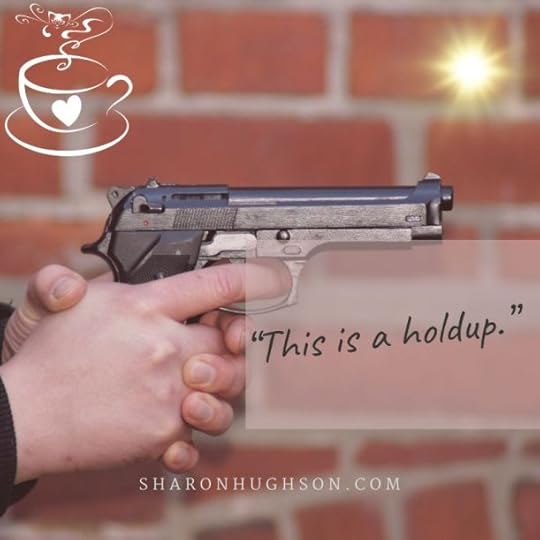
The boy across the aisle snickered. His mother elbowed him. The girl stared with wide eyes, turning in her seat to watch the men slither closer. Both held handguns in one hand and black sacks in the other.
“Put your valuables and wallets into the bag. Nice and easy.” The first man pointed his handgun at an elderly couple two tables away.
“That wasn’t part of—” The old man’s words cut off with a splutter when the robber slammed the butt of his weapon on the tabletop, an inch from the man’s dessert plate.
Her eyes widened. That seemed a little over the top. She noted it for the review she’d write for the resort website and her Yelp account.
“No talking!” These menacing words were laced with a bit of an accent. One she’d heard often from her native Spanish speaking students.
She narrowed her eyes and studied the man’s hands. They were smeared in grease, the nails black as if they hadn’t been washed in weeks.
People followed the orders. She considered her diamond stud earrings and wedding ring. Both items seemed too small to hand over, too easily lost or misappropriated. She tucked her hands under the table. Her husband’s hands were under the table too, but he held his phone. Was he trying to record the robbery?
Another person held their phone at table level and pointed it toward the robber. The second bandit grabbed the phone and flung it across the car. It smashed against the highly polished wooden bar where three waiters stood, agape, hands raised. One’s leg fidgeted, causing his apron to dance inappropriately.
A hollow expanded in her stomach and filled her throat. Actors wouldn’t destroy someone’s property. Would they?
The woman whose phone had been knocked away flushed and wiggled to standing. The outlaw pointed the gun at her, a hand’s breadth from the center of her chest.
“You can get a new phone,” he said, “But getting a new heart out here in the desert? Not so easy.”
She paled and dropped like a stone back into her chair.
“No phones!” He scowled and scanned the room. “If I see ‘em, they’re gone.”
She blinked at her husband. He shifted in his seat, and she prayed he had put the phone out of sight.
The dark-handed man approached them. “Wallet and valuables.”
Her husband pulled out his wallet and dropped it in the bag. She shook her head, tried to say something and swallowed hard.
“Let’s see that ring.”
She didn’t want to give it up. They’d only bought it last year while traveling in the Caribbean.
The barrel of the gun fixed on her. She twirled the ring, spinning it against her clammy hands and finally tugging it off. The bandit offered his palm, the half-filled sack melting onto the tabletop.
“What’s that? A carat? More?”
She licked her lips. Still, her voice abandoned her.
“1.69 carats,” her husband said. Of course he remembered the exact weight. How could he sound so blasé? It must be his journalistic training.
“What about earrings?” The gun waved toward her face.
“Not great quality,” said her husband. Really? Was that a ploy? Or was she just learning that her tenth anniversary gift was sub-par?
“Give ‘em here.”
Her fingers trembled as she unscrewed the backs. The gunman pocketed the jewelry in his jeans. Jeans? Those were not appropriate for period costumes. Why didn’t someone notice this before and stop them from boarding?
Time dragged. Her head spun. Silence pounded worse than a migraine. Eventually, the men left their car and another bandit from the first dining car leaned against the doorway, handgun pointed at them on a gentle scan. No one played hero. That’s not what they signed up for. But robbery? It has sounded like a good idea on paper.
After the men left, the train jerked forward. She glanced out the window. A black pickup raced across the sage-scattered field before it disappeared over a rise.
“License plate was covered with mud,” her husband said. She hadn’t even thought to look at it.
The waiters came by to collect dishes, apologizing for the unscheduled robbery. When the train slowed a few moments later, they saw a group of horses beside the tracks. The conductor stopped the masked men before they boarded. See? Why hadn’t they done that earlier? One of the false bandits pulled out a cell phone, to call the authorities she hoped.
A buzz of conversation started. Several cowboys with bandanas around their necks strolled through the car. “Are you alright? Is everyone okay? Does anyone need medical assistance?”
Once the train returned to the station, the interesting date night became a debriefing with the local sheriff’s department. Her husband shared his video files. She described her jewelry. Only then dis she remember the ring was insured against theft and loss.
How convenient. If she had to pay to be robbed, the insurance company could pay too.
****
Have you ever been to a “fake” event like this?
December 22, 2023
Merry Christmas! It’s Fiction Friday
Merry Christmas! I’ll help you celebrate with this excerpt from my first published book.
It’s the time of year when people read holiday tales and binge all the silly romances on the Hallmark Channel.
If you prefer a visit to the Nativity, this month’s excerpt comes from A Pondering Heart. It’s the story of Mary of Nazareth.
This peak inside the covers of the book is the second half of the first chapter. Imagine you’re a teenage girl telling her father about an unexpected pregnancy. And you’re a virgin. But an angel told you you would become pregnant before you’re married.
This is how I imagined the scene:
Anna huffed, arms crossed over her chest, when she shuffled
down into the small room she shared with Father. Father
and I had spent time together in the evenings since before my
mother died. He taught me to read, write, and do sums. Some
might accuse him of defying tradition (only men need these
skills). However, teaching his daughter—who in turn taught
her sisters—was a necessity. With all the labor required to
keep the farm going, he didn’t have energy for the record
keeping.
I scanned the largest room in my father’s house rather
than looking him in the eye. I recalled all the hours of sitting
here to eat with my family. I recalled sitting around the fire
listening to Father’s deep voice teach us the stories from the
Torah. Now, the silence pressed against me like a weight. If I
listened closely, I could hear my brothers whispering in their
bed behind a hanging goatskin less than twelve spans away.
My father’s hand patted my shoulder, and I turned my
gaze toward him. Black eyes dwarfed the portion of his face
not covered by his mostly gray beard. Heli bar Matthat, my
father, concealed a host of emotions behind those dark eyes. I
blinked to keep the tears stinging my own eyes from betraying
how weak I really felt.
I knelt like a common servant at his feet, my hands
clenched together. My heart felt lower than the hardened
earth beneath my aching knees. He was sending me away to
Elisabeth. I hadn’t seen her in seven years. She came to care
for Jesse after Mother died giving birth to him. Elisabeth, wife
to a priest, had no children of her own and could be spared to
spend several months with a widower and his three children
until a more permanent caregiver could be found.
“I will arrange for you to travel with a merchant.” Father’s
voice, low and gravelly, revealed what his face did not: disappointment,
a hint of despair.
“Abba, I swear I’m telling the truth.” I sounded like my
youngest brother, Caleb, tattling on Jacob, who was closest to
him in age.
Father’s warm, calloused finger tilted my chin upward.
The waning candlelight reflected off moisture in his eyes.
“I have always known you were special, Mary.”
My lips trembled, smiling at his words. The tension gripping
my heart loosened, making it easier to breathe. He
believed in me. Warmth swelled my heart.
“You must not tell others,” he said.
A knot twisted my stomach. Not tell others? But once my
condition became evident, they would believe the worst about
me. Did Father expect me to bear their judgments silently?
Heat flooded my face as if I stood before an open flame.
“They will believe what they want,” he said. “It is the
nature of people to believe the worst. If you tell them . . .”
I watched his throat wobble beneath his whiskers. My
shame would be his shame.
“Abba, no,” I said, unable to keep a tear from streaking
down my upturned face. “People will speak ill of you. I can’t
bear it.”
“If I can bear their scorn, you can bear it.” His harsh tone
startled me. “We know the truth. Nothing anyone says will
change it.”
“But Joseph . . .”
Tears choked me. The thought of seeing pain in his gentle
eyes raked across my soul. His opinion of me mattered almost
as much as my father’s. Joseph was older, but he had pursued
me specifically, even though other girls had more appealing
dowries. He would know we hadn’t been together. He would
think I had . . .
More heat flooded through my face and spread down my
chest until I thought I might burst into flame.
“We will meet with him together,” Father said. “I will
explain your situation to him. Just the three of us.”
“I’m sorry.”
How could calloused hands be so gentle? He pulled me
up, holding me on his lap as he often did with the young ones.
I couldn’t remember the last time I was held this way. Safe,
for the moment, in his arms.
“Never be sorry when Jehovah’s plans are not your own.”
His warm breath, smelling of wine and thyme, tickled my
cheek. “His ways are not our ways, daughter. They are
higher. We can’t understand, but we can obey.”
My chin shivered, making answering him difficult. “Yes,
Father.”
My father’s reputation would soon lie in ruins. And it was
all my fault. No man would ever marry me. I was sullied. I
tried to imagine sharing this house with Father and Anna and
the young ones, carrying my own child bound to my chest.
Anna would dislike me even more. It would be worse than a
death sentence.
And so I sobbed late into the night. Did I even weep this
much when my mother died? My pillow muffled the
anguished sounds, so my siblings slept undisturbed
around me.
I spilled so many tears that night I doubted the straw
inside the linen cover would ever be dry again.
If you want to keep reading, the ebook of this story is only $1.99 through the end of the year. Grab it here.
Or contact me and order an autographed paperback as the perfect gift for your mother, grandmother, or sister.