David Schneider's Blog
October 28, 2017
Current Holdings
The post Current Holdings appeared first on 8020 Superinvestors.


September 13, 2017
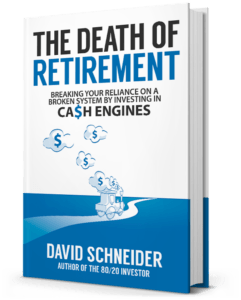
NEW BOOK: The Death of Retirement
What if I told you that everything you knew about investing for retirement was wrong? That what we call ‘investing’ these days is just millions of people over the world being lured into a game they don’t understand? We are all conditioned to think about the world of finance, stocks markets, and mutual fund products as an easy route to riches, particularly when it comes to saving for retirement.
But investing in financial markets for retirement is nothing more than a fool’s game.
This book will show what’s wrong with conventional retirement planning and investing for retirement. You will learn how you should approach investing for retirement and what you actually should be investing in first. You will explore an approach that is more in tune with real economics and everyday life – one that goes beyond simply buying and selling slices of other people’s pies.
If you ever want to free yourself from the vicious cycle of financial disappointment and dependency on the same empty retirement promises from companies that couldn’t care less about you, you need to focus on freeing yourself from their grasp.
This book will show you how to establish your own enterprises and sources of income – cash engines; how to reformulate your expectations of retirement; and how to fit your planning around everyday life and its many responsibilities. Retirement as we know it is over. Free yourself from the lies of those who say it isn’t.
Overview
Part I of this book will show you how the system of investing for retirement has been consistently been abused and degraded into a cash cow for a few privileged individuals and firms. That the theories are old, outdated and simply not working anymore – if they ever did.
Part II shows you a new approach to investing based on an approach that is tangible, incentivizes you to save and invest, and gives you results in less than 1000 days. All this, with returns mutual funds can only dream of.
You will learn:
The three defensive layers of our current retirement system
That the conventional approach is obsolete
The importance of the understanding the investment process for retirement planning
The importance of striving for highest possible returns with a minimum of financial risk
The power of cash engines
The value of bootstrapping in the investing process
Practical decision making through powerful case studies
And much more
Would You Like To Know More?
Become an expert on retirement that goes beyond simple retirement planning. Get your copy now and click on the buy button!
The post NEW BOOK: The Death of Retirement appeared first on 8020 Superinvestors.
September 6, 2017
From Laying Out Money Today to Achieving Passive Income
GET YOUR COPY ON AMAZON!
Investing is often described as the process of laying out money now in the expectation of receiving more money in the future. The whole process is similar to farming. You sow the seeds in the appropriate season, and wait for the crops to be harvested in the future. Both require planning, hard work, and an understanding of the effects of time. In farming, you can cover your bases by diversifying crops for different seasons, or by choosing crops that yield the highest calorie output for calorie input.
A successful investment formula looks rather simple. You establish a primary cash flow. You start saving part of that cash flow, which you reinvest, or purchase valuables that increase or at least maintain value that you could sell later. It’s all about future cash flows that result from the decisions we make today. In the process, you enjoy an effect that financial gurus call ‘compounding of returns’ — in other words, making more money with money at an exponential rate. This is the core attraction of investing, and the main reason to take the time to learn it from the ground up. Just imagine if your income from past investments is enough to cover all your everyday costs. This is achieving passive income. This is pure financial freedom— the freedom to do what you really want in life, to be the person you are striving to be.
In 1968, legendary money manager Gerald Tsai described why he felt at home in the world of investing in the center of Manhattan: “I felt that being a foreigner I didn’t have a competitive disadvantage there.” Indeed, the skill of investing skill is a powerful tool that doesn’t discriminate. Successful investors are everywhere and are different ages, races, genders, and socioeconomic classes. You could be a black woman from Detroit and become an investment success, like Latasha Kinard from Millennial Wealth Academy, or a German-born, gay, white male, like Peter Thiel.
The Joys of Achieving Passive Income
The ultimate goal of investing is, of course, passive income. By definition, passive income means acquiring income without actively producing it. There is nothing more powerful than the prospect of achieving passive income. If done correctly, mastering investing has some very attractive benefits, which include more money, potential early retirement, the removal of the chains of an unloved 9 to 5 job, and the escape of the burden of 100-hour shifts at consultancy, investment banks or law firms. Passive income could mean the ability to live out your hedonistic tendencies like Hedonismbot and “apologize for nothing.” For others, it means dedicating life to study, self-improvement, or community welfare.
Another advantage of investing skills is the possibility of location independence, or a Location Independent Lifestyle Design (LILD). The original idea behind LILD was, as Timothy Ferriss described in his book The Four Hour Work Week, to escape spending your day in a cubicle doing menial or unfulfilling work. Put simply- it is “not being tied to a certain location for any reason.” It is much more than just changing working from the beach with your laptop, although this idea appeals to many readers. It means making a conscious decision to be in control of your life for “maximizing your lifetime experience of happiness.” As opposed to early retirement, LILD practitioners still pursue paid activities. It could be the skilled IT expert, a specialist for SEO (Search Engine Optimization) and digital marketing, who offers his or her skills as a freelancer working from a coworking space in Bali. It could be the yoga instructor who gives online lessons and seminars via YouTube or Skype while improving his or her skills in an ashram somewhere in India. It could be the fiction writer renting a castle in the remote areas of Transylvania that really gets his or her creatives juices flowing while co-writing with other authors at the same location and sharing the cost of renting the castle.
What all these examples have in common is the advantages of earning their revenues in a hard currency—such as USD or EUR—while living in a country with a lower value currency such as Poland, Vietnam or Mexico. This alone can reduce the cost of living noticeably. Many creatives, as part of growing group of digital nomads, can still enjoy the same result and the same standard of living they’d enjoy back home in the industrialized West. They simply utilize telecommunication technologies to earn a living wherever they choose to reside for the moment. But it’s not only the financial aspect that has real merits. Those not comfortable with extreme weather and seasonal changes simple escape to a climate zone that is more suitable for their well-being. Like birds changing location with seasons, they, too, can change their work locations for a couple of months and exploit the best the world has to offer. This is real location independent lifestyle design.
It’s obvious LILD is much easier to attain than a strict form of early retirement, since you would still be working. In fact, LILD could be the smooth transitioning period from full-time employment to retirement. In many cases, those who have already achieved financial freedom and location independence continue pursuing their work activities. Many times, their lifestyle is founded on the passion for their work that made them a financial success in the first place. From own observations, even those who could afford early retirement continue some sort of work activity. LILD is your choice to make, and you will never have to make a decision under pressure. The key to achieving this new form of lifestyle choice will be achieving passive income and it’s start with making the right investment decisions today.
***END***
Stay tuned for more excerpts on retirement investing, passive income and early retirement.
***GET YOUR COPY ON AMAZON***
The post From Laying Out Money Today to Achieving Passive Income appeared first on 8020 Superinvestors.
September 5, 2017
How Much Do I Need to Retire?
GET YOUR COPY ON AMAZON!
In the last post, we saw that we have retirement options and that we could choose an ultra conservative path by simply working and stashing away money. It’s transparent and easy on the mind so that anyone could do it without the help of specialists or anyone else. But there are some major challenges and downsides to this path – it’s not inflation!
The Challenges of Saving
People’s behavior about saving and investing can be pretty baffling. Richard Thaler and Cass Sunstein describe a puzzling case in their book Nudge: Improving Decisions About Health, Wealth, and Happiness. In the United Kingdom, some pension plans are paid entirely by the employer. To be eligible, all the employee has to do is visit HR and sign a document. That is literally all they have to do to get a pension without any contributions or pay deductions from their side. The fact that one out of every two eligible employees failed to sign up surprised the HR departments and Thaler and his research team. According to Thaler, it is “equivalent to not bothering to cash your paycheck.” The only persuasive explanation they could come up with was “many people make poor financial decisions that cause themselves real financial harm.” It’s the sad reality, but not a satisfying explanation.
Conversely, when the decision is, to a certain extent, taken out of our hands, the results can be impressive. Singapore is the perfect example. The Central Provident Fund in Singapore (CPFS), which is a compulsory employment based savings plan to fund retirement, healthcare and housing needs in Singapore, is one of the most successful savings plans in the world. Since its inauguration, the mandatory savings rate for both for both employers and employees was continuously set higher until it reached 25% in 1985 which applies to this day for employees. According to the Singapore Business Review, the bulk of household assets is in properties (49% of total), while cash and deposits made up 19% in 2013. Additionally, according to Forbes, Singapore is the world’s third richest country per capita.
How Much is Enough?
The biggest question of all- how much is enough? The conventional advice given by such firms as Fidelity Investments states that you should “have the equivalent of your salary saved by age 30 and (…) 9 times your final salary in savings, if you wanted to retire by age 65.” If you earned $50,000 by age 29, you would have put aside $50,000 by age 30. A person age 35 earning $70,000 a year is supposed to have saved $140,000 on monthly savings of $1,000, made up of matching contributions and private savings. If your salary were to be $120,000 gross by age 60, you would need have at least $1.1 million put aside at the time of your retirement at age 65.
There are so many assumptions in these calculations that it’s impossible to explore them all. Ask yourself: if you are 35 and receive $70,000 gross salary, what are the odds you will actually have up to $140,000 saved?
Many retirement calculations are based on the 4% withdrawal rule made famous by a 1998 study known as the Trinity Study. It suggests you can withdraw 4% of your account annually and never run out of money (assuming, of course, that your money earns more than 4% above the rate of current inflation—so, these days, roughly 7% in the US). In a popular blog post, business consultant and serial entrepreneur Tim Connelly wrote: “Under the 4% withdrawal rule you might have to save up $2 million to have a comfortable withdrawal rate [of] $50,000, not accounted for any inflation or tax scenario…totally passive index funds or bonds must save a minimum of $2,500,000.”
There’s no doubt that this is profoundly challenging. It’s obvious that you either need to jazz up the returns on your savings or, as the Economist has suggested, settle for a life of continuous work. Both options are less than enticing, even though Fidelity and Co. are more than happy to help out. Maybe there is a third way that utilizes the power of investing but doesn’t rely on the help of financial service providers. Maybe, it’s the wrong question to ask: How Much Do I Need to Retire?
***END***
Stay tuned for more excerpts on retirement investing, passive income and early retirement.
***GET YOUR COPY ON AMAZON***
The post How Much Do I Need to Retire? appeared first on 8020 Superinvestors.
Do You Need to Be Invested?
GET YOUR COPY ON AMAZON!
Another characteristic of private plans is that they often involve investing in the stock market; for many 401(k)s, that is what the account is structured to do. Instead of asking whether defined contribution plans are good or bad, a more important question to ask is whether we need to invest in stocks and mutual funds at all. The truth is that there is no academic evidence that we need to be invested in risky stocks or mutual funds. On the contrary, there are two fundamental reasons why you should stay away completely.
You know you can’t and don’t want to handle the possible psychological agony and the real financial consequences related to financial markets.
You have neither the knowledge nor the experience in financial market investing.
Ask yourself, how you would react to see your retirement portfolio reduced by 30% or more due to a blip in the market, even if your retirement is yet decades away. Can you trust yourself to stay the course? How much are you able and willing to lose? If the answer is “not much,” then it’s only prudent to make a conscious decision to stay away completely from any financial market product. Keep in mind the answer to this question is not purely mathematical— you need to understand what sort of an impact price declines and real losses will have on your life and your psychology. However, people aren’t weak. To the contrary, we have built-in panic reflexes precisely to warn us when things are going wrong. Ignoring your instincts and reflexes may make sense in some settings; but in others, it makes none at all.
There are only two logical choices:
Stay away from Wall Street’s money game entirely and focus on the traditional ways of preparing for retirement, which includes not planning for retirement at all—the “default” position.
Study investing and its principles in detail and choose an appropriate strategy that suits your personality and God-given talents — the “optional” position. How do we move forward?
Default Asset: Cash is King
The best risk management policy in the world is to avoid unnecessary risks. If you don’t understand the games; don’t want to spend the time to learn them; and don’t want to let other gamblers play with your money, eliminate risk by not participating in the game. If you know yourself, and have a strong distaste for all things Wall Street or simply can’t stand the confusing nature of price auctions and price quotations, say, “No, thanks.” – A very conservative retirement option, but effective.
Don’t despair. There are plenty of ways to get you prepared the old-fashioned way. And contrary to today’s definition of saving for retirement, it all starts with good old cash. The absolute default position of any retirement plan or investing mission is always the least risky asset—and that is, by default, cash. Granted, it doesn’t yield anything, and it will lose in value the longer you keep it dormant, but that is never an excuse to gamble or to be forced into a decision one will later regret.
What it means is to put your money aside, a portion of any paycheck or income you earn. There are so many personal finance books that teach how to save money, so I will not go into detail here. Some of the advice is sheer borderline insanity, and there seems to be heated discussions and conflicting positions on how to spend your money. However, it works; and that savings is viable is demonstrated by Mr. Money Moustache, a popular personal finance blogger. “If you can save 50% of your take-home pay starting at age 20, you’ll be wealthy enough to retire by age 37,” he argues.
With this comes another core advantage: the optionality of cash. This is just a fancy way of saying that cash gives you more options than investments. If you have cash your money is easily accessible; you can buy what you like when you like it. You should not take this option lightly or for granted. No bank, professional portfolio manager, or even pension management has it; neither do full-time professional gamblers, day traders, and speculators. Controlling your cash and cash inflows is an enormous advantage to have.
The issue of fighting inflation remains. To compensate for this, keep your money in the highest quality short-term debt papers and government guaranteed debt notes, especially short term durations (not longer than a year) to avoid pricing risks. Through 401K or IRA plans, one could keep cash through high-quality money market funds that charge the least fees. The small income they generate could at least partially offset the risk of inflation while keeping market pricing risk low and liquidity high.
If you have access to Treasury Inflation-Protected Securities (TIPS), you should consider adding them to your retirement accounts. TIPS are extremely low-risk investments since they are backed by the U.S. government and the principle is inflation adjusted. According to TreasuryDirect, a website run by the Bureau of the Fiscal Service under the United States Department of the Treasury, “The principal of a TIPS increases with inflation and decreases with deflation, as measured by the Consumer Price Index. When a TIPS matures, you are paid the adjusted principal or original principal, whichever is greater.”
In today’s low-interest rate and inflation environment, their yields are low, but that might change quickly. In 2017, Federal Reserve Chairwoman Janet Yellen increased benchmark rates by 25 basis points twice, and most experts expect her to increase them by another 25 basis points later in 2017. Long-term yields have already reacted to this by showing a rising uptrend. Two-year Treasury notes yield 1.4% per year in June 2017, the highest yield in eight years.
It’s never a bad idea to keep a portion of your net worth in gold. General recommendations range from 5 to 10% with an emphasis on real physical gold, such as standard coins and bars. Gold has proven the test of time, not as an investment, but as insurance for your existing wealth. It’s a very liquid and broad market, and you can always sell it for a fair price. Surprisingly, in the age of digital currencies, gold has additional benefits. As James Rickard, famed author of the Road to Ruin, asserts: “You can’t hack it, you can’t erase it, you can’t delete it.”
The greatest advantage you have with this default option is simplicity and robustness. What you see is what you get. It’s easy to manage, usually comes at minimum fees, and you can always keep a close watch over how much you have. You will not be bothered by the constant fear of stock markets crashing, needing to chase the latest hot tip, or Wall Street stealing from orphans. You can focus on the tasks you are good at. Choosing the simple way of simply stashing your money will never give you a misguided sense of security based on unrealistic growth assumptions. If there is not enough money you will know in advance, and will be forced to make proper adjustments that reinforce positive action. You either work longer, find new job opportunities beyond retirement age, or simply save more, when you can. Indeed, a very conservative retirement option. Some might say “too conservative!”
***END***
Stay tuned for more excerpts on retirement investing, passive income and early retirement.
***GET YOUR COPY ON AMAZON***
The post Do You Need to Be Invested? appeared first on 8020 Superinvestors.
September 3, 2017
Protected: A Plethora of Retirement Options Today
This content is password protected. To view it please enter your password below:
Password:
The post Protected: A Plethora of Retirement Options Today appeared first on 8020 Superinvestors.
August 31, 2017
Protected: Retirement Planning – Prepare to Work a Little Longer!
This content is password protected. To view it please enter your password below:
Password:
The post Protected: Retirement Planning – Prepare to Work a Little Longer! appeared first on 8020 Superinvestors.
Protected: Mutual Fund Returns – Not as Good as They Used to Be
This content is password protected. To view it please enter your password below:
Password:
The post Protected: Mutual Fund Returns – Not as Good as They Used to Be appeared first on 8020 Superinvestors.
August 30, 2017
Protected: Capital Markets Power Growth and More Wishful Thinking
This content is password protected. To view it please enter your password below:
Password:
The post Protected: Capital Markets Power Growth and More Wishful Thinking appeared first on 8020 Superinvestors.
August 28, 2017
Protected: Losing the Loser’s Game – The Death of Retirement
This content is password protected. To view it please enter your password below:
Password:
The post Protected: Losing the Loser’s Game – The Death of Retirement appeared first on 8020 Superinvestors.