How Much Do I Need to Retire?
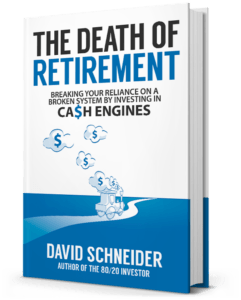
GET YOUR COPY ON AMAZON!
In the last post, we saw that we have retirement options and that we could choose an ultra conservative path by simply working and stashing away money. It’s transparent and easy on the mind so that anyone could do it without the help of specialists or anyone else. But there are some major challenges and downsides to this path – it’s not inflation!
The Challenges of Saving
People’s behavior about saving and investing can be pretty baffling. Richard Thaler and Cass Sunstein describe a puzzling case in their book Nudge: Improving Decisions About Health, Wealth, and Happiness. In the United Kingdom, some pension plans are paid entirely by the employer. To be eligible, all the employee has to do is visit HR and sign a document. That is literally all they have to do to get a pension without any contributions or pay deductions from their side. The fact that one out of every two eligible employees failed to sign up surprised the HR departments and Thaler and his research team. According to Thaler, it is “equivalent to not bothering to cash your paycheck.” The only persuasive explanation they could come up with was “many people make poor financial decisions that cause themselves real financial harm.” It’s the sad reality, but not a satisfying explanation.
Conversely, when the decision is, to a certain extent, taken out of our hands, the results can be impressive. Singapore is the perfect example. The Central Provident Fund in Singapore (CPFS), which is a compulsory employment based savings plan to fund retirement, healthcare and housing needs in Singapore, is one of the most successful savings plans in the world. Since its inauguration, the mandatory savings rate for both for both employers and employees was continuously set higher until it reached 25% in 1985 which applies to this day for employees. According to the Singapore Business Review, the bulk of household assets is in properties (49% of total), while cash and deposits made up 19% in 2013. Additionally, according to Forbes, Singapore is the world’s third richest country per capita.
How Much is Enough?
The biggest question of all- how much is enough? The conventional advice given by such firms as Fidelity Investments states that you should “have the equivalent of your salary saved by age 30 and (…) 9 times your final salary in savings, if you wanted to retire by age 65.” If you earned $50,000 by age 29, you would have put aside $50,000 by age 30. A person age 35 earning $70,000 a year is supposed to have saved $140,000 on monthly savings of $1,000, made up of matching contributions and private savings. If your salary were to be $120,000 gross by age 60, you would need have at least $1.1 million put aside at the time of your retirement at age 65.
There are so many assumptions in these calculations that it’s impossible to explore them all. Ask yourself: if you are 35 and receive $70,000 gross salary, what are the odds you will actually have up to $140,000 saved?
Many retirement calculations are based on the 4% withdrawal rule made famous by a 1998 study known as the Trinity Study. It suggests you can withdraw 4% of your account annually and never run out of money (assuming, of course, that your money earns more than 4% above the rate of current inflation—so, these days, roughly 7% in the US). In a popular blog post, business consultant and serial entrepreneur Tim Connelly wrote: “Under the 4% withdrawal rule you might have to save up $2 million to have a comfortable withdrawal rate [of] $50,000, not accounted for any inflation or tax scenario…totally passive index funds or bonds must save a minimum of $2,500,000.”
There’s no doubt that this is profoundly challenging. It’s obvious that you either need to jazz up the returns on your savings or, as the Economist has suggested, settle for a life of continuous work. Both options are less than enticing, even though Fidelity and Co. are more than happy to help out. Maybe there is a third way that utilizes the power of investing but doesn’t rely on the help of financial service providers. Maybe, it’s the wrong question to ask: How Much Do I Need to Retire?
***END***
Stay tuned for more excerpts on retirement investing, passive income and early retirement.
***GET YOUR COPY ON AMAZON***
The post How Much Do I Need to Retire? appeared first on 8020 Superinvestors.