
Nava Atlas's Blog
September 30, 2026
Olga Ivinskaya, poet, literary translator & Boris Pasternak’s muse
Russian poet Olga Ivinskaya (1912–1995) is remembered as Boris Pasternak’s friend and lover, and the inspiration for the character of Lara in Doctor Zhivago (1957). She was also his co-translator for contemporary poetry collections.
Olga Ivinskaya was instrumental in getting Doctor Zhivago published in Italy and in other countries after Pasternak (1890 – was unable find a publisher in Russia. She was imprisoned in a labor camp for several years because of her relationship with Pasternak and involvement in the publication of the novel.
Ivinskaya was one of the nine prisoners of conscience who led to the creation of Amnesty International in 1961.
Early life and career
Born in Tambov in central Russia in 1912, Olga Ivinskaya, of German-Polish descent, moved to Moscow with her family in 1915. After graduating from the Editorial Workers Institute in 1936, she worked as an editor for various literary magazines.
She married twice, first in 1936 to Ivan Emilianov, who hanged himself in 1939. Her second marriage was in 1941 to Alexander Vinogradov, who was killed at the front in 1943 during World War II. She had a daughter (Irina Emelianova) with Ivan Emilianov and a son (Dmitry Vinogradov) with Alexander Vinogradov.
An admirer of Russian poet Boris Pasternak since her adolescence, Ivinskaya regularly attended literary gatherings to listen to his poetry. Pasternak was already famous for his poetry collections My Sister, Life (1922), The Second Birth (1932) and subsequent works.
Ivinskaya became acquainted with him in 1946 when she was in charge of the new authors department at the editorial office of the monthly literary journal Novy Mir. She became his friend and lover (he was divorced and remarried, with two sons) from 1947 until his death in 1960.
Ivinskaya’s literary translations with Boris Pasternak
Fluent in several languages, Pasternak was a prominent literary translator. He did this work to provide for his family, because like many Russian authors, he was affected by the Soviet crackdown on their writings. He did translations of stage plays by William Shakespeare as well as by German playwrights Goethe and Friedrich Schiller, and Spanish dramatist Calderón de la Barca. His translations were popular with Russian audiences because of their colloquial and modernized dialogues.
Pasternak also translated 19th-century poetry collections by French poet Paul Verlaine, Hungarian poet Sándor Petőfi, Polish poet Juliusz Słowacki, Ukrainian poet Taras Shevchenko, and Georgian poet Nikoloz Baratashvili. He also translated poems by his friend the Austrian poet Rainer Maria Rilke.
Because of her relationship with Pasternak, Ivinskaya gave up her job at the literary journal Novy Mir in 1948. She became his literary assistant and worked closely with him to translate 20th-century poetry collections into Russian, including those of Bengali poet Rabindranath Tagore and Czech poet Vitĕzslav Nezval, an avant-garde writer (and translator) who participated in the Surrealist movement.
. . . . . . . . . .
. . . . . . . . . .
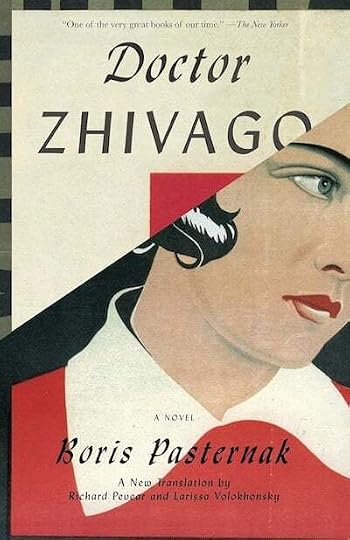
Boris Pasternak’s Doctor ZhivagoOlga Ivinskaya was the inspiration for the character of Lara in Doctor Zhivago (1957). Following the eponymous protagonist, physician and poet Yuri Zhivago, the novel spans more than forty years, from 1902 (at the time of Imperial Russia) to 1943 (during World War II). It encompasses the 1917 Russian Revolution, Civil War (1917 – 1922), rise of the Soviet Union (1922), and the Great Purge (from 1936 to 1938).
Pasternak spent many years writing this complex, multi-layered novel with a number of plot lines and themes. Yuri Zhivago is torn between his obligations to his wife and his consuming passion for Lara he encounters at war.
Often described as semi-autobiographical, the novel is a powerful depiction of a turbulent period in Russian history. and the harsh realities of Soviet life as experienced by Pasternak. The novel includes several poems originally written by Pasternak for Olga.
Doctor Zhivago novel was submitted in 1956 to the literary journal Novy Mir. The editors refused to publish it because of Pasternak’s rejection of socialist realism and its communist values with society prioritized over individuals. Some parts about Stalinism (Joseph Stalin ruled the country from 1922 to 1953), Collectivization (the Soviet system of state-controlled farms) and the Gulag (the Soviet system of labor camps) were deemed anti-Soviet by censors.
Dr. Zhivago’s publication in Italian, French, German and English
Pasternak sent copies of the manuscript to some friends in the West. In 1957, he gave the manuscript in 1957 to Italian journalist Sergio d’Angelo to smuggle it out of the Soviet Union and deliver to Giangiocomo Feltrinelli, an influential publisher and political activist living in Milan, Italy.
Ivinskaya was instrumental in the publication of Dr. Zhivago, and conducted all the negotiations on Pasternak’s behalf. Feltrinelli resisted all efforts by the Soviet government and the Italian Communist Party to cancel its publication. Doctor Zhivago was first published in 1957 in an Italian edition (translated by Italian literary critic Pietro Antonio) that quickly became a bestseller.
Pasternak, who was writing his correspondence in French (including with Feltrinelli) to escape Soviet censorship, was eager to see a French edition as well. The novel was translated by French slavic scholars Michel Aucouturier, Louis Martinez, Hélène Peltier-Zamoyska and Jacqueline de Proyart. The French edition was published in 1958 by Gallimard in Paris shortly after the Italian edition.
A German edition (translated by German translators Reinold von Walter for the main work and Rolf-Dietrich Keil for the embedded poems) was published in 1958 by S. Fisher Verlag in Frankfurt am Main, after the French edition and before the English edition.
An English edition (translated by British lecturer Max Hayward and British translator Manya Harari) was published in 1958 by Collins and Harvill Press in London, and by Pantheon Books in the United States. It spent six months on the New York Times bestseller list.
The first Russian-language edition of Dr. Zhivago
Dr. Zhivago was banned in the Soviet Union. The first Russian-language edition was illegally printed in 1958 by Mouton Publishers in The Hague, Netherlands, probably from photographs of the typescript by British intelligence officials.
The novel was printed with the backing of the CIA (Central Intelligence Agency) that secretly organized and funded the publication of around one thousand hardback copies (as confirmed in 2014 in declassified documents) with Mouton’s trademark blue cloth binding and the imprint of legitimate publisher Feltrinelli (who didn’t know about the print run) on the title page.
The purpose of the print run was to distribute some copies to Soviet visitors at the 1958 Brussels World’s Fair in Belgium, and to distribute many more copies to Soviet visitors and officials staying in European capitals (who might smuggle a copy back into the Soviet Bloc) in order to undermine the Soviet government and counteract Soviet censorship.
Feltrinelli threatened legal action when he learned about the illegal print run. Mouton Publishers agreed to an indemnity obligation to print an additional five thousand legitimate copies for Feltrinelli.
Feltrinelli was also able to license the translation rights into many other languages and to sell the movie rights to Italian film producer Carlo Ponti.
Pasternak’s Nobel Prize in Literature
Boris Pasternak was awarded the Nobel Prize in Literature in 1958 “for his important achievement both in contemporary lyrical poetry and in the field of the great Russian epic tradition.”
He sent a first telegram accepting the award and a second telegram declining it under pressure by the Soviet government. Even after declining the award, he was demonized by the Soviet Union of Writers, who expelled him from the Union.
His poetry disappeared from bookstores and from public view. His translations of European plays were pulled from theaters, and he couldn’t find translation work anymore. He was repeatedly defamed by the Soviet press and shunned by many of his peers. Olga Ivinskaya stood firmly by his side during the ordeal and persecution.
The Soviet government also threatened him with exile to the West, which was his worst fear. Pasternak replied in a letter to Nikita Khrushchev (who ruled the country from 1953 to 1964): “For me this is impossible. I am tied to Russia by birth, by my life and work. I cannot conceive of my destiny separate from Russia, or outside it.” (cited in Olga Ivinskaya’s A Captive of Time: My Years with Pasternak, 1978).
A Russian-language edition of the novel was once again printed in 1959. The imprint of the paperback pocket-size edition (for it to be easily smuggled) was the Société d’Édition et d’Impression Mondiale (Global Company for Publishing and Printing), a fictitious French publisher invented by the CIA to cover its tracks (as confirmed in 2014 in declassified documents).
More than nine thousand copies were printed, with seven thousand handed to Soviet tourists and officials who might smuggle a copy back into the Soviet Bloc. Two thousand copies were distributed at the World Festival of Youth and Students held in Vienna, Austria.
The purpose was again to undermine the Soviet government and to counter Soviet censorship by disseminating the work of a prominent Russian author who had just been awarded the Nobel Prize in Literature, censored in his own country. The Cold War (a long period of political tension between the United States and the Soviet Union) was the background.
A legitimate Russian-language edition was published in 1959 by the University of Michigan Press in the U.S., after Feltrinelli granted them license to the to proceed with publication. It was followed by the publication of a Russian-language edition of Pasternak’s Poems (1959) and Collected Works (1961). The Library Special Collections now include the University of Michigan Press Pasternak Records, 1958–1988, with the bulk of the records dated 1959—1962.
. . . . . . . . . .
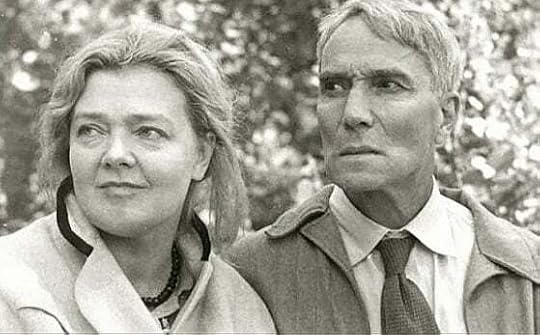
Unattributed and undated photo of Ivinskaya and Pasternak,
possibly late 1950s or early 1960s
. . . . . . . . . .
Due to her relationship with Pasternak, Olga Ivinskaya was arrested in 1949 and imprisoned in a labour camp (Gulag) for four years. At the time of her arrest, she was pregnant by Pasternak, and miscarried.
She was released in 1953 after Joseph Stalin’s death. In a 1958 letter to a friend in West Germany, Pasternak wrote of Ivinskaya:
“She was put in jail on my account, as the person considered by the secret police to be closest to me, and they hoped that by means of a grueling interrogation and threats they could extract enough evidence from her to put me on trial. I owe my life and the fact that they did not touch me in those years to her heroism and endurance.” (cited in Olga Ivinskaya’s A Captive of Time: My Years with Pasternak, 1978).
Ivinskaya was imprisoned in a labour camp for a second time from 1961 to 1964, after Pasternak’s death in 1960, for the first two years with her daughter Irina Emelianova.This time she was accused of receiving foreign royalties in hard currency from the western publishers of Doctor Zhivago.
The Soviet media orchestrated a smear campaign accusing her of accepting roubles and dollars smuggled past customs and of swindling Pasternak’s rightful heirs (according to Ivinskaya’s 1995 obituary in the British newspaper The Independent).
All of Pasternak’s letters to Ivinskaya, along with other manuscripts and documents, were seized by the KGB (the main Soviet security agency from 1954 to 1991). She served four years of an eight-year sentence. She was one of the nine prisoners of conscience (imprisoned for peacefully expressing their views) featured in the book Persecution 1961 by British lawyer Peter Benenson, who founded the human rights group Amnesty International the same year.
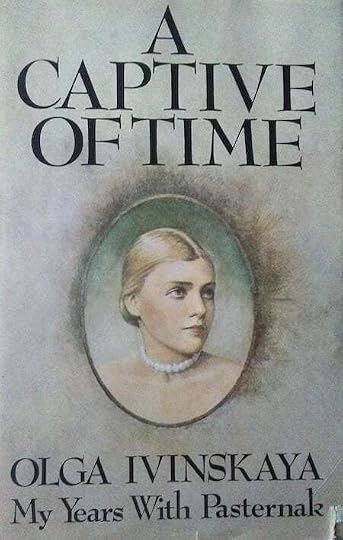
Written in the 1970s, Olga Ivinskaya’s memoir was smuggled out of Russia. The Russian-language edition was published in 1978 by Fayard in Paris. The English edition (translated by British lecturer Max Hayward, who, as mentioned earlier, co-translated Doctor Zhivago in 1958) was published as A Captive of Time: My Years with Pasternak (1978) by Collins and Harvill Press (London), and by Doubleday (New York).
Ivinskaya was rehabilitated in 1988 by Mikhail Gorbachev (who ruled the country from 1985 to 1991) as part of his Glasnost (transparency) campaign for decreased censorship and greater freedom of information.
. . . . . . . . . .
. . . . . . . . . .
Life after Dr. ZhivagoBoris Pasternak died of lung cancer in 1960 at the age of seventy, two years after declining the Nobel Prize in Literature. Under heavy surveillance by the KGB, his funeral was attended by his wife Zinaida Pasternak, and his two sons, Evgeny and Leonid Pasternak. His friend and lover Olga Ivinskaya was also in attendance, along with many literary figures and artists and more than one thousand admirers, in a silent act of public dissent.
The 1965 film adaptation of Doctor Zhivago by legendary English filmmaker David Lean won five Academy awards and became one of the highest-grossing and critically acclaimed films of all time.
Doctor Zhivago wasn’t published until 1988 in the Soviet Union, thirty years after the first Russian-language print run in 1958. It was serialized across five issues in the literary monthly thick journal Novy Mir, the same journal that had employed Olga Ivinskaya until 1947 and that had refused to publish Pasternak’s novel in 1956. American journalist David Remnick wrote:
“What was really incredible in 1988 and 1989 was to ride the subways and see ordinary people reading Pasternak in their sky-blue copies of Novy Mir. For a couple of years, stokers, drivers, students, everyone consumed this material with an animal hunger. They read all the time, riding up escalators, walking down the streets, reading as if this would all disappear once again into the censor’s black box” (from Lenin’s Tomb: The Last Days of the Soviet Empire, 1994).
Pasternak’s son Yevgeny Pasternak traveled to Oslo, Norway in 1988 to belatedly accept the Nobel Prize in Literature on behalf of his father.
Ivanskaya’s memoir was published in 1992 in Russia, by Libris in Moscow, fourteen years after the first Russian-language edition by Fayard in Paris. Despite spending several years in litigation, Ivanskaya couldn’t regain Pasternak’s letters to her. They had been seized by the KGB during her second arrest in 1961 with other manuscripts and documents.
Olga Ivanskaya died of cancer in Moscow in 1995 at the age of eighty-three. Her daughter Irina Emelianova, who emigrated to France in 1985, wrote a memoir about her childhood in Moscow, her mother’s relationship with Pasternak, and the brutal Soviet persecution they endured. The Russian edition was published in 1997 by Ellis Lak in Moscow.
The French edition (translated by French professor Gérard Abensour) was published in 2002 by Fayard in Paris as Légendes de la rue Potapov (Tales of Potapov Street — that being the street where they had lived in Moscow. It was republished in 2020 by Éditions des Syrtes in Geneva, Switzerland. An English edition doesn’t seem to be available as of yet.
The involvement of the CIA in the first Russian-language print runs of Doctor Zhivago (in 1958 and 1959) was confirmed in 2014 in more than one hundred declassified documents. The memos, letters and cables showed how the novel was used as a Cold War propaganda tool to undermine the Soviet Union. The documents were declassified following a request by Peter Finn (an American journalist and editor) and Petra Couvée (a Russian writer and translator) as part of their research for their book The Zhivago Affair: The Kremlin, the CIA, and the Battle Over a Forbidden Book, published by Pantheon Books in 2014.
. . . . . . . . . .
Contributed by Marie Lebert. Marie is a French translator who has worked for international organizations and global projects in several countries. She writes about translation and translators past and present with a focus on women translators who have been forgotten or overlooked, and who were also writers. Marie holds a PhD in linguistics from the Sorbonne University and an MPhil in social science from the University of Caen Normandy. Her articles, essays and ebooks are available online in English, French, and Spanish at Marie Lebert. Explore more entries by Marie Lebert, most profiling translators, on Literary Ladies Guide.
Further readingDoctor Zhivago by Boris Pasternak (1957)A Captive of Time: My Years with Pasternak by Olga Ivinskaya (1978)Lenin’s Tomb: The Last Days of the Soviet Empire by David Remnick (1994)The Zhivago Affair: The Kremlin, the CIA, and the Battle Over a Forbidden Book
by Peter Finn and Petra Couvée (2014)Lara: The Untold Love Story and Inspiration for Dr. Zhivago by Anna Pasternak (2017)
The post Olga Ivinskaya, poet, literary translator & Boris Pasternak’s muse appeared first on Literary Ladies Guide.


September 4, 2026
Anne Dacier, translator of Homer’s The Iliad and The Odyssey
Anne Dacier (1645–1720), born Anne Le Fèvre, was a French classic scholar and one of the rare learned women in Europe who earned a living as an editor and translator.
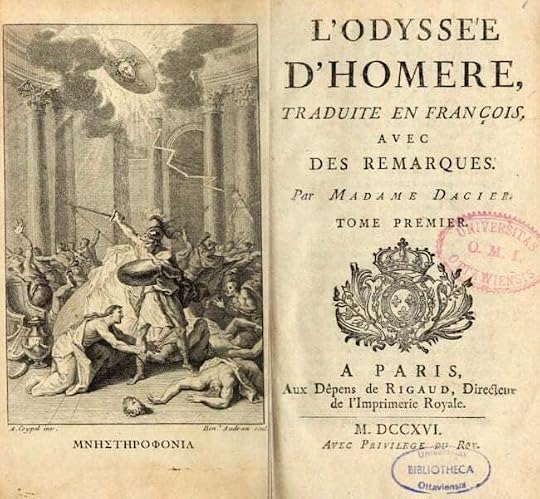
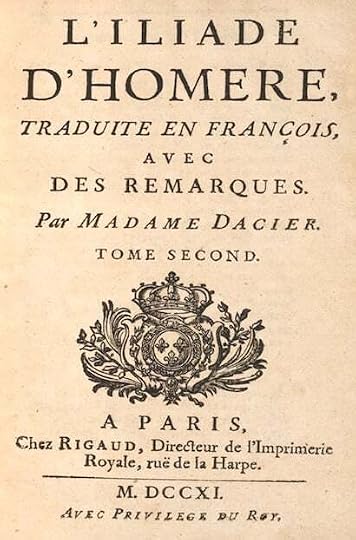
She is best known for the prose translation of the Homeric epics from the original Greek language into French, a fifteen-year labour of love published as L’Iliade in 1711 and L’Odyssée in 1716.
The French editions were then translated into English by famed poet Alexander Pope, and published in 1715–20 for The Iliad and in 1725–26 for The Odyssey.
A good education
Raised in a Protestant family in Saumur, a town in western France, Anne Le Fèvre was taught Latin and Greek by her father Tanneguy Le Fèvre, a classic scholar who went against the tendencies of his time by giving his daughter a good education along with her brothers. She showed him her gratitude by signing her first works with the mention Anna Tanaquilli Fabri filia (Anne, Daughter of Tanneguy Le Fèvre).
Anne’s first husband was Jean Lesnier, a much older printer-bookseller who was a friend of her father’s. She separated from him in 1670 after the death of their son three weeks after his birth. Jean Lesnier died five years later, in 1675.
. . . . . . . . . .
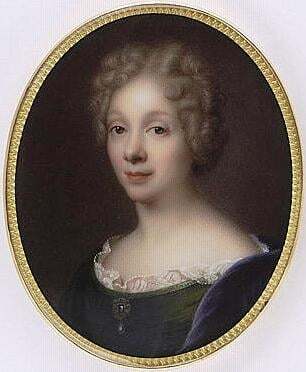
Anne Le Fèvre Dacier
. . . . . . . . . .
After her father’s untimely death in 1672, Anne moved to Paris to earn a living as an editor and commentator for the Delphin Classics. The Delphin Classics (Ad usum Delphini in Latin, meaning “For the use of the Dauphin”) were a series of annotated editions of Latin and Greek classics published under the supervision of French scholar Pierre Daniel Huet, another friend of her father.
Pierre Daniel Huet was one of the tutors of the Dauphin Louis of France, the eldest son of King Louis XIV. The Delphin Classics were intended to contribute to the Dauphin’s education but they went far beyond that. The 64 volumes published between 1670 and 1698 became a literary institution.
Anne was the only woman in a team of prominent scholars. She first annotated a new Latin edition of Roman poet Publius Annius Florus (in 1674), which was widely praised while readers were very surprised to discover that its editor was a woman.
Anne edited some works by Greek poet Callimachus (in 1675, independently, from her father’s manuscript), by Greek chronicler Dictys Cretensis (in 1680), and by Roman historians Aurelius Victor (in 1681) and Eutropius (in 1683). To produce new Greek or Latin editions of these works meant writing a long preface, many notes and extensive commentary.
Working as a translator
But readers now preferred annotated French editions to annotated Latin editions. French definitively supplanted Latin in the literary world, hence the need for translations in the Delphin Classics. Anne and her colleagues switched from editing to translating.
Anne translated some works by Greek lyric poets Anacreon and Sappho (in 1681), by Greek comic playwright Aristophanes (in 1684), and by Roman comic playwrights Plautus (in 1683) and Terence (in 1688). The translations included a lengthy preface, a number of notes and a detailed commentary as well.
Anne Le Fèvre actively participated in the Quarrel of the Ancients and the Moderns (Querelle des anciens et des modernes). The literary quarrel opposed the Ancients, a group of classical writers led by poet Nicolas Boileau, and the Moderns, a group of writers who favored contemporary literature, led by author Charles Perrault (known for his fairy tales as a new literary genre). Unsurprisingly, Anne stood for the Ancients, who favored the classical authors she edited and translated.
Anne Le Fèvre married her colleague and friend André Dacier in 1683. He was a Protestant, a former student of her father, and a longtime editor of the Delphin Classics. The couple moved to Castres (André’s birthplace), a town in southern France, in 1684.
At their instigation, the whole town converted to Catholicism in 1685 to avoid persecution and destruction in a mainly Catholic country. They were rewarded by a pension granted by King Louis XIV, with 1,500 livres (the currency of the Kingdom of France) for André and 500 livres for Anne.
Back in Paris in 1686, Anne and André Dacier teamed up to translate Meditations by Roman philosopher Marcus Aurelius (1690–91) and the first six Parallel Lives by Greek philosopher Plutarch (1694). André Dacier was elected to the French Academy (Académie française) in 1695 and appointed keeper of the Library of the Louvre in 1702.
. . . . . . . . . . . .
. . . . . . . . . . . .
Translation of Homer’s epic poemsThe first partial translations into French of the Homeric poems were signed by the Renaissance scholars Jacques Pelletier du Mans and Amadis Jamyn in the 16th century. Pelletier du Mans translated the first two books of The Odyssey, published in 1547 with other translations. Jamyn translated part of The Iliad, published in 1580, and began a translation of The Odyssey that was left unpublished.
One century later, a loose translation (or more exactly an adaptation) of Homer’s epic poems was penned by French scholar Achille de La Valterie from a Latin edition, and published in 1681.
After reading La Valterie’s translation, Anne Dacier was outraged by the inaccuracies and liberties taken with the Homeric texts. She undertook a translation from the original Greek language, a major task to which she devoted fifteen years of her life.
Her prose translations were published as the three-volume L’Iliade in 1711 and the three-volume L’Odyssée in 1716, with a long preface, numerous notes and extensive commentary.
Widely praised for their fidelity to the source texts, her two translations introduced Homer to her contemporaries and won over a large audience throughout Europe — French being the literary language by excellence —s while ensuring its translator’s fame.
. . . . . . . . . . . .
. . . . . . . . . . . .
Another French translation based on Dacier’sAnother French translation of The Iliad followed, this time by poet and academician Antoine Houdar de la Motte. Having little knowledge of Greek, Houdar de la Motte based his verse translation on Anne Dacier’s prose translation. The abridged verse edition was published in 1714 with just twelve instead of the twenty-four books of the full version. The text was modernized and — in the translator’s own words — improved upon the original.
An essay by Houdar de la Motte criticizing Homer’s literary merit was included in the translation under the title Discours sur Homère (Discourse on Homer), in which he explained the reasons why the epic poet failed to satisfy his own critical taste.
Deeply shocked by these criticisms, Anne Dacier rushed to Homer’s defense and penned a 445-page essay entitled Des causes de la corruption du goût (Of the Causes of the Corruption of Taste), published in 1715.
The two translators embarked on a lengthy literary debate over Homer’s talent and style, aptly named Querelle d’Homère (Quarrel of Homer) as the ultimate chapter of the Quarrel of the Ancients and the Moderns.
Other essays were penned by several prominent intellectuals, including academician Jean Terrasson, who sided with Houdar de la Motte, and philosopher Claude Buffier, who attempted to defuse the situation by demonstrating that Houdar de la Motte and Anne Dacier both celebrated Homer but in different ways.
The controversy ended in April( 1716 when the two literary rivals met at a supper they were both invited to. Houdar de la Motte finally agreed on the fact that Homer was a literary genius, and they both drank to the health of the great epic poet.
But French scholar Jean Hardouin, a former colleague of the Delphin Classics, went on with the debate in his own Apologie d’Homère (Apology of Homer), once again questioning the literary value of the Homeric texts.
Anne Dacier took up her pen again to write a 220-page essay entitled Homère défendu contre l’apologie du R. P. Hardouin (Homer Defended Against the Apology of Father Hardouin), published in 1716.
The lengthy controversy saddened the last years of her life. She died in 1720 from poor health and her husband André died two years later.
An English translation by Alexander PopeAnne Dacier’s translation of the Homeric epics was praised by many, including English poet Alexander Pope (1688–1744), who by his own account was fascinated by Homer since his childhood. As a young man, before joining the literary society in London, he read the Homeric poems in their entirety as well as classics by Roman poets Horace, Juvenal, and Virgil.
Homer’s epic poems had already been translated into English one century earlier by poet and playwright George Chapman, a contemporary of Shakespeare who translated several Greek and Latin classics during his lifetime. Chapman published The Iliad in installments from 1598 onwards before a full translation of the two epic poems, entitled The Whole Works of Homer and published in 1616.
In 1713, Pope announced his decision to work on a new verse translation of The Iliad and signed a contract the following year with the printer-publisher Bernard Lintot, who paid him the astounding fee of 200 guineas per volume. The six-volume translation was available by subscription, with one volume published every year over six years from 1715 to 1720.
The translation of The Iliad became a bestseller and Pope went on with the translation of The Odyssey, with equivalent wages but without the need for a subscription this time, with a publication in five volumes in 1725–26.
The money earned from his two bestselling translations allowed Pope to acquire a beautiful villa in Twickenham (west of London) in 1719, where he could create his famous romantic grotto (that survives to this day) and the gardens of his dreams, two major sources of inspiration for his new poems.
Much of Pope’s translation was based on Anne Dacier’s French translation, a fact that is well known but has regularly been downplayed or bypassed for three centuries. To translate an existing translation instead of the original work was common at the time but to translate an existing translation penned by a woman was still unheard of.
In the second French edition of The Iliad, published in 1719, Anne Dacier wrote an essay on Pope’s translation of the same work, which gained her some fame in England as well.
However, after the painstaking process of translating The Iliad on his own, Pope only translated twelve books of The Odyssey himself, and secretly enlisted the help of two other poets, William Broome (who translated eight books) and Elijah Fenton (who translated four books). The secret leaked out and damaged Pope’s reputation for some time, as well as some criticisms relating to Homer’s “wild paradise” reduced to “order”, with no incidence on the sales of his two bestselling translations.
. . . . . . . . . . . .
. . . . . . . . . . . .
Much praise in the literary world and legacyWith the exception of scholar Paul Tallemant, an influential member of the Moderns who penned an epigram criticizing her husband in order to attack her, Anne Dacier was widely praised in the French literary world.
Scholar Gilles Ménage dedicated his history of women philosophers (Historia mulierum philosopharum, 1690) to her and described her in the introduction as “the most learned of women whether of the present or the past.”
Poet Nicolas Boileau praised her in the preface to his translation of On the Sublime (Traité du sublime, revised edition, 1701), a treatise penned by an unknown Greek author in the 1st century, writing about “this learned woman … who now works to make us read Aristophanes, Sophocles, and Euripides in French”.
She was also celebrated by philosophers Voltaire and Jean de La Bruyère, by fabulist Jean de La Fontaine, by memoirist Henri de Saint-Simon, by literary critic Charles Augustin Sainte-Beuve, and by many others.
Being a learned woman who was respected by her peers didn’t entirely prevent misogynistic comments from prominent male scholars. As stated by German philosopher Immanuel Kant in his Observations on the Feeling of the Beautiful and Sublime (originally published in German in 1764):
“A woman who has a head full of Greek, like Madame Dacier, or who conducts disputations about mechanics, like the Marquise du Châtelet, might as well also wear a beard; for that might perhaps better express the mien of depth [the overall appearance] for which they strive.”
But Kant certainly read their works which probably influenced his own writings.
Contemorary recognition
During the Golden Age of American comics in the mid-20th century, Anne Dacier was the heroine of a two-page biographical comic strip in the Wonder Women of History series included in Wonder Woman (number 48, 1951), the famed comic book series published by DC Comics.
She was recognized as a pioneering intellectual whose life reflected the spirit of emancipation embodied by the Wonder Woman character. She overcame the barriers imposed by her gender to become a renowned and respected editor and translator of ancient texts, including the famous Homeric poems.
Contributed by Marie Lebert. Reprinted by permission. Marie is a bilingual French-English translator. She has worked as a translator and/or librarian for international organizations and has written ebooks, articles and essays about translation and translators, ebooks, libraries and librarians, and medieval art. She holds a doctorate of linguistics (digital publishing) from the Sorbonne University, Paris, and a master of social science (society and culture) from the University of Caen, Normandy. See more entries by Marie Lebert, most profiling women translators, on Literary Ladies Guide. Find more about women translators of the past at Marie Lebert.
Sources Thirty pioneer women writers / translators A history of translation in 150 portraits Les premières traductions françaises de L’Odyssée (in French)The post Anne Dacier, translator of Homer’s The Iliad and The Odyssey appeared first on Literary Ladies Guide.
August 23, 2026
Tove Ditlevsen, Danish author of The Copenhagen Trilogy
Tove Ditlevsen (December 14, 1917 – March 7, 1976) was a Danish author best known for The Copenhagen Trilogy, an account of her life from childhood to adulthood, marriage, and drug addiction. She was also an accomplished and prolific poet.
Her contemporaries largely marginalized her work, despite the name she made for herself in Danish literary circles.
Ditlevsen’s work has seen a resurgence with the reissue of much of her body of work, especially the autofictional Copenhagen Trilogy, which has been translated into some thirty languages.
Tove Ditlevsen’s working-class rootsTove Irma Margit Ditlevsen was born in Copenhagen in 1917. She grew up in Vesterbro, which was then a working-class district, with her parents and older brother, Edvin. Her father was a coal stoker.
In the Copenhagen Trilogy, Ditlevsen wrote, “Down at the bottom of my childhood my father stands laughing. He’s big and black and old like the stove, but there is nothing about him that I’m afraid of.”
Her mother, on the other hand, was, “Beautiful, untouchable, lonely, and full of secret thoughts I would never know …” Her capricious temper ruled the household, and the young Tove would often find herself on the end of her mother’s “dark anger [that] always ended in her slapping my face or pushing me against the stove.”
It was an unhappy childhood. Ditlevsen recalled: “Time passed and my childhood grew thin and flat, paper-like. It was tired and threadbare, and in low moments it didn’t look like it would last until I was grown up.”
Early forays into poetry
Despite her father’s warning that “a girl can’t be a poet,” Ditlevsen began writing poems at the age of ten. She later described these as “long, mysterious words [that] began to crawl across my soul like a protective membrane. A song, a poem, something soothing and rhythmic and immensely pensive, but never distressing or sad, as I knew the rest of my day would be distressing and sad.”
Ditlevsen began submitting these poems to literary magazines while in her teens. Meanwhile, she left school at sixteen to help her family financially, working at a series of low-paying jobs, including typist, stock clerk, and receptionist. Still, she continued to write.
Her first published poem appeared in the Danish journal Vild Hvede (Wild Wheat) in 1937. Her first poetry collection, Pigesind (From A Girl’s Mind) was published in 1939.
Following these early poetry collections, she produced a book every year or two until her death. It was a remarkably prolific output that included eleven books of poetry, seven novels, four collections of short stories, and the Copenhagen Trilogy – as well as countless articles and a long-running “agony aunt” column in the women’s weekly Familie Journalen.
. . . . . . . . . .
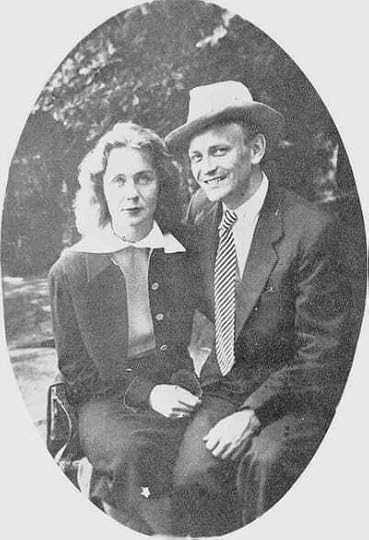
Ditlevsen with fourth husband Victor Andraesen in 1951
Photo courtesy of Wikimedia Commons
. . . . . . . . . .
Ditlevsen married four times. Her first husband, Viggo F. Møller, whom she married in 1940, was the editor of Vild Hvede. They married three years after this journal published Ditlevsen’s poetry. She was twenty-two to his fifty-two; the marriage lasted just over a year.
She initially attributed her early literary success to Møller but later observed, “It probably wasn’t necessary to marry him to move up in the world, but no one had ever told me that a girl could make something of her own.”
After she and Møller divorced, she married Ebbe Munk in 1942. They had one daughter, Helle, born in 1943, but this marriage didn’t last much longer than the first. By 1945, she and Munk had divorced, and she married to Carl T. Ryberg, a physician. They had a son, Michael, born in 1946. Ryberg had a daughter, Trine, from a previous marriage.
This was a deeply unhappy time for Ditlevsen. She became addicted to prescription drugs (partly due to Ryberg, who supplied her with them), in particular Demerol. She nearly died before seeking treatment. In 1949, she was admitted to a psychiatric ward – the first of several brief in-patient stays.
In 1951, she married Victor Andraesen, the editor of the tabloid newspaper Ekstrabladet. This was the longest of her marriages, lasting for twenty years before ending in an acrimonious divorce.
. . . . . . . . . .
. . . . . . . . . .
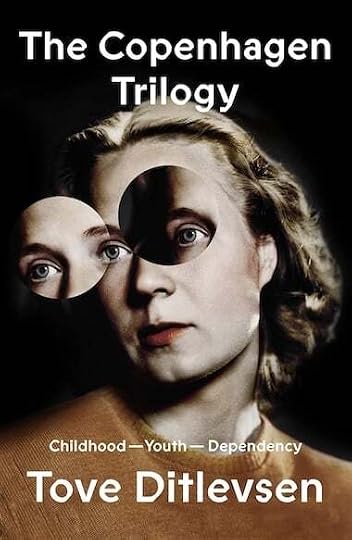
The Copenhagen TrilogyMuch of Tove Ditlevsen’s work drew on her own experiences, and dealt with themes of love, class, addiction and mental illness, particularly as they pertained to women. Arguably the best-known example is the Copenhagen Trilogy, first published separately as Barndom (Childhood, 1967), Ungdom (Youth, 1967) and Gift (Dependency, 1971).
The trilogy charted her life from her childhood in Vesterbro through her teen years and early adulthood to marriage, childbirth, and addiction. Perhaps appropriately, Gift in Danish translates to both “married” and “poison” in English – an apt summing-up of how she experienced love. (Note, English editions of Gift are titled Dependency.)
The three books, however, aren’t a straightforward autobiography: scholar Sherilyn Hellberg pointed out that Ditlevsen was “constantly playing with this line between biography and fiction.” Today, the trilogy is often considered autofiction.
. . . . . . . . . .

. . . . . . . . . .
Poetry: “A girl’s dream”Tove Ditlevsen’s poetry was rich in themes similar to those in her prose works, particularly class and the role of women in society. The first collection to appear in English was There Lives a Young Girl in Me Who Will Not Die, translated by Sophia Hersi Smith and Jennifer Russell (2005).
In her poems, she often alluded to the “strange alienation” of housework and childrearing, and to her experiences of domestic abuse and illegal abortions. In the titular poem “There Lives a Young Girl in Me Who Will Not Die,” she wrote, “You had a girl’s dream of a husband and baby, / and you got what you wanted but were still alone.”
In the 1955 poem “Marriage,” she summed up her view of married life as “unknowingly coerced / into a lawful death of love.”
Her poetry was often critiqued as old-fashioned. She continued to write in rhyming verse well into the 1960s, while many of her contemporaries were shifting the poetic form into something freer and less rigid. In a 2005 TV interview, the author Klaus Rifbjerg commented, “She wrote rhyming poems, which were well crafted and well formulated, but were a kind of corset she had squeezed herself into…”
Another Danish author and poet, Olga Ravn, however, has argued that the subjects of Ditlevsen’s poems weren’t seeking anything new. Rather, they sought:
“… to review what has been cast off by tradition, the poetic scraps on the garbage heap. Why do they want to do that? Because using an archaic register is a working-class poet’s middle finger to the hoity-toity modernists and, at the same time, a way of resurrecting discarded language. With this discarded language, it’s possible to express an experience that cannot be articulated in the prevailing forms.”
“A worker’s writer”
Ditlevsen never self-described as a feminist, yet has been labelled a “woman’s writer” who, according to Dorthe Nors, is “loved by generations of women and put down by generations of men … [She is] the Billie Holiday of poetry… her prose turned the dreams and disappointments of life as a woman inside out.”
Olga Ravn notes Ditlevsen’s commitment to working-class literature:
“The revolutionary subject has always been presumed to be the man at the factory. But when women bring children into the world, children who grow up to go to the factory, work is being done… Hence, women’s literature about their own bodies and housework is workplace literature. Tove Ditlevsen was a worker’s writer.”
Despite achieving fame in her lifetime (she regularly appeared in newspapers and magazines for interviews and photoshoots), her place in the literary canon has long been disputed. According to Sherilyn Hellberg, Ditlevsen has,
“… been largely overlooked in this very male, very European tradition of modernism… Just talking about reading her seems to inspire all these really strong emotional reactions. There were all these debates about should Ditlevsen actually be read and was she worthy of being an object of literary criticism. It was really bizarre but also fascinating.”
Ditlevsen received many literary prizes, including De Gyldne Laurbær (The Golden Laurel) prize in 1955, a prestigious award bestowed by booksellers. Yet she still felt rejected by the literary establishment, particularly by the Danish Academy — she was never offered membership or its annual award.
Tove Ditlevsen took her own life at the age of fifty-eight by overdosing on sleeping pills. Photographs of her funeral show a crowd of working-class women following behind her coffin through the streets of Copenhagen.
. . . . . . . . . .
Contributed by Elodie Barnes. Elodie is a writer and editor with a serious case of wanderlust. Her short fiction has been widely published online and is included in the Best Small Fictions 2022 Anthology published by Sonder Press. She is Books & Creative Writing Editor at Lucy Writers Platform, she is also co-facilitating What the Water Gave Us, an Arts Council England-funded anthology of emerging women writers from migrant backgrounds. She is currently working on a collection of short stories, and when not writing can usually be found planning the next trip abroad, or daydreaming her way back to 1920s Paris. Find more of her writings here and on Literary Ladies Guide.
. . . . . . . . . .
More about Tove DitlevsenMajor Works
Ditlevsen was quite prolific. Relatively few of her works have been translated to English from their original Danish. Her first book, a collection of poems, was published in 1939; her last, also a collection of poems, was published in 1978. Here is her full bibliography.
English translations:
Childhood, Youth, Dependency: The Copenhagen Trilogy(1967–1971; first published in English translation in 2019)There Lives a Young Girl in Me Who Will Not Die: Selected PoemsVilhelm’s Room (a novel)The Trouble With Happiness and Other Stories The Faces (a novel)
Further reading
The Image of the Doll: Tove Ditlevsen’s Worn-Out Language(The Paris Review)Tove Ditlevsen’s Art of Estrangement (The New Yorker) Overlooked No More: Tove Ditlevsen, Danish Writer
of Confessional Autofiction (New York Times)
The post Tove Ditlevsen, Danish author of The Copenhagen Trilogy appeared first on Literary Ladies Guide.
July 22, 2026
10 Fascinating Facts About Ida B. Wells, Fearless Journalist & Activist
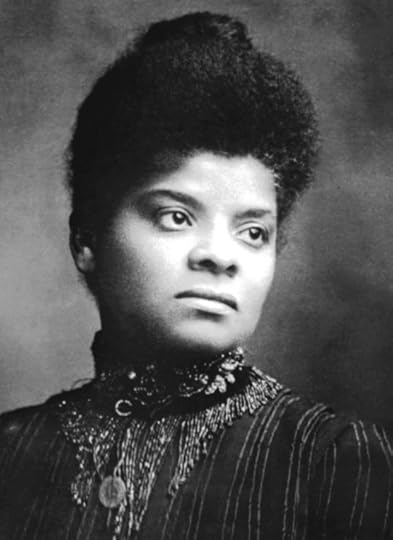
Ida B. Wells was a fearless crusader in the early civil rights movement. A journalist, editor, speaker, reformer, and suffragist, she was born on July 16, 1862 (and lived her big, courageous life until 1932). Get an introduction to her remarkable life and work with these fascinating facts about Ida B. Wells.
Wells was best known for spearheading a national antilynching campaign, through which she worked tirelessly and fearlessly to end the uniquely American practice of the public mob murders of Black Americans.
Wells’ reputation continues to grow, even decades after her death. Journalism awards have been established in her name, scholarships are endowed in her honor, and there’s a museum celebrating her legacy in her hometown in Mississippi.
In 2020, nearly ninety years after her death, Ida B. Wells was awarded a long overdue posthumous Pulitzer Prize in the category of Special Citations and awards for “her outstanding and courageous reporting on the horrific and vicious violence against African Americans during the era of lynching.”
Wells’ legacy lives on in the civil rights work she founded and the courage she displayed as a journalist and newspaper publisher. Following are some fascinating facts about her life and work, adapted from Ann Allen Shockley’s essay in Afro-American Women Writers 1746 – 1933.
. . . . . . . . . . .
Learn more about Ida B. Wells
. . . . . . . . . . .
Ida Bell Wells was born in 1862, into an enslaved family living in Holly Springs, Mississippi — the midst of the Civil War. Her parents and youngest sibling died during the yellow fever epidemic in 1878.
At just fourteen, she was suddenly the head of the family, responsible for four younger brothers and sisters. Resisting her extended family’s desire to separate the siblings to various foster homes, she managed to keep the family together. To that end, she worked as a teacher while still in her teens to support her siblings.
She refused to move from a white train carWhile traveling to Tennessee on the Chesapeake & Ohio Railroad in May, 1884, a conductor asked Wells to move to the smoking car. When she refused, the conductor, and baggage man, tried to force her out. Wells braced herself by planting feet on the back of a seat, and bit the conductor’s hand.
In Memphis, she instigated a lawsuit against the railroad. She won the case, and was awarded five hundred dollars and damages. Her triumph proved short-lived; the railroad appealed and the Supreme Court of Tennessee reversed the decision in 1887. This case foreshadowed Plessy v Ferguson, the 1896 U.S. Supreme Court ruling whose cruel and absurd “separate but equal” was foundational to decades of Jim Crow laws.
As a young journalist, Wells was in great demandWells’ writing and editing talent blossomed when she was hired as editor of a small church paper. She wrote her first article for another paper, The Baptist Weekly, on her experience with the railroad lawsuit. Soon, she found herself in demand, and contributed articles to the Detroit Plaindealer, Christian Index, Indianapolis World, Gate City Press, and A. M. E. Review, among others.
Wells was the not only the first woman to attend the Afro-American Press convention in Louisville, Kentucky, but was also elected as the the organization’s assistant secretary.
Wells bought into newspaper ownershipIn 1899, Wells bought a one-third interest in the Memphis Free Speech and Headlight. At the time, she was still teaching in Memphis, but came to the conclusion that it wasn’t her calling due to its “confinement and monotony.”
As the partial owner and editor of a newspaper (and not one to ever hold her tongue or her pen) was free to express what she called “the real me.” Shortening the name of the newspaper to the Free Speech, she devoted full-time to traveling, researching, and writing for the paper.
She encouraged Black citizens of Memphis to move westThe March, 1892 lynching of three young Black businessmen in Memphis, owners of the People’s Grocery Company, was a turning point of Wells’ life. She wrote scathing editorials condemning the white community of the city for allow the lynching.
Wells urged the Black citizens of Memphis to leave and go west. And indeed, hundreds, including entire church congregations, heard her call She also helped organize the first boycott that encouraged the Black community in the city to boycott white businesses.
Wells’ newspaper office was destroyed by a white mobThat same year, spurred by an editorial response by the white newspaper to Wells’ writings on race relations in Memphis, a white mob descended on the building in which Free Speech operated, destroying it and all its contents. While this was a major calamity, at least Wells was away at the time. She never returned to Memphis and took up residence in New York City.
. . . . . . . . . .
. . . . . . . . . .
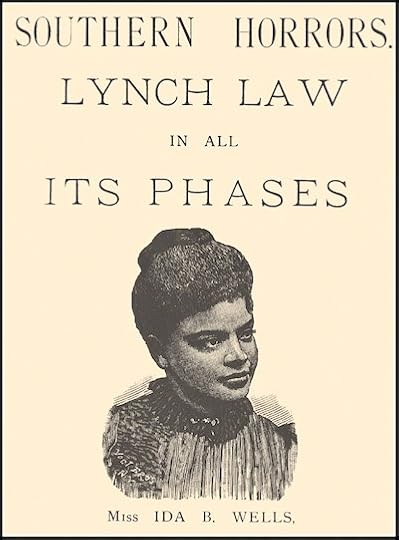
Her anti-lynching crusade coalesced in New York CityWells was immediately hired to write for the legendary Black newspaper, the New York Age. The front page of the June 5, 1892 issue featured her detailed piece on lynching. Four months later, it was republished as a pamphlet titled Southern Horrors: Lynch Law in All Its Phases (1892).
By this time, her writings had caught the attention of Frederick Douglass, who contributed a letter to the pamphlet. He praised Wells as a “Brave woman!” The two maintained a lifelong friendship.
Well’s militant anti-lynching writings encouraged other Black women to rally behind the cause. In the fall of 1892, she gave her first public lecture before crowd of prominent Black women on the horrific practice of lynching. This event laid the groundwork for the nascent Black women’s club movement.
She was soon inundated with requests to speak on lynching at home and abroad. In 1893 and 1894, she traveled to England, Scotland, and Wales to amplify the impact of her work at home.
. . . . . . . . . . .
. . . . . . . . . . .
She settled in Chicago and become a mother of fourAfter Wells settled in Chicago, she wrote A Red Record: Tabulated Statistics and Alleged Causes of Lynching in the United States, 1892-1893-1894 (1895). This notable work detailed lynching statistics and its history.
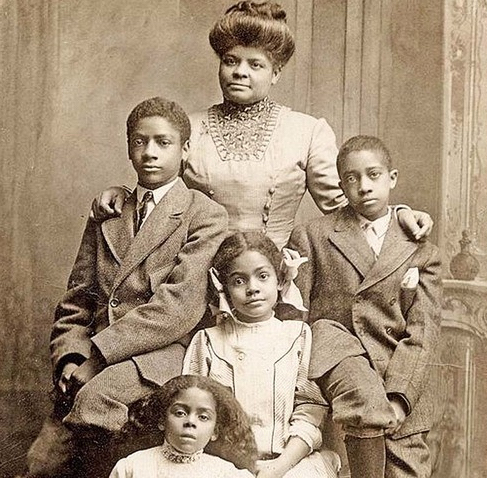
She joined the staff of Chicago’s pioneering Black newspaper, the Conservator, owned by Ferdinand L. Barnett, an attorney and widower. Romance blossomed, and on June 27, 1895 the couple married. From then, she was occasionally referred to as Ida B. Wells-Barnett. Even with four children, motherhood was no obstacle to continuing her writing and activism.
Wells was also deeply involved in the suffrage movementIn 1913, Ida organized the first suffrage group composed of Black women, the Alpha Suffrage Club, which published a newsletter, the Alpha Suffrage Record.The club’s work laid bare that truth that many Black women didn’t have sufficient education to take part in politics and the electoral process. This inspired her to reach out to other clubs that catered to Black women to help remedy this situation.
This same year, she also traveled to the first suffrage parade in Washington, D.C. organized by NAWSA. At the parade, she and sixty Black women were told to march in the back. To this, Wells responded “Either I go with you or not at all. I am not taking this stand because I personally wish for recognition. I am doing it for the future benefit of my whole race.”
. . . . . . . . . . .

. . . . . . . . . . .
Her legacy has been preserved by her daughter and granddaughterWells wrote that she fought a “lonely and almost single-handed fight against lynching long before men or women of any race entered the arena.” She began telling her story as an autobiography in 1928. Her memoirs were eventually edited by her daughter, Alfreda M. Duster, and published posthumously as Crusade for Justice: The Autobiography of lda B. Wells (1970).
Michelle Duster, Ida’s great-granddaughter, has continued to preserve her legacy with books including Ida B. the Queen (2021) and Ida B. Wells: Voice of Truth (2022), both intended for a YA readership (but perfect for anyone looking to become acquainted with Wells’ life and work).
The post 10 Fascinating Facts About Ida B. Wells, Fearless Journalist & Activist appeared first on Literary Ladies Guide.
July 20, 2026
Shirley Hazzard – on Travel, Love, and Language
Like many of the main characters in her novels, Australian-American writer Shirley Hazzard (1931–2016) traveled and moved homes from a young age. At first, this relocation was due to the decisions of parents responding to work or world events, and later to the dictates of her employers.
Photo at right, Shirley Hazzard in 2007, photo by Christopher Peterson. Courtesy of Wikimedia Commons.
In her short stories, we sometimes see tourists and travelers who visit of their own free will—for the sake of it. And those who fall in love with a place that may nurture them even more than a human they had the poor luck to fall in love with.
Hazzard’s fiction, therefore, is a neat fit for those who love to travel and for those (like me) who have also moved all their lives. Across her writing and interviews, a taxonomy of travel emerges. There are the Bell sisters in The Transit of Venus (1980), who are simply happy to have arrived in England from Australia, as Shirley Hazzard had.
Less worried than their new English friends and mentors about the work they must get, they feel that they’ve accomplished their triumphant objective: arriving. This IS the project, what they’ve long planned to do: Getting here. Victory is theirs from the beginning. And this is one way we travel.
. . . . . . . . . .
Learn more about Shirley Hazzard
. . . . . . . . . .
But Hazzard depicts other types of travelers, who neither love nor assimilate into the places in which they’ve arrived. A character in a short story (“Harold,” 1962) learns not a single phrase of Italian while studying cello in Siena for the summer. “She spoke of England with a longing as constant as though she had been condemned to exile.”
The Fenwicks, a couple in Hazzard’s first story collection, “had been gratified to find so many forebodings justified” on their first visit from England to Italy. They don’t know what to make of the Italian sky, however, which was “not their King James version sky.”
Shirley Hazzard, we begin to see, is a master of literary snark, nailing a character with a phrase that captures their worldview, or simply the way they’ve capitulated to their bureaucratic environment. If Cliffs of Fall, her first story collection, focuses on a range of romantic entanglements, her second collection, People in Glass Houses, surveys how people thrive, are corrupted, or barely survive working in massive institutions:
“Tong was beaming. ‘Some bad news, yes.’ Not naturally malicious, he had developed rapidly since entering bureaucracy.” Another character is back from the field in Africa: “Flinders had no complaint, making him an object of curiosity.”
Against characters like these, Hazzard pits Lidia, a translator, who quotes Bakunin: “I shall continue to be impossible so long as those who are now possible remain possible.”
In the short story, “The Flowers of Sorrow” (1964), the Director General of an organization delivers a speech to its members. Everyone feels that he has gone off script, confused when he says: “Will the flowers of joy ever equal the flowers of sorrow? But we should remember that sorrow does produce flowers of its own. It is a misunderstanding to always look for joy.”
Perhaps no lines best encapsulate Hazzard’s view than these, so randomly delivered to members of the Organization (a thinly veiled name for the United Nations, where she worked for many years). Whether regarding love, work, or travel, Hazzard focuses on what we embrace or miss. Sure, the speech is flowery, especially for a bureaucrat. But it also spans across Hazzard’s main theme that it’s better to have loved and lost — than the opposite.
. . . . . . . . . . .
. . . . . . . . . . .
Fortunately for Hazzard’s writing (and our reading), she was accepted for a post in Naples, just when her work life in New York had become grueling, and a love affair went sour. Unlike her future grumpy characters, the Fenwicks, she didn’t find that it satisfied her forebodings. She found it wonderful.
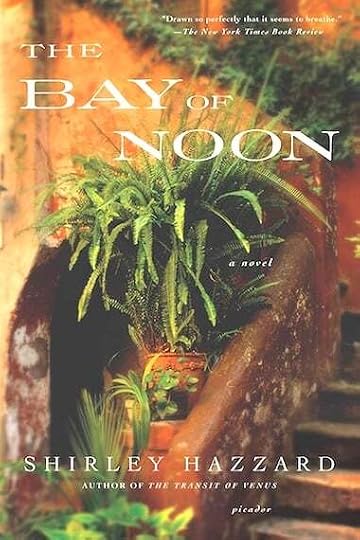
In Hazzard’s first novel, The Bay of Noon (1970), a rare book she wrote in the first person, she seems to echo the narrator, Jenny, in finding Naples an unexpected pleasure, an escape from the grind after a secretarial job in New York. In Naples, Jenny experiences the traveler’s joy in a new place that is as loved as it is nourishing for the soul.
Still, unlike Jenny, many of her colleagues settle into their work and lives as if they hadn’t moved anywhere. Again, we see how different travelers can be. Quickly, (unlike Hazzard and Jenny) they are moored in place, just accidentally in a place they no longer see.
. . . . . . . . . . .
. . . . . . . . . . .
No one is as susceptible to this as Graham Greene, who despite having lived in and written about many dangerous places now traveled “in Greeneland, bringing his world, including amore, with him.”
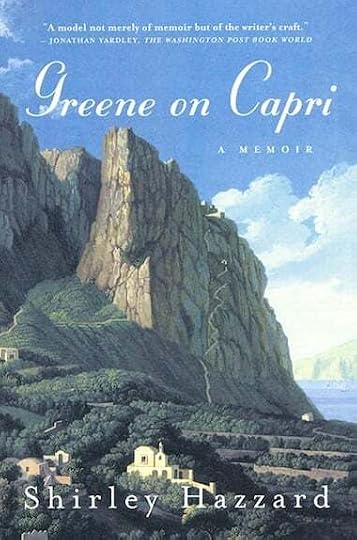
Like the Fenwicks (as Hazzard remarks in Greene on Capri, 2000), Graham Greene can also be something of a grumpy traveler. Observing an island in the bay between Capri and Naples, he remarks, “the place looks idyllic, but might be hell.” Hazzard notes that “Greene was inclined to suspect –in some moods, perhaps, to hope—that most idylls might be hell.”
Thus, certain travelers journey as if blind. Or travel grumpy. Perhaps even more so when amore is involved. In Greene on Capri, Hazzard tracks the history of travel at least from Britain to Italy and how for a certain class of people a visit was obligatory following the 18th-century discoveries of ancient Pompeii and Herculaneum.
She is grateful that she experienced Naples and Capri before the floods of tourists arrived, when Capri was a destination for those who sought a warm climate for their health and, “still other travelers came in retreat from the disapproval of society: unwed lovers, homosexual partners, and, less commonly, couples of mixed race. And there were the solitaries, who stayed because they had come to love the place.”
It is this last category that best characterizes both Hazzard and the main narrators of her novels, set after World War II. During that post-war period, Hazzard’s family moved to Hong Kong at age sixteen, when her father was sent to a diplomatic post. The plan was for her to attend university there, but the buildings had not yet recovered from having been bombed. As a result, Hazzard never went to university. But as she said in her Paris Review interview, she found good things in that:
“I cannot think that I could have loved and enjoyed literature more through an academic exposure to it. I occasionally feel, on the contrary, that I’ve had a narrow escape from such contortions as deconstruction. Whatever has been “missing” from my accidental approach, I’ve enjoyed an immediacy, a sort of impassioned humility, and inexpressible delight from a life of reading, and would not have it otherwise.”
An avid reader and successful autodidact, she also had a keen memory for verse. She met Graham Greene because they were sitting at adjoining tables (as strangers) in Capri, and he was trying to remember the next lines of verse he’d just quoted to his dinner partner. As Hazzard rose to leave, she supplied the lines he couldn’t remember.
Later, when they had already become friends, Greene asked her whether she studied in order to memorize verse. She told him no. “If the language is fine enough, I don’t forget it.”
While Hazzard’s stories and novels contain travel and love stories, they also narrow in on her love and attention to language. A cad will speak the language of a cad. An unhappy bureaucrat will collect his organization’s contradictions in terms because “Algie and his organization were incompatible and should never have mated.”
. . . . . . . . . . .

. . . . . . . . . . .
What’s true of work can be true of love. Hazzard often tracked couples on the verge of leaving one another. Or couples who compromised early on, only for one of them meeting another person they’re truly compatible with. Such missed moments are encapsulated in the metaphor contained in the title of The Transit of Venus, Hazzard’s best-known work.
Even today, it seems, astronomers struggle to predict when and where on our planet and Venus, in her celestial travel, will pass between us and the sun. In the novel by that name, an older figure reminds Caro, Venus’s main character, that had Captain Cook not gone in search of and mistaken the Transit’s timing, she would not be in England now. Yes, because Cook would not have landed on the unknown territory of Australia.
We mistake timing all the time: in love and work and war. One instance of good timing was when Hazzard’s sent her first story to The New Yorker’s slush pile, and it was accepted. She was also lucky in love with a sound marriage herself. She recalled that her first joy in writing about Greene on Capri was remembering her time with her late husband. And it is somehow comforting that Hazzard herself found the love and companionship that only some of her fictional characters do.
In a body of work attuned to the arrivals and departures of travel, it’s also fitting that Hazzard’s first lines (always our own arrival into one of her stories) often contain that drama of a journey’s beginning. The Transit of Venus begins “By nightfall, the headlines would be reporting devastation.”
An unexpected storm has come, just as one of the key characters, Ted Tice, is arriving to serve as an assistant to a scientist at the latter’s country home. We first get to know Ted Tice by seeing him plod steadily through the storm towards his duty. He’s unaware that just as much as the storm he’s braving took others unaware, he is trudging through a harsh downpour towards the love of his life, Caro Bell. Weather, transits, pure chance, and secondary characters who sour relationships with their kin all figure in Hazzard’s stories.
. . . . . . . . . . .

. . . . . . . . . . .
“And they were starting,” initiates our journey into her third novel, The Great Fire, which the central character Aldred Leith launches from a train leaving a station. As the train sets off, his thoughts soon wander to the difference between himself and his father who wrote novels, love stories set all over the world — the reason why Leith had a rootless upbringing. But Leith doesn’t find his father especially loving, nor as fixed on departures as he is.
Other family members (and work colleagues) are more toxic, such as the parents of the sibling pair Leith befriends. The parents are only too willing when their teenage son gets a complex, undiagnosed illness, to let their daughter just a few years older, serve as primary caregiver.
The theme of parents unhappy with their children echoes across Hazzard’s fiction. As tough as work or love toxicity can be, surely family fissures are the hardest.
In her story, “In Ones Own House,” the mother admits which of her two sons she prefers. Her elder son had always seemed reproachful of her. We get a glimpse of where that reproach might come from when the mother thinks: “She was distressed, but not surprised that he had managed to have a nervous breakdown.” The story unfolds under her roof, while the son she prefers, unknown to her, is hopelessly in love with his brother’s wife, who also living under her roof.
“Harold,” one of the early stories Hazzard published in The New Yorker (where she would continue to publish much of her work), describes an evening dinner among guests summering at a pensione outside of Siena, Italy. At last, romantic love is put aside. “It had all gone very well this year: no one had been ill, or quarreled or fallen in love. They were all on the best of terms, even with Miss Nicholson.”
The line is funny, as is much of Hazzard’s fiction. It is also striking because across her fiction, characters are ill, they quarrel, and most certainly fall in love. We watch these love stories from a distance, thanks to Hazzard’s precise and objective prose. As in life, people fall in love with the wrong person or with someone who is a mismatch, in terms of sentiment — as Jane Austen meant it: an equal level of experiencing the world or in terms of commitment. A man might genuinely be in love, but in real life, that might not dissuade him from marrying instead the heiress he’s engaged to.
In Hazzard’s writing, pleasure comes to those who are open to love and human connection, open to travel and experience, and, above all, to those who can put these adventures into words.
Contributed by Chris Prickett, a writer, editor, and retired professor of English and the humanities. Find her at ChristinePrickett.com.
. . . . . . . . . . .
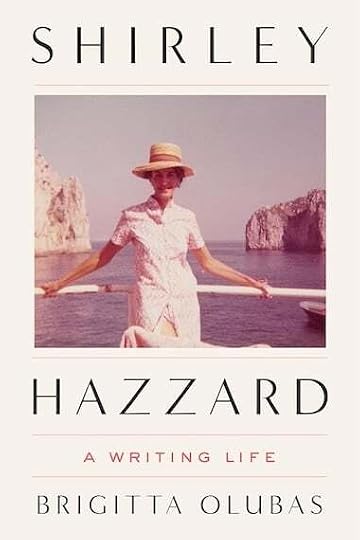
Further reading about Shirley Hazzard The Booker Prize The New York Society Library Shirley Hazzard: A Writing Life by Brigitta OloubasThe post Shirley Hazzard – on Travel, Love, and Language appeared first on Literary Ladies Guide.
June 27, 2026
Émilie du Châtelet (1706–1749), mathematician, physicist & translator
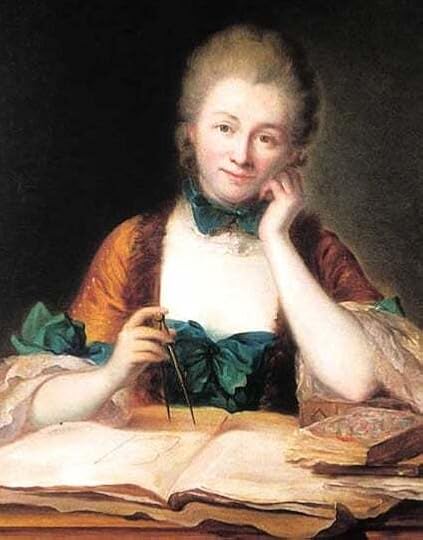
Émilie du Châtelet (1706–1749) was a French mathematician, physicist, and translator. Her major work as a writer was Foundations of Physics, first published in 1740.
Her major work as a translator was the translation of fellow scientist Isaac Newton’s seminal book Mathematical Principles of Natural Philosophy from its original Latin into French. Published in 1759, her translation is still the standard French translation to this day.
Émilie du Châtelet received a good education in literature, mathematics and science. After marrying the Marquis du Châtelet at the age of nineteen and bearing three children, she resumed her mathematical studies in 1733 at the age of twenty-six.
She became the intellectual collaborator and romantic partner of the French philosopher Voltaire, one of the key figures of the Enlightenment. Later on, while still being friends with her husband and with Voltaire, she began an affair with the French poet Jean Francois de Saint-Lambert but didn’t survive a new pregnancy one year later.
Émilie was the first woman to have an essay published by the French Royal Academy of Sciences in 1739. Her essay dealt with the nature and propagation of fire (“Dissertation sur la nature et la propagation du feu”).
. . . . . . . . . .
Émilie du Châtelet
. . . . . . . . .
Émilie du Châtelet’s main work as a writer was Foundations of Physics (original title: Institutions de Physique), published in Paris by Prault fils in 1740. A second edition was published in 1742, with a revised text under a slightly different title, Institutions Physiques.
Foundations of Physics synthesised and discussed the main ideas expressed by the prominent mathematicians and physicians of her time. The book covered many subjects, including the principles of knowledge, the existence of God, space, time, matter and the forces of nature, as well as Isaac Newton’s theory of motion and universal gravitation, which was attracting a lot of interest among her peers.
Foundations of Physics was translated into German and Italian in 1743. Her ideas were expressed in some chapters of the famed French Encyclopédie, a monumental encyclopedia in twenty-eight volumes (seventeen volumes of texts and eleven volumes of plates) published in France between 1751 and 1772 to incorporate all of the world’s knowledge, with many contributors.
Mathematical Principles of Natural Philosophy
Émilie’s main work as a translator was the translation into French of fellow scientist Isaac Newton’s Mathematical Principles of Natural Philosophy (original title: Philosophiae Naturalis Principia Mathematica), often referred to as Principia.
Written in Latin and first published in 1687, with two further editions in 1713 and 1726, the three-volume book details Newton’s laws of motion and his law of universal gravitation, and the mathematical methods Newton used in formulating his physical laws. Principia is now considered one of the major works in the history of science.
All the translations were based on the third edition in 1726. An English translation authored by the English mathematician Andrew Motte was published in 1729, with several subsequent editions.
The French translation authored by Émilie du Châtelet included a summary section (a common summary for the three volumes), an extensive commentary section (two thirds of the second volume) and an analytical section in which she applied the new mathematics of calculus to Newton’s most controversial theories.
The first French edition (considered “temporary”) was published in Paris by Desaint & Saillant in 1756, six years after Émilie’s death, under the title Principes mathématiques de la philosophie naturelle [traduits] par feue Madame La Marquise du Chastellet. The second French edition (considered “final”) was published in two volumes by Desaint & Saillant in 1759, and is still the standard French edition to this day.
Her translation was a major step for the dissemination of Newtonian physics in France and in Europe and for the completion of the two-century Scientific Revolution which led to an empirical and evidence-based approach to science.
The Fable of the Bees (1715)
Émilie also translated The Fable of the Bees (1715) by the Anglo-Dutch social philosopher Bernard Mandeville under the title La Fable des Abeilles (1740).
In the preface to her translation, considered less a translation than a free adaptation into French, she strongly argued for the education of women, particularly a secondary education for young women as was available for young men. She explained that, by denying women a good education, society prevented women from becoming eminent contributors in the arts and sciences.
Being a learned woman respected by her peers didn’t prevent misogynistic comments. As stated by the German philosopher Immanuel Kant in his Observations on the Feeling of the Beautiful and Sublime (original title: Beobachtungen über das Gefühl des Schönen und Erhabenen), published in German in 1764:
“A woman who has a head full of Greek, like Mme Dacier [a French scholar and translator], or who conducts disputations about mechanics, like the Marquise du Châtelet, might as well also wear a beard; for that might perhaps better express the mien of depth [the overall appearance] for which they strive.”
But Kant did read their works, which probably influenced his own writings.
Further reading History of Scientific Women Who was Émilie du Châtelet and Why Does She Matter? The Scientific Trailblazer Who Turned Heads in VersaillesContributed by Marie Lebert. Edited by Nava Atlas, Literary Ladies Guide. See more entries by Marie Lebert, most profiling women translators.
The post Émilie du Châtelet (1706–1749), mathematician, physicist & translator appeared first on Literary Ladies Guide.
June 26, 2026
Quotes from Shirley Jackson’s Psychological Thrillers
Shirley Jackson (1916 – 1965) was an American author whose work explored motifs of psychological horror. Presented here is a selection of quotes from Shirley Jackson’s best-known fiction in this genre, in which she was a master.
Many of her works addressed the dark side of human nature. “The Lottery” (1948) is her best-known short story; standouts among her novels are The Haunting of Hill House and We Have Always Lived in the Castle.
Life Among the Savages and Raising Demons pioneered the genre of “momoirs” that inspired such writers as Erma Bombeck and Jean Kerr. In Jackson’s case, her own family life wasn’t quite as fun as the glossy and wry depictions in her pages.
As a master of the psychological horror genre, Jackson influenced Stephen King and others. Having suffered from various ailments and addictions, she was only forty-eight when she died of heart failure. Even so, Jackson’s literary legacy has proven sturdy and enduring.
. . . . . . . . . .
The Lottery (1948)
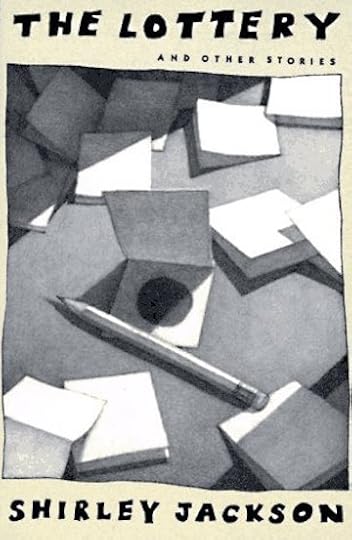
“The morning of June 27th was clear and sunny, with the fresh warmth of a full-summer day; the flowers were blossoming profusely and the grass was richly green.”
. . . . . . . . . .
“Although the villagers had forgotten the ritual and lost the original black box, they still remembered to use stones.”
. . . . . . . . . .
“They stood together, away from the pile of stones in the corner, and their jokes were quiet and they smiled rather than laughed.”
. . . . . . . . . .
“Tessie Hutchinson was in the center of a cleared space by now, and she held her hands out desperately as the villagers moved in on her. “It isn’t fair,” she said. A stone hit her on the side of the head.”
. . . . . . . . .
The Road Through the Wall (1948)

“In ten years I will be a beautiful charming lovely lady writer without any husband or children but lots of lovers and everyone will read the books I write and want to marry me but I will never marry any of them. I will have lots of money and jewels too.”
. . . . . . . . .
“The weather falls more gently on some places than on others, the world looks down more paternally on some people. Some spots are proverbially warm, and keep, through falling snow, their untarnished reputations as summer resorts; some people are automatically above suspicion.”
. . . . . . . . . .
“Outside were the eucalyptus trees, like lace against the sky. If it were only possible to lie against them, light and bodiless, sink into their softness, deeper and deeper, lost in them, buried, never come back again …”
. . . . . . . . . .
“We must expect to set a standard. Actually, however much we may want to find new friends whom we may value, people who are exciting to us because of new ideas, or because they are different, we have to do what is expected of us.”
. . . . . . . . . .
Hangsaman (1951)
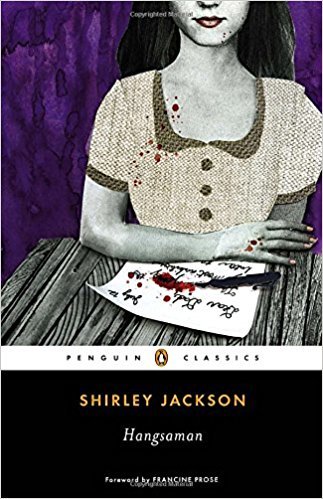
“Natalie Waite, who was seventeen years old but who felt that she had been truly conscious only since she was about fifteen, lived in an odd corner of the world of sound and sight past the daily voices of her father and mother and their incomprehensible actions.
. . . . . . . . . . .
“The gap between the poetry she wrote and the poetry she contained was, for Natalie, something unsolvable.”
. . . . . . . . . . .
“Someday I will be sixty years old, sixty-seven, eighty, and, remembering, will perhaps recall that something of this sort happened once (where? when? who?) and will perhaps smile nostalgically thinking, What a sad silly girl I was, to be sure.’”
. . . . . . . . . . . .
“Imagine, always pretending to run a world. Always imitating the sort of people they think they might be if the world were the sort of world it isn’t. Pretending to be words like ‘normal’ and ‘wholesome’ and ‘honest’ and ‘decent’ and ‘self-respecting’ and all the rest, when even the words aren’t real. Imagine, being people.”
. . . . . . . . . . . .
“‘Do you plan to be a writer?’
A what? Natalie thought; a writer, a plumber, a doctor, a merchant, a chief; the best-laid plans of; a writer the way I might plan to be a corpse? ‘A writer?’ she repeated, as though she had never heard the word before.”
. . . . . . . . . . .
The Sundial (1958)
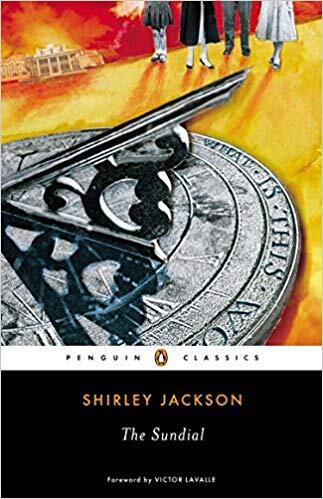
“The sight of one’s own heart is degrading; people are not meant to look inward–that’s why they’ve been give bodies, to hide their souls.”
. . . . . . . . . . . .
“The question of belief is a curious one, partaking of the wonders of childhood and the blind hopefulness of the very old; in all the world there is not someone who does not believe something. It might be suggested, and not easily disproven that anything, no matter how exotic, can be believed by someone.
. . . . . . . . . . . .
“When shall we live if not now?”
. . . . . . . . . . . .
“Now, she thought; I may go mad, but at least I look like a lady.”
. . . . . . . . . . . .
“The experiment with humanity is at an end,” Aunt Fanny said.
“Splendid,” Mrs. Halloran said, “I“was getting very tired of all of them.”
. . . . . . . . . .
The Haunting of Hill House (1959)
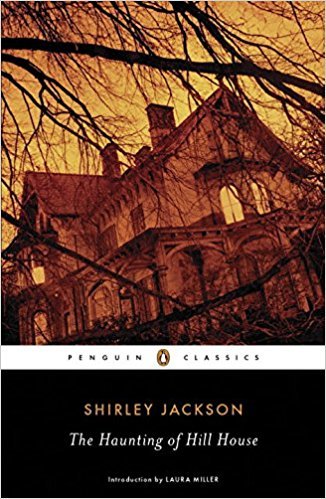
“Hill House has an impressive list of tragedies connected with it, but then, most old houses have. People have to live and die somewhere, after all, and a house can hardly stand for eighty years without seeing some of its inhabitants die within its walls.”
. . . . . . . . . .
“When they were silent for a moment the quiet weight of the house pressed down from all around them.”
. . . . . . . . . .
“Materializations are often best produced in rooms where there are books. I cannot think of any time when materialization was in any way hampered by the presence of books.”
. . . . . . . . . .
“Certainly there are spots which inevitably attach to themselves an atmosphere of holiness and goodness; it might not then be too fanciful to say that some houses are born bad.”
. . . . . . . . . .
“My dear, how can I make you perceive that there is no danger where there is nothing but love and understanding?”
. . . . . . . . . .
“Nothing is ever really wasted, she believed sensibly, even one’s childhood, and then each year, one summer morning, the warm wind would come down the city street where she walked and she would be touched with the little cold thought: I have let more time go by.”
. . . . . . . . . .
We Have Always Lived in the Castle (1962)
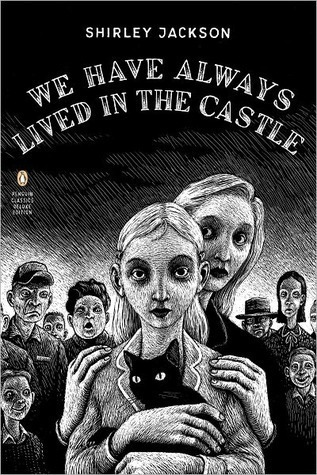
We Have Always Lived in the Castle
. . . . . . . . . .
“What are you reading, my dear? A pretty sight, a lady with a book.”
. . . . . . . . . .
“I remember that I stood on the library steps holding my books and looking for a minute at the soft hinted green in the branches against the sky and wishing, as I always did, that I could walk home across the sky instead of through the village.”
. . . . . . . . . .
“On the moon we wore feathers in our hair, and rubies on our hands. On the moon we had gold spoons.”
. . . . . . . . . .
“I was pretending that I did not speak their language; on the moon we spoke a soft, liquid tongue, and sang in the starlight, looking down on the dead dried world.”
. . . . . . . . . .
“I can’t help it when people are frightened … I always want to frighten them more.”
. . . . . . . . . .
“There had not been this many words sounded in our house for a long time, and it was going to take a while to clean them out.”
. . . . . . . . . .
“On the moon we have everything. Lettuce, and pumpkin pie and Amanita phalloides. We have cat-furred plants and horses dancing with their wings. All the locks are solid and tight, and there are no ghosts.”
. . . . . . . . . .
Further reading about Shirley Jackson Shirley Jackson on Motherhood, Experience, and Fiction Writing Shirley Jackson: Mother of the Fictional and Real-Life Teen Six Novels by Shirley Jackson: Psychological Thrillers by a MasterThe post Quotes from Shirley Jackson’s Psychological Thrillers appeared first on Literary Ladies Guide.
June 5, 2026
Lizzie Magie: Forgotten Inventor of The Landlord’s Game
Introduction by Literary Ladies Guide: Although Monopoly is one of the most iconic board games in the world, the fascinating story of its origins has been lost to time. First published by Parker Brothers in 1935, the game’s invention was long credited to Charles Darrow, a salesman. But Monopoly was actually based on The Landlord’s Game, invented and patented by Lizzie Magie in 1904.
The usurping game is now the best-selling modern board game, by far, with approximately 285 million copies sold. Its digital equivalent, Monopoly Go!, has amassed 150 million downloads, with millions of daily active users.
Some history of Lizzie Magie and her invention is explored in the following piece by Evan Atlas, who recently reimagined Magie’s creation as an online game called Prosperity.
. . . . . . . . .
Lizzie Magie and The Landlord’s GameContributed by Evan Atlas
Who Was Lizzie Magie? She was a champion of prosperity. That’s the short version. But this incredibly multifaceted woman defies brief classification. Her path was one of iconoclasm and entrepreneurial creativity.
Elizabeth Jones Magie (1866 – 1948), born in Macomb, Illinois, was the daughter of James Kingsley Magie and Mary Jane Ritchie. Her father sparked her lifelong interest in economic justice by introducing her to Progress and Poverty, the groundbreaking book by Henry George. It not only inspired The Landlord’s Game, but stayed with her throughout her life.
. . . . . . . . . . .
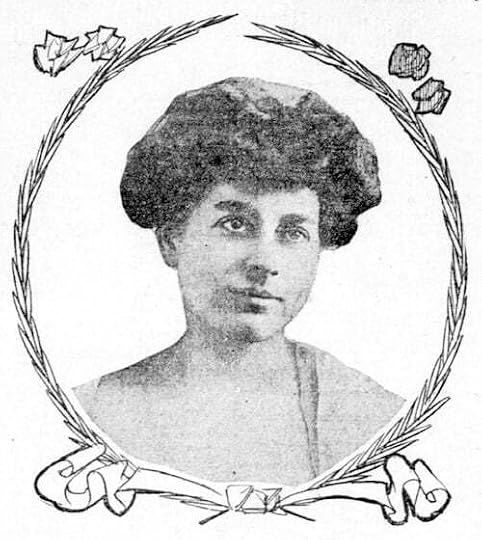
Lizzie Magie in 1906
Learn more in “The Woman Inventor Behind Monopoly“
. . . . . . . . . . .
In her early twenties, Magie became a proficient typist and stenographer, even starting her own business centered on these skills. But she was anything but mechanical. At just twenty-six years of age, she secured her first patent for innovating the typewriters she had mastered.
Notably, it was a time when less than 1% of patents were issued to women. This was the engineering side of Magie. She both understood systems and had the inclination to change them:
“We are not machines. Girls have minds, desires, hopes and ambition.”
Artistically, she dabbled in writing, live comedy, and theatre. A collection of her poetry, titled My Betrothed, and Other Poems, reveals other varied interests such as psychology, philosophy, and squandered opportunity:
Society, thou ill-constructed thing,
Reform thyself!
Dethrone the worthless idlers!
Make room for worthy Genius!
O ye men of wealth and power,
Should this be so?
Should Genius, out of place,
Toil on till death, impoverished, unknown?
This poet soul, imprisoned, dreams away.
A thousand brilliant thoughts
Come rushing to his brain,
And, like some caged wild bird,
Flap their wings and cry for liberty,
But find it not,
And fade and die imprisoned.
Elsewhere, she displayed her literary talents as an investigative journalist, covering the grueling working conditions of women. She was a vocal feminist throughout her life, and gained notoriety for placing a satirical ad for “herself” in a newspaper:
“Young woman American slave to the highest bidder: Intelligent, well-educated, refined, true, honest, just, poetical, philosophical, and womanly above all things. Brunette, large gray-green eyes, full passionate lips, splendid teeth, not beautiful but very attractive, features full of character and strength, yet truly feminine; height 5 feet 3 inches; well proportioned, graceful.”
But near the end of her life, she listed her occupation as maker of games.
. . . . . . . . . . .

Magie was awarded a patent for the Landlord’s Game in 1904
. . . . . . . . . . .
The Landlord’s GameMany games have a philosophical aspect to them. It just so happens that Monopoly is more covert than its forgotten predecessor. Its style of play fits neatly within the prevailing economic orthodoxy, so it isn’t recognized as having a distinct philosophical stance. Yet it does. It subscribes to the practice of bundling together land rents and structure rents.
We can see this at work in both the game — and in daily life beyond the board. If I own a property (in Monopoly or in my home state of New York) that consists of land and a house that I built, I’ll be charged a property tax. This tax is based on the combined value of the land and the house.
Magie considered this an economic injustice. Why? Because my efforts and resources produced the value that results from constructing a house, but not the value that is inherent to the land. From this logic, the land value tax was born.
The value of land is a public good that is privately captured. So the remedy is to tax land at a rate that recaptures that value and effectively restores its status as a public good. This is the philosophy that inspired Lizzie Magie, and is the economic foundation of The Landlord’s Game.
She achieved this with a brilliant game rule that was later left out of Monopoly—the prosperity rule. It follows from the same logic explored above: It should be expensive, not profitable, to hoard undeveloped land. Monopoly, lacking this rule, was born as an ode to injustice. It was in 1935 that the Parker Brothers company bought the rights to her game for just $500.
This has been characterized as a swindle, understandably. But make no mistake: Magie was not duped into thinking that’s all the game was worth. What convinced her was not the $500—it was that they offered to sell and promote The Landlord’s Game along with Monopoly.
She truly believed this was how her Georgist board game would finally reach the wider world. Parker Brothers, however, did little to promote her game, and discontinued it shortly after it went into production. Since then, it has been mostly lost to time, with few having ever heard of it.
In her poem title “Self,” she wrote:
The great are those who make the world
The better by their deeds.
Her dream was buried. But she was true to herself to the very end. I think that Magie, as a maker of games, did a little wordplay here. Of course it is our actions (our deeds) that shape reality. It couldn’t have been far from her mind that the same could be said of our property deeds.
. . . . . . . . . . .

For the expanded version of this post,
see Prosperity: A Georgist Game
. . . . . . . . . . .
See (and Play) for YourselfLizzie Magie once said, “I am thankful that I have been taught how to think and not what to think.” That’s why sometimes we need games, not textbooks.
If you’re as inspired by Magie’s story and her lost board game as I am, you may be wondering where you can play The Landlord’s Game. That’s why I’ve re-imagined it as a modern online game called Prosperity. Play the game and see Lizzie Magie’s ideas clearly for yourself. With her help, we can change the world.
. . . . . . . . .
Contributed by Evan Atlas. Evan is a writer and political philosopher from New York’s Hudson Valley. His work confronts our most significant challenges, and develops a theory of change for the 21st century that is unlike anything you’ve heard before. He believes that the future of humanity can be more loving, more free, and more beautiful, but that this future is in danger. Join him at evanatlas.com and on his Substack and help create a more beautiful planet.
Further readingChokshi, Niraj. “A New Monopoly Game Celebrates Women, but What About the One Behind the Original?” International New York Times / International Herald Tribune. September 2019.Dodson, Edward J. “How Henry George’s Principles Were Corrupted Into the Game Called Monopoly.” December 2011.Edwards, Gavin. “Overlooked No More: Lizzie Magie, the Unknown Inventor Behind Monopoly.”The New York Times. April 2024.Terrell, Ellen. “The Very Fascinating Elizabeth J. Magie.” Library of Congress. September 2022.
The post Lizzie Magie: Forgotten Inventor of The Landlord’s Game appeared first on Literary Ladies Guide.
May 8, 2026
“I Do Not Consent” The Life of Writer and Activist June Jordan
June Jordan (July 9, 1936 – June 14, 2002) was a poet, playwright, and essayist, known for her political activism and commitment to human rights.
Her writing spanned thirty years and nearly thirty books, covering subjects such as marginalization, oppression, and inequality, as well as racial, political, and sexual identity.
She was also passionate about the use of Black English in writing and in education, and had a thriving teaching career in several universities.
Early life in New York
June Millicent Jordan was born in the Harlem section of New York City in 1936 and raised in Bedford-Stuyvesant, Brooklyn. Her parents, Mildred and Granville Jordan were immigrants from Panama and Jamaica, respectively. An only child, she had a difficult relationship with her father, who never hid his disappointment that she was not a boy.
Later, she would write, “For a long while during childhood I was relatively small, short, and, in some other ways, a target for bully abuse. In fact, my father was the first regular bully in my life.” However, she credited him with passing along his love of literature, and by age seven, she began writing her own poetry. Her mother later took her own life. Fifteen years later, in a 1981 essay called “Many Rivers To Cross,” Jordan wrote:
“I thought about the idea of my mother as a good woman and I rejected that, because I don’t see why it’s a good thing when you give up, or when you cooperate with those who hate you…I came too late to help my mother to her feet. By way of everlasting thanks to all the women who have helped me to stay alive I am working never to be late again.”
She attended Midwood High School in Brooklyn for a year, followed by the elite Northfield School in Massachusetts. The student bodies of both schools were predominantly white. In 1953, she attended Barnard College in New York (the women’s college affiliated with Columbia University), but also felt alienated as a Black student, and by the white-centered curriculum. In her 1981 book of essays, Civil Wars, she wrote of the experience:
“No one ever presented me with a single Black author, poet, historian, personage, or idea for that matter. Nor was I ever assigned a single woman to study as a thinker, or writer, or poet, or life force.” Because of this disconnect, Jordan left Barnard without graduating.
. . . . . . . . . .

. . . . . . . . . .
Marriage, divorce, and sexual identityIn 1955, Jordan met and married Michael Meyer, a white student at Columbia University. She followed him to the University of Chicago, where she also enrolled, but ultimately returned to Barnard and graduated with a Bachelor of Arts degree in 1957.
In 1958, she gave birth to the couple’s only child, Christopher, and raised him alone after she and Meyer divorced in 1965.
Jordan always identified openly as bisexual, saying, “Bisexuality means I am free and I am as likely to want to love a woman as I am likely to love a man, and what about that? Isn’t that what freedom implies?” After her death in 2019, she was one of the first fifty American “pioneers, trailblazers and heroes” inducted into the National LGBTQ Wall of Honor at the Stonewall National Monument in New York City.
A life dedicated to activism
Jordan was active in the civil rights, feminist, anti-war, and gay rights movements. She attended rallies, marches, events and conferences throughout her life. She wrote in Civil Wars: Selected Essays (Boston: Beacon Press, 1981).
“It seems unreasonable that more than 400 million people, right now, struggle against hunger and starvation, even while there is an arable earth aplenty to feed and nourish every one of us. It does not seem reasonable that the color of your skin should curse and condemn all your days and the days of your children. It seems preposterous that gender, that being a woman, anywhere in the world, should elicit contempt, or fear, or ridicule, and serious deprivation of rights to be, to become, to embrace whatever you choose…”
After the Harlem Riots of 1964 (in which James Powell, a Black teen, was shot dead by an NYPD officer – a shooting which sparked six nights of rioting and clashes between protestors and the police), Jordan was “filled with hatred for everything and everyone White.”
It was a conversation with civil rights leader Fannie Lou Hamer that led her to eventually believe that “this condition, if it lasted, would mean that I had lost the point: not to resemble my enemies, not to dwarf my world, not to lose my willingness and ability to love.”
After the riots, she collaborated with architect Buckminster Fuller on an architectural redesign of Harlem to improve living conditions for residents. However, the plan was never developed.
Jordan was also a passionate supporter of Palestinian rights, and said that the Palestinian struggle was the “moral litmus test” of her life. After traveling to Lebanon in 1982 and visiting the Sabra and Shatila refugee camps, and seeing the devastation of the Israeli massacres there firsthand (and then returning in 1996), she wrote in the poem “Apologies to All the People in Lebanon”:
“Yes I did know it was the money I earned as a poet that / paid / for the bombs and the planes and the tanks / that they used to massacre your family… I’m sorry. I really am sorry.”
. . . . . . . . . .
. . . . . . . . . .
Teaching careerJordan’s teaching career began in 1967 when, after running poetry workshops for children in Harlem, she began teaching at the City College of New York. Later, she taught at Yale University and Sarah Lawrence College, and became Professor of English at Stony Brook, where she directed the Poetry Center.
In 1988, she became Professor of African American Studies at the University of California at Berkeley, where, in 1991, she co-founded Poetry for the People with Janice Mirikitani – a program to train undergraduates to bring poetry into community groups as a form of political and social empowerment.
She was known for using Black English both in her own writing and in her teaching. She saw it as a vital way of keeping the community and culture alive, and she encouraged her students to respect it as its own language and to use it in their own work.
Her essay, “Nobody Means More to Me Than You and the Future Life of Willie Jordan,” criticizes the use of “White English” as standard English, saying that “compulsory education in American compels accommodation to exclusively White forms of ‘English.’”
“To rally the spirit of your folks”:
an extensive writing career
In 1969, Jordan published her first volume of poetry, Who Look at Me. This was followed by several books for children and young adults, including His Own Where (1971), Dry Victories (1972), New Life, New Room (1975), and Kimako’s Story (1981).
Later, she explored her own childhood in the memoir Soldier: A Poet’s Childhood (2000), and in a NewsHour interview with Elizabeth Farnsworth, she said of the book,
“I wanted to honor my father, first of all, and secondly, I wanted people to pay attention to a little girl who is gifted intellectually and creative, and to see that there’s a complexity here that we may otherwise not be prepared to acknowledge or even search for…” In a separate interview, she said, “My father was very intense, passionate, and over-the-top. He was my hero and my tyrant.”
She also wrote poetry and fiction, and librettos for the operas Bang Bang Uber Alles, and I was Looking at the Ceiling and Then I Saw the Sky. Her journalism was published widely, and she was a regular columnist for The Progressive. Her essays were largely political, and in collections such as Civil Wars (1981), On Call (1985), and Technical Difficulties (1992), her topics ranged from conflicts in South Africa, Nicaragua, and Lebanon, to issues of race and class in the U.S.
Jordan often wrote about her personal experiences in her work, including the experience of being raped. In ‘Poem About My Rights’, she wrote, “I have been raped / be- / cause I have been wrong the wrong sex the wrong age / the wrong skin the wrong nose the wrong hair the / wrong need the wrong dream the wrong geographic / […] / but let this be unmistakeable this poem / is not consent I do not consent / […] / I am not wrong: wrong is not my name”
When she was asked about the role of a poet in society, she replied, “The role of a poet, beginning with my own childhood experience, is to deserve the trust of people who know that what you do is work with words … Then the task of a poet of color, a Black poet, as a people hated and despised, is to rally the spirit of your folks …”
She was awarded a number of prestigious grants, including Fellowships from the National Endowment for the Arts, Massachusetts Council on the Arts, and the New York Foundation for the Arts, as well as the National Association of Black Journalists Award and a Rockefeller Foundation Grant. She was also a finalist for the National Book Award in 1972 for His Own Where.
. . . . . . . . . .
. . . . . . . . . .
Later yearsJordan was diagnosed with breast cancer in the 1990s, but continued to teach, write, and protest. She died in June 2002 at her home in Berkeley, California.
In an obituary, Lynell George wrote in the Los Angeles Times, “[Jordan] spent her life stitching together the personal and political so the seams didn’t show,” while Jordan’s contemporary, Toni Morrison, said of her career, “I am talking about a span of forty years of tireless activism coupled with and fueled by flawless art.”
. . . . . . . . . .
Contributed by Elodie Barnes. Elodie is a writer and editor with a serious case of wanderlust. Her short fiction has been widely published online and is included in the Best Small Fictions 2022 Anthology published by Sonder Press. She is Books & Creative Writing Editor at Lucy Writers Platform, she is also co-facilitating What the Water Gave Us, an Arts Council England-funded anthology of emerging women writers from migrant backgrounds. She is currently working on a collection of short stories, and when not writing can usually be found planning the next trip abroad, or daydreaming her way back to 1920s Paris. Find more of her writings here and on Literary Ladies Guide.
More about June Jordan June Jordan’s complete bibliography
Further reading
This Unruly Witness: June Jordan’s Legacy, ed. by Lauren Muller, Becky Thompson,Dominique C. Hill. Haymarket Books, 2025The Essential June Jordan, ed. Jan Heller Levi and Christoph Keller, Penguin Classics, 2021Passion (Poems), by June Jordan, Penguin Classics, 2025Haruko/Love Poems, by June Jordan, Serpent’s Tail Classics, 2023 June Jordan on America’s Black Holocaust Museum Poetry Foundation
The post “I Do Not Consent” The Life of Writer and Activist June Jordan appeared first on Literary Ladies Guide.
April 20, 2026
“Marriage and Love” by Emma Goldman, a 1911 essay
Emma Goldman (1869 – 1940) was a noted as a promoter of the anarchist philosophy. Best known for her role in the development of its theories in the early twentieth century, she was also actively involved in other social reforms. “Marriage and Love,” one of her best-known and widely read essays.
This thoughtful, often cynical, and surprising examination of marriage in the early twentieth century still speaks to the contemporary institution in many ways.
In 1906, Goldman founded the Mother Earth Journal, serving as both an editor and frequent contributor. The essay that follows was originally published by Mother Earth Publishing Association in 1911. It is in the public domain.
. . . . . . . . . .
Marriage and Love by Emma GoldmanThe popular notion about marriage and love is that they are synonymous, that they spring from the same motives, and cover the same human needs. Like most popular notions this also rests not on actual facts, but on superstition.
Marriage and love have nothing in common; they are as far apart as the poles; are, in fact, antagonistic to each other. No doubt some marriages have been the result of love. Not, however, because love could assert itself only in marriage; much rather is it because few people can completely outgrow a convention.
There are today large numbers of men and women to whom marriage is naught but a farce, but who submit to it for the sake of public opinion. At any rate, while it is true that some marriages are based on love, and while it is equally true that in some cases love continues in married life, I maintain that it does so regardless of marriage, and not because of it.
On the other hand, it is utterly false that love results from marriage. On rare occasions one does hear of a miraculous case of a married couple falling in love after marriage, but on close examination it will be found that it is a mere adjustment to the inevitable. Certainly the growing-used to each other is far away from the spontaneity, the intensity, and beauty of love, without which the intimacy of marriage must prove degrading to both the woman and the man.
Marriage is primarily an economic arrangement, an insurance pact. It differs from the ordinary life insurance agreement only in that it is more binding, more exacting. Its returns are insignificantly small compared with the investments. In taking out an insurance policy one pays for it in dollars and cents, always at liberty to discontinue payments.
If, however, woman’s premium is a husband, she pays for it with her name, her privacy, her self-respect, her very life, “until death doth part.” Moreover, the marriage insurance condemns her to life-long dependency, to parasitism, to complete uselessness, individual as well as social. Man, too, pays his toll, but as his sphere is wider, marriage does not limit him as much as woman. He feels his chains more in an economic sense.
Thus Dante’s motto over Inferno applies with equal force to marriage. “Ye who enter here leave all hope behind.”
That marriage is a failure none but the very stupid will deny. One has but to glance over the statistics of divorce to realize how bitter a failure marriage really is. Nor will the stereotyped Philistine argument that the laxity of divorce laws and the growing looseness of woman account for the fact that: first, every twelfth marriage ends in divorce; second, that since 1870 divorces have increased from 28 to 73 for every hundred thousand population; third, that adultery, since 1867, as ground for divorce, has increased 270.8 per cent.; fourth, that desertion increased 369.8 per cent.
Added to these startling figures is a vast amount of material, dramatic and literary, further elucidating this subject. Robert Herrick, in Together; Pinero, in Mid-Channel; Eugene Walter, in Paid in Full, and scores of other writers are discussing the barrenness, the monotony, the sordidness, the inadequacy of marriage as a factor for harmony and understanding.
The thoughtful social student will not content himself with the popular superficial excuse for this phenomenon. He will have to dig down deeper into the very life of the sexes to know why marriage proves so disastrous.
Edward Carpenter says that behind every marriage stands the life-long environment of the two sexes; an environment so different from each other that man and woman must remain strangers. Separated by an insurmountable wall of superstition, custom, and habit, marriage has not the potentiality of developing knowledge of, and respect for, each other, without which every union is doomed to failure.
Henrik Ibsen, the hater of all social shams, was probably the first to realize this great truth. Nora leaves her husband, not—as the stupid critic would have it—because she is tired of her responsibilities or feels the need of woman’s rights, but because she has come to know that for eight years she had lived with a stranger and borne him children. Can there be anything more humiliating, more degrading than a life-long proximity between two strangers?
No need for the woman to know anything of the man, save his income. As to the knowledge of the woman—what is there to know except that she has a pleasing appearance? We have not yet outgrown the theologic myth that woman has no soul, that she is a mere appendix to man, made out of his rib just for the convenience of the gentleman who was so strong that he was afraid of his own shadow.
Perchance the poor quality of the material whence woman comes is responsible for her inferiority. At any rate, woman has no soul—what is there to know about her? Besides, the less soul a woman has the greater her asset as a wife, the more readily will she absorb herself in her husband.
It is this slavish acquiescence to man’s superiority that has kept the marriage institution seemingly intact for so long a period. Now that woman is coming into her own, now that she is actually growing aware of herself as a being outside of the master’s grace, the sacred institution of marriage is gradually being undermined, and no amount of sentimental lamentation can stay it.
From infancy, almost, the average girl is told that marriage is her ultimate goal; therefore her training and education must be directed towards that end. Like the mute beast fattened for slaughter, she is prepared for that. Yet, strange to say, she is allowed to know much less about her function as wife and mother than the ordinary artisan of his trade.
. . . . . . . . . .
Emma Goldman in 1911
. . . . . . . . . .
It is indecent and filthy for a respectable girl to know anything of the marital relation. Oh, for the inconsistency of respectability, that needs the marriage vow to turn something which is filthy into the purest and most sacred arrangement that none dare question or criticize. Yet that is exactly the attitude of the average upholder of marriage. The prospective wife and mother is kept in complete ignorance of her only asset in the competitive field—sex.
Thus she enters into life-long relations with a man only to find herself shocked, repelled, outraged beyond measure by the most natural and healthy instinct, sex. It is safe to say that a large percentage of the unhappiness, misery, distress, and physical suffering of matrimony is due to the criminal ignorance in sex matters that is being extolled as a great virtue. Nor is it at all an exaggeration when I say that more than one home has been broken up because of this deplorable fact.
If, however, woman is free and big enough to learn the mystery of sex without the sanction of State or Church, she will stand condemned as utterly unfit to become the wife of a “good” man, his goodness consisting of an empty brain and plenty of money.
Can there be anything more outrageous than the idea that a healthy, grown woman, full of life and passion, must deny nature’s demand, must subdue her most intense craving, undermine her health and break her spirit, must stunt her vision, abstain from the depth and glory of sex experience until a “good” man comes along to take her unto himself as a wife? That is precisely what marriage means. How can such an arrangement end except in failure? This is one, though not the least important, factor of marriage, which differentiates it from love.
Ours is a practical age. The time when Romeo and Juliet risked the wrath of their fathers for love, when Gretchen exposed herself to the gossip of her neighbors for love, is no more. If, on rare occasions, young people allow themselves the luxury of romance, they are taken in care by the elders, drilled and pounded until they become “sensible.”
The moral lesson instilled in the girl is not whether the man has aroused her love, but rather is it, “How much?” The important and only God of practical American life: Can the man make a living? can he support a wife? That is the only thing that justifies marriage. Gradually this saturates every thought of the girl; her dreams are not of moonlight and kisses, of laughter and tears; she dreams of shopping tours and bargain counters.
This soul poverty and sordidness are the elements inherent in the marriage institution. The State and the Church approve of no other ideal, simply because it is the one that necessitates the State and Church control of men and women.
Doubtless there are people who continue to consider love above dollars and cents. Particularly is this true of that class whom economic necessity has forced to become self-supporting. The tremendous change in woman’s position, wrought by that mighty factor, is indeed phenomenal when we reflect that it is but a short time since she has entered the industrial arena. Six million women wage workers; six million women, who have the equal right with men to be exploited, to be robbed, to go on strike; aye, to starve even.
Anything more, my lord? Yes, six million wage workers in every walk of life, from the highest brain work to the mines and railroad tracks; yes, even detectives and policemen. Surely the emancipation is complete.
Yet with all that, but a very small number of the vast army of women wage workers look upon work as a permanent issue, in the same light as does man. No matter how decrepit the latter, he has been taught to be independent, self-supporting. Oh, I know that no one is really independent in our economic treadmill; still, the poorest specimen of a man hates to be a parasite; to be known as such, at any rate.
The woman considers her position as worker transitory, to be thrown aside for the first bidder. That is why it is infinitely harder to organize women than men. “Why should I join a union? I am going to get married, to have a home.”
Has she not been taught from infancy to look upon that as her ultimate calling? She learns soon enough that the home, though not so large a prison as the factory, has more solid doors and bars. It has a keeper so faithful that naught can escape him. The most tragic part, however, is that the home no longer frees her from wage slavery; it only increases her task.
According to the latest statistics submitted before a Committee “on labor and wages, and congestion of population,” ten per cent. of the wage workers in New York City alone are married, yet they must continue to work at the most poorly paid labor in the world. Add to this horrible aspect the drudgery of housework, and what remains of the protection and glory of the home?
As a matter of fact, even the middle-class girl in marriage can not speak of her home, since it is the man who creates her sphere. It is not important whether the husband is a brute or a darling. What I wish to prove is that marriage guarantees woman a home only by the grace of her husband. There she moves about in his home, year after year, until her aspect of life and human affairs becomes as flat, narrow, and drab as her surroundings. Small wonder if she becomes a nag, petty, quarrelsome, gossipy, unbearable, thus driving the man from the house.
She could not go, if she wanted to; there is no place to go. Besides, a short period of married life, of complete surrender of all faculties, absolutely incapacitates the average woman for the outside world. She becomes reckless in appearance, clumsy in her movements, dependent in her decisions, cowardly in her judgment, a weight and a bore, which most men grow to hate and despise. Wonderfully inspiring atmosphere for the bearing of life, is it not?
But the child, how is it to be protected, if not for marriage? After all, is not that the most important consideration? The sham, the hypocrisy of it! Marriage protecting the child, yet thousands of children destitute and homeless. Marriage protecting the child, yet orphan asylums and reformatories overcrowded, the Society for the Prevention of Cruelty to Children keeping busy in rescuing the little victims from “loving” parents, to place them under more loving care, the Gerry Society. Oh, the mockery of it!
Marriage may have the power to bring the horse to water, but has it ever made him drink? The law will place the father under arrest, and put him in convict’s clothes; but has that ever stilled the hunger of the child? If the parent has no work, or if he hides his identity, what does marriage do then? It invokes the law to bring the man to “justice,” to put him safely behind closed doors; his labor, however, goes not to the child, but to the State. The child receives but a blighted memory of its father’s stripes.
As to the protection of the woman,—therein lies the curse of marriage. Not that it really protects her, but the very idea is so revolting, such an outrage and insult on life, so degrading to human dignity, as to forever condemn this parasitic institution.
It is like that other paternal arrangement—capitalism. It robs man of his birthright, stunts his growth, poisons his body, keeps him in ignorance, in poverty, and dependence, and then institutes charities that thrive on the last vestige of man’s self-respect.
The institution of marriage makes a parasite of woman, an absolute dependent. It incapacitates her for life’s struggle, annihilates her social consciousness, paralyzes her imagination, and then imposes its gracious protection, which is in reality a snare, a travesty on human character.
If motherhood is the highest fulfillment of woman’s nature, what other protection does it need, save love and freedom? Marriage but defiles, outrages, and corrupts her fulfillment. Does it not say to woman, Only when you follow me shall you bring forth life? Does it not condemn her to the block, does it not degrade and shame her if she refuses to buy her right to motherhood by selling herself?
Does not marriage only sanction motherhood, even though conceived in hatred, in compulsion? Yet, if motherhood be of free choice, of love, of ecstasy, of defiant passion, does it not place a crown of thorns upon an innocent head and carve in letters of blood the hideous epithet, Bastard? Were marriage to contain all the virtues claimed for it, its crimes against motherhood would exclude it forever from the realm of love.
Love, the strongest and deepest element in all life, the harbinger of hope, of joy, of ecstasy; love, the defier of all laws, of all conventions; love, the freest, the most powerful moulder of human destiny; how can such an all-compelling force be synonymous with that poor little State and Church-begotten weed, marriage?
Free love? As if love is anything but free! Man has bought brains, but all the millions in the world have failed to buy love. Man has subdued bodies, but all the power on earth has been unable to subdue love. Man has conquered whole nations, but all his armies could not conquer love. Man has chained and fettered the spirit, but he has been utterly helpless before love. High on a throne, with all the splendor and pomp his gold can command, man is yet poor and desolate, if love passes him by. And if it stays, the poorest hovel is radiant with warmth, with life and color.
Thus love has the magic power to make of a beggar a king. Yes, love is free; it can dwell in no other atmosphere. In freedom it gives itself unreservedly, abundantly, completely. All the laws on the statutes, all the courts in the universe, cannot tear it from the soil, once love has taken root. If, however, the soil is sterile, how can marriage make it bear fruit? It is like the last desperate struggle of fleeting life against death.
. . . . . . . . . .
You may also enjoy
Anarchism: What it Really Stands For, also published in 1911.
. . . . . . . . . .
Love needs no protection; it is its own protection. So long as love begets life no child is deserted, or hungry, or famished for the want of affection. I know this to be true. I know women who became mothers in freedom by the men they loved. Few children in wedlock enjoy the care, the protection, the devotion free motherhood is capable of bestowing.
The defenders of authority dread the advent of a free motherhood, lest it will rob them of their prey. Who would fight wars? Who would create wealth? Who would make the policeman, the jailer, if woman were to refuse the indiscriminate breeding of children? The race, the race! shouts the king, the president, the capitalist, the priest. The race must be preserved, though woman be degraded to a mere machine,—and the marriage institution is our only safety valve against the pernicious sex awakening of woman.
But in vain these frantic efforts to maintain a state of bondage. In vain, too, the edicts of the Church, the mad attacks of rulers, in vain even the arm of the law. Woman no longer wants to be a party to the production of a race of sickly, feeble, decrepit, wretched human beings, who have neither the strength nor moral courage to throw off the yoke of poverty and slavery. Instead she desires fewer and better children, begotten and reared in love and through free choice; not by compulsion, as marriage imposes.
Our pseudo-moralists have yet to learn the deep sense of responsibility toward the child, that love in freedom has awakened in the breast of woman. Rather would she forego forever the glory of motherhood than bring forth life in an atmosphere that breathes only destruction and death. And if she does become a mother, it is to give to the child the deepest and best her being can yield. To grow with the child is her motto; she knows that in that manner alone can she help build true manhood and womanhood.
Ibsen must have had a vision of a free mother, when, with a master stroke, he portrayed Mrs. Alving [in the play Ghosts]. She was the ideal mother because she had outgrown marriage and all its horrors, because she had broken her chains, and set her spirit free to soar until it returned a personality, regenerated and strong. Alas, it was too late to rescue her life’s joy, her Oswald; but not too late to realize that love in freedom is the only condition of a beautiful life.
Those who, like Mrs. Alving, have paid with blood and tears for their spiritual awakening, repudiate marriage as an imposition, a shallow, empty mockery. They know, whether love last but one brief span of time or for eternity, it is the only creative, inspiring, elevating basis for a new race, a new world.
In our present pygmy state love is indeed a stranger to most people. Misunderstood and shunned, it rarely takes root; or if it does, it soon withers and dies. Its delicate fiber can not endure the stress and strain of the daily grind. Its soul is too complex to adjust itself to the slimy woof of our social fabric. It weeps and moans and suffers with those who have need of it, yet lack the capacity to rise to love’s summit.
Some day, some day men and women will rise, they will reach the mountain peak, they will meet big and strong and free, ready to receive, to partake, and to bask in the golden rays of love. What fancy, what imagination, what poetic genius can foresee even approximately the potentialities of such a force in the life of men and women. If the world is ever to give birth to true companionship and oneness, not marriage, but love will be the parent.
The post “Marriage and Love” by Emma Goldman, a 1911 essay appeared first on Literary Ladies Guide.

