Fernando Gros's Blog
April 30, 2026
Putting The Memoir Away For Now

I started writing the memoir soon after my mother passed away in September 2022. It took shape during the months I spent on the Granta Memoir Writing Workshop. It grew through other workshops and during regular sessions with my writers’ group. The writing, the structure, the quality of the work evolved and deepened with every iteration.
The memoir is about my relationship with her. How it changed over the years. Especially after I left Australia. And what happened to us as she became ill in her final years. But it’s also about growing up as an immigrant kid. How gentrification has changed the Australia she chose to settle in. How racism meant she never felt fully at peace and I felt compelled to leave. And what it means to come to understand yourself as a result of living a long way from home.
I workshopped my query letter and sent out queries to a long list of agents who deal with memoir. I also wrote and delivered a pitch to publishers here in Australia. There was interest. Sometimes very intense interest. But in the end, everyone passed.
There’s a lot of industry talk about how this isn’t a good moment for memoir. I tried to emphasise the hybridity of my work. It’s a Latin American immigrant story, a work of cultural criticism, and a book about cooking and food, complete with recipes.
At the same time, I had a pretty challenging 2025. Part of what made 2025 so challenging was that I sent out a lot of submissions to literary magazines. Far more than I ever had before. And apart from one little rant, they were all rejected. Some of these are among the best essays I’ve ever written. And as we turned the corner into 2026, the rejections kept coming.
I need some time to think about what I’m doing.
My tendency, when it comes to writing, is to push out a lot of work. But also, to push myself to burnout. And that path to burnout often involves judging my craft harshly. More revisions, rewrites and restructuring, until it becomes impossible to know whether the words are improving or simply changing for the sake of difference.
I’m going to put the memoir aside for now. Probably for the rest of the year. To give myself time so I can come back and reread it with fresh eyes. Maybe in that time, the market for memoir might change. Or other opportunities to share the work might appear.
The post Putting The Memoir Away For Now appeared first on Fernando Gros.


March 25, 2026
Notes And The Four Note Modes
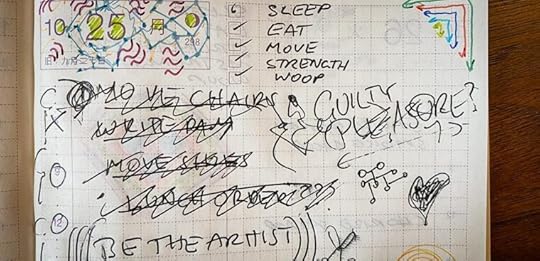
Apple Notes, Bear, Obsidian and Tot. Four different note-taking apps. And I use them all. At least once a week. Sometimes every day.
I could use just one app. That works for a lot of people. And it’s the advice that most productivity gurus and grifters seem to offer. One app for everything.
But it’s that guru-and-grifter advice that got me wondering. For a while, Notion was the app that could do everything. Then it was Obsidian. That’s great for people who sell courses on the promise that one app will change your life.
But if you are trying to do things, and not just sell advice to others on how to do things, you might find yourself asking questions.
The questions I had were about the nature of notes. Their modality, if you will. At its essence, a note is a piece of information we write down. Even if we focus on electronic notes, some notes contain information we want to keep forever. While the usefulness of other notes expires within minutes. Some notes evolve over time. While other notes never change.
Notes and Note ModesAs I thought about this, making notes about notes, I came to see that, for me, notes have four modes.
1. Notes as a constellation of thoughts
2. Notes as a collection of information
3. Notes as a guide to completing a major project
4. Notes as a store of ephemeral details
And for each of these modes, I use a specific app.
1. Obsidian for thoughts
2. Apple Notes for information
3. Bear for guiding a major project
4. Tot for temporary details
Obsidian is for thinking. It’s a storehouse of ideas and concepts. Highlights from articles and books. Insights from life. Reflections on work and projects. Snippets from things I’ve written. Questions I want to explore. Because of Obsidian’s graph and linking tools, it helps me make connections between ideas.
The notes in Obsidian keep evolving. Often, revisiting a note is an opportunity to rewrite it. Expand upon it. To link it to other notes. Or create new notes about related ideas. Obsidian’s graph shows me the notes as a constellation of ideas. But I also like to think of them as a garden. Ideas are planted, fed and watered, and pruned so they can grow together.
Apple Notes is more like a filing cabinet or a compactus. It’s a place to store specific information. The way I use Apple Notes reflects David Allen’s notion that our brains are for “having ideas, not holding them”. These notes contain everything from settings on domestic appliances to my favourite seats in various cinemas from Tokyo to Melbourne.
These notes don’t really change once they are written. There’s no editing or revision here. It’s just recall. Search and find. Use and move on.
Tot is the digital equivalent of Post-it notes or scribbles on a notepad. I use Tot for small notes during the day. Like shopping lists or temporary passwords. It’s a place to hold dates and details while planning travel. Or maybe to write the first draft of an email or other communication that will be sent later that day.
Bear used to be my main note-taking app. But the other apps are better for the uses I’ve mentioned above. However, there is one specific use for which Bear still shines.
Right now, I’m trying to move my site off WordPress. I want to end up with a site that is lighter, safer and not bogged down in outdated ideas about how websites should work. To do this, I’m having to do a lot of learning, choosing which bits of information I want to incorporate into my new site and storing chunks of code along the way (something Bear does very well).
These are project-specific notes. And it is a big, gnarly, slow-moving project.
At some point, some of these notes will end up in Apple Notes as things I need to remember about the new site. A few might end up in Obsidian as ideas about how websites should be designed and built. But a lot of the notes will cease to be worth keeping because they’ll just be part of the architecture of the new site. Choices that found their final form in the site’s design and implementation.
Deeper into Note ModesWe could put these modalities of notes on a graph. One axis showing how long the note needs to be kept. The other showing how likely the note is to change.
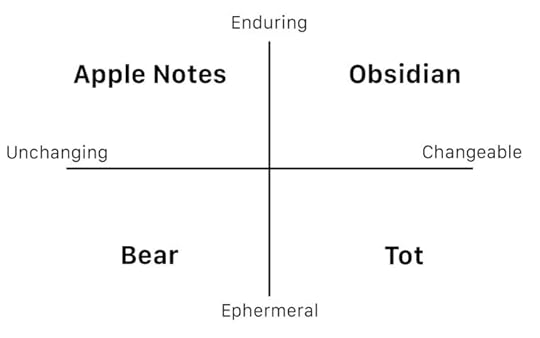
This allows us to see the modalities for each note-taking app.
1. Obsidian: enduring and changeable
2. Apple Notes: enduring and unchanging
3. Bear: ephemeral and unchanging
4. Tot: ephemeral and changeable
This works for me because I’ve also made two upfront decisions – meta-strategies, if you like. First, I’m not interested in an everything app. Second, I’m not looking for an eternal and all-encompassing archive.
The Allure of the Everything AppIt’s not just the grifters with their promise of one app to solve all your problems who put me off a single solution for all kinds of notes. There’s also the challenge of making one app work for all four modalities.
Doing that requires designing a system and customising how the app works. It’s like another layer of work. Some people love that. I don’t. It’s not that I object to customising settings or designing workflows. But time can’t be stretched indefinitely.
For me, the cost of switching apps is low. Especially if the purpose of the app is well defined. That’s why thinking about the different kinds of notes and their modes matters. This helps avoid putting notes in the wrong place. And makes it clear which app to use for what purpose.
On Not Being a CollectorI’m not interested in cataloguing every thought I have. Or recording every experience. I don’t need to compress my whole life into a database. Or save every note I make forever.
I feel like the online productivity space is dominated by the idea that adult life should be an extension of university and high school. Challenges should be repackaged into lessons. Everything is explained. And notes are like an insurance policy against being examined, which will always take the form of regurgitating prepackaged bits of information.
I don’t find that idea appealing. It also doesn’t feel like an accurate picture of what it means to be an adult.
Life has a lot more mystery and ambiguity. And many moments of incompleteness. We learn things we never use. And we sometimes improvise answers on the spot.
I think about this in relation to what it means to be or not to be a collector. I have a lot of music gear, for example, but I’m not a collector. I have a few 9 Series Ibanez guitar effect pedals. But I have no desire to own the whole series. I have the ones that help me make music.
Someone can be a collector of music gear and not even be able to make music. Or maybe they made music once, but no more. There are offices and lounge rooms all over the world with guitars as adornments. Cupboards full of music gear that hasn’t made music in years.
My assortment of music gear is incomplete, imperfect – maybe even wrong in the eyes of some. I don’t know every setting on every device. And it doesn’t really matter. The tools work for me in the way I need them to.
My notes are the same.
The post Notes And The Four Note Modes appeared first on Fernando Gros.
March 13, 2026
Verification Was The Answer
The Financial Times called it a while ago: social media is dead. Some countries are going so far as to ban kids from social media. Opinion writers are suggesting we should all follow suit. Academics are even claiming social media is irredeemably bad for our well-being.
I don’t agree. Okay, I do agree that social media is dead. Kids should have very limited access. And all adults should rethink how they use it.
But I don’t buy the argument that it never had the potential to be a force for good. Because it did. We all saw it – at least those of us who were there early enough.
And who turned up authentically as ourselves.
Twitter was good for years, until it turned bad. And it largely turned bad through neglect and direct attempts to undermine discourse. Instagram was good until Facebook bought it. Other platforms now largely forgotten – like SoundCloud – were also good for a moment, until they lost their compass.
What being “good” meant in all these instances was people connecting with people to create communities. Twitter, Instagram and SoundCloud all bred local meet-ups, where users interacted face to face. Friendships were made. Collaborations were launched. Movements were born. Culture was created.
It wasn’t just an “online thing”. Social media was primarily social. It was a people thing. Social media was a tool for meeting interesting people.
As platforms grew, the issue of figuring out who was being authentic – who was real and being real – became more urgent. Hostility increased. As did misinformation. There was a coordinated effort to undermine the potential of social media as a force for good. It wasn’t just trolls. It was political as well. We didn’t know it then, but we can see it now.
That’s why verification was so important.
Verification started as a way to solve the problem of impersonation. But how something starts is often different from what it becomes. And Twitter was always an example of something where innovations emerged through use rather than design. Retweets and hashtags were all user innovations, not platform designs.
Verification became a way to know who was real.
Verification didn’t confer authority. It recognised activity. The fuel for online discourse comes from the people who share ideas and generate conversations. We talk about influencers and content creators. But they are the most superficial level of social media. Academics, artists, designers, photographers, musicians, scientists, sportspeople – along with journalists and writers – made online spaces fertile and fascinating.
Twitter should have verified far more people. In reality, anyone who posts online as themselves should be verified. Bloggers, photographers, musicians… verify them all. If you post original stuff online as yourself, and you have a public profile that is your actual identity, you should be verified.
Under part-time CEO Jack Dorsey, verification became one of many problems labelled “too hard.” Every aspect of keeping Twitter’s ecosystem healthy was treated the same way for years.
While Instagram verified celebrities, Twitter verified experts. This access to deep knowledge and extensive experience was the thing that made the golden age of social media so special.
Right now, our public discourse is infected with misinformation and could collapse under the weight of a never-ending landslide of AI slop. To overcome this, we need hierarchies of knowledge. The voices of people who know what they are talking about.
Not all opinions are equal.
We also need sincere, earnest and generative conversations. Or at least the chance to have those free from trolls, sea lions and bad-faith actors.
Social media with widespread verification – the kind that Twitter chickened out of introducing – would be fundamentally different. Because real people with real identities and real social accountability behave differently.
Or at least that was my hope for years. Now I don’t know anymore. Maybe it is all broken. No one is going to build the better-for-society version of social media because the harmful-for-society version is so much more profitable.
What I do know is that navigating towards people is the right course. As is seeking out knowledge, expertise and wisdom. Social media isn’t a fact of life. It’s not air or water. It’s a tool. And you can always decide whether a tool works for you. Or not. And, if necessary, replace that tool with something else.
The post Verification Was The Answer appeared first on Fernando Gros.
January 31, 2026
This Week I Quit Dreaming About Internet Radio
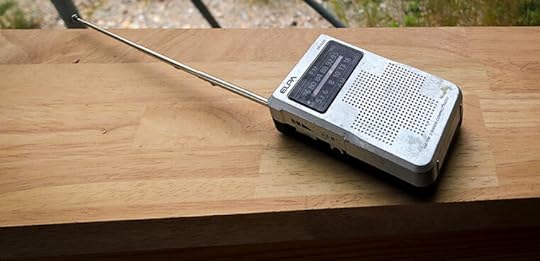
For more than twenty years, since I left London for the first time back in 2003, I’ve had “start an internet radio station” on my to-do list. The shape of that to-do list – paper or digital, app or freeform – has changed many times since then. But that item has remained, carried over from year to year. An internet radio station. Focused on jazz music. Broadcasting around the world.
Nothing else has stayed on my mind for so long and progressed so little.
This isn’t because the technical problem is too hard to solve. Several services make it easy to host music, automate playlists and announcements, and connect a music player and feed to your URL.
The problem is licensing.
The Invisible HandEvery time you play a piece of music, you need to pay the songwriter (or composer) and publisher a fee. This is called a performance royalty. These royalties are collected by agencies that work on behalf of songwriters, composers, and publishers.
And these royalties are collected in the country where the music is listened to, not where it is broadcast from.
In traditional radio, this meant the radio station had a relationship with the royalty collection agency (or agencies) in that country. But if you are an internet radio station, then – if you want to be legal and fair – you need a relationship for every country in which you have listeners.
There is no global licence.
Live365 is a company that delivers technology to make running an online radio station easy. And they also offer a single fee that allows you to work in Canada, Mexico, the UK, and the US. But if you have listeners in Japan, or Australia, you need to pay for those licences and set them up for yourself.
Every time I think about starting an online radio station, I look at the map of this blog’s readers. I see Denmark, France and Germany, Hong Kong, New Zealand, and Singapore, along with lots of other countries, and I wonder about potential listeners in those places.
And all those licences.
At this point, I can imagine someone saying, “Don’t worry about it.” Perhaps. It might be that a lot of small internet radio stations simply do that. Or they just license for their own country and kind of ignore the rest. I’m not sure.
To me it feels like far too big a grey hole.
Where The Real Work HidesThere is a challenge that can appear in any kind of creative project. The challenge of balancing the time spent doing the thing and the time spent building and maintaining the infrastructure that makes the thing possible. Writers often spend a huge amount of their time pitching and selling and generally explaining their work. They don’t just write. Photographers often spend only a small portion of their time with a camera in hand, making photographs.
For something that’s a side project, done for fun rather than profit, this question becomes even more acute. The radio station idea was always, for me, a hedonic adventure. Something I wanted to do because it felt good.
And everything involved in navigating the cloud of licensing doesn’t feel good.
The Emotional Clout of QuittingSo I find myself asking: what were the desires lurking behind this dream of starting an internet radio station? What feelings did I want to feel?
I’ve written a lot about quitting things. What I’ve learnt is that quitting always leaves a hole. A hole in the sense of the thing we’ve quit. But also a hole in terms of the person we were trying to become through doing that thing.
When I quit my PhD there was a hole in terms of the time and effort consumed in that work. But also a hole with regard to the status and recognition I was hoping to achieve through that process. Even with something far less meaningful, like quitting a digital app, there’s the energy that was taken up by the thing and the dream of personal transformation – being more organised or more popular, for example – that went along with it.
With the internet radio there was certainly a desire for validation. A way to display my taste and musical knowledge. But also an excuse to give time to the part of me that loves to learn and discover new things. Permission to dive into jazz magazines and new release lists. To research the back catalogues of labels like Blue Note and ECM.
There was also a desire for fun. Making technology work for us can be entertaining. Listening to good music is one of my favourite activities. Even making lists can be a fun pastime for me.
The story doesn’t really end with quitting. Giving up on a dream isn’t the final word. There’s a further journey where we find the ways to express those desires we have and feel those feelings we crave.
The internet radio station won’t happen. But music is still central to who I am. I can make playlists. I can make time to find new music. I can read about the global jazz scene. And I can talk with friends and people I meet about how wonderful music is and the tremendous joy it can bring to our lives.
The post This Week I Quit Dreaming About Internet Radio appeared first on Fernando Gros.
January 21, 2026
A Moratorium On Months
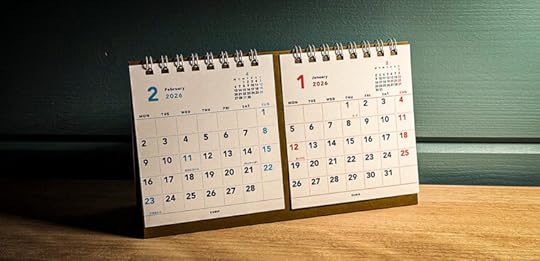
Months confuse me. For starters, they aren’t all the same length. And they don’t start on the same day of the week. They come at us in chaotically unpredictable ways. Commit to doing something once a month and you’re locked into a pattern that changes every few weeks.
One of my favourite regular commitments is a memoir writers’ group. At first, we agreed to meet once a month. But I found the cadence hard to connect with. If you meet monthly, but choose the same day every month (in this case Monday morning for me), it creates an irregular rhythm. Sometimes, because I was across the International Date Line, I wound up having two meetings in the same month. It was introducing stress into what should be a liberating creative experience.
So I investigated the idea of monthly meetings. They weren’t popular. Okay, the people I know are mostly productivity geeks and creative souls. So it might be a self-selecting cohort. But I heard a steady stream of reasons to avoid monthly meetings. If something is pressing, then once a month isn’t enough. Twice a quarter can be just as good as monthly. Or ten times a year, spread out to avoid holiday seasons.
Monthly is just kind of a default. We inherited an odd calendar and got used to adapting to it. The cycles of the moon make sense to me. The Gregorian months, not so much.
So what if we just did away with months?
My big productivity gambit for 2026 is to pretend, as much as I can, that months don’t exist. I’m not committing to anything that relies on a monthly cadence. I’m counting days, weeks, and quarters or seasons. But not months.
Days make sense. The older I get the more I find myself wanting my days to be more or less the same as each other. The things I really want to do with my life – writing, making art and music, staying healthy, and supporting my family – are most likely to happen if I schedule them every day. The simple binary of workday and non-workday allows for the other important things that need a repeating rhythm, like rest, gardening, seeing films, visiting museums and galleries, or staying connected with friends.
Weeks also work. Okay, I don’t like the odd seven-day thing. I dream of weeks being different. I feel like 5 days of work and 3 days of rest suits me better than 5+2 or 4+3. But on some level we have to try and fit into society. The French tried to adopt a metric ten-day week after the Revolution. Let’s just say it didn’t end well.
And the on-off binary works with weeks as well. Working week. Holiday week. The holiday weeks allow for things that matter to me too. Travel, skiing, and the kind of rest you can’t get when your mind is drifting towards the work you need to do tomorrow.
How often those holiday weeks come in is shaped by the quarters or seasons. I’m using quarters to explain the idea of dividing the year into four. And a lot of people think in quarters because of work. But my mind drifts towards seasons. Nature sets a pattern for me. Summer and winter invite reflection and self-evaluation. Spring and autumn tend towards focused work and getting things done. I take them in interchangeable pairs so I can stay in the same mindset as I travel from the southern to the northern hemisphere.
How many weeks of holiday to take is a big topic. Too big to discuss here. But I believe every quarter needs its holiday. Every season needs its fallow week. When I recall the worst experiences of exhaustion and burnout, the phrase “more than three months without a rest” is lurking somewhere in the story. It was certainly the case for me in 2025.
Sometimes we forget that a lot of the systems we use to count and quantify the passing of time are just made up. Lately I’ve become curious about Christian liturgical calendars. Mid-morning and mid-afternoon feel like fruitful ideas to explore. Mid-morning is the transition from writing to the rest of my work. Mid-afternoon is the time to think about what needs to be finished and done by the end of the day.
The moment we start to feel the way our lives unfold through time, all sorts of possibilities open up for tuning our schedules specifically to our needs.
For 2026, I’m looking at week 20 or 24 instead of sometime in May or June. I’m trying to feel, in a more granular way, how tight or accommodating my schedule feels.
For the writers’ group I suggested we try a five-week cadence. That was close to monthly. But consistent. And since some of us were always feeling a little rushed to have our words ready, it let the rhythm breathe a little more. So far it’s working well.
The post A Moratorium On Months appeared first on Fernando Gros.
January 10, 2026
The Effort Is The Point
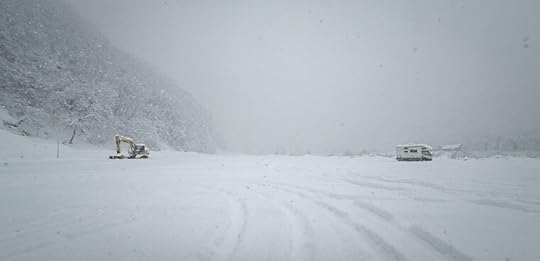
The philosopher Martin Heidegger would often retreat to a small, three-roomed ski hut in the Black Forest, at an elevation of 1150 m, to do his work. In his essay Why Do I Stay in the Provinces?, Heidegger paints a vivid picture of what it was like to work in that remote location.
“On a deep winter’s night when a wild, pounding snowstorm rages around the cabin and veils and covers everything, that is the perfect time for philosophy. Then its questions must become simple and essential. Working through each thought can only be tough and rigorous. The struggle to mold something into language is like the
resistance of the towering firs against the storm.”
Heidegger’s example feels like the opposite of the kind of working life promised by the AI evangelists. Heidegger is working through each thought in a tough and rigorous way. AI boosters suggest we should outsource the struggle to an AI that will think on our behalf.
We could extend that further and imagine an AI content strategy for a modern philosopher. Rent a cabin in Aspen and surround yourself with all the smart and beautiful people. Spend the day in a spa with mountain views while the gentle pummelling of your masseuse helps you unlock a list of prompts you can feed to the AI as it writes your next bestseller.
By contrast, Heidegger’s cabin might have sounded romantic, but it was rather rustic. He wasn’t surrounded by his peers or society’s elite. His neighbours were farmers and folk who had lived their lives in the mountains.
For Heidegger, this was the point. He contrasts being known and remembered by the mountain folk with the ephemeral nature of popularity in the city, where your status and press coverage rise and fall with your latest efforts and changing fashions. He talks about an elderly neighbour who would traipse through heavy snow just to check if he was okay. And who remembered him even on her deathbed.
And rather than nature giving him the inspiration to work, he saw work as giving him the framework to understand nature. Working in solitude gives Heidegger the sense that his own being can open up to and merge with what he calls “the presence of all things.”
AI is sold to us as a way to remove the effort involved in everything from making art to writing emails for work. This flattening of human existence is in itself revealing. Work emails are often a mundane chore. Creating art or literature or music is the greatest expression of our humanity. But what if these things – writing emails and making art – are not the same? And what if, in these and other fields of human endeavour, the effort is the point?
This isn’t to suggest that exploitative jobs and harsh labour doesn’t exist. But there is a difference between alleviating harm and eliminating effort altogether. We should use technology to make work safe and humane.
But, it takes a particular kind of cynical moral calculus to believe the least effortful way of working will always produce the best results. I’m not about to give up my washing machine or power tools. But we are suspicious of cutting corners for good reason. We know that sometimes the slower or more laborious way of cooking a dish will yield the tastiest results. And we would rather receive a handwritten card from a loved one than an AI-generated text message.
Consider music. Plenty of AI companies are offering to “democratise music” by making it possible for anyone to create songs in seconds. While I like the idea of more people making music as a hobby, this endeavour feels so misguided.
Making music is hard because it requires you to rewire your brain and change your body. In a sense, we can all sing and tap rhythms. But learning music is like learning a language. The vocabulary of jazz or classical music is just as complex as the grammar of Japanese. And neuroscientists can use brain scans to predict the instrument a musician plays from the way the folds of the brain have evolved in response to the physical requirements of the instrument.
The effort changes the artist.
Even in the case of mundane chores, effort is not useless. Consider chopping onions. A burdensome task for sure. But do it enough times and you become attuned to the way that simple act is telling you something about the ingredient you are going to use. How hard or soft, sweet or not, are the onions you’re about to use? How will you have to adapt the recipe as you cook?
Even with those dreaded work emails the effort is not in vain. Any act of writing is an exercise in organising our thoughts. Finding the right words invites us to clarify our commitments and responsibilities. I often find that when email becomes hard or overwhelming, it’s because there is something out of whack in my relationships with the people or organisations I am communicating with, or in the work I’m doing. I can’t outsource solving that existential dilemma.
In these examples, and every other one I could think of, the effort shapes us and our relationship to reality. It’s not always as dramatic as Heidegger in a wintry, Black Forest cabin, but it’s akin in spirit.
A musician practising scales is not engaged in drudgery. They are shaping themselves through something that approximates a spiritual practice. The office worker communicating with colleagues is crafting a shared landscape of action and meaning and thought.
And as we apply effort, we also apply ourselves. The effortful moments are exactly the times we bring our unique perspective and insight and experience to what we do. Rather than the effort of work dehumanising us, we humanise the work through our effort.
The post The Effort Is The Point appeared first on Fernando Gros.
January 4, 2026
Catharsis – Yearly Theme 2026
For a long time I couldn’t even imagine 2026. I was so stuck in the day-to-day routines and responsibilities of 2025. So I just kept making notes about what I hoped might make the coming year different.
A lot of those notes involved deleting things. Unfulfilled dreams from my someday/maybe lists. Forgotten shows and films from various streaming watchlists. Even people who were lurking in my contacts lists long after they’d brought any joy into my life.
There was this urge to purge myself of everything that no longer had a place in my life. For a while I toyed with choosing exorcism as my yearly theme. It was perhaps too messy and religious a term. But there’s something in the idea of purification, and maybe even ritual as well, that felt right.
I’m longing to feel unburdened, open, and creative. But I know the coming year will bring burdens, restrictions, and interruptions to the creative flow.
You always know you’re onto a good yearly theme when you can feel the tension between your hopes and your expectations.
Like the cliché says, sometimes the only way through is through. There is no point in trying to avoid the uncomfortable feelings. You have to feel them. Anything else becomes a self-inflicted wound over time.
The more I paid close attention to my experiences in 2025, the more I noticed a pattern: pain and release. My body would manifest the stress I was feeling in all sorts of ways. I would seek an intervention – dental work, podiatry, acupuncture, physiotherapy, talk therapy – and find release.
In fact, there was a third part of the pattern. It was pain, release, and rejuvenation. I thought for a long time I was spiralling downwards. But towards the end of the year, I started to wonder if I was actually spiralling upwards instead. It felt like I was waking up from something. I remember saying to my therapist, “Is this what it feels like to be alive?”
It felt like some sort of catharsis.
For a year that was so fraught, 2025 drew to a close with so much calm and clarity. I felt loved and supported in a way I hadn’t in years. I knew 2026 could turn out to be hard work again. But I was ready for it.
To do that, I wanted to better understand the idea of catharsis.
The word “catharsis” comes to us from the Greek words we translate as “cleanse” and “pure”. We typically describe the release of strong emotions as cathartic. Especially when it’s something we’ve held in for a while. Something that needs to come out.
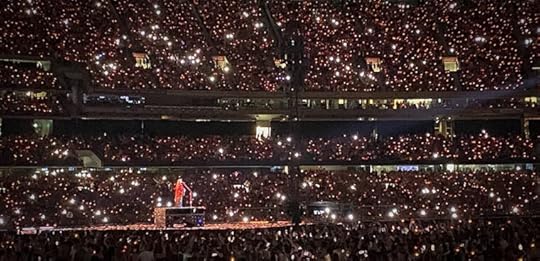
When I think of the word catharsis, I imagine myself lost amongst 96,000 fans at Taylor Swift’s Melbourne Eras Tour concert, deep in the moment, free and unashamed, singing the songs that are the soundtrack of our lives. In those kinds of moments we are fully alive. There are no walls between the parts of our lives. This is something special, spiritual, and sacred.
Seeking more catharsis runs parallel for me with craving more humanity. I feel like the way AI has been sold to us is dark, dystopian, and unrelentingly undemocratic. Humanity’s artistic output has been pillaged to “train” tools that largely don’t work and very often cause real harm. It is cultural vandalism. Human creativity has been held in contempt. And we’re expected to pay for the privilege.
Am I being dramatic? Perhaps. But my goodness, it feels good to say it.
Catharsis is always dramatic, and that is why I wondered if it was wise to choose this word as my theme for the coming year. Drama is bad, isn’t it? We should try to avoid drama. We should live undramatic lives. That seems to be the common wisdom.
Except I’ve never been a fan of common wisdom.
Drama can be a red flag. Sure. Toxic people create unnecessary drama around them. Sure. Especially narcissistic people. They use drama to coerce and destabilise, to assert dominance, or coax sympathy. Their drama is a form of manipulation. It’s a way to get other people to do things they don’t want to do. It traps people in cycles of destructive behaviour.
I’m talking about a drama we choose for ourselves. Think of it as a stage you want to walk onto. A stage you’d like to decorate. A costume you’d want to wear.
Taking your loved one to a special meal is a drama. Staging and costumes matter. You want to let the emotions out. To say and feel everything that needs to be said and felt.
Or think about that Taylor Swift concert. All those smiles. All those tears. Loving couples. Parents with their kids. Groups of friends. People attending alone because they feel safer in a crowd of like-minded strangers than anywhere else in the rest of their lives. That’s drama. The good kind of drama. The kind that brings catharsis.
Making space for catharsis is about making space for emotion. It’s no coincidence that experiences of catharsis are often associated with music and art, time in nature, religion, and acts of great service. The mix of awe and vulnerability attunes us to the wonders of the universe and fragility of our existence.
Every stage in our lives can be a space for good drama. For deepening our relationships, exploring our emotions, expressing our hopes and dreams. Maybe it’s time we stopped making our lounge rooms look as cold and clinical as a car showroom? All white walls and harsh downlights. If you want people to look beautiful you don’t put them in a doctor’s waiting room. You invite them to a flowering garden bathed in warm late afternoon light. We should decorate accordingly.
My 2025 started to turn around when I changed the staging for my nights. I bought a gazillion candles and put them around my little lounge room. No more downlights. I bought a nice warm reading lamp and set it next to a comfortable chair. I started showering early and sitting down to read in a dark robe on those cold nights. I might look like some cliché vampire in the candlelight. And I don’t care. I love it.
Increasingly, that stage brought its own small dramas. When we make room for art in our lives, reading, listening to music, watching dance, or looking at sculptures and paintings, we start to notice things. Not just in the art. But also in ourselves. Noticing awakens our senses. It turns us on. Brings us to life. Drama.
That nonsensical “common sense” about living a life without drama might be about avoiding toxicity. But I’m inclined to believe it’s got more to do with not taking up space, speaking up for yourself, orienting your life around what makes you unique. We tell children they are special, then construct a society that spends the rest of their lives telling them they aren’t special and they just have to fit into ever smaller boxes. It’s ridiculous and it has to stop.
I’m here for the drama. The good drama. Turn on the lights and decorate the stage, I say. Turn up the music and feel the emotions. Show your love, passion, and enthusiasm. Let it out. Damn the stoics, the techbros, and the podcast grifters. Give me K-pop, Swifties, and everyone who reminds us that life can be beautiful, fun, and liberatingly cathartic.
Looking Back On Previous ThemesMy yearly theme for 2025 was Golden. The coming year felt like it would be challenging, and it turned out to be even harder than expected, but there were golden moments, positive memories to cling to despite the hardship. I was hoping to live a more harmonious life by finding the right patterns and cadences for things I did in life. The yearly theme reminded me to keep looking for them.
You can learn more about choosing your own yearly theme or read below for the themes I’ve used since 2108.
2025 – Golden
2024 – Frequency
2023 – Savour
2022 – Tensegrity
2021 – Imagination
2020 – Momentum
2019 – Conviction
2018 – Simple
The post Catharsis – Yearly Theme 2026 appeared first on Fernando Gros.
December 7, 2025
What Was That 2025?
This year broke me. In so many ways. I was lost in a cloud. Bumping up against unknown obstacles. All I could see was my next step. And I so lived, day to day, for months. I’m ending 2025 feeling a mix of calm and courage. But it took a lot to get here. And it will take even longer to understand how this year has changed me.
The broad brushstrokes are that I moved from Melbourne to Adelaide in April. After my mother died in September 2022, I commuted regularly between the two cities. I would spend at least a full week of each month in Adelaide. And often more. There were several times during the ski season when I would fly back from Japan, spend a night or two in Melbourne unpacking and washing clothes, then hop on a flight to Adelaide, returning to Melbourne for a night to pack before the next trip to Japan.
In 2025, my wife’s work responsibilities changed, and she needed to spend more time in the northern hemisphere. Melbourne isn’t the right location for that kind of role. Normally, I would follow her and add another city to the list of places I’ve lived. But as so many of us have said this year, these are not normal times.
For reasons I don’t want to go into right now, my parents never signed up for the government services that are available for elderly people. They were “fiercely independent.” A quality I’ve never admired. But one I’ve tried to respect.
What that meant after my mother passed was that on those visits to Adelaide I would cook meals, usually twice a day, and clean the kitchen, vacuum the floors, clean the bathrooms and toilets, garden, and supervise visits from tradespeople who came to clean gutters and do other home maintenance and repairs. I didn’t feel like I could move halfway across the world, given the situation.
For more than a decade and a half before the pandemic I would regularly visit Adelaide on holiday. So I had a little place, a small cottage, which was neat and clean and a nice place to sleep. It worked well as a space for family holidays. For 7 to 12 weeks a year I would stay there. Visiting my parents every day.
But as a place to live it is small. And when I moved my things over from Melbourne, it felt even smaller. It would be months before I made any progress on unpacking. And I still have boxes to deal with.
In April, my father was unwell. And he got worse. He had a nasty infection. Maybe he’d been unwell for some time. I’m not a professional. In May, he started getting treatment at home. For two weeks it was nurses’ visits three times a day. Then twice a day for a few weeks. Then gradually down to three times a week. Thankfully, he was mobile and able to sleep. I was doing around 13 hours a day of care for him. Helping him with all his meals. And handling all the admin and calls that go with that kind of care.
The admin and calls that go with caring for an elderly parent are really their own kind of line item in this story. And I know people who have way more dramatic responsibilities than I do. But it is worth saying that the work that goes with making sure the care services are in place takes a lot of time. The people who work in these services are lovely professionals. But what we have in Australia is less like government services and more like a government-supervised service marketplace. Just understanding how it works and finding out which companies can provide which services is its own kind of challenge.
My father started recovering, although these kinds of things are never a linear progression. Thankfully, my father did see that outside help was a good idea. He agreed to sign up for government aged care services. But it would be a long wait before that led to any major changes. Still, by mid-June, I was able to get a break for two weeks and a chance to travel to Japan. I returned to more than four months of daily care responsibilities with no break. Two meals a day. Doing chores and errands. Five to six hours a day.
Inside of every day, things were okay and getting better. My father and I were frequently having good conversations. The kind you want to have with a parent as they get older. His mindset was improving – something that had concerned me earlier in the year and always worries kids as they see their parents age.
But I was increasingly weighed down by the thought that this was going to be my reality for the next few years with no break. I was heartbroken by the idea of missing Christmas with my wife and daughter. Christmas is my favourite season of the year. I love the short days, the winter lights, the music, and the decorations. And New Year’s is my second favourite. Apart from the pandemic interruption, we’d celebrated every New Year since 2013 in the Japanese Alps.
And I also felt stuck because normally I would plan the coming year. Part of being an adult is that you are busy and have a lot of commitments. And so does everyone around you. My wife has her career, and now my daughter does too. They have commitments through to 2027. That’s true for my friends as well. If I can’t plan, then I risk having to react at the last minute to everything. To being perpetually tired and stressed out. And to being the kind of person who is always asking people to accommodate them and make exceptions for them.
And I risk also being a bad husband and a bad parent. The whole snow, ski, winter-in-the-mountains thing is fun. But it works for us because I agree to shoulder lots of responsibilities. And if I don’t turn up, to clear some snow, cook some meals, be on call in case the heating or lights stop working, then I’m making the lives of the people I most love even harder.
Through August and September this distress started to sink me. I went more than seven weeks without a good night’s sleep. My heart rate variability hadn’t been great all year, and it bottomed right out. I was increasingly tired. Perpetually lonely. Making a lot of mistakes throughout the day. Not exercising. And worst of all, starting to blame others (and the algal bloom) for my plight.
When I woke up in the middle of the night with blood streaming out of my mouth, I knew I was in trouble.
I’ve always tended to grind my teeth when stressed out. But now that was amplified by having overlooked getting my teeth professionally cleaned. Sitting in the dentist’s chair, I had an epiphany. Or maybe I was just desperate to divert my attention away from the dental hygienist’s grinding and scraping inside my mouth.
I needed more people cheering me on.
There are times in life when you really notice who steps up and who doesn’t. I’ve had two years in the past where life really went off the rails. The last time, in 2004, soon after I moved to India, I deleted everyone from my contacts list. I remember feeling like people would need to earn their place back in my life after I quit my PhD, got sick, and sat there in Delhi, wondering why people were not replying to my emails and messages and attempts to call, and pleading requests that they consider coming to visit since I had so much room for guests.
This year was less dramatic. Even when I felt like I had no time, I still made time for my wife and daughter. They brought light into my days. My friends stepped up, checked in, listened, and shared their love. But some people in the extended circle, so to speak, went silent. And it was noticeable how little effort they put in if I wasn’t doing the work of keeping the connection open.
In that dentist chair I hatched a plan. I looked at my health plan and checked the services I had available. I was already seeing a therapist, but I didn’t have a GP referral. I got one, which cut the cost dramatically for six sessions, then used that to double how often I could see the therapist. Physiotherapy? Yes, I feel stiff and have strange pains. I’ll get some of that. Podiatry. Okay. My right foot has always been weird, and now it feels weirder than ever. Acupuncture? Sure, let’s try. Unexpectedly, this had the biggest effect of all.
I’d done an intervention on myself.
Instead of wondering if the universe had forgotten me, I was starting to feel like the universe was smiling again. A cynic might say that money and health insurance was really doing the talking. Perhaps. But I prefer to move through life trying to surround myself with people who are trying to help. Who through their actions are saying “you’ve made a good choice trusting me, and I’m going to repay you by making your life a bit better.”
Towards the end of the year, the elderly health care marketplace also started to speak up. In late October, my father started to get meals delivered, which took a huge and daily burden off my shoulders. Other services started to fall into place, giving me a glimmer of hope that I might be able to plan the coming year and not feel trapped.
And for the first time in ages I was sleeping through the night again.
Amazingly, throughout 2025 I still managed to write. My mornings became a haven of productivity. Although I couldn’t remember from one day to the next what I worked on. But I did fully restructure the memoir, adding several fresh chapters. I sent queries to agents and pitched in person to commissioning editors. I sent 9 new essays out on submission. 85 submissions in total. I have 57 unfinished essays right now. Some of those will never go anywhere. But at least a dozen will be ready in the first quarter of 2026, either for publication here or to be sent to a journal somewhere. I also attended 10 writing workshops (36 individual sessions) this year and kept in close monthly contact with my memoir writing group, who proved to be a lighthouse that helped me avoid sailing to the rocks during the year’s many storms.
I’m calling an end to my 2025 here, December 7th, the second Sunday of Advent. I still have some words to write, some chores to do, some visits with my “team” to enjoy. But I’m done with whatever this year was.
My theme for 2025 was “Golden.” In a way it was a special year. The time with my father has been special. We’ve had priceless conversations. I know far more about him and his life now. And there is more honesty and emotional vulnerability between us than ever before. The time with my wife and daughter has been special, and we’ve churned lifelong memories together this year. All my close friendships feel closer and more open. I have a circle of care around me. And people I can talk to about art and the emotional rawness required to create.
I don’t yet have a theme for 2026. But I have the contours for how I hope the year will feel. I will clear out a lot of my contacts list. Same for watch-lists and someday/maybe dreams. This is not the time to cling to the past. I’m already online way less than I used to be, and that trend feels permanent. I don’t want to be tired when I travel. I want to move through the world gracefully. Which means never doing things at the last minute. I want kind and emotionally open conversations. I want to be rid of unnecessary ambiguity so I have some capacity to respond when life does throw genuinely unexpected things my way.
And with that, I’m saying goodbye to 2025. We all have different gods and we worship in different ways. But the year draws to a close for all of us, and I hope that however you mark them you find peace and joy.
The post What Was That 2025? appeared first on Fernando Gros.
October 21, 2025
This Week I Quit Podcasting
I’m getting too old to have a long “someday/maybe” list. It’s not that I don’t have enough time left on earth to try new things. But there are pipe dreams I’ve carried with me from year to year for more than two decades, and I find myself no closer to bringing them to life this year than last.
I was reminded of this when the domain name renewal came up for Seventeentrees. Domain renewals are the tombstones of dead projects. They feel like the last thing we let go of when we finally give up on an idea. I’ve often bought domains as an act of faith. A space where a dream might grow. Then, years later, with a simple click on a screen, the dream dies.
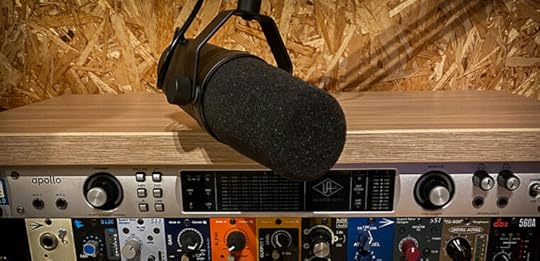
So this week I let go of the domain names I’d registered for a podcast that ran for a short time between 2018 and 2021.
Podcasting: My Part In Its DownfallWhen The Society for Film (2013 to 2016) podcast ended, I found myself wanting to start another one. My hope was to emulate the kind of podcast where a few creatives—artists, makers, musicians, writers—would discuss their craft and their work.
But I never found collaborators for that.
So I looked for posts from this blog that could work as solo podcast episodes. As I wrote previously, I was fascinated by
“…the idea of living well and in harmony with nature. The connections between ecology and spirituality run deep for me. Whether it’s visiting a Shinto shrine in Japan or a Shaker village in New England, I’m fascinated by the way people’s beliefs shape how they experience nature.”
Seventeentrees was a way to stay active in podcasting. Editing podcasts is fun but challenging work (I made a video about my workflow). The services available to distribute podcasts and gather analytics on them are ever-evolving. I wanted to be ready if an opportunity came along.
It didn’t.
When I wrote about quitting Seventeentrees in 2021, social audio looked like it might be the next big thing. For a hot minute during the pandemic, Clubhouse and Twitter Spaces had vibrant audiences. Then everyone went back to their lives.
Podcasting is in such a weird place right now. It’s never been more popular, but it feels synonymous with a kind of unhinged political discourse. And even the podcasts that aren’t partisan pap are so often long, rambling, largely unedited conversations—as if the hosts are relentlessly fishing for an improvised line of semi-coherent opinion that they can clip and share on social media.
Chasing AuthenticityThese unedited conversations might be the hallmark of authenticity as we understand it today. The spirit of the age. The reason why podcasts have evolved the way they have.
But I wonder if there’s something else at work. It’s easier to talk for an hour or two than to sit down and write. Rather than honing words in tiresome solitude, it’s easier to get your point across if you give yourself endless passes at getting it right. It’s easier to produce a podcast if you decide not to do much (or any) editing.
And it’s easier to have someone explain their work to you, to tell you what it means, than to struggle with it for yourself, making meaning through your own time, effort, and wrestling with the limits of your own knowledge.
Going Back To The BeginningA lot of people now think of a podcast as a rambling, casual interview. I’ve been a little guilty of making that generalisation myself in this essay. But that’s just a reflection of the way the technology—and the algorithms that shape what we listen to—has rewarded a certain kind of product and shaped expectations.
It’s a bit like how we were conditioned to believe a song should be a certain length because that’s what used to fit on one side of a seven-inch vinyl single.
Back when I started listening to podcasts, they were a new feature on iTunes. And the podcasts I found were all radio programmes formatted for digital distribution. They were golden voices recorded with good microphones and radio-standard production values.
I fell in love with podcasts because I’ve always been in love with sound. I love the human voice. And I love the technology that is used to record it. I always have.
Back Before We BeganIn high school, we had creative writing assignments. Ms Caldwell, my Grade 8 English teacher, encouraged us to explore other formats for our ideas. For the first big assignment, I hand-bound a little sci-fi novella. It fell apart, so I had to put it in a standard folder. Instead of regular feedback, Ms Caldwell gave the novella to four students who read it and gave me verbal feedback on what they liked and what they wanted to see developed.
For the second assignment, I handed in a cassette with a radio play.
I was a huge fan of the original BBC radio version of The Hitch-Hikers Guide to the Galaxy. And I’d almost memorised Jeff Wayne’s audio adaptation of The War of The Worlds after listening to the vinyl through headphones in my bedroom so many times.
So I wrote a script about punks and new wave gangs fighting on the streets of a post-nuclear-holocaust London. After many battles, a group of Rastafarian priests emerge and negotiate peace. Then everyone sings along to the last remaining copy of Stevie Wonder’s Master Blaster.
The whole thing was recorded in one day. A friend came over to help me with character voices. I unplugged my dad’s prized hi-fi (without his consent) and hooked up a bunch of cassette decks, microphones and turntables—and somehow managed not to blow anything up. Everything was bounced and mixed on the fly. Dialogue was narrated while dropping the needle on background music. The final touch was spray-painting a cassette case cover. I even scratched an anarchy symbol into it with a rusty old knife.
Ms Caldwell said nothing and just smiled when I put the cassette on her desk. A few days later, she played the radio play for the class. I got an A. But the grade wasn’t really the point.
The Power of QuittingI write these little This Week I Quit essays because they’re useful markers of change. It’s not just the individual acts of quitting. It’s also that quitting seems to come in clusters during certain seasons of life.
And this feels like a season when I’m inclined to rebel against my circumstances. I feel a deep disquiet about the way the world is changing. I want to quit with intention. I’m wondering how many of the unfulfilled dreams I’ve dragged along with me over the past 20 years really have a place in my future. And I want to break out of the creative frustration I’ve felt since closing my studio and leaving Japan in 2019.
In a way, quitting is less about closing things down or giving up than it is about making room for new growth. When we quit well, we discover something about ourselves. And that self-discovery is like a map that helps us navigate the way forward.
The post This Week I Quit Podcasting appeared first on Fernando Gros.
October 14, 2025
The Case For Physical Media
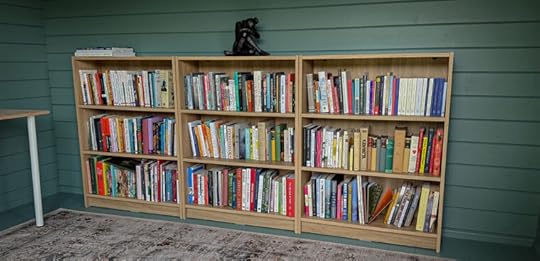
The architect wanted to show me a house he had built. It had some ideas similar to some he had suggested for the mountain lodge I was wanting him to design. I walked in ready to look at kitchen and bathroom features. But what captured my attention was the vast lounge room.
Every wall was filled with expansive floor-to-ceiling bookcases. They were stacked with old books. Mostly novels and poetry and history. And vinyl. Lots and lots of vinyl. “Yes, he collects,” the architect said. But this felt less like a personal collection than some kind of treasure trove. A mirror held up to 20th-century Japanese culture.
There were a couple of sofas, a few more reading chairs, some side and coffee tables, a floor lamp, and a big dining table. But those vast bookcases and the high raked ceiling made this feel like more than just a living room. This was a place in which to live, in the fullest sense of the word. In which to flourish. A space that rewarded reading and listening patiently.
I still buy books. Physical books. Maybe too many books. Over the years I’ve had people look at my bookcases and ask, “Have you read all those books?” That really isn’t the point. You buy books in order to always have something to read. Not as tokens of having already read.
I also buy vinyl. And occasionally CDs, when vinyl isn’t an option. Lately, I’ve started buying DVDs and Blu-rays again.
This isn’t some kind of anti-streaming stance. I like Apple Music and Apple Music Classical. There are aspects of streaming for TV and film that I enjoy. Convenience and portability are things I appreciate.
But I wonder how sustainable these digital services are.
Streaming is costly. And the prices for these streaming services rise in ways untethered from how our income increases. Will they even be affordable in the future? Will they still stream the things we want? How many different services will we need to sign up for? And how useable will they be?
My father had to “upgrade” his cable service box recently. For his age, he’s very good with technology. To watch him struggle with a poorly designed menu system was painful. And there doesn’t appear to be any way to make the interface easier to navigate. There are no accessibility settings. The whole thing is actively hostile to any user who has less than perfect vision or lacks sharp reflexes.
I imagine myself in my 80s or 90s. I like to think I’d still want to watch the best new films. But I probably wouldn’t care much if I saw them months after they came out. What’s the rush? I’d love to still be reading every day. But I’ll probably be on fewer flights, or waiting less often in distant places, and so I might not need a library in my pocket like digital devices promise to be.
I’m not quitting digital streaming services. At least not now. Maybe I never will. But I’ve decided not to go all in on them either. I’m relying on them less and less. And enjoying the freedom that comes with that. I like that I can read a book, listen to music, or watch a film without worrying about what my password is or whether my payment details are up to date.
I also love that some Silicon Valley company can’t take away my access to the physical media I have on my shelves. Or edit their content to suit current political trends in a country I don’t even live in.
The life of the mind is an expression of freedom I want to hold onto.
From time to time, I think about that house with the vast bookcases. Sometimes I drive past it when I’m back in the Japanese Alps. I like to reconnect with the sense of awe I felt the first time I saw that lounge room. It was a vision of an ideal way to live. Made real in physical form. As I get older, it’s an increasingly appealing vision.
The post The Case For Physical Media appeared first on Fernando Gros.