Rebecca Scritchfield's Blog
December 28, 2016
Manifest a Healthier, Happier, and Kinder 2017
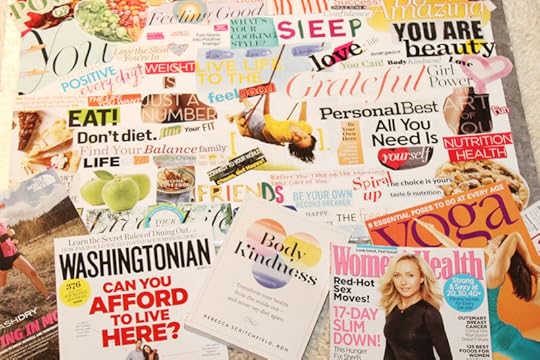
A visual representation of body kindness.
Create a body kindness vision board.
Here’s a perfect idea for an end of year reflection and goal setting. My first vision board was over a decade ago and it was useful in helping me focus, get and stay motivated, and remind myself about what really mattered to me (becoming an author was on there!)
Vision boards are wonderful at letting us dream about something we might not think is even possible and turn it into our reality (ditch dieting, overcome inner critic voice, become flexible with food, trust your body, be kind and gentle toward yourself, say no more, sleep more, spend time on a hobby. Etc!!!!)
Hopefully you can make time for vision boarding before or early on in 2017. It’s a great way to kick off New Years Resolutions into practical cultivation of your future.
My 3 step body kindness vision board.
Spend 10 minutes (set a timer) coming up with as many ways you can complete this sentence “I want to be the kind of person who ________ (action). This is body kindness so your “blank” needs to at least be about being good to your body.
Spend 30 minutes flipping through any magazines and cut out what speaks to you. Do not overthink it. (You could stop here and pick it back up another day for time, or continue on.)
Spend 20 minutes placing what you found plus adding your own words from construction paper, favorite quotes, cards, or anywhere else (print things from online).
When you do this, expect fears to arise along with some excitement. Just keep cutting pasting and dreaming your way toward what you want. I found you can use the modern magazines but you’ll probably cut out a bunch of “don’t” (for don’t diet) and “no” (for no body bashing).
Here’s a social media shareable.
I’m creating a #BodyKindness vision board. Who wants to #spiralup with me?
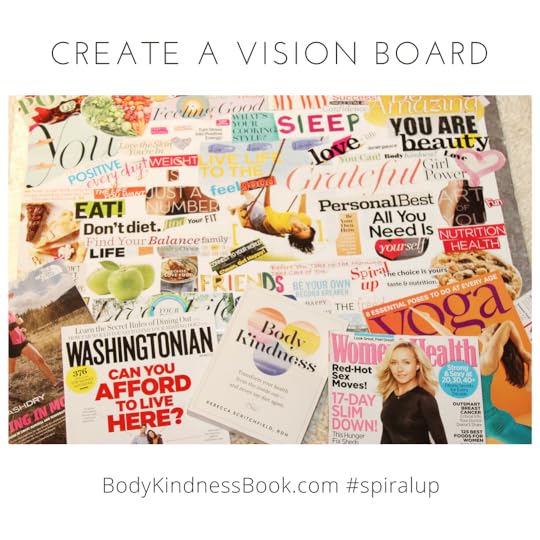
If you do a body kindness vision board tag me in a pic. I’d love to see it.
Want more help?
Sign up for my free Body Kindness digital training and get my best tools to start spiraling up your mood and health, including a daily tracker for food, fitness, sleep, mood and more.
The post Manifest a Healthier, Happier, and Kinder 2017 appeared first on Body Kindness.


December 27, 2016
Podcast 15: It’s My #BookBirthday, Let’s Celebrate Body Kindness!
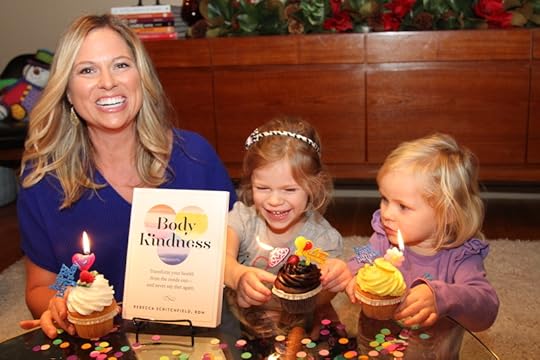
December 27, 2016 is a day I won’t soon forget. It’s the official “due date” of my “book baby” (yes, we all lovingly refer to “her” as a member of our family).
This book is my voice. It’s also my life experiences that shaped the Body Kindness philosophy and who I am today. Filled with tools and exercises I have been using in my counseling practice for years, this book will take you through the necessary steps to reject dieting, make peace with food and your body, and set new goals to create meaningful change in your life.
In this podcast episode, my good friend and Body Kindness accountability partner (and former chronic dieter / Biggest Loser “winner”) Bernie Salazar and I chat about how we reconnected at just the right time when Bernie needed a new approach to health. Dieting didn’t work, Biggest Loser didn’t work. Not doing anything didn’t work. (If you’re a new listener, check out all of season one episodes 1-14 to get a feel for how we got together and Bernie’s mindset and life started to shift.)
We’ll talk you through the ins and outs of how Body Kindness is designed to help you make better choices and become a more compassionate person. Plus you’ll learn how you can get a free book chapter, Body Kindness digital training, and my clients’ favorite habits tracker – the health and happiness journal and save 25% off the book in the resources and links below.
Resources mentioned:
www.bodykindessbook.com – sign up for a free digital training and get started on your Body Kindness journey.
Watch “why I gave up on dieting” video and why we need body kindness video.
Save 25% off list price 12/27-1/31 when you order Body Kindness from Workman with the special offer code: KIND
Subscribe to Body Kindness so you never miss an episode – we’re on iTunes, Soundcloud and Stitcher. Catch up on previous episodes here.
We’d be grateful if you’d rate us on iTunes – it only takes a few seconds and helps spread the Body Kindness message.
Listen to Episode 15
Time coded show notes:
[0:49] Rebecca and Bernie talks about Rebecca’s first book, Body Kindness
[4:35] Rebecca speaks about what people can expect to learn about Body Kindness. They can expect tools they can use to help them create values-driven goals.
[7:41] Bernie shares why Body Kindness works and how his relationship started with Rebecca. They lost touch along the way but reconnected to create the podcast. It came at a time when Bernie needed help with his health.
[15:20] Rebecca shares her struggles and how she had outdated knowledge before. She shares how she changed that as her knowledge changed. Bernie affirmed Rebecca’s willingness to explore the right direction.
[19:03] Rebecca talks about the 2nd part of her book which is about feelings. She shares how people can also take advantage of her book and the available free resources.
[21:42] Changing habits takes time but it is possible with commitment. Rebecca shares how the book is setup to help people become committed.
[22:42] Connection with others is important in our lives. This is the last part of the book and Rebecca expounds on what it is about. Bernie confirms how important connection is base on what happened in his life. They discussed how wrong perceptions of society harms our perception of our body.
[26:27] Health change over time as bodies change over time. You can define your own version. Rebecca and Bernie talks about the wrong perceptions about health and how Body Kindness is different.
[33:02] Rebecca shares how she wants to connect with people and discuss how she can help spread the value of Body Kindness.
Nothing in this podcast is meant to provide medical diagnosis, treatment, cure, or prevent any disease or condition. Individuals should consult a qualified healthcare provider for medical advice and answers to personal health questions.
The post Podcast 15: It’s My #BookBirthday, Let’s Celebrate Body Kindness! appeared first on Body Kindness.
December 24, 2016
Ditch the Diet and Weight Loss Resolutions (Do This Instead)

Health and happiness go hand-in-hand. Here’s how to make more joyful resolutions.
Now’s the time to adopt these three keys to healthier and happier living.
Looking to shed some holiday pounds? You’re not alone – weight loss is consistently a top New Year’s resolution. I’ve got a much better plan than the one you’re on. It’s a structure of three key concepts, critical to anyone’s long-term success, and it’s absolutely free for you if you just read on.
While the $65-billion-a-year diet industry pushing pills, supplements and plans would love to keep taking your money, the fastest way to rebound from recent holiday weight gain is simply to get back on track with your tried-and-true healthy living habits.
Don’t be fooled by those “it’s not a diet, it’s a lifestyle” plans, either. If the plan is setting external rules around calories, types of foods you can and can’t eat, has the word “detox” or “cleanse” in it, and doesn’t address what to do when you’re hungry, it’s not a lifestyle (it’s a diet in disguise).
I find the problem is that if people aren’t following someone else’s diet plan, they aren’t sure what to do when they need that reset (and we all feel the need to “reset” after the holidays, raising my hand here).
There’s nothing wrong with structure and plans, which is why I’m giving you one right here. Here’s how you can try a new diet-free approach to resetting your health habits.
My plan is easier on your heart and your pocketbook
1. Be real.
Set realistic goals. The holidays were not just a few days; they essentially span over an eight-week period. Give yourself compassionate and realistic goals – not drastic – that are spread over a reasonable time frame.
Tip: Return to whatever eating habits were easy for you before the holidays. They will become familiar again. Put time back into planning and preparing your own nutritious (and delicious) meals, even though the easier thing is ordering take out. If you drank more alcohol over the holidays, maybe it’s time for a dry spell.
2. Work with your brain, not against it.
The brain learns habits pretty slowly after repeated experiences. Give your brain the experience it needs to learn with any effort you can squeeze in today. Taking even a small action is information for the brain to learn and repeat.
Tip: If you feel like you’re starting over with exercise, try incremental short bursts of activity – what you can do without quitting on yourself. Simply 10 minutes of exercise at a time can have positive physical and mental health benefits. Stop worrying about the “not long enough, not hard enough” stuff. Last I checked, 10 minutes is better than zero.
Learn simple tips to master the “mini workout,” and check out the Burst! Workout book for 10-minute high-intensity interval trainings that can be done anywhere.
3. Follow the positive.
Health and happiness go hand-in-hand. The mind and body must be in unison to create a healthier and happier lifestyle. If there’s one thing we can’t “fake,” it’s positivity. It must be authentic. If you need a mood boost, cultivate it.
Tip: Try my “three things” challenge, and do three things that make you feel great everyday. It could be a moment of contentment like enjoying the chill in the air or the crunch of snow on the ground. Maybe it’s unwinding and reconnecting with a friend or loved one over a glass of tea before bed. Try a new recipe over the weekend that you can reheat and eat later. Or go take a nap. Often, when we’re happier, we make healthy choices. We feel better, and that makes us even more happy.
Want more help?
Sign up for my free Body Kindness digital training and get my best tools to start spiraling up your mood and health, including a daily tracker for food, fitness, sleep, mood and more.
The post Ditch the Diet and Weight Loss Resolutions (Do This Instead) appeared first on Body Kindness.
Why the New Rules for Talking to Kids About Weight is a Really Big Deal

“He glared at my son, poked his belly, and said ‘You don’t want to look like a dough boy, do you?’”
My friend was fighting back both tears and rage when she spoke these words to me. This type of behavior is offensive coming from anyone, but from the boy’s own doctor, it’s unacceptable and unethical.
Let me tell you something about this 10-year-old boy. He plays soccer and baseball. His dad is a Marine and marathon runner. His mother likes to run, do yoga, and cook. The family has a garden and enjoys beekeeping — for fun. They aren’t the kind of people who ignore health and well-being. In fact, self-care is an inextricable family value. But the doctor never asked about lifestyle. He just recorded his weight and BMI before spouting disapproving commentary on the boy’s appearance — not his health.
“I just froze. I couldn’t believe my ears. I’m supposed to trust my doctor. I doubted myself in the moment. ‘Maybe he’s right,’ I thought. Maybe I need to be concerned about his weight. But he’s barely chubby. All I wanted to do was get the hell out of there. I grabbed my son’s shirt and ran.”
I would like to believe that this type of event is rare, but it’s not. Our culture inappropriately associates appearance as an indicator of health and worth. Weight stigma occurs every day in direct and concealed ways. We allow it to happen even to our most vulnerable — our children. We allow it to happen every time we disparage our own appearance, every time we put ourselves on a diet, every time we are repulsed by a fat person, and every time we don’t advocate for respect of all bodies — no matter what they look like or how they live their life.
Weight stigma and the supposed “solution” for fatness, dieting, are more likely to lead to eating disorders and depression than better health. Fifty years of research tells us that eating disorders are the most deadly mental illness.
When something isn’t helpful, it’s time to stop it.
This month, the American Academy of Pediatrics took an important leap with their latest guidelines for preventing obesity and eating disorders in adolescents.
The AAP acknowledged that dieting, weight talk, and weight teasing are associated with both obesity and eating disorders. (Dieting behaviors were associated with a twofold increased risk of becoming overweight and a 1.5-fold increased risk of binge eating; Parents who had conversations about weight had adolescents who were more likely to engage in dieting, unhealthy weight-control behaviors, and binge eating; Family weight teasing predicted the development of overweight status, binge eating, and extreme weight-control behaviors in girls and overweight status in boys.)
It may seem pretty obvious that weight teasing is not a good thing — it’s like bullying. But dieting and weight talk (defined as “comments made by family members about their own weight or comments made to the child by parents to encourage weight loss) has been the norm from the medical establishment. Until now.

In a major departure from their 2007 guidelines, now the AAP discourages physicians from focusing on weight when talking to their patients and instead focus on behaviors.
The guidelines encourage the use of the motivational interviewing approachto converse with their patients about goal-oriented lifestyle changes. Find out what they’re interested in changing and help them overcome ambivalence. (Docs, take note: have these conversations regardless of your patient’s weight. Thin people benefit from healthy habits just as much as fat people do.)
Docs, parents need you to be the calm, confident one.
“I remember the office instantly got colder the second I saw the doctor poke my half-naked son. When I needed rational advice I got ridicule.
If a parent has a weight concern, the first thing you should do is bring it back to health. Is there a health concern? What are the labs? Family genetics? Trends over time? Has anything in their behaviors changed recently? Puberty onset?
Ask about their habits. Ask about their stress levels. Ask about their interests and confidence in making improvements. Most people know when they should do better, but they often feel overwhelmed by the effort — where’s the time? It’s hard! Are small steps good enough to make a difference?
Even if habits should change, be the one to help quell their fears and anxieties. Tell them “Do not diet”. Tell them “Don’t worry about weight. Let me observe that. Let’s talk health behaviors.”
Change your lifestyle… and then you will lose weight. Just, No!
This is very important. You can control a behavior, but you can’t control weight. Perhaps kids will grow into their weight. Or maybe as they grow, they develop healthy habits and stay fat — it’s OK. Excess body fat does not necessarily impede health. Families need to understand this if they are to resist dieting’s siren song.
As their doctor, you’re in a position to help them stay focused on what matters. Promising weight loss as an outcome of behavior change is a diet even if you don’t call it one. The more you confidently put weight concerns on the back burner and focus on health and well-being, you free up the family’s energy to focus on positive behavior changes. It’s not your job or the best use of your time to “dig in” and solve every behavioral conundrum. Find out your family’s challenges and connect them to the next professional who can put the time in to help your patients change.
Parents, your kids need you to be the calm, confident one too.
Even if you are freaking out about your child’s habits, his weight, and his health, you can be doing more harm by engaging with these negative emotions around your kids.
Building healthy habits is not a punishment. Be the one with the positive attitude. Make changes as a family and involve everyone in meal planning. Positioning healthier eating as an adventure or experiment can pique kids’ interests. When they realize food still tastes good and they won’t be placed on a rigid diet, it’s satisfying. Eat together as a family as much as possible. The AAP guidelines suggest that frequent family meals are associated with healthier eating patterns, reduced dieting, and fewer eating disorders.
Ask your kids to brainstorm three things they may enjoy for movement and make sure they get exercise. Let kids know they are allowed to have preferences and say what they like or don’t like when it comes to food and fitness. You want to be flexible to allow the change process to happen through discovery. The more they enjoy, the more motivated they will be. The easier it will become for you. Don’t let them avoid any amount of effort, but let them take it slow and celebrate even little accomplishments. Tell them it’s not always easy, but the effort is worth it.
If you aren’t sure what “healthy eating and exercise” looks like, find out from a professional you trust. It’s not unusual for eating disorders to develop out of intentions to “eat clean,” when families and adolescents mistake food eliminations and diets as healthy patterns — they are not. Many studies suggest that dieting is counter productive to weight management efforts and can predispose kids to eating disorders. (You can find the studies in the AAP guidelines under “evidence based management strategies — dieting”)
I like myself.
Focusing on behaviors to be healthy and fit, as opposed to dieting for weight loss goals, enhances a child’s body image and reduces their weight concerns. Boys and girls with higher body dissatisfaction are more likely to diet and engage in unhealthy weight-control behaviors, including reduced physical activity in girls, and more binge eating in boys.
According to the AAP, approximately half of teenage girls and one-quarter of teenage boys are dissatisfied with their bodies; these numbers are higher in overweight teenagers. Let me translate —a shocking number of kids aren’t happy in their bodies and it’s making them less healthy, physically and emotionally.
No matter what society says, make sure your child knows you love them no matter what. Let them know that all bodies are good bodies. Tell them people can be different shapes, sizes, heights, weights, eye color, hair color and be a healthy, strong person. This will help them build a positive body image even if they don’t look like society’s ideal human. Even if you struggle saying the words, say them anyway. We all have bias. As a product of society, you may have internalized stigma. The more you say it, the more you will believe it.
I am so mad at myself for not standing up for my son. I’m angry that I didn’t just tell the doctor off or at least explain with confidence all the healthy habits our family does every single day.”
Even with all this effort, you still may come into an unhelpful situation like my friend experienced. But at least now, finally, when someone says your kid needs to go on a diet to lose weight, you can say back “Not according to the American Academy of Pediatrics!”
I think that’s a very big deal.
Originally published on Medium.
The post Why the New Rules for Talking to Kids About Weight is a Really Big Deal appeared first on Body Kindness.
Finally Saying “I’m Sorry” to My Body

With my two girls at Berlin Lake August 6, 2016
I wore a bathing suit this weekend…
While that’s not unusual for me — a water-loving mom of two girls just learning to swim — this was definitely different. This weekend, I returned to the place my body hatred began. When I first feared becoming fat, when I got the urge “watch myself” around food, to promise I would exercise “off” what I just ate, and where I started to believe I was more lovable when I felt thin.
I came to apologize and to make amends with a younger version of myself. A girl I know was innocently trying to do the right things. But instead she got it all twisted and became another victim of our society’s harsh judgment of females — we’re only good when we look great (or at least putting all our efforts in the pursuit).
As I stood there gazing at the glass like surface of the water, feeling the tug of each daughter’s hand wrapped around my index fingers, I wondered “how did I get from the curly-haired, curious girl who spent hours making ashtrays for my grandpa from beach clay, to the one who congratulated herself for eating less than everyone else at the picnic, or chastised herself for eating too much.” The truth is, I don’t really know. Something took hold the summer of 1990 that would lead to years of hurtful self-talk, lots of dieting, and a years-long sadomasochistic relationship with a scale.
It was probably orthoexia before it became an actual word. I ate healthy food when it was around, but calorie counting (i.e. intentional food restriction) was my jam. I chose exercise classes over time with friends to crank up my calorie burn. I hid my disordered behaviors well in my “normal-looking” body and nobody, not even my best friend, heard me say out loud the mean words I said to myself. The way I lived my life wasn’t in the spirit of good health and only fueled my bad body image. I was building a tiny room, brick by brick, with every new rule I created. It became my own little prison that kept me from fully experiencing life at 12, 13, 14… and many years to come. It was that piece of cake I avoided at the birthday party, the dance I didn’t attend, and the food I ate in secret because I was starving.
My body image problems stayed with me throughout high school and college. If I’m 100% honest, they’re still there — but different, like a shadowy part of my past capable of rearing it’s ugly head once in awhile. While part of me wants to say “be grateful you never had an eating disorder,” (I am.) But that’s actually not good enough for me. I spent years entangled in body dissatisfaction disguised as healthy habits. It wasn’t dedication or discipline. It was a delusion. I wasn’t taking care of myself the ways one should — making choices from a place of love and respect. I wasn’t connecting to my body to respond to it’s needs. I was dissociating from it to somehow make it better, prettier, and more worthy.

Carefree at Berlin Lake, circa 1979
The reality is I was just a girl in a body, no better or worse than anyone else — perfectly unique and perfectly normal. The real beauty in life is in our diversity of body shapes and sizes — and our freckles, wrinkles, and bumpy noses. We don’t need to Photoshop a more perfect version of who we really are. We need to be a true friend to ourselves. We need to treat our bodies with kindness, and when we do, the choices we make are naturally good for us. It would take decades for me to learn this lesson. Even building a career in nutrition and fitness wasn’t enough. I needed to find my happiness and satisfaction in the study of positive psychology, the practices of mindfulness and self-acceptance, yoga, and the school of not giving a damn about what other people think anymore!
Standing there on the shore, a grown woman with more confidence and compassion than my childhood self, I held my emotional battle scars as evidence of the most meaningful insight of my life. You can’t hate yourself healthy. But you can drop your weapons, call a truce, and move forward. So I did. There was no ceremonious Baptism in the waters absolving me of my body sins. It was more like a silent, gentle embrace with my inner child, “I’m sorry I hurt you. I’m glad you’re OK. I love you.” And then it was over.
This weekend, I wore a bathing suit at Berlin Lake. I cried a mixed emotion of sadness for my suffering and gratitude for the strength it gave me. Because of my difficulties I will make sure my children grow to love and respect their bodies, even as they change, even when they don’t like what they see in the mirror. I will teach them it’s OK to feel uncomfortable, imperfect, ugly, or gross. Those feelings are fleeting moments bound to be replaced by more positive emotions after a caring word of self-love, a tiny moment to pause and tell the feeling, “I’m with you, stay as long as you need. I’ll be eating what I want, moving for my health, and making ashtrays from clay for fun.”
If you have made it this far, dear reader, I know you can relate to my story. Here’s my wish for you — a challenge of sorts. Summer technically ends on Thursday, September 22, 2016 at 10:22 a.m. precisely! The way I see it, you have until then to get in your bathing suit and make peace with your inner child — or any version of yourself you have wronged. You need to have your moment so you can feel the freedom of forgiveness and brick by brick release yourself from your isolation. There’s no complicated list of steps to follow, just one simple action. Say “I’m sorry,” really mean it and get back to your life.
Originally published on Medium.
The post Finally Saying “I’m Sorry” to My Body appeared first on Body Kindness.