Doug Jordan's Blog
December 31, 2025
25.24 Wilkins Micawber’s Principle
I shared an office with a distinguished older gentleman who was many times more, or less, the man than met the eye. A smaller man but a towering intellect, immaculately dressed, and a sly sense of humour, with a propensity for lickerous limericks.
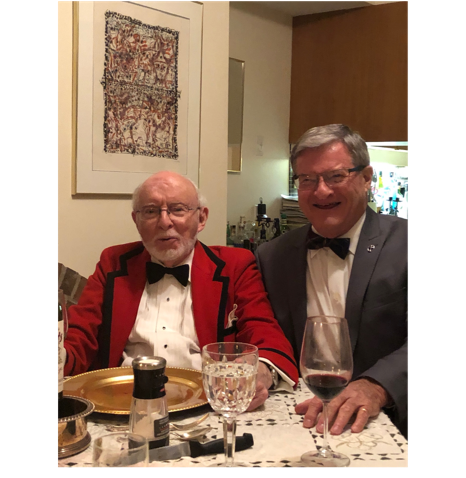 His Nibs and the author, New Year’s Eve 2018
JFW came from a privileged family and enjoyed a comfortable life growing up in the 1940s Toronto. Privileged perhaps but he also had to make his own way. He was educated at a prestigious private school in Toronto – possibly because his mother was bright and had ambitions of her own; a scrawny little kid, likely bullied, incongruously he claimed, to have served as an army cadet in Camp Borden and as a car jockey at the Canadian National Exhibition in its three-week August run each summer. He subsequently earned a degree from Trinity College of the University of Toronto in philosophy and then progressed to U of T Faculty of Law.
He was called to the bar in Ontario, but never practiced law per se. Instead, he somehow got into the labour dispute world and for much of his career operated as an independent professional, as a labour arbitrator. Over the 50 plus years of an illustrious career Mr. W. must have delivered hundreds and hundreds of labour arbitration decisions.
Except for his time articling in a law firm, he was never an employee in a private corporation or government, though later in his career served a short spell heading up a government agency. He made ‘good money’, as they say, especially in the halcyon days in private practice in Toronto. He also enjoyed the benefits of two tidy inheritances and the lifestyle one might expect of a prosperous gentleman: frequent upscale lunches and dinners, world travel, especially to his favourite cities, Paris and London; fine wine, the occasional cigar and his daily martini. In short, he lived a happy life (though no doubt not without some of the usual life crises we all suffer through from time to time, usually having to do with family).
His fortunes shifted somewhat when he moved to Ottawa – not to say there are shoals in Ottawa upon which one’s career might founder but he found life there a bit more confining.
When I met him he had just re-launched his labour arbitration practice in Ottawa and leased an office suite in the Delta Hotel Office building. I had been building a consulting practice of my own (human resources advisor, career counselor and executive coach, if not an all-around factotum) and I was in need of an office; I invited myself to become his roommate. We made for strange bedfellows, though there was a certain logic to it (labour relations and employee relations, if you will), though in reality the only thing we did together was the occasional lunch and worry about paying the rent.
The literate lawyer and I, the career counsellor (also aspiring author), often spent time at lunch, or in the office library, discussing literature and language and consulting thereto various reference books, or, latterly, google! My roommate had a prodigious memory and could quote at will from any number of things he had read – quite scary for a pretender such as myself.
All of this is prelude to the tale I want to tell about Wilkins Micawber.
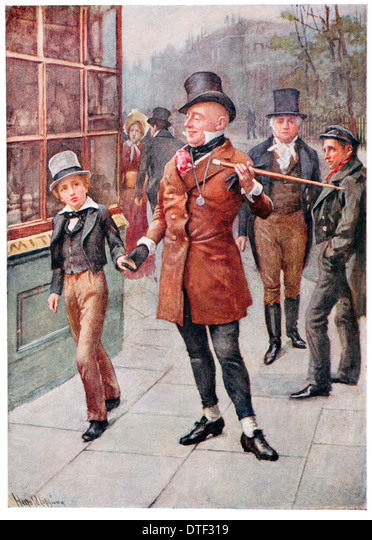 Wilkins Micawber & David Copperfield
Any literate person in English will have read some of Charles Dickens, or at least heard of him (oh come now: Mr. Scrooge in A Christmas Carol?; A Tale of Two Cities (‘It was the best of times, it was the worst of times’)?; Oliver Twist (“Please sir, may I have some more?”)? No? Well, Mr. Micawber was one the more memorable characters in Dickens semi-autobiographical novel, David Copperfield.
Wilkins Micawber may in fact have been patterned after Dickens’ own father; fancied himself a gentleman and presented himself as such, though perhaps a little ragged; in and out of the poor house the best part of his life. He was of unknown education but rich in vocabulary and aphorisms; his ambitions and his lifestyle chronically exceeded his means, though his long-suffering wife stood by him. Micawber’s formula for happiness was entirely pecuniary:
‘Annual income twenty pounds, annual expenditure nineteen nineteen and six, result happiness. Annual income twenty pounds, annual expenditure twenty pounds nought and six, result misery.’
Written in full, the formula stipulates that for happiness, expenditure must be less than income! If income twenty pounds and expenditure nineteen pounds, nineteen shillings and sixpence (£19/19/6), happiness; expenditure of £20/0/6 results in misery. (In modern British decimal currency there are no shillings so the cause of misery would be expenditure, 20 pounds and 2.5 pennies.)
Micawber chronically hovered on the misery side of the scale. But Micawber was an optimist and ever hopeful that misfortune was only temporary: ‘Something will turn up!’
I’m not suggesting that my erstwhile roommate, Mr. W., was in any material way like Mr. Micawber, nor even that he spent time in his cups to avoid facing up to his reality, only that Mr. W. was a self-employed professional, as was I, and that meant cash-flow can be irregular. That is to say, revenues may be uncertain but expenses are largely constant: the rent must be paid on the first of every month; the phone bill and the internet bill come monthly, as does that credit card statement with all those lovely luncheon expenses listed.
Mr. W. may have been an iconic arbitrator but he was a reluctant salesman, and in that dimension was I similarly. I networked more extensively than he did but was tentative with ‘the ask’ and ‘the close’; lunching with potential clients is not sufficient to the art of the deal. So when our respective calendars were only intermittently filled with contracts, expenses frequently exceeded income and the ‘Micawber Principle’ was in play.
All this drama played in the background.
The arbitrator and the coach may have shared the rent and the occasional musing about the tentativeness of life, but rarely shared money worries, and then only obliquely; typical of reserved English Canadians, we didn’t really talk about it, merely mumbled hints at the state of our respective billable hours. The lawyer, or the performer, in one or the other of us would resort to quoting our favourite Dickenson character, Wilkins Micawber.
‘Something will turn up.’
For Wilkins Micawber, something did turn up: he emigrated to Australia, became a bank manager and a magistrate.
For Mr. W., he found his great reward in 2020.
As to your faithful reporter, I am still hopeful that the expected good fortune will yet arrive, but it better come soon as the creditors are all barking at the door.
And with that, I wish all my faithful readers, and myself, a Happy New Year and a very prosperous 2026!
Doug Jordan, reporting to you from Kanata
© Douglas Jordan & AFS Publishing. All rights reserved. No part of these blogs and newsletters may be reproduced without the express permission of the author and/or the publisher, except upon payment of a small royalty, 5¢.
The post 25.24 Wilkins Micawber’s Principle appeared first on AFS Publishing.


December 15, 2025
25.23 The Secret of Secrets
The Secret of Secrets. That’s the title of Dan Brown’s latest novel featuring the unlikely flamboyant adventures of ‘symbologist’ Robert Langford. And as titles go, it’s a pretty good one: It invites you to wonder what the book could be about? What are the secrets? And what secret holds other secrets? There are few hints on the cover to let you know – you need to read the book to find out – and that’s the whole point of a book title and cover.
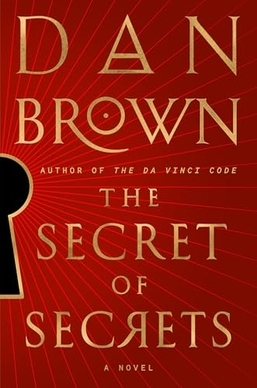
Dan Brown is now a very well-known author, achieving the kind of recognition most aspiring authors seek. His second book, The Da Vinci Code sold millions and millions of copies and was made into a blockbuster Hollywood movie. This success made his first, largely overlooked, book, Demons and Dragons, a best seller too, and this led to four more Langdon books in the series, of which The Secret of Secrets is the latest.
Rating Brown’s Book
I confess, I enjoyed the Da Vinci Code, both book and movie, and that lead me to Demons and Dragons, which somehow did not have the grip and pace of Da Vinci Code. I never got around to reading the 3rd, 4thand 5th books in Brown’s series despite some intriguing precepts in the books: Why should a series about an unlikely protagonist, a Harvard academic, attract readers? Books with a heavy lading of historical information and obscure facts? Each of his books are well-researched, it appears, but why the widespread interest in Roman Catholic Church esoterica, historical references, architecture and symbology (whatever that is)?
Brown’s novels feature a compelling pace, multiple characters, mystery and intrigue. Short chapters, each ending with an irresistible invitation to read on.
But they can be annoying. Extremely unlikely premises, too many characters converging, a staccato-like pace bullying you to continue reading well past your bedtime lights out promise to yourself.
In Secrets a key theme is a theory of consciousness, and, despite my reservations, I was interested in what Brown had to say about it. Professor Langford’s main squeeze this episode is a neurologist named Dr. Katherine Solomon who has become a pioneer in the new science of ‘noetics’; she has postulated a theory that consciousness does not reside in the brain but in the universe; the brain is just a neurological receptor for signals that come from ‘out there’. And wouldn’t you know it, the CIA is very interested in this potentially powerful way to control the thoughts and behaviours of the presumed enemy.

Well I pretty much lost it at that point, but because of Brown’s compelling writing stye, I didn’t stop reading, just muttered a lot.
My review of The Secret of Secrets can be found on my Goodreads page here (or here[1]). Is it a four-star rater? (inventive plot, compelling writing, well-researched) or a two? (over-the-top cliché-ed plot, overbearing writing, lazy academic rigour). Even if I used my -5/+5 rating scale, I don’t know. Both/and perhaps.
Consciousness
What I really want to rant about though is the apparent preposterous premise of the noetics scholar and her theory of consciousness. And it is for this reason that I found Dan Brown’s swash-bucking novel offensive. He makes no serious attempt to clarify how or what causes consciousness to somehow reside in the universe nor give any evidence as to how the brain (presumably) tunes into the signals from the universe. The problem of consciousness deserves a whole lot more serious attention than the throwaway new-age ‘universe’ meme Brown gives us. Many serious scholars, scientists and thinkers have offered theories or ideas of what exactly is consciousness and how it comes about. No one has a final accepted answer.
Let me hasten to say that I have read a lot about consciousness – one of the four or five most crucial speculative questions human beings with their overactive brains have pondered: ‘what is the nature of the universe?’ How did it all begin? What is infinity (and beyond?) (How big is big, how small is small?)? Is there a god? Is there life after death? What is consciousness, really?
Let me also say that I don’t have an answer (though I do have a preferred view). It is highly probable that mere humans will never find the answer to these questions, unless, perhaps, there really is life after this life and god gives the newest arrivers all the answers then. (And the problem with that solution is that nobody has ever written home and let us terrestrials in on the secret.)
First, what is meant by consciousness? It is surprising how many of us have not given this a lot of attention – we just accept that we ‘are’ conscious and that’s it. The mind and the brain are simply accepted as one and the same thing. Consciousness is generally defined as ‘the state of being aware of and responsive to one’s surroundings’ (AHDOEL). But that’s not quite enough. For humans, consciousness is not just being aware of and responsive to one’s environment, it is the self-awareness that we are aware.
All zoological species have at least some perceptional ability to detect its surroundings and respond accordingly, especially if the phenomenon moves. Amoebas to alligators take in information through their senses and respond according to whatever meaning they apply to that perception; their motivations basically three simple things: danger (survival response, fight or flight), food, or sex. But there is no, or almost no, evidence that any of these animals have any self-awareness. Faithful readers who ever knew dogs realize that there is clearly something going on in the dog’s small brain, when it is awake (and maybe even when it is sleeping) – you can see him interact with his surroundings, sniffing eagerly in the corner of the yard, cocking her head in an inquiring way, coaxing you into throwing that tennis ball, or fishing for the treat hidden in your pocket. They have five senses, (or possibly six – How do dogs know when you are coming home[1]??); environmental information is passing through those receptors and on to their brains; the dog’s brain must then process the information and do something with it: fight, flight, eat it, fuck it or ignore it, mostly ignore it. But is the dog aware of its own thinking? Is it self-aware? Is it conscious?
Now, as a biological materialist, and evolutionist, my belief is that human doings are not much different from your typical standard poodles: We, our brains, take in data through our five senses, (or possibly six?), filter it in some fashion, compare the information to previously experienced information stored in memory, predict what is likely to happen next (as it has in the past) and act accordingly. And if that action didn’t produce the expected response, the brain feels surprise and makes adjustments, both to actions and to the stored information. The fittest amongst us – those with the physical attribute that produced the best response, and the mental ability to make the most accurate predictions more often than not, survived to reproduce and pass on their advantaged genes. And most of this takes place without us actually being aware of it, or least, before we became aware of it.
The answer to the question
In many ways the answer to the question of consciousness is simplicity itself. We humans are no more conscious than dogs, or even lobsters. (The answer to the question of how it all began, and by whom, is completely unanswerable.)
I said I was a biological materialist: What you see is pretty much what you get. We are mammals made of a couple of hundred pounds of atoms and molecules (mostly hydrogen, oxygen and carbon) and our brains (mostly fat and protein) run on glucose. That 3 ½ pound universe contains enough specialist nerve cells, and many more multiples of connections, to process a lot of information in very little time; it perceives environmental events, compares those events to previously perceived and remembered actions and ‘orders’ a response in nano-seconds, then stores the experience in memory. A brain is a biological organ performing certain tasks, just as all the other organs in our bodies have specially evolved to perform particular tasks. That’s it.
But this functionality doesn’t answer the question of why we think we are actually conscious, that we are simultaneously acting, and aware of ourselves acting, and doing so in real time. We believe our conscious minds are in control of our bodies and our actions, but there is plenty of evidence to show that neural activity in regions of the brain that control the action are active as much as hundreds of milliseconds before we actually become conscious of the action. In other words, the action precedes our awareness. And If the action preceded the awareness, what actually commanded the action? Moreover, where in the brain is this awareness occurring? Where is this thing we call a mind? Is it a homunculus in some sort of control room in charge of the rest of our bodies? Are ‘we’ actually in control of our thoughts and actions? or mere spectators in the theatre of our minds?
This 3 ½ pound lump of electro-chemical matter, and innocent arrogance, somehow asks the questions that may have no answers. And, for some, even asks the question: Am I conscious now?
Our complex and very fast brains create mental ‘concepts’ (images, sounds, smells, tastes, touch) of what it has perceived. It also has created a self-awareness concept of ‘itself’ and records the information in memory which is played back nanoseconds after the actual event. I think mind/consciousness is all illusion. But I could be wrong..
For Dan Brown to suggest, with no evidence, nor even attempt at explanation, that the brain is merely a signal receptor and acts on messages coming from beyond in some timeless instantaneous universe, is fraudulent and lazy. He may even be right. But we deserve better.
Doug Jordan, reporting to you from Kanata
© Douglas Jordan & AFS Publishing. All rights reserved. No part of these blogs and newsletters may be reproduced without the express permission of the author and/or the publisher, except upon payment of a small royalty, 5¢.
[1] This is a two star book – too long, convoluted, fraught with unrelenting action typical of Brown.
This is a five star book, fluid writing, fast-paced compelling narrative, practically impossible to put down.
This is many books in one: a thriller, a treatise on consciousness, an examination of mental health, a moral dilemma, an education of historical facts, and an amazing travelogue of Prague. Probably the last point is the most compelling: tourism to Prague will increase in the next few years.
[2] Rupert Sheldrake, The Sense of Being Stared At, and Other Unexplained Powers of the Mind, (2003)
The post 25.23 The Secret of Secrets appeared first on AFS Publishing.
November 29, 2025
25.22 Care for the Caregivers
[This is the sixth (and last) in a series of articles from Guest Writer Catherine Mossop narrating her husband, Brian’s, journey with the dispiriting effects of dementia, likely Alzheimer’s Disease. In our last installment – Musical Mind – we read of the relief Catherine, and Brian’s friend Jeff, felt when Brian, despite being in late stages of his affliction, picked up his harmonica and played, and relaxed into the music.
[We also learned through this series, often only hinted at, of the tremendous strain Catherine was under to care for Brian, deal with others’ misunderstanding the situation, live in fear for her own safety, and grieve for the gradual loss of her husband. This is her story.]
I wrote this series about our – Brian’s and my – Alzheimer’s Dementia journey to share some of the insights I gained about this dreadful disease, and in addition the experience of those care-giving partners out there who are as bewildered as I was. I am a strong and resilient professional woman, resourceful, and a fierce advocate, but this journey has been the most challenging – emotionally and intellectually – of anything I’ve had to deal with in my life. What ought to have been the least of my difficulties, navigating the health system in Ontario was tremendously frustrating. I began to wonder how care-giving partners without the knowledge and toughness I have, cope on their journeys with their loved-one. This article is for them.
Petro-Canada CareMakers Foundation has produced a 1 minute commercial that effectively captures the plight of the Care-giver of an Alzheimer’s patient:
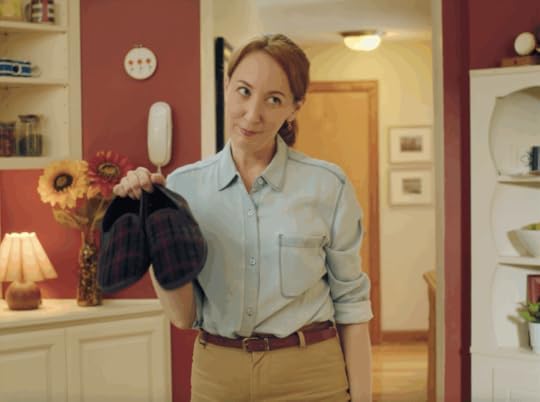
https://www.facebook.com/share/r/1G4WnqkFj1/xxx
Everybody ‘knows’ about Dementia, and Alzheimer’s, but beyond general awareness, I’ve discovered there is very little pragmatic support for the afflicted and their caregivers. Dementia doesn’t have cachet – it is seen as ‘normal’, or worse, an embarrassment. And so, appreciation of the heavy burden on the primary caregiver is lacking. Some in Brian’s family didn’t want anyone to know he was on the Dementia journey! When I organized a 70th – and likely last – birthday party for him, I invited family and friends to bring favourite photos and a story that could go into creating a memory book; some of Brian’s closest family not only refused to contribute, they were reluctant to even show up. They were aghast I would do such an event – I guess they thought it was like a wake. I have no regrets. His memory book became a staple in his care program – his care team tell me it is one of the best they have ever had and use it daily.
My care goals for Brian, and me, in his dementia journey, fall into three simple categories:
To have no regretsTo be safe and assure all who support his journey, are safeFor him to feel loved and be at peace.To do this, the care partner needs support; and there is a shocking dearth of support systems out there. Dementia may manifest differently from one person to the next, and from stage to stage, but every care partner begins this journey bewildered and ends in exhaustion. The Dementia Journey is a ‘living grief’. The primary caregiver supports the patient, but who supports the caregiver?
Here are things you can do to support a care partner[1]:
Paperwork
Canadians are reticent and don’t like to interfere in things they regard as ‘personal’. Get over yourself. The caregiver needs help. Even if they say they can manage, help. Ask the questions, especially of the ‘awkward kind’ – legal stuff, and the money. This is of ‘Do Not Pass Go’ importance. Asking good questions helps steer people toward good decisions. If you are the care giver, take this advice, and ignore, politely, the people with empty advice and ‘you shoulds’.
Here are the critical administrative things that must be taken care of. The caregiver may have little capacity in this area so what can you do to help? Ask questions about:
Wills: Inquire that they are in place, reviewed and adjusted as needed. This ought to have been done long before moving from Mild Cognitive Impairment to a more acute disease state but the anxious caregiver may procrastinate. Ask. Help them find a lawyer.Power of Attorney for Financial: as for Wills, you need to ask the caregiver if a POA is in place and is the best person identified as POA. This is essential as banks need a copy of the POA and at some point a Medical Letter will be required indicating the patient is no longer capable of making financial decisions. Timing is important. The POA is best done before any illness or disability is indicated.The POA should be ready before it is needed. Ours were in place when we bought our first house, 10 years before Brian showed any sign of disability. I already paid all bills; I cancelled his credit card, had a restriction placed on his debit card and gave him cash (he liked having cash in his wallet – today he keeps old Canadian Tire bills). The need of a Medical Letter was only required for the Bank and when he was admitted to Long Term Care.Permanent Disability designation: for tax purposes and Long Term Care benefits. The Family Doctor completes the form online for the Canada Revenue Agency. Paper forms are no longer available. Power of Attorney for Medical: Caring for the care-giver includes asking difficult sensitive questions. This is one. As Alzheimer’s is a terminal disease, the POA Medical must be in place and might need an adjustment to include a DNR – this is a deeply personal decision and needs thinking through.The POA Medical is done at the same time as the Will and POA Financial. Implementing it is complex and filled with grey zones. Discuss with a lawyer and your social worker. The person who holds the POA needs to have this on file with the Doctor so that you can attend medical appointments otherwise the privacy and confidentiality requirement remains in place. Complications can arise if the Caregiver and the POA is not the same person. The carer of the Care giver – you – can assist in this delicate area. Care Planning: This is much more detailed than the POA, and includes thinking about care from now to end of life and should clearly outline what the loved-one wants: any advanced funeral planning, ‘what happens if’ scenarios, and what instructions are to be given to the health team? what conditions apply in DNR (Do Not Resuscitate); what is ‘no tubes’?; what is ‘Comfort Care’? Who pays for what? These are emotional conversations and top the list of important – the social worker assigned to your case is a key resource. As a carer for the caregiver, what you can do to help is to make sure they access these resources.Estate Planning – this covers everything under the sun and more. I constructed a binder with sleeves for original documents, lists and instructions. There are resources such as: I’m Dead, Now What? ; Sorry, It’s Your Problem Now, Because I’m Dead ; and F*CK I’m Dead, Now What? – all on Amazon. Estate Planning also includes what to do in the event the care provider gets hit by the proverbial bus. Unfortunately, I know of several incidents where the care provider died before the afflicted Loved One; the planning documents become crucial to whoever steps in in place of the original care partner. People close to the care giver should be fully briefed on what is going on; if you’re one of those people, ask. Call an ALL-Family meeting. All the family members who have any connection to the patient should be informed of what is happening and what is planned. It can be a difficult meeting. The Alzheimer’s Society will facilitate this meeting if requested. Review the entire Estate Plan with them. Surface all the issues and be clear on what is what: ‘there is no money flowing to you’, ‘I will look after all financial and medical expenses’, that sort of stuff. As a friend of the caregiver you may be able to give support.Peace of Mind.
All these formal processes are tremendously draining and doubly so for the inexperienced. When these things are resolved the stress on the Caregiver is lessened. Don’t assume she’s coping – she’s not. Give her a hand.
Ongoing Support
Once Peace of Mind is sorted out, ongoing support is all about keeping the care partner alive and healthy. I’m not being dramatic.
Friends or family members of a care partner mean well but often have no idea what the caregiver is actually going through.
Brian experienced tremendous fear and reacted strongly to situations he didn’t expect – this is called ‘responsive behaviour’ in the medical word (I know, peculiar use of the term). Not all Dementia patients become aggressive. Some are 90-year-old smiling sweeties, others 60-year-old confused puppies, some are shockingly violent – and everything in-between. The disease can be unpredictable and changeable. Consequently, the care-giver must be constantly vigilant and appropriately responsive. It’s exhausting. You as the outside party might not see it; the care-giver has to live with it.
Living in a heightened state of self-preservation day in and day out was all-consuming and the effects touched everything: how I responded to sudden movement, how new information was presented, and received, how I communicated generally, how I made decisions. Unrelenting anxiety creates constant tension. ‘Focus and Stay Alive!’ became my mantra.
Providing meaningful support is the hard part of caring for the Caregiver. My world shrank to being a prisoner in my own home. My reprieve was my two sisters who visited every three weeks or so, and my husband’s son, who gave me 3-hours off once a month. I needed more than that but that’s all they could provide – keep in mind, Brian wouldn’t allow anyone else into the house; after an hour he would become agitated, and my sisters would need to leave.
The Alzheimer’s Society does a brilliant job providing help and information to the Caregiver[2]. But they have very limited resources – and getting tighter with increasing numbers of cases over the next 10 years. This support is incredibly valuable – much more is needed.
The Alzheimer’s Society has an outstanding library online, learning and support programs for care givers, and programs for the loved one (group programs, volunteer visitors), but I was very restricted as I couldn’t be away from Brian and he wouldn’t allow ‘strangers’ into our house. Nor could I access any other community programs because of his unpredictable ‘responsive behaviours’. I was isolated. If you are known and have the capacity to sit with the loved one, this can allow the Caregiver some respite.
My best resources support have been other caregivers who share their experiences and tidbits of advice that help make this difficult journey just a tiny bit easier. Some people may choose not to access the Alzheimer’s Society programs, but everyone has access to the library, and all caregivers need to know they are not alone. I am thinking of you.
Things you can do to help a care provider:
Instead of saying “let me know if there is anything I can do to help” – in extreme stress, people simply can’t answer that question – try: Would it be helpful for me to cook and drop off a meal for youI can stay with your person for an hour or a few hours so you can go out/take a break/visit a friend/go shopping/go to counselling or support group – lets set a scheduleLet’s schedule some time for me to do an activity with your person/play music/read-to/watch a movie, to give you a breakShall I create a play-list for your personMay I take your person out to lunch (probably not possible in advanced stages), for a walk, for an activity (find a Christmas tree, garden centre, apple picking, etc.) so you can have time just for you?Please let me … help with the garden, shovel snow, trim trees – fill in the blankMay I help you find respite care/community resources/a volunteer visitor/a hand and foot nurse to come do their nails for youI could collect stories and photos for an album-based memory book (make 2 copies so you don’t panic when one disappears)I could create a folding story-board for you with maps of places you have travelledLet me help put together a set of memory cards I created a deck of 40 cards wherein each card is photo of an item, memory, person, activity that he enjoyed in the past – gardens, cycling, musical instruments, people photos. (I had them cut and laminated at Staples/Business Depot. Brian sorts the cards with his activities therapist.)May I drive you to appointments/outings/lunch/shopping?I could knit/crochet/quilt a lap blanket for your person. (Use acrylic yarns, not good wool! When the item goes to LTC later-on it is boiled to prevent disease transmission.) Let me organize a contractor to install safety changes.Instead of saying “you need to look after yourself” (not surprising, this statement is one of the least helpful things others say to a care partner) – try:I could go through your home to identify the things that might be dangerous (knives, hunting/fishing gear, machetes, chemicals, chain saws (all are weapons); I’ll sneak them out of the house and keep them at my place for the time being I’ll look into getting access to support programs for you from the community/Alzheimer’s Society what is the safety plan for you. Do you know where to go? How can I be part of your plan; can I provide an overnight hotel stay as part of your safety planCan I help find a visiting support service for you/your personI’ll call you 1X per week as your personal check-inMay I teach you how to knit – knitting and crochet are meditative arts that are known to reduce stress; or maybe do jigsaw puzzles togetherCan I bring all or part of a special occasion meal, help you celebrate your birthdayI can be your ‘make a call to distract and diffuse’ I can get special dementia door locks and have them installed for youSpouses live the paradox. I am Brian’s wife – this is the person I love – but I no longer have a life-sharing partner – I became the primary care provider. Yet, the precarious life I lived was not fully appreciated by others. Family members of an Alzheimer’s patient often only see and experience moderate manifestations of the disease, not the reality the primary caregiver lives.
A known quality of the early-stage Alzheimer’s persons is their ability to rally for a few hours, appearing quite normal. But this is not sustainable. For example, at a special event – Thanksgiving say – visitors may see the rally, and only occasional memory lapses; they do not experience the confusion, frustration, fear, do-overs, sudden outbursts, the anguish that is the reality of the disease. And as the disease progresses the reality the care giver lives becomes more and more precarious until finally, the patient – the Loved One – is confined to a Long Term Care institution.
Secondary carers (family and friends) may not appreciate that the spouse-of does not have options that are normally assumed. In caring for the caregiver, being patient and understanding is paramount – even in your own frustration with the situation, this is not the time to discount, deny, falsely accuse, or harangue health care workers, personalize, ignore, hide, ghost, build an alternate reality, gaslight the care giver ….
It takes courage for a primary care provider to say, “I need help, even for just an hour, please come.” As a carer of a caregiver, good intentions are not enough. When a primary care provider says they need your help, please take this ask seriously – you could be saving the caregiver’s life.
Catherine Mossop, reporting to you from Cobourg, Ontario
(With contributions from Doug Jordan, Kanata, Ontario.)
© Catherine Mossop & AFS Publishing
All rights reserved. No part of these blogs and newsletters may be reproduced without the express permission of the author and/or the publisher, except upon payment of a small royalty, 5¢.
[1] Care-givers support family members with other afflictions besides Alzheimer’s/ Dementia: people and kids with disabilities, physical and mental; cerebral palsy; Parkinsons, multiple sclerosis and ALS, terminal diseases, cancer. They are all struggling to care for their loved-ones and don’t get much care themselves.
[2] There are a number of Associations providing support to care-givers, e.g., Carers Canada, Ontario Care giver, Petro-Canada Caremakers, but for care-givers of dementia sufferers, The Alzheimer’s Society is most comprehensive.
The post 25.22 Care for the Caregivers appeared first on AFS Publishing.
November 15, 2025
25.21 Luck and Gratitude
Would you rather be lucky, or rich?
Luck: success or failure apparently brought by chance rather than through one’s own actions. (AHDEL)
Luck could be either good or bad, but to be ‘lucky’ generally implies you are imbued with a magical trait of attracting good fortune. You might argue being lucky is better than being rich because if you are lucky, you likely will also be rich. But is that true? Even if you are lucky and win the big lottery, is being rich the goal of life?
Human beings tend to admire ‘success’; and very often define success as wealth, and the power and status wealth affords. But the admiration comes with a touch of envy, even resentment: their success wasn’t earned, it was luck. They had the good fortune to be born into wealth and privilege; they were lucky to inherit ‘good genes’ – strength, talent and beauty that gave them advantage in the race of life. She was in the right place at the right time when fortune smiled on her as she bought the winning lottery ticket, found the 20-dollar bill on the sidewalk, bought the Shopify stock.
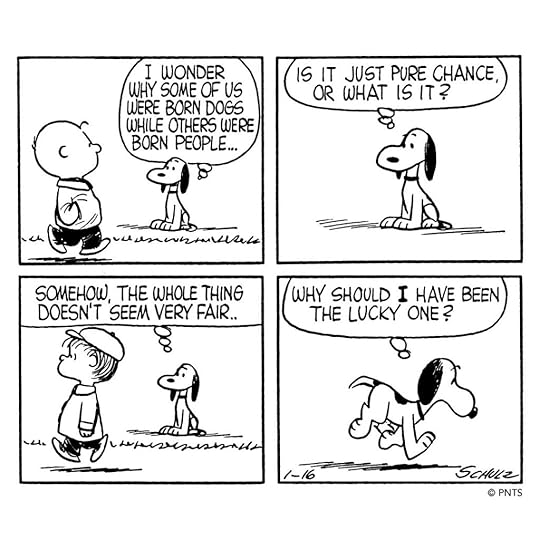
Zoologists remind us only humans have a conception of wealth. Other animals do not accumulate material goods, (well, except perhaps for crows and magpies), nor feel the curse of envy. Anthropologists do suggest, however, as with other primates and most social animals, human beings seek power, and the status that affords – probably because of the advantages power brings: priority over others, especially to eating, and breeding rights. And if you can’t be the alpha male, or alpha female, being close to the alphas brings its own referred power and status.
So, if you lack brain or brawn, or inherited wealth, better to be lucky and be shown the easy path to wealth, power and status.
Don’t get me wrong, I’m not against prosperity. I’m not of the St. Francis of Assisi school of virtue. Financial security provides relief from the sting of worry and anxiety. But is power and status really what we want out of life?
Readers of this blog have heard me preach that the point of life is not wealth and materialism, nor even status and power, but the personal satisfaction that comes from achieving worthwhile things. Happiness comes from being engaged in life, accomplishing satisfying outcomes through the use of your best talents, especially for the benefit of others. For that you don’t need to be lucky (or rich), though it may help.
Randomness nevertheless happens. Having the good fortune for things arriving out of the universe to help you along with your projects is a blessing; having the misfortune of untimely adverse events, sets you back. It’s not karma, or fate, it’s just luck.
But luck often is more than randomness – being in the right place at the right time – it’s also about preparedness. Seneca advised that luck is the convergence of opportunity with preparedness; Lord Baden Powell offered similar advice to Boys Scouts, perhaps more as contingency against ‘bad’ luck: ‘Be Prepared’. Yogi Berra might have put it less elegantly: ‘when you come to a fork in the road, take it’.
I read an interesting book some 20 years ago by the quirky psychologist, Richard Wiseman, The Luck Factor. I wrote a long blog about Wisman’s assessment of luck which you can read on my AFS Consulting Blog page (here and here). Among other things Wiseman argued that some people seem to be luckier than others. In his research he found that ‘Lucky People’ tended to have higher positive scores in three of the ‘Big Five’ Personality factors than the average, and that people who self-identified as ‘Unlucky People’ scored lower than the average in these three factors: Lucky people scored higher in Extroversion (i.e., perceive external stimulus as positive and gain energy from social interaction), Calmness (i.e., low in Neuroticism – that is, do not perceive external events as threatening), and Openness to Experience (i.e., willing to try new things); ‘Unlucky people’ tend to score lower in Extroversion, higher in Neuroticism, and lower in Openness. (There appears to be no distinction between Lucky and Unlucky people with respect to Conscientiousness and Agreeableness the other two ‘Big Five’ factors). In other words, Lucky people appear to be more willing to engage with life’s events and take more risks. This doesn’t mean Lucky people always succeed, they just succeed more often than cautious careful people. Extroverted, calm, and open people are more likely to buy a lottery ticket. Or as the Great One said, ‘You miss 100% of the shots you don’t take’. Lucky people take the shot, unlucky people pass. Was Gretzky lucky, or just an Optimist.
I mention Optimism because Martin Seligman in his book, Learned Optimism, would have agreed that Optimists likely score positively on the same three of the Big Five factors as Lucky people and conversely, Pessimists would score low. Seligman’s advice to pessimists: lighten up, take the shot.
Wiseman would probably agree with this assessment. Lucky people are positivists and are more likely to recognize when the moment is fortuitous. Lucky people, and optimists, are appreciative, they are willing to acknowledge the randomness of the external event (opportunity knocks) but also that they were somehow ready to take advantage of that opportunity.
Seligman went on from his work in clinical depression to launch the Positive Psychology movement. He wrote a now famous book, Authentic Happiness, in which he encouraged people to not be hijacked by thinking in the past, or fearing the future, but to live mostly in the present, to savour the moment when good things are happening and to practice gratitude regularly, reflecting on the good in their lives.
Lucky people, so claims Wiseman, also appear to be appreciative of their good fortune. They may not even realise that their good fortune may have had as much to do with their own preparedness (hard work, training, risk taking) as the opportunity that presented itself.
It’s one thing to believe good luck brings good outcomes, (and bad luck is responsible for bad outcomes), but what of the view that in bad situations there is also good luck? Lucky people, and optimists, are also likely to see the positive in the midst of a negative event, more likely to see the silver lining in dark clouds.
Bad things happen to lucky people too, but rather than dwell on the negative and spiral into unhappiness, they bounce back, or at least find something to be grateful for in the midst of the misery. They recognize that life is not all a bed of roses, there are also some thorns. But rather than dwell on the thorns, they find something positive in the roses. This is the resilience of lucky people, this is the finding something positive about the negative event. Lucky people, and optimists, are grateful for the silver lining and count themselves lucky.
I have a friend who lives alone and recently underwent emergency by-pass surgery for blocked arteries to her heart. Of course she was justifiably stressed and anxious about the situation (she likely scores high on the neuroticism scale at the best of times), but as she recovered in post-op and her prognosis settled into high positive, she began to accept her changed circumstances, became less fearful and began to feel optimistic about her future. She began to count herself lucky:
She was lucky that while in her GP’s office she mentioned feeling pressure in her chest while walking. The doctor stopped examining her, asked her how she was feeling at that moment – pressure, she said. The doctor immediately gave her three crushed 81 milligram aspirin tablets and called an ambulance to be rushed to the hospital;She said it was lucky that she had recently lost a lot of weight and had been exercising regularly, actually strengthening her heart and body making her a better candidate for successful bypass surgery and recovery;She was lucky to have friends and neighbours who were willing to help her out in her time of need and recuperationShe was grateful for being so lucky.Maybe she should buy some lottery tickets.
Doug Jordan, reporting to you from Kanata
© Douglas Jordan & AFS Publishing. All rights reserved. No part of these blogs and newsletters may be reproduced without the express permission of the author and/or the publisher, except upon payment of a small royalty, 5¢.
The post 25.21 Luck and Gratitude appeared first on AFS Publishing.
25.21 – Luck and Gratitude
Would you rather be lucky, or rich?
Luck: success or failure apparently brought by chance rather than through one’s own actions. (AHDEL)
Luck could be either good or bad, but to be ‘lucky’ generally implies you are imbued with a magical trait of attracting good fortune. You might argue being lucky is better than being rich because if you are lucky, you likely will also be rich. But is that true? Even if you are lucky and win the big lottery, is being rich the goal of life?
Human beings tend to admire ‘success’; and very often define success as wealth, and the power and status wealth affords. But the admiration comes with a touch of envy, even resentment: their success wasn’t earned, it was luck. They had the good fortune to be born into wealth and privilege; they were lucky to inherit ‘good genes’ – strength, talent and beauty that gave them advantage in the race of life. She was in the right place at the right time when fortune smiled on her as she bought the winning lottery ticket, found the 20-dollar bill on the sidewalk, bought the Shopify stock.
Zoologists remind us only humans have a conception of wealth. Other animals do not accumulate material goods, (well, except perhaps for crows and magpies), nor feel the curse of envy. Anthropologists do suggest, however, as with other primates and most social animals, human beings seek power, and the status that affords – probably because of the advantages power brings: priority over others, especially to eating, and breeding rights. And if you can’t be the alpha male, or alpha female, being close to the alphas brings its own referred power and status.
So, if you lack brain or brawn, or inherited wealth, better to be lucky and be shown the easy path to wealth, power and status.
Don’t get me wrong, I’m not against prosperity. I’m not of the St. Francis of Assisi school of virtue. Financial security provides relief from the sting of worry and anxiety. But is power and status really what we want out of life?
Readers of this blog have heard me preach that the point of life is not wealth and materialism, nor even status and power, but the personal satisfaction that comes from achieving worthwhile things. Happiness comes from being engaged in life, accomplishing satisfying outcomes through the use of your best talents, especially for the benefit of others. For that you don’t need to be lucky (or rich), though it may help.
Randomness nevertheless happens. Having the good fortune for things arriving out of the universe to help you along with your projects is a blessing; having the misfortune of untimely adverse events, sets you back. It’s not karma, or fate, it’s just luck.
But luck often is more than randomness – being in the right place at the right time – it’s also about preparedness. Seneca advised that luck is the convergence of opportunity with preparedness; Lord Baden Powell offered similar advice to Boys Scouts, perhaps more as contingency against ‘bad’ luck: ‘Be Prepared’. Yogi Berra might have put it less elegantly: ‘when you come to a fork in the road, take it’.
I read an interesting book some 20 years ago by the quirky psychologist, Richard Wiseman, The Luck Factor. I wrote a long blog about Wisman’s assessment of luck which you can read on my AFS Consulting Blog page (here and here). Among other things Wiseman argued that some people seem to be luckier than others. In his research he found that ‘Lucky People’ tended to have higher positive scores in three of the ‘Big Five’ Personality factors than the average, and that people who self-identified as ‘Unlucky People’ scored lower than the average in these three factors: Lucky people scored higher in Extroversion (i.e., perceive external stimulus as positive and gain energy from social interaction), Calmness (i.e., low in Neuroticism – that is, do not perceive external events as threatening), and Openness to Experience (i.e., willing to try new things); ‘Unlucky people’ tend to score lower in Extroversion, higher in Neuroticism, and lower in Openness. (There appears to be no distinction between Lucky and Unlucky people with respect to Conscientiousness and Agreeableness the other two ‘Big Five’ factors). In other words, Lucky people appear to be more willing to engage with life’s events and take more risks. This doesn’t mean Lucky people always succeed, they just succeed more often than cautious careful people. Extroverted, calm, and open people are more likely to buy a lottery ticket. Or as the Great One said, ‘You miss 100% of the shots you don’t take’. Lucky people take the shot, unlucky people pass. Was Gretzky lucky, or just an Optimist.
I mention Optimism because Martin Seligman in his book, Learned Optimism, would have agreed that Optimists likely score positively on the same three of the Big Five factors as Lucky people and conversely, Pessimists would score low. Seligman’s advice to pessimists: lighten up, take the shot.
Wiseman would probably agree with this assessment. Lucky people are positivists and are more likely to recognize when the moment is fortuitous. Lucky people, and optimists, are appreciative, they are willing to acknowledge the randomness of the external event (opportunity knocks) but also that they were somehow ready to take advantage of that opportunity.
Seligman went on from his work in clinical depression to launch the Positive Psychology movement. He wrote a now famous book, Authentic Happiness, in which he encouraged people to not be hijacked by thinking in the past, or fearing the future, but to live mostly in the present, to savour the moment when good things are happening and to practice gratitude regularly, reflecting on the good in their lives.
Lucky people, so claims Wiseman, also appear to be appreciative of their good fortune. They may not even realise that their good fortune may have had as much to do with their own preparedness (hard work, training, risk taking) as the opportunity that presented itself.
It’s one thing to believe good luck brings good outcomes, (and bad luck is responsible for bad outcomes), but what of the view that in bad situations there is also good luck? Lucky people, and optimists, are also likely to see the positive in the midst of a negative event, more likely to see the silver lining in dark clouds.
Bad things happen to lucky people too, but rather than dwell on the negative and spiral into unhappiness, they bounce back, or at least find something to be grateful for in the midst of the misery. They recognize that life is not all a bed of roses, there are also some thorns. But rather than dwell on the thorns, they find something positive in the roses. This is the resilience of lucky people, this is the finding something positive about the negative event. Lucky people, and optimists, are grateful for the silver lining and count themselves lucky.
I have a friend who lives alone and recently underwent emergency by-pass surgery for blocked arteries to her heart. Of course she was justifiably stressed and anxious about the situation (she likely scores high on the neuroticism scale at the best of times), but as she recovered in post-op and her prognosis settled into high positive, she began to accept her changed circumstances, became less fearful and began to feel optimistic about her future. She began to count herself lucky:
She was lucky that while in her GP’s office she mentioned feeling pressure in her chest while walking. The doctor stopped examining her, asked her how she was feeling at that moment – pressure, she said. The doctor immediately gave her three crushed 81 milligram aspirin tablets and called an ambulance to be rushed to the hospital;She said it was lucky that she had recently lost a lot of weight and had been exercising regularly, actually strengthening her heart and body making her a better candidate for successful bypass surgery and recovery;She was lucky to have friends and neighbours who were willing to help her out in her time of need and recuperationShe was grateful for being so lucky.Maybe she should buy some lottery tickets.
Doug Jordan, reporting to you from Kanata
© Douglas Jordan & AFS Publishing. All rights reserved. No part of these blogs and newsletters may be reproduced without the express permission of the author and/or the publisher, except upon payment of a small royalty, 5¢.
The post 25.21 – Luck and Gratitude appeared first on AFS Publishing.
October 30, 2025
25.20 A Journey With Dementia 5 – Musical Mind
[This is the fifth in a series of articles from Guest Writer Catherine Mossop narrating her husband, Brian’s, journey with the dispiriting effects of dementia, likely Alzheimer’s Disease. In our last installment – Missing – we read of the drama, and Catherine’s anxiety, when Brian decided he didn’t want people visiting for Christmas (2023 December) and took himself for an unauthorized drive. Brian was missing for the next 27 hours.
We learned that, before Alzheimer’s began to destroy his brain, Brian was an accomplished, multi-talented, loving and generous man. We also learned he played harmonica, sang in a band and wrote his own songs. Where had the musician disappeared to? This is his story, and Catherine’s story.]
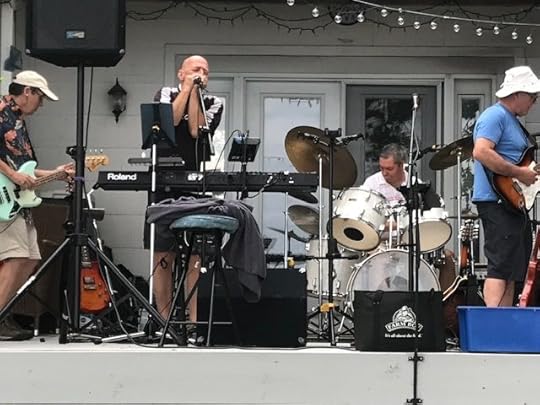 Brian playing with the band – August 2022
Brian is a musician and played in bands for years. When we invited people over for any occasion, they automatically brought their musical instruments and many hours of music filled our home, back yard, cottage. Music was always a significant part of Brian’s life: 6-string, 12-string, base guitars, cajon box, bongos, shakers, and all 30 of his blues harps; and the bonus – he can sing. Brian has an amazing voice and he plays the blues – wow! could he play the blues – music is in his soul.
Music is a ‘Red Thread’ – it is a connector of people and narrative no matter how close or disparate they might appear. The story…
It is a blustery day. I’m sitting in my car down at the pier, composing myself – it had been necessary to execute my escape plan – waiting, breathing. Our Visiting Behaviour Support Nurse pulled up beside me for a de-brief. “No worry” I said, in my usual masking way, “I have Brian’s car key, and I called his son to do the ‘distract to diffuse’ phone call. So, all is safe and my guess is I have about 15 minutes before he starts to panic.”
My VBSN begins by asking me how I feel; she knows about my situational extreme anxiety. I indicated that I think I have an ulcer taking shape to which she began describing what a woman’s heart attack feels like. I am not so sure I take comfort with her description but at least my pain isn’t a heart attack.
Having de-briefed and feeling calmer, I returned home only to find Brian disassembling the front door – so much for ‘all is safe’. The door had become a slab with bore holes. The lock set and handle were in bits strewn hither and yon, and tools spread over the porch. With electric drill in hand, he was working hard to pop the third hinge. He hadn’t yet lifted it off the frame. I had no idea why he was disassembling the door other than his compelling gibberish description with occasional clear words of ‘strangers’ and ‘bad people’ in the house – that might be me. Oddly, I understood that juxtaposition – remove the front door to keep the strangers out – got it! Clearly, Brian is anxious and afraid.
Taking a deep breath so as not to show my alarm – on goes my façade – I calmly said “Hey! Let me give you a hand with that!!”.
As a re-direct, I suggested since fixing the door is such hard work, now is a good time to take a break, have a beer and listen to Van Morrison. “Honey, I just heard a new release from Van Morrison – you will love it! Come listen and let’s have a beer”. This is called ‘therapeutic dialogue’ even though in my mind it is still fibbing. I quickly locate a Van Morrison track on Brian’s play list and give him a beer. Here we go, Van Morrison “Into the Mystic” – a favourite. Brian relaxes.
Music is the exit ramp out of TERRIFIED. It has proven time and again to be a significant de-escalating and calming force. (See ‘Notes’, below, on the role and value of music in Dementia care).
Then I called the locksmith who had installed new locks only a month earlier. I will never forget his look of bewilderment when he arrived later in the afternoon to do the repair – the door hanging by a hinge, the lock set gone. He had to go back to the shop to get a new lockset. (I anticipate I will find the missing pieces in the dryer or refrigerator sometime in the future.)
(Note to self: locksmiths show up in emergency situations and are trained to expect the customer to be in distress; they are very patient with a Dementia loved one – they say they have experience and I am thankful.)
In the ensuing few months Brian’s health continued to deteriorate – he had been at Stage 4 Moderate Alzheimer’s. Then came a significant escalation event that led to Brian being taken to hospital and placed in a secure room waiting for a transfer to the dementia specialty unit at Peterborough Hospital.
Harps and Happiness
On one of my visits with Brian at the hospital, I asked the nurse specialist if I could bring him a harmonica to play. She looked at me askance. I am aware that a ‘harp’ could be a ‘weapon’; I mention that Brian seemed to have a good relationship with one of his security guards and my thought was he could play when that guard was on duty. I believed the risk to be low. Since every moment is unique and unpredictable, I kept some harmonicas in my purse as a just-in-case.
The Nurse replied, Okay, but only three minutes please.
And it was MAGIC! Like a sunbeam through dark clouds. He transformed for just a few moments from bewildered and fearful to the musician I loved. Nurses came by and opened the door to his room, other patients stood in the hallway transfixed. Brian was alive with joy, his soul dancing in the clouds.
Three minutes please? – it was 10!
OMG! OMG!!– I found the key to life! I immediately thought I must call Jeff.
Jeff
Brian and his best friend Jeff played music together for years. Jeff, a professional base guitarist, also plays 6-string for fun. He had stayed connected and was pleased to hear from me. He wasn’t like others who abandoned us when Dementia showed up. Jeff and his wife, Sandra, are by my side on this journey.
Thrilled that Brian could access the music part of his brain, I ask; “Can we please arrange a music date? Can you please play your guitar with Brian?” He didn’t hesitate for a second, “YES!!” he said.
We went through Brian’s music book and created a ‘10-set’ with all the harp-keys matched with the song music. Some of these Brian had composed himself. Perfect. “I’ll get clearances and make the arrangements. This could make a big difference.” Jeff is the rock of Gibraltar. I’m so happy I just might burst – I’m thinking, this is going to make a huge difference for Brian. Huge, just huge, oh so huge.
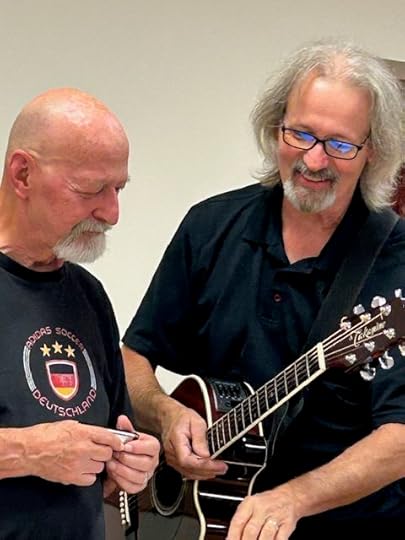 Brian with his ‘harp, Jeff pointing to the music
And it has. Jeff visited Brian at the Long-Term Care Home and played with him every month.
But Brian’s journey continues. This past summer Brian did a 4-month stint at the special Dementia Care Unit of the Brain Institute (Toronto Rehab Institute, University Health Network). While there, the Alzheimer’s Society Music Project (see Notes below), had fitted him with a wearable MP3 player and headset, loaded Brian’s play list on it so that music can be with him always. Music has a calming influence. But Jeff was not able to play with him there.
Alzheimer’s disease has an odd way of inflicting decline: big stair down, then sit on a plateau for a bit, then suddenly another big stair down. Brian is now Stage 6 – Late-Stage Alzheimer’s. (There are only 7 stages – the last is ‘end of life’.) With no ability to communicate using words, and failing mobility, we can only rely on facial expression and reactions to understand what is working and what isn’t. We thought we’d lost Brian’s ability to play; we didn’t know if he had enough ‘breath’ to play anymore – but we must try. I bring his harps, put one in his hand, blow on it to make a sound and lift his hand to mouth; Jeff strums his guitar, Sandra sings, we wait 20 seconds and voila! Brian plays. And Jeff and I cry – we can’t help it. Alzheimer’s is a thief so to score a glimmer of Brian is precious. There are no words, only the red thread that may tangle but not break, for his soul to sing to the music.
In the words of Oliver Sacks: ‘To those who are lost in dementia… music is no luxury, but a necessity, and can have a power beyond anything else to restore them to themselves, and to others, at least for a while.’ (p. 385)
Jeff wrote a song about the loss of Brian in his life – a tender melody of melancholy. I feel his living grief. Jeff is on this journey with me. “…Watching him fade away…A crying shame…”
For Brian, I hope he feels the love I have for him when he looks in my eyes; I hope music feeds his soul; I hope he feels Jeff’s tenderness and that fills him with peace; and when I hold his hand, I hope he feels safe on this journey that is so terrifying.
Catherine Mossop, reporting to you from Cobourg, Ontario
(With contributions from Doug Jordan, Kanata, Ontario.)
© Catherine Mossop & AFS Publishing
NOTES
The Benefits of Music for Those Living With Dementia
Oliver Sacks, made famous in the Robin Williams movie, Awakenings, did much research into the causes and amelioration interventions in mental and motor dysfunctions, particularly Parkinson’s Disease, but also many other neurological diseases including Dementia. In his book, Musicophilia (2008) Sacks tells of many cases of the effect of music as therapy for patients with various neurological afflictions: it is the ‘Mozart Effect[1]’ that comforts and soothes, not only cranky babies and stressed out students but also distressed patients struggling with failing memory and mental confusion. In the last chapter, Music and Identity: Dementia and Music Therapy, he tells of the relief patients with Dementia and Alzheimer’s get from listening to soothing familiar music from their past. ‘Music therapy is possible because musical perception, musical sensibility, musical emotion, and musical memory can survive long after other forms of memory have disappeared. Music of the right kind can serve to orient and anchor a patient when almost nothing else can.’ (p. 373)
‘patients with dementia [do not have to be] specially gifted in [music] and yet – remarkably, and almost without exception – they retain their musical response and tastes even when most other mental powers have been severely compromised. They can recognize music and respond to it emotionally even when little else can get through. Hence the great importance of access to music, whether through concerts, recorded music, or formal music therapy.’ (p. 379)
Sacks reports cases of some dementia patients who were consummate musical performers in their past lives, who, otherwise severely demented in everyday self-awareness and self-care, can play their instruments as they did when they had all their faculties. ‘Regrettably, there appears to be no carryover from performance and procedural memory [music] to explicit memory or usable knowledge.’ (p.378)
The Alzheimer’s Society has picked up on these findings and implemented music therapy into the treatment of patients with dementia:
Music is deeply embedded in both our conscious and unconscious minds. This connection becomes especially crucial when brain function declines, as seen in dementia and other cognitive or physical impairments. Music has the power to awaken the brain, unlocking a wealth of memories linked to familiar songs and cherished tunes.
When an individual with dementia is exposed to music they listened to earlier in their lives, they may be able to recognize the song and even recall some part of the memory they previously associated with the song. The well-researched benefits of personalized music include improvements in mood, cognition, and communication; it can stimulate memories and promote relaxation.
Sharing music that is meaningful can also promote a sense of connectedness and can be a bridge between persons with dementia and family members and healthcare professionals. Indeed, overall quality of life may be improved by reducing adverse dementia symptoms and providing an enjoyable activity to engage in. In short, the Music Project provides moments of joy to those living with dementia and their care partners.
The Alzheimer Society Music Project helps individuals with dementia reconnect with the soundtrack of their lives. We provide MP3 players filled with personalized music tailored to each person’s unique tastes and memories. This personalized music experience can significantly benefit those living with dementia by enhancing physical and social activity, rekindling old memories, and improving sleep, mood, cognition, communication, and overall quality of life.
Since 2013, the Alzheimer Society has been facilitating the Music Project with great success. On average the program delivers 800 MP3 players every year to individuals living with dementia in Toronto and across the province.
[1] The Mozart Effect’ has been shown to be largely unfounded when it comes to intellectual development, but music generally, not just Mozart, does provide temporary relief for distress, especially in neurologic patients. The reason for this – the how of neurological processing – remains unclear. (For more on memory and the brain see the blog post, Coding and Decoding.)
All rights reserved. No part of these blogs and newsletters may be reproduced without the express permission of the author and/or the publisher, except upon payment of a small royalty, 5¢.
The post 25.20 A Journey With Dementia 5 – Musical Mind appeared first on AFS Publishing.
October 15, 2025
25.19 Sympathy for the Devil
It’s doubtful Mick Jagger had the Palestine-Israeli conflict in mind in 1968 when he and the Rolling Stones produced ‘Sympathy for the Devil’, but it certainly fits the pattern – Evil as the root cause of criminal atrocities throughout history. The irony of the title is not lost on me but seems to be lost to so many liberal apologists: Sympathy for the plight of Gazans has been conflated with the evil perpetrated by Hamas.
For two years following the horrors committed by the Islamist terrorists, Hamas, upon Israel October 7, 2023, the perversity continued in altogether unimaginable ways. Even with the ceasefire and the optimistic peace accord brokered by US President Donald Trump, violence and enmity threaten the fragile entente. And a fractured world warily watches, or worse, continues to vent its spleen over Israel’s right to exist and to seek justice. For two years Israel sought to have the return of the remaining hostages (most of whom are now cadavers) from Gazan tunnels, and the permanent elimination of Hamas terrorists; but the world perceived instead, wrongly in my view, a brutal destruction of the Palestinian enclave in Gaza. Israel’s fight for existential survival has, perversely, come to be seen as an oppressive occupation of the land of vulnerable victims. Privileged Western sympathizers have somehow put themselves in the position of supporting a brutal barbaric regime rather than an oasis of democratic ideals and hope. Civilized Western society is gradually being undermined and subverted, ironically, naively, from within.
 Pro-Palestinian Encampment at U of Toronto
In my blog article of 2023 November 15, titled No Tolerance for Terrorism, I inveighed against the brutal evil that was on display by 6000 Hamas terrorists from Gaza upon innocent Israelis just across the walled borders, with over 1200 Israeli civilians and a handful of IDF members ritually assaulted, raped, tortured and murdered, and some 240 others kidnapped and taken back to Gaza as hostages, bartering chips for future negotiations and leverage – grotesque crimes by any measure. Almost as horrifying was the wide displays of glee and triumph of non-combatant Palestinians in Gaza and by Palestinian sympathizers around the world. The widespread support for the truly evil Hamas insurgents came as a surprising, appalling, perversion of civilized values.
But it got worse. Instead of seeing the Hamas ‘Resistance’ for the depraved evil that it is, the world has largely cast its support for the Palestian cause, perhaps without realizing, or admitting, what that cause actually is. Aligned Muslim countries around the world, and most particularly the Arab world, reflexively backed the Palestinian cause (mostly Gaza) against the military might of Israel (tiny, democratic, fiercely determined to defend itself). (It must be noted, however, many Muslim countries, particularly Jordan, Egypt and Saudi Arabia were conspicuously silent on the Palestinian affair – they want no truck with these radical Islamists and their international Islamist Brotherhood.)
Many third world countries identified with Gazans as oppressed victims against Israeli aggression; (many did not, preferring to stand back and adopt an officially neutral stance – not their circus). The Union of South Africa took this twisted anti-Israel view to the highest court (?) – the International Criminal Court – and filed a complaint [preposterous, unfounded] against Israel for alleged genocide. Israel’s actions in Gaza do not even remotely meet the international definition of genocide. Israel had a right to pursue those perpetrators of heinous crimes and achieve the return of their kidnapped citizens; this has come at the cost of brutal urban warfare where-in the cowardly militant Hamas hid in their vast maze of tunnels and in plain sight using Gazan citizens as human shields. This is not Israeli-caused genocide of Gazans, but ongoing war-crimes by the barbaric Hamas.
But it got worse.
As Israel girded itself to seek justice for the victims of Hamas perversity and retrieve the Israeli hostages (and in a number of cases, other foreigners), Palestinian and their Islamist sympathizers in diaspora in Western countries including Canada began demonstrations of support for the alleged plight of the Gazans. Organized sympathisers and weekend warriors demonstrated in their thousands in the streets of major cities all over Western Europe, Canada and Australia, deliberately blocking the mobility of ordinary citizens, and without any regulation or intervention from law enforcement officers; tent city occupations on university campuses; frequent vandalism and violence against Jews, synagogues and businesses became widespread; deliberate acts of subversion masking as prayer disrupted the streets of Montral and Toronto weekly, almost daily, designed to mock and flaunt their destain for authority. To my amazement the ranks of these expected sympathizers quickly began to swell with many times more support from the citizenry of these Western countries – the idealistic and naive university students, and their subversive professors, the middle-aged social progressives seeking to express their sympathy for the ordinary residents of the war theatre that is Gaza, the burned out boomers who are reliving their own 1960’s rebellious youth. In the ensuing months, empathy for the Gazans became antipathy of Israel and Jews. Police forces, misguidedly perhaps, tolerated these acts of civil disobedience and mischief; they refused to police Western behavioural norms and have essentially lost control of the streets and public places. It was astounding.
And, finally, unsurprisingly perhaps, the leaders of many of the major Western democracies have come out holding Israel accountable for the destruction of Gaza (a predictable consequence of a complicated urban war), paying lip service-only to Hamas’ fundamental responsibility for this mess. Countries from which we should expect true leadership for the fundamentals of democratic free societies – Britain, France, Australia and even peace-loving Canada – have abandoned 70 years of moral clarity and now equivocate over the right of Israel to defend itself against enemies on all sides bent on its destruction and refusal to accept its right to exist. It is to weep.
These sycophants may genuinely believe, Chamberlain-like, that peace in our time can be achieved through the implementation of a two-state solution. The two-state solution has been on the table since 1947 with UN Resolution 181 establishing the states of Israel and Palestine. But the Palestinians and other Arab neighbours did not accept this solution and made war on the fledgling state of Israel, surprisingly losing to the desperate Jews determined never again to submit to tyranny. Israel subsequently won six[1] more conflicts with the Palestinian and Arab neighbours over the ensuing almost eighty years, and endured almost constant rocket barrages from Hezbollah in Lebanon and Syria, Fatah in the West Bank territories, Hamas in Gaza and Houthis in faraway Yemen. While Israel built a prosperous enlightened democratic society, the Palestinians built tunnels, and provoked conflict. And with each loss Israel took more and more control of ancient Palestinian-claimed territory. One by one Arab nations abandoned the fight and recognized the right of Israel to exist. Except the Palestinian fanatics and their Iranian Islamic theocracy backers – they refused to accept a two-state solution, only one – Palestine.
The Palestinian chant, ‘From the River to the Sea’, i.e., from the Jordan River to the Mediterranean Sea, did not mean freedom for the Palestinians, it meant the annihilation of Israel.
But ultimately, to the Islamist Brotherhood, it means even more than that. It means the suppression of the very concept of nation-state. It means a universal Islamist caliphate of the entire world, the destruction of Western society. Somehow, sympathetic Liberal Infidels don’t understand this.
The Western World may one day come to appreciate the conviction of American President Donald Trump standing up in support of Israel and against the barbarity of the would-be architects of the Muslim caliphate. The Arab world increasingly seems to agree.
The moral dissonance we find on the progressive left defies understanding: the DEI adherents supporting a society with no consideration of Women, LGBT, Trans, and other minority rights; supporters of freedom of expression who would enjoy no such rights in Muslim societies; and most particularly, Sharia Law over western principles of democratically determined Rule of Law. Curiously, incomprehensibly, progressive supporters of Hamas seem to conflate Russian aims in Ukraine with Israeli ‘aggression’ in Gaza; it should be obvious that Israel and Ukraine have the same fundamental goal – fight for survival. (And it must be said, Trump’s quixotic behaviour vis-à-vis the Ukraine theatre seems so much at odds with his steadfast support for Israel.)
Israel is not just fighting for its own survival, it is now our surrogate, effectively fighting on our behalf for the ideals of the Western world for fairness, respect for individual rights and freedoms, and for the rule of law. We should be grateful for Israel’s grit, determination and success, not marching in the streets campaigning for some illusion of ‘Free Palestine’.
In ‘No Tolerance for Terrorism’ I wrote: ‘Canadians can have an opinion about the complex issues that are the Middle East, and more particularly the Israeli/Palestinian conflict, but to justify, not to mention celebrate, the terrorist acts of Hamas (or Hezbollah for that matter) is ethically, morally and even intellectually wrong.’ How have the confused minds of Western sympathizers got it so wrong?
Doug Jordan, reporting to you from Kanata
© Douglas Jordan & AFS Publishing. All rights reserved. No part of these blogs and newsletters may be reproduced without the express permission of the author and/or the publisher, except upon payment of a small royalty, 5¢.
[1] Suez Crisis, 1956; Six-Day War, 1967; The Yom Kapur War, 1973; the First Intifada, 1987-93; the Second Intifada, 2000 – 05; and now the ‘Gaza Resistance’, 2023-25.
The post 25.19 Sympathy for the Devil appeared first on AFS Publishing.
September 30, 2025
25.18 Rating Scales
10! She’s a ten.
And everyone, well, almost everyone, knows exactly what that means: A beautiful woman. Bo Derek in the movie, 10:
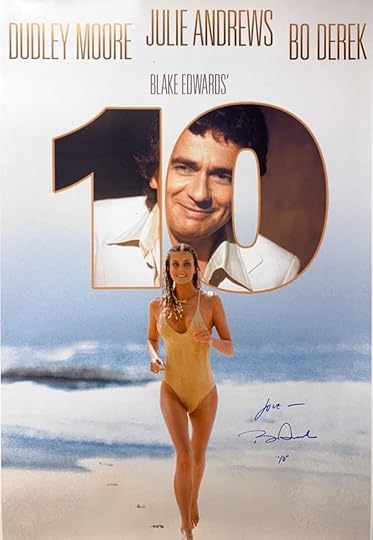
Personally, I never thought Bo Derek was a ten but there you are.
Six, she scored a perfect six. And what do we mean here? Why, it’s the [former-day] Olympics: gymnastics, diving, figure skating, where 1 meant very poor and 6 meant outstanding[1]. But are they absolute or relative terms?
The film industry has two scales[2]: the five-star system used by most reviewers (and the general public) and the ‘Rotten Tomato’ score. (Paradoxically, a high % Rotten Tomato score depicts a highly praised film.)
Books are rated on a five-star system, but nobody knows what five stars actually means. Excellent, evidently, but how excellent? Many reviewers reserve ‘5’ for exceptionally positive and, perforce, will downgrade their otherwise strong positive rating to a four. If 4 is the default score for a highly regarded book, how can we know what 3 stars mean? or even fuzzier, what does one star mean? Most would intuit that a 1 means terrible, but if that is the case, why any star at all?
And for many reviewers, a five-point scale doesn’t give enough gradation: I gave that book 3 stars on Goodreads; I didn’t think it a 4 but there’s no 3½ on the five-star scale.
So what does 10 (or 6 or 5) really mean? Without a definition of the points on the scale it becomes completely subjective: the usefulness of a rating scale can be improved if a qualitative description is given with each point on the scale. For example, if the points 1-10 are given without description, some people may select 10 readily, whereas others may select the category rarely. If, instead, “10” is described as “near flawless”, the rating is more likely to mean the same thing to different raters. This applies to all categories – if they are well-defined – not just the extreme points.
I don’t know what sort of scale judges use in a book award competition. Maybe it’s like figure skating. I know that books competing for a big prize are reviewed by a panel of judges, themselves, presumably, accomplished writers/editors/reviewers. There is a set of criteria assessed: plot, flow, character development, and so on, and each criterion is evaluated and then a total assessment of the book as a whole is rated. The panel then comes together, compares ratings and notes, and argue amongst themselves until a winner is produced. But what scale is used? I believe it is the same 5-star system but without a clear rubric as to what 5, or 4 stars mean, we still don’t know whether the winner was an absolute excellent book or merely mediocre, the best of a poor lot. Even with relatively well-defined criteria we still have a subjective process going on – one person’s 5 could be another person’s 2.
Look at any book widely reviewed on Goodreads. (I say widely reviewed so that we can have some sense of detachment from these reviewers – they’re not all family and friends trying to give the book a boost.) Here’s one: Amor Towles, The Lincoln Highway (one of my all-time favourite books (I gave it a five!)).
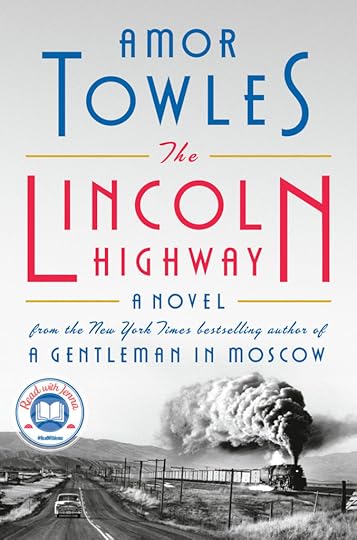
Community Reviews:
Overall average, 4.22; 303,919 ratings; 31,546 reviews
5 stars 136,972 (45%)
4 stars 111,398 (36%)
3 stars 43,748 (14%)
2 stars 9,265 (3%)
1 star 2,536 (<1%)
Wow, over 300,000 ratings! And 45%, like me, thought it a terrific book. On the other hand, 0.8% rated it 1 star, but that’s still 2500 people who, presumably, hated this book.
Compare these scores with my book, The Treasure of Stella Bay. Nine raters gave it an average score of 4.33; all 4s and 5s, none gave it only 1 star. Does this mean my book is better than Towles’?
Not likely. But in any event, unless they wrote a review to accompany their rating, we don’t know why these raters thought the book was ‘good’ – were they merely family and friends, not wishing to offend, or overly effusive in praise of my effort, if not the result?
I think these 5-Star rating scales for books and movies are fatally flawed and don’t provide objective ‘truthful’ information.
We need a scale where some sense of negative assessments (failure) factor into the ratings. We need some clarity around what does a five mean, and a three for that matter, but we certainly need to know what a 1 or 2 might mean: is that still a positive rating? What if the book is truly dreadful? Does it still get a 1?
As an active member of the Canadian Authors Association, as well as offering my services as a publisher/consultant helping other writers find their audience, I have been on the reviewer side of many books from aspiring and emerging writers; in most cases these books showed potential as stories but often lacked polish, even coherence; some are excellent and deserve to have a wider audience. As a life-long readers I have also read and reviewed hundreds of books from published authors whose works have survived the scrutiny of the publisher/editor. Often these are writers whose works have been on best-selling lists for months. And they are dreadful, and yet rated 5 stars by devoted followers. Being a published or ‘best-selling author is no guarantee that the book itself is any good.
So what to do?
We all experienced, I hope, the thrill, or agony, of getting our examination paper back from the teacher/examiner and frantically looking for our mark: pass or fail, superior or unsatisfactory; where 100 is perfect and 50 is a pass; 80 is superior and 30 is abject failure; now there’s a scale we can understand.
We need a scale that allows for ratings of superior quality as well as inferior quality. Both positive ratings as well as negative.
Social scientist pioneer, Rensis Likert, developed 5-point preference scale to try to measure positive response as well as negative: Not at all favourable, somewhat unfavourable, neutral (neither agree nor disagree), somewhat favourable, fully favourable. You can vary the terms but in all cases the scale needs to be balanced from negative to positive and the mid-point as neutral. The problem is, people often feel that a five point scale is too blunt, doesn’t provide enough nuance, and the neural score is perceived as empty, meaningless.
I propose an extended Rensis Scale for rating books ranging from the truly awful to the wonderfully crafted and entertaining. It needs to be an odd-numbered scale to allow for a central midpoint evaluation, but not neutral – the pass/fail threshold. It would need to be a sufficiently wide scale to allow for rater subtlety. Perhaps a seven-point scale, but more likely an 11-point scale to adapt raters used to tens, or fives.
Something like this:
-5 Truly dreadful-4-3 Too many flaws-2 -1 Slightly Unsatisfactory 0 Barely acceptable1 some merit and potential23 workmanlike competence45 Exceptional Merit(The 4s and 2s on this scale are left undefined for lack of sufficient vocabulary and to allow the rater to choose his/her own sense to the meaning. Maybe a seven-point scale is enough.)
With our eleven-point scale maybe now we can get some meaningfulness in rating books.
Doug Jordan, reporting to you from Kanata
© Douglas Jordan & AFS Publishing. All rights reserved. No part of these blogs and newsletters may be reproduced without the express permission of the author and/or the publisher, except upon payment of a small royalty, 5¢.
[1] But in fact the 6-point ranking process has been replaced with a complex 10-point achievement scale multiplied by a difficulty factor. We may not have known what 6 (or 10) meant before but, other than the judges themselves, we have no better idea now what a 9.7[1] means than a 6 previously, only that the person awarded that high score beat out all the other competitors for the gold medal. In today’s Olympic games, a modern Nadia Comaneci could never score a perfect 10.
[2] Well, actually there was a time when film reviewers Gene Siskel and Roger Ebert rated movies on a two-point scale, thumbs up or thumbs down, but Siskel and Ebert often didn’t’ agree themselves.
The post 25.18 Rating Scales appeared first on AFS Publishing.
September 15, 2025
25.17 The Delicate Art of Editing
To be an author takes a load of courage, or maybe it’s unadmitted hubris. Authors – well maybe not all authors – believe in themselves; they have to. They have a story to tell, and a belief they have the skills to tell it, well.
Well, not always. Deep down, or maybe close to the surface, they have doubt, lots of doubt. They worry that they don’t have the talent, and they fear that some reviewer will confirm that fear; others hope for affirmation, if not approbation.
So, to have some reassurance that his or her manuscript is ready to face the outside world, the next step in the author’s journey to being published is having a capable person edit his/or her work. Or should be.
Editors, on the other hand, seem not to have the same misgivings.
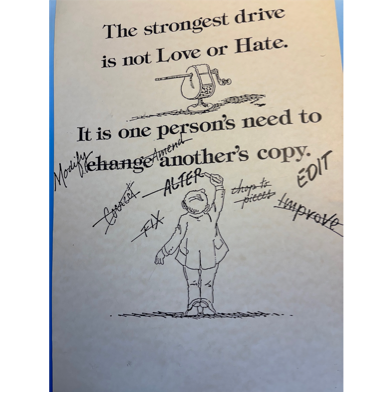
(This cartoon was given to me as a poster, and signed by all my staff, when I was VP HR at Mitel Corporation, 40 years ago. I’m sure it was affectionate feedback.)
So, to give his manuscript to an editor is a ritual authors are likely reluctant to engage in. All that (‘positive’) feedback, and opinion disguised as ‘suggestions’, may not be taken well, even if the author smiles savagely in thanks to the editor.
Knowing this, the editor has a very challenging job: giving feedback and providing advice, guidance and suggestions, all without usurping the author’s ownership of his own opus – and undermining the relationship – takes a tremendous amount of tact, diplomacy, and finesse. And likely, courage.
Beyond diplomacy, and due regard for the author’s tender ego, what are some requisite attributes for an effective editor?
Well, rather obviously, a good command of the language (let’s assume here the document is in English): spelling (despite the help of spellcheck software) – especially the misplaced homophones not caught by spellcheck, and grammar (in spite of ‘Grammarly’ software – Grammarly is not the last word on grammar, nor is Fowler). The problem with ‘correct’ grammar: not everyone agrees as to what is correct. (I’ve written more on this here, and here.) The author, having his own peculiar style guide, may have deliberately chosen to split that infinitive, to use the passive voice, punctuates with a variety of separators – not just commas but also dashes, semicolons, and the occasional oxford comma; it’s not for the editor to insert his sense of ‘proper grammar’ in place of the author’s. Except, if the meaning is not clear: if idiosyncratic grammar and punctuation confuses the reader, the editor is obliged to point this out to the author. This also includes the patience and eloquence to try to explain the problem to the stubborn writer.The editor needs to be tuned into the logic of the text. The secret to clear writing is clear thinking. But the writer, fully immersed in his story in his head, may not realise his text has left out some important bits, or they are in the wrong place.Closely related to logic is structure. There are different ways the writer can construct the plot and roll out the story but the pieces of the puzzle need to come in a rational way, not out of sequence to the logic of the structure. Timelines may go back and forth but you can’t have an event later in the text that has no logical connection to events earlier in the text.Closely related to the logic problem is ‘the twist’: the introduction of a new character or event out of the ether, or out of convenience, to bring the plot to a satisfactory conclusion. This is a particular problem for mystery genre writers.Closely related to structure is ‘point of view’ – ‘POV’ in the biz. The author has to decide whose story is this anyway, and then stick to it. The author needs to determine who the narrator is, the ‘person’ delivering the story to the reader: the professor writing a learned text, the biographer telling of the life of the subject, the memoirist telling his own story. The memoir is told in the first person, naturally; a work of fiction can be told in the first person as if by the main character himself; more commonly is the fiction told from the point of view of the main character, but instead of in the first person is told by the involved narrator in the third person. The problems with pov for the author is sticking with it: the author can’t shift from one pov to another in the same text. The skilled writer understands this problem, selects his POV at the outset and sticks with it. But in the flow of things, sometimes he will slip up. More insidious is when the plot requires new information that can only come from a source different from the main character as narrator. This is the problem of omniscience: if the narrative is told from the first or third person personal point of view the narrator can’t know what is in the mind of another character in the story. There are devices to overcome that problem but often these are unsatisfying to the reader. To overcome the individual pov problems the author has to adopt an omniscient narrator point of view from the outset. POV can be difficult to sustain by the author deep into his draft, but to fresh eyes, i.e., the editor, the pov problems are usually more apparent, if not jarring. Now the problem is, how does the editor explain to the author that one of them has lost the plot.Okay, one more structural problem the editor has to be vigilant for is tense. I mean, the relationship between the author and editor is tense enough but here I’m speaking of verb tense: past tense or present tense. Most authors prefer past tense as the most natural voice for a story that evidently has already occurred. But many authors prefer to use the present tense, as if the story is actually happening as the reader reads it. This tense is more conducive to creating energy and, dare we say it, ‘tension’ in the reader, more immediacy, as if the reader is a direct witness to the events of the story. The problem with tense is something like the problem with pov. Once you decide which tense you’re going to use you have to stick with it. And when events in the present require knowledge of something that happened in the past, you either have to go back to the place in the narrative where it should have occurred to insert the events, or otherwise get tangled up in complicated past imperfect or subjunctive tenses. The problem for the editor is to point out these lapses and then comfort the writer who realises what a lot of work he now has to do to fix these problems.Genre bias. We all have our biases and that’s no less true for editors. It is likely that editors – masters of grammar and style – will have preference for some genres over others. Editing technical papers requires not just good command of language but domain knowledge as well. An editor of historical fiction will likely struggle with speculative fiction; fantasy/romance writings will not go over well with biographers. Editors should probably decline to review a manuscript in a genre they are unfamiliar with, or don’t appreciate. I don’t know who poets can go to for feedback.Unnecessary content. Authors love their words, and their sentences, but for the editor to persuade the creator there are ‘too many words’ is a difficult conversation. The saving grace is that the writer, even though in love with her own words, soon forgets them once they have been deleted, especially if the new sentence or paragraph reads much more smoothly. One of the great advantages of word-processing software is the ease of cutting & pasting text: cutting from the manuscript and pasting in a reserve file for use some other day in some other manuscript, assuages the authors angst over the loss of her children.Close cousin of too many words is too few. The author expresses a scene or an action ‘economically’ leaving the reader to ponder and guess what the writer is getting at. This is an opportunity for the editor to invite the writer to embellish and add more colour and flavour to the passage. It’s also an opportunity for the editor to help the writer with his block by offering some of the missing text himself, at risk of hijacking the opus.Cliché vigilance. Close corollary to the author’s love of his own words is the lack of awareness of the use of clichés in his or her text. Much of the content of our minds is subconscious absorption of thoughts, ideas and expressions that come from our social existence, the memes of our lives. Fully immersed in the creative process of bringing an idea into a written story the creator doesn’t realise the idea has already been explored by others, overused even; the highly descriptive imagery, simile, metaphor, the comfortable turn of phrase, is a horse already beaten to death. The editor needs to suggest, delicately, the author’s unoriginality.Fact checking. The editor is not the researcher – that’s the author’s job, even if the author delegated the task to an intern – but the editor has to pay attention to the doubts and questions that arise from the mists in his mind that that statement, claim or name the author used isn’t correct. When the editor is not a domain expert, and assumes the writer is, or at least has done the investigation of the facts, it’s natural to trust the author to have done his job. The problem comes when the author’s faulty knowledge goes unchecked into the text. The editor has to flag anything that ‘just doesn’t appear right’.‘Show, don’t tell.’ The classic stylist advice for every author. Of course it is insulting to the intelligent reader to explain the obvious. Even children will roll their eyes at ‘obvious-man’. But for writers of fiction, memoirs, biographies – any narrative effort whatever – telling is what the job is. Showing without telling is hard, nye, unrealistic. I have struggled with this ‘challenge to writers’ many times, usually solving the problem by giving the job to the characters in my novels through dialogue: it’s easier to have the characters telling each other what’s going on than describing the scene itself. So, the advice for the editor fresh out of creative literature class, unless it’s painfully obvious, shut up about it. I read recently in a delightful novel about a book-store owner, the origin of this hoary guide to authors: it was intended for screen-play writers, not novelists. The playwright tells the story largely through dialogue, naturally, leaving the director of the play to create the scenes and stage the play to show the audience what is going on: ‘Show, don’t tell, is a complete crock of shit. It comes from Syd Field’s screenplay books but it doesn’t have a thing to do with novel writing. Novels are all tell, they aren’t meant to be imitation screenplays.’Finally, there is accountability and reputation to accept and protect. Authors often want to acknowledge the contribution of the editor, without which this book might never have come to being published; (this is even more of a problem if the book is self-published). But if the book is sloppily written and so published, some of this mess falls to the editor. (I wonder if many editors publish under a pseudonym.)In my experience as an editor – of which I’ve had decades of practice and acquired a ton of self-learned expertise (ref. above cartoon) – editing is exhausting work. You have to read every line, and then, when you stumble over something, go back and read it again, then make some markings in the document, or the margins (digitally or in hard copy (the old fashioned way, with red pen)), and then review it all with the writer. Remote computer access has rendered this process somewhat semi-antiseptic: e-mail the marked-up document to the author and let them go over it on their own, stewing and seething in gratitude and confusion at all this wonderful feedback.
I guess the advice to editors (if that’s what you want to do), is, show, don’t tell. But with tact and diplomacy.
Doug Jordan, reporting to you from Kanata
© Douglas Jordan & AFS Publishing. All rights reserved. No part of these blogs and newsletters may be reproduced without the express permission of the author and/or the publisher, except upon payment of a small royalty, 5¢.
The post 25.17 The Delicate Art of Editing appeared first on AFS Publishing.
August 31, 2025
25.16 Authors and Editors
Almost every author I know, and a lot more that I read, remark in their acknowledgements that they are so very grateful for their editor for making their opus so much better. It’s kind and generous of them to say so.
But I think they are lying. Or if not lying, exactly, they say it grudgingly, through clenched teeth.
I’m not sure what editors think of their role on the production of a book. Glad to be of help? Superior? Just as stressed as the author?
It’s not an easy thing to give feedback and suggest ‘improvements’ without straining the relationship. Harder still to accept those suggested inputs gracefully, without rancour, resentment, even if it is needed.
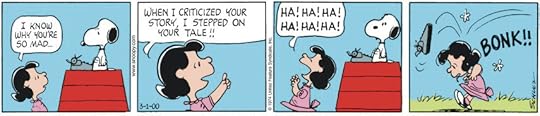 The Author lets the Editor know what he thinks of her feedback.
There are two kinds of writers, of course: good ones and bad. (Well, in reality, there is a spectrum from good to bad and many degrees of mediocre in between; but never mind that now, we’re building a case here.)
And there are two other categories of writers: those who welcome feedback on their work, and those who don’t.
This leads to a 2×2 matrix:
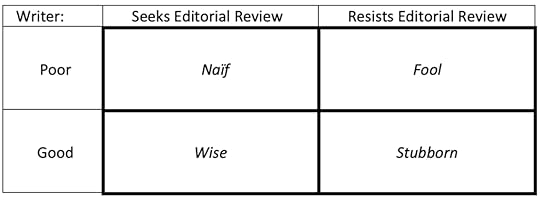
Naïf, doesn’t mean the writer is shallow or ignorant, though it might include that, it really means innocent. Naïfs don’t know whether their writing is good or poor, or whether their story idea is empty and common, or novel and entertaining. Either way they need honest and constructive feedback: encouragement to keep on revising, or the advice to give it up.
A Fool and his money are soon parted and this maxim certainly applies to the poor writer who resists feedback, for the Fool may spend loads of money on cover design, production costs, advertising and entry fees, and get no buyers.
The Wise author may not realise he’s good (but probably suspects it) and seeks editorial review because he genuinely wants another opinion on his manuscript from an experienced editor/reviewer who can add value to his opus. He swallows his pride and seeks the help and revises his manuscript accordingly. He may even get a flattering blurb for the back cover of his book.
Stubborn is an adjective and it probably would go well as a moderator of Fool, hence this quadrant might better be labelled idiot. For what does it cost but silly pride to seek constructive feedback from a credible source.
(You’ll note that I used the third person masculine pronoun in describing these type-casts because, for me, the Fowler follower, this is correct usage to denote a generic gender: I’ll not truck with the current clumsy third person plural ‘they’ or ‘them’ or ‘their’ to denote neutral. Besides, I’m not sure whether female, or even gender obtuse, authors ever resist seeking feedback.)
I’m sure you, my faithful reader, wishes to know which quadrant of my matrix I (He/Him for any of you in doubt) fall into. If you guessed Stubborn you might be right. (I do think idiot a bit strong, though it’s true I have never covered my production and marketing costs in trying to sell my books.) I admit to having enough hubris to think my writing is good, economic, accurate, ironic, fluid, readable: entertaining, if not educational. Why would I want feedback only to have my deepest fears confirmed. At reviewer might be entitled to her opinion but she might be wrong. I’ve had enough approbation from my devoted readers to feel both affirmation of my writing and encouragement to write more. As for the rest, I can think of dozens of reason why they missed the point.
So I resist getting an editor to review my manuscripts. I get beta readers instead. I select beta readers who are likely to be positive but also diplomatic in giving me suggestions for improvement. By the time my beta readers have their hands on my manuscript (fully formatted and in book-sized advance copy) I’ve reviewed it and revised it many times over. I live with the maxim, Fourth Draft (after the book by John McPhee, Draft #4, On the Writing Process) thinking that, as a ‘good writer’, four is enough. And truth be told, those drafts have been edited multiple times before they ever get into beta readers’ hands. I don’t much worry about typing errors – MSWord finds most of them (of which there are many) – but I do look for awkward sentences, illogical statements, structural problems, and the like.
And despite me instructing my beta readers not to labour over typing errors (they are not line editors), they seem to find plenty. What I’m really asking for is whether the story itself is worthwhile, with suitable logic to the plot, good flow, good character development and consistency. If they suggest something that I agree with that improves the work, I take that into account in the fifth draft; if not, I ignore – thank profusely, but ignore.
I think that’s what most writers do, at least to some degree. After all, it’s their project, not something to be hijacked by some jumped up English major!
And there’s the rub. The author pours a lot of energy, effort, time and ‘soul’ into the creation of his or her book; to put it in the hands of someone else to care for and foster means the final product is not the author’s alone and some part of him is lost, even if the final product is better than the original. It’s a dilemma.
To be an author takes a load of courage, or maybe its unadmitted hubris. Authors, well maybe not all authors, believe in themselves; they have to. They have a story to tell, and a belief they have the skills to tell it, well. (Well, not always.) Deep down though, or maybe close to the surface, they have doubt, lots of doubt. They worry that they don’t have the talent, and they fear that some reviewer will confirm that fear; others hope for affirmation, if not approbation.
In either case, to expose one’s work to an editor takes courage. To give up one’s creation – one’s baby – to someone else to ‘improve’, is very hard on the ego, the very self. Is it any wonder authors – Stubborn or otherwise – are reluctant to submit their work to an editor’s review.
Well, maybe most authors don’t harbour those feelings of fear and resentment and genuinely welcome the suggested improvements. Maybe it’s just me who resists editorial review.
But I don’t think so.
Doug Jordan, reporting to you from Kanata
© Douglas Jordan & AFS Publishing. All rights reserved. No part of these blogs and newsletters may be reproduced without the express permission of the author and/or the publisher, except upon payment of a small royalty, 5¢.
The post 25.16 Authors and Editors appeared first on AFS Publishing.