
M.J. Walker's Blog
November 20, 2016
Free Book Giveaway: Lord Morgan’s cannon
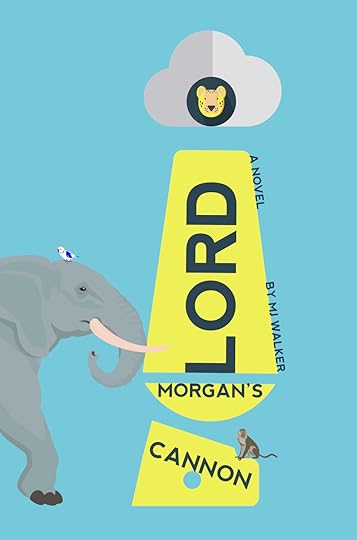
The animal adventure story Lord Morgan’s Cannon by MJ Walker
IS FREE TO READ ON AMAZON KINDLE FROM 20-24 NOVEMBER 2016 INCLUSIVE.
You can download your free copy here:
https://www.amazon.co.uk/Lord-Morgans-Cannon-MJ-Walker-ebook/dp/B01B554I9C/
“The anteater, elephant, budgie and pin monkey know of only one way to save their ruined circus.
They must seek out Lord Morgan, and his huge new cannon, which can only be operated by the cleverest animals in all the world.
The old leopard meanwhile, fancies taking a piece of Lord Morgan’s thighs.
So begins an endearing and revealing story about the nature of humans and animals; what we think and feel, and the differences, if any, between us…”
Copyright: MJ Walker



October 19, 2016
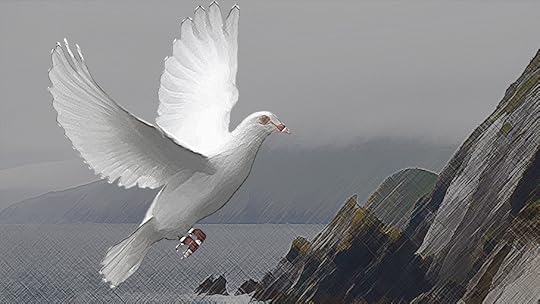
A Young Rock Dove
For the first time, he notice the island’s age, the fault lines in the rock, the tired grass bleached by guano. Overhead, a thousand birds raced, surfing unseen waves, above a white sea that never rested. Each squawk and screech called him home. A powerful gust caught his arms, lifting him.
By the cliff’s edge, a wisp drifted from the roof of the house. An ocean of wind blasted two hundred feet of jagged granite, dispersing the smoke. The house leaned towards the chasm.
In the door of the house, he saw the shadow of the old man. His keen eye could discern the man’s tight, weathered skin stretched over bones full of air. He hoped the old cock had the answers he’d been seeking.
He glided down to the house, alighting gently on the path. The old man grinned, placing a large net full of holes against a wall built without render. The man folded the boy’s collar, ran his empty hands over him, preening, beckoning him in.
Upon a fire, a bird roasted, breast dripping, the fire spitting the fat onto the stone floor. “Why did you ask me to return?” asked the boy. “To tell you who you are. What you will become,” said the man through a small, sharp mouth.
He gestured for the boy to sit in a wooden chair opposite the fire. The old man took a stool. “Did you have trouble finding me?” the man asked.
The boy looked into the flames. The maps called this place Bird Island, but had forgotten why. They didn’t record the guillemots and gannets, the gulls and terns, the chatty puffins and occasional albatross that nested the crannies. The thousand years of culture. The hardy women and brave men who climbed the cliffs on ropes, plucking eggs from ledges. The Bird People who now lived within black and white photographs pinned high to the walls of the empty library across the channel.
“Yes,” the boy said. “The trawlermen say no-one lives on the island. They didn’t want to bring me.” “Fishermen forget to look up,” chuckled the man. “Are you hungry, would you like some meat?”
The boy recognised the bird on the spit, an auk, and declined. He hadn’t eaten it since he’d fledged and flown away, years before. He wanted to ask how it had been harvested.
“Do you want to get started?” asked the old man, his back straightening. “Yes,” the boy answered, forgetting his question.
The old man pulled off his boots, warming ten prehensile toes in the fire.
“Do you know why we called you squab?” he asked. “Not really,” said the boy. “Because I was young and weak?” “Do you know what a squab is?” “A baby pigeon,” answered the boy. “A baby rock dove,” said the old man. “There’s a difference.”
Pigeons, said the old man, lived on the mainland. In the towns and cities. They are common birds, nothing special. They get fat on modern life, and are prone to disease.
He then took the boy’s hand in his. “They forget how to fly,” the old man said, eyes glinting in the shadows.
Rock doves are the ancestors of pigeons, the original breed, the bird from which pigeons descended. Rock doves are youthful and sleek, almost lighter than air itself. They twist and turn, purely for fun. They venture far. And unlike pigeons, they always fly home, to the first roost.
“But why did you call me squab?” asked the boy. He now realised his name had not been an insult, but still he could not understand. “Rock doves don’t live here,” he said.
“They once did,” replied the old man. “They used to fly this land, these cliffs. They could reach every hillock, each nook and ledge. How else do you think they harvested the eggs, before the metal ladders and ropes? They flew of course!”
The auk’s skin began to brown and crisp.
“Over the centuries, each generation lost more feathers. Their nests became houses. They fell to the ground, becoming domesticated, many moving away. Those that stayed could only cling to the cliffs, using their fingers and toes, occasionally plummeting to earth, covering the rocks in yolk.”
“But just when we thought we’d bred ourselves into extinction…” The old man, mouth agape now, hovered a few inches off his stool. “…an ancestral line was reborn,” he exclaimed, settling back upon his wooden perch. “And now a young rock dove has returned!”
He stood the boy up, ruffling his hair, feeling the strength of his muscles. He walked him out of the warm house into the cold wind. The sun had begun to set. He took the boy’s coat from his back. “You won’t need this,” he said.
He turned the boy’s body eastwards, into the prevailing gusts. Standing behind, he lifted the boy’s arms, turning his palms. “Do you feel it?” he asked. The boy looked at his feet, and realised he was off his toes.
“This is your home now,” said the old man. “You won’t need any ropes. Ignore the rusting ladders.” The birds above fell silent. They zigged and zagged away, leaving clear red sky. They invited the boy upwards.
© 2016 MJ WALKER


March 31, 2016
A Professor’s Life
This short story is more personal than most.
It’s in honour and memory of Professor Robert McNeill (Neill) Alexander, who taught me, and so many, so much.
A Professor’s Life
(648 words)
One day, a young man with an extraordinary interest in animals picked up a mouse, and played with it in his gentle hands. He wondered about the mouse, and as it was caressed, the mouse wondered about the man.
They studied each other, until the man, content with what he saw, allowed the mouse to leave. He opened his palms, and watched as the mouse leapt from his fingers, awed by how such a small rodent could make such a jump from such tiny legs.
At that moment, the man rubbed his smooth chin, and made a promise to one day understand the mouse, and how it now skipped away. And the freely skipping mouse made a promise to one day understand the man, and how gentle he had been.
The years passed, and with them the man’s insights into the abilities of animals grew in strict accordance with the hair upon his face.
Stroking his beard, he watched spiders weaving, the geometries of their actions floating as gossamer upon his thoughts. Fireflies sparked new theories in his brain, dreams of rampaging dinosaurs chasing his mind in new directions.
He studied shoaling fish, learning to pilot others as to how life worked. He taught the young about nature as mother chimpanzees teach theirs. In old bones he saw great vigour, and as he matured, he soared with the eagles, resolving the trajectories of their flight, until in his later years, he became a professor of zoological mechanics, knowing enough about the animals with which he shared the world that he inherited the grace and wisdom of a great, aged whale.
Finally, as he had calculated all bodies must, his began to fail. Within his mind he still ran with the cheetahs, and the springing boks they chased, measuring their movements. He swung with the gibbons, to feel how they defied gravity in such brief, graceful arcs. He marched with the ghosts of long dead mammoths, and inspired by the okapis and giraffes, he continued to look up. But one day, his vigour left him, and the now old man with a white beard became bones himself.
He returned to the earth, where the creatures took their turn to study him.
First came the worms, who pushed against him, verifying the resilience of his tissues. Snails slithered up and down his limbs, in awe at their form, until the beetles lifted him onto their backs, carrying him forth to meet his subjects.
Out under the stars, a grass snake confirmed the straightness of his back. A badger applauded his ability to dig, a wildcat his insatiable curiosity. From afar hawks gazed into the professor’s eyes, noting a twinkle that attracted the most beautiful moths, while a langur monkey celebrated the man’s wily looks, as an elephant recognised the size of his heart.
Yet more animals came to record his dimensions: nattering parrots, lonely jaguars, flying frogs, chameleons, an army of ants and a herd of wildebeest queuing to validate his true nature.
Until at last his mouse ran upon him, finding comfort nesting in his long, white beard. It curled up within his palms, feeling one more time his gentle caress.
Then it kept its promise to the man. The mouse surveyed and audited his head. It noted the angles, computed the volumes, did its sums and resolved its equations, until at last, it had the measure of the old professor’s mind, and the great leaps it had made when in life.
Happy that now it finally understood the man, and his gentle nature, the mouse released the old professor, giving him over to the bats and the birds. They lifted him up, feeling his levity and grace, and finally the weight of his soul, until, all studies finished, they let him go, watching as his white beard fluttered on the wind, and he drifted up into the clouds.
© 2016 MJ Walker


March 27, 2016
The Candidate
The first poster appeared in the window of a small pharmacy selling Chinese herbs to the people of Dawlstone, Tennessee. It showed a face: two eyes and a wide nose above a flat grin. Locals disagreed over what kind of face it was. Light or dark, if it stared or just looked upon the world, whether it seemed kind or ambivalent to their fate. One old boy, who claimed to have worked as a trapeze artist, but who now lived in a three-wheeled supermarket trolley, flagged down a passing police car, telling an officer the face looked guilty, of something.
Plastered on the window’s outside, the poster soon caught the sun, was pulled down, rolled and used by a customer to smoke the extract of a plant. That’s how the pharmacy owner, the son of an immigrant, remembered it.
Within a month, a second poster appeared, two blocks from the first, upon the sidewall of a garage specialising in fixing America’s cheapest motor vehicles. It looked much like the first, but the auto mechanics recall it in colour; with the same face sitting under a mop of brown, or perhaps black, hair. A third was glued to the window of the Italian barbers and a fourth on the side of a yellow garbage truck that drove the same twelve streets each Wednesday morning. No one recollects a name accompanying the face.
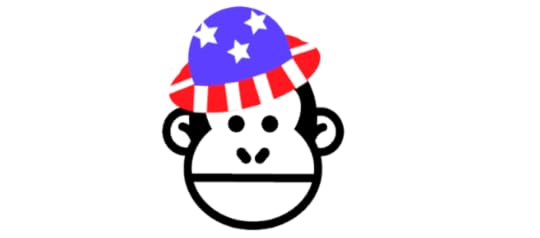
After the summer passed and colder winds began to blow, a spate of posters appeared across Yellow County, each showing a clearer face, the subject eyeing its audience more intently. Modern, richer inks improved the quality of the prints. The improved definition led many to speculate the face wore a hat, one covered in Uncle Sam’s Stars and Stripes.
The hat began to divide opinion. At that time, in those parts of Tennessee, some people didn’t take kindly to the Stars, while the Stripes offended others. A few liked the Stars and the Stripes, but not on a hat. And at least one youth was arrested for staging a sit-down protest in front of a poster that he admitted stealing from the bark of a tree and pasting onto a placard. Before being led away, he was heard shouting that the colours red, white and blue offended his God.
Then the rumours started.
Maybe it was because the value of the dollar had fallen, and the good folk of Yellow County had, over the past four generations, grown to become suspicious of their neighbours, and any person they could not recognise. Or because of the disagreements about the style of hat this face wore, or the morality of sporting a hat covered in a flag. It could have been because the policeman, forewarned by the old drunken tramp, had taken in his spare time to searching shopping malls for vendors of such attire, in the hope of finding a clue to the wearer’s identity.
But people began to suggest the face in the posters was wanted by the authorities. For more than a misdemeanour. Possibly wire-fraud, or embezzlement. Robbery even, or murder. That would explain the sudden rise in the number of posters appearing, and their placement high above the children’s heads. An editorial in Yellow County’s newspaper described how wanted posters didn’t depict felons wearing hats, especially those of colour. It suggested the face in the poster wanted to be recognised. Editors of the official newspaper of neighbouring Blue River County countered, stating that any such person must be a narcissist, but one of great sophistication, given they had not added their name to their picture now pasted upon the walls of empty tenement houses corroding the capitals of counties across the State. And that editorial caught the attention of Tennessee Public Radio, which conducted a midnight poll asking if listeners knew of such a person. It received hundreds of names, suggested by those drunk, lonely, addicted to the airwaves passing through their skulls, or suffering from insomnia.
At that point, speculation turned to confusion. Many names attributed to the face were fictional. A number belonged to people already dead, who looked nothing like the posters’ face when living. But a few resonated with the audience. And for some inexplicable reason, men and women whispered these names, over dinner and during the ad breaks of daily soap operas appearing on cable television. The mutterings became sirens, and the more these names were said, the more posters appeared. Each beckoned the face, with its brown or perhaps black hair covered by a hat depicting the national flag of the United States of America, out from the ether, until there were so many posters, portraying so many eyes staring down upon the people of Tennessee, that they finally caught the attention of the federal agencies.
The Federal Bureau of Investigation sent their best to solve the mystery. They examined the face a thousand times, and heard the same name mentioned a thousand more, the others now sticking in the throats, no longer making it past people’s lips. But they could find no evidence of a crime having been committed. So they placed the name and the image in the posters on file, pending further inquiries. Without prompting, the Inland Revenue Service said it would examine the financial affairs of the named individual, to check they were in order. And the Department of Homeland Security sent a team to remove the posters from the state of Tennessee, just in case.
But the day they arrived to begin their work in the town of Dawlstone, posters began appearing across the country, in the states of Washington, Maine, Florida, and Texas where they billowed across the sand with the tumbleweeds. Loud and proud, people young and old called one name, as if speaking of a friend, whose picture they hung in the windows of their homes and businesses, and even from telegraph poles they did not own. For a brief time, everyone agreed the face was benevolent, the name a good one, and they wished the person in the posters might visit them, perhaps on Thanksgiving.
The owner of Dawlstone’s Chinese pharmacy received more customers than he’d ever known. He sold the window pane that hosted the first poster, the one that went up in smoke. He gave the money to the tramp, helping him move out of his supermarket trolley, to under a bridge, and the tramp told the town sheriff that the face in the poster was guilty only of great feats of leadership and charity. The policeman hoped one day to find a red, white and blue hat of his own.
And then the sightings began. A boy said he had seen the face in the Port of Milwaukee, visiting the dock workers. An old lady who lived next to a Florida golf course recalled the person in the posters knocking at her door, asking if she was well. A merchant banker claimed to have seen the person ring the bell of the New York Stock Exchange, minutes before shares in the hundred largest companies lifted an average of twenty four points. Folk singers and rock stars weaved the name into their lyrics. The President of Venezuela suggested she, and the person in the poster with the wide nose and flat grin, had much in common.
The nation celebrated, and one entrepreneur thought up the greatest idea.
Backed by the country’s largest bank, he would put on a show. He would hire the largest convention centre in the whole of Tennessee. He would get flags printed, and plastic copies of the hat covered in the Stars and Stripes. He would invite newspapers, magazines, radio stations and chat show hosts, and he would sell $50 tickets so the hometown people of Dawlstone, of Yellow County and Blue River County, of Tennessee, Kentucky, Alabama and beyond, of the United States of America, and anyone visiting from Canada or Mexico, might sit and stand. So they might meet the face in the posters, hear the timbre of its voice and watch it wave in the air an arm and hand that most of America had not yet seen. So they might tell their grandchildren they had shared a giant room with the person whose name once passed the lips of half a nation, whose face had adorned a million posters stuck to walls and windows in every small town and city from west coast to east.
And supposedly, such an event took place, though no one can quite remember it now.
Some people recollect the event being advertised, others the convention centre, its big stage and bright lights. A few, including the pharmacy owner and town sheriff, admit to buying a ticket, sitting in a plastic, spring-loaded bucket seat, and clapping and hollering as the entrepreneur whipped them into frenzy. But when asked directly, they shy from saying who their applause and cheers were for, and deny seeing anyone appearing on stage.
Only one person has gone on record stating they visited the convention centre, bought a flag, and waved it. The old tramp who once swung from the roof of a circus tent, who lived now under a bridge, told the National Enquirer that when the music started, he stood as best he could. He saw an image of the poster he’d first seen in Dawlstone projected upon a huge screen. He heard the entrepreneur announce a name he cannot now remember.
He saw the face he’d used his last $50 to witness, and watched as it leapt onto the stage, and tried to stand upright before him. There it thumped its chest. It pulled its lips back into its wide nose, shrieking and screaming, baring its teeth at those gathered beneath. It tried to speak but made no sense, said the old boy. It attempted to scratch its head, but the blue, red and white hat it wore was made of tin, making a noise that drowned out all rational thought.
And then the old tramp who’d spent most of his adult life inside a three-wheeled supermarket trolley realised he did recognise the face in the posters, and he was right to have seen guilt in its eyes.
For the face was not that of a man, woman, or even a child, he told the Enquirer. It was of an ape. A trained chimpanzee that had, for a few years at least, learned to juggle, before slipping its chains, escaping the circus in which the old boy had once worked, taking with it a stolen piece of metal attire.
The National Enquirer published his account but few read it, and fewer believed it. No one could understand how so many posters had been printed of such an animal, nor fathom how or why any nation, especially the United States of America, could have become so enthralled by the pictures, stories and candidature of a chimpanzee. Especially a chimp wearing a tin hat.
© 2016 MJ Walker
 Chimp in a hat (MJ Walker/freepix)

March 24, 2016
Lord Morgan’s Cannon
The anteater, elephant, budgie and pin monkey know of only one way to save their ruined circus.
They must seek out Lord Morgan, and his huge new cannon, which can only be operated by the cleverest animals in all the world.
The old leopard meanwhile, fancies taking a piece of Lord Morgan’s thighs…
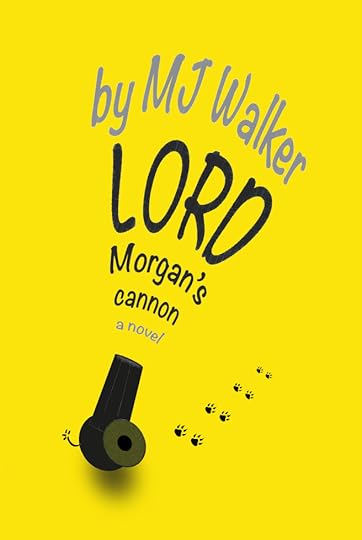 A work of science, historical and literary fiction. And a great read. For young adults and adults
EXCERPT
The old leopard knew what to do. He tightened his cheeks, revealed his teeth and made his whiskers bristle. He did it again, this time forcing a guttural roar up and out from his flaccid belly, flaring his nostrils. Then, to unsettle those watching, he raised an arthritic blotched paw, and pulled at the shiny new metal collar around his neck. It snagged on his ear, as it should. So he pushed up from his haunches and made the effort to leap down from the red and white stool.
The chain linking his collar to the stool tugged at his neck, swinging his body in an arc. A whip cracked across his black nose, forcing a sharp wind up his nostrils and across his tongue. He tasted hot leather and wretched. He pawed at the collar again, dislodged the false bolt, and off it came.
He was free.
The old leopard roared with purpose this time, baring a cracked pair of canines that still impressed the good seats in row E. He moved quickly across the sawdust, reaching the ring’s edge, and began to pace, occasionally lifting his head to glimpse seat 28.
Canvass bellowed high above his head. Adrenaline began to course through his veins, a drop of saliva falling from his black gums. He lashed a dark tongue across his lips and imagined Lord Morgan’s thighs. They would be juicy thighs, he knew. Everyone who sat in seat 28 had rich, fat thighs, swollen within thin trousers. He was not too old to remember the taste of living flesh, twitching and bloody. He wanted one final warm meal.
He quickened his pace, practising for the evening. It would be his most difficult challenge: how to stalk a prey that had paid to see his every move. How to move faster than the whip, and how to leap the children that would inevitably sit in his way, waving pink candyflosses, obscuring his view of his target.
If he rehearsed properly, and planned it right, he would make it, and later tonight, Lord Morgan would be his. He would leap from the posters advertising this tawdry circus and on to Lord Morgan’s thighs, landing in people’s dreams, their nightmares. He would make the London papers, and everyone would know his name. It would be his last show, his greatest show, one for the ages. Even the elephant would respect him, once he was done.
The whip cracked again, flicking across his tail. His hips immediately collapsed, an involuntary hiss escaping his jaws. He coiled his creaking back, his tongue licking blood off his rear. The lashing angered him more than the thousand before. This was his final rehearsal, and they weren’t giving him the stage. He hadn’t finished his planning. He wasn’t ready to be put back in his cage.
Suddenly he felt a new pain, as a long wooden fork pinned his neck to the floor. The more he hissed the harder the Ring Master pushed, a strut grating against each jugular. He hated the fork more than the whip. He snarled, breathing dirt as a rusting collar was thrown over his head, and tightened. He tried to kick it off again, but he knew instantly this was his proper collar, with a functioning bolt, the one he’d worn since arriving in a crate all those years ago. He spun on to his back, hissing and spitting, bringing up four legs, absent claws pawing at the air.
“Get the net on him,” the Ring Master bellowed.
The black mesh descended and the circus boys tied him in a writhing ball. The Ring Master sneered as they dragged his old feline bones across the floor of the ring, the sawdust and dirt rubbing out his spots.
He could see the Ring Master no more. But he heard him.
“That old cat is so stupid. I want a panther, a black panther. Something exotic. Get me a panther, I don’t care how much they cost. Something to scare the kids.”
He stopped fighting the net, and relaxed. Leopards are cunning, he reminded himself, and old leopards are very cunning indeed.
He would play nicely for the rest of the day. He’d eat the chicken they gave him on show days, to sate his belly and appetite for spectators. He’d lick his coat and present himself properly. He’d walk his cage, biding his time and when the circus boys checked on him at dusk, he’d hiss and roar and he would look the part.
They couldn’t do tonight’s show without him. He’d get one more chance. They would swap his collar for the one that doesn’t work. He would throw it off as he did every evening, in every performance from Brighton to Bristol. He’d hear the gasps, then watch as the paying spectators tucked back into their sweets, stuffing their faces as the Ring Master pretended the old leopard was on the loose.
But this time he would prowl for real. He would beat the whip. And as he bounded from the ring and over the stalls he would scare the wits out of the parents, and particularly their kids, as his whiskers brushed their little heads.
He would pounce on seat 28, in row E. He would kill this Lord Morgan, and savour his flesh. He would taste warm blood one last time, before the bullet struck between his eyes.
He would ruin the Ring Master, this Big Top and all in it. He would show them he wasn’t a stupid circus animal. He would show them he was a leopard.
© 2016 MJ Walker
ADD TO GOODREADS
FOLLOW MJ WALKER ON TWITTER



