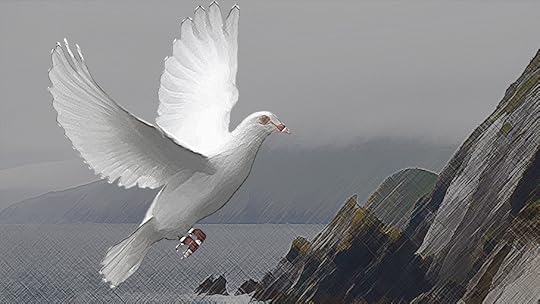
A Young Rock Dove
For the first time, he notice the island’s age, the fault lines in the rock, the tired grass bleached by guano. Overhead, a thousand birds raced, surfing unseen waves, above a white sea that never rested. Each squawk and screech called him home. A powerful gust caught his arms, lifting him.
By the cliff’s edge, a wisp drifted from the roof of the house. An ocean of wind blasted two hundred feet of jagged granite, dispersing the smoke. The house leaned towards the chasm.
In the door of the house, he saw the shadow of the old man. His keen eye could discern the man’s tight, weathered skin stretched over bones full of air. He hoped the old cock had the answers he’d been seeking.
He glided down to the house, alighting gently on the path. The old man grinned, placing a large net full of holes against a wall built without render. The man folded the boy’s collar, ran his empty hands over him, preening, beckoning him in.
Upon a fire, a bird roasted, breast dripping, the fire spitting the fat onto the stone floor. “Why did you ask me to return?” asked the boy. “To tell you who you are. What you will become,” said the man through a small, sharp mouth.
He gestured for the boy to sit in a wooden chair opposite the fire. The old man took a stool. “Did you have trouble finding me?” the man asked.
The boy looked into the flames. The maps called this place Bird Island, but had forgotten why. They didn’t record the guillemots and gannets, the gulls and terns, the chatty puffins and occasional albatross that nested the crannies. The thousand years of culture. The hardy women and brave men who climbed the cliffs on ropes, plucking eggs from ledges. The Bird People who now lived within black and white photographs pinned high to the walls of the empty library across the channel.
“Yes,” the boy said. “The trawlermen say no-one lives on the island. They didn’t want to bring me.” “Fishermen forget to look up,” chuckled the man. “Are you hungry, would you like some meat?”
The boy recognised the bird on the spit, an auk, and declined. He hadn’t eaten it since he’d fledged and flown away, years before. He wanted to ask how it had been harvested.
“Do you want to get started?” asked the old man, his back straightening. “Yes,” the boy answered, forgetting his question.
The old man pulled off his boots, warming ten prehensile toes in the fire.
“Do you know why we called you squab?” he asked. “Not really,” said the boy. “Because I was young and weak?” “Do you know what a squab is?” “A baby pigeon,” answered the boy. “A baby rock dove,” said the old man. “There’s a difference.”
Pigeons, said the old man, lived on the mainland. In the towns and cities. They are common birds, nothing special. They get fat on modern life, and are prone to disease.
He then took the boy’s hand in his. “They forget how to fly,” the old man said, eyes glinting in the shadows.
Rock doves are the ancestors of pigeons, the original breed, the bird from which pigeons descended. Rock doves are youthful and sleek, almost lighter than air itself. They twist and turn, purely for fun. They venture far. And unlike pigeons, they always fly home, to the first roost.
“But why did you call me squab?” asked the boy. He now realised his name had not been an insult, but still he could not understand. “Rock doves don’t live here,” he said.
“They once did,” replied the old man. “They used to fly this land, these cliffs. They could reach every hillock, each nook and ledge. How else do you think they harvested the eggs, before the metal ladders and ropes? They flew of course!”
The auk’s skin began to brown and crisp.
“Over the centuries, each generation lost more feathers. Their nests became houses. They fell to the ground, becoming domesticated, many moving away. Those that stayed could only cling to the cliffs, using their fingers and toes, occasionally plummeting to earth, covering the rocks in yolk.”
“But just when we thought we’d bred ourselves into extinction…” The old man, mouth agape now, hovered a few inches off his stool. “…an ancestral line was reborn,” he exclaimed, settling back upon his wooden perch. “And now a young rock dove has returned!”
He stood the boy up, ruffling his hair, feeling the strength of his muscles. He walked him out of the warm house into the cold wind. The sun had begun to set. He took the boy’s coat from his back. “You won’t need this,” he said.
He turned the boy’s body eastwards, into the prevailing gusts. Standing behind, he lifted the boy’s arms, turning his palms. “Do you feel it?” he asked. The boy looked at his feet, and realised he was off his toes.
“This is your home now,” said the old man. “You won’t need any ropes. Ignore the rusting ladders.” The birds above fell silent. They zigged and zagged away, leaving clear red sky. They invited the boy upwards.
© 2016 MJ WALKER