
Discover new books on Goodreads
See if your friends have read any of Shay K. Azoulay's books

Shay’s 2025 Year in Books
Take a look at Shay’s Year in Books, including some fun facts about their reading.
Shay K. Azoulay’s Followers (8)


2,939 books
|
3,273 friends

959 books
|
65 friends

353 books
|
46 friends

195 books
|
1,353 friends

306 books
|
249 friends

217 books
|
3 friends

350 books
|
3 friends

2 books
|
83 friends
More friends…


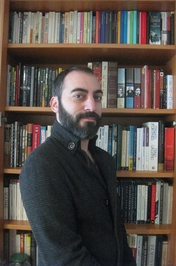
Shay K. Azoulay
Goodreads Author
Born
in Tel Aviv, Israel
December 24
Website
Twitter
Influences
Member Since
February 2012
To ask
Shay K. Azoulay
questions,
please sign up.


|
FLAPPERHOUSE - Year Three
by
—
published
2017
|
|

|
לזארטו
by
—
published
2019
|
|

|
FLAPPERHOUSE #11 - Fall 2016
by |
|

|
המחלקה
by |
|

|
רכוש צבאי
|
|

|
מאדים זה כאן: הסיפור הישראלי הספקולטיבי
by
—
published
2021
|
|
Reading Questionnaire
I recently answered a questionnaire by an Israeli publisher about my favorite books and reading habits, and I thought this might be good place to post my answers.
1) What are your favorite books?
 There’s a long list of authors who, once I discover them, I feel like I have to read everything that they’d ever written, these include Franz Kafka, Jorge Luis Borges, Samuel Beckett, Albert Camus,
Read more of this blog post »
There’s a long list of authors who, once I discover them, I feel like I have to read everything that they’d ever written, these include Franz Kafka, Jorge Luis Borges, Samuel Beckett, Albert Camus,
Read more of this blog post »
1) What are your favorite books?
There’s a long list of authors who, once I discover them, I feel like I have to read everything that they’d ever written, these include Franz Kafka, Jorge Luis Borges, Samuel Beckett, Albert Camus,
Read more of this blog post »




Shay’s Recent Updates


“Faster than light space travel to distant galaxies has been proven impossible. The existence of other planets or alien races, therefore, remains mere conjecture as these cannot be reached or contacted. Miraculous machines that let you travel backward or forward in time are impossible – an unsolvable paradox. Teleportation, precognition, telekinesis, and all versions of extrasensory perception have all been scientifically disproven. Technological and medical advancements have allowed people to live longer and better but there is no sufficiently advanced technology that has freed mankind from tedious labor, eventual suffering, or death. Most inhabitants of the developed world go to work every morning, where they sit for several hours in front of blinking screens, and then return home to sit in front of other, bigger screens.”
― מאדים זה כאן: הסיפור הישראלי הספקולטיבי
― מאדים זה כאן: הסיפור הישראלי הספקולטיבי
“Jonathan Safran Foer’s 10 Rules for Writing:
1.Tragedies make great literature; unfathomable catastrophes (the Holocaust, 9/11) are even better – try to construct your books around them for added gravitas but, since those big issues are such bummers, make sure you do it in a way that still focuses on a quirky central character that’s somewhat like Jonathan Safran Foer.
2. You can also name your character Jonathan Safran Foer.
3. If you’re writing a non-fiction book you should still make sure that it has a strong, deep, wise, and relatable central character – someone like Jonathan Safran Foer.
4. If you reach a point in your book where you’re not sure what to do, or how to approach a certain scene, or what the hell you’re doing, just throw in a picture, or a photo, or scribbles, or blank pages, or some illegible text, or maybe even a flipbook. Don’t worry if these things don’t mean anything, that’s what postmodernism is all about. If you’re not sure what to put in, you can’t go wrong with a nice photograph of Jonathan Safran Foer.
5. If you come up with a pun, metaphor, or phrase that you think is really clever and original, don’t just use it once and throw it away, sprinkle it liberally throughout the text. One particularly good phrase that comes to mind is “Jonathan Safran Foer.”
6. Don’t worry if you seem to be saying the same thing over and over again, repetition makes the work stronger, repetition is good, it drives the point home. The more you repeat a phrase or an idea, the better it gets. You should not be afraid of repeating ideas or phrases. One particularly good phrase that comes to mind is “Jonathan Safran Foer.”
7. Other writers are not your enemies, they are your friends, so you should feel free to borrow some of their ideas, words, techniques, and symbols, and use them completely out of context. They won’t mind, they’re your friends, just like my good friend Paul Auster, with whom I am very good friends. Just make sure you don’t steal anything from Jonathan Safran Foer, it wouldn’t be nice, he is your friend.
8. Make sure you have exactly three plots in your novel, any more and it gets confusing, any less and it’s not postmodern. At least one of those plots should be in a different timeline. It often helps if you name these three plots, I often use “Jonathan,” “Safran,” and “Foer.”
9. Don’t be afraid to make bold statements in you writing, there should always be a strong lesson to be learned, such as “don’t eat animals,” or “the Holocaust was bad,” or “9/11 was really really sad,” or “the world would be a better place if everyone was just a little bit more like Jonathan Safran Foer.”
10. In the end, don’t worry if you’re unsuccessful as a writer, it probably wasn’t meant to be. Not all of us are chosen to become writers. Not all of us can be Jonathan Safran Foer.”
―
1.Tragedies make great literature; unfathomable catastrophes (the Holocaust, 9/11) are even better – try to construct your books around them for added gravitas but, since those big issues are such bummers, make sure you do it in a way that still focuses on a quirky central character that’s somewhat like Jonathan Safran Foer.
2. You can also name your character Jonathan Safran Foer.
3. If you’re writing a non-fiction book you should still make sure that it has a strong, deep, wise, and relatable central character – someone like Jonathan Safran Foer.
4. If you reach a point in your book where you’re not sure what to do, or how to approach a certain scene, or what the hell you’re doing, just throw in a picture, or a photo, or scribbles, or blank pages, or some illegible text, or maybe even a flipbook. Don’t worry if these things don’t mean anything, that’s what postmodernism is all about. If you’re not sure what to put in, you can’t go wrong with a nice photograph of Jonathan Safran Foer.
5. If you come up with a pun, metaphor, or phrase that you think is really clever and original, don’t just use it once and throw it away, sprinkle it liberally throughout the text. One particularly good phrase that comes to mind is “Jonathan Safran Foer.”
6. Don’t worry if you seem to be saying the same thing over and over again, repetition makes the work stronger, repetition is good, it drives the point home. The more you repeat a phrase or an idea, the better it gets. You should not be afraid of repeating ideas or phrases. One particularly good phrase that comes to mind is “Jonathan Safran Foer.”
7. Other writers are not your enemies, they are your friends, so you should feel free to borrow some of their ideas, words, techniques, and symbols, and use them completely out of context. They won’t mind, they’re your friends, just like my good friend Paul Auster, with whom I am very good friends. Just make sure you don’t steal anything from Jonathan Safran Foer, it wouldn’t be nice, he is your friend.
8. Make sure you have exactly three plots in your novel, any more and it gets confusing, any less and it’s not postmodern. At least one of those plots should be in a different timeline. It often helps if you name these three plots, I often use “Jonathan,” “Safran,” and “Foer.”
9. Don’t be afraid to make bold statements in you writing, there should always be a strong lesson to be learned, such as “don’t eat animals,” or “the Holocaust was bad,” or “9/11 was really really sad,” or “the world would be a better place if everyone was just a little bit more like Jonathan Safran Foer.”
10. In the end, don’t worry if you’re unsuccessful as a writer, it probably wasn’t meant to be. Not all of us are chosen to become writers. Not all of us can be Jonathan Safran Foer.”
―
“Fear is a powerful weapon. When people are afraid for their lives they’ll obey whoever’s in charge, whoever claims he can lead them out of the desert, and for that they’ll gladly give up all of their rights.”
― לזארטו
― לזארטו
“Faster than light space travel to distant galaxies has been proven impossible. The existence of other planets or alien races, therefore, remains mere conjecture as these cannot be reached or contacted. Miraculous machines that let you travel backward or forward in time are impossible – an unsolvable paradox. Teleportation, precognition, telekinesis, and all versions of extrasensory perception have all been scientifically disproven. Technological and medical advancements have allowed people to live longer and better but there is no sufficiently advanced technology that has freed mankind from tedious labor, eventual suffering, or death. Most inhabitants of the developed world go to work every morning, where they sit for several hours in front of blinking screens, and then return home to sit in front of other, bigger screens.”
― מאדים זה כאן: הסיפור הישראלי הספקולטיבי
― מאדים זה כאן: הסיפור הישראלי הספקולטיבי
“I love my wife and sons.
But I have thought about abandoning them.
Because single mothers are heroes.
And what kind of man would I be to get in the way of a woman becoming a hero?
The best way for me to fight the Patriarchy is to stop being a patriarch.”
― That Joke Isn't Funny Anymore: On the Death and Rebirth of Comedy
But I have thought about abandoning them.
Because single mothers are heroes.
And what kind of man would I be to get in the way of a woman becoming a hero?
The best way for me to fight the Patriarchy is to stop being a patriarch.”
― That Joke Isn't Funny Anymore: On the Death and Rebirth of Comedy
 Speculative Fiction in Translation
— 357 members
— last activity Jul 20, 2026 10:11AM
Speculative Fiction in Translation
— 357 members
— last activity Jul 20, 2026 10:11AM
This is a group dedicated to reading SF works from around the world translated into English. We cover both new releases and older publications, and no ...more