Shep Hyken's Blog
October 6, 2026
Six Ways to Win Customers for Life
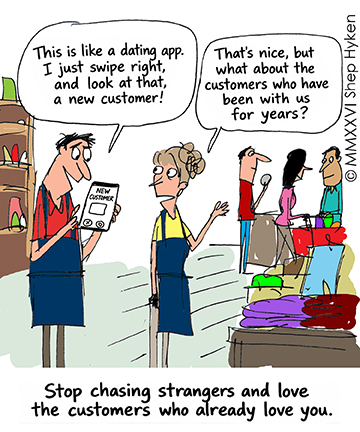 This article answers the question: How can companies win customers for life?
Answer: Companies can win customers for life by focusing on retention, aligning employees around a clear customer experience vision, valuing existing customers, and consistently delivering an experience that gives customers a reason to come back.
I recently interviewed Ed Howie, founder and CEO of Lifelong Customers, for an episode of Amazing Business Radio . He shared what he refers to as “six essential realities for winning lifelong customers.” Here is his list along with my commentary and interpretation of each strategy:
Customer service doesn’t create growth. Customer retention does. I’ve written that the problem isn’t customer service. That’s the solution. The problem is customer retention. Growth happens from new customers, getting existing customers to return, and getting those who return to buy more. When you create an amazing experience, customers come back and spend more. Focus on retention, and your business grows.
Most companies are competing in the wrong economy. Howie’s explanation of the “wrong economy” is that companies focus the large majority of their marketing budget on new customer acquisition. He suggests focusing instead on the “customer attention economy,” which is about customer retention. My suggestion is for organizations to put the right people on the front line, train them properly, and empower them to deliver the experience you want customers to have.
Clarity creates alignment. Alignment accelerates sales velocity. Every employee should be aligned with your customer experience vision. I call it a mantra, a one-sentence-or-less phrase that describes exactly what you want the customer to experience. Without clarity on that mantra, employees may not be aligned to deliver the experience you want.
Stop chasing strangers and love the customers who love you already. I love this one. Howie’s take is to not “gush” over new customers while taking existing customers for granted. Think about industries like internet and phone services, where new customers get incredible deals, while existing customers pay substantially more. If you’re going to offer new customers an incentive, do something special for your current customers that proves you love them just as much, if not more. That goes for how you treat them, too.
Loyalty is a feeling. Customer retention is an operating system. You can’t force a customer to be loyal. Loyalty is an emotion that is earned over time. Retention, however, is something you can manage. You can make it a process through training and essential behaviors you put into place to deliver a consistent experience. Think of retention as the system that creates the opportunity for loyalty. Get that right, and over time, customers may reward you with loyalty.
Customer experience is either winning or losing your lifelong customer . I go back to my comment in the first strategy about customer retention and growth. When I hear someone say, “They don’t have customer service,” my response is, “No, the company does have customer service. It’s just not good customer service.” The experience you deliver will either drive customers away or draw them back. Consistently deliver the experience customers want and expect, and you can turn a one-time customer into a repeat customer, and eventually a loyal customer.
While I’m 100% in agreement with Ed Howie’s six strategies, my take on them may differ slightly. Ultimately, we end up in the same place. Winning customers for life isn’t about one great interaction, a loyalty program, or a clever marketing campaign. It’s about a consistent experience that gives them a reason to come back.
Shep Hyken is a customer service/CX expert, award-winning keynote speaker, and New York Times bestselling author. Learn more about Shep’s customer service and customer experience keynote speeches and his customer service training workshops at www.Hyken.com . Connect with Shep on LinkedIn .


October 5, 2026
How Memberships Create Customer Loyalty and Retention with Jeff Helfgott
How can a membership model improve customer loyalty and retention?
How do membership programs eliminate customer decision fatigue?
What is the difference between a membership program and a discount program?
How can businesses use subscriptions to create more predictable customer experiences?
How can businesses protect their brand’s perceived value while offering membership rewards?
Top Takeaways:
Think experience, not transaction. Think interaction leading to the next interaction, and create that experience that makes people say, “I’ll be back.”
Membership and subscription models improve the experience by eliminating the friction of having to make a buying decision. It just happens automatically.
A membership is more than a discount program. While some memberships and subscriptions may offer better pricing and can reward loyalty, the overall experience should still deliver premium value.
Small details, when operationalized, can make all customers feel genuinely cared for. Adjusting the environment, anticipating comfort, and eliminating unnecessary steps show that a company respects the customer’s time and money.
Plus, Shep and Jeff talk about the importance of meeting the needs of all key stakeholders, including the investors, franchisees, customers, and employees. Tune in!
Quotes:
“Results first, people always.”
“A company’s core values are just words on a page unless you live them every day.”
“A big part of helping people relax is removing decisions from them. A membership removes the decision about where to get a product and when to get it.”
“Investors get really excited about recurring revenue, but I think they’re excited because it speaks to a level of loyalty and predictability earned with customers. That’s the most valuable asset a business can create.”
About:
Jeff Helfgott is the CEO of Boardroom Salon for Men, an upscale grooming brand with over 50 locations. The brand’s services and experience are built on its “Results First, People Always” philosophy.
Shep Hyken is a customer service and experience expert, New York Times bestselling author, award-winning keynote speaker, and host of Amazing Business Radio.
Top 5 Customer Service & CX Articles for Week of October 5, 2026
Amazon Prime’s Vice President Says Loyalty Isn’t a Reward by ClickZ
(ClickZ) Every retailer talks about loyalty. Few want to talk about what it costs to earn it. At Shoptalk Fall’s Retail Stage, Jamil Ghani spent twenty minutes pushing back on that idea. He leads Prime worldwide for Amazon. For an industry built on punch cards and expiring points, his argument landed as a direct challenge.
My Comment: We kick off this week’s Top Five with a lesson from Amazon’s VP of Prime, Jamil Ghani, who shares his thoughts on loyalty and the cost to earn it. If you’ve ever thought of Amazon Prime as a loyalty program, think again. Ghani says, “Prime is a membership program that earns trust through usage, rather than a loyalty program that rewards it after the fact. The point is that when customers pay to be a member, they are treated differently than if they sign up for a program that will eventually earn points and perks. This excellent article offers powerful lessons on loyalty and membership programs.
The Profitable Customer: Why Nobody Owns The Asset That Keeps Your Business Alive by Lior Arussy
(Chief Executive Group) We’ve built entire infrastructures, including systems, budgets, incentives, reporting lines and even our language, around products. Then we’re surprised when customers behave like transactions.
My Comment: The article starts with a question you should consider in your next leadership/team meeting: “Who in this company owns customer profitability?” Many departments interact with or impact a customer, but typically, no single leader or department is responsible for whether the customer is profitable. And this surprised me. Even if there is a Chief Customer Officer, they own responsibilities that include CX, data management, and more, but not pricing, sales, and other areas tied directly to the profitability of an individual customer.
Delivery Experience Emerges as Key Driver of Consumer Loyalty, Roadie Research Finds by Jeff Berman
(Logistics Management Magazine) Research recently issued by UPS subsidiary Roadie, an on-the-way delivery service with the nation’s largest local same-day footprint, in conjunction with Studio by Informa Tech Target, examined the key delivery factors that drive repeat business from consumers.
My Comment: You might think that shipping and delivery aren’t a marketing strategy, but you would be wrong. Thanks to companies like Amazon, which have taught us what a great delivery experience should be. If a company fails to meet its customers’ expectations of a good delivery experience, they will move on to another company that does. The article cites plenty of stats and findings to back this up. Who would have thought that delivery is such an important part of the customer experience, so much so that it’s now a competitive differentiator?
3 Numbers on What Customers Want from Holiday CX This Year by Bryan Wassel
(CX Dive) The busiest shopping period is approaching fast, and consumers’ plans for how they’ll approach their gift-buying sprees are becoming clear.
My Comment: Although the title mentions the upcoming holiday, the information in this article applies to any business at any time of year. The three big takeaways include… 1) Customers are using AI tools to help them research and buy. And what I mean by “buy” is that AI actually makes the purchase on the customer’s behalf. 2) Even with AI and online retail sites, almost half (44%) of customers still want to visit a store and see and touch a product before buying. And 3) One in five customers say that a good employee turns a good experience into a great experience. Whether it’s holiday time or the slowest time of the year, if a customer comes to your store or interacts with a live employee, seize the opportunity to win them over for that sale and many more in the future.
Improving Customer Service Doesn’t Have to Come with a Big Budget: 5 Lessons from Disney Institute by Christopher Fults
(Chase) Great customer service doesn’t mean everything always goes perfectly. It means your team knows what to do when it doesn’t, your customers feel seen, your employees feel trusted and your business can deliver a consistent experience — even when things don’t go according to plan.
My Comment: We opened this week’s Top Five with a lesson from Amazon. Let’s close with five lessons from Disney on how to improve customer service. You may say there is nothing new here, and it’s all common sense, but that’s the point. The basics in a customer experience are what bring people back. Be consistent, find moments in the interaction that let you stand out, and turn customer service into a competitive advantage. This article introduces how Disney creates customer loyalty.
Shep Hyken is a customer service/CX expert, award-winning keynote speaker, and New York Times bestselling author. Learn more about Shep’s customer service and customer experience keynote speeches and his customer service training workshops. Connect with Shep on LinkedIn.
September 30, 2026
Who Gives a Crap: What Toilet Paper Can Teach Us About Customer Experience
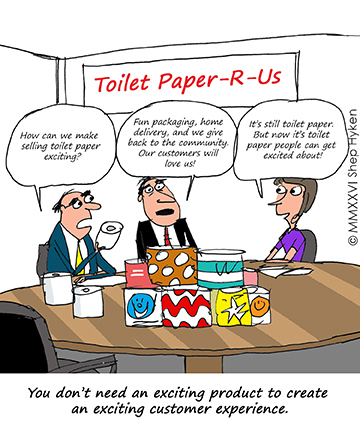 This article answers the question: What can a toilet paper company teach businesses about customer experience?
 Answer: Who Gives a Crap shows businesses how to create a better customer experience, even with an ordinary product like toilet paper, by focusing on convenience, social responsibility, and a memorable brand personality.
I may have caught your attention with the title, but this isn’t a statement about not caring – in fact, Who Gives a Crap is the name of a company founded in Australia that’s been around since 2012 and sells toilet paper (along with tissues, paper towels, and other household goods). To fund the company, its founder, Simon Griffiths, sat on a toilet for 50 hours. He livestreamed the “experience” to crowdfund the $50,000 he needed to start the company.
3 Customer Experience Lessons from Who Gives a Crap
As much fun as it is to use the company’s name as the title of this article, the real story here is about the lessons we can learn from a company that sells products that, according to its website, “clean rears, tears and kitchen smears.” There are at least three major takeaways any company can consider in their customer experience strategy:
Convenience:
Is there anything easier than having what you need appear on your doorstep? Today, almost anything, not just newspapers and magazines, can be turned into a subscription. Netflix did it with movies and TV shows. Chewy.com did it with pet food. Dollar Shave Club did it with razor blades. And in this case, Who Gives a Crap offers its customers a subscription for toilet paper and other kitchen and household cleaning items. Depending on how many people live at home, a case of toilet paper can be delivered every couple of months, or subscriptions are adjusted as needed.
Social Responsibility:
Who Gives a Crap is big on “giving back,” donating a whopping 50% of its profits to organizations like WaterAid and WaterSHED, providing funding for clean water and sanitation projects worldwide. The goal is to help everyone have access to clean water and a toilet, and so far, the company has donated more than $14 million! In addition, its products are made out of 100% bamboo or recycled paper. My annual CX research proves that customers like doing business with companies that give back. We found that 62% of U.S. customers prefer to do business with a brand that supports a local cause, and 50% say a company’s involvement in a social cause increases their loyalty.
Make the Ordinary Extraordinary:
When I talk about turning the ordinary into extraordinary, I am usually talking about turning an average customer experience into something special. In this case, I’m talking about taking one of the most commoditized and unexciting products imaginable, toilet paper, and creating an experience and personality around it. The company name is memorable. The advertising and promotional copy is funny. Even the packaging is fun. The lesson is simple: You don’t have to sell an exciting product to create an exciting experience.
Who Gives a Crap? It might be a funny name, and right on its website, it states: Funny Name. Serious Business. Convenience gets customers to buy. Its purpose gets customers to feel good about who they are buying from. And the overall experience gives customers something to talk about. It’s obvious that Who Gives a Crap is a company that really does give a crap about its customers and the planet.
Shep Hyken is a customer service/CX expert, award-winning keynote speaker, and New York Times bestselling author. Learn more about Shep’s customer service and customer experience keynote speeches and his customer service training workshops at www.Hyken.com . Connect with Shep on LinkedIn .
September 28, 2026
How to Operationalize Customer Retention with Ed Howie
What is the difference between customer service and customer retention?
What are the 6 essential realities for winning lifelong customers?
Why is customer retention more important than customer acquisition?
How does employee training impact customer retention and brand reputation?
How can leaders bridge the gap between employee behavior and business goals?
Top Takeaways:
Customer retention results from businesses knowing what customers want, delivering it, and doing it consistently. Customers don’t only want a good experience once. They want confidence that the same quality will show up the next time too.
Hire for empathy, then train for execution. Hire employees who genuinely care about customers and train them on what to say, what to do, and how to reinforce the brand’s standards.
Customers don’t always need points, perks, or an app to keep coming back. Every small detail that makes up an amazing customer experience can create loyalty on its own.
Every customer interaction becomes your brand in that moment. Customers judge the company through the person serving them in that moment.
Ed Howie explains the 6 essential realities for winning lifelong customers:
Customer service doesn’t create growth. Customer retention does.
Most companies are competing in the wrong economy.
Clarity creates alignment. Alignment accelerates sales velocity.
Stop chasing strangers and love the customers who love you already.
Loyalty is a feeling. Customer retention is an operating system.
Customer experience is either winning or losing your lifelong customer.
Business owners can discover their strengths and weak spots by taking the free Customer Retention Readiness Report at morelifelongcustomers.com. It will look into whether you truly know what your customers need and how consistently you deliver it.
Plus, Shep and Ed discuss why the most successful brands don’t need a traditional loyalty program to keep customers coming back. Tune in!
Quotes:
“A true loyalty program can be found in a company’s operation. It is in the product selection, the pricing, and the nice qualities that keep customers coming back.”
“Your customers want you to give them what they want, but they also want you to do it in a way that they trust that you’ll do it again and again”
“Strive for perfection, but when mistakes happen, you can oftentimes fortify the customer relationship by the way you respond to that error.”
“Business is not a democracy. Business is a top-led, leader-informed, leader-inspired enterprise. And if you’re not providing clarity and alignment to your team, it will not exist. So, be clearer.”
About:
Ed Howie is the Founder & CEO of Lifelong Customers®. He is a customer retention expert, keynote speaker, host of The Wonder of WOOO Podcast, and author of the upcoming book Lifelong Customers®: The Secret to Scaling Profitably.
Shep Hyken is a customer service and experience expert, New York Times bestselling author, award-winning keynote speaker, and host of Amazing Business Radio .
Top 5 Customer Service & CX Articles for Week of September 28, 2026
The Word Steve Jobs Wouldn’t Let Us Say—and How It Built Apple’s Most Loyal Customers by Ron Johnson
(Fast Company) Apple’s products were never going to win people over without stores. Our approach to service made them work.
My Comment: We kick off this week’s Top Five roundup with an article about a word that Steve Jobs (Apple) would let people use. Spoiler alert: The word is “love,” as in “love your customers.” You’ll have to read the article to find out why. It’s a very good reason, and some might say the word he prefers is a better one.
Turning Viral Attention into Lasting Customer Loyalty by Dan Edelman
(Retail Week) Viral content can fill a shop floor overnight, but the retailers seeing the greatest return from social media are those converting that attention into repeat customers says American Express UK general manager, merchant services Dan Edelman.
My Comment: Companies and brands spend a lot of money on getting people to notice them and ultimately buy from them. The Holy Grail of content marketing is to have something go viral. You get noticed, and customers show up. And here is the most important point of this article: Once you get them to you, what do you do to make sure the experience makes them say, “I’ll be back?” That’s where the magic happens: when you give them the experience that makes them say, “I’ll be back.”
How Online Review Trends Reveal What Customers Expect from Brands by Joanna Clark-Simpson
(CX Network) One of the most relevant sources of customer sentiment, online reviews can be an insights goldmine when utilized correctly. Joanna Clark-Simpson sets out four ways brands can transform negative feedback into customer trust.
My Comment: Online reviews can make or destroy a brand’s credibility. This short article offers fresh insights into how consumers think about reviews, which types of reviews build confidence, what scares them away, and the power of a negative review.
The Gen Z Loyalty Surprise by Cotality
(Cotality) Digitally savvy Gen Zers who compare mortgage offers with a few swipes on their phones are often described as having short attention spans and fickle consumption habits. So, assuming that young people fitting this profile makes them natural rate chasers is low-hanging fruit for the housing industry.
My Comment: Although this article relates to the mortgage and financial industry, much of the information applies to other industries. I’m always interested in how different generations do business. Gen Z is the up-and-coming generation that will soon have major influence and buying power. Learning how they like to buy, what they think about technology, and what makes them loyal will be crucial for any business to know.
Customer Loyalty Statistics: Key Trends & Insights for 2026 by Sathish Loganathan
(ClickPost) Customer loyalty has shifted from a nice-to-have into a measurable growth engine, with 91% of companies now running formal programs. The data spans retention economics, ROI benchmarks, and personalization impact — giving businesses a clear financial case for investing in loyalty.
My Comment: We wrap up this week with an article featuring stats, trends, and findings on customer loyalty. These are compiled from numerous sources. There is something here for every type of business. My take on this is that loyalty programs work, but it has to be the right program. One size does not fit all.
Shep Hyken is a customer service/CX expert, award-winning keynote speaker, and New York Times bestselling author. Learn more about Shep’s customer service and customer experience keynote speeches and his customer service training workshops. Connect with Shep on LinkedIn.
September 22, 2026
The Customer Is Always Right … and Five Other Lies
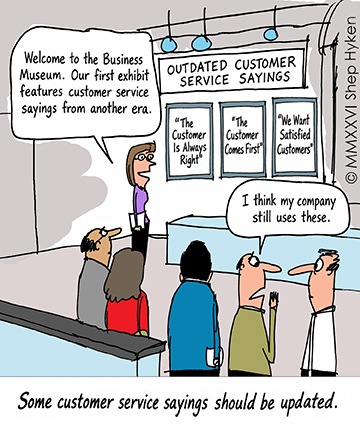 This article answers the question: Is the customer always right? And what other customer service sayings are outdated or no longer true?
Answer: Many traditional customer service sayings are outdated or incomplete because great service and CX today are less about always agreeing with customers, exceeding expectations, or simply satisfying them, and more about respecting customers, empowering employees, delivering consistent experiences, and earning loyalty.
If you’ve been following my work, you know I don’t believe the customer is always right. Sayings like that have been around for a very long time, but some have become outdated or are just plain wrong. Okay, calling them “lies” may be a slight exaggeration, but I got your attention. Here are six customer service sayings that deserve an update.
The customer is always right . It’s simply not true. If that’s what we’re taught and the customer is wrong, what do we do? It’s not about who’s right. It’s more about how to handle a disagreement that preserves the relationship. Consider this alternative: The customer is not always right, but they are always the customer. So, if they are wrong, let them be wrong with dignity.
The customer service department handles problems and complaints . This isn’t a lie, but it’s a partial truth. Yes, the people in the customer service “department” may handle complaints and questions, but everyone has a role in the customer experience. Even employees who never interact directly with customers make decisions or perform work that eventually impacts the customer. So here’s the alternative: Customer service is not a department. It’s a philosophy to be embraced by every member of an organization .
No news is good news . Just because a customer doesn’t complain doesn’t mean they’re happy. Whether the experience is good or bad, many customers won’t tell you. And, “satisfied” customers don’t complain. The experience isn’t great, but it’s not terrible, and complaining isn’t worth the effort. So remember: No news from a customer doesn’t mean they’re happy.
Go above and beyond for every customer. Above and beyond sounds great, but it creates an unrealistic standard. You can’t “blow the customer away” at every interaction. They don’t need a WOW moment every time. You can, however, consistently meet their expectations. Always be helpful. Always be friendly. Always return calls quickly. You get the idea. So, instead of always trying to exceed expectations: Be consistently and predictably good.
The customer comes first. It’s nice to say, but is it practical? A customer-first mindset matters, but remember, it really begins with employees. What happens inside an organization will be felt on the outside by customers. I’ve often talked about the Employee Golden Rule : Do unto employees as you want done unto your customers, if not even better. Leadership must put employees first by creating the right culture and giving them the training and tools they need to take care of customers. Employees come first, so they can put the customer first.
We want satisfied customers. No, you don’t. What you want are loyal customers. There’s a difference. Satisfactory is a rating. Loyalty is an emotion. Satisfaction can mean average. More importantly, my 2026 annual CX research found that nearly one in four customers (23%) who rated a business satisfactory didn’t return. So, make it clear to all employees: We don’t want satisfied customers. We want loyal customers.
These sayings aren’t necessarily wrong. They’ve become incomplete. Customer service has evolved, so perhaps it’s time for the language we use to describe it to evolve, too.
Shep Hyken is a customer service/CX expert, award-winning keynote speaker, and New York Times bestselling author. Learn more about Shep’s customer service and customer experience keynote speeches and his customer service training workshops at www.Hyken.com . Connect with Shep on LinkedIn .
Why Customer-Centric Companies Outlast Competitors with Clifford Hudson
How do you build a business strategy around customer experience instead of technology?
How does removing customer friction lead to higher sales and retention?
What is the biggest mistake companies make when implementing new technology?
How does increasing customer convenience drive long-term business value?
Why do customer-centric companies outlast competitors?
Top Takeaways:
Start with the customer experience, not the technology. Begin by understanding what customers need and the experience they want. Then work backward to determine which technologies or processes will improve that experience. Technology should support the strategy, not become the strategy itself.
Use technology to strengthen what makes your brand stand out. Every new initiative, whether it is a new tool or a process, should strengthen the qualities that distinguish your brand.
Successful businesses are the ones who can anticipate their customers’ needs. Hudson mentions Wanye Gretzki’s famous line, “skate to where the puck is going.” Keep your eyes open for what your customers are doing and what they need. Shifts in customer behavior, even small ones like how they order or how they prefer to pay, are trends you can plan to stay ahead of.
Customers should be the center of every decision that a company makes. View every new action, process, or product through the lens of how it can better serve customers. Companies that put customers first outperform those that don’t.
The right technology should make life easier for your customers. Before investing in new technology, always ask: Does this make things easier and more convenient for the customers we serve?
Great ideas matter, but putting them into action is what really makes a difference. A customer-focused strategy creates the direction, and good execution turns it into great customer experience.
Plus, Shep and Cliff discuss more ideas from Bricks and Clicks: How We Drove Sonic Into the Digital Age . Tune in!
Quotes:
“Don’t think about technology. Think about your customer and their experience and go from there.”
“Technology should remove friction, increase convenience, and strengthen customer relationships.”
“As a leader, don’t make the mistake that you have to be the fountain of knowledge for everything. Don’t put pressure on yourself to think you’ve got to come up with all the ideas. New ideas abound around you. Keep your head up and your eyes open and seize them when they make sense.”
About:
Clifford Hudson, co-author of Bricks and Clicks and former CEO of Sonic Corp. for 23 years. He helps organizations drive value through customer-centric innovation.
Shep Hyken is a customer service and experience expert, New York Times bestselling author, award-winning keynote speaker, and host of Amazing Business Radio .
September 21, 2026
Customer Service Week and CX Day 2026
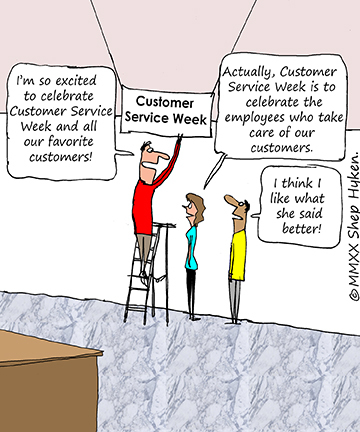 One Week to Celebrate, 52 Weeks to Practice It
Two weeks from now is a BIG holiday. It’s not a holiday that is on the traditional calendar that you buy in a store, but if you work or run a company, it should be. October 5-9, 2026, is Customer Service Week, and Tuesday of that week (October 6) is Global CX Day.
It’s not too late to celebrate, and it doesn’t have to be elaborate or expensive. Recognition can be as simple as a handwritten thank-you note, bringing in lunch, recognizing employees in a team meeting, or sharing customer compliments with the people who earned them.
The point is to recognize the people who take care of your customers and remind everyone how important customer service and CX are to the organization.
Here are several articles and videos I’ve shared with ideas you can use:
Customer Service Week: A Time to Celebrate Customers AND Employees
Customer Service Week 2024
National Customer Service Week 2023
The History of Customer Service Week and International CX Day
Customer Service Week began in 1987 as a way to recognize the importance of customer service and the people who serve and support customers every day.
Five years later, in 1992, Congress designated National Customer Service Week as a nationally recognized event, and President George H.W. Bush signed a proclamation to recognize the celebration. Today, Customer Service Week is an international event celebrated by organizations around the world.
In 2011, as customer service morphed into customer experience, CX legends Bruce Temkin and Jeanne Bliss formed the Customer Experience Professionals Association (CXPA). Two years later, CXPA held the first CX Day, an annual celebration of customer experience and the CX professionals who make it happen.
And let me close with a reminder: Customer Service Week and CX Day may be reasons to celebrate, but appreciating employees and customers shouldn’t be limited to one week or just one day.
Use the first week of October to celebrate. Then use the other 51 weeks of the year to prove you mean it!
Shep Hyken is a customer service/CX expert, award-winning keynote speaker, and New York Times bestselling author. Learn more about Shep’s customer service and customer experience keynote speeches and his customer service training workshops at www.Hyken.com . Connect with Shep on LinkedIn .
Top 5 Customer Service & CX Articles for Week of September 21, 2026
Brands Ignore Customer Feedback at Their Own Peril by Matt Vartabedian
(CX Dive) Brands have a wealth of customer sentiment and behavior data available to them but often can’t close the circuit between collection and action.
My Comment: We kick off this week’s Top Five with an article that reminds us that ignoring customer feedback can be costly. The article quotes a finding from Quantum Metric’s consumer study that 56% of customers have left brands that ignored their feedback. My customer experience research backs this up and includes another finding worth mentioning: 65% of customers say they never hear back from a company after completing a survey. A good start to fixing this problem is to thank customers for sharing their feedback. Then, do something with the feedback. Otherwise, it’s a waste of everyone’s time. See feedback as a gift. Consider a complaint as an opportunity not only to fix a problem, but also to restore a customer’s confidence in continuing to do business with you.
10 Strategies to Improve Utility Customer Engagement by Oracle
(Oracle) The relationship between utilities and their customers has evolved beyond that of provider and consumer. Interactions once centered on utilities sending bills and customers picking up the phone when something went wrong. While these interactions remain essential, utility customer engagement today encompasses much more, including initiatives that motivate and help customers take more control of their energy consumption and costs.
My Comment: While this article focuses on the utility industry, it offers plenty of takeaways for organizations in any industry. A utility company has limited competition, if any. However, they still want to provide a good CX. At the end of the article, there is a summary of the four types of customer engagement for utility companies: 1. Communicating with customers, 2. Serving them (good customer service), 3. Managing their energy use, and 4. Engaging them in new programs and services. If you change #3 to Managing/helping them get the most out of your products, these four ideas apply to just about any organization.
Both Ineffective and Invasive Personalization Turn Customers Away by Bryan Wassel
(CX Dive) More than 2 in 5 consumers say they have stopped doing business with a brand when its personalized marketing felt too repetitive, personal, or off-base, a Site Impact survey found.
My Comment: Personalization is an important part of marketing and CX. When done well, it brings customers closer to the company. But a stumble could cause a customer to walk. Just over 25% say the brands they do business with understand them. Over half say they don’t. With all the tools to analyze their customers’ data and behavior, there shouldn’t be many mistakes. Credibility is destroyed when a brand “offers inaccurate or invasive personalization.”
The Customer Service Gap No One Is Fixing by Scott Lieberman
(Fast Company) Ask your department heads how things are going, and you’ll hear good news. Leads and engagement are up, sales hit quota, and customer service is chipping away at response time. Every dashboard is green. But ask your customer, the one that’s been passed along three times in five minutes between chatbots and agents and intervention specialists, and you’ll get a different report.
My Comment: I seldom write about an article that includes “breaking up silos” as a strategy. But it’s not just silos. It’s really a system. When a customer shares info with a chatbot, then gets passed to a live agent and has to start over, that’s a breakdown in the system. When that happens, the customer blames the agent who doesn’t have all the information. But it’s not their fault. Fix the system. Create fluid communication between channels and departments. That’s where you start fixing a broken system.
Why the Best CX Advice Is Usually Uncomfortable and Rarely Complicated by Andre Prins
(LinkedIn Pulse) The advice that actually changes an organisation’s experience is rarely a secret. It is usually something leadership already knows and has been quietly avoiding.
My Comment: Let’s wrap up this week’s Top Five with another article from Andre Prins, who shares that good CX isn’t complicated. And regardless of how simple or uncomplicated it is, leadership often knows what to do but, for some reason, avoids doing what’s necessary. Prins took the ideas from eight experts and summarized them in a way that will get you thinking. Take two or three of these thoughts and have a discussion around them at your next leadership meeting.
Shep Hyken is a customer service/CX expert, award-winning keynote speaker, and New York Times bestselling author. Learn more about Shep’s customer service and customer experience keynote speeches and his customer service training workshops. Connect with Shep on LinkedIn.