
Brian Hodge's Blog
March 25, 2013
The Liberating Power of Creative Constraints
 Hiatus over.
I’ve had constraints on the mind lately. Time constraints, mostly, as I’ve been striving to take advantage of every opportunity that’s come along in recent months, plus train for a belt test, and contend with a bout of walking pneumonia in there somewhere. (Hint: The walking part is total b.s.) Which goes most of the way toward explaining the lull here.
But this inevitably makes me think of creative constraints, as well. Not as the enemy, but as an unlikely ally. Just as we narrow our focus to our highest priorities when time gets as pinched as the middle of an hourglass, and maybe even squeeze out better work under pressure, a limited pallet of creative options can actually be a helpful thing.
Paralysis By Paradox
If you’ve ever backed away from a decision because you couldn’t quite hack through the thicket of options to conclusively choose, then you’ve succumbed to a behavioral glitch dubbed the Paradox Of Choice. Or Paralysis By Choice, which I like better, because — spoiler alert — it tells you the end result.
It gelled as a theoretical given in 2000, after a famous jam study in which people could see their way clear to buying a jar of jam when they had 6 types to choose from, but 24 turned everyone into flustered, indecisive hand-wringers. Because jam, I’m sure we can all agree, is a serious commitment.
The theory has deservedly lost some luster since then, at least as a blanket model for how people tick. When was the last time you ran screaming from the cereal aisle, or went fetal at Starbucks? The reality is more nuanced: Some circumstances trigger the twitches, and some don’t.
But I’d be willing to bet that all of us have experienced this in a creative context. A project in which the open-ended blankness of our chosen medium has too many potential starting points (or paths down which to continue) that it leaves us stalled.
Portrait Of A Mad Waffler
You see this a lot in music. Especially with synthesizers. Technological aeons ago, early synths had to be programmed one sound at a time, with no memory recall. Now both hardware and software synths routinely come with hundreds, even thousands, of presets right there for instant access. And nobody can live with just one synth. You do the math.
With entire worlds of sounds at your fingertips, where do you begin? You can spend all your music-making time dialing through presets, weighing options, instead of actually making music. As a hobbyist who loves soundscaping — painting with sound, essentially — I’ve been there.
And that’s before I get to tweaking sounds to customize them, or programming from scratch.
The best way out of this quagmire I’ve found? Set rules. Whip up a group of sonic colors and stick with them. Establish the parameters early: one from this synth, one from that one, another from that library, etc. Decide quickly — say, 5 minutes tops to pick each one. Then make the most of them, as if they’re the only sounds in the world.
Eliminating the burden of choice as soon as possible really can move you past that place of paralysis.
As for more traditional songwriters, there’s a reason so many choose to rough out a song’s framework on acoustic guitar or piano. If the chords and melodies work well with such bare-bones instrumentation, then the musician knows she’s not hiding a weak song behind production tricks.
Familiarity Breeds Contempt … And Beyond
In some private photography lessons that my luv took a few years ago, the tutor had her begin by confining her shooting within our home. Not just a restricted space, but the environment with which she was most familiar.
Week after week of this.
She chafed at it, but there was a valuable purpose behind this: It forced her to take subjects whose everyday familiarity made them seem mundane, and stick with them long enough to start seeing them anew. To approach them from different angles and perspectives, imposing new juxtapositions.
Get used to doing that in the confines of home, and you’re much more likely to capture images that are uniquely your own once you carry this tendency back out into the world.
Strategic Myopia
All well and good for sound and vision, but how can these principles apply to the page? That’s up to you. You’re the one who gets to pick out your own set of handcuffs.
But here are a few ideas to get you thinking in that direction, whether as a spark for a single story, as a means to break through a block on a chapter, or just for a new challenge.
• Ever hear of a locked-room mystery? It’s typically a subgenre of detective fiction in which the crime, the unknowns, and the solution are all confined within a tight space from which nothing seemingly gets in or out. Give it a whirl, or adapt the format to a different kind of story.
• A lot can change in a single car ride. Find a way to wring the entirety of the human condition out of what happens inside that car.
• Rob a character of one or more key senses at the worst possible time. How do they process the world and what’s going on with the senses that are left?
• “Character is destiny,” said Flannery O’Conner. So forget about the contrivances of plot needs, and retrofitting characters to match what you think a story demands. Just start with interesting characters. Three, four, whatever. Know them well — speed-date them if you have to — then stick with what you know. No cheating, no changing. Maybe they’re so radically different from one another they’d never end up in the same place at the same time. Throw them together anyway and see what their shared destiny is.
• Work differently — more simply. Is your conduit of choice a computer? Trying the stripped-down approach of a pen and pad may alter your approach to anything from words to structure. It has mine, when I’ve done it, whether that’s been by choice or forced by circumstances. Entire novels have been written on cell phones. OK, that’s more of a Japanese thing, but still…
• Ditch your research. Or at least set it aside for a while. Research can be an invaluable part of storytelling’s nut-and-bolts, as you dig up details that will give your material the kiss of life. But it has a dark side. Research can also overwhelm you with options of what to use and where to use it. Before beginning my current novel-in-progress, I’d done so much research that I was left with no idea where to begin. It was like running around the outside of a stadium, unable to choose which entrance gate to use. It was only when I let all that go and focused instead on the characters that I could begin.
Doing The Most With What Little You Have
My all-time favorite lesson on the power of constraints comes from the legendary comedy troupe Monty Python. In speaking of the BBC TV show that gave them their foundation, this brief insight from John Cleese explains much: “If we’d had a budget, we would’ve only been mediocre.”
I love that.
Without production values to hide behind, the Pythons knew they were going to be standing there naked, which forced them to work harder on coming up with some of the funniest, most original, whacked-out stuff anybody had ever seen. It holds up amazingly well, too. Of this early body of work from the late 1960s and early ‘70s, very little seems dated. It’s timelessly goofy, with an infinite shelf life.
Proving that less really can lead to more.
[Photo by Konstantin Stepanov]
Enjoy it? Get some good out of it, or know someone who could?
Then please, share it … tweet it … like it on Facebook … and subscribe!


August 2, 2012
Save Your Creative Life In One Hour Or Less

You’d never treat your life’s work this way, right? Your lips say no no no, but your habits may say yes yes yes.
File this under Things You Would Never Do: dump your entire life’s creative work in a pile, spray gasoline on it until everything’s soaked, and flip a lit match at it.
We all have Days Of Suck when we feel like doing this. Following through, though? You just wouldn’t. That’s for drama queens in cheesy movies.
But unless you’re adequately backing up your computer-based work — crucial word there, adequately — playing with fire is exactly what you’re doing. Every day. It’s no different. You’re just hoping the match snuffs out before it hits.
Computer pros have this scary saying: There are two kinds of people — those who’ve lost data, and those who are going to. It’s just a waiting game. All hard drives will fail eventually.
Yet backing up remains one of those things everybody knows they should do, but only a minority actually practice. Which is why data recovery services thrive. And why do they charge so much? Because they can.
If your work is worth laboring over in the first place, isn’t it worth investing an hour or so to disaster-proof it all?
Here’s how. I promise to make this, as Einstein suggested, as simple as possible, but not simpler.
And if you still need convincing, imagine ending up like this guy:
When You Can’t Be A Good Example…
I saw it happen again recently: a Facebook friend reeling over the scorched earth left by some really rotten luck.
There had been a break-in at his home. During which the thief or thieves made off with his laptop and its auxiliary external hard drive. Evidently, not once in 15 years had he backed anything up.
Result: 15 years’ worth of writing, notes, photos, and the like … poof. All gone.
The response was predictable, a flood of “poor baby” messages. Well, OK — you don’t want to be cruel, and add insult to injury.
Still, I didn’t join in the litany of commiseration. To be blunt, this would have been hypocritical. I wasn’t feeling it. Here’s what was really going through my head:
You sad, sad fool, you. Instead of fishing for public sympathy, you should be hanging your head in shame.
Because you let this happen. No, worse — you invited it. Worse yet, you were complicit with the thief. Of course I feel bad for you for the computer and hard drive and everything else that was taken. You’re right, though, stuff can be replaced. As for the real loss, the true casualties, it didn’t have to be this way.
But no. You thought you knew better. You trusted in the wrong things and you couldn’t be bothered. And now you’ve thrown away 15 years of work and memories because you didn’t value it enough to invest a little time, and maybe a little cash, in protecting it.
So now you’ve become the worst kind of object lesson. Because you failed to be a good example, you’ll have to serve as a horrible warning.
Harsh? Good. It should be. Losing everything is a harsh outcome.
Backup Theory 101
Backing up is like a workout regimen: The best plan for you is the one you can stick with. And the easiest plan to stick with is the one that, after it’s up and running, you hardly have to think about unless you need it.
Fortunately, you can easily set this up for both kinds of backup that Information Technology professionals routinely rely on to protect vital business data.
I’ve had occasion to talk with and interview numerous IT professionals, and some of their habits and approaches have rubbed off, as I detailed here. Including how I go about protecting my life’s work.
Here’s the key: Data isn’t safely backed up unless it’s backed up at least twice, both on-site and remotely.
Why two copies? An on-site backup can become a casualty too, because there are worse things than hard drive failure. Theft, fire, flood, tornado — if the situation is dire enough to wipe out your computer, it may also claim your close-at-hand backup. Redundancy can save your butt.
But What If This Geeky Stuff Just Isn’t Your Forte?
In wired households, there’s often one person who plays the role of the IT person. Under our roof, that’s me. Hardware set-up, networking, wi-fi, printer sharing, routine maintenance, troubleshooting … it all falls to me.
But if, in your home, that’s not you, ask the person who does handle these tasks to get you set up. Ask, beg, play the guilt card … whatever it takes. And if you don’t have a live-in IT proxy, then you surely know somebody who groks this stuff.
Whoever it is, put them on the job and make it worth their time. A plate of cookies, a gift card from Starbucks or Amazon or Best Buy … you’ll think of something.
It’s not as big an imposition as you might think. True geeks find this stuff fun. And if we like you, we’ll probably work cheap.
Three Shades Of Backing Up
This is the backup system I use, with on-site and remote copies, plus a third copy I call an off-site backup. It’s hardly your only option, or the last word on the topic, but I do think it’s the most comprehensive, most flexible, and fastest-access-if-you-really-need-it configuration.
(1) On-Site Backup
What you need: External hard drive; backup software
Your primary backup is your first line of defense. This is the one that should cover anything and everything that, if you lost it forever, would have you eyeing the rafters for the best place to dangle a noose.
Mac. This is my platform of choice, and I’m highly satisfied with Time Machine, the backup program built into the last several iterations of Mac OS X. Set-up, found in System Preferences, is dead simple. It runs hourly and does versioning, meaning you can retrieve an earlier version of a file. More than once I’ve used it to fetch an earlier draft of a document, and rescue something that got deleted.
Windows. Select versions of Windows have also provided a built-in backup program since at least XP, although it’s buried deeper. In recent versions, follow this path, or something similar: Start —> Control Panel —> System and Security —> Backup and Restore. At which point, you’re off to see the wizard.
Both platforms’ homegrown programs have their critics, mostly on the grounds of being too simplistic and not providing a lot of user options. If you’re just getting started, this probably isn’t going to be an issue.
Still, in case you prefer to go third-party: On the Mac, I can recommend Prosoft Engineering’s Data Backup, which is also available for PC. Or you could choose something from Lifehacker’s list of readers’ picks for the 5 best Windows backup tools.
Backup destination. Any reliable external drive should do. This allows you to easily shuttle your backup to another computer if needed. Just make sure it has at least twice as much storage space as your current data requires. This gives you room to grow.
My current choice: Iomega’s MiniMax FireWire 800/USB 2. I like the flexibility of 2 types of connectivity, FireWire 800 is really fast, I’ve had great service from Iomega products, and it runs in almost total silence.
(2) Remote Backup
What you need: High-speed Internet connection; account with Dropbox, or similar online storage service
The rise of cloud computing makes remote backup easier than it ever has been. While many online storage services are available for a monthly fee, a basic Dropbox account (with 2 GB storage) is free, and free is always awesome.
Dropbox works by installing a folder on your hard drive. Anything put in that folder gets uploaded to cloud storage; when a file is changed, the latest version uploads, replacing the earlier draft. As long as you’re connected online, this synchronization happens almost immediately. It doesn’t do versioning, obviously, but you do have a near-instantaneous duplicate of whatever you choose to back up, which you can access from other computers.
Now, a lot of people, myself included, don’t want to dump everything we wish to protect into a single folder. I use Dropbox for a variety of important files — work documents past and present, financial records, e-mail database, etc. — and prefer to keep my longtime organization scheme intact.
Not a problem. I just use symbolic links (symlinks for short), instead.
If you’ve ever used a shortcut in Windows, or an alias in the Mac OS, then you’ve got the principle behind symlinks nailed already. It’s the same thing: a tiny file that points to an actual file, folder, application, etc. Symlinks just work on a deeper operating system level than the Mac’s Finder or Windows Explorer. When an alias or shortcut fails to fool a program into thinking it’s found what it’s looking for, a symlink usually does the trick.
Dropbox is one such program. It balks at shortcuts and aliases, but feed its folder symlinks and it’s happy.
How do you create symlinks? While you can do it with command line tools, it’s much easier with a utility that turns the process into a simple menu option.
On the Mac, a tiny freeware plug-in called SymbolicLinker works great. For various flavors of Windows, here’s a quick tutorial on different methods, including an add-on called Link Shell Extension.
(3) Off-Site Backup
What you need: Portable external hard drive; backup or disk cloning software; someone or someplace you trust
This is an extra level of protection that may not be necessary, depending on how complete your remote backup is. For me, it’s a good idea. I currently have 1.3 TB of stuff to back up. That’s a long, time-consuming download if I need it, and if I do need it, that means my original drives and primary backup are toast, so I’m already having a stupendously bad day and apt to be a bit impatient.
A further consideration: If things are that bad, could I even count on having a reliable high-speed connection? Plus I prefer having a bootable backup that I can quickly work or restore from, if needed.
So: I’ve used a clone utility, Carbon Copy Cloner, to make simple clones of my hard drives and partitions. If you’re on PC, check the aforementioned Lifehacker list for tools that will deliver the same results.
I store this mega-clone a few minutes away from home. Every couple weeks or so I bring the drive in, update the clones, and back out it goes.
Most of that 1.3 TB of data doesn’t change nearly as often as my active work files. Because I use Dropbox for the most important stuff, I can be more leisurely with this second backup covering all the rest.
Get Your Own Back
People who don’t back up are staking the survival of their work on two things: that they will never make a mistake, and nothing bad will happen.
When has this ever been the smart longterm play?
The world doesn’t cooperate with that. We screw up. Hard drives crash, data gets corrupted, components fry. Thieves take. Disaster strikes.
Even as I’m wrapping this up, I’ve received an email from a European publisher asking if I could send them a tax-related digital form that accompanied a recent book payment. Which they’ve deleted on their end, and apparently hadn’t bothered to … well, you know.
They’re hosed. I binned it too. Almost immediately. Because I have no need to hang onto the financial documents somebody else is required to keep for their business.
Nobody else can pull you from the fire. Only you.
Only you can minimize the damage, and preemptively prevent a data mishap from turning into an irreparable calamity that erases years of your life.
Seriously, you have enough to worry about. So protect what’s yours. Schedule an hour and set this up. And be the good example … not the horrible warning.
[Photo by Patrick Correia]
Enjoy it? Get some good out of it, or know someone who could?
Then please, share it … tweet it … like it on Facebook … and subscribe!

July 10, 2012
It’s A Small World After All: Audience & Reach In The E-book Age
 [Cross-post with Storytellers Unplugged]
We forget the length of our reach sometimes.
We underestimate the universality of our experience — of the truth as we know and tell it — and the potential for others to tap into it.
And the more we remember the potential of stories to leap cultural chasms in a single bound, the closer we are to being writers not just for a region, for a particular demographic, for our country of residence or for the fellow native-born speakers of our tongue, but for the world.
It Came From Mumbai
I got an inquiry about optioning the film rights to one of my novels the other day. It happens sometimes. Never like this, though. Until now, the farthest afield these inquiries have ever come from is Canada. And Canada, to me, feels pretty much like the U.S., just with a lot more hockey and things with antlers.
This time the inquiry, about my crime novel Mad Dogs, came from a writer-director in the Indian film industry.
Not Indian as in Native American. Indian as in 12 time zones between Mumbai and the Rocky Mountains. Literally on the other side of the world.
One paragraph into the e-mail, my initial thought was that, okay, this is someone from a thriving foreign film industry — you’ve probably heard the term Bollywood — looking to expand into the U.S. market. Which I based on nothing other than intimate knowledge of the book in question:
Mad Dogs follows not quite two weeks in the life of a struggling actor who gets mistaken for the real-life fugitive he’s recently portrayed on an America’s Most Wanted-style TV show. A mistake like that isn’t going to hold up for long, but it sets into motion multiple chains of dominos that, once they’ve started falling, can’t be stopped. Including the actor and his situation suddenly becoming a Hollywood hot property, a status which is better served by his continuing to remain a fugitive in his own right. Then there’s the matter of the real criminal deciding that he has to meet this guy who’s just played him on TV…
It’s harsh and comic and violent and satirical, and, because I wrote the thing, I can state with 100% certainty that it was written as an allergic reaction to what I considered to be uniquely American cultural craziness.
But hardly uniquely American in the view of the man from Bollywood:
“I see great potential in it to be adapted into a ‘Hindi’ language film. Great characters and plot, very suitable to the Indian milieu and context, as the celebrity culture and the so-called associated subculture is just about bursting at its seams here.”
…And This Floored Me
I’ve never been to India. My image of it has been shaped by such personalities as Gandhi and Mother Teresa, and its longtime status as a destination for seekers of enlightenment. My closest direct contact with India has been the occasional customer service call routed to Bangalore, speaking with someone whose accent leads me to suspect he/she was not, at birth, named Suzy or Steve … so no, they’re not fooling me, but because they’re so polite, so unfailingly earnest and guileless, and so committed to a positive outcome, I excuse this tiny falsehood and want to believe them anyway.
Plus I really like the food.
Contrast this with the kind of can’t-be-bothered stateside help who, if you dare walk in and ask for assistance, look at you like you’ve just chundered on their shoes, and want nothing more than for you to leave so they can resume parsing the complexities of Jersey Shore.
So … India. I know they have nukes, and the long, ugly legacy of the caste system. It still didn’t seem like the kind of place where Mad Dogs could happen.
Now, if I hadn’t had the blinders screwed so tightly to my head, I’d’ve already recognized that modern Indian society has ample capacity to be every bit as epically vapid and shallow as ours can be.
Just a couple weeks ago, via BBC News, I saw an article on the Indian trend of vaginal bleaching. I wish I were making this up. If you believe the commercial — and when would a commercial ever lie? — beautiful Indian women are being shunned by their mates until they, quite literally, lighten up.
Whether or not men this thick-headed should even risk passing their genes down to the next generation is another matter, but there’s probably a cool story in that, too.
Think Globally, Act Locally
To boil it down: What we have here is a situation in which a writer-director in Mumbai downloads one of my novels in e-book format, reads it on his Kindle, and despite its thoroughly American DNA, feels it has a significant resonance in his own world. And feels strongly that there’s a large audience who will resonate along with it.
I have no idea, of course, where this will lead, if anywhere. But I do know it couldn’t have happened even 5 years ago, when Mad Dogs was first published in hardback. Not like this. Not with this kind of rapidity, nor this kind of fluidity, in which borders and distance mean nothing.
Yet there’s something timeless going on here, as well. It’s a testament to the power of story, its ability to transcend surface differences and cut deeper, to the heart of shared experience and the bridge of unexpected parallels.
With story in hand, your reach can be longer than you think.
It’s hard, if not impossible, to engineer a thing like this. It happens if and when it happens. But there are a few things to remember and apply when trying to extend the length of your own reach.
You already have a home field advantage. If you’re reading this, odds are that you write in English. This is a huge advantage. English is the world’s dominant language, the language of international business, finance, and technology. And it’s only going to continue to spread, through all levels of global society.
Write as deeply from the heart as you can. Beyond the words, even, emotion is the true universal language. Content and context may differ, but our joys, sorrows, and yearnings … everybody speaks these. Very often, the things that seem most personal end up being the most widely relatable. Bullets and black comedy aside, Mad Dogs was as heartfelt as anything I’ve ever written, replete with overarching themes of brotherhood, betrayal, family strife, and the hunger for success.
Study Joseph Campbell and his legacy. If you don’t know Campbell’s work, suffice to say he spent a lifetime immersed in world mythology and identifying the core elements that universally connect to the human psyche. For a look at how this feeds into modern storytelling, check out The Writer’s Journey, by Christopher Vogler. This book takes Campbell’s classic, The Hero With A Thousand Faces, extracts the core elements that underlie countless myths and fables from around the world and throughout the human timeline, and shows how they work together to form a kind of master storyteller’s template that nevertheless remains endlessly malleable.
Study Shakespeare. If ever there was a writer for all time, William Shakespeare has to be the one. There’s a good reason his plays can so readily be adapted to and reimagined for periods and places far beyond their origins: The depth and breadth of his understanding of the human heart is unsurpassed.
With story in hand, your reach is longer than you think.
And so, it must follow, is your grasp.
[Photo by dullhunk]
Enjoy it? Get some good out of it, or know someone who could?
Then please, share it … tweet it … like it on Facebook … and subscribe!

June 21, 2012
When Should You Admit Defeat, Give It Up, And Go Eat Worms?
 The doubts must cross everyone’s mind at some point:
This is just too much. I’m getting nowhere. Why bother continuing this ongoing exercise in masochism? It’ll only be more of the same. Why not pack it in and give this up.
Certainly it crossed reader FZA’s mind recently, when he posted this in the comments:
“Can I ask a delicate question? Do you agree that there is a concept that at a certain stage in somebody’s life, if you haven’t made it then you simply don’t have ‘it’?”
I do, yes. It’s that stage of life when you’re declared clinically dead.
Until then, the game is still on.
Of Course, It’s Easy To Say That
It’s easy for me, for anyone, to say don’t give up. Easy to say hang in there. Easy to quote Joseph Campbell’s “follow your bliss” line. That’s the easiest thing in the world. As David J. Schow once said somewhere, “Talk is cheap. Hell, talk is free.”
Doing, and enduring … that’s the hard part.
That’s the part that takes more than a skill set. It also takes defiance, and a tolerance for pain and disappointment, and the willingness to keep getting up after getting knocked down. It takes a long-term vision and commitment and belief in yourself. Most of which have come up in the last couple of posts.
But there’s a threshold where all those natural resources start to feel tapped out. There’s a point at which the pain of contemplating “It hasn’t happened yet” outweighs the pleasure of anticipating “But it might.” I’m not going to deny that.
But it’s not for me, for anyone, to tell a person when they’ve reached that stage. I’m just not in the habit of telling people to surrender. With the possible exception of that neighbor who fancies himself a singer, and hauls his guitar out onto his deck to serenade whoever’s in earshot, and never at a good time. Him, yeah, I’d consider squashing that dream like a rotten peach.
For everybody else…
Only you can say when you’ve hit the wall.
But before you finish sorting that out, be sure you’ll be making a truly informed decision.
The Myth Of “It”
As synchronicity would have it, a couple days before the above question was posted, I finished a book I’d recommend to anyone engaged in this kind of soul-searching: Talent Is Overrated, by Geoff Colvin. It’s undoubtedly going to make my 2012 list of the 5 most useful books I’ve read during the year. It’s influenced the way I approach practicing the piano, and I can already tell a difference.
The core premise is this: Whatever “it” you think there is to have, at least in the sense of some innate quality you were born with, “it” doesn’t exist. No research study has ever found a basis for inborn talent.
Rather, whatever “it” is, it’s been grown over a long time through an enormous amount of focused effort. “Deliberate practice” is Colvin’s term for it. Which means not merely sticking to your comfort zone and doing what already comes fairly easily — that’s just hanging out on a plateau, without climbing higher. It means, instead, working on what doesn’t come easily, on what’s hard. Which automatically means it’s not much fun. And unless you can be brutally honest and realistic with yourself, informed feedback is usually a necessary part of the process.
To bolster his case, Colvin argues that a couple of oft-cited yeah-but-what-about examples are just myths: Wolfgang Amadeus Mozart and Tiger Woods. Both are widely viewed as prodigies who displayed preternatural abilities as children. In truth, they were both the products of passionately devoted fathers who were excellent teachers and started instructing them as toddlers.
Colvin doesn’t mention hockey legend Wayne Gretzky, but it’s the same story. His father had him in skates at age 2, and would flood the family’s back yard so he’d have a private skating rink right outside the door.
In my own instance, I started writing in second grade, and was winning or placing in contests by high school and college. Every so often, an influential teacher made a difference at a key point. By the time I was 22, a Harvard professor assured me I was ready to make the leap to novels … and she was right.
It sounds like an accelerated pace, but by then, I’d already been writing for 15 years. It was much less a matter of innate gifts — none of that juvenilia would I ever want to see the light of day now — than having a passion for putting in the necessary time and effort. And even then, I was still barely getting started.
Diagnosing Yourself
So if you and your writing (or any other endeavor) aren’t where you want to be, consider:
Maybe you haven’t spent enough time at it yet. And how long should that be? This brings us back to the 10,000-hour mark that comes up repeatedly: To become pro-grade good at something takes about 10,000 hours of focused effort, which is roughly equal to 3 hours/day for 10 years.
Or maybe you haven’t been getting the right kind of feedback.
Or maybe you haven’t been continually pushing yourself past your comfort zone.
This is all a double-edged sword, and may or may not be reassuring. On the one hand, it means that just about anything is potentially do-able. On the other hand, it lets the universe off the hook for what it has or hasn’t given you, and instead shifts the onus onto you.
So the question is no longer whether or not you have an innate talent or ability, but whether or not you’re willing to put yourself through the long, not-terribly-fun regimens of doing whatever it takes to cultivate it.
Keeping Up With The Joneses
Although he may not have conceived of it that way, FZA’s post was actually a two-parter. There’s also this:
“I’d like to bring your attention to a sickening story regarding talent and ability in regards to this.
“One of my favourite writers, Thom Jones, tried to place a couple of his stories with various magazines late on in his career when he resumed writing seriously after stints in the army. Joyce Carol Oates rejected ‘Rocket Man’, an absolutely amazing story.
“So in the following interview he describes what happened next:
“He approached a fellow writer for advise. This published writer said that he had to write a story that COULDN’T be rejected. So as he recalls in the interview above, he decided the write ‘The Pugilist at Rest’ which got picked out of the slush pile at The New Yorker and went on to win the O. Henry Award and then become the title story in his debut collection which was shortlisted for the National Book Award. Another story out of that collection, ‘I Want to Live’, was selected by Updike at one of the best stories of the 20th Century.
“How can anyone compete with that?”
And who told you you had to compete with that?
I certainly don’t have to. No writer I know would regard him- or herself as competing with that. It’s impressive, to be sure, but how is it in the way of whatever you want to do? And has Jones himself even duplicated the feat … and if he doesn’t, does that mean everything after is worthless?
The world’s most dismal spectator sport is using other people as the yardstick by which to measure yourself: what they’ve done, what they have, how they look. It’s one of the surest ways to make yourself miserable.
You can look at someone else’s exemplary achievement in one of 2 basic ways:
• An impossible standard to live up to, which fills you with despair, envy, or resentment.
• A confirmation of what is possible, which motivates you to work harder or smarter, or to just hang in there longer.
While there’s a lot we don’t have control over, how to frame an outlook is one of the things for which we do.
Third Alternatives
The choice doesn’t have to be as binary as quit/don’t quit. If you look for it, you might find a little wiggle room somewhere in between.
Focus only on the process awhile instead of the end goal. Sure, it’s a cliche, that line about how it’s all about the journey rather than the destination. It’s not even true. If the destination isn’t at least a little important, why set off in the first place?
Still, sometimes restricting your range of vision is necessary to keep your sanity, or hold off a sense of overwhelm.
As a part of Krav Maga practice, I also do a bit of Brazilian Jiu Jitsu, just to round out my ground game a little better. Except BJJ is like falling down the proverbial rabbit hole. Where technique and its refinement are concerned, there’s no bottom. There’s always a deeper level. And when you’re grappling with more experienced training partners, you tend to get tied in knots a lot. After a while, this isn’t much fun, and can start to get demoralizing.
Here’s something the instructor recently told someone who was clearly frustrated: Forget about winning or losing. Just focus on one thing you want to do in the round. One sweep, one reversal, one technique, whatever it is. Get that, and there’s your victory for the round, no matter how the rest of it goes.
So take that same outlook to the page: Forget about publication or acclaim. Just write the story you’ve been dying to write, regardless of how marketable you think it is. Come up with the character you’ll find irresistible to work with. Craft a passage so exquisitely balanced that one errant word would throw it out of whack. Give some characters the sharpest dialogue they’ve ever spoken.
You’ll know when it’s time to raise your head and look to the distance again.
Redefine what constitutes success for you. Also around the same time FZA posted the question, links were popping up on Facebook to this brief essay by one-time screaming comedian and actor Bobcat Goldthwait, on the power of quitting to get to the happy part. Except what he’s been up to in recent years isn’t so much about quitting as recalibrating what he finds most satisfying.
People renegotiate with themselves all the time. Sometimes it hurts, sometimes it’s a relief. Maybe the rarefied air of The New Yorker isn’t in your future. That doesn’t mean someplace else isn’t. It’s only the end of the world if you’ve made your world that constrained.
One Last Consideration
Walking away from something that, presumably, you once found satisfying … only you can tell yourself whether or not it’s the right thing to do. While it’s not a decision anyone is apt to make lightly, they might still forget about the responsibility they’re turning their back on.
Responsibility…? Yeah.
And to cover that, the last word goes to legendary dancer and choreographer Martha Graham:
“There is a vitality, a life force, an energy, a quickening that is translated through you into action, and because there is only one of you in all of time, this expression is unique. And if you block it, it will never exist through any other medium and it will be lost. The world will not have it. It is not your business to determine how good it is nor how valuable nor how it compares with other expressions. It is your business to keep it yours clearly and directly, to keep the channel open.”
[Photo by Gruenemann]
Enjoy it? Get some good out of it, or know someone who could?
Then please, share it … tweet it … like it on Facebook … and subscribe!

June 5, 2012
Getting Published: 5 Ways To Increase Your Chances Of Beating The Odds
 Think of the last entry, “5 Undying Myths About Published Writers And Their Eerie Powers,” as, not the bad news, just the bracing slap of cold water. At its core, the takeaway is this:
It’s up to you. You are responsible for your own success. Nobody else can do it for you, even if they wanted to. It’s your mountain to climb.
Now it’s time for the upside.
There are things you can do to boost your chances of getting to yes those first few all-important times, be it from editors, publishers, or an agent. Some are attitudes, others are habits. Some are obvious, others less so.
But they’re all under your control.
In looking back, these were the 5 things that made the biggest difference in taking me from a place of no publishing credits (outside of school) and no connections, to publication. From my first story sale, to 2 back-to-back book deals with New York-based publishers, in about 4 years.
Other writers may have different lists. I’d be surprised if they didn’t. I’d also be surprised if there wasn’t some overlap.
And yes, the landscape is different now. There are e-book and other DIY options that didn’t exist when I was starting out. But that’s secondary anyway. Work ethics still come first, and those are timeless.
(1) No middle ground, no half measures. You’re all in or all out. So as long as you’re in, work your ass off.
In his novel Factotum, Charles Bukowski put it as succinctly as it can be:
“If you’re going to try, go all the way. Otherwise, don’t even start.”
There are no shortcuts — most people who’d like to call themselves writers hate hearing that. Most hate contemplating the part about Lots Of Hard Work, and get comfortable at the idea stage. Go to a barbecue and ask around, and you might be amazed at the number of people who will tell you they have an idea for a book, a screenplay, something. But ask them how much they have done on it, and you’ll find that they’re usually a lot more prolific about making excuses.
If you make friends with the Lots Of Hard Work part, that automatically puts you ahead of legions of dreamers.
In recent years, the 10,000-hour rule has seeped out of academia into mainstream consciousness. It maintains that to become really, really, really, really good at a demanding pursuit takes about 10,000 hours of focused practice. Which breaks down to roughly 3 hours/day for 10 years. That takes an enormous amount of long-term dedication. It may look like part-time work, but it’s a full-time mentality.
Put in the time, the effort, and you will get better. Hey, it worked for Stieg Larsson.
(2) Be careful who you tell your dreams to. Share them only with people worthy of hearing them.
I first got truly serious about writing while still in college, and pretty much clammed up about it in general conversation. Good friends, people I could count on, sure, they knew what was going on. For everybody else, it was none of their business.
Part of this was a put-up-or-shut-up mindset, and I wanted to put up. I didn’t want to be mistaken for someone who merely talks about doing something, someday.
The rest of it? I only wanted supporters around me. I wanted the writing to come up solely in the context of believers, people I trusted to have faith in me to make it happen. I wanted a cheerleader squad.
What I didn’t want? Detractors. Anyone who might pick away at my confidence with “Yeah, sure” cynicism or “That’s nice” condescension. Anyone who’d let themselves get poisoned by their own dormant dreams … and they were out there.
Early on, self-confidence can be about all you have to rely on. And there are armies of people who, deliberately or unwittingly, will make it their life’s mission to erode that. If they’re all you’re hearing, they might even get through.
But they can’t attack what they don’t know about. While the support of good people can be tremendously sustaining while you’re putting in the hours.
(3) Put yourself in places and positions that can lead to good things happening.
If you were to ask what enabled the single biggest quantum leap I ever made, I wouldn’t even have to think about it. It was going to a weeklong intensive in Boston, called the New England Writers Conference, a year after graduating from college.
The lure was that Stephen King was going to be a guest presenter one day. While he lived up to expectations, that turned out to be the least of it.
That week changed my life by such an order of magnitude that I can’t imagine how differently things might have gone if I’d stayed home, wishing.
It gave me the idea and impetus to write my first novel, Oasis. It led to my getting the agent who sold it. It introduced me to novelist Robert B. Parker, whose work I’ve loved ever since, and who later provided an endorsement of my third novel, Nightlife. The icing on the cake? I made two lifelong friends whose impact on my life has been such that, again, I can’t begin to fathom never having met them.
Here’s the thing, though. You don’t always realize your life is changing while it’s happening. That only becomes clear in hindsight.
Which leaves you to follow your gut, and look for those things that send a bolt of lightning to your antenna, and do whatever you can to show up where it’s telling you to be. Then capitalize on whatever happens.
I drove 1000 miles to Boston, straight through, after working a 10-hour day, because something in my head yelled at me to be there.
You may have something similar. A destination of your own, be it physical, geographical, virtual — the right place at the right time. I can’t tell you what it is. Maybe you don’t even know what it is. Maybe it doesn’t even exist yet. But if you’re paying attention, you’ll feel the magnetic pull when you see it.
(4) Do whatever it takes to fall in mad, passionate love with the rewrite process.
Early on, I heard the great Robert R. McCammon say that rewriting felt to him like beating a dead horse. The tale had been told, and now he was just flogging it. Obviously that hasn’t stopped him from generating a shelf’s worth of wonderful books.
But I had a different take. Polar opposite, actually: I love the rewrite process, because that’s when the horse really starts to snort and stamp and come alive.
This would serve me well, McCammon assured me.
It did, and has ever since. Even after all the work simply to make it presentable, I rewrote Oasis four times before it sold, as my agent brought it back with a maybe, and the notes of one editor after another. Every time, it got a little closer, until it finally broke through. My second, Dark Advent, went through not just a rewrite, but a significant conceptual overhaul.
Between the two of them — which sold to different publishers three months apart — it was like getting a college education in the basics of how to write a novel.
Which wouldn’t have happened without the willingness, even eagerness, to keep going back to page 1 and starting over, again and again.
There’s a corollary tucked in here, too: Don’t get so caught up in the preciousness of your every word that you refuse to believe editorial attention can make it better.
(5) Mindset is crucial. Cultivate whatever outlook will serve you best. Even if it’s a lie.
On paper, the odds are long — I always knew that. Whenever you see the stats on how many submissions a publisher receives, and compare that with how much they actually acquire, it can be … well, demoralizing is putting it gently.
So I knew the odds. I just developed the outlook that they didn’t apply to me. I rejected the entire notion. I viewed myself as outside this entire numbers game, and instead adopted an attitude that making the right breakthroughs and getting published was an inevitability.
Delusional? Probably. But it worked. It served the cause, because it left so little room for doubt.
Playwright George Bernard Shaw was onto this special kind of thickheadedness a long time ago:
“The reasonable man adapts himself to the world; the unreasonable one persists in trying to adapt the world to himself. Therefore all progress depends on the unreasonable man.”
So be unreasonable. Be as unreasonable as you need to. There’s a method to this madness.
Whatever you tell yourself, though, tell it with conviction. Convincing the rest of the world always starts with convincing yourself.
*
So there you have them: 5 ways of shaving down the odds so they’re less stacked against you, and maybe even in your favor. They’re what made the biggest different for me.
But your path is your own, and so is your timetable … and so will be your triumphs, great and small, along the way.
[Photo by Images_of_Money]
Enjoy it? Get some good out of it, or know someone who could?
Then please, share it … tweet it … like it on Facebook … and subscribe!

May 15, 2012
5 Undying Myths About Published Writers And Their Eerie Powers
[Cross-post with Storytellers Unplugged]

“What’s that, you say? Please send you my six volumes of unpublished gothic poetry? I’d be delighted!”
To the unpublished writer — and maybe there’s another level here we’ll call underpublished — life on the other side of the divide can seem like a place of rarefied air.
This can lead to some erroneous assumptions, including about what writers farther down the path can actually do for someone still at the trailhead.
I doubt I know a single veteran writer who didn’t, at some early point, reach out to touch some of that mojo and see if a little might rub off. I certainly did. Most accomplished writers, I’m convinced, won’t hesitate to give others the benefit of their experience, when asked.
But if your expectations are unrealistic, or based on erroneous assumptions, this will, at best, lead to a fruitless exchange. At worst, it could completely undermine what might have been a valuable association.
Myth 1: Publishing is a tight-knit cabal intent on keeping you out.
Some people apparently believe that the publishing world is structured like a coalition of country clubs where everybody with a byline periodically gets together to compare elbow patches on their tweed jackets, then circle the wagons and blackball everyone else.
This can, perversely, be more comforting than this unappealing diagnosis: that if you’re not making any headway, maybe it’s because your stuff isn’t ready for prime time. Yet.
Another possibility: You know how you’re always hearing about people losing out on job opportunities because prospective employers know how to use the Internet too? And can see what these people are really like? Editors, along with everyone else, are more likely to shy away from someone whose online conduct makes him look like a paranoid sociopath with rage issues.
You only have a certain amount of time and energy. Devoting them to conspiracy theories may mean you’ll never lack for company … although it will never advance your cause.
Myth 2: Authors are eager to read the unpublished, unsolicited work of strangers and will drop everything to get right on it.
They’re not. Sorry.
Most of us already have reading lists that would take 3 lifetimes to get through even if all we were was a head in a jar, with one finger on the outside for turning pages.
Another reason? Fear of accusations of plagiarism. We live in a litigation-happy world where anyone can sue anyone else for anything. Including “stealing my ideas.” If this is a factor in a writer’s refusal to read your work, it’s no reflection on you. It’s simply a policy in place to deny that one buzzing human mosquito out there an entry point to sink his proboscis. It’s easier to fend off a potential accusation by establishing a clear precedent of not reading unpublished works, period.
Now, why ask a stranger or distant acquaintance to read something in the first place? Ah, now we’re getting to the heart of it…
Myth 3: It materially matters whether a writer tells you if something is any good or not.
We all need validation. We all want to know, early on, whether we might actually have something going, or if we’re just deluding ourselves and wasting our time.
Except, in my experience — and I bet I’m far from alone in this — the person who’s asking for an honest reaction is really prepared to hear only one answer.
Yet even if they get an appraisal that raises their hackles, so what? It’s just one person’s opinion at one point in time. And one person’s opinion, in a vacuum, doesn’t mean much.
It’s just a verdict. This isn’t what a hopeful writer really needs. In truth, if it’s so early an effort that the writer can’t even tell whether it’s any good or not, then the odds are that it’s not publishable. As is. But could be, with more work.
What a hopeful writer really needs here is detailed feedback, possibly on an ongoing basis. This isn’t something that a working author is in a position to provide on demand. It’s time-consuming and takes a lot of focus. Most working writers are too focused on their own work to act as an unpaid editorial advisor to anyone who asks.
The alternative? Classes. Workshops. Reading and critiquing groups. None of which, thanks to the Internet, have to be based close to home. These may not provide the immediate encouragement or ego boost of having the writer give some piece of work a thumbs-up, but in the long run, they’ll do the writer more good, by providing actionable feedback.
Myth 4: Published authors can hook you up, no sweat.
“I just need a publisher,” someone once told me.
As if I could tell this querent right where to go, and done deal.
Contrary to popular belief, authors aren’t plugged into the system in any broad sense. Their connections are often limited to a relatively tiny sphere of active participants in current projects. They don’t necessarily know, or even need to know, who’s reading for what, who’s buying, who may be a likely candidate for a particular manuscript. This is what agents are for.
Oh, okay, I just need an agent, then. Could you…
Not so fast. Working relationships like these are valued, and virtually all working writers are sensitive to how insanely busy editors and agents are. And are reluctant to add to their workload with continued referrals. To expect otherwise is to put the writer in an awkward position.
I can count on one finger the times that I’ve actively interceded, sending a novel to a likely-to-be-receptive editor. But in this instance, the writer had been a friend for years, and someone whose work I’d admired for even longer, who’d published numerous pieces of short fiction, and had a lot of people anticipating what she would do for a first novel.
At most, I expedited what was already destined to happen as a result of her own hard work.
These things do happen, certainly, but when they do, they’re more likely to happen because a friendship or association developed naturally, without expectations. And because they were earned through years of sweat equity.
Myth 5: Published writers don’t care about anyone else and are only out for themselves.
Which is sometimes the conclusion after all else fails.
Again: Most writers, I’m convinced, are willing to give others advice and the benefit of their experience. They want to see others do well. They want to see hard work rewarded and new talent flourish.
But, realistically, they can do only so much. Their time is short and their influence limited.
Ironically, the people I’ve felt most compelled to assist, in whatever small way I could, were the ones who asked for the least.
These are the ones who seemed to understand — by their actions, and not just lip service — that one’s time is a valuable resource.
That the hard work and legwork were up to them, and nobody else could do it for them.
In short, these were the ones who had already mastered the art of professional conduct, regardless of how many times their bylines had seen print.
They got it, and this was obvious in how they presented themselves.
In my experience — and I bet I’m far from alone in this, too — there are 3 kinds of people who ask for advice:
(1) Those you never hear from again, because what you’ve told them sounds too much like more work.
(2) Those you don’t hear from again right away, because they’re too busy acting on the advice they’ve received.
(3) Those you do hear from again right away, because you must’ve been holding back before, and there really is more you can do for them, if they’re just pushy enough.
Two out of three ain’t bad.
Enjoy it? Get some good out of it, or know someone who could?
Then please … share it, tweet it, like it on Facebook, and subscribe.

May 3, 2012
A Survival Guide For Writers In Love (And Those Who Love Them)
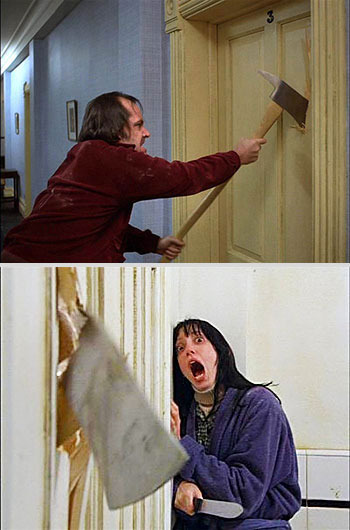
Really, it doesn't have to come to this.
Writers have a reputation of being notoriously difficult to live with.
Pretty much all creative types, but writers seem to get it the worst.
You doubt? Two words: The Shining.
It’s that need for solitude, both physical and mental. All that time spent cooped up in a room, looking at a screen or a sheet of paper. All that time with our minds light-years away from our bodies. Even when we’re there, we’re not always really there there.
This can take its toll on a relationship. The writer who wants to maintain happy co-existence with a significant other has a balancing act to work out. You both do. But it’s mostly on your head. Not all, but most. Call it 60/40. Because you’re the one who gives the appearance of withdrawing, just by the nature of what you do.
It Made Me Ache To Even Read This…
Recently, in the Comments section:
“My wife just accused me of wanting to be a writer more than a husband. It’s an awful thing to have to choose between, isn’t it?”
It is, yes. Or would be, if that’s what it really has come down to. I don’t believe it has to be a choice, unless someone’s issuing an actual ultimatum … and if that’s the case, it’s another issue entirely. What to do when a partner refuses to accept what is intrinsically important to you is beyond the scope of this piece.
This is about finding a way to make it work. About finding the balance.
In my own life with my mate, Doli, it works because we give each other the space we need to grow and keep being the person the other loves.
But that hasn’t come without conscious effort, and going through bumps, and resolving issues, and doing some recalibrating, particularly in myself and my ways of being.
Which Is Mightier: The Pen, Or Cupid’s Arrow?
The last thing I want is for this to come off like trying to tell anyone how to live, or how to conduct their relationships. Mostly I’m trying to identify some of the key wedge issues that come up. How you sort them out is up to you.
For The Writers
It’s not all about you. Your partner is just that: a partner. Not staff. Like anyone doing anything that takes a long, challenging time, you need emotional support, encouragement, understanding, appreciation. But that’s not a one-way valve. Your partner needs these same things from you. Which you undoubtedly know, in your head. But may still find it easy to postpone, from your heart.
Your partner isn’t a mind-reader. This was my single greatest failing, early on. I just expected Doli to know. Know what, exactly? Everything, pretty much: When I was in active work mode. When I was in passive work mode. When the psych-up process demanded most of my mental energy. When the aftermath left me too depleted for any kind of emotional engagement.
My thinking went like this: She’s seen it before, she’s seen the symptoms, doesn’t she recognize them by now?
Whether she did or didn’t was immaterial.
She still needed to hear it from me. Just so there would be no doubt. She could deal with pretty much anything, as long as she had a clear idea of where I was, and didn’t have to guess.
All it took was communication. For me to say, in effect, “I’m in this place right now,” or “I need some space to tackle this,” or “I love you, but am so utterly wiped that I just can’t focus.”
This wasn’t easy for me. I didn’t grow up with a good example of it. Breaking the silence was something I had to learn, but for the sake of our relationship making the effort was vital.
There’s this and there’s that. “Be here now,” goes the old Buddhist tenet on mindfulness and being in the present moment. Western productivity paradigms advocate the same thing, just in different words. The gist of it is this: When you’re working, be fully present in your work; when you’re in your home life, be fully present in your home life. You have to find a way to leave your role as writer at the desk, and fully inhabit your role as partner.
A certain amount of carryover is inevitable. Things will linger. Characters will nag. But while imagination is a beautiful thing, a life spent predominantly in an imaginary world is no substitute for living truly, madly, and deeply with the fellow inhabitants of your everyday 3-D world.
Besides, you don’t have to actively think about your work to put your mind on it. Your subconscious is happy to shuffle things around while your conscious focus is elsewhere, then bring you the results when you’re receptive. Which is why so many eureka moments happen in the shower.
For Those Who Love Them
It’s nothing personal. Have you ever seen pro athletes interviewed immediately after a game, and they can barely string together a coherent sentence? Or they just loop, repeating the same thing? They’re not stupid. Their brains literally haven’t made the transition yet. Their minds on still on the field, on the court.
Writers in work mode can be like this. Sometimes we genuinely may not hear you. Or if we do, we may not be capable of processing what you’ve just said. We may scarcely even see you, or register the fact that we have. We’re not being rude or dismissive or dense. We’re just still on the field.
Working doesn’t always look like work. Writing isn’t always about pounding keys. Sometimes writing means lying on our back staring into space. Sometimes it means doodling on a piece of paper. Or going for a walk, alone. Or an infinity of other forms. It may even look like playing an Xbox 360, although I wouldn’t stake my life on that.
So please don’t think we’re wasting time even though outward appearances may not look productive.
Back to The Shining, in which Jack Nicholson laid it out in unequivocal terms:
“When you come in here and interrupt me, you’re breaking my concentration. You’re distracting me. And it will then take me time to get back to where I was … When you come in here and you hear me typing—” tap tap tap “—or whether you don’t hear me typing, or whatever you hear me doing, it means that I’m working.”
And please don’t take what looks like downtime as an all-clear to engage. It just escalates to the axe-through-the-bathroom-door stage, and nobody wants that.
Your writer isn’t a mind-reader either. I said earlier that I had to learn to communicate better…? So did Doli. Not that this was ordinarily a problem. She’s a champ at communicating. But there was a time, when I’d be in Sustained Heavy Work Mode, that she’d keep one thing and another to herself, so as not to bother me.
But little things, squashed down long enough, tend to turn into big things. And when they blow, they blow with pressure.
Eventually we learned to meet each other halfway with this communication stuff.
So. If you, our partners, are feeling lonely, left out, ignored, or that you miss us … tell us. Tell us sooner rather than later. Tell us before it turns into a Big Deal. Tell us before it becomes an accusation.
And, um, try to pick a good time, if you can. When we’re in the middle of working? Not a good time. Remember, your objective is to get through to us. Not to try to interview us while we’re still on the field.
How Others Have Managed It
Normally, Warrior Poet comes solely from my own perspective. This time, though, it felt important to expand beyond that a bit, and bring in other points of view.
I contacted a few people who are friends, acquaintances, or colleagues, and asked them to chime in with whatever seemed particularly relevant. Their backgrounds are all different, but their aims are the same: harmonizing their work within a shared home life. This could mean establishing clear priorities, resolving issues, or finding a partner who’s wired the same way.
Barb Hendee. “I’m in a somewhat unique situation where my partner of twenty-seven years is also a writer — and we collaborate on a series — though this wasn’t always the case. He and I went to college together. We raised a daughter. We’ve been busy having a life. But throughout our adult lives together, I’ve always put the needs and feelings of J.C. and our daughter before the writing. I think that is the key. Of course having time to oneself and the writing are incredibly important, but our partners and our children have to come first. Always.”
Mark Alan Gunnells. “I found it almost impossible to write with him in the house because despite saying he understood how important it was to me, when I was writing he didn’t seem to consider that I was ‘doing anything’ and would interrupt me endlessly. He seemed to be annoyed at how much time I spent online trying to promote the books, talking to my publishers, doing interviews, that sort of thing … The way I dealt with it was writing a lot during downtime at work and trying to limit the online promotion machine to certain days.”
Elizabeth Massie. “My writing certainly wasn’t a plus to my relationship with my ex, and though it wasn’t the primary cause of its downfall, he never understood my need for solitude (which I really didn’t ask for very often; I tried very hard to balance things) in order to write and he often felt resentful. Now, however, I’m in a domestic partnership in which both of us make a living by creative freelancing. I’m a writer. Cortney is an illustrator. We understand each other’s needs for time alone. Our relationship thrives because we have can have our quiet time, our alone time, and then share what we’ve created for input or critiquing.”
Brian Keene. ”Writing cost me two marriages. At least, that’s what I tell myself. In truth, it was really me.
“My first marriage dissolved when I was trying to become a professional writer. We lived in a trailer and had about three dollars to our name. I worked all day in a foundry (and later as a truck driver) and then came home at night, and focused on my word processor, rather than my wife. I was young and dumb and it never occurred to me that my equally young wife might like me to spend some time with her rather than writing. Even when we did spend time together, we didn’t really communicate. She was usually watching TV while I had my nose buried in an issue of Deathrealm, The Horror Show, Cemetery Dance, New Blood, or one of the other big horror lit magazines of the time. When she left, I had that word processor and those horror magazines for comfort, and not much else.
“My second marriage lasted eight years (after an additional eight years of courtship), and dissolved long after I’d become a professional writer. By then, I was old enough and mature enough to have figured out that I should spend time with her and talking to her after putting in 7 or 8 hours at the computer. Despite that, communication was still the culprit in the end. There were things I was unable to properly communicate — the pressure of deadlines; the stress of fame (because even a little bit of fame can be a very fucked thing); how it felt to live under a public microscope that examined and often took issue with everything I wrote, said, thought, or did; the paranoia and self-loathing that creeps in when everyone — even your once closest friends — seem to want something from you; how utterly demoralizing it was to me that I didn’t have a weekly paycheck, health insurance, or a 401K to provide for my family the way every other husband I knew did.
“I should have tried harder to talk about these things, but I didn’t have it in me. I didn’t have it in me because after 8 hours of writing, I was emotionally and mentally exhausted at the end of the day.
“I don’t believe we choose to be writers (or musicians, painters or any other form of the arts). I believe we don’t have a choice. To be given an ultimatum like the one that inspired this Blog — to be told ‘choose me or the writing’ — is no choice at all. I probably could have saved my second marriage by quitting writing and walking away from it, but doing so would have been a lie. Writing isn’t like a sales job where you quit one firm and go to another. I’m a writer. I could no more quit than cut off my arms or voluntarily drag my balls across six miles of broken glass. Believe me, I thought about it. I thought about it long and hard. But in the end, quitting would have destroyed my marriage even more assuredly, because I would have been miserable, unhappy, unsettled, and eventually dead. That’s not hyperbole. That’s a certainty.
“They key is communication. I look back now and shake my head in disbelief that a guy who made his living communicating to the general public was unable to do the same for the people he was closest to in his private life. I’m currently in a relationship with a fellow writer — somebody who has been doing this just as long as I have, and has gone through and experienced all of the same things. And while we both intimately understand each other’s need for everything from solitude to the pressures of deadlines, we still make a concerted effort to communicate when we’re done. Because we both know just how hard it is to be in a relationship with a writer. There really are four of us — me, her, and our muses. It’s important that all four get a chance to talk.”
Simon Clark. A word, first, about Simon, the only guest here that I wasn’t already personally acquainted with. There’s a quote of his I’ve hung onto for years, which includes this line: “I think as a writer you have to sacrifice a hell of lot, and you must develop the iron-will and sheer bloody-mindedness to put your ambition firmly in the center of your life.” Yet I knew he’s a long-time family man. So I was interested in the input of someone who could say that — and mean it, and walk it — but still not regard the work as his sole center of gravity:
“I’ve been a full-time writer working from home for almost twenty years. My wife, Janet, and I have probably (almost!) got used to this life-style by now. But I appreciate that she must find life trying at times. After all, writers spend a lot of time living in their head. Even when not working at the computer, they can be distant and distracted by story ideas whirling round inside of them. This must be frustrating for Janet. I know she summons up vast reserves of patience when she has to repeat the same question two or three or times, because, in my imagination, I’ve been battling monsters in the jungles of Borneo, or whatever the current story happens to be.
“I do try to live in the real world, and what helps me achieve this is to work office hours. When I switch off the computer at 5.30 I do STRIVE to be engaged with home life. Another huge help was our children. Children cannot be ignored of course. So being in their lively, boisterous company dislodged me from thinking too much about the novel or story that I was working on.
“Now I realize being able to leave the writing world behind during the evening and weekends was vital for a harmonious family life, and vital for my writing. I think it does a writer good to stand back from their work and gain some perspective on what they’re doing. The image of the poet secluded in the attic room, surviving on dry bread and green tea, while they work in perfect solitude may be romantic — but, for one: they’ll be heading for health problems, either mentally or physically, and, two, I’m sure there ‘master work’ will turn out to be self-indulgent drivel.”
Both/And, Not Either/Or
This past weekend we watched Into The Wild, the film adaptation of Jon Krakauer’s 1996 nonfiction book on the short, intense life of Christopher McCandless, who, straight out of college, lived as a vagabond before retreating to a Thoreau-like existence in the Alaskan wilderness.
It didn’t end well for him.
Near the end, he writes this in a book: Happiness is not real unless it is shared.
You can certainly debate the truth of that, or the nuances of what McCandless may have actually meant … and people have. It’s interesting to see the different takes.
I don’t believe it, myself. I’ve had, among other spells of solitude, no end of happy times when it’s just me and the words. No writer could tell you otherwise.
But I do believe this: While happiness may be every bit as real when it’s just you, it’s better when it’s shared.
Awesome people share.
You are awesome, aren’t you…?

April 10, 2012
How Committed Are You, Really?
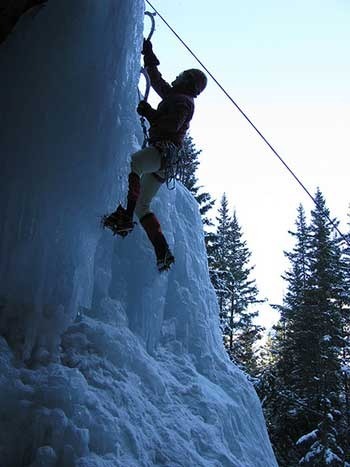 They found a dead man in the New Mexico wilderness the other day, lying peacefully beside a cool stream. He went out for a run and never came back.
It probably wasn’t news where you live, but where I live in Colorado, it was top-headline material in the Sunday paper. It should’ve been an April Fool’s Day joke, but wasn’t. He was local, sort of, when he wanted to be. His name was Micah True, née Michael Randall Hickman, but a lot of people knew him best as Caballo Blanco, Spanish for White Horse.
I wasn’t one of them — don’t get the wrong idea. I knew of him only through the printed page, a book called Born To Run. I’ve raved about it ever since, as one of the favorite books I read last year, and among the books I got the most good out of.
Without Caballo Blanco, there never would have been a Born To Run. The events at the heart of this wonderful book would never have happened. He was the most indelible of a gaggle of indelibly larger-than-life characters, and probably — and, paradoxically — both the easiest and hardest to understand.
The Cliff’s Notes version: Two decades ago he dropped off the face of the civilized world, retreating to some of the most inhospitable country on earth, bonding with and learning from some of the planet’s most reclusive people, eventually becoming a kind of flesh-and-blood myth. He lived to run and ran to live. He made running the center of his existence. He sought out the people who do it better than anyone. He bridged worlds, with running as a common language.
By the end of the book, I was trying to imagine his future. It was impossible for me to imagine anything other than more of the same. He’s going to die out there — I really did think this, out there being Mexico’s Copper Canyons or someplace almost as remote. It wasn’t an ominous thought, just a nod to what seemed like a logical inevitability. But I certainly wasn’t expecting it to happen within a matter of months.
No, But If You Hum A Few Bars, I’ll Fake It
I began this thinking of Caballo Blanco as one of the most committed individuals I’ve ever heard of, but already I’m squirming away from that. Maybe it wasn’t so much a matter of commitment as it was an honest conviction that there were no other options, at least none worth considering. As presented in Born To Run, he seemed to be a character who recognized his unconventional path with such clarity that he was oblivious to the approval and good opinions of others. Even the people of the Mexican outback thought he was crazy, or maybe not even human.
At first.
He seemed like someone who’d heard his call, and heeded it, and kept heeding it while the rest of the world caught up to him.
And yes, of course that takes commitment. There are always paths of less resistance, and hills that aren’t as steep. But first it takes clear vision, and the willingness to see who and what you really are. It may take courage to accept that, and even more to shrug off the need for the approval and good opinions of others … especially the ones who have a ready-made box for you that they insist is just your size.
After that, well, what else is left but the journey?
I’ve told this before, but today it bears telling again. Pat Fish, proprietress of Tattoo Santa Barbara, who left a mark on me that goes all the way through, once told me how another legend-in-his-own-time, Ray Bradbury, gave her the one critical tool that helped her recognize just the road ahead.
“He came annually to speak to the journalism club at my high school, it was the Ray Bradbury chapter of Quill & Scroll, and he said one year something so profound it changed my whole life: that inside yourself you have an internal gyroscope that hums when it gets near the things you love, and leans you towards them. So if you learn to pay attention to this you never have to do a stupid job, you figure out what you love to do and then make it how you make money.”
All great journeys begin with the sound of a hum.
Which Came First: The Ending Or The Beginning?
I have long tried to live this way — to live as authentically as I can. I heard the hum, the One Great Hum against the background of secondary hums, and there could be no mistaking what it was.
And I take immense joy in the reports of others who say the same. I’ve lost track of the number of people — writers and otherwise — who’ve said that things began really working for them only when they put this singular ambition at the center of their lives. That what made the biggest difference was when they boldly committed their souls.
Yet, for all that, there are times I wish I hadn’t heard the hum. Or that I’d heard a different hum. Or that, while the hum was fine, I’d been more worthy of it. There are times when I wobble and doubt, and maybe listen for another hum that just isn’t there. There are days like that. We all have days like that … don’t we? Then it all comes around again, and something happens that leaves me glad I didn’t hear anything else.
It occurs to me that the most ineffectual times of my life have usually been when I’ve lost sight of this. When I’ve hedged or diluted, when I’ve let the focus blur and the center has not held. The flipside is true as well: that some of the greatest triumphs have come from sticking with something just a little longer than a better pragmatist might’ve taken to give up.
Somewhat notoriously, William Faulkner stated that writers are congenital liars, convinced they “can create much better truth than circumstance can.”
Fine. Lie to the rest of us, lie for the greater good, lie for the sake of a better story…
But don’t lie to yourself. Not about who you are and what you’re here to do, if you’re lucky enough to have seized upon these things.
“Begin with the end in mind” — common advice, but you always hear it small-scale, on a project level. For the sake of argument let’s stretch it out for a lifetime.
Imagine the great end, whether it comes to you in your bed or rush-hour traffic or beside a cool New Mexico stream. Then imagine what comes next. The gatekeeper at the delivery door checks the paperwork from the original order and frowns at what he sees. You know how these clipboard guys are. Everything has to match up just so.
“Are you sure?” he says. “This is you? No, this doesn’t look like you at all.”
Who wants to hear a thing like that? How about this, instead:
“Yeah, yeah, come on in. And put your ID away. I’d know you anywhere…”
It’s a start, anyway.
[Photo by Falashad]
Awesome people share.
You are awesome, aren’t you…?

March 23, 2012
When “I Can’t Get No Satisfaction” Is A Good Thing (If Not Necessarily Good Grammar)
 Have I done you a disservice lately?
I don’t think so, but when there’s room for doubt, better to dispel the notion.
The point of contention is a line in “How Better Happens,” from a few weeks ago, which looked at some realizations, upon proofing OCR scans of some of my earliest novels, that became apparent only with the passage of time. Specifically, this bit:
“It’s so clear: Things got better. I got better. Mostly as a consequence of not stopping. Not stopping, and an unrelieved sense of dissatisfaction.”
That word, dissatisfaction. The implication that it’s a constant, like each day’s sunrise. Later on, the words humbling and humiliating get thrown in. Hard words, all of them. Welcome to the world.
Since then, I got an e-mail from a reader respectfully wondering if I might not be sending out an unhelpful, even damaging message: that you’re not supposed to take pride in your own work. That getting better means you have to linger in a state of perpetual misery about it. That, like the Greek myth of Tantalus, you must doom yourself to an eternity of reaching for a bunch of succulent grapes you can never touch.
Gee, I hope not. That would mean I’ve squandered an awful lot of gloomy days with a perfectly inappropriate sense of contentment.
“A Foolish Consistency Is The Hobgoblin Of Little Minds” *
Paradoxical creatures, we homo sapiens. But often to our benefit, as F. Scott Fitzgerald latched onto with this observation:
“The test of a first-rate intelligence is the ability to hold two opposing ideas in mind at the same time and still retain the ability to function.”
Like, say, (A) “I’m happy with my work today,” and (B) “I’m not happy with my work in the grand scheme of things.”
The two don’t have to be mutually exclusive.
I’ve never let any piece of writing go out from underneath my roof until I felt that it was the best I could possibly make it. That it was something I would feel proud to have my name on. But my best may be my best only at that particular time.
This inevitably gets tangled up with a longer-term view: recognizing that my best could still be better in the future, and that this lies on the other side of more work, care, and attention to detail.
The only way to reach it is to not get too comfortable, or overly satisfied, with where I am today.
Satisfaction is like aspirin: A little can help, but more isn’t necessarily better, and may even make things worse. Too much self-satisfaction may lead to smugness at best; at worst, outright hubris. If you want an unforgettable depiction of the consequences of hubris, it doesn’t get much starker than Into Thin Air, Jon Krakauer’s account of a notoriously ill-fated attempt at summiting Mount Everest in 1996.
I love this quote, from one of the commercial expedition leaders:
“We’ve got the big E figured out, we’ve got it totally wired. These days, I’m telling you, we’ve built a yellow brick road to the summit.”
His frozen corpse is still somewhere up on the mountain.
An extreme example? Sure. But people pull the equivalent with their personal and professional lives every day. I’ve done it myself, when I’ve lost sight of having been taught better.
“When I Was 17, It Was A Very Good Year…” **
Not everybody is fortunate enough to be able to pinpoint when and where a principle like this was instilled in them. To the extent anyone is able, I am.
As a high school senior, I had one of my two favorite teachers for College Prep Writing. He also supervised the school literary magazine, whose staff I was on that year. Mr. Quinn, his name. We already knew each other pretty well by that point. TQ, some of us called him.
For our assigned papers, TQ’s grading schema had two scores: one for content, the other for presentation. What you said, and how well you said it. A perfect score was 100/100.
Except I seemed unable to ever wriggle past 96/96. Sometimes a gut-churning 94 crept into the mix. What does it take to get 100 out of this guy, I would think, and go into each new assignment determined to make this one the one that pushed my grade to the top.
It never happened. Solid A’s, but never that perfect score. Not once. It wasn’t like Harry Potter’s world, where Dumbledore gives you the winning points just because he likes you.
Only during the last few days of my senior year did I find out what was actually going on, from my friend Leslie, that year’s lit-mag editor-in-chief. She’d been privy to the master plan for some time.
TQ was never going to give me 100, Leslie told me. He’d apparently decided this early. I could turn in the finest work he’d ever seen, and he was still never going to grade it higher than 96.
Because TQ saw something, and didn’t want me to stop striving to do better. He didn’t want me to feel complacent. Didn’t want me feeling entitled to coast.
So I never got 100 on some paper whose content I would’ve forgotten in a few months? Big deal. Instead, I came out of TQ’s class with something that could carry into the rest of my life. It was one of the best lessons I never remotely realized I was learning.
Now that’s a teacher.
“All Anyone Asks For Is A Chance To Work With Pride” ***
By all means, take pride in your work. If we’ve done our best, we should. We should love it for what it is, and maybe, sometimes, in spite of what it isn’t … yet.
But our best is only a snapshot in time. A single way station along a winding path or an uphill climb.
Can you truly say you love your work if you’re willing to let it take a breather halfway along the journey … and then stay there?
Subhead quotes:
* Ralph Waldo Emerson ** Frank Sinatra *** W. Edwards Deming
[Photo by Avenue G]
Awesome people share.
You are awesome, aren’t you…?

March 9, 2012
Logic: Without It, Your Story May Have A Serious Neurological Disorder
[Cross-post with Storytellers Unplugged]
“No, my lord! If we don’t let him go now, how will the enemy know when, where, and how to attack us?”
Even though life doesn’t always seem to proceed with anything resembling logic, fiction generally has to. If it doesn’t, the wires start to show, and it becomes obvious that you’re just making it up as you go along. Which you are, totally … except most readers and viewers aren’t keen on being slapped in the face with a reminder.
Let logic lapse too many times, or too flagrantly, and you will pay a price for it. Your work may be rejected altogether. Or if it does make it to an audience, some of them (along with reviewers) may call you out on the offenders. And it’s embarrassing when that happens. I recently went through OCR scans of my first two novels, for new editions, and took the opportunity to fix a spot in each one that deservedly drew fire their first time around.
Better, though, had these slips never appeared at all.
Anatomy Of A Screwup
When lapses in logic occur, it can be for any number of seductive reasons: We get lazy, we’re stumped for viable ideas, we want to make it easier on ourselves or harder on the characters, we’re just not thinking … or without the lapse, the momentum stops or there’s no story at all.
Here are some of the common symptoms of logic failure:
You repeal the laws of physics and/or nature.
You violate basic human nature.
Characters suddenly start acting wildly out of character.
You break your own rules established for your fictional world or universe.
You ignore the obvious easy solution in favor of the dramatic difficult.
Mind, now, any of these can be pulled off in grand style. But this is nearly always the result of a lot of subterranean effort to make it work … not laziness or carelessness. And then there are people like David Lynch, who’s made a long career out of doing films that, for the most part, don’t make a lot of sense on the surface.
Most of us, though, can’t get away with that. For most of us, logic is another item in the long list of things we need to be alert for as we scrutinize a semi-finished work, to see how well it’s hanging together.
To that end, here’s a quick demo of sniffing out lapses in logic, and speculating on how they might be fixed.
Case Study: The Lord Of The Rings
The filmed version, that is. Some lapses will also apply to Tolkein’s books; others, maybe not. I’m not bashing either here. I love this story and these movies dearly; so much, in fact, that in my home, ever since they were all available on DVD, we’ve spent most New Year’s Days vegging out with the whole extended edition marathon. It’s only because I’ve seen them so many times that their warts chafe.
(1) Lapse: The entire quest journey doesn’t even need to take place.
I can never watch LotR without wondering why they couldn’t just saddle Frodo on one of those magnificent eagles that Gandalf periodically calls in, and airlift him straight to Mount Doom. The whole thing could’ve been handled between second breakfast and afternoon tea. The eagles are great, but they do seem to be brought in only when there’s no other way out of a predicament.
Workaround: How to write the eagles off? I could be wrong, as it’s been a long time since I’ve read The Hobbit, but I seem to recall them being portrayed in this earlier novel as aloof and not much concerned with the affairs of humanity. Thus they could refuse the request. Or maybe Gandalf fears that, being animals, they might be unpredictably susceptible to the ring’s malign influence. Either way, this option could be cleared from the table at the council of Elrond, when everyone’s arguing over what to do. It would take 3 or 4 lines at most.
(2) Lapse: Aragorn stops King Theoden from killing the traitorous Grima Wormtongue and the entire population of Edoras just … lets him go???
This may be the most egregious lapse in the entire saga, because it isn’t merely passively illogical, but actively stupid. Not only does Aragorn physically restrain the land’s king from hacking Grima into two well-deserved halves, but gives this rationale: “Enough blood has been spilled on his account.” Umm, yeah, and payback’s a bitch … unless the story needs you to hurry back to Saruman and blab about everyone’s plans and vulnerabilities.
So they all stand around and watch Grima snarl, run off, steal a horse, and ride back to their enemies, all but calling out, “Vaya con Dios, my friend!” It’s kind of excruciating.
Workaround: Two parts here. First, sparing Grima’s life. The land of Rohan is based on Anglo-Saxon culture, which recognized a rudimentary right to trial. If Grima suddenly invokes that right, that would give Aragorn logical cause to intervene … but more for Theoden’s sake than Grima’s. A king who butchers a man invoking his right to trial, in front of his people, could be gravely diminished in their eyes.
Next, getting Grima away. It’s conceivable there could be a second conspirator in Edoras who releases him from captivity. Or: Saruman has already shown, through the king, that he has the capacity for mind-control; he could flex this muscle again, targeting a guard, long enough to let Grima go.
(3) Lapse: Aragorn releases the spectral army from their oath of service while the biggest confrontation — the assault on Mordor — is still to come.
Another puzzlingly short-sighted decision from the future king. Aragorn risked his life to enlist this ghostly army of cutthroats, without whom the good guys would’ve been crushed at Minas Tirith and Pellinor Fields. And then? “Thanks, fellas! We can take it from here. We’re only heading into the heart of darkness, with reduced numbers, against even more overwhelming odds.” What’s the rush? These green dudes have been in limbo for centuries, so another few days shouldn’t hurt.
Obviously the alliance has to dissolve; otherwise, ultimate victory comes effortlessly. Still, there was a missed opportunity here to tighten the screws and heighten the direness of the situation.
Workaround: This could’ve played better, for more suspense, if Aragorn comes out of the Minas Tirith victory fully expecting the spectral army to be with them until the end, but instead its leader confronts him, demanding their freedom. Not because Aragorn intended all along to give it this early, but because he was overly restrictive in his choice of words. In short, he conscripted them for the battle, not the war, and now has no choice but to release them or be dishonored as an oathbreaker.
(4) Lapse: Is Arwen immortal or isn’t she?
There’s a scene in The Two Towers when Elrond apparently taps his gift of foresight to describe a bleak future for his daughter Arwen should she remain behind in Middle Earth, rather than sailing into the west with the rest of the elves. It includes an eternity of widowhood after Aragorn’s death in old age, and it clearly upsets her. However, this seems to contradict The Fellowship of the Ring, when she surrenders immortality and chooses a mortal life.
Workaround: I’ve seen people complain about this as a continuity goof, if nothing else. Eventually I got to wondering: Does Elrond even know she’s done this? I suspect not, but with this much room for doubt, the issue was sloppily handled. It could be clarified by either having her blurt out what she’s done here, or mention earlier to Aragorn that she intends to keep this decision a secret from her father.
(5) Lapse: Over 3000 years, Middle Earth seems not to have advanced in weapons technology one bit.
Bonus round, this one. I’m grossly overthinking this — sometimes you just have to suspend disbelief — but still, it’s interesting to contemplate. In both the prologue and the rest of the story, people go to war with exactly the same weapons: swords, spears, bows-and-arrows, maces, etc. This bears no resemblance to our own civilization. In theirs, Saruman’s bomb and the ring itself are clear aberrations. I can buy it that, in an agrarian society, daily life could remain in stasis in perpetuity, but when it comes to killing each other, we seem to never stop looking for bigger, more efficient ways to get the job done.
Workaround: If you were to touch on this, Gandalf would be the key. He’s lived “two hundred lives of men,” so he’s obviously going to have a longterm perspective. He’s also prone to philosophizing in quiet moments. I’d be very interested to hear his take on this issue, even if, as is sometimes the case, he doesn’t have all the answers. I would wonder if he might have sensed some underlying consciousness in their world that limits their capacity for mass destruction, so they don’t destroy themselves in their baser moments.
Sure, I know … a complete fantasy.
But you can dream, can’t you?
Awesome people share.
You are awesome, aren’t you…?


