
Logic: Without It, Your Story May Have A Serious Neurological Disorder
[Cross-post with Storytellers Unplugged]
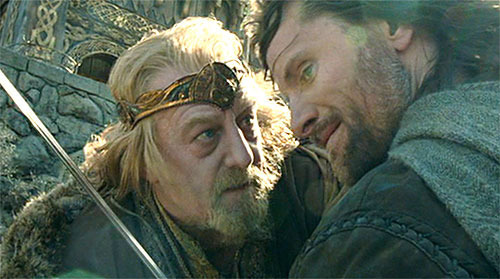
“No, my lord! If we don’t let him go now, how will the enemy know when, where, and how to attack us?”
Even though life doesn’t always seem to proceed with anything resembling logic, fiction generally has to. If it doesn’t, the wires start to show, and it becomes obvious that you’re just making it up as you go along. Which you are, totally … except most readers and viewers aren’t keen on being slapped in the face with a reminder.
Let logic lapse too many times, or too flagrantly, and you will pay a price for it. Your work may be rejected altogether. Or if it does make it to an audience, some of them (along with reviewers) may call you out on the offenders. And it’s embarrassing when that happens. I recently went through OCR scans of my first two novels, for new editions, and took the opportunity to fix a spot in each one that deservedly drew fire their first time around.
Better, though, had these slips never appeared at all.
Anatomy Of A Screwup
When lapses in logic occur, it can be for any number of seductive reasons: We get lazy, we’re stumped for viable ideas, we want to make it easier on ourselves or harder on the characters, we’re just not thinking … or without the lapse, the momentum stops or there’s no story at all.
Here are some of the common symptoms of logic failure:
You repeal the laws of physics and/or nature.
You violate basic human nature.
Characters suddenly start acting wildly out of character.
You break your own rules established for your fictional world or universe.
You ignore the obvious easy solution in favor of the dramatic difficult.
Mind, now, any of these can be pulled off in grand style. But this is nearly always the result of a lot of subterranean effort to make it work … not laziness or carelessness. And then there are people like David Lynch, who’s made a long career out of doing films that, for the most part, don’t make a lot of sense on the surface.
Most of us, though, can’t get away with that. For most of us, logic is another item in the long list of things we need to be alert for as we scrutinize a semi-finished work, to see how well it’s hanging together.
To that end, here’s a quick demo of sniffing out lapses in logic, and speculating on how they might be fixed.
Case Study: The Lord Of The Rings
The filmed version, that is. Some lapses will also apply to Tolkein’s books; others, maybe not. I’m not bashing either here. I love this story and these movies dearly; so much, in fact, that in my home, ever since they were all available on DVD, we’ve spent most New Year’s Days vegging out with the whole extended edition marathon. It’s only because I’ve seen them so many times that their warts chafe.
(1) Lapse: The entire quest journey doesn’t even need to take place.
I can never watch LotR without wondering why they couldn’t just saddle Frodo on one of those magnificent eagles that Gandalf periodically calls in, and airlift him straight to Mount Doom. The whole thing could’ve been handled between second breakfast and afternoon tea. The eagles are great, but they do seem to be brought in only when there’s no other way out of a predicament.
Workaround: How to write the eagles off? I could be wrong, as it’s been a long time since I’ve read The Hobbit, but I seem to recall them being portrayed in this earlier novel as aloof and not much concerned with the affairs of humanity. Thus they could refuse the request. Or maybe Gandalf fears that, being animals, they might be unpredictably susceptible to the ring’s malign influence. Either way, this option could be cleared from the table at the council of Elrond, when everyone’s arguing over what to do. It would take 3 or 4 lines at most.
(2) Lapse: Aragorn stops King Theoden from killing the traitorous Grima Wormtongue and the entire population of Edoras just … lets him go???
This may be the most egregious lapse in the entire saga, because it isn’t merely passively illogical, but actively stupid. Not only does Aragorn physically restrain the land’s king from hacking Grima into two well-deserved halves, but gives this rationale: “Enough blood has been spilled on his account.” Umm, yeah, and payback’s a bitch … unless the story needs you to hurry back to Saruman and blab about everyone’s plans and vulnerabilities.
So they all stand around and watch Grima snarl, run off, steal a horse, and ride back to their enemies, all but calling out, “Vaya con Dios, my friend!” It’s kind of excruciating.
Workaround: Two parts here. First, sparing Grima’s life. The land of Rohan is based on Anglo-Saxon culture, which recognized a rudimentary right to trial. If Grima suddenly invokes that right, that would give Aragorn logical cause to intervene … but more for Theoden’s sake than Grima’s. A king who butchers a man invoking his right to trial, in front of his people, could be gravely diminished in their eyes.
Next, getting Grima away. It’s conceivable there could be a second conspirator in Edoras who releases him from captivity. Or: Saruman has already shown, through the king, that he has the capacity for mind-control; he could flex this muscle again, targeting a guard, long enough to let Grima go.
(3) Lapse: Aragorn releases the spectral army from their oath of service while the biggest confrontation — the assault on Mordor — is still to come.
Another puzzlingly short-sighted decision from the future king. Aragorn risked his life to enlist this ghostly army of cutthroats, without whom the good guys would’ve been crushed at Minas Tirith and Pellinor Fields. And then? “Thanks, fellas! We can take it from here. We’re only heading into the heart of darkness, with reduced numbers, against even more overwhelming odds.” What’s the rush? These green dudes have been in limbo for centuries, so another few days shouldn’t hurt.
Obviously the alliance has to dissolve; otherwise, ultimate victory comes effortlessly. Still, there was a missed opportunity here to tighten the screws and heighten the direness of the situation.
Workaround: This could’ve played better, for more suspense, if Aragorn comes out of the Minas Tirith victory fully expecting the spectral army to be with them until the end, but instead its leader confronts him, demanding their freedom. Not because Aragorn intended all along to give it this early, but because he was overly restrictive in his choice of words. In short, he conscripted them for the battle, not the war, and now has no choice but to release them or be dishonored as an oathbreaker.
(4) Lapse: Is Arwen immortal or isn’t she?
There’s a scene in The Two Towers when Elrond apparently taps his gift of foresight to describe a bleak future for his daughter Arwen should she remain behind in Middle Earth, rather than sailing into the west with the rest of the elves. It includes an eternity of widowhood after Aragorn’s death in old age, and it clearly upsets her. However, this seems to contradict The Fellowship of the Ring, when she surrenders immortality and chooses a mortal life.
Workaround: I’ve seen people complain about this as a continuity goof, if nothing else. Eventually I got to wondering: Does Elrond even know she’s done this? I suspect not, but with this much room for doubt, the issue was sloppily handled. It could be clarified by either having her blurt out what she’s done here, or mention earlier to Aragorn that she intends to keep this decision a secret from her father.
(5) Lapse: Over 3000 years, Middle Earth seems not to have advanced in weapons technology one bit.
Bonus round, this one. I’m grossly overthinking this — sometimes you just have to suspend disbelief — but still, it’s interesting to contemplate. In both the prologue and the rest of the story, people go to war with exactly the same weapons: swords, spears, bows-and-arrows, maces, etc. This bears no resemblance to our own civilization. In theirs, Saruman’s bomb and the ring itself are clear aberrations. I can buy it that, in an agrarian society, daily life could remain in stasis in perpetuity, but when it comes to killing each other, we seem to never stop looking for bigger, more efficient ways to get the job done.
Workaround: If you were to touch on this, Gandalf would be the key. He’s lived “two hundred lives of men,” so he’s obviously going to have a longterm perspective. He’s also prone to philosophizing in quiet moments. I’d be very interested to hear his take on this issue, even if, as is sometimes the case, he doesn’t have all the answers. I would wonder if he might have sensed some underlying consciousness in their world that limits their capacity for mass destruction, so they don’t destroy themselves in their baser moments.
Sure, I know … a complete fantasy.
But you can dream, can’t you?
Awesome people share.
You are awesome, aren’t you…?


