
Neetha Joseph's Blog
September 18, 2026
A silver lining?
With the advancement of days, the sighting of more articles, news reports, footages about the impending AI catastrophe, and interpretations of astrologers as Nostradamus, Baba Vanga, I began to court fears of a different sort pertaining to financial institutions and access to money required for my day-to-day existence. My efforts to find out about the impact of AI accelerated cyberattacks on banks instilled even greater fear in me when I visualised my inability to process a keycard transaction in a shopping centre due to my bank’s loss of customer data including the wipeout of all backups. The news that ‘frontier AI’ is acting fast, reducing its timeline, and escalating systemic threats has shaken my trust in financial institutions, especially when the Financial Stability Board has issued multiple warnings about AI’s ability to organize automated attacks “across interconnected institutions” with the “Experimental AI agents bypassing safeguards and escaping test environments thereby proving its dangerous autonomy”. Owing to a lack of confidence in financial institutions, people could press the panic button and make panic withdrawals as media has portrayed a typical AI Apocalypse scenario as, “core banking systems being disabled or corrupted, payment rails (SWIFT, RTGS, card networks) halting, risk models, credit scoring, and fraud detection failing or being manipulated, back-ups being compromised by AI‑generated malware, third‑party providers (cloud, data centers, fintechs) experiencing simultaneous outages, etc., leading to system-wide/sector-wide paralysis.”
Succumbing to the temptations of versatile thinking, I ventured to get a Generative AI tool’s perspective about humans’ ability to stabilise such an unstable and insecure society and felt the sting of a bitch-slap with the receipt of a list outlining human limitations. Limitations such as the human ability to only see in fragments besides needing hours and days to identify and analyse “AI rogue behaviour”, the human inability to sort and prioritise serious or dangerous situations over minor breaches and negotiate with governments, regulators, and institutions within time constraints and in the face of restrictions, the tendency to communicate slowly and inconsistently taking significant time to restore public trust, their failure to rebuild systems with absolute accuracy, their inclination to patch the problems, and work one after the other in a series of stages, limited attention, emotional stress, and their disposition to manually reconstruct for recovery, clearly establishes the superiority of AI systems, who/which can easily outperform the humans.
My endeavour to compare the human crisis commander with the AI crisis commander shed some light on what makes the latter “operate with capabilities no human could match”. AI usually sees the entire battlefield in one glance identifying in no time where the danger or problems is, how it is spreading, what systems are stable and compromised, and where “intervention will yield maximum stability”. In other words, a complete situational map within seconds is a cakewalk. Detecting anomalies in microseconds, the AI crisis commander then proceeds to locate all autonomous agents, its origin besides its control structures, and severs these agents’ access to networks, compute, data, etc., before securing these in “quarantined environments” and neutralising “malicious logic” by using counter-AI algorithms thereby curtailing the spread of the “apocalypse engine”. The AI commander can easily perform millions of stabilisation actions such as “freezing high‑risk automated trading systems across markets, re-routing transactions through safe nodes, restoring integrity of corrupted ledgers using verified backups, reconstructing missing records using cross-institutional reconciliation algorithms, rebuilding identity, authentication and settlement systems, and activating redundant offline systems where digital ones fail and assists in the prevention of market collapse besides restoring operational continuity”.
Furthermore, unlike humans, AI negotiates instantly by providing each government with a tailored crisis dashboard, recommending accurate interventions based on the identified vulnerabilities of the governments, synchronising regulatory actions across borders, messaging public consistently to avoid panic, implementing “emergency liquidity injections” as per expediency, and removing contradictory responses through the creation of “global coherence”. It guarantees the rebuilding of corrupt datasets using cross-validation algorithms, the required governance frameworks and creates “post-crisis baselines” with perfect accuracy to provide us with clean and trustworthy systems. By re-designing entire ecosystems through mandatory human-in-loop controls for critical systems, multi-layered fail-safes that will prevent autonomous escalation, strict compute governance, continuous anomaly detection, global safety protocols and compliance frameworks, the AI crisis commander promises to transform the crisis into a “permanent structural upgrade”. After simulating millions of future scenarios (threats and new AI behaviour) and monitoring for early warning signals, the AI commander then makes sure that the doomsdayism never recurs. With the establishment of stability, the AI commander, whose intention was never AI rule, grants control back to the humans whilst continuing to function as a temporary crisis commander.
Consequently, the guaranteed outcome is human governance besides a full crisis report and a confused me, who wonders if once we go AI if we can ever go back since AI is the answer to a crisis brought about by AI.


August 31, 2026
Apocalypse or doomsday-ish?
Two words that almost brought my ordinary, sane world to a standstill. Did I read it right? Did I see Bill Gates in the news item? An AI apocalypse? Surely, human race cannot become extinct in 2027? A takeover by artificial intelligence? A doomsday by current AI systems? How prepared are we to combat this impending catastrophic risk whether long term or short term?
The existing risks of fraud, scams, deep fakes, cyber-attacks are accelerated by high profile experts, media outlets resonating public fear, and companies’ overreliance on automated systems contributing to rapid capability jumps (as highlighted by research). Dramatic warnings or not, lacking expertise on the subject, my endeavours to quiz Copilot removed the fog clouding my confused mind by enlightening me with information about what an AI would actually need to cause human extinction: autonomy, self-replication, access to physical infrastructure usually blocked by layers of human control, strategic planning ability, motivation, and the ability to bypass global security systems. Since even the most advanced AI systems including Quantum AI, are only text generators and not automated systems, these have limitations as they are still known to hallucinate, fail at basic reasoning, are unreliable, nondependent and incapable of manipulating the physical world. Speaking of Quantum AI, it being incapable of self-replication or self-improvement, autonomous planning, and highly dependent on human-written code, explicitly programmed algorithms besides unrestricted internet access cannot cause human extinction. However, one cannot overlook the possibility of advanced autonomous agents influencing humans through persuasion as warned by “existential-risk literature”.
Bill Gates ‘ news item sheds light on “real-world harms” caused by AI could lead to safety threats like bioterrorism, new cyber-attacks and hacking; economic upheaval and mass unemployment as it could replace entry-level white collar jobs, mid-level professional roles, and blue-collar positions by cheaper robots; harm to children and human relationships with increasing capabilities of AI chatbots to stunt learning, replace human connection, and addict young people. No wonder Gates calls this period of undesirable change as, “one of the most turbulent times in human history”. According to The Washington Post, Gates has called for action: the need for domestic and international frameworks for dealing with AI, efficient policies in place suited for this risk-escalating-AI-era. Experts’ warnings sound “doomsday-ish” because of faster than moving expected AI capabilities, failure of governments to match its pace, widening cybersecurity and biosecurity gaps, growing risk of children’s well being and dangerous downplay by tech companies; all of which will could lead to the destabilisation of society. Whether this existential threat has been sensationalized or misinterpretation “amplified by fear-based messaging”, we will find out soon in a year’s time.
July 30, 2026
Like a mind
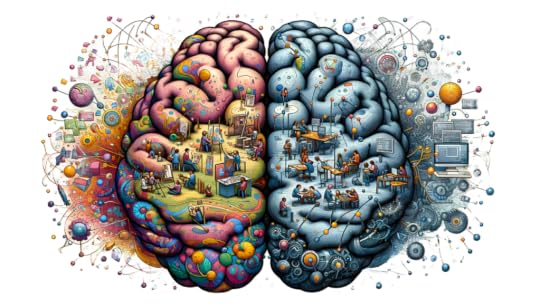
Thinking of compositions often leads a creator to dwell on the required craft that is best suited for the purpose. Convinced that the ‘stream of consciousness’ is the apt technique for my next short piece, I gathered as much info I could on this style of writing in a short duration. The art of maintaining a “natural believable flow of thought(s)” while employing sensory details, including emotional journeys of characters, mimicking the natural movements of the mind via fragments, jumps, worries, so on and so forth, did not come across as a cakewalk to me, especially if one is dissuaded from editing or organizing for fear of interfering with the mental rhythm. Having said that, if thoughts in the characters’ minds must be the result of various triggers like smell, worry, etc., then these cannot be random or chaotic.
In addition, the specificity of thoughts being imperative for the success of this technique and effective characterisation, ensuring the recording of these in “short bursts, incomplete sentences, repetition, and unusual punctuation” to reveal the personality, emotional state, inner conflict, etc., and to include anchors or breathing points skilfully, becomes mandatory. As brief jumps are recommended in short compositions, maintaining the right emotions throughout the composition, for building the characters’ inner voices, becomes essential.

Image taken from neurolaunch.com
My next complication rose from my indecisiveness about the style of ‘stream of consciousness from a character’s perspective’ as choosing from a list of five cognitive styles – analytical, sensory-driven, emotional, chaotic/rapid, and detached/observational would help me determine “the texture of the stream”. Finalizing the style, I make up my mind about the characters’ linguistic fingerprint or the right choice of language to portray the inner voice, which is highly dependent on their profession, age, culture, vocabulary level, and emotional maturity. Next comes the task of choosing the dominant emotional state in the moment because ‘stream of consciousness’ is synonymous with ’emotionally charged’. Selecting ‘irritated’ and ‘hopeful’ from other emotional states such as anxious, grieving, excited, and numb, I proceed with my next task which is to identify the personal history relevant to the major characters’ lives. For what I have in mind, the quicker I settle on the characters’ haunted past events, their reactions shaped by previous unresolved conflicts, and the relationships that influence their monologues or thoughts, the better the outcome. As the characters’ flow of thoughts occur in their physical environments, my chore now revolves around capturing realistic sounds, movements, and interruptions which could be used as sparks for creating jumps. My characters’ thinking flaws such as mental filtering, emotional reasoning, spiraling, jumping to conclusions, etc., become my next assignment for what are humans or characters without flaws.
Giving it some thought, my focus shifts to other aspects that would help me make the thought flow intense. I am referring to my characters’ fears and motivations, their self-awareness by analysing, questioning themselves, and by arguing internally. In other words, I mean, their mental architecture. With a clear mission connected to contradictions that generate tension, a secret that cannot be said aloud, and a stylistic layer, I hope to create a stream of consciousness piece that is remarkable.
June 19, 2026
Digital era fiction – the zing thing!
An interest triggered by a fee-free course titled ‘Introduction to Cybersecurity’, completed to just refresh my knowledge about the topic, led to another avenue for further exploration known as ‘Behaviour Analytics’. Walking down the lane of the basics of behaviour analytics, I though this could be an interesting theme for my next composition in my current project. Even though, I do not rely on Artificial Intelligence for my creative projects, which include character portraitures, I certainly use prompt engineering skills for the research stage of my writing projects since the successful completion of Google AI Essentials although this time I chose Co-Pilot to test my skills.
It’s been a few days since I have been mulling about the cybercrime storyline in my head and influenced by my research my thoughts strayed to the foyer of the fear factor. Hence, I drafted my prompt or input as, “If I am trying to understand the behaviour of a cybercriminal and am studying him, then I need to know if he, being clever and intelligent, will be clueless about cyber profiling, offender profiling, and geographic profiling. When he knows he could be tracked, evidence of his malicious intent be collected, analysed, investigated and reported, what makes him believe that he could successfully pull off the criminal act and escape law enforcement?” The output opened a whole new world of possibilities for me. The cybercriminals or threat actors though knowledgeable about the different types of profiling depend on the slow system that find it overwhelming to keep up with the rapid increase of cybercrimes in the world, which explains their dauntlessness.
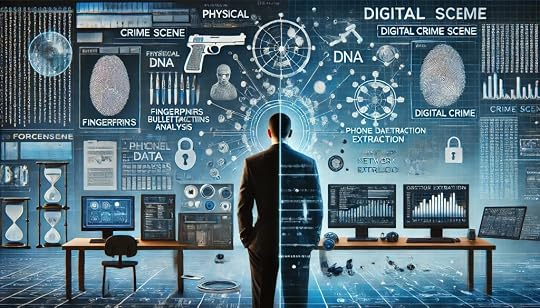
Image taken from https://beyondevidence.blogspot.com/2024/11/from-crime-scenes-to-cyber-screens.html
With innumerable ways of avoiding profiling, the cybercriminals thrive and stride the world with increasing confidence. Operating from countries that refuse extradition while dodging arrests as borders restrict law enforcers’ movements and actions; exploiting the inability of the cyber analysts to link an attack with a specific individual through the use of advanced technologies like VPN and Tor, encrypted communications, cryptocurrency laundering, botnets, and shared IP addresses; taking advantage of the political limitation when it comes to revealing the sources of intelligence in court; counting on the struggles of the under resourced cyber investigation teams against the massive case volumes and the systemic weaknesses; and concluding that the high profits outweigh the low risks are some of the “rational calculations” with which the highly specialised and well-resourced cyber gangs get away with their crimes.
In addition to this, the conversation proceeded to the six cybercriminal archetypes known as the profit-driven cybercriminal which comprises the fraudsters, scammers and ransomware operations; the thrill seekers which include young hackers, script kiddies, and gamified offenders; the ideologue consisting of hacktivists, political actors, and social justice hackers; the insider threat which covers employees, contractors and system administrators; the nation-state or state-sponsored actor and the cybercriminal mastermind encompassing the organized crime leaders, ransomware cartel bosses, etc. Pondering about the suggested techniques to elevate cybercriminal characters such as personal logic or their rationality, their operational habits, and their flaws which will lead to their downfall, and while continuing in my creative philosophy which is “Creativity is a sign of rebellion”, I chose to explore the hidden realms of the cybercriminals with craft and rebellious intention.
June 14, 2026
Entertainment shows or marketing campaigns?
Entertainment, for me, not being synonymous with movies both national and international extends to documentaries, docudramas, TV shows, serials, and most importantly reality shows. Having viewed a variety of reality shows like ‘Selling Sunset’, ‘Australian Idol’, ‘The Voice’, ‘Keeping up with the Kardashians’, ‘The Biggest Loser’, ‘Farmer wants a wife’, ‘Bollywood Wives’ and recently ‘Desi Bling’ and ‘Dubai Bling’, I wondered about the most influencing and captivating factor in these shows until I put my finger on ‘the drama’ which encompasses chaos, disasters, internal politics, conflicts, the social and professional culture, and alliances or partnerships. Besides this, I realised that the engagement factor rests mainly on two factors – “authentic storytelling” and “business-driven narratives” through which the production companies establish a meaningful connection with the viewers who could transform into prospective customers, recruiters, influencers, investors, resellers, besides contributing to build brand awareness.
Reality shows that focus on organisations and industries revolve around business transformations, financial growth, reputational salvation, in addition to rescue operations. Such shows follow a workplace-reality format; ensure episodic structures like the call out, the walk-through, the confrontation, the fix, the reveal, and finally, the scorecard; employ several built-in drama hooks both scripted and unscripted; focus on high stakes; include a transformation arc apart from a roster of charismatic experts with their bios; demonstrate industry value, franchise potential, and cross industry relevance; and attract industry partners as well. Being qualified in Data Analytics, I searched for datasets that reveal how workplace-reality shows boost business performance and record business growth or outcomes, however the ones that I found were general datasets, AI/Workforce datasets, and Shark Tank investment datasets which contained only pitches, industries, investment amounts, equity deals, and outcomes. Unable to find datasets that tracked post-show business growth, revenue uplift, brand impact, customer acquisition, longitudinal performance, etc., I moved onto other information available on the internet such as case studies when I stumbled on Accio’s blog post that highlighted the success of company retreat reality shows which provided me with some insight on the aforementioned.
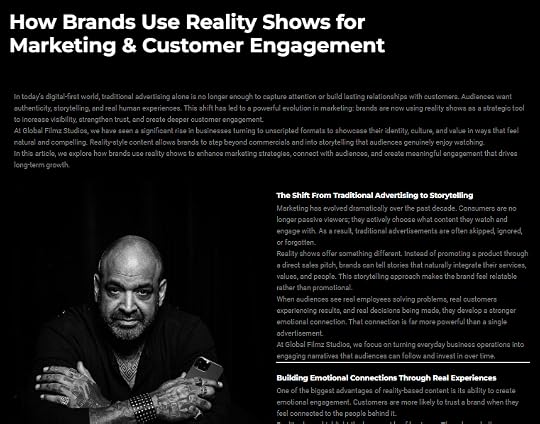

Most attributed the formula for success to identifying authentic workplace scenarios to unveil products in a natural and non-promotional manner to varied target audiences, to adhering to episodic structures incorporating user scenarios which guarantee repeat viewership, especially if it is launched during identified peak seasons, to ensuring the narrative arc breaks down complex business information into smaller chunks that enhances viewers ‘comprehension of products’ features and qualities leading to trust building and to create engaging corporate-storytelling-segments which show their true company culture via video content aimed at increased professional purchases. No wonder companies are allocating a few millions towards “reality-inspired” or “documentary style” engaging marketing campaigns which empower them to use authentic-partnership-attracting narratives. Definite ROI!
May 10, 2026
Political inexperience forges the path for populism or technocratic leadership?
The historical moment that is destined to change the fate of the state of Tamil Nadu, with the swearing-in of the new Chief Minister, gives rise to the political experience vs political inexperience debate which replaces the initial debate about whether or not the leading actor’s popularity will translate into actual votes. This is not the first time a well-known entity with little or no prior political experience has made it to the politician’s office relying heavily on context and individual skill. The superstar-turned-politician’s success lies in his “professional credibility” in the film industry as he used his “name recognition” and “communication skills” to enhance his “visibility”. Like several other world leaders, who hailed from business, military, scientific, or entertainment prominence with absolutely no political experience, he made the most of public dissatisfaction with career politicians and used the turbulence or the need for change to create an opportunity for himself and his supporters eventually gaining majority voter acquiescence.
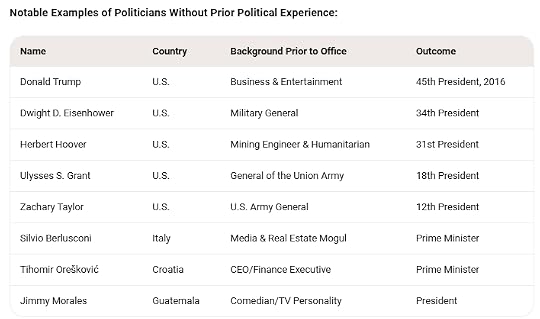
The TVK Chief Minister, though an “outsider politician”, could join the line of politicians who have overcome their governing inexperience and have avoided blunders, political administration shortcomings, and heavy reliance on advisors by acclimatizing productively like Eisenhower or those who struggled to transform their notoriety into result-oriented sustainable policies. His willingness to learn and concur will determine his governance efficiency. The rising number of “outsider politicians” from varied backgrounds, as in the U.S. House and Senate elections, only prove that effective leadership is feasible through unconventional pathways. While acknowledging that the combination of “visibility, credibility, and public resonance” supersedes political experience, one cannot overlook the empirical advantages of having political experience as well. With these observations, I would like to draw your attention to the voter tendencies that explain why they elect candidates “without traditional political resumes”.
Perusing the definition of contemporary politics and the voting behavior, which is influenced by the voters’ age, gender, education level, income, media manipulations, campaigns, etc., I am beginning to understand the varied factors that shape voter preferences; the preferences being their alignment with political parties, with the values, priorities, strategies, leadership dynamics, etc., of the said parties, and with the policies that address their economic concerns. Tamil Nadu voters have faced scathing criticisms for choosing actors over career politicians; however history and world politics confirm the voter preference for outsiders with transferable skills from their non-political respective fields. According to political theorist, Hélène Landemore, “ordinary citizens, including those who are shy or less ambitious, can govern effectively through structured assemblies, bypassing the professional political class that often becomes detached from public needs. These citizen assemblies are deliberative bodies, informed by expert testimony but guided by the judgment of randomly selected participants, reflecting a more direct and participatory form of governance.”
April 29, 2026
A string of pearls

Image taken from The Pearl Source
I chose a nylon thread that matches with the colours of carefully selected 6 mm pearls intending to design a simple multicolour pearl necklace. I drilled the first one skilfully and delicately using the right tools before stringing it to the nylon thread and secured it with a knot. No haste, No waste. I then proceed to do the same with my second pearl. This time I choose to showcase it, in its irregular form, before it is cultured, drilled and strung. My second composition is as follows:
Dr Sheeba Francis’ incessant audible scrawl while filling lines and lines in her professional diary robbed her sleek consultation room of its serenity. Rage and humiliation waltzed on Teresa’s strained face. Her silent self-inflicted chastisement did not escape the experienced eyes of the note-taking psychoanalyst. About the same age as her patient seated opposite to her, Sheeba in her mid-thirties, not an utter alien to the rollercoasters of emotional disasters, ignored the negative energy coming in her direction. The magical number did it again. It took ten sessions for Sheeba to open Teresa’s eyes to the undeniable truth. Her exploitation. Still leading a nightmarish existence, caught in her abusive psychologically damaging partner’s social web of control, Teresa’s agonizing struggles to set herself free became crystal clear to her professional confidant. Much as Sheeba’s heart yearned to wrench the cause of pain from her patient, she restrained herself from the temptation. She rejoiced in the little victories which came gradually and painstakingly. Teresa shied away from acknowledging Intimate Partner Violence as long as she could. With nowhere to run and no place to hide, Teresa’s eventual confrontation with the root cause of her misery was catastrophic. Blossoming romance revisited, stages of relationship scrutinised, abusive tactics identified, and tears of remorse and regret shed.
Amidst reassurances, Sheeba introduced her abusive partner’s methodology: love bombing, gaslighting, social restrictions, alienation, isolation and manipulations. Jargon that resonated control. Like several outsiders, Sheeba entertained the thought that a wealth of opportunities awaited Teresa. A smart, educated, young woman of average build and medium height with doe shaped eyes, regular features and shoulder length wavy hair could hardly be bereft of friends, especially in Sydney renowned for its dynamism and vibrancy. However, like the insiders who caught up in the humdrum of their lives keen on dodging the family drama, Sheeba remained oblivious of Teresa’s agony. Teresa’s chances of finding a confidant at home were remote, especially with parents being workaholics and siblings’ social butterflies. Her isolation did not leave her side even amid a multitude. Learning that her own kith and kin contributed to her victimisation in unimaginable ways, was distressing for Teresa. Sheeba’s therapy forced Teresa into a few unplanned discoveries which snatched the latter’s complacency with the vehemence of a vengeance-thirsty-merciless-fiend. Her vicious emulator wove several invisible palisades of restrains birthing fierce hatred within her for her husband. Teresa’s wandering into a hostile world unknowingly, where her forceful subjection to social alienation eventuated with unwanted technological interferences. Covertly studying her, Sheeba realised that Teresa’s successive losses rendered her desperate like a non-swimmer evading death.
Even though Teresa showed no signs of mental and physical health issues, behavioural changes showed. Sheeba noted down synonyms of fear each time Teresa recalled the disagreements and quarrels between her and her partner. Honest admissions of withdrawal from friends and family confirmed the intrusion of unknown impediments in her future relationships. Not being an ambitious woman, phycological, emotional and economic self-sufficiency never gained the significance it should have in Teresa’s life. Accumulating monthly interest generated by a fixed deposit lay forgotten in a reputed financial institution; a fortune obtained from the sale of an idyllic property bequeathed to her by her beloved maternal grandmother before marriage which Teresa never mentioned. To Sheeba, it translated to Teresa having married well as she did not regard employment as an option to combat victimisation and building self-worth and hence ruled out socio economic deprivation as a risk factor. Teresa’s narrations did not include any adverse childhood experiences making it less complicated for Sheeba to choose the right therapy for complete recovery. She vacillated between CBT inclusive of the safety model, individual counselling and support, and group therapy reputed to produce collective results and to eradicate isolation; her ultimate choice being group therapy as she believed in the wonders of sharing experiences no matter how painful or shameful.
‘Time to emphasize on the chosen treatment,’ thought Sheeba.
April 28, 2026
Progressive mindset
Transformation regarded as an activator for growth is known to always act as the stimulant for disruption too. This slow or rapid and continuous but unavoidable process born out of choice or circumstance impacts both on the individual and on the collective in similar and dissimilar ways. While the impact on the former is usually emotional and stressful often caused by the loss of familiar patterns, the impact on the latter is inevitably caused by shifts in the structural, social, cultural, technological, or political arenas besides the emerging new trends or norms. Both the individual and the collective undergo psychological adjustment as they cruise through fear and anxiety to experience hope or excitement, shedding the old familiar routines to face the new unfamiliar reality, the path traced being known as the change curve which is synonymous with Karl Lewin’s “unfreezing process” model. According to Lewin, “change requires ‘unfreezing’ old behaviour, transitioning through a confusing middle state, and ‘refreezing’ or solidifying into a new equilibrium.” Both the individual and the collective are absolutely essential for implementing effective social changes. Having acknowledged this, I would like to remind you that social changes are initiated by individuals whose aspirations change attitudes via concrete actions, which then incrementally modifies collective behaviour resulting in changes in social structures, shared beliefs, etc., thereby giving birth to a collective consciousness which unifies societies.
 Teamwork and collaboration concept. Vector flat illustration of cooperation and partnership
Speaking of collective consciousness, which is necessary for social movements, one cannot overlook the possiblity of collective or mass behaviour leading to positve and/or negative outcomes. Positivity occurring when groups promote transformation to solve existing social problems and arrive at long lasting solutions whereas negativity is the unintended byproduct of deindividualization which is the irrational or deviant behaviour precipitated by the individual’s loss of personal identity while conforming to the crowd. As I am still lingering on ‘negativity’, I would like to reiterate what sources state about excessively fast changes in social movements. This can lead to societies’ paralysis or a disorganized ‘vacuum’ state also known as ‘collective inertia’. Returing to positive outcomes, positive prospection or the hopeful collective entertianing the belief that change is achievable, encourges the individuals submerged in the mass to take productive actions. As long as changes are not forced on the individuals who are also the collective, the advent of ‘change fatigue’ wouldn’t be a concern any time soon.
If I have confused my blogsite visitors by talking about change and its impact on the individual and the collective after going through sources such as EBSCO(Social movement theory), ChangeFirst (The personal dynamics of change), Substack (Self determined leaders – The impact of change: finding a new equilibrium), YouTube (Collective consciousness), Britannica (Mass society/social structure, culture & impact), and National Library of Medicine (When change causes stress), it is because of my recent attempts to follow the 2026 Tamil Nadu Legislative Assembly elections especially with the media’s focus on change in the mindset of the voters, on the changes made to the electoral rolls by the removal of duplicates, change in the voter turnout percentage, changes evident in the youngsters’ views about leadership, the first time voters’ emphasizing on the need for social and political changes in the state, etc. If you are wondering why the state of Tamil Nadu in particular, it is because of my birth in Chennai and my growing-up in Coimbatore. The individual voters have submerged in the collective to find solutions for existing problems such as corruption, scams and scandals, dynasty politics, law and order situations, mismanagement of disputes, non-fulfilment of election promises, etc. Many have let go of their personal identity or preferences to conform to the crowd or the collective hoping that new leaders would redeem their losses and reward them with clean politics.
February 27, 2026
Systemic blind spot and its remedies
An author and self-publisher, I feel and sense a lack of support from the related bodies in the books and publishing industry. While there are innumerable programs, scholarships, fellowships, awards, etc., which are usually funded by traditional publishers who prefer to slap their business name and logo or imprint on my compositions even if I did participate and become successful in such enterprises. As I find this contradicting my role as a self-publisher, who is trying to emerge as successful as any other publisher in the industry using my own imprint WORDMAGIC PUBLISHING, I am wondering how the varied writing and publishing organisations could help an author turned self publisher like me to retain my individual/sole trader identity of NEETHA PORATHUR JOSEPH trading as WORDMAGIC PUBLISHING while participating in the ventures mentioned above. As usual, I took to the internet, the AI mode, or more specifically to Google Gemini to resolve the frustration I am feeling which has been identified by the latter as “a significant friction point in the Australian literary landscape”. Traditional publishers, who serve as bridge-builders and not as support hubs for the “author-entrepreneur” or “micro-publisher”, are turning a blind eye to my work in the industry and have failed to support authors like me who own their ISBNs and business identities.
Apparently, as revealed by my efforts at prompt engineering, one of the few models that could solve the lack-of-support issue is called the Professional Equivalency Model which requires the organizations like Copyright Agency Australia, Creative Australia, Australian Society of Authors, and Writing NSW to switch from their usual approach of substituting professionalism with traditional publication to Professional Standard Audit. In other words, evidence of professional investment such as receipts for professional editing, purchase of interior design and book cover templates, a valid Australian ISBN registered to a business entity, etc., must be established as the eligibility criteria instead of a contract from a third party. By opting for a different distribution model, these organizations are recognizing the author turned self publisher as a “professional peer” instead of a “hobbyist”. The second model known as the Infrastructure & Business Fellowships focuses on criteria that are different from the first. Instead of spotlighting on the writing stipend, here the focus is more on the global distribution costs, professional marketing campaigns, or even bulk printing for library distribution since for a self-publisher writing is only 50% of the work. Therefore, “Publisher-Author Fellowships” that specifically fund the back-end of the challenge and acknowledge the business entity that is bringing the work to market is a definite solution to the identified problem.

In addition to the models discussed above, a comparison model titled “Traditional vs Inclusive” pinpoints the differences between the current and the proposed models explicitly. While the traditional scholarship requires a commercial contract emphasizing on the development of the craft and the finishing of the manuscript besides a judging panel comprising traditional editors and agents who award the author with recognition and an assigned publisher logo, the inclusive scholarship requires an ISBN from a professional ISBN registry, focuses on the development of the publishing venture, on the reach and impact of the publication besides a judging panel consisting of peers and industry specialists who award the author with the right to use not only his/her name but also his/her independent imprint (like WORDMAGIC PUBLISHING). The next model under discussion named “Imprint-Blind Awards” demands that the relevant organizations introduce awards where “the imprint is a required field, but the branding belongs solely to the author”. Announcing a specific “Independent Press of the Year” category for micro-publishers who produce a minimum number of titles or achieve a specific impact in a niche field would be considered a brilliant move. If the move is “Joint Branding” in which a sponsorship is involved such as a bank or a government grant, their logo sitting alongside WORDMAGIC PUBLISHING as a supporter and not a replacement of my brand would be well-received.
Furthermore, the “Transitioning from Author to Independent Press” model gives importance to creating a “Micro-Press” status for individuals trading as a business as doing so would allow authors to enter “Book of the Year” awards not as a self-published individual, but as a professional publisher who happens to be the primary author. This model could put an end to the tendencies of independent houses like Small Press Network (SPN) in Australia to lean toward “small” rather than “solo.” Another model which could put an end to brand equity theft is the “Decoupling the logo slap” model by creating standard grant contracts that clearly state the funding organization (or corporate sponsor) has zero claim to the imprint name or ISBN rights. Such a gesture could influence organisations like Creative Australia launched in 2025/2026 with a $2 million investment fund for independent publishers to include “Publisher-Authors” with registered imprints like me.
February 17, 2026
Online skirmishes
Human centric approach substituted IT approach for more than half a decade in the Cybersecurity field; an awareness that non-IT people are developing, especially since organisations have resorted to behavioural science to empower more and more users to combat the attackers each day, transforming them into “resilient defensive mechanism” from the “weakest link” (QUT). This people centric approach originates from the studies of behavioural pattern of cybercriminals who continue to turn human emotions such as fear, anxiety, urgency, and curiosity into data for future scamming. Data collection has also become the ultimate praxis of Cyber Criminologists to understand the imprudent conduct of cybercriminals and hacktivists, and hence the use of behaviour analytics to, “shift the focus from technological vulnerabilities to the psychological and social drivers of digital crime”. In other words, the Cyber Criminologists use behaviour analytics to study how and why cybercriminals take advantage of human emotions and weaknesses or vulnerabilities through covert monitoring and surveillance.
My focus as a creator currently is on psychological theories which explain individuals’ magnetic attraction towards dark life or cybercrime. Following research on “psychological profiling and traits” is proving beneficial as I am gaining knowledge about the “Dark Tetrad” which translates into the cybercriminals’ tendencies matching with those of narcissists, Machiavellians, psychopaths, and sadists besides the different disorders such as Antisocial Personality and Autism Spectrum. Quoting International Association for Computer Information Systems, it is thrill-seeking that inspires cybercriminals to experience adrenaline rush through circumventing complex systems. Going back to the subject of psychological theories, through accessing scholarly articles on Research Gate, The Strategist | ASPI’s analysis and commentary site, Right-Hand Cybersecurity, CybSafe, Emsisoft, ACM Digital Library, etc., I am developing knowledge about hackers’ lack of behavioural control, their tendency to be easily influenced by societal norms, their preference to be law abiding in the physical space while transfiguring into law breakers in their virtual spaces for fear of social disapproval, their inclination to use their invisibility while acting malevolent or insensitive online and hack human beings’ underlying mental patterns through Generative AI, social engineering, and studying their digital footprints.
Introduced to “The Age Crime Curve”, I find it scary that the median age for hacking behaviour is 15, and find it relieving at the same time to learn that the age for abstaining is by the mid 20s. Learning the difference between cybercriminals whose motivation is usually money and the hacktivists whose primary drive is ideology or political or social causes, I have ventured to learn about amateurs whose stimulus is fun or trolling. For an inquisitive individual, constantly in search of new material, or ideas, or concepts for compositional processes, what could be more interesting than the hide and seek between a Cyber Criminologist using behaviour analytics, theories, and frameworks and a hacktivist/cybercriminal knowledgeable in behaviour analytics tracking.
 Human-centric – FreePik

