
 Sign in with Facebook
more photos (2)

Faiqa’s 2025 Year in Books
Take a look at Faiqa’s Year in Books, including some fun facts about their reading.
Faiqa Mansab’s Followers (160)


216 books
|
53 friends

10,495 books
|
5,001 friends

991 books
|
48 friends

2,378 books
|
331 friends

240 books
|
95 friends

1,168 books
|
441 friends

534 books
|
123 friends

10 books
|
36 friends
More friends…
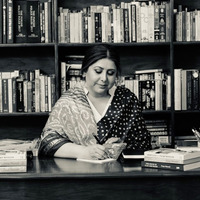
Faiqa Mansab
Goodreads Author
Born
in Lahore, Pakistan
Website
Twitter
Genre
Member Since
May 2017
URL
https://www.goodreads.com/faiqa_mansab
Popular Answered Questions

Faiqa Mansab
Connecting with people. I love to hear fro my readers :)


|
This House of Clay and Water
—
published
2017
—
8 editions
|
|

|
The Sufi Storyteller
|
|

|
Representations of Femininity: Society, Identity and Literature
by
—
published
2017
—
2 editions
|
|

|
The Sufi Storyteller
|
|
* Note: these are all the books on Goodreads for this author. To add more, click here.
Why Do we Read Fiction?
Reading calms me. It brings me the kind of pleasure and joy few things do. Stories are a way for me to recognize other people and myself too. I read all kinds of genres and books and authors according to what I feel I need. There days when i only want comfort reading, and nothing but fantasy will do. Other times I want adventure and I'll read children's books, YA and MG books. I read non-fiction w
Read more of this blog post »


Faiqa’s Recent Updates
|
Faiqa Mansab
rated a book it was ok

|
|
| This book read like a very dry, school text book. A dump of information and no “voice”. | |
|
Faiqa Mansab
did not finish

|
|
|
Faiqa Mansab
has read

|
|
|
Faiqa Mansab
rated a book it was amazing

|
|
|
Faiqa Mansab
rated a book liked it

|
|
| A few good essays but needed to be more critically rigorous. Too general but a decent attempt at creating some critical discourse on Punjabi literature and language. | |

|
|
|
Faiqa Mansab
did not finish

|
|
| The concept of wintering rests on patience and austerity, quiet time and kindness, survival— not self pity, white privilege, selfishness and blame. | |
|
Faiqa Mansab
rated a book really liked it

|
|
|
Faiqa Mansab
rated a book really liked it

|
|
|
Faiqa Mansab
rated a book really liked it

|
|
“Nobody thinks of protecting others from themselves. It's the people who claim concern and love who damage us the most.”
― This House of Clay and Water
― This House of Clay and Water
“People who roam these roads in their metal cars don't feel, don't see. They will honk and curse if an accident happens in front of them, while the people on motorbikes, on bicycles and rickshaws, will stop to help. They have not travelled enclosed in metal prisons too long, and so the wind and the sun have touched them, helped them remain more human.”
― This House of Clay and Water
― This House of Clay and Water
“You taught me to think, and you put ideas in my head. People read to forget. Books don't change the world, ji. You didn't tell me that. You talked of the dignity of the human spirit to a hijra.”
― This House of Clay and Water
― This House of Clay and Water
“I had never said those words because there were no words left. My beloved and I were both exiles from language. Our love couldn't be expressed in words. Our love had been woven into the melodies rendered by his flute, and it was subsumed in the atoms of the air we breathed. It had been consecrated in this shrine. It had never been named. It was an unnamed thing that had remained unspoken, unuttered, unsaid. I did not need to name it when he could already hear it.”
― This House of Clay and Water
― This House of Clay and Water
“It is not often that I have two options to choose from. It is nice to be compelled towards something, otherwise one drifts through life unimpeded.”
― This House of Clay and Water
― This House of Clay and Water
“I was an utterance in absentia. I was a forgotten word, uttered and mislaid long ago. I was the word that existed because there was another word that was my opposite, and without it I was nothing. I gained meaning only by acknowledging that possible other.
Nida”
― This House of Clay and Water
Nida”
― This House of Clay and Water
“I'd morphed, altered, nipped and tucked away bits of my personality for so long, I no longer recognized myself. I feared that one day, even if I wanted to, I wouldn't be able to identify myself. I'd be forever trapped in an image of another's making, and there would be no escape because I would have forgotten to want to escape.
Nida”
― This House of Clay and Water
Nida”
― This House of Clay and Water
“In the nights though, I couldn't help but weave the golden cloth of my dreams. Each stitch from heart to thought, and thought to heart, was painful to bear, even if it was joyous at times. Because each thread was fraught with the fears of being broken midway, lost and never found again.”
― This House of Clay and Water
― This House of Clay and Water
