Hûw Steer's Blog
November 30, 2025
Literal Escapism
When one frequently writes, as I do, about people breaking into or out of places and/or objects, it pays to do a little practical research.
Rewatching the Indiana Jones and Mummy movies on repeat is not, alas, sufficient (but still recommended), and despite having meant to do so for years at this point I still haven’t invested in a set of lockpicks and one of those transparent practice locks. (I do, however, have a bag full of the old locks from a friend’s house that they replaced when they moved in, so I’ve at least got some materials. Also I can usually crack open those combination key-safes without much difficulty. Don’t ask how I know that.) But when my loveable rogues – whatever flavour they might be, sci-fi or fantasy – are faced with an obstacle, it’s not normally just a lock. I aim higher than that.
If you’ve read any of the Boiling Seas books you’ll have seen me write these scenarios, and you’ll know how much I love a good puzzle. I’ve done whole floors of pressure pads, I’ve done hidden safes and locks – my favourites have to be in The Owl in the Labyrinth, which among other things has a musical combination lock. In my science-fiction worlds I do tend to fall back on technobabble to create equivalent challenges but I base it on fact as much as possible; thank you, father, for introducing me to the concept of a scramble pad at your place of work all those years ago. It’s turning those modern conveniences of security into their fantasy equivalents that’s the most fun, though, especially when real history can lend a hand. Did you know that the Romans had combination locks? Cause they’ve found a couple.
I love coming up with weird ways to challenge my characters. But like I said at the start, I need experience; I need to solve some puzzles to be able to pose them. If only there was a way to do that: to lock myself in a room with an overly complicated exit process.
Oh wait.
I, my wife, and some good friends of ours have been systematically working our way through all the escape rooms we can find for a couple of years now, and loving every one. We thought we’d done everything on offer at our chosen establishment until a few weeks ago when they very kindly opened a new puzzle just for us. (It’s ClueQuest in Kings Cross, if any Londoners are interested; they’re very good escape rooms.) Because we four are a very effective team, and even as I participate I’m making mental notes on the group dynamic, on what everyone does and how they confront different puzzles. What’s easy for one person isn’t for another, and it won’t always be Tal, Max and Lily solving my own puzzles – and even they get stuck, a lot. We divide our efforts wisely, on the whole: my wife and one friend are excellent at finding stuff, at pressing all the buttons and opening all the hidden panels and gathering the scattered puzzle pieces to assemble later; while myself and our other friend will stand with our heads together and methodically work through the mysterious symbol alphabets or connection of many wires. Between us there is no mystery we cannot conquer. We attack these escape rooms without mercy and with maximum whimsy.
Because, as I said, I (and indeed we) love puzzles. We love fitting the pieces, physical or otherwise, together, we love that moment of crystal clarity when the answer comes to you – and we love doing it together even more. Immersing yourself in something you love is always fun, but doing it as a team, sharing in the victory – that’s even better. It would be a far less satisfying story if Tal just did all the lockpicking on the Boiling Seas, after all. The best puzzles to write are the ones where multiple people attack from different angles and with different expertises – when they’re assembling the puzzle of their own different skills in the process of assembling the puzzle itself. And that’s as true in fiction as it is in real life.
And now, as I finish writing this, we’re off to conquer the next room. There are animatronics, apparently. If you see some robots show up in a future Boiling Seas story you’ll know exactly where they came from.


November 23, 2025
30 Years Weird
Today, I am 30. Just three more years and I’ll be an adult hobbit at last.
And to celebrate that, I must remember to mention, ALL my books are currently 0.99 on the Kindle store. Get me a birthday present by getting yourself something to read. Go on. Get on with it.
It seems like quite a long time, thirty years, but given that for most of it I was a child it also seems like barely any time at all. It’s only in the last decade or so that I’ve done ‘real life things’, or so it feels. I’ve studied, I’ve travelled, I’ve worked, I’ve gotten married. And soon (hopefully) I will actually have a house, a process throughout which I keep thinking I need a real adult’s approval for every bit of red tape, only to remember with crushing horror that I am technically a real adult. (Which doesn’t stop me consulting my parents at every possible juncture.)
And I’ve written things. Six published books is pretty good going for 30, I’d say, and that’s not even mentioning all the unpublished ones that lurk on my hard drive awaiting finishing, rewriting, and sanity. This year has already been a big one for me creatively, finishing The Owl in the Labyrinth – and thusa trilogy, which I have to remind myself is objectively reasonably impressive – and publishing a few short stories into the bargain. I’m quite pleased that I accidentally lined up that milestone with the milestone of me getting arbitrarily older. It feels right, somehow. If only I’d written one Boiling Seas book per decade.
A small part of me feels like some sort of momentous goal is in order, some change to things, some grand gesture of ‘I am an adult now’. But then I am buying a house, I think that’s good enough. Because I feel no older. The only times I really feel like an adult at all is when I’m surrounded by small children at work, and even then I’m building LEGO with them so ‘adult’ is stretching things a bit. It’s just the height difference, really. For every Real Grownup Thing like buying a house, there are ten moments when I buy myself children’s trading cards, or play various forms of make-believe with my friends, or am most excited, among all my birthday presents, by this really cool knife my sister found.
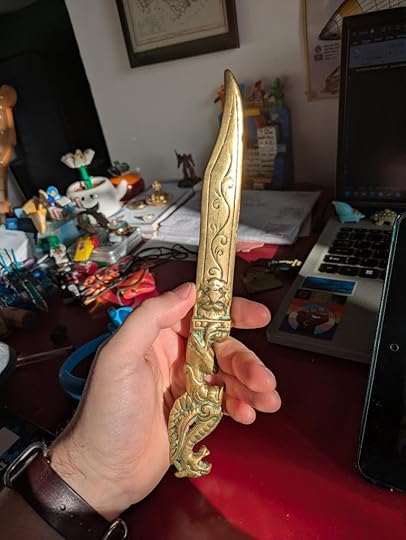 Look at it. It’s just so cool. This is probably going in a book sometime, isn’t it.
Because I’ve grown older but by no means grown up, and I fundamentally never truly intend to. In thirty years time when I write my next big birthday blog post, presumably using the power of my mind to dictate telepathically to some sort of robot scribe, I hope that I still won’t have. I am a fantasist, in my writing and my life; I am and always will be a big kid, eschewing the serious for the silly, and I like it that way.
Who knows, maybe Tolkien was right, and 33 is the real age when you mature. I guess I’ll find out in three more years. But I don’t expect to.
Now, I’m off to play board games and drink alcohol, which is one of the only ‘grownup’ things I will accept as quite a good idea.
November 16, 2025
Owl Review – The Mockingbard
“so much fun… a fascinating environment, populate[d] with unique and endearing characters”
A lovely long-form review of The Owl in the Labyrinth has emerged, from E.L. Haines/Sparrow/The Mockingbard, an author of many names and many books!
Check it out below!
Submersibles and Serpents – The Owl In The Labyrinth
Review – His Ragged Company
The thing about speculative fiction is that all the different branches of it go together so well that half the time you can’t even tell them apart. Is Star Wars sci-fi or fantasy, or both? Is my own Ad Luna purely SF or pretty much just space-F? Because all these genres hinge on ‘what-ifs’, on distortions of the real world – and so they also combine beautifully with conventional genres, and in such combinations you will find some of the best books you’ve ever read. Mix a tense political thriller with space opera and you get A Memory Called Empire. Throw some dragons into a police procedural and you get the Rivers of London series.
Stick some eldritch happenings into the Wild West, and you get His Ragged Company by Rance D. Denton. Now unlike those previous examples, when you hear the words ‘Lovecraftian western’, they don’t seem to go naturally together. But they do. They really do.

Elias Faust is the grizzled marshal of a grizzled town in the arse-end of nowhere, otherwise known as Blackpeak, Texas. He spends his time trying not to shoot drunken miners and petty criminals, which is a difficult task when much of Blackpeak’s population seems to have dedicated their time to spitting in the eye of Faust’s rough and ready version of the law. Faust is stretched thin trying to keep the peace, stretched thinner when organised crime and hate groups begin rearing their heads nearby, stretched to breaking-point when the people in power, who he’s meant to be enforcing the law for, become the ones who seem most bent on tearing it down. He’s a pragmatic, weary man with far too big a job to do, at once sick of violence and finding himself resorting to it time and again, and I would enjoy reading his story if that was it: if it was just the tale of a small-town marshal in the American west trying to keep his town together.
But His Ragged Company is more than that. Because some of those criminals take a lot more bullets than they should to bring down. Because that ‘lucky bullet’ really does seem to do something, though you couldn’t really call it ‘luck’. Because not all those scrawlings on the walls are just random doodles. Because that woman from out of town is from a long way out of town. Because slowly but surely, eerie event by event, Denton builds up far too much Weird Bollocks for Elias Faust to be able to entirely ignore. There is something in Blackpeak that is more than just dust and coal, more than just grim people and grim lives. There is something else, under the earth, and there are people who want it, and they will stop at nothing to get it, and it seems that the only one standing in their way is a tired marshal with less and less trust from his people – or in himself – by the day.
“Don’t believe them when they say [dying] doesn’t hurt… what they refuse to tell you is this: time, to pain and agony, knows no boundaries.”
It’s that slow build that really captured me when I read this book. Little things, that Faust explains away – that we as readers can see are too weird to be explained away, but that Faust’s narrative voice does so well at smoothing over, at ignoring until they can be ignored no more. As Denton’s protagonist slowly opened up to the strangeness of these goings on so did I.
It’s a masterclass in slowly raising the stakes, that is only marred by the very beginning of the book, which starts in media res, much as I did with The Blackbird and the Ghost: we kick off with Faust in the middle of some very definitely eldritch happenings from the end of the novel, and only then jump back to the beginning. And while it works, and sets a dark tone, I can’t help but wonder if it would have been better to just start at the start: with the first pair of criminals Faust faces down, with the first hints of something bigger and darker going on, to commit entirely to that slow build towards the truly fantastical events. I have received similar criticism for the start of Blackbird, and now, reading His Ragged Company, I see what that criticism was about. Would I change my own writing? Hell no. But I understand.
But that aside, His Ragged Company is excellent. Just because the end is hinted at the beginning doesn’t mean it’s not a beautifully written book. In fact – in counterpoint to myself – realising, chapter by chapter, what all those mysteries at the start meant, as one by one they were introduced, was great fun. There is so much more going on in Blackpeak than meets the eye. And I think that combination of hard-bitten western characters and the creeping darkness of Lovecraft-style eldritch horror really works: I could really buy how slow these people were to accept the supernatural, when their daily lives were so full of hardships to be shut out, when times were already bad enough.
I hope Denton gets around to a sequel, someday. I’d like to ride with Faust again. Because surely he’s managed to get himself on the wrong side of a lot more trouble by now.
November 9, 2025
The Final Sessions
It’s a strange thing, coming to the end of a story, especially when it’s a story that you’ve only half written yourself.
My made-up, mashed-up, terrible piece of game design Kill-Team role-playing campaign has been going for more than two years now. And with a bit of luck, by the end of this year it’ll be finished. It’s been one hell of an undertaking getting this far – we have weathered real-world hiatuses of many months in the process of reaching the gripping conclusion of the narrative just in time for one of my players to go off travelling at the start of next year. Thankfully, I haven’t had to rush things – I wouldn’t have wanted to end the story without him there, but the story was already drawing towards its end, and so all we have to do is make sure that the bad guys are defeated and the planet saved within the next two sessions.
Two more sessions, to tie it all together. Well, most of it. I’m not going to answer every question when I’ve got the seeds of a sequel story in my head, and despite the imminent departure of one player that still leaves three players and their characters to work with. And if our travelling companion happens to be back in town at the right time, I’m sure Stefan ‘I Already Ran In’ Cadavore could make a guest appearance in the future.
Assuming that any of them survive the next two sessions, of course. Given that two players have ended up inside a nuclear reactor full of explosives and the other two are racing to join them before an entire city is blown to kingdom come, this is very much not a certainty. But I reckon they’ll make it out. They may not have done anything quite as mad as this before, but it’s pretty close.
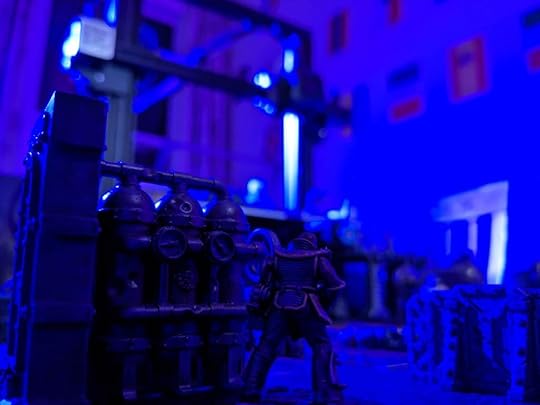 Pictured: bad decisions in the making
Because while I can write up the environment and plan ahead for the fight scenes, while I can steer them in whatever direction is necessary to keep the plot moving along, ultimately this isn’t my story. Not entirely. This is their story, my four players. I’m just trying to keep the plot coherent and desperately improvising dialogue for an alien circus performer with a Welsh accent. It’s their (bafflingly stupid) decisions that drive the narrative forward at the end of the day. I may be storyboarding a lot more than the average DnD game (my excuse being that I have to physically build the sets for every Big Fight each time so I do need some idea of what’s going to happen), but it’s my boys who decide who to shoot in the face and what to blow up. It’s them who befriended the bird-man space pirate and the aforementioned Welsh clown. It’s them who took tango lessons from an orangutan. It’s them who will, at the end of the day, save this city or die trying. Horribly and messily, most likely.
I’ll miss this story when it’s done. It’s my first attempt at a proper role-playing campaign and while it’s absolutely clunky, railroading and messy, I am still very proud of it. I think I did a good job. My players tell me that I’m doing a good job, anyway. And ultimately that’s all I want: for my friends to have a good time playing my stupid little game.
Now I have about a week to get everything written up, decide on the rules for the small army of baddies I’ll be throwing at the lads this time around, and finish building a prop nuclear reactor. You know, normal author things.
November 2, 2025
10.45 from Platform One
If you have been reading this blog, or indeed certain of my stories, for any length of time, you’ll have realised that I bloody love trains. Honestly, it’s surprising that I’ve only published one railway-themed story in my career so far. That does not, of course, mean I’ve only written one such story (Great Martian Railways II, you’ll come out some day…), and by happy coincidence I managed to start a train scene in one of my current WIPs just in time to be on a three-hour train today.
Also I’ve been reading a lot about the rapidly disappearing world of sleeper trains lately (thank you, Andrew Martin’s Night Trains), so that’s probably why they’re on my mind so much.
There’s just something about train travel that feels more like travelling than any other mode of transport. Planes are faster, but once you’re up you’re just in a metal tube with nothing to look at but sky, or a landscape so abstracted by height that while it’s beautiful it doesn’t have the same impact as seeing the trees and fields rush by the window. Cars have that advantage too, but the fact that you will inevitably spend most of the journey looking at other cars or just the road is much less appealing – and these days, as a theoretical adult, I am often the driver and thus forced to actively contribute with too much concentration to appreciate the act of travel. In a car you are deciding where you’re going, all the time, whether it’s into the next lane or down a different road.
But though so many of its branches may have closed, the British railway network still runs through a beautiful countryside, silver wires shot through green. One minute I’m embraced by the steep sides of a cutting, trees looming overhead in what’s practically a natural tunnel – the next, the earth falls away and it’s rolling fields as far as the eye can see. And there are pockets of the artificial too, of course, but apart from those moments when one pulls into a station or through its accompanying town, they are distant things, parts of the background. A looming power station chimney or a forest of wind turbines might be man-made, but from the window of a train rushing past they’re just as much landscape as the trees that grow alongside them. Even the graffiti on the parked freight trains is a thing of beauty, splashes of bright colour against the green. For this is still a green and pleasant land, for the most part, as much as it’s easy to forget it.
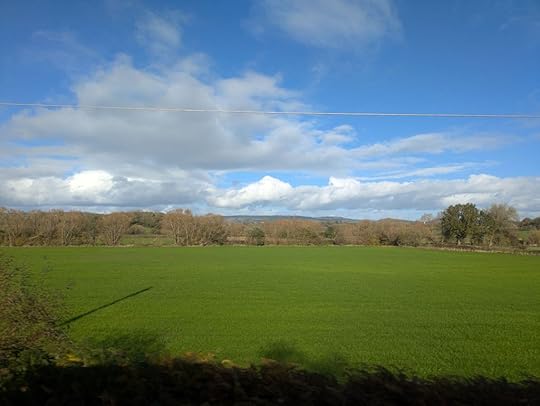 Some Wales
And from a comfortable enough seat, even facing backwards as I am now while typing this, you are at once isolated from the outside (and yes, a train is just a different form of metal tube to a plane but it’s so much nicer) and part of it, close enough to touch the landscape but far enough away to see so much of it passing by. The wheels jolt on the rails beneath you, the motors whine – there is a sense of motion, a knowledge that you are being conveyed, not simply sitting down in one place and standing up in another – but nor do you have to constantly consider that destination and how to get there, as when driving. You can sit back and read a book, or eat, or just watch the world go by. It’s not the far superior chugging and chuffing of steam but it’ll do. A plane is too abstract, too smooth; a car is too involved, too small; a train is just right.
And by now I have watched a fair bit of world go by, or at least a fair bit of Britain; I have entered Wales, where the valleys are greener and the sheep are rounder. I have a while to go yet, in sufficient comfort I’m sure. (Well, it is Transport For Wales on my next leg, but at least it’s not Arriva anymore. I still have flashbacks.) I’m not going to be there instantly. I don’t want to be. I’m not at the wheel myself and nor am I crammed into a flying box, with endless admin to do at either end. I’m in a seat, with a tiny table thing, and a book, and a view. The rails hum beneath me; other conversations hum around me. The world passes by me.
This is the only way to travel.
October 26, 2025
Bookshops, Anxiety, and Lack Thereof
I have reluctantly joined Threads, to add another account to the list of social media platforms I barely understand how to use effectively. If you use it, and want to watch me flail, you can.
I was out in Elephant and Castle last night. I was in fact on my way to a party, but I was waylaid, dear reader, because I came across a bookshop. A bookshop that was still open at 7pm – a bookshop, therefore, that I had to go and poke my nose into.
It was The Book Elephant. It’s a nice little bookshop. It has books, and it has book-related stuff, and it has a little café. It wasn’t busy. It was a cold evening outside, but the lights were warm. And it had chairs, and tables, and so I sat down for a little while and read.
Which is something that you can’t always do in a bookshop, because as much as being surrounded by books is lovely you are also in a shop, and that provides a certain capitalistic pressure to be there for the purpose of buying something. A library has places to sit and read, because that’s the whole point; a bookshop, especially chains like Waterstones, often don’t, because they want you to focus on the shop part. (Or if it’s one of the tiny second-hand bookshops I love so much, where the tomes are stacked ceiling-high and wall-to-wall, there’s no space to sit down.) At least that’s how I’ve often felt, in places like this: I can relax in a bookshop, I can spend hours wandering around and looking at books, but there is always that pressure at the back of my mind. Also, unlike a library, if you take a book off the shelf and just start reading it then somebody is going to ask you to pay, which is both reasonable and less conducive to sitting down and relaxing.
But not here. I had my own book, and I wanted to get a few more pages in before the party, to decompress after a day of work and before throwing myself back into a very social situation. And I did. And I felt myself at the most relaxed I’ve been in a bookshop for a long time; it was warm, and comfortable, and quiet, and smelled of paper, and there is little better.
Because despite the fact that I love books and writing in all their forms, I don’t always feel good in a bookshop, or a library. I get, quite frequently, really anxious there. Because words have weight, and I am surrounded by them, and I feel from all sides the imagined spectres of hundreds of authors finding me wanting, for I am not among them. There is a slot at the end of the S section where I would like very much to see my name on a spine, and it is not there. It may never be there. But there are other names there, so many of them, and they have succeeded, their words are here, and mine are not, and after a few minutes of getting my ego kicked in by my own brain I have to step outside. It’s not fun, I’ll tell you that.
Not here, though. I didn’t feel that at Book Elephant. I even looked at their shelves and realised that, if I were represented here, I’d be next to Adrian Tchaikovsky, and that would in fact be pretty cool. I didn’t feel anxious. I didn’t feel any of those above-mentioned pressures. I had a good book in my hands, and I could sit and read it, and all was right with the world.
(And I even got my wife part of her Christmas present into the bargain, so that was handy.)
October 19, 2025
Help I Accidentally Started Another Book
I have things to write. I have lots of things to write. I have Salvage 7 to redraft – which I am doing – I have several short stories that need finishing and editing. I have the finale sessions for my Warhammer-ish RPG to plan and write up. I have the second draft of an audiobook to proof, too. And I already have two other books, or at least much longer stories, that I’ve been semi-regularly poking at and adding to bit by bit. And these are of course only the ideas that I’ve actually started; there are dozens more waiting in the wings for me to get started on them.
So of course this week I started another one.
It wasn’t planned. It wasn’t from an idea I had lying around already. It was a thought I had on the train home on Wednesday, apropos of absolutely nothing. I noted it down, let myself sleep on it, and the next day just… started. And it worked. It worked well, I think. So well that I reckon I have another novella in the pipeline once it’s finished.
Maybe, anyway. There is no questioning the fact that I’m going to write this story; ever since I set my hands to the keyboard it’s been nibbling at the back of my brain, luring me away from the rest of my work: write this, let it out. But it’s a bit of a weird idea, truth be told. It is, in fact, a sequel to something I’ve already published, but very much not the sequel one would expect. (I realise this narrows the possibilities down a fair bit; it’s not the Boiling Seas because I already have too many ideas for more of that, it’s not quite a few other options… you can probably figure it out, I’m just not going to outright say it.) It takes a concept that worked very well and… throws most of that concept away. It takes a world that I spent a long time crafting and moves far away from it, in time and space and feeling. No returning characters – not really – no returning environment, a very different overall feeling. There is more melancholy to this one, at least to start with. I think it’s going to be a build towards the feeling of the original story, if it ever truly reaches that point.
It’s just the concept, really, in a different setting and in a different character’s hands. And while I have to get this story out I am already nervous about how it might be received. Because it’s a sequel, to something that people really liked, but it is such a departure from so many aspects of that thing that I have no idea if it’ll be liked in the slightest. I do not want to make that first story worse by adding to it.
Do I even publish it? Do I just take this story for myself and let that original story be? Or do I give it to all of you lot and brace for feedback?
I don’t know yet. But I do know that I’m going to write this. And there’s no point wondering about anything else until then, honestly.
October 12, 2025
Children’s Card Games
Last weekend I had an absolutely delightful time returning to the age of 10, and spending the day playing children’s card games with my friends.
I have never stopped loving Yu-Gi-Oh. I’ve played this game and collected these cards for about 25 years now, and it has always been a source of joy to me, from being 10 and playing endlessly with my cousins to rediscovering it as a sad teenager and finding it a genuine balm to my mind.
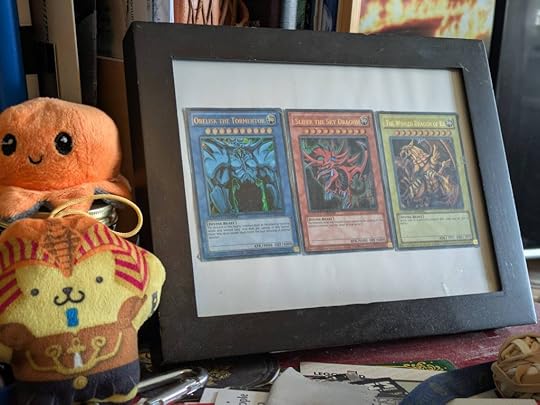 Well may you call me a nerd, but only one of us has all three of the Egyptian God Cards on their desk, and it ain’t you.
But in most of that time, I haven’t really been playing the card game. I’ve been collecting, I’ve been reading the old manga and watching the shows – both Abridged and original – and I would go through occasional phases of trying out videogame versions both new and old to keep vaguely abreast of the modern rules. But playing card games? That’s hard to do on your own. And so while I have added a lot to my collection of shiny cardboard, most of those cards have never seen the surface of a duelling field.
Until last weekend.
For while out at the shops I noticed, quite by happenstance, that a box of Yu-Gi-Oh cards that should have been £15 had been discounted… to £4. At that point, it was rude not to pick a couple up, so I did. But then I had a brainwave, because I’d been swapping old manga volumes back and forth with a friend, who had mentioned that he’d quite like to try playing the game. So I went back and picked up a couple more boxes. And then I roped in another friend. And another. And so by the time I’d completely cleared out this shop of all its absurdly cheap cardboard there were four of us: me, with my entire child- and adulthood collection, and three friends into whose hands I essentially forced as many cards as possible.
We sat down together. We built decks. We put on the original series soundtrack. And we had an absolute blast.
This card game has changed a lot since I was a wee boy, but all the absurdly small text in the world couldn’t stop us from pitting fossilised dinosaurs against an army of angels, or against what was supposed to be a collection of fish but ended up just being a bunch of Godzillas. In the parlance of card games they were all, for the most part, ‘pure jank’, but that just makes it more fun, and all the more satisfying when I managed to overcome the aforementioned army of Godzillas with a deck composed entirely of rubbish Normal monsters from 2005. Because there is a pure and childlike joy in Yu-Gi-Oh that I’ve never found in any other card game – and believe me I’ve tried a few. You can put your heart into these cards, whether they’re good ones or bad, maybe especially if they’re bad. When you pit yourself against your friends it feels personal, like you’re matching yourselves, not just some bits of cardboard.
We all played this game as children, or watched the cartoon, or read the books. We were all of us loaded with nostalgia. But for once, I think we had just as much fun revisiting the past as we did when we were really there.
Because this is far from a one-off event: we only had a few hours, and multiple challenges have been laid down for matchups we didn’t get round to. We have gods to pit against one another, we have niche secondary anime characters to try and find decks for. I have to convince one of our number that yes, while you can build a tournament-viable deck for about £20 these days, and it might work very well online in Master Duel, he’ll have much more fun against we mere mortals in real life with something less overpowered. And of course, I have not stopped my acquisition of more trading cards, definitely only because I’m looking for those which will work with my friends’ decks, yes, for no other reason at all, why do you ask. But when I bade farewell to everyone with the message, ‘remember, kids: buy more trading cards’, there was not just ironic laughter. I have these poor buggers hooked again now.
Nostalgia is a powerful thing. Friendship is another. I think that games like this, things we did as kids, are a potent combination of the two: not just recalling a fun thing you used to do but a fun thing you used to do together. And discovering as an adult that you don’t have to just remember those times, but you can get some friends together and pick up right where you left off? That’s even better.
We all got to be 10 years old again for a day, my friends and I. And we show no signs of stopping.
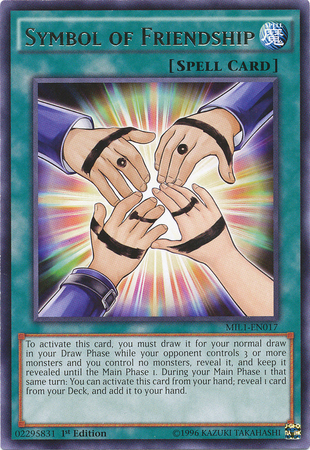 You could even call it a…
October 7, 2025
*ANOTHER* New Story – The Health Police
Short stories really are like buses, it seems; you wait all year for responses and progress and then two of them come out at once.
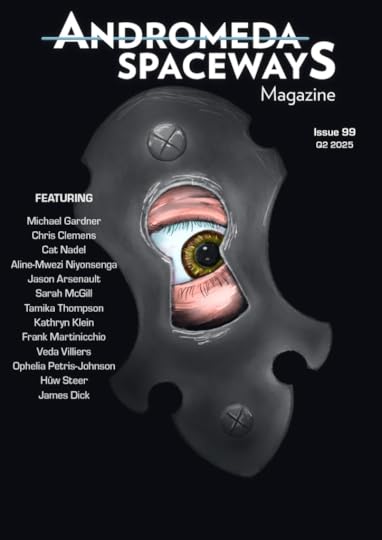
This time it’s ‘The Health Police’, in Andromeda Spaceways Magazine #99. (My fourth Aussie credit for my third Aussie publisher; Australian readers, am I doing something right without realising it?)
It’s an unusual bit of smuggling this, essentially: sneaking around below the radar of the law, but with a very different type of contraband… diseases. Because I’m British, and with all this too-topical dystopian fiction around these days it’s important to feel represented. No corporate overlords and nuclear wastelands here – just interminable, endless bureaucracy and excessive government oversight, taking the British instinct to demand a license and registration for every aspect of our lives and extending it even to the diseases we catch and the medicines we take. I wanted to put a different spin on the potential futures of gene therapies and weird treatments to explore how those systems can get abused – because what if you could take an illness away entirely, but it still had to end up somewhere?
Sound interesting? Read this story, in ASM #99.