Lydia Schröder's Blog
March 7, 2021
Perlemoen, Schulphoek and Chinese Flying Money
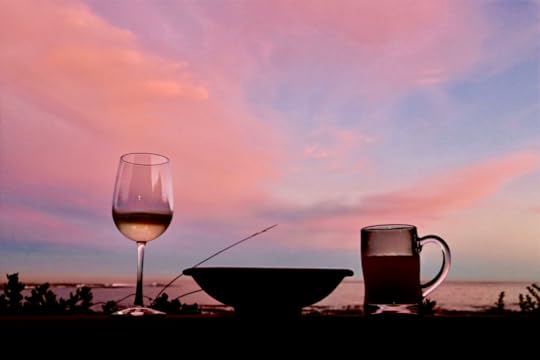
‘John says the abalone poaching and the Cape drug trade are all part of the bigger wildlife trafficking problem,’ Anthon said, taking a sip from the glass of wine in his hand.
‘John?’ I asked, my mind on the golden fires flaring up at De Kelders, on the other side of Walker Bay, as the sinking sun reflected off the west facing houses’ windows. Much closer, the shacks at Schulphoek shone silver.
I picked a green olive from the bowl next to my own glass and popped it into my mouth.
‘John Grobler,’ Anthon replied, his concentration on the latest copy of The Village News, our weekly source of what’s happening in Hermanus.
‘The Namibian journalist? The one who exposed Hage Geingob’s friend and business associate Jack Huang?’
‘Yep,’ Anthon nodded. ‘He’s been investigating the link between abalone and other wildlife poaching, the SA drug trade and the Chinese for some time.’
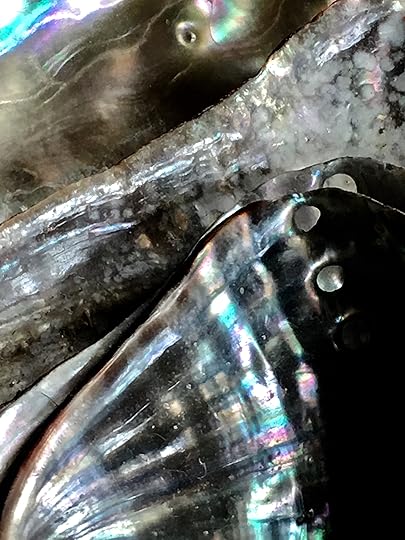
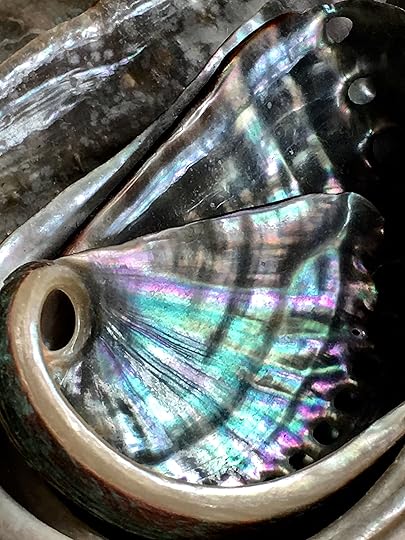
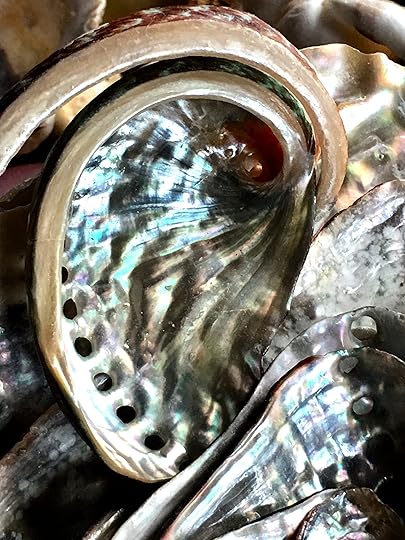
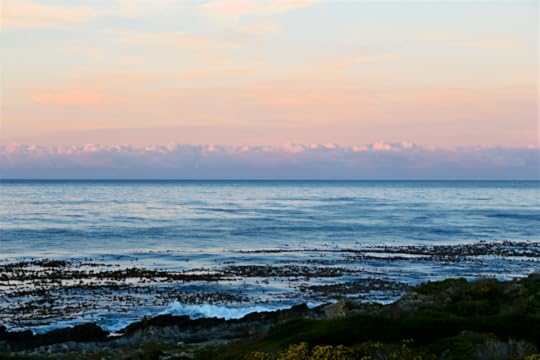
It’s a perfect winter’s day in late June. After a week of stormy seas, the swells had receded into calm, undulating sighs. The silvery-grey water resembled the inside of a Cape abalone, or perlemoen, as we call it in Afrikaans.
We were sitting on our wooden deck, suspended above our own patch of fynbos. —My previous neighbour regarded this garden as a fire hazard. To him, a garden was something filled with exotic species, like a lawn. Or paved over. Ours was designed by nature, therefore it’s continuously redesigning itself.—
It was magic-hour. That time when sea merges with sky in a slow sensual tango till the Southern Cross materialised over the bay. The lighthouse at Danger Point fought to get its signal through the layer of fog rubbing out the horizon.
The last couple of days were Champagne-days, as my mother used to call these brilliant cerulean days.
‘See this soft layer of moisture on the outside of our glasses?’ she would comment as we sat down for lunch on the deck. ‘For it to be a Champagne-day, the moisture in the air must be sufficient to give a bottle of ice-cold wine this matt sheen.'
She would’ve enjoyed today. It was as if someone had switched the ambient light to vivid-mode, turning every colour into a near-fake flamboyant hue of itself.
‘He explains how the poachers are paid with cash or Tik and other drugs,’ Anthon continued. ‘As Tik can be sold for much more than the local cash value of the perlemoen, it’s the preferred method of payment. You must read the article. The reason why nobody ever gets caught…’
‘…is all those payments to corrupt officials and law enforcers all the way up to the top?’ I interjected, anger rising with my voice.
‘It’s more intricate than that,’ he answered, ‘although that’s part of the problem. They use an ancient payment system, called Chinese Flying Money, whereby the money never actually leaves China.’
‘So the money trail cannot be followed?’ he’d now awoken my interest.
‘Exactly,’ Anthon confirmed. ‘John writes here that the rich Chinese kingpins, living our side, restock their local money supply by undervaluing and under-declaring the goods they import from, and pay for, in China. Then they sell it for much more locally. That way obtaining the cash to pay the small guys and bribe officials. And ministers, of course. Ingenious.’
A flash of light flickered amongst the kelp.
‘They’re out again,’ I sighed.
‘They were dropped earlier, in full daylight…’ his voice matter-of-fact.
‘As always,’ I interjected.
‘… already dressed in their wetsuits. Same blue car. Yes, as always,’ Anthon got up to fill our wine glasses. The divers called out to each other, the Xhosa words bobbing on the harmless waves like a song.
‘I still find it interesting that one often sees police, or Overstrand vehicles, hanging around the lookout over the bay during the day, but for some reason, they’re never here when the guys get dropped or are in the water, like now,’ I fumed.
Five years ago we’d still have phoned the neighbourhood watch or Fauna and Flora. Until we were warned that the poaching gangs targeted the residents reporting them. Now it’s common knowledge that the poaching chain of command goes right up to the top. There’s nobody to report to anymore. Nobody seems to care. Our beautiful perlemoen will soon be extinct in the wild. My grandchildren will not understand why I compared the sea with the inside of an abalone shell. They’ll never have the privilege of encountering a wild rhinoceros in the deserts of Namibia either. All because a section of a destructive species, called Homo Sapiens, had created the fiction that eating abalone and rhino-horn enhances their virility. As if we need to enhance the ability of Sapiens to pro-create. An even larger section of Sapiens believes that Money has a value beyond that of a bartering system, that a person’s worth is measured by the size of his bank account. That money is worth more than the natural resources on the only known planet able to sustain man’s own species. Most profess they’re doing it for their children. How incredibly stupid.
‘According to John’s recent Vrye Weekblad article, the explosion of squatter camps we are seeing in our small coastal towns, like Hermanus, is directly related to the abalone and drug trade.’ Anthon folded the newspaper and turned his attention to the pearlescent bay, dissipating into the approaching night.
‘It’s like a gold rush. Everybody wants a part of the spoils.’
This small plot of earth is my root; used to be my root. I’ve known this place since I’ve been able to retain memories. My grandfather built a holiday cabin here; one of those which grew incrementally as funds became available. Over the years I’ve been uprooted many times. I’ve lived all over Southern Africa. I’ve learnt to pull up my roots at a moment’s notice. I’ve become a floating water plant. But I kept one anchor here, in this tiny bay called Sandbaai.
Last year, in October, the squatters moved onto the neighbouring piece of private land, called Schulphoek. They chopped down the 400-year-old Milkwood forest, —people are more important than trees, they professed,— and slashed and burned all through Christmas, renamed it Dubai City.
Early January, as an unseasonal North-Westerly reached hurricane strength, the fires got out of hand and our paradise turned into an inferno. Hell. When the orange smoke surrounded us, I cried. I, also, have no other home. I’m as part of this continent as perlemoen and rhinoceros. But I knew the time had come to pull up this root as well.
I felt Anthon’s arm around my shoulders. Together we looked over the serenity of the bay, ignoring the occasional flash of light from its depths.
‘Remember how the whales spent night after night right here in front of us, last spring?’ Anthon said, his voice reverberating in his chest, where my head nestled.
‘It was a mother with a calf,’ I recalled. ‘They kept on splashing the water with their flippers. The clapping sound hovered on the edge of my dreams the entire night.’
***
For more on John’s article, see the following:
www.thevillagenews.co.za issue: 26 June 2019 Multi-billion dollar trafficking exposed
www.vryeweekblad.com issue: 7 June 2019 Perlemoen en Rampokkerbedryf floreer in die tentakels van korrupsie
www.facebook.com/JohnGroblerjournalist
If you enjoy my writing, you might enjoy reading my book, ‘A yellow butterfly on an elephant’s foot.’
Available from www.amazon.com
More info and link on my website www.lydiaschroderauthor.com


January 10, 2021
How to turn your job into a safari
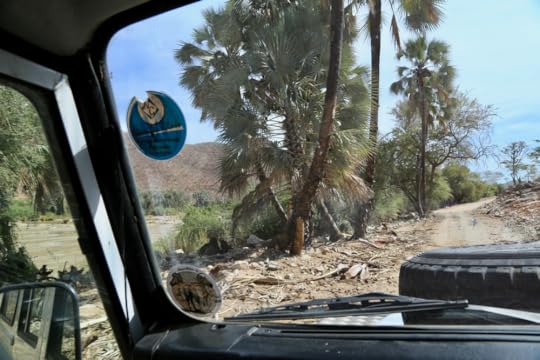
‘Mein Schatz, I finally hit on a workable business idea!' Anthon clutched Henry's steering wheel in both hands, bouncing in his seat like an excited kid who couldn't wait to go on a rollercoaster.
It was late winter, 2015. We were on our way to Aus. Henry, our Landie, was happily cruising along the spectacular D707 in Southern Namibia, churning up a haze of ochre dust in our wake. I attempted to recall my soul from where it was suspended in that blur between rusty desert and cerulean sky. Forcing myself back, I tried to make sense of his words.
‘You know how my accountant always tells me that I was born without a business brain? Well, listen to this plan!' He looked at me with expectation. I obliged.
‘You have a business plan?' I asked rather dryly.
‘Why don't I sell my practice, you retire as architect, we put all our furniture in storage, give up the house and leave Windhoek when Louise finishes matric?'
‘That's a business plan? Shouldn't it cover some means of income as well?' My mind was still fuzzy of the heat in the old Land Rover.
‘Patience, I'm getting to it!' followed by silence. He loves keeping one in suspense.
‘Come on!' I shook his arm.
‘Think Mohammed-and-the-Mountain, Mein Schatz. If it's inconvenient for a lodge to cart all their food-handling staff, —which could number anything between one and fifty persons,— to the nearest doctor, —which could be up to three hours away on a gravel road,— there must be an opportunity for us to drive to the lodge, ask for accommodation and subsistence as part of our deal and examine the staff right there, without interfering in their normal operations in the slightest. Exactly what we're going to do in Aus this weekend, except we'll turn it into a lengthy Safari!'
‘Think about it,' he was on a roll, ‘we won't need any employees, we won't need office space; we'll sleep and eat at the lodges. Our only overhead will be Henry and his diesel, tyres and upkeep. And our time, of course!'
‘Wow!' was all I could muster. I had to think about such a proposition. I wasn't entirely sure that I loved sitting in Henry quite enough to do it 365 days a year. I voiced my concern out loud.
‘Not for the entire year,' he laughed. ‘There aren't enough lodges in Namibia to keep us busy that long. Anyway, quite a number might not even come on board.'
‘So what do we do for the rest of the year?'
‘I'll finish my Ego State and Somatic Experiencing training, we'll spend some time in Sandbaai to allow you to finish your book and once I've retrained, I'll try my luck building a practice somewhere in Germany!'
I love this man. He makes life seem so simple; especially his uncanny knack to turn the slightest opportunity into a bush safari or world tour.
‘So you're finally prepared to close your medical practice in Windhoek?' I had to make sure I understood him correctly.
‘I can't close my practice for three to four months at a time while I finish my studies or while we do these medicals. I'll lose all my patients. Some even complain if I take a three week holiday over Christmas. And with my receptionist resigning, I simply cannot face training yet another front-desk person again.'
‘And as we both know so well, overheads keep running, whether you generate an income or not,' I added. I was the balancer of books. Our most expensive month in the year was always December. All our employees, whether at home, in Anthon's practice or my architectural office, wanted a thirteenth cheque in December, yet all of them demanded their annual leave over Christmas. On top of it, the entire population of Windhoek migrated to Swakopmund and the coast. We had little choice but to close up and go on holiday ourselves and worry about filling the huge end-of-year hole in our bank accounts on our return in January.
‘I'll miss my patients though; especially the kids,' he continued. ‘I opened my practice in 1993. Twenty-two years is a long time. I have patients for whom I did their pregnancy test, assisted with the birth, inoculated the babies, saw the kids grow up and eventually did the daughter or daughter-in-law's pregnancy test again, twenty years later.'
We slowed down to allow a lone Gemsbok, trapped in the road reserve, to duck under the fence and gallop into the distance; a majestic creature in an endless sea of burnt-orange sand.
So what are food-handler's medicals? In Namibia, there's a law which requires that every person handling food or drink for public consumption must be examined by a medical doctor once a year, for any diseases which could be transmitted in food. This doctor then has to issue the lodge with a certificate of compliance.
It may sound like a good idea if you're the tourist, but as a lodge owner, it's a logistical nightmare. The majority of lodges are located in semi-wilderness areas, often far from a town where a General Practitioner is available. Add that in many areas the authorities will not issue the lodge with a liquor licence without them having a valid food-handlers fitness certificate, and the problem becomes acute: What is a lodge-stay in the wilderness without a beer or a bottle of wine to accompany the glorious sunsets?
Doing these examinations has been part of Anthon's medical practice since the mid-nineties when a lodge near Sossusvlei asked him to be their company doctor. He went out for a long weekend once a year and examined their entire staff compliment, at their request. They believed that examining all their staff, from chefs to cleaners and even the maintenance personnel, was good for staff morale. It also allowed them to give promising back-of-house staff more responsibility. In the more than twenty years he served as their company doctor, Anthon saw youngsters come in as room cleaners and rise through the ranks to become duty managers. We always joked that we've seen lodge owners and managers come and go, only us and a couple of staff members stayed on.
Along the way, a couple of other lodges came online. But until this idea came into his head it was more a matter of a long weekend every couple of months. We provided a service while having a rest, as we always requested a day or two extra to recoup from the rush in Windhoek.
‘And, Mein Schatz, maybe I can sneak in a pro bono clinic on the side for the non-food-handling staff who never get to a doctor?'
I just laughed. He always did it anyway.
* * *
In 2016 we implemented Anthon's Great Business Idea. Perhaps I should add, any business plan which doesn't cost us money is seen as Great. For us, ‘breaking-even’ is reaching that balance described by the words ‘when enough is enough.' This year, 2019, in February and March, we drove more than 11,000km through Namibia. When the heat became unbearable during the day, especially when Henry's air-conditioning system gave up on our way into Damaraland and we had to resort to spraying each other with a bottle of water in order to survive the heat, I vowed it was my last lodge trip. Yet every evening, when the African sun set fire to the sky, the wind died down and a zebra or giraffe silently appeared at the lodge's waterhole, we clinked our wine glasses and counted our blessings.
We've had our ups and downs, our hilarious moments and our times of despair, but all in all we've only enriched our lives. I believe that travel lengthens one's life, and the past three and a half years serve as proof: it feels as though we'd packed up our house in Windhoek ten years ago.
* * *
If you enjoy my writing, you might enjoy reading my book, ‘A yellow butterfly on an elephant’s foot.’
Available from Amazon
More info and link on my website www.lydiaschroderauthor.com
For more about Anthon, click here.
Epupa, crocodiles and being African
We pushed open the heavy dropper screen, allowing light to stream into the rustic hut.
‘This must be what heaven looks like!’ I raved.
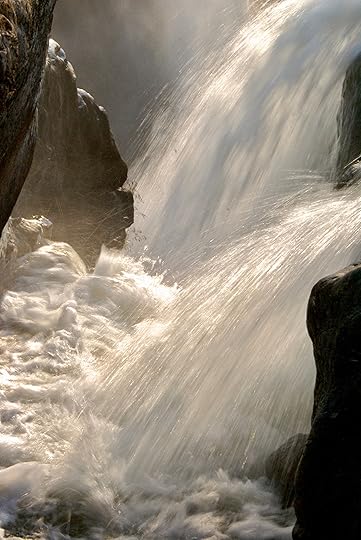
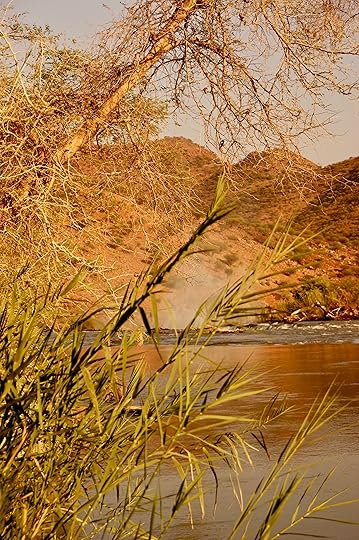
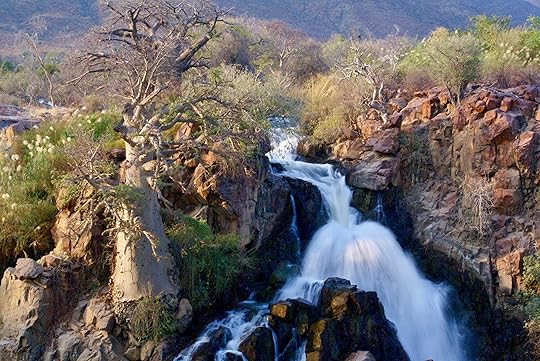
From our right, a mass of grey-green water floated into the framed opening, just to be swallowed by an invisible chasm to our left. A puff of mist hovered above this spot, like a ghost bellowing its warning with an unceasing roar.
A slow-motion blast of moist air engulfed our bodies.
‘Hot as hell, though!’ Anthon chuckled, perspiration dripping from his forehead as he lowered the bottom flap outwards as well. The riverside of our tree-hut was now completely open from waist-height upwards, the lower panel forming a handy countertop.
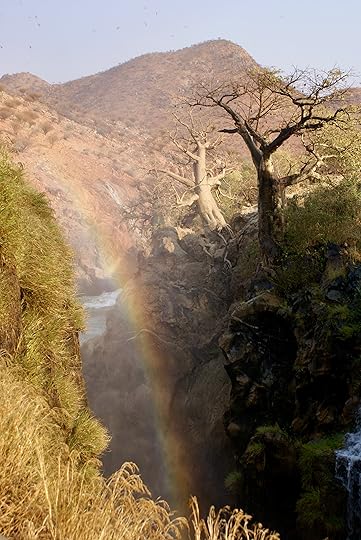
I was still mesmerised by the drama. We were suspended between tall Makalani palms teetering on the edge of the Kunene River. Not twenty meters from us, it dropped into the narrow part of the hairpin gorge creating the Epupa Falls. Massive baobabs clung to boulders, their roots groping for support deep into the rock-face.
Across the water, on the Angolan-side, the lush palm forest in the foreground belied the barrenness of the mountains embracing the gorge.
‘This must be one of my favourite places on the planet.’
Water entrances me. Whether the ebb and flow of surf along the Cape Coast or the reverberation as it crashes over a cliff, it invigorates and soothes me.
‘Can’t wait to sleep with this sound tonight,’ I added.
‘We’ll have to open the windows on the other side as well. And hope for a westerly late-night breeze,’ Anthon inspected the possibilities. ‘If we tuck our mozzie-net under the mattress and sleep under damp kikois, we might survive the heat.’
‘Well, it’s all part of doing this trip in high summer, not so?’ I laughed. ‘Most normal people won’t choose January as the best time to travel all the way from Katima Mulilo along the northern border of Namibia.’ Thirst clawed at my throat. I wondered whether I’d left my water-bottle in Henry.
‘Let’s go and say hi to Koos, then grab something to drink on the deck,’ Anthon read my mind.
Koos Verwey is the owner of Epupa Falls Lodge. Nicknamed the White Himba of the Kunene, his leathery exterior hides his compassion for the Himba, the endemic people of the Kunene, who still live in harmony with this ancient landscape. This time we found him on crutches, having recently had a knee replacement.
‘Glad to see you two again!’ Koos’s piercing blue eyes twinkled above his bearded smile. ‘I’ve still got some errands to run, but we’ll chat over a dop tomorrow evening. Selma will prepare some T-bones for you. Just tell her when you’re ready.’
Koos was the first to establish a camping site at this idyllic spot in 1991. Through the years a few other camps opened their doors, but the distance from the main centres and the condition of the access roads had kept it pristine; a refuge only frequented by slow-travellers and a couple of overland vehicles. We would find out later that those days might, unfortunately, be numbered. One of the camps had just been sold to a large tourist chain selling beds by the busload.
As Koos left, Selma came out of the kitchen to greet us. ‘You’re the only guests tonight,’ she beamed. ‘When would you like to eat?’
We looked at each other. Though the idea of one of Selma’s T-bones made my mouth water, my thirst was more urgent. And the sun would soon be dipping behind the mountains.
‘As soon as the sun’s down,’ we agreed.
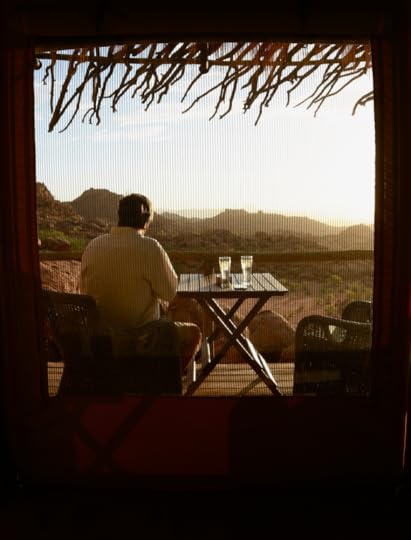
We pulled two chairs to the edge of the deck. Selma brought us large beer-mugs filled with water and ice.
‘I brush my teeth with water,’ Anthon complained. ‘Where’s my beer?’
‘You need to drink lots of water up here,’ she scolded, smiling. ‘I’ll bring your drinks when you’ve finished these.’
‘Thank you, Mother,’ Anthon joked.
Once Selma had obliged him with a beer, we sank back into our chairs.
’Do you remember the trip we made up here with the Pienaars and Hugo?’ he asked. ‘Didn’t your brother also come along?’
‘Yes, Riël also joined. And Jeannie, Hugo’s sister-in-law,’ I answered. ‘Wow, that was more than ten years ago.’
‘Let’s drink to wonderful camping trips!’ We clinked glasses, the last drops of orange sun spilling into our drinks.
‘I’ll never forget how Vincent wrapped a blanket over Arnie’s spare wheel when we camped at Mowani that first night,’ I smiled. ‘He joked that the mozzies might puncture the tyre, its tread was so low.’
Anthon boomed with laughter. ‘And how prophetic weren’t those words! If I remember correctly Arnie wrote off two tyres the next day.’
‘Hugo also had a flat. Only Henry behaved himself like a decent 4x4.’
‘We had to alter our route to go through Opuwo so that Arnie could buy an extra spare. Just for incase,’ Anthon added.
‘But it was also a blessing in disguise,’ I said, ‘as it gave us the chance to camp wild in that riverbed not far from Otjiu.’
‘We didn’t have much of a choice. It was getting dark and we were still very far from Opuwo. Riël, Hugo and Jeannie decided to share the large tent, to save time when we set up camp. We all just wanted to eat and go to bed, we were so tired.’
‘Remember the full moon?’ I asked.
‘I do,’ Anthon stretched out his legs, gazing at the sky where the evening star had just appeared. ’We were looking at the moon from our rooftop tent when that hyena started to howl in the middle of the camp.’
‘And Jeannie woke up terrified. She tried to wake Riël and Hugo, but they just kept on snoring. Apparently, she then pulled her sleeping bag over her head, hoping the animal would go for the snorers first.’
We looked out over the wide river. The West Wind had started to stir, the light breeze refreshing our damp skins.
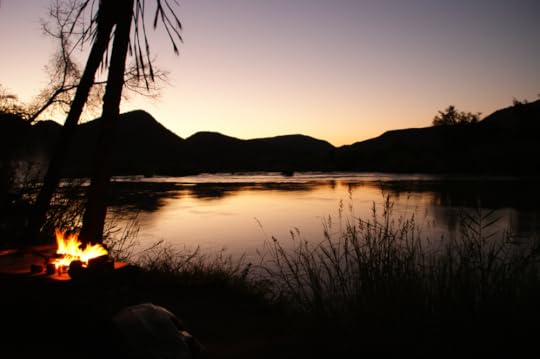
Further up-river, campers had lit a fire for their evening meal. Seated on Makalani logs laid lengthwise along the river’s edge, they were also watching the last glow of day carving out the mountain tops.
Without any visible provocation, Anthon burst out laughing.
‘What?’ I asked.
‘Remember the last night we camped here with Arnie and them?’ he laughed again. ‘Refresh my memory?’ I said.
‘When that self-drive group of Italians pulled in next to us, as the sun was going down? They started to set up their little dome tents right on the river’s edge, much too close to us for our liking. So Arnie and I walked over to them to find out where they’re from, do our normal praat-’n-bietjie-kak-met-die-bure thing.’
‘Rings a bell,’ I said, ‘but I want to hear the entire story again. I like the way you tell them.’
I slumped back in my chair, resting my feet on the middle bar of the railing. Sipping my gin and tonic, I allowed his voice to draw me back into another era of our lives.
He obliged, enjoying his reminiscence.
‘One of the guys could speak a bit of English. “You see these logs?” Arnie said to him, pointing at the Makalani palm trunks along the river’s edge. He looked at us and shrugged his shoulders. “So? What about these logs?”’ Here Anthon put on a heavy Italian accent, sounding like a Mafiosi in a Francis Ford Coppola movie.
‘“They’re put there to keep the crocodiles out at night,” Arnie answered. This got the guy’s attention. “There’re crocodiles here?” he asked, concerned. I stretched out my arms in both directions. “BIG ones,” I said. Then Arnie pointed to an opening between the tree stumps, right between their camp and ours. “You see this gap here? That’s where they came out of the water last night.” The Italian’s eyes became large. I decided to add my bit and waved my arm in the direction of our camp. “See how our ground tents are far away from the river? That’s because of the crocodiles. We’ll only put our rooftop tents close to the water.” The man’s eyes nearly bulged out of his head. He turned around and released a barrage of Italian, electrifying his compatriots into action. The next moment it looked as if an anteater had dug up an anthill, with tents being pulled away from the opening and the water’s edge until they were all huddled into the far corner, a good distance from us.’
‘Now I recall it clearly!’ I sat upright and started to laugh as the memory became vivid. ‘You and Arnie came back to the camp, laughing so much we could hardly make out what you were saying. While we were sitting around our campfire, we watched our neighbours having something like two-minute-noodles on little gas-burners, then disappearing into their tents as soon as it became dark.’
‘Do you remember what happened later?’ Anthon chuckled.
‘I do. Three of the Italian girls joined us. They couldn’t resist the smell of the steaks we were grilling over the coals. Didn’t want to believe a word about the crocs. So you told them there were crocs, huge ones, but they didn’t like eating Italian. A bit later Stellie and I went to bed. You joined soon afterwards, but the two bachelors and Arnie had a ball entertaining the girls from next door with loads of whisky until late into the night. Luckily the noise of the water drowned out their laughter, so I slept like a baby.’
The aroma of grilling T-bone steaks reached us. Selma served us our dinner, then left for the night.
We were alone on the deck. The campers had retired to their tents, leaving a few embers to gleam faintly whenever a waft of wind brushed over them.
As the darkness became thicker, the universe unfolded overhead. Frogs and insects chanted in sync with the drone of the waterfall.
‘Being African is a state of mind,’ I said.
‘Let’s drink to that,’ Anthon agreed.
* * *
If you enjoyed this story, you will enjoy reading my book, ‘A yellow butterfly on an elephant’s foot.’
Available as a paperback and for Kindle.
For more about me and my book, click here.
For more about Anthon, click here.
Should you want more information on Epupa Falls Lodge and Campsites you can access their website here.
The man who wanted to shake the doctor's hand
Extract from ' A yellow butterfly on an elephant's foot
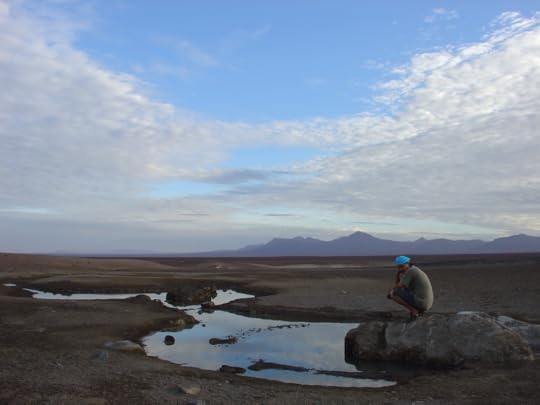
‘In these out-of-the-way rural areas few people can speak English,’ Anthon picked up where we left off a few kilometres earlier. ‘For my clinics in Opuwo, I employed a translator to help me communicate with the Ovahimba. My Herero keeps me out of trouble, but is far from fluent enough to allow me to take a patient’s case history and make a diagnosis.’
‘Any special stories?’ I nudged.
‘Many,’ he chuckled, ‘but I’ve got a favourite.’
‘So?’ I urged as he just sat there, arms wrapped around Henry’s steering wheel, smiling at his own recollection.
‘One morning an old Ovahimba man came to see me. I asked the translator to find out what his ailment was. The man explained he’d been suffering from diarrhoea for many years. His life was miserable. He had little energy and was desperate for a cure. He’d been to the State Hospital on numerous occasions where he always had to sit in line for the entire day, just to be sent home with a little yellow plastic envelope filled with paracetamol tablets and a few multivitamins.’
He navigated Henry through a slippery puddle. The carved Makalani seeds dangling from the rear-view mirror swung rhythmically from side to side.
‘I listened to his story, then prompted the translator to get him to list all his symptoms. His was a classic case of Amoebiasis, an illness often contracted by people drinking water from communal wells shared by animals. Although it’s a horrible disease it’s quite easy to cure with the correct treatment.’
The road straightened out again. He relaxed back into his seat.
‘As I told you before, I always took a variety of medicines along to Opuwo. I gave him the right medication to effectively cure his condition and explained how he should take it. He paid me for the consultation, couldn’t thank me enough and went on his way.’
We drove through another patch of mud. Blobs of clay plonked onto the windscreen, shuddered, then wriggled sideways, painting brown squiggles across my field of vision.
‘Two months later, on a subsequent visits to Opuwo, I saw the same man sitting amongst the waiting patients. While busy with the queue of people in front of him, I racked my brain, trying to figure out how I could possibly have misdiagnosed him before. He merely sat there, showing no sign of being impatient or agitated, waiting for his turn to talk to me. When I came to him, I asked the translator to find out why the tate kuru was back, whether the medication didn’t improve his condition.’
‘Explain to me what exactly tate kuru means,’ I interjected, ‘you’ve been using the word often.’
‘A tate is a man and kuru translates as old. Not old in the negative, western sense, but rather as a form of respect. Calling a man a tate kuru is therefore a respectful way to address a male person of your own age or older. For a woman, you would use meme, as I called you just now when we spoke to Queen Elizabeth.’
‘Okay. Now it makes sense,’ I said. ‘So what did the translator say?’
‘He told me, “No, Doctor, he says he’s never been better. He came back to shake your hand and to tell you that you’re a blessed man; that you changed his life; that God will bless you for what you did for him.” You could’ve pushed me over with your little finger, the answer was so unexpected. I asked the interpreter to find out where the man lived, curious to know how far he’d travelled to see me. “Doctor,” he answered after a lengthy consultation with the old man, which included a lot of arm swinging and pointing into the distance, “If you walk from here, 90km into the mountains, that way,” he pointed in a north-westerly direction, “you’d get to the village where he lives.”
***
If you enjoyed this story, you might enjoy reading my book, ‘A yellow butterfly on an elephant’s foot.’
Available from www.amazon.com
More info and link on our websites www.lydiaschroderauthor.com and www.doctoranthonschroder.com
December 29, 2020
Slow-travel with Mark and Charlie
A visit to Shamvura Camp , on the banks of Namibia's Kavango River, and a boat trip with Mark Paxton, is an experience you'll never forget.
‘Hey Mark, what’s that! Over there between the waterlilies?’ I pointed to the opposite riverbank.
‘Fuck!’ Mark steered the boat towards the floating field of white lilies, the slow motion of the boat welling up glassy swells reflecting upside-down distortions of trees, white clouds and violet skies.
‘What? Is it a cro…’ Anthon started.
‘… I warned you not to use the C-word!’ Mark shouted above the drone of the engine, but he was too late. Thunzi, the Weimaraner, was already in a quiver, nearly falling overboard with excitement. The Jack Russel Uju’s back legs lifted off the deck as she heard the dreaded word. Cream Puff attempted to heave his heavy Labrador body onto the stern of the boat, to join the action.
‘DOWN! ALL OF YOU!’ Mark yelled.
So where were we? What were we up to? Anthon and I were sitting on a small aluminium-hulled motorboat on the Kavango River, with Mark Paxton and four dogs. Fortunately, the cat and the goat didn’t join us. The goat had the habit of emptying its bowels and its bladder ---simultaneously,--- when it saw a crocodile.
I’d just spotted something dangling between the waterlilies on the side of the river, which turned out to be a forty-meter long illegal fishing net.
‘Help me bring this piece of shit in!’ Mark shouted. Anthon obliged. I merely took more photographs. I couldn’t resist the opportunity to get close-ups of these glorious white waterlilies. Mark prefers birds. He adores finding them, observing them, identifying them, photographing them. The only living creatures he loves more are snakes. Especially Black Mambas.
Anthon’s happy. He’s on a river in the Caprivi, in Namibia, in Africa.
I hate photographing moving objects. Well, objects that move fast, anyway. I prefer taking my time; composing my picture, balancing the verticals and the horizontals, checking that my white balance and light settings reflect what I want to capture.
‘I’m sorry to be the bearer of bad news,’ I said, trying to appear nonchalant, ‘but there’s something similar floating on the other side of the inlet.’
‘Fuck, fuck, fuck!’ Mark hated the nets, loved taking them out. I wasn’t sure whether the love or the hate gave him the bigger kick.
‘And, wow! There’s a yellow waterlily!’ I cried.
‘They’re the night bloomers. Only opening now, late afternoon. Shit, I cannot concentrate on waterlilies as well! Help us with the net!’ Mark was as happy as a kid in a jumping castle.
I decided to switch my attention to the net.
‘Mark,’ I asked as reality dawned on me, ‘who set these nets?’
‘The fucking Angolans!. They catch everything whether big or barely hatched. Soon we’ll have no fish left in the Kavango River.’
‘And which side of the river are we currently on?’ I asked, although I knew the answer.
‘The Angolan side, of course!’ Mark answered.
I looked up. From the level of the boat, the riverbank was a couple of meters higher than the top of my head. I couldn’t see over it.
‘And what if the owner of the net appears on this riverbank, three meters from us, right now?’
Mark patted the leather holster on his hip. ‘I’m ready for him!’
I lost all interest in waterlilies. I pulled nets as if my life depended on it. I still believe my life did depend on it. I hate guns. Would never survive in the US.
Finally the nets were in. No armed or dangerous Angolans appeared on the river bank.
‘And now? What do we do with these?’ I asked.
‘Oh, we take them home. Tomorrow I’ll phone the police in Rundu. I’ll collect the officer in my bakkie on Thursday, as they never have vehicles available. Then we’ll search for more nets, find the culprits, they’ll get a fine and the nets will be destroyed.’ The reality of law enforcement in Africa, far from police stations and governments.
‘And the sunset?’ I wasn’t sure whether we’ll still have one. On the river, that is. We were on a sunset cruise, according to Mark’s invitation.
‘Of course we’ll watch the sunset from the river!’ Mark laughed. ‘And you’ll get your G&T! Thanks for spotting those nets, though!’
The dogs were all happy and wagging their tails. They returned to their stance in the stern of the boat, shivering with anticipation. I focussed on their silhouettes against the sunset.
‘But remember not to mention the C-word! The sandbank we’re on our way to might be full of C’s!’ Mark was his old jovial self again. ‘Uju once jumped off the boat when he saw one!’
We were doing Mark and Charlie Paxton’s medicals at Shamvura Camp, on the Kavango River, 80km west of Divundu. They have four dogs, a cat, a goat, —which used to sleep between them at night—, an undisclosed number of chickens, some with chicks, roosting in beautiful Kavango baskets in the lounge, —‘No,’ Charlie told me, ‘you cannot buy that blue basket, it’s my favourite hen’s nest.’— Folklore has it that they also had an otter, which joined them in bed on the odd occasion, but he/she left for unknown reasons. —Mark grumbled something about the otter taking a short-cut through the swimming pool on it’s way to the bedroom, in the middle of the night, then parking itself in-between the two of them.—
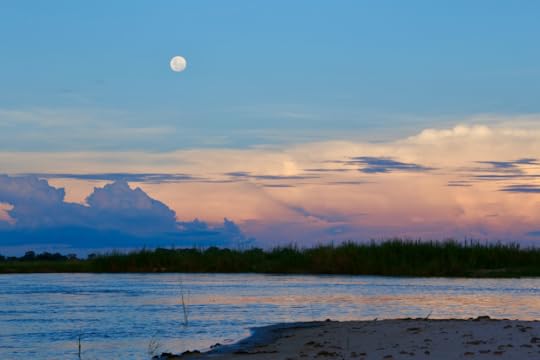
The sun was sinking behind us as the boat glided over the silver water.
In front of us, an enormous red moon popped out behind a low cloud, directly over the sandbank we were heading to.
‘The famous Super Moon everyone talked about on Facebook for the last couple of days,’ Anthon commented.
We pulled onto the sandbank. While offloading the chairs and the cool box, the dogs charged around the edge of the island, looking for crocodiles, the dreaded ‘C’s’. A herd of hippos grunted as they surveyed us from the next river bend, their eyes bobbing gently above the wake created by our boat.
‘Thanks Mark, this must be the most spectacular sunset cruise we’ve had in a long time,’ I sighed, gin-and-tonic in hand.
We were the only three humans in the universe. Cream Puff lay next to us, the other three dogs were outlined against the flaming sky. To the east, the giant moon unrolled a long glittering path over the Kavango.
We arrived back at Shamvura’s slipway after dark. Mark’s right-hand man, Wesley, waited for us with lanterns, to guide us up what felt like a hundred steps to the camp, perched in the forest high above the river. We entered the house as Charlie was putting the finishing touches to a delicious lamb curry.
My introduction to the goat took place through the kitchen window.
‘He’s called Bokkie Spitbraai,’ Charlie informed me. ‘He used to be so aggressive and obnoxious. Then I had him castrated. His entire personality changed to sweet, loving and calm overnight!’ She gave him an affectionate pat on the head.
‘And for many months afterwards I slept with one eye open!’ Mark shouted from the bar in the lounge. ‘I was convinced Charlie was going to castrate me while I was asleep, to see if it’ll have the same effect!’
Charlie’s eyes glazed over and a dreamy smile spread over her face as she considered the possibility.
‘Did I tell you that he shot me in the arm once?’ she retaliated. I moved slightly out of the direct line of fire between them, just for in case.
‘I didn’t see you. I was sitting at the bar and noticed Bokkie Spitbraai devouring a book from the shelf in the passage,’ Mark tried to defend himself from the lounge.
‘He grabbed the airgun and took a potshot at the poor goat. The pellet ricocheted off the passage wall and lodged itself in my arm,’ Charlie continued, unruffled.
‘How was I to know you were lurking in the shadows behind the goat,’ Mark retorted.
‘I calmly walked up to Mark,’ Charlie carried on as if she hadn’t heard him, ‘showed him the wound, took out the pellet and dropped it in his hand. Do you know what he did?’
I shook my head, trying very hard to suppress the giggles welling up inside my throat.
Then Mark boomed with laughter behind me.
‘See?’ Charlie said, ‘that’s exactly what he did!’
‘And for months afterwards, I woke up in the middle of the night, cracking myself at the thought that I actually shot ol’ Charlie!’ Mark yelped with delight.
‘Yet you still manage to pull him through every time he gets bitten by a Black Mamba?’ I asked innocently.
‘Of course!’ Charlie smiled. ‘What’ll I do here all by myself, without the old chap?’
We spent the night in their tented campsite. With all the flaps open, the cool breeze rushed through the gauze, along with the sounds made by thousands of frogs, insects and other nocturnal creatures.
The next morning we had a leisurely breakfast with the Paxtons. Charlie explained to me that they fully supported subsistence fishing if it uses legal, traditional, methods. However, commercial fishing, with massive monofilament, --see-through--, nets has been banned by the Namibian Government. All culprits are not Angolan. Namibians also set their nets on the Angolan side, believing they cannot be removed by Namibian inspectors. The land across the river from Shamvura forms part of the Luengue-Luina National Park. Angolan and Namibian rangers therefore work together, with assistance from the local lodges like Shamvura, to kerb illegal fishing, which is threatening aquatic diversity in the Kavango River.
She also explained that orphaned baby otters will stay with them until they are old enough to fend for themselves, then instinctively go wild.
After a second coffee, we packed Henry and set off for our next destination, 50km further down the river.
We prefer not to be called tourists; ‘Slow-Travellers’ is so much more descriptive.
Ps. Since this trip took place nearly two years ago, both Cream Puff and Bokkie Spitbraai left the Paxtons for the Great Animal Heaven in the sky.
Pss. The great Covid-19 disruption of 2020 hit the Namibian tourism industry particularly hard. Please support people like the Paxtons and Shamvura camp. Our smaller family-run lodges are slowly being swallowed by the large supermarket-style lodge chains. We need diversity. We need slow-travel destinations like Shamvura Camp.
If you enjoyed reading this post, you will enjoy my book, 'A yellow butterfly on an elephant's foot.' Available from Amazon.com.