Ali Master's Blog
January 14, 2020
Goodbye 2019 and Hello 2020!

Hello friends. Is January 14th too late to wish everyone a Happy New Year? I think I am still safe, right? I hope you and yours had a wonderful New Year’s. I have to say 2019 has been a year like none other for me. Being able to reach the important milestone of getting my story out into the public via Beyond the Golden Door brought with it many exciting, heartwarming, and challenging moments. I thought I would share some of the key highlights, my learnings, and what’s ahead for 2020:
1. What I am most thankful for? In 2019, through this experience, I have been reminded of the remarkable support system I have among my family, EY colleagues and friends. You were always there to encourage, pray, and brainstorm with me. Thank you! One of the biggest blessing in 2019 was sharing about my book with my extended Pakistani and Indian born family. I didn’t know how they would respond to my disclosing the very personal details of my life. Would they be angry? Disappointed? I was encouraged to be more proactive in informing my family by one of my dear cousins. I followed her advice. Friends, I truly believe God moved in my family’s hearts, as their responses have been nothing short of miraculously loving, embracing, humble, and kind. That was the highlight of 2019!
2. What were my learnings? I had been warned by the pros that the amount of work involved after you publish a book is at least as much as what you put into writing the thing. Well, they were right! The past six months have been frenetic with numerous media interviews, podcasts, and speaking engagements. I’ve learned to share my story on the air and that’s been a lot of fun. I’ve also had to learn to redirect tricky questions! On the serious side, the author business can be very isolating if you become overly fixated on Amazon rankings, book sales, comparisons, and social media. This is exactly what happened to me in the first four months. Then the Holy Spirit hit me with a two-by-four trying to help me see the idolatry that was underway. I am now learning to run the marathon versus the sprint. This temptation is not restricted to authors. Have you found yourself consumed by a project or an opportunity? How are you maintaining balance?

3. What’s ahead in 2020? This journey has been a little bit like entering a mansion with many rooms and some clues given to you as you roam around and discover new doors which you must enter to find additional interesting rooms. The trick is to discern which doors to open—you can’t go through every door (please pray for wisdom for me about this). The 2019 exposure is continuing to create some neat opportunities which include sharing about Belonging at my work, converting a business blog I have done for new college graduates into an audio pod-cast series, some university and church speaking engagements, and even a potential opportunity to host a pod-cast or radio show. One of my biggest goals for 2020 is to work on the audible version of the book. Of course, all of this must be juggled while doing my day job! I still love being a partner at Ernst & Young.
His power at work in us can do far more than we dare ask or imagine.
In closing, I want to encourage us all to meditate on Ephesians 3:20b (CEV) which states that “His power at work in us can do far more than we dare ask or imagine.” That’s my prayer and hope for 2020! Would you join me in praying for that? Have a wonderful start to your New Year!
The post Goodbye 2019 and Hello 2020! appeared first on Ali Master.


January 13, 2020
Goodbye 2019 and Hello 2020!
 Hello friends. Is January 13th too late to wish everyone a Happy New Year? I think I am still safe, right? I hope you and yours had a wonderful New Year’s. I have to say 2019 has been a year like none other for me. Being able to reach the important milestone of getting my story out into the public via Beyond the Golden Door brought with it many exciting, heartwarming, and challenging moments. I thought I would share some of the key highlights, my learnings, and what’s ahead for 2020:
1. What I am most thankful for? In 2019, through this experience, I have been reminded of the remarkable support system I have among my family, EY colleagues and friends. You were always there to encourage, pray, and brainstorm with me. Thank you! One of the biggest blessing in 2019 was sharing about my book with my extended Pakistani and Indian born family. I didn’t know how they would respond to my disclosing the very personal details of my life. Would they be angry? Disappointed? I was encouraged to be more proactive in informing my family by one of my dear cousins. I followed her advice. Friends, I truly believe God moved in my family’s hearts, as their responses have been nothing short of miraculously loving, embracing, humble, and kind. That was the highlight of 2019!
2. What were my learnings? I had been warned by the pros that the amount of work involved after you publish a book is at least as much as what you put into writing the thing. Well, they were right! The past six months have been frenetic with numerous media interviews, podcasts, and speaking engagements. I’ve learned to share my story on the air and that’s been a lot of fun. I’ve also had to learn to redirect tricky questions! On the serious side, the author business can be very isolating if you become overly fixated on Amazon rankings, book sales, comparisons, and social media. This is exactly what happened to me in the first four months. Then the Holy Spirit hit me with a two-by-four trying to help me see the idolatry that was underway. I am now learning to run the marathon versus the sprint. This temptation is not restricted to authors. Have you found yourself consumed by a project or an opportunity? How are you maintaining balance?
3. What’s ahead in 2020? This journey has been a little bit like entering a mansion with many rooms and some clues given to you as you roam around and discover new doors which you must enter to find additional interesting rooms. The trick is to discern which doors to open—you can’t go through every door (please pray for wisdom for me about this). The 2019 exposure is continuing to create some neat opportunities which include sharing about Belonging at my work, converting a business blog I have done for new college graduates into an audio pod-cast series, some university and church speaking engagements, and even a potential opportunity to host a pod-cast or radio show. One of my biggest goals for 2020 is to work on the audible version of the book. Of course, all of this must be juggled while doing my day job! I still love being a partner at Ernst & Young.
His power at work in us can do far more than we dare ask or imagine.
In closing, I want to encourage us all to meditate on Ephesians 3:20b (CEV) which states that “His power at work in us can do far more than we dare ask or imagine.” That’s my prayer and hope for 2020! Would you join me in praying for that? Have a wonderful start to your New Year!
The post Goodbye 2019 and Hello 2020! appeared first on Ali Master.
November 27, 2019
A Call to Thankfulness Amid Turmoil
 Tomorrow is Thanksgiving which is one of my favorite times of the year (Christmas is #1), and we will have all of the kids under one roof which is a rarity these days. During this season, I have been contemplating the many reasons I have to be thankful. Even today, while running a few errands, I turned on BBC World News radio, which quickly put life into perspective in terms of how thankful we should all be for where we live and the freedoms and privileges we enjoy. I was saddened to hear about the Albanian earthquakes that just hit with many casualties and deaths. I was reminded of the plight of the protesters in Hong Kong as the reporter described the clean-up underway in the Polytechnic University where many of them had been hunkered down trying to voice their opposition against the suppressive Chinese controlled regime. The topic then turned to the “silent genocide” that may happen in Zimbabwe where the senior doctors are on strike because of the lack of funding, salaries, and equipment to treat the sick. These were just a few highlights of the turmoil of the day. Jesus couldn’t have been more on point when he said, “Each day has enough trouble of its own” (Matthew 6:34b NIV).
As you enjoy some family, turkey, and football tomorrow, say a prayer for the families impacted by the natural, political, or economic calamities that seem to be transpiring around the world on a regular basis. We have much to be grateful for.
I am thankful for the safety and security of my modern country life, close to every convenience, yet surrounded by the peace and privacy that nature brings. I am thankful for the freedom of speech I and others demonstrate and enjoy daily in America. Even the impeachment craziness that is underway in Washington has a silver lining—there is a process in our republic that allows for checks and balances. In many other countries I have traveled to, such a process would be impossible to execute without bloodshed. I am also very thankful that I was able to both afford and access healthcare at a nearby medical clinic for pain I was suffering, where a competent doctor was readily available.
As you enjoy some family, turkey, and football tomorrow, say a prayer for the families impacted by the natural, political, or economic calamities that seem to be transpiring around the world on a regular basis. We have much to be grateful for.
Happy Thanksgiving!
The post A Call to Thankfulness Amid Turmoil appeared first on Ali Master.
September 10, 2019
5 Keys to Success You Didn’t Learn in College (Part 5 of 5)

Sponsors—I’ve had them throughout my career. In my early days, I didn’t know that’s what one should call them. Nor did I fully appreciate the crucial role they could play in one’s advancement. To better understand this sponsor-protégé relationship, let’s first go over a common misunderstanding.
What a sponsor is not:
A sponsor is not a mentor. These two roles should not be confused. While at times the same person can wear both hats, a mentor-mentee relationship is generally one where someone with greater experience offers advice and coaching to someone less experienced, and the mentor may or may not be a person who can exert significant influence on your career advancement. Additionally, a mentor typically does not have set expectations of the mentee’s performance.
What a sponsor is:
Unlike the mentor, a sponsor is a person of influence who advocates on your behalf at some personal risk and serves as a catalyst for career advancement. In the sponsor-protégé relationship, the protégé is an individual with talent but less experience and professional status than the sponsor. If you aspire to elevate your career, it’s important to find sponsors and to better understand your relationship with your sponsors. I recently heard author Sylvian Ann Hewlett speak about this in her new book, The Sponsor Effect. Check out this podcast where she discusses more about the sponsor-protégé relationship.
A sponsor is a person of influence who advocates on your behalf at some personal risk and serves as a catalyst for career advancement.
My first sponsor’s name was Ron. I talk about him fondly in my book, Beyond the Golden Door. Ron was the chairman of the elder board at my church. He was also the managing partner of a local accounting firm. When my first tax business failed, it was Ron who took a chance on me, inviting me to work for him and to serve his clients with my tax ideas. Ron advocated on my behalf with his other partners and risked some of his firm’s working capital to let me start an unproven practice because he saw it’s potential. Ron also coached me along the way. When he felt my career would be better served at a Big-4 firm like Ernst & Young, he advised me to pursue that opportunity instead of holding on to me for personal gain. That is a great sponsor!
It is the protégé who must drive the sponsor-protégé relationship.
The sponsor-protégé relationship is not a one-way street. The sponsor takes risk and pushes the protégé towards career advancement, but it is the protégé who must drive the sponsor-protégé relationship. It only works if the protégé overdelivers and proves him or herself worthy of the trust, risk, and investment made by the sponsor. The protégé must make the sponsor look good to continue the momentum in the relationship. In my case, I had to pursue Ron and make an ardent case for my ideas. Ron then took the necessary risk because he believed in me. I had to then work doubly hard to deliver the goods and execute. There is a give and take in the relationship, but it is the protégé that must do the heavier lifting.
You may be wondering, how can I find a sponsor? You don’t find sponsors by sending a mass email asking for sponsorship. Rather, as you begin your career journey, form relationships with a range of professionals in your organizations who are going places and continue to deliver high-quality results in your work. Over time you will identify a few you connect with well, and hopefully, the sponsor-protégé bond will form naturally.
Miss any of the 5 Keys to Success that You Didn’t Learn in College?
1. Under promise. Over deliver.
2. Understand your company’s value chain.
3. Develop your executive presence.
4. Build your personal brand.
5. Find a sponsor and know your role as a protégé.
The post 5 Keys to Success You Didn’t Learn in College (Part 5 of 5) appeared first on Ali Master.
August 6, 2019
5 Keys to Success You Didn’t Learn in College (Part 4 of 5)
Everyone has a “personal brand”—you, me, and that new hire who sat right next to you at orientation who made all that nervous small-talk. Each of us are either building up our personal brand or letting it dissolve. So what is a personal brand anyway?
Personal brand refers to the first thoughts, feelings, or images that people immediately think of when they hear or read your name.
Let’s play a game to help elaborate. I will throw out a name, and then suggest their brand. See if you agree or disagree:
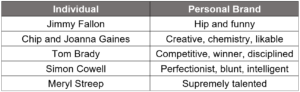
Steelers fans may vehemently disagree with me about Tom Brady’s brand categorization and Jimmy Kimmel watchers may say I have the wrong “Jimmy” on my list. I am not saying that personal brands are always agreed upon. However, over time, personal brands can and do form about someone that are generally accepted. Brands can be positive or negative, and they can rise and fall based on new discoveries. Who can forget Lance Armstrong, the champion professional road racing cyclist whose brand crashed upon the discovery of performance enhancing drug use?
How do you build your brand in business, especially when you are just starting? Building and managing your personal brand is fundamental for career success, and is especially vital in larger organizations where competition is stiff and it is more difficult to standout.
What are you most known for in your organization? Are you a good leader? A great speaker? An astute researcher? Highly organized? Are you always the go-to person on some new technology? An outstanding closer? Do people think of you when it comes to an industry sector? Your personal brand could be one or many traits. The important thing is to start focusing early on developing what you want to be known for.

> How can you grow your brand?
> What do you do if your brand takes a hit?
> Can one rebuild his or her personal brand?
Listen to my podcast below to discuss some of these questions and learn more about building your personal brand.
http://alimaster.com/wp-content/uploads/2019/05/unscriptedNo5AliMaster.mp3
Miss any of the 5 Keys to Success that You Didn’t Learn in College?
1. Under promise. Over deliver.
2. Understand your company’s value chain.
3. Develop your executive presence.
4. Build your personal brand.
5. Find a sponsor and know your role as a protégé. (Stay tuned!)
The post 5 Keys to Success You Didn’t Learn in College (Part 4 of 5) appeared first on Ali Master.
July 18, 2019
5 Keys to Success You Didn’t Learn in College (Part 3 of 5)
 “Ali, you just don’t have the same executive presence that she does.” That was the stinging message delivered to me years ago by my supervising partner when speaking about another senior manager. So, what is “executive presence?” Can it be cultivated, or is one born with it?
The label “executive presence” (EP) is often used to describe a person with gravitas who possess the “it” factor—someone who commands the respect of his or her colleagues, superiors, and clients. Some call it “boardroom presence.” EP is often a tiebreaker when rating the highest performers, awarding assignments or gauging promotion readiness.
EP is often a tiebreaker when rating the highest performers, awarding assignments or gauging promotion readiness.
You recognize a strong EP when you see it. Oprah Winfrey. Colin Powell. Anderson Cooper. Katie Couric. I know what you are thinking, those are some seriously talented people, and if that’s what it takes, then I’m never getting promoted! You can relax. These are just examples to help you understand what EP looks like.
There is hope! I’ve learned and developed my EP over the years, and you can too! The sooner you start, the better.
Five tangible tips you can apply to grow your own executive presence:
1. Dress the part.
EP is all about confidence and being comfortable in your own skin. Looking your best is a great start. People take notice of appearances, and looking disheveled or being underdressed does not help your cause. This is the easiest of the five tips to put into practice.
2. Force yourself to present more.
EP is about perception. At least in the American culture, I found that people judged me based on how I articulated things—especially in group settings. Place yourself into situations that require presenting. For me as a young staff, it started by agreeing to plan client luncheons where I had to welcome the guests. Find small opportunities to practice speaking. They are valuable no matter the context. Participate in Toastmasters. Agree to present on a business topic of interest during a lunch. Be creative.
3. Learn to listen.
EP requires “reflective” listening. People love when you confirm what you heard. If you are around a superior or a client, questions that show you are fully engaged will go a long way. You can even prepare good questions prior to your meeting to enhance your EP.
4. Learn to say “no” tactfully.
EP is also about learning how to navigate difficult situations. Speaking about handling tough conversations, one of EY’s most successful leaders shared this wisdom: “Good leaders don’t leave a wake.” She meant that no matter the situation, when people disagree with you, leave the situation with everyone feeling heard and respected—even if you had to say “no.” This one’s hard! Start practicing this skill with your peers.
5. Know your stuff.
There is no substitute for knowing your content. If you want to grow your EP, you must prepare diligently for your upcoming meeting, interaction, or presentation. It shows when someone is prepared, and it is equally evident when one is not. When a question comes up and you can cite a statistic with confidence or refer to an article you researched, you shine. Be prepared!
For me, #4 was what my boss was alluding to when he made his hard-to-hear but truthful remark. Earlier in my career, I didn’t always handle disagreement or critique well. Fortunately, I had people who cared enough to give me honest feedback and helped me grow my EP. Start developing yours today!
Miss any of the 5 Keys to Success that You Didn’t Learn in College?
1. Under promise. Over deliver.
2. Understand your company’s value chain.
3. Develop your executive presence.
4. Build your personal brand. (Stay tuned!)
5. Find a sponsor and know your role as a protégé. (Stay tuned!)
The post 5 Keys to Success You Didn’t Learn in College (Part 3 of 5) appeared first on Ali Master.
July 4, 2019
Independence Day: A Day to Celebrate America

It is appropriate to interrupt my blog series on the “5 Keys to Success You Didn’t Learn in College” to reflect and celebrate Independence Day. This fourth is extra special to me since my book, Beyond the Golden Door, which extols the virtues of American freedoms, was released earlier this week.
Sadly, polarization continues to intensify in Washington and it seems even celebrating July 4th undergoes scrutiny of political correctness: How much celebration is too much? What should it look like? When does one cross the line into wastefulness? These types of questions may have good points, but it’s frustrating that no matter what actions leaders of one party take, they become the subject of criticism by the leaders of the opposition and vice-versa.
While there is much work to be done for America to solve her big challenges, we should pause to acknowledge what a remarkable nation we inhabit.
Instead of focusing on these divisive issues this July 4th, I would like to spotlight three amazing reasons to love America and to remind my readers and leaders of just how blessed we are to call the USA our home.
Our superior freedom of speech. Just before writing this blog, I heard many commenters freely ridicule the Trump administration’s Independence Day parade plans. Do you think one can go on national TV and do that in every nation? No way! China, for instance, may only allow certain “elite” to criticize. Nations in the Middle East range from allowing limited critique of the government to high restrictions and penalties. There are sedition laws in India that can be manipulated against freedom of speech, making it the deadliest country in Asia for media personnel.
Our incomparable freedom of identity. Freely identifying yourself without fear of reprisal is another freedom we take for granted. Whether you’re an ethnic minority, gay, Muslim, Hindu, Christian, or atheist. It’s all acceptable when it comes to interviewing for job positions, participating in sports, or applying for college. I am not suggesting conscious or unconscious bias doesn’t exist—it surely does; but the primary focus is not on your identity—it is on your grades, experience, and talent. A quick browse through of the Human Rights Watch’s 2018 report will give you chills—many countries impose stiff penalties for just believing or behaving different than what’s defined as “normal” by the majority.
Our exhilarating freedom of enterprise. The first two may also be found in other places of the Western Hemisphere, but do you realize how immeasurably fortunate we are to be alive in America during this era of technological boom and free enterprise? The technology at our fingertips coupled with the ease of starting a new business in America is truly an empowering combo that is hard to beat. In 2018, the USA was ranked as the #6 friendliest place on the globe to do business. The study takes multiple variables including start-up costs, minority protection, regulation, and tax rates as variables. The nations ahead of America are places like New Zealand, Singapore, and Denmark. However, this analysis leaves off a very salient fact—the gigantic size of the American market. An innovative product that “catches fire” in our market can have unparalleled success.
I could go on, but there are burgers to grill, fireworks to enjoy, and parades to watch. While there is much work to be done for America to solve her big challenges, we should pause to acknowledge what a remarkable nation we inhabit. Let’s also take a moment to salute the men and women in uniform who preserve the freedoms we enjoy.
https://www.worldatlas.com/articles/best-countries-to-start-a-business.html
The post Independence Day: A Day to Celebrate America appeared first on Ali Master.
June 28, 2019
5 Keys to Success You Didn’t Learn in College (Part 2 of 5)
A simple but profound lesson that has helped me throughout my career is understanding my company’s value chain. Simply put, no matter what your position, you need to understand how your employer ultimately makes money.

When we think of companies, most of us think of their end-product—a Chick-fil-A sandwich, an H&M T-shirt, an Amazon everything! The “value chain” is the chain of value-adding activities that bring the product or service to the customer.
As a young crewperson at McDonald’s, I observed the various steps prior to handing that delicious breakfast sandwich to the customer. Days or weeks in advance, someone tracking inventory ordered the ingredients—the frozen sausage patties, eggs, and muffins. Upon arrival, someone had to unload the products into the freezer. Someone kept the small freezers by the grill stocked throughout the day. A drive-thru crew member took the order and payment. The cooks prepared the sandwiches. The “bin caller,” who forecasted the orders so food was always ready and fresh in the bin, wrapped the sandwiches. The drive-thru runner quickly filled a bag with the sandwich, hash browns, and napkins as he delivered the order with a smile to the customer in the car. Each order transpired in under 120 seconds from the time of the sale.
No matter what your position, you need to understand how your employer ultimately makes money.
Do you see the many links in this chain? Value was being created every step of the way. If at any step someone didn’t do their job, the entire operation breaks down. The sooner an employee understands the links that make up the chain, the faster he or she will climb the ladder of success.
Three significant benefits to understanding your company’s value chain:
1. Increased purpose and satisfaction.
Understanding the big picture of the value chain makes your job more meaningful. Now you understand that every repetitive or dull task you do is vital to the end product or service your company provides, and you will appreciate and enjoy your work more because of it.
2. Increased visibility to management.
Employers, managers, and supervisors assess those directly under them through a lens of usefulness to the company, and because you understand the company’s value chain, your work will attest to your worth and versatility. In short, your boss will be impressed and will appreciate you more, giving you an edge to available promotions.
3. Increased business opportunities.
When you understand your company’s value chain, you begin to understand how a business operates from start to finish and how it makes money. This knowledge opens the doors for two opportunities. First, you have the opportunity to be an intrapreneur—to find creative ways to make your company more money. Second, you set yourself up for the ability to be an entrepreneur—to start your own business applying the same principles you learned from that company’s value chain.
At an early stage in my career, I learned to see business this way. No matter what the job, seek to understand your company’s value chain. It may even be helpful to draw it out on a flow-chart. If there’s something you don’t understand, ask questions. Learn. Grow. I promise you will turn the heads of your superiors.
Missed Part 1 of the 5 Key to Success that You Didn’t Learn in College? Click here: Under promise. Over deliver.
Stay tuned for the the last three keys to success that you didn’t learn in college:
⇒ Develop your executive presence.
⇒ Build your personal brand.
⇒ Find a sponsor and know your role as a protégé.
The post 5 Keys to Success You Didn’t Learn in College (Part 2 of 5) appeared first on Ali Master.
June 9, 2019
5 Keys to Success You Didn’t Learn in College (Part 1 of 5)

I recently watched my daughter Mollie walk across the stage with her business degree diploma from Samford University. It was an exceedingly proud moment, and it reminded me about my journey from being a new college graduate to making partner with Ernst & Young (EY) in a relatively short ten-year period of time.

I found myself compiling a mental list of things that contributed to my success. While having an accounting degree with a high GPA and passing the CPA exam were viewed as gating criteria for a Big 4 firm like EY, I was fixated on the things that I was not taught in class.
Over the next coming weeks, and as students across America celebrate this rite of passage, I will share five keys to success that have consistently paid huge dividends for me in the business world.
Under promise. Over deliver.
No matter how many millions of tax dollars I found for a client, if I promised more, the result was still a negative.
When I started at EY, I was full of great ideas on how to save clients tax dollars. I had acquired certain niche tax knowledge by working at a smaller boutique firm, and I was eager to apply this know-how to the larger companies served by EY. The problem was, in my enthusiasm to impress these clients with big numbers, I would consistently broadcast the best possible outcomes. The result was a disappointed client, even though they received “found money” from my efforts. I was befuddled, “These companies didn’t even know they had a million-dollar refund coming! What’s the big deal if I promised two million?”
Sometime later, I was approached by a friend and successful businessman who shared this formula for success that has stuck with me ever since: “Success equals performance minus expectations.”

No matter how many millions of tax dollars I found for a client, if I promised more, the result was still a negative. Duh! It took me some time to figure this out. In Pakistan, you don’t say “no” to your elders and their expectations, and you routinely use the phrase Inshallah (God willing)—even if you don’t agree. It took some adjustment to understand that it was far better for me to share what could go wrong than to paint a rosy picture.
No matter what you do for a living, it’s crucial that you learn to manage expectations of your superiors, colleagues, and most importantly, your clients and customers.
Stay tuned for the the next four keys to success that you didn’t learn in college:
⇒ Understand your company’s value chain.
⇒ Develop your executive presence.
⇒ Build your personal brand.
⇒ Find a sponsor and know your role as a protégé.
I hope you will find these insights meaningful, and I wish you Godspeed with your career!
The post 5 Keys to Success You Didn’t Learn in College (Part 1 of 5) appeared first on Ali Master.
5 Keys to Success You Didn’t Learn in College (Part 1)
I recently watched my daughter Mollie walk across the stage with her business degree diploma from Samford University. It was an exceedingly proud moment, and it reminded me about my journey from being a new college graduate to making partner with Ernst & Young (EY) in a relatively short ten-year period of time.
I found myself compiling a mental list of things that contributed to my success. While having an accounting degree with a high GPA and passing the CPA exam were viewed as gating criteria for a Big 4 firm like EY, I was fixated on the things that I was not taught in class.
Over the next coming weeks, and as students across America celebrate this rite of passage, I will share five keys to success that have consistently paid huge dividends for me in the business world.
1. Under promise. Over deliver.
No matter how many millions of tax dollars I found for a client, if I promised more, the result was still a negative.
When I started at EY, I was full of great ideas on how to save clients tax dollars. I had acquired certain niche tax knowledge by working at a smaller boutique firm, and I was eager to apply this know-how to the larger companies served by EY. The problem was, in my enthusiasm to impress these clients with big numbers, I would consistently broadcast the best possible outcomes. The result was a disappointed client, even though they received “found money” from my efforts. I was befuddled, “These companies didn’t even know they had a million-dollar refund coming! What’s the big deal if I promised two million?”
Sometime later, I was approached by a friend and successful businessman who shared this formula for success that has stuck with me ever since: “Success equals performance minus expectations.”
No matter how many millions of tax dollars I found for a client, if I promised more, the result was still a negative. Duh! It took me some time to figure this out. In Pakistan, you don’t say “no” to your elders and their expectations, and you routinely use the phrase Inshallah (God willing)—even if you don’t agree. It took some adjustment to understand that it was far better for me to share what could go wrong than to paint a rosy picture.
No matter what you do for a living, it’s crucial that you learn to manage expectations of your superiors, colleagues, and most importantly, your clients and customers.
Stay tuned for the upcoming blog topics:
2. Figure out the value-chain (how your employer makes money) and insert yourself into it.
3. Develop your executive presence.
4. Build your personal brand—whether you know it or not, you have one.
5. Find a sponsor and know your role as a protégé.
I hope you will find these insights meaningful, and I wish you Godspeed with your career!
The post 5 Keys to Success You Didn’t Learn in College (Part 1) appeared first on Ali Master.