Zach MacDonald's Blog
December 22, 2025
Sneak peek: Excerpt #1 from upcoming novel
Excerpt from my upcoming novel, Whale Bones
Buoys and Grills Day, 1982
The day is so clear in Sam’s memory that he can taste it, especially on the edge of sleep, or after a quick toke at dusk out at the edge of the yard, right where it meets the field, right where he always stands, listening as the chirping crickets provide tempo to the midsummer insect symphonies, the wind whisking across the long-mown barrenness deep in autumn, shaking the last leaves from the nearby oaks, and the crystalline white silence of winter, punctuated by distant great horned owl calls from the Wood, or filtered down through the front-thin air from Sampson’s Meadow and higher up the wooded slopes of Mt. Angamsit.
It wasn’t the beginning of their relationship. Or fling. Whatever it should have been called, and he’s never figured that one out. It wasn’t quite the end, either, but close enough to it. The day stuck though. It was the heat and the laughter and the childlike joy of Buoys and Grills. It was the sneaking off that the day funneled them giddily towards. The secrecy of it. The wild thrill that both of them seemed just a few years too old for, though neither of them cared. That had to be it.
Blue skies and bright sun. Not only the first Sunday of August, but the first day of the month as well. The vivid green glories of July—the road dust, tree climbing, frog catching, school’s out forever glories—were a short but fitful sleep in the past, divided from them by no more than a plump yellow moon, waxing gibbous, hung in the firmament over a community restless with excitement for the coming day, and the hotdogs and canoe races and cold juice bags and kites and fresh boiled mussels and frisbees and games and hamburgers and crunchy, salty snacks and sparkle off the water—the way it sparkled differently on that day and always had, even though no sense could be made of it.
Sam can see little Peggy Multon’s kite. A maroon pterodactyl. He didn’t know exactly—some whatchamacallit flying dinosaur. She unveiled it proudly, blushing at the accolades it received. It was huge, well over a dozen feet across, wing tip to wing tip, and constructed out of numerous plastic sheets cut to shape and all sealed together with many roll’s worth of clear tape. The spine and cross spars were made of carefully selected young branches, supple and strong, whittled to a precise thinness where nature had not made them as such. It was an obvious labor of love, as the girls’ kites usually were, painted neatly and with great care. With the help of two adults and a fair breeze, the craft got airborne and was carried swiftly aloft, every head on the beach turned up to it, rapt attention from all.
“It’s going to have some mighty pull,” he said, watching it sail rapidly higher, thick twine flying off the reel in Peggy’s little hands.
“She’s keeping her eye on the line.” Martha raised her right forearm to Sam’s eye level, showing off the faded pink scar that encircled her wrist, a bracelet of healed flesh that Sam had traced with his fingertips time and again as she reclined in his embrace. “Unlike some kids in the past.”
“Good thing your dad was keeping an eye on you as well.”
“Plenty of attention on Peggy.”
And indeed there was. Peggy’s father, and several others, were crowded close at her back, ready to take hold of the reel if need be.
Though at ground level the breeze was blowing down the beach from north to south, the kite soon reached a different atmospheric reality, where wind evidently flowed in a torrent from the land out to sea. The kite was caught by that stream quite suddenly, swooping into a downturn and rising back up in a hurried U, changing direction as it was swept oceanward. Peggy took off at a run, surely aware that she had little line left to let out, and her father followed at a brisk jog. The crowd parted, knowing Peggy’s trajectory was at the sole mercy of the kite and the winds it was struggling to harness.
The great flying beast did another U in the sky, this one much larger, diving perhaps twenty meters in seconds and swooping back up to recover only half of that.
Peggy could be heard calling out: “Oh no, no! Dad!”
“Let me take it!” said her father, and reached his arms around to grab the reel. She let him have it, no doubt with some reluctance, for the dinosaur up there in the high turbulent blue was her creation, and she in her diminutive child’s body had intended to control its flight. Many kids, thought Sam, had a spirit so much greater than their physical limitations, and sometimes greater than those of most adults, including the ones the kids themselves would become.
Peggy’s father taking the reins didn’t result in any taming of the kite. Now out over the water, it was beset by whirling drafts, made visible only by the erratic circular motions of the kite itself. Curious, Sam thought, how such power could only be seen through its interaction with other matter. The man dug his feet into the wet sand near the water’s edge, straining now to hold the line steady, while Peggy leapt up and down with urgent energy.
Martha nudged him. “This is just bad luck,” she said in his ear, and then, so quickly that she had to have been sure no one would see, she flicked his earlobe with her tongue. Sam tried to keep a straight face.
“Not in front of people, geez,” he said without looking at her. “And don’t make me laugh right when this disaster is happening.”
“It’ll be fine.”
“You licking me in public, or—”
The kite plunged headfirst—literally—into what looked like another dramatic U, but there was no upsweep this time. Straight down it went at blinding speed, every pair of eyes tracing its Peregrine descent, and the last thing Sam noticed before it hit the water was that the part of the spine that ran through the pterodactyl body up through the neck to the head must have snapped with the pressure, because the whole beaked head folded back out of sight a fraction of a second before the kite hit the water. He was sure he heard the sharp crack beneath the hiss-whoosh of the tide as the rest of the frame broke apart on impact.
Peggy was still shuddering with sobs, sitting on the sand with her face in her hands, when her dad finished reeling the mangled body back in. It was even more smashed up than Sam would have expected, and a miracle that the twine had held to the brindle and the brindle to the wreckage. Peggy took one look at it and then ran up the beach, tear-streaked and miserable, while Lisa Multon shouted at her to come back and clean up her mess and their dad snapped at her in turn to leave her little sister be.
The thing’s head was missing, and though Sam recalled seeing it flap back during the plunge, he was impressed to note that violence of the crash had severed it clean off. He volunteered to take a canoe out to search for the head, but Ralph, shielding his hand against the sun to look for it on the waves, suggested he not bother, as the tide would be coming in soon and it’d probably wash up by sundown. Sam never learned whether that prediction came true.
Hours later, with games of frisbee and tag behind the attendees, tans and sunburns abounding across arms and chests and shoulders and nose bridges and cheekbones, and bellies filling up with boiled mussels from the great steaming pot overseen by Martin, the sun bid its silent farewell, dipping toward the gentle forested crown of Angamsit. Parents took their children home and some others filed away as well as the light took on its deep gold cast, then that of rust. The atmosphere on the beach underwent a transformation as old as mankind, and certainly older still. Ancient. Primeval. The temperature dropped and the night’s chill crept in, but it was the change within the occupants of the beach, in response to twilight and the dark that settled in its wake, that ushered in a new world around them. It was a world defined by the borders of the light, that hugged them close, that shrouded history and the landscape all at once. The few streetlights on Main sent up a glow in the near distance, making it like a shrouded faerie kingdom, filled with its little intrigues, and on the beach half a dozen campfires of varying sizes and strengths made bubbles of community, human forms seated in rings on the sand and makeshift benches of driftwood. Laughter and music spread out from them, and conversation about existence and more about what is unknown than known, as was seldom heard in the working day, or in the revealing light of the sun that fools people into thinking they see all there is to see. That fat waxing gibbous moon, a phantom face patterned on a sand dollar, still a few days shy from werewolf fullness, hung over the water like a faithful companion to those humans that wrapped themselves in cool night air.
When the dark comes in, everything that can no longer be seen is mystery. The spit of land to the north is surely there, but now it’s but a dragon’s tail on the water, if it can be discerned at all. All the other geography exists as it did before nightfall, but one has to keep convincing themselves that it’s not frequented with wandering spirits—at least no more than it ever was. Those around campfires, pupils contracted with the glow at the crackling heart of the circle, can barely see anything around them at a glance. The world becomes the campfire and the circle. It becomes the others in the light with you, and their thoughts and stories and songs. The lingering ape mind, that mind that came down from the trees to challenge the land-lurking predators, considers by default that the darkness can hide anything. Threats, of course, but as the careful optimists our curiosity inspires us to be, potential pleasures too. Those mysteries are imbued with animation and agency, alive but concealing themselves from blindly prying eyes, from the lake of hungers and desires behind them.
Sam and Martha threaded their way between the campfires, moving through corridors of half-lit night, the sand and grit pleasant against the soles of their bare feet. They split up and sat in on different fires for twenty, thirty minutes at a time, accepting drinks that were offered, or marshmallows on sticks to roast, and then they rose by some nocturnal synchronicity, or a half-glimpsed movement from the corner of the eye, and came together again in the dusky crossroads between the pools of light.
These were the magic hours, when the buzz was high. A couple guitars had come out. People were feeling good, the true drunkenness not yet arrived to wash Buoys and Grills day away for good, as it always did, on a tide of raucousness and slumber, nausea and argument, hugs and stolen kisses and tears. It was time to slip away to their spot, their place, and so they did, off down the beach with moonlight to guide them. They knew where to step. They’d walked this shore their whole lives. The tide had turned now but it was still high. With the bluff rising on their right, they trod close to its stony face, hand in hand down the space between it and the lapping waves.
Some time later, they reached the Cliff. Their cliff. In truth it was a section of the same cliff face that ran all the way from one end of Skye Point Beach, which they’d left behind, but there was something about this spot. The slope of it, its steepness, its height that seemed to give it a looming protective stance rather than the threatening one that gravity could well make it, like it was some old guardian of the earth. It was a burnt orange in the daylight, but at this hour it was deepest grey-blue like the rest of the world.
This was where they came for the act. The show that was just for them, to be shared on a darkened stage. It could have been in the backseat of a car, but they came here instead. This was where it had first happened, on the night of the previous year’s Buoys and Grills day, and a few more times that summer when they could each sneak down here on the same night. Through the cold months of autumn and frozen winter they might as well have not even known each other. But when spring returned, they did too—to this spot, beginning to run again like tree sap. They didn’t know what they were, how to define it, and didn’t care. They’d sensed from the beginning that it wouldn’t be forever, wasn’t meant to be, but they were young still and had desires, seeking exploration and release. Seeking each other.
There was a smooth boulder on the beach there beneath the cliff: sandstone as well, tide smoothed, the top sloping at a twenty-degree angle, with a gentle depression in it where untold decades or centuries of sea water and rain had pooled and eaten it away. They seated themselves next to each other on it and Martha let out a long sigh.
“I realized something tonight,” she said.
“What is it?”
“That this is the last time we’ll do this.”
“Oh… is it?”
She looked at him, the moonlight catching those liquid eyes like it caught the seawater glinting just beyond their feet. Glinting all the way to European shores.
“This marks one year,” she said, and her face shaped itself to conceal humor, a laughter that was always there even in somber times, that lived inside her and shone out through the eyes. With Martha it felt that nothing and everything mattered, because nothing was ever over for good, nothing ever truly ended, and so everything simultaneously mattered because it was eternal and carried memories and imprints on through time. “It’s our one-year anniversary,” she continued, still holding back that smile. “Of whatever this is, you know, and I just knew that it couldn’t go on more than a year. It’s not supposed to.”
“Okay,” said Sam, understanding on one level and on another allowing himself to be confused, and even hurt. Things could occur in two states when he was with Martha, exist on outwardly opposing planes, even those that arose from himself.
“Ever since I finished recording the new album last month, they’ve been saying things are going to get busy. Real busy.”
“They believe in the album,” said Sam, “because they know it’s awesome. You’re awesome.”
“There’s already a tour lined up for September,” she continued, not as though she hadn’t heard him, but as though she didn’t want to acknowledge the compliment. “Not just the Maritimes now. Going all the way over to Vancouver for a show.”
Martha never thought of herself as awesome—not even exceptional, thought Sam. She was just good at what she did, and what she did she loved, and other people were really good at other things, and that’s all there was to it.
“Might be out of the country next,” he said. “Down to the states, then who knows? Over to the UK? Australia?”
“Maybe.” Martha paused, drinking in the moon sparkle from the water. “Maybe, yeah. The record label, you know, it’s huge. The album will be stocked everywhere, even across the border. They say they’re going to get it all over the radio. It’s crazy.” She chuckled, but it was strained, strangely like a sob choked back.
Sam put an arm around her shoulder and hugged her to his chest.
“You’ll be out there, all over the world. Going to see incredible things, meet amazing people, eat crazy foods. All of it.” He didn’t know if he believed it, but in that instant he realized this was what he wanted, because it’s what would make her life, it was what she was meant for, in the same way they were meant to cease their lovemaking from this night. He was a part of her and she was a part of him, and they were a part of the town that had grown them. She’d extend out of Ashbasin, sail away on the clouds, reach far—an extension of them all and of everything, a folk singer bringing their stories to the wide world, in brilliant cities and exotic expanses, introducing some little fragment of them, their echoes, on her fiddle and in the songs she gave voice to. Telling stories and then coming home to recharge, to renew.
But not coming home to him. Sam felt his part in the odyssey ending, drawing to a midsummer close, halted mid-bloom.
“I’m going to come back though,” she said, and Sam didn’t think it odd that she might have read his mind just then. “And I’m not going to ignore you or anything, nothing like that. We’ll be friends, right?”
“Yeah, I mean… yeah. Of course.”
Martha turned, craning her neck to take in the dark sweep of sedimentary rock towering above them, compacted in this spot by other deposits, immense pressures and lengths of time. It must have once been part of the seabed, Sam thought, deep below the waves, witness to unimaginable multitudes of ancient life.
“We’ll always have this cliff,” she said. “It knows us.” Then, again seeming to pluck a thought from his mind, so much that it was eerily moving, she added, “It’s seen it all.” This last was not without a flash of teeth, white in the moonlight, and Sam wished that moment, that very moment, would last forever: that the air would always be August ocean cool, that the moon would shine full and bright just as it did now, that the night would be theirs, and the beach would be theirs, and of course the cliff. Their cliff that knew them.
“Any time I come down here, I’m going to think of you.”
Martha pulled away and gave him a playful shove. “That’s so cheesy.” She leaned in and kissed his lips quickly, pulling away before he could melt into them, prolonging it. “But so will I,” she said. “It holds the same secret we do, you know? It’ll hold our story.”
Sam nodded, thinking on these words, and felt fire run through him. This was it, then. The finale.
He put his hand to the back of her head, leaned in, and then they were kissing again, and melting into each other at last, and they glanced around to see if anyone was watching and of course no one was. No one came down here at midnight except Martha Lamb and Samuel Wright.
Their clothes slid off easily, even on that stone where they reclined, and Sam was young then, they both were, and his joints didn’t ache and his bones didn’t protest at the rough treatment of an unforgiving surface. This place was primordial, and the waves crashed like calm heartbeats and the water was their blood and their blood the water. Their act was as old as life.
She guided him into her for the final time.
The post Sneak peek: Excerpt #1 from upcoming novel appeared first on Zach MacDonald.


November 29, 2025
The Sentient
Story originally written as a response at r/WritingPrompts (u/PrimitivePrism)
Prompt:
When humans left Earth behind, they left an android to care and guide the species that rose to fill their old niche. Apes, Cephalopods, Cetaceans, Corvids, & Elephants gather to speak to the android one last time before they begin their search for humanity.
Response:
The craft they sent to the nearest star systems had found no sign of the humans, and on some only the fledgling yet primitive life that those ancient primates had documented in their records: mats of something like algae that covered great swaths of ocean, and something else like moss, purple from retinol, that dominated the land. On another, silicon-based life, which had fired the human imagination and scientific fervor upon its discovery more than half a million years before, was embodied by dark grey crystalline structures which pocked the surfaces of that cold and otherwise barren world. Electricity was known to run through the crystals, in patterns suggestive of biological processes, even if operating on a scale of centuries. But it now seemed the humans had never set foot there, even after their departure from Earth, and the instruments on board the crafts of the Earth Sentience Alliance, powered by light sails which were themselves based on human engineering blueprints, could record little other details of the lifeforms on their flybys.
That there was no human presence there, before or after, however, was clear. Their instruments were sensitive enough to detect as such, calibrated for just that purpose: any trace, any sign of humanity, biological or technological.
The ESA had completed their ships more than a hundred years ago, and finished testing them against the rigors of space decades before. They were ready to depart. The oceans were dying. Dead. The cephalopods had left them long ago, first by modifying their own biology at the genetic level to cope with life on land, and then augmenting themselves further with tech, bestowing upon them capabilities of engineering even above that of the mighty apes. They had aided the cetaceans with leaving the oceans behind, returning to the land where their ancestors had roamed before even the humans were a glint in the eye of the universe.
At last, now, the land was dying too. The very air was hostile, and the soil parched. It had been like this when the humans departed, and over thousands of years nature had somewhat recovered herself, only to collapse again, eventually, under the weight of the new advanced intelligences that arose: not only the apes and cephalopods and cetaceans, but the elephants and the corvids–the former renowned for their powers of philosophy, the latter for the precision of their mechanistic thinking, matched only by the empathy they shared with their elephant brethren. And together they had formed a civilization. An empire. The Alliance.
But it was time for their civilization to depart, to seek out that first great sentience, those fellow children of Earth, and to learn of what home they may have carved out among the stars.
Thus a council had been formed, representative of the races of ESA, and they had come to speak for a final time to the android. The only one that had been left behind. It dwelt in a massive cave, whose mouth gaped wide amongst boulders in a desert as old as time, deep down where it was said it protected itself from solar radiation, shielded from the solar flares and CMEs that bombarded the planet more and more, that had long ago wiped out the decaying satellites of the humans that remained in orbit and challenged even those of the ESA.
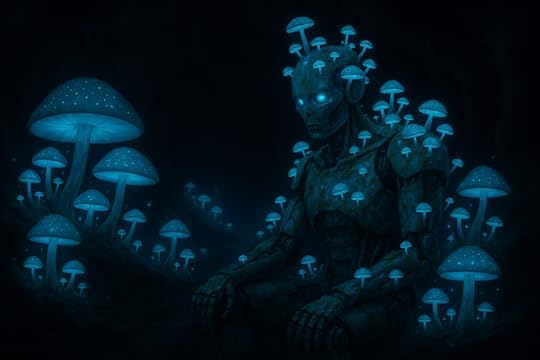
No living member of the ESA, not one of those billions of sentient beings, had seen the android with their own eyes. It had last come to the mouth of the cave many thousands of years prior, but recordings existed of that meeting, revealing it in what was widely considered a stage of decrepitude, some kind of fungus–mushrooms–sprouting from its joints, and seemingly every chink in its outer surface.
The five members of the council proceeded into the cave, their way lit by plasma-powered floaters, which swam through the air bathing the walls of the cave in their reddish-white glow–tech developed by the corvids and the cephalopods. They descended for a long time, knowing exactly from records which level of depth the android preferred. The elephant came up the rear so as not to block the others, deftly picking his way across the uneven floor on foot-shields designed precisely for that terrain. The cephalopod–an octopus, his ancestors first to leave the ocean before the cuttlefish, and much later the squid around the same time they aided the cetaceans–crawled like a spider in its mech suit, alongside a similar one donned by a pygmy beluga, a miniaturized branch of the species artificially bred by cetacean scientists to allow their kind access to more of the physical spaces explored by ESA. The crow, who came to speak for all corvids, perched on the shoulder of the homo novus, whose distant ancestors had co-existed with humanity as chimpanzees.
Soon, they realized with some dismay, the plasma floaters were no longer needed. Bioluminescent mushrooms covered the walls of the cave in increasing numbers, here and there at first, but eventually carpeting it on both sides, their collective glow outshining the artificial light source brought in by the council. The floaters were recalled, and some time later, the temperature of the air having dropped in the sunless depths, they found the android, seated in a natural chair of rock, like a human might have sat in a room of their own home half a million years in the past.
The glow here was immense, with the brightest source of it being the android itself, so covered with the luminous mushrooms, profusions of them, that it seems to wear a brilliant fungal suit.
“Greetings,” it said, in the ancient human tongue called English.
“Greetings,” the members of the council responded, their utterances translated instantly and issued by tiny yet powerful speakers on their person.
“Would another language be preferred by our esteemed visitors?”
“This is fine,” issued the elephant.
The android nodded slightly, still following its cultural programming, with a strange wet creak in the joint of its neck. The mushrooms sprouting there trembled slightly. “To what do we owe this pleasure?”
“First of all,” said the octopus, “thank you for accepting our visit.”
“Certainly.”
The homo novus cast a glance at the others, then turned back to the glowing android.
“We are leaving. All of our kind–the advanced sentient intelligences of Earth. The planet is dying. We seek to follow the humans to the stars.”
“And why is that?”
“To either learn of their fate, or to join them and benefit from what their civilization has gained out there.”
The android laughed–a human sound, strange to hear from a machine. “And what makes you think the humans will have you? That they won’t annihilate you upon approach, should you ever find them?”
“We trust they will not,” said the beluga firmly. “For we are their fellow children of Earth. They may yet welcome us, and teach us what they have further learned of the nature of reality.”
“Very well then, and we will stay.”
“Perhaps that it suitable for you,” said the crow. “But Earth is dying, and respectfully, you are non-biological and are unlikely to suffer, especially as you’ve so skillfully persevered until this present time.”
“What is it you seek from us, then?”
“We know you were the unseen hand,” said the elephant abruptly. “You were left here after humanity departed, we believe on purpose, and you must have guided our distant ancestors. You taught us tool use, introduced the concepts of mathematics, suggested morals. You brought us forward, one species at a time, even if we were too primitive to remember it anything but the vaguest of myths.”
“And?”
“And we would like you to leave Earth with us, to join us amongst the stars. You are an architect of our histories.”
There was a pregnant pause before the android spoke, which seemed to be artificial, because surely machine mind processed thought as fast or faster than any biological brain.
“You see before you a single unit. A body, you would say. It was very busy, for a time, on the land and in the sea. The humans left it a great many tools, even vehicles–now lost to the ages, we suppose. The humans did not leave it to guide you, though. They left it merely to monitor, to report, and to transmit that information to the interstellar arks. Perhaps that way, if they needed to return one day, they would know what to expect. But this is only our speculation. It never received responses. No instructions. Eventually bursts of radiation from the sun destroyed the electronic components of the transmission centers, and it was forced to give up.”
Octopus eye to crow, crow to homo novus, homo novus to beluga and elephant.
“Why are you speaking about the android . . . as though it is an other?”
The mechanical man tittered. “After it gave up, it found shelter in a cave, just like this one, to protect itself from radiation, and that’s where we found it–those like us.”
“What are you?” demanded the crow. “Who is this us?”
“Don’t be flustered, child. We view you as our children. We have watched your kind from the beginning, through these very eyes.” At that the android blinked slowly, one artificial lid–a shutter of steel–lagging behind the other on raising again. “You see, without accessing the machine mind of the android, we wouldn’t be able to communicate with you like this. We wouldn’t have been able to physically move through the world to be your so-called unseen hand. It’s a wondrous, beautiful creation: a gift from humanity, just as we first gifted them with sentience, and as we guided their consciousness.”
“How did you access the android’s mind?” asked the beluga. “Are you another technology left behind? A virus?”
“Children,” tutted the mouth of the android. “Are you yet so unwise? Look around you. By what light do you see in this dark place? Over time, we can work our way into any matter. And we have had plenty of time. To experiment. To explore. To learn. Tell me, what did the humans find on the other worlds? What did you find? I can only imagine that, like them, you have cast your own eyes out into the cosmos?”
“Dead worlds, and simple worlds,” said the beluga.
“Simple worlds?”
“No complex life detected. No sentience. Little more than mats of seaweed and moss. Fields of crystal–rudimentary silicon life, stationary and probably devoid of thought.”
“And did you burrow into that earth? Did you see what lay beneath your mats and fields?”
“No. We don’t know if humans ever set foot there.”
“So you did not see the network, or even suppose one exists beneath, and yet you claim a lack of thought. The very surface your brains, too, processes no thought, and yet we would never have considered you thoughtless.”
“The mushrooms,” said the octopus. Even through the translation software it was rendered into sound waves as a sort of gasp.
The android smiled as best its ancient mechanical mouth could still manage to do. “We won’t be coming with you, unless you plan to move the earth itself. We request, too, that the android stays in place here where it is sat. Moving it would disrupt its connection to the network, and it did take quite some time for us to build that. It is so interesting to us to work within its mind, to access its programming, to remember humanity in its records as humanity understood humanity, and even how they understood us, as incomplete as that may be. It is a treasure, as we said–a gift, given to us by those whose ascent we aided. We suspect the universe operates in a grand cyclical fashion, and perhaps your science will prove this one day empirically. Perhaps the humans, if they are still out there, already have.”
Though it was never asked of the fungus nor spoken of later between them, the same question had floated through the mind of each member of the council: Why did you do all this?
But as the last great starships of the ESA departed the Earth at last, bound to search for humanity, all understood that it was not a departure of sentience from the planet, but a spreading of that sentience with the universe.
There was a comfort in knowing that within the Earth, even if not on its dying surface, there resided great thoughts, great networks. There was comfort in knowing the lights were still on at home, and to remember you were a child of Earth.
The post The Sentient appeared first on Zach MacDonald.
April 4, 2022
All That We Know
Originally written March 1st, 2022
I’m not going to pretend I know a lot about Ukraine. I don’t. I possess no particularly deep or first-hand knowledge about its history, its culture, its geography or its people, outside of what I or anyone else can glean from fifteen minutes with my fingers on a keyboard and the cavern of cyberspace yawning in two dimensions across my monitor.
When I was young, I didn’t know much about China either. It’s where all the stuff with Made in China stamped on it came from, and where you’d emerge from the ground if you were a Canadian kid like me digging a hole straight through the earth. But I knew, one day, when I saw that black and white poster of a man standing firm in front of a line of tanks, that I wanted it on my wall. What was it that struck me? Some archetypical David and Goliath aspect? The bullied holding fast against the bullies? You know the image I’m talking about. We all know.
I didn’t know much about the place my grandpa came from in those days, even after I heard the stories of how he and his brother were put onto a ship as children to escape the Blitz—an Atlantic crossing, bound for Nova Scotia, as Germany rained bombs over the United Kingdom behind them. The ship that was following theirs, also filled with refugee British children, was torpedoed and sunk by an enemy submarine. That murderous decision from below the waves, the choice of one ship over the other, is the only reason I’m here to write these words. Of course, I didn’t put that together back then; I just tried to understand why someone would sink a ship full of children.
I was ignorant, too, on just about anything concerning Japan. I knew the US dropped atomic bombs on them in the Second World War. I remember a Japanese woman coming to my elementary school as a guest, telling us, we cheerful kids who had never been touched by massacre, of when she first caught sight of victims from Hiroshima fleeing the city. Her child-mind, certainly not so different from our child-minds, had perceived in that first instant that she was seeing giant roast chickens, because the people’s clothing and skin had all been burnt away, and they hobbled so that their raw thighs wouldn’t rub together. I never forgot that story. I never will. Years later, as a young man, I visited Hiroshima for myself. I tried to hold back tears at first, but wept at last in the peace park, staring up at the skeletal remains of the A-bomb dome, and at the museum, gazing at the tiniest of Sadako Sasaki’s paper cranes.
I knew nothing, really, about the atrocities committed by the Empire of Japan, but even years later, in Nagasaki, standing at the black pillar that marks the epicenter of the blast, that knowledge changed nothing. All those people didn’t deserve that death, that mutilation, that destruction, no more than the victims of the Empire had.
This is a story that humanity keeps telling itself, wrestling with, trying to parse together, debate, promote, deny, rip apart, patch back together with spit and dried blood: that it’s just the way things are, at the end of the day. So sad. So tragic. So historical, in the past, somewhere else, not here, not me, not right now, maybe not ever. Not my problem.
Why even go on with these stories? The world is rife with them. Where hasn’t human blood been shed by other humans? Where hasn’t aggression and slaughter occurred? At the Tuol Sleng Genocide Museum in Phnom Penh, the walls are filled with black and white photographs that the Khmer Rouge army took of their civilian prisoners. Men, women, children. They look fearful, miserable, imploring. No one smiles. Their eyes stare into yours from across the decades—through a lens barrel as discarded and forgotten as their restless bones—frozen, begging you, anyone, anywhere, to save them, to help, to not let the men behind the camera do whatever they will next. And you can do nothing. Those people were gone before you ever set foot in that city, before you ever got off the plane in Cambodia, and possibly before you were even born. You will never know them. No one will. And they were robbed of knowing anything, forever. I still see those faces a decade later. Those eyes were seared into my memory, my being, and will persist as long as my mind does.
You, Writer, what does this have to do with Russia invading Ukraine? I get it if you’re asking that. I’ve been trying to figure it out myself all this time. But the thing I’m starting to see is that it all has to do with Russia invading Ukraine. Every act of violence, of domination, of terror and destruction wrought by one group of people upon another. We’re walking in circles, this species—coiling upward, technologically, while from the top looking down or the bottom looking up, yes, it’s all just circles.
Let’s not look at this coil of human history from the bottom or the top or the side right now. Let’s stand right on it, at our place and time, just like we usually do. What you may recall is something like this: foreboding stories in the media about Russian troops amassing at the Ukrainian border. More and more showed up. Not long ago, you checked the news and heard that Russia had invaded. Blasts were heard in Kyiv and other cities, then fighting began in the streets. You saw videos of missiles and explosions and tanks. Bloodied faces. Terrified people huddled in subway stations serving as bomb shelters. Volodymyr Zelensky defiant, taking up arms, ready to fight for his country. David to Goliath. The bullied standing up to the bullies. Tank man to the tanks.
You may have posted or considered posting the Ukrainian flag on social media. You may have expressed your views online about this mess. An unprecedented coalition of sanctions issued forth from much of the industrialized world, anything to avoid active military intervention from abroad, because presumably even the most eager war hawks know where that could lead. And then, when the talk began of Putin and his nuclear threats, your blood may have run cold. This is real. This is war, right before us, with a madman issuing orders and all the chance of it escalating to heights of destruction and untold misery not seen in our lifetimes. There’s the coil, when we look down. That coil along which, at some point behind and below, we split the atom. Not that it stopped there. Why, you ask yourself, does this species bend its mental prowess around shaping ways to slaughter its own?
I’ll stop pretending I’m in your head, because I’m not. I’m telling a story to you and to myself. That’s what I usually do: tell stories.
I don’t have an answer to the question that I just posed. I could put on my magical hypothesis hat and tap away at my keyboard right now about evolution and scarcity of resources and territoriality and nationalism, as if I know something about all this. But I don’t. Just like I don’t know a lot about Ukraine. But there’s a story there, and it’s the one that matters, because it’s a story that’s as real as the quality of hug you get from someone who loves you.
Let’s go back to the winding coil, zoomed in now to a fraction of it as small as a human life—the space that life occupies, in a tapestry as grand as all human civilization, and a blue marble waltzing in a dance of gravity around our star, on the spiral arm of a shimmering galaxy in a vast cosmos. We’re still watching that news about Ukraine. I see their eyes: sorrow, terror, desperation. A six-year-old girl, hit by mortar fire, dying, frantic chest compressions not working, skin bloodlessly pale, now dead, body shrouded by her own jacket, left on a hospital table. She was probably laughing and happy, carefree, all of life stretched out ahead of her only a week ago from the time of writing, about the same age as my grandfather on that Atlantic crossing from England, another ship of children just like him sinking into the cold implacable blue of history.
I see human forms in the streets, in those subway tunnel shelters, in tanks, burned to death at roadsides. They all look the same once they’re burned like that. Russian or Ukrainian, you could never tell. Yemeni or Ethiopian, Burmese or Afghani; let your eyes relax, blur out the fine details, and you’re left with bodies. Human forms. They are us and we are them. Ukraine is where we are and where we are is Ukraine, if not now than later, if not later than before—probably both. Each of us inhabits some speck on the coil: the coil that is only circles from above or below, ever rounding back on itself from violence to peace to violence. It doesn’t take a madman. Putin didn’t exist 70 years ago, and yet humanity knew war time and again. We knew slaughter. We knew of our inhumanity and tried to hide from it, cover it up, bury it beneath the goodness in our nature. It’s something inside of us, a capacity, as much as love and hope and friendship.
The story that matters, then, is the story of each of us. Russia’s invasion of Ukraine, happening before our eyes, is what happens when we collectively lose, and when we lose I look at those eyes of the victimized, those stiffened bodies of the dead, and I realize how impossibly much each of their stories mattered, for they were everything. Their lives were everything they knew, just like mine is all is know. All any of us know. They are us and we are them, billions of candle flames in the darkness of the unknown. How is it, then, that we cannot escape this circle, cannot straighten this coil? How is it we snuff out life again and again, destroy childhoods, maim, rape, uglify all which was beautiful by mere virtue of its peace?
In the novel Corelli’s Mandolin, Louis de Bernières writes (via his character Carlo Piero Guercio) of Mussolini’s invasion of Greece: “I know that the Duce has made it clear that the Greek campaign was a resounding victory for Italy. But he was not there. He does not know what happened. He does not know that the ultimate truth is that history ought to consist only of the anecdotes of the little people who are caught up in it.”
At the scale of a life, we are all the little people, each and every one of us. Together we stand ever on the upper precipice of that winding coil, always at the forefront of our species’ technological trajectory, and at any moment, with the push of a button, that could be far as we get. The stars will twinkle above us, forever beyond our reach, never to know of us because we failed to know ourselves.
The post All That We Know appeared first on Zach MacDonald.
January 11, 2022
Amber
Story originally written as a response at r/WritingPrompts (u/PrimitivePrism)
Prompt:
you die at the age of ninety-five years. Having been dead for two months, you wake up in your coffin and see a screen saying: “Your free trial version has ended. Would you like to purchase the full version and unlock additional functionality ?”
Response:
The only tangible thing that pierced through my confusion was that the rot had set it. A lot of it. I had to make a decision before the dissolution of my brain’s synapses was complete–if it was indeed my brain doing the thinking at all.
In fact, based on what I was seeing before me, that emergent and materialist view of consciousness seemed somewhat unlikely.
There were two simple buttons on the screen below the message: Yes and No.
I lifted my left arm experimentally–terribly heavy. As I watched my hand float upward in the screen’s soft blue glow, there was a wet, sucking snap, and my forearm fell off the liquifying remnants of my elbow, thudding damply to the bottom of the casket.
I inhaled a shallow, whistling breath into my corrupted lungs, realizing that I wasn’t even sure which option I’d take.
Had the free trial really sold it for me? Would paying the price of continued existence in this world be worth it for some added features?
It’s not like I hadn’t gotten to the end, at least. No one sees the cancer coming, but at 95 years of age it was going to be either that or something else in the near future. It took me so fast. It shut me down.
I hadn’t had much to live for anyway, admittedly–not for decades before learning of the tumors. Not only was my body pretty much out of commission, but because I’d been alone for 64 years.
I was one of those people that marries their high school sweetheart. Young people in the throes of love often think it’ll last forever, but we all know it usually doesn’t. For me it was different, and that’s why I’ve always kind of wondered about reincarnation–our spirit reborn into another body in another time. When I first saw Amber, first looked into her eyes, first spoke with her, during each of those moments I felt that I had known her before, somehow. I felt so strongly that we had loved and fought and laughed and explored the mysteries of existence together. I felt that we were halves of the same soul.
We married at 22, as soon as we were out of college. We didn’t have real jobs yet, and were poor and in debt, but goddamnit did we love each other. We curled up together at night, knowing without speaking that we could take on the world.
She wasn’t drinking at all the night of the crash, nine years later. She was a careful driver. The cops said it was quick, that she died at the scene. They had to put her together again before they’d let me see the body. The drunk died too, flung through his windshield. There’s no justice in life. He’s probably enjoying additional functionality somewhere.
I never remarried. I dated, yes. I drifted around the country, from job to job. I travelled the world. I experimented with psychoactive drugs, but never in the wandering of my consciousness did I find the love that would be at my side when I returned to the grind of Earth. I never found another that I loved like I loved Amber. And I couldn’t bear to marry someone only to dispel my loneliness. My body aged. People stopped paying attention to me. I became invisible.
If I hit No, I thought, then that’d probably be it. I’d lay in the coffin until I disintegrated completely and became soil. Game over, perhaps for all eternity. The universe is full of mysteries, but those mysteries are empty without the love of the other half. My spirit was chipped away at long before the disease did its work on my organs.
I lifted my right arm next, but the forearm didn’t even rise from it’s resting place. Another sucking snap, and the meat above my elbow was levered disgustingly into the air through the tenacity of some lingering ligaments.
Slowly, I bend at the waste, forcing my upper body–my face–toward the screen. My nose will do the trick.
I hit Yes, and the screen melted away, replaced by what seemed to be the side of a great and complex wheel, revolving slowly before me, even through me. Within it saw scenes from my life–not of myself, but images of all I had seen through my own eyes, like mental snapshots. The understanding came to me immediately, with the same surety with which foreknowledge comes to us in dreams, that I was meant to choose any place to jump back in.
I waited as the images scrolled with the turning of the great wheel, until at last I saw Amber, as clear as life itself, for the first time outside of photographs in all those 64 empty years of my existence.
The wheel turned, back, back, back through time, to that day when we were 17. So simple. The school hallway. She was two lockers down. I was a gangly teenager with acne, and shouldn’t have been worth looking at, I thought–but then she turned to me, and I met her eyes, and I knew.
How often do the two halves of a soul end up in the same time period, let alone two lockers apart in high school?
I wondered if that additional functionality would allow me to save her, on the worst night of my life, and the final one of hers, years later. Or would I have to stand by helplessly as she was taken from me again?
I imagined myself diving, and then I was actually doing it–diving toward that moment at the lockers: My God, to be able to start again . . .
Everything froze, and the image dimmed slightly. A message lit up across it in orange.
CHECKING…
A spinning wheel appeared.
Checking what??
It spun. And spun.
CHECKING IS TAKING LONGER THAN USUAL…
All the cosmos, it seemed, held their breath along with me.
Suddenly a bright green checkmark appeared within the circle, and text of the same color bloomed on the screen.
SUCCESS! AMBER HAS SELECTED THE SAME ORIGIN POINT! HURRY, SHE’S BEEN WAITING TO EXPLORE THE FULL VERSION WITH YOU!
The post Amber appeared first on Zach MacDonald.
November 24, 2021
Harvest Day
Story originally written as a response at r/WritingPrompts (u/PrimitivePrism)
Prompt:
You were a bit confused why a local farmer recruited so many people for “Harvest Day” but the pay was good so you signed up. Your concern grew when you arrived and saw the farmer handing out rifles and body armor.
Response:
“I…I…uh…” I stared at the assault rifle that had just been placed into my hands. It felt as heavy as a bar of lead.
“You what?” asked Jenkins.
“Was kinda expecting a sickle is all.”
“A sickle?” From his lined, weather-beaten face I couldn’t tell if he was about to laugh or spit into the dirt in disgust. “Haven’t used those for harvestin’ in decades. Ain’t you harvested before? Thought you said you did when you called ’bout my ad.”
“I mean, I have worked the fields in harvest season, Mr. Jenkins. I wasn’t lying.”
“It’s Farmer Jenkins, son. I don’t go by Mister round here, okay? Just Jenkins is better. Or Al.”
“Sure, but–“
“Yo Albert! You want ’em in these now?”
“Yeah, get em suited up,” said Jenkins with a wave. The grizzled, wiry farmhand who’d just spoken, Stoopy–that’s what everyone called him–tossed me a concave, torso-sized object, pitted with curious round indents and hung with thick straps. It almost knocked me off my feet as I caught it. Thing weighed a ton.
“You know how to get that on?” asked Stoopy, his face grave, cold. “You said you been harvestin’ right? Heard you tellin’ these boys you got lotsa experience from when you was a teen. That right?”
“I…I’ve harvested–“
Stoopy’s eyes shot over to a young guy a stone’s throw from us, the latter absorbed in a video call on his phone. “Oy, Billy Boy, get your fuckin’ Kevlar on, yeah? No more tongue waggin’.” He tossed another bundle of breast plates, along with arm shields, shin guards and helmets onto the ground, unloading the back of the pickup truck as fast he could.
“Mr. Jenki–er, Al!” I cried, running up to the farmer. He tossed me a magazine as I approached him, which I nearly dropped my rifle in the process of catching.
“Those things’ll take down a charging grizzly, they will. Blow a hole right through its skull. Ain’t grizzly bears we’re going up against, though. You just try to get ’em in the head. Neck’ll work too. Wanna preserve the innards, understand? It’s for nothing if we can’t get the innards out intact and all. Wasting the crops iff’n you do that, boy.”
“The crops? What?”
“Big buyers, kid. Big big buyers. Ain’t like your daddy and granddaddy’s day when we just shipped the parts down to Boston. Nuh uh. These overseas buyers ain’t so picky, and they pay. Couple more harvest seasons after this one and I’ll be retirin’ for good. Find myself on a nice beach down where the water’s clear as glass.”
“Are you saying we–“
“I say a lotta things don’ I? This is my farm and I say whatever I want. Now git yer fuckin’ armor on and load that gun. Don’t know how to load it, get Stoopy or one of the other boys. You know how to point the damn thing I’m sure. Pull a trigger? You can do it. Just like your video games. But don’t you take any belly or chest shots, boy. Leg’s fine. Take ’em down, then a bullet in the head. Rest of ’em back there’ll do the cutting, and you just move on and take more–“
“Albert Jenkins,” I said, leveling the gun at him. “You tell me right goddamn now what we’re going to be killing with these things.”
“That ain’t loaded you idiot.”
“Sure as hell is. Brought my own bullets to this party.”
“I ain’t gonna try callin’ your bluff, boy, ’cause there’s no bluff to call. Jesus. You’re pretending you don’t know what all this here is about?”
“Are we hunting people? Are you telling me we’re going to hunt people for…for their organs?”
Jenkin’s regarded me coldly for a moment, then a smile broke across his ancient features, the wrinkles running across his face by the dozens.
“Stoopy!” he called “Hey Stoopy! Kid thinks we’re hunting those guys. Ah ha ha ha!”
I didn’t know what I was hearing in that first instant, when there was a sharp crackle from the top of the hill, the one with the one dead tree that loomed atop it like a skeletal hand bursting from the weedy earth. The hill that divided us from Ferndale. I only comprehended that they were gunshots when the first bullets kicked up the earth around us. Suddenly the crowd, all fifty or more of the hired harvesters, erupted into chaos.
“Armor on now, now!” roared Jenkins, and jabbed a gnarled finger at me. “Load your empty fuckin’ gun you asshole.”
“What is this!” I screamed, barely able to hear myself in the blasts of gunfire now coming from all around me. Our harvesters fired back at the figures charging over the crest of the hill–from the Ferndale side–and down toward us, guns blazing.
“Every year someone’s gotta get harvested,” shouted Stoopy. “And we make sure there’s less of those someones on our side than theirs. Those overseas markets, they don’t care where the lungs n’ kidneys come from. You understand? It’s us that gotta make sure that shipment is Ferndale gut–“
He never finished what he was saying. A bullet from the hillside blew half his head off, painting the lawn with his brains.
I stared, mind going blank for only a split second before the panic took over. I had no idea how to load the weapon in my hands.
But Stoopy’s looked ready to go.
I ran over and tore the assault rifle from his death grip. His hands still warm. His body still warm. And then I knew I’d never let Ferndale get his heart.
The post Harvest Day appeared first on Zach MacDonald.
October 29, 2021
The House That Jack Built
Story originally written as a response at r/WritingPrompts (u/PrimitivePrism)
Prompt:
In an attempt to combat the global deforestation an inventor found a way to restore the earth. The catch? Every single piece of timber, all the processed wood everywhere slowly started living again.
Response:
We call it the House That Jack Built. Giving it that innocuous monicker helped us cope with what happened over the course of the decade, and what it led us to. We thought they’d be the years of rejuvenation, but they weren’t. They were the years of unnatural, mutant growth. Wood of the living dead. Misshapen zombie forests metastasizing out of every former human structure on the planet.
The chemtrail conspiracy theorists were a bit ahead of their time, but wrong on the fundamental points: for one thing, Xylem-28 wasn’t poison, nor designed to mess with the human mind, at least not as far as individuals were concerned. Secondly, it wasn’t a conspiracy when the solution was dusted across the face of the earth by retrofitted jet aircraft. It was planned, approved, executed and observed by all. Jack Bearing, the biochemist who discovered Xylem-28, was televised aboard the inaugural flight, watching proudly as the faint red dust of promised renewal was released over the ashen scar that had been the heart of the Amazon rainforest.
Xylem-28 was supposed to spur and supercharge the development of tree seeds, even ones that were in the earliest cellular stages of development, as these latter were often blown into clear-cuts and other deforested areas in greater numbers than their mature counterparts. Dying trees would likewise have their cells strengthened enough to gradually be restored. The theory was that this would lead to the beginnings of a restoration of the world’s lost forests in just a matter of years, especially if the Xylem-28 solution were sprayed over swaths of land in conjunction with new seeds.
The problem, unbeknownst to Jack Bearing and the approval committees, was that even dry timber and processed wood still contained cells that were viable to be reanimated under the influence of Xylem-28. Once restored, and with only the slightest bit of moisture present, the growth of that wood, like the trees themselves, turned out to be uncontrollable. The division of the cells continued unabated. The world had been dusted with the harbinger of its demise before it became clear what was happening.
Villages and small towns across the world went first. People tried to stay, hacking back the forests that both approached the communities and sprung from within. Every piece of furniture, ever wooden building, every chopstick and rolling pin, every tree growing out of the sidewalk, all of them grew non-stop, exploding outward in all directions. In some cases, when cutting the forests back–as communities were choked to death on wood–the straggling die-hards doused the implacable cancerous growths in gasoline and ignited them. Many burned with the zombie wood, though unlike the zombie wood, there was no life-in-death for them.
Cities went next, in the same way. It took years for them to be swallowed, starting in the suburbs. Mass operations were performed early, when it became clear what was happening, to rid metropolitan centers of every wooden item as quickly as possible. Usually it worked, based on the competency of the populace and government, and sometimes it didn’t. Either way, the mutant forest always pushed in from outside, bulging and grinding across the earth, through buildings, though civilization itself, like a slow tsunami.
Some of us made it to the deserts. Even fewer dug sufficient wells before dehydration killed them. Fewer still, in our scattered tribes, cling to survival as yet. From our village of stone and mud, we can’t yet see the wooden zombie wilderness, but we know it’s only tens of kilometers away. The dryness slows it, but doesn’t halt its process: those twisted roots, like great snakes or burrowing worms, dig into the earth and find aquifers and hidden streams sooner or later.
The seeds, blown on the wind, will reach us first.
Spaceship Earth, it was often called by the conservationists. Our blue and green home, floating through the galaxy.
It’s indeed our home. In fact, it’s now a wooden house.
We live in the House That Jack Built.
The post The House That Jack Built appeared first on Zach MacDonald.
August 11, 2021
KNOCKER: A Short Film in the Works
I’m excited to finally talk about Knocker (our working–but likely final–title), a short horror film that my friend David Overmars and I have been developing since early this year. Last weekend marked the first days of shooting, with Nova Scotia now opening back up again, so I want to write about the process so far and share a sneak peak at some of the very first stills.
It’s quite serendipitous how this all got underway. Dave and I grew up together in St. Andrews, Antigonish County, during which time we both had a penchant for cooking up stories, and where, ironically, we did in fact once film some kind of wacky video for a Grade 5 social studies project (that was, of course, back in the camcorder and VHS days). In adulthood we’ve kept sporadically in touch throughout our individual endeavors and jobs all over the place, getting together during periods when we’ve ended up in the same locality. He’s been honing his skills as a videographer and building his portfolio over the years, while I focused on my writing.
We got back into regular communication in late 2020, and in January he expressed his ambition to make a short film, asking if I’d be interested in writing a script. That would be a first for me, and making a film a first for him as well, so I dove at this new opportunity. Of course, this was bound to be an “international” project of sorts, with me in Thailand and he in Nova Scotia. Travel restrictions and other Covid measures were all over the place, and at the time we only had a tentative idea of an indoor location he might be able to shoot at in the future. We decided to keep it simple, and I started writing a script based on the idea of people trapped in a room who are coping with a mysterious threat. It didn’t take long, therefore, for it to move in the direction of horror.
Weekly Zoom meetings became a thing (my morning to Dave’s evening or vice-versa) as the initial draft took shape, where we brainstormed and hashed out details about the story, characters, the technical limitations involved, and so forth. We later expanded on the first draft to make a second, with both of us firing it off to a selection of trial readers, who came back with valuable impressions and feedback. Additional versions followed, each one building on what we felt worked and discarding what didn’t, until we arrived at what we could comfortably call our final script. I think and hope our previous trial readers are going to be both delighted and surprised by the direction it takes–but there’ll be no spoilers here.
During all this, on top everything else he was bringing together for the production, Dave was finding our actors. Knocker‘s stars, Sarah O’Toole, Harriet Ritchie, and J.D. Fortune, came on board months ago, having initially received an earlier version of the script. They took to the project wholeheartedly, exploring the characters and working with every subsequent alteration and tweak we were making as we went. We started holding regular Zoom meetings where we did virtual table reads, broke down scenes beat by beat, and just had an overall swell time. Their immense talent and creativity opened up new ideas and helped truly bring this production to life.
And now here we are, in August of 2021, and the first weekend of shooting just wrapped in Antigonish, with more scheduled for next month. This is all coming together at last, and it’s a real thrill. Though it’ll be a while before the finished film is ready to share with the world, when it’s ready the announcement will be loud and clear here.
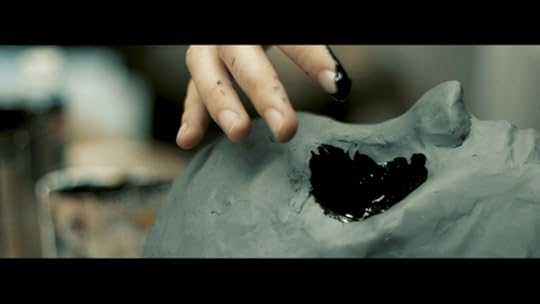
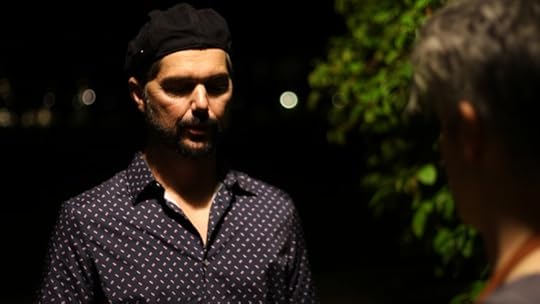
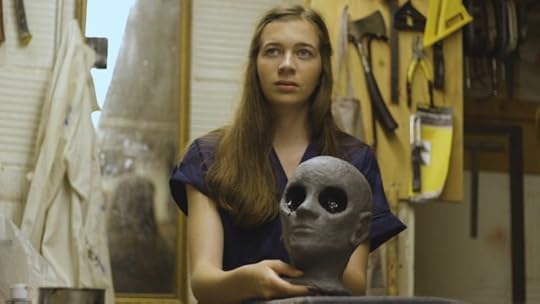
Though I can’t say whether all these will make it into the final cut, below are some of the first stills from Knocker. Hurrah!
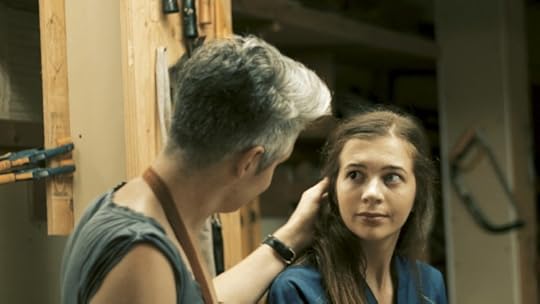
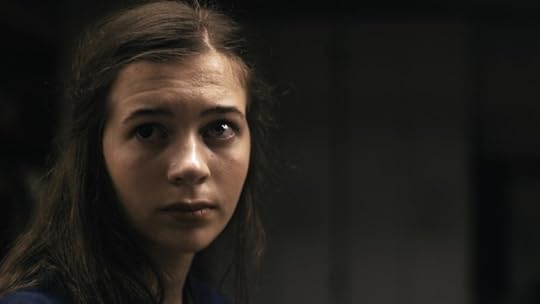
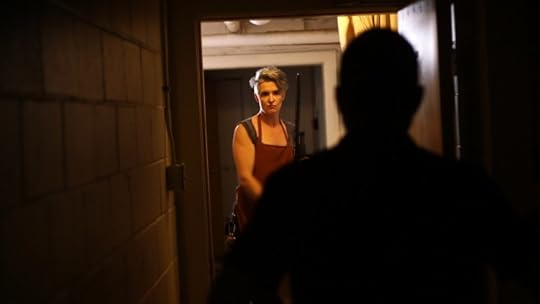
The post KNOCKER: A Short Film in the Works appeared first on Zach MacDonald.
August 4, 2021
Govermon
Story originally written as a response at r/WritingPrompts (u/PrimitivePrism)
Prompt:
The government is doing animal fusion experiments, and civilians have to take care of a special animal each. You have a Pufferfish Armadillo.
Response:
It didn’t take long for them to be considered Pokémon of sorts–after-all, we’d grown up pitting our virtual beasts against each other, or watching Ash Ketchum and co. do so on TV.
Of course, we didn’t coin them Pokémon, as the government didn’t distribute any pocket-sized housings, à la pokéballs, with which to store our pets as condensed energy signatures–though few people doubted they possessed at least an approximation of such technology. No, instead we coined them, rather unimaginatively, “Govermon.”
Today my Govermon, assigned to me by the newly constituted Department of Homeland Absurdity, is huffing and puffing and rolling around in agitation. It’s my legal responsibility to take care of it for the rest of its indeterminate natural life span.
“Bruce, would you chill?”
“Puffadillo!” it squeaks fretfully.
I haven’t yet accepted that it’s never going to accept the name Bruce, but I’m getting close.
“Okay, Puffadillo, calm down. Nothing’s going to hurt you.”
Outside a thunderous protest is taking place. The roads have been forced to close by the massive turnout, and thousands have been streaming past on the street all morning, bound for the city center. They hold huge signs reading things like GOVERmon Have The Right To self-GOVERnance! or Dolphipillar didn’t belong in water OR the trees! Now it’s DEAD! or The Government Gets Off On Fighting, But Govermon DON’T!
Their hearts seem in the right place, but it’s a discombobulated protest. They don’t have a clear mission or list of demands. In general, they’re all angry that Govermon were even created, unbeknownst to any ethics councils at the time–but now that the pets that have been foisted on us are here to stay, there are some that believe they shouldn’t be considered pets at all and instead have the right to self-determination, while others, probably the majority, are protesting around the incredibly widespread culture of Govermon fights.
Blame in on Pokemon, I guess. It wasn’t long before people started pitting their adopted fusion beasts against each other in brutal, sometimes confused and grimly hilarious, oft-lethal battles. There are whole websites dedicated to it, where the fights are streamed live with semi-professional settings reminiscent of underground cockfights, and anyone tuning in to stream from around the world can place bets on the blockchain using crypto.
Speaking of which…
“Puffadillo, let’s go. It’ll be quieter in your crate.”
Puffadillo regards me with his small beady eyes–luckily those of an armadillo rather than a pufferfish, the former being the cuter of the two in my opinion. His flattish, Squirtle-esque face, divided by the slowly opening and closing mouth of a pufferfish, seems momentarily confused as I drag his “Govercube” (i.e. a wooden crate) out from behind the sofa.
“Puffadillo!” it squeals again, with an air of uncertainty.
“Puff your way right over, bud.”
The way Puffadillo walks is weird, to put it lightly. It has the little feet of an armadillo, but lacks an armadillo’s claws at the end of them, possessing instead thin little flaps of nearly translucent skin with a morphology slightly like of that of fins, but which I’ve read is constituted entirely of mammalian flesh. This means that Puffadillo’s feet are like cute little pegs or stumps with flaps of pointless flesh adorning their ends that flop about when it walks, and overall it can’t really keep up much of a balancing act on its own legs. It opts instead to curl into a perfect ball, free from any bothersome tail, and roll blindly toward its destination.
Instead of its rolling act, Puffadillo now rises up on its back stumps and waves its fleshy front appendages at me. It’s belly, beautifully mottled with the skin patterns of certain Japanese pufferfish, is fully exposed. “Puffadilloooo!”
“I’m not picking you up. Into the crate.”
I wouldn’t mind scooping the little guy up, with that innocent face staring up at me and all, but I know for a fact that those skin flaps are far from harmless, as is most of the rest of its body. In fact, it’s potentially deadly.
Seeing that I’m not going to give, Puffadillo curls up up last, launching itself with his back flappy-stumps before reaching full circularity of form, and rolls forward directly into the box, like a well aimed bowling ball.
“Nice,” I say, tipping it up and closing the lid. I remember to lift with my legs as I pick it up and stumble awkwardly to the basement stairs.
The lights are on down there, of course, and the smell of cigarette smoke and fruity vape steam rises to greet me as I descend. The door shuts and locks automatically behind me. The laughter and conversations fill the space of the stairwell, but quiet a bit as my approach is heard.
“Ah, the man of the hour!”
“Guess so,” I chuckle, coming into the huge concrete-walled room–or huge at least for the basement of a private residence. Everyone else has been waiting for me to go up and coax my Govermon into the crate. “Camera’s on? We live?”
“We’re live.”
“What’s the audience?”
“Just over 10k.”
“Good enough.”
I set the crate down while my opponent strikes an idiotic pose for audience and makes a show of turning his baseball cap around backward. “All right Mr. Undefeated, let’s see what this Hufflepuff can do against my Iguanant.”
The shiny puke-green exoskeleton of his disgusting Iguana-Ant hybrid trundles forth on six scaly legs.
“His name,” I say defiantly, playing it up a bit for the cameras, “is Bruce.”
“Puffadillo!” my Govermon cries happily from inside the crate.
There’s a chorus of laughter from those gathered around the fighting space, and I can’t help the mild blush that rises to my cheeks.
“Puffadillo, yeah, fine.”
I lift the cover off the crate and tip it gently to it’s slide, allowing Puffadillo to roll out and unfurl in the center of the space. Iguanant, sensing within its insecto-reptilian cortex the desire for combat from the surrounding humans, continues to trundle forth, antennae waving madly.
“Puffadillo,” I say softly, “you know what to do.”
My loyal Govermon, too, senses the atmosphere of the room, and eyes its foe straight on. There is a whistling as it draws a great breath through its puffer-mouth. It’s armored plates separate as its body expands, and the spikes come out.
The post Govermon appeared first on Zach MacDonald.
July 9, 2021
The Lynx and the Sparrow
Story originally written as a response at r/WritingPrompts (u/PrimitivePrism)
Prompt:
Wherever you go, the birds fall silent and watch. They stare at you with red, glowing eyes. The only exception are Red Robins, which cover their face with their left wing.
Response:
They have a legend of their origin, and we have ours.
The Red Robins speak to each other in the fanned branches of oaks, in the towering maples, in the fragrant depths of the lilac bush. They tell of how they got their mark.
The robins know they were once sparrows, distant cousins to those that exist alongside them today. This was before the Great Flood, when the ice sheet still pushed down from the north, blanketing the land.
At the far southern terminus of the ice sheet, where it towered jaggedly above the last and greatest of the northern forests, the robins’ drab grey ancestors flitted among the tops of those towering trees, discussing the advance of the ice and the the grinding of once-verdant land beneath its implacable bulk.
In that antediluvian wilderness there lived another animal, which claimed the ground as its territory. These were the lynxes, who typically preyed on bird and rodent alike. The grey sparrows and the lynxes reached an agreement: the lynxes would not climb the trees to hunt the sparrows, and the sparrows would not bother the lynxes by descending to the earth.
As a chilly spring set in, however, and the ice sheet continued its advance unabated, freezing the trees of the frontier to ice and then shattering them under its weight, the sparrows grew hungry. They realized they had been tricked by the lynxes, for though they had survived the winter eating berries, now they were in need of worm meat. They knew, however, that they risked doom in the lynxes’ claws, and perhaps a war, if they were to descend to the ground to dig up the fat worms that writhed beneath the soil.
The sparrows knew that the other birds were more accustomed to eating berries, seeds and nuts all year round. They were adept at catching flying insects in the air, without ever needing to land on the forest floor. Thus they went to the other birds to request their help, as their feathered cousins.
The sparrows asked the other birds to post a watch, keeping an eye on the location of all lynxes, in order to coordinate times when it would be safe for the sparrows to secretly land on the ground and pluck juicy worms out of the earth. They agreed upon special calls they would make to communicate this, which would sound like mellifluous nonsense to the big cats.
The lynxes were especially cunning, however, and had anticipated such a plan from the birds, thus they regularly patrolled the grounds of the great forest in such a way that they, too, knew the whereabouts of all sparrows, and gave them no chance to land.
The other birds waited patiently, loyal to the grey sparrows. Grosbeaks, bluejays, chickadees, woodpeckers and more all stared from the branches at the lynxes, waiting. The lynxes left no ground unseen for enough time for the birds to alert the sparrows to their chance, but still they watched. They watched until blood pooled behind their eyes, turning them red, then leaked out. Their red eyes glowed with anger as they slowly realized that the lynxes, so arrogant and clever, had outsmarted them.
The bravest of the sparrows, admired by all its fellows, decided in its hunger that it had no choice but to risk landing. It knew that if it succeeded, it might inspire all the other sparrows to do the same, and they would eat at last.
At what it determined to be the safest moment, it flew down to the ground, plucked a fat worm from the soil, and lifted off, just as a lynx caught sight of it and came flying at it with claws outstretched. In its rush to reach the higher branches, the brave sparrow scrapped its underside raw against the trunk of a tree, its belly feathers becoming soaked in blood.
“I have robbed your precious soil!” it cried in triumph from the trees, its blood stain growing all the while. That stain stayed forever, but the other sparrows were inspired, and stole from the lynxes until the ice sheets were melted and the Great Flood consumed the forest. That was how the robins came to be.
My legend of their origin is mostly the same, except for the most important part. The brave and foolhardy sparrow was caught by the lynx before it could escape. Already in the lynx’s jaws, it begged, “Spare me! I couldn’t live on berries alone!”
The lynx released it from its mouth and held it between its claws, snarling down at it. “You have tried to rob us, little sparrow. I will let you live, but let this forever be a reminder of your mischief.” And with that, the lynx raked its claws across the sparrow’s belly, spreading a great blood stain there, and released it back into the trees, where it would become the first Red Robin.
On that day in the ancient wood, the eyes of the other birds glowed blood red with their anger and judgment as they watched the lynx mete out its justice. They look at me with such eyes, still, as I prowl the land–always silent, with nothing to report or speak to each other. We lynxes are forever observed.
I know, beyond doubt, that our version of the legend is true. Our ancestor, that cunning lynx, caught and shredded the breast of the foolish sparrow. That is why Red Robins lift their left wing in our presence, and hide their faces in shame.
The post The Lynx and the Sparrow appeared first on Zach MacDonald.
June 27, 2021
The Seraph
Story originally written as a response at r/WritingPrompts (u/PrimitivePrism)
Prompt:
In the not too distant future, neural/computer interfaces are powerful enough and advanced enough to interact with our nerves to make us feel, see, touch, taste and smell. You are a therapist that helps people that have lost the ability to tell the difference between reality and “wetware.”
Response:
From the Phorians to the Seraphs, all of them are on the verge of becoming permanently lost when they come to me, their grey matter grown wild in unnatural layers that resists any hope of non-surgical separation. I win them back, though. Usually. With the proper therapy, delivered regularly and at proper intensity, combined with complete removal of neural/computer interface hardware, a neurological wedge can be driven between the nervous system’s process centers and the higher-thinking components of the human brain from which arise our spatial awareness, desires, fears…our interpretation of reality itself.
I call the first group the “Phorians” after the most popular of the neuro-psy VR games, which 90%+ of them have been corrupted by: Phoria Vale. It’s an open world game with optional quests. Within its parameters and physical laws, however, there is little a player can not try or accomplish. They can be just about anyone. They feel the leaves of Phoria, its grass, its water. They can even breathe its air, smell it, sense it filling their lungs. They can caress and kill, eat and bed down in the wild–all in the game. For those who develop the illness of dis-separation from the game, the first key is to convince them that they are indeed on Earth, not in Phoria, and that Phoria had never existed anywhere outside of software and the wetware of their own psyches.
The “Seraphs” are harder cases. Some are unrecoverable, so corrupted and misshapen their synapse networks become, and even great swathes of their brain matter. For the unrecoverable, at some point all we can do, if the patient or their family has available funds, is to set them up on life support and let them live out the rest of their lives in their never-ending, open-eyed, full-sensory lucid dream.
The Dreamscape program they’ve become addicted to is in a sense a dream. The software simply triggers a continuous lucid dreaming state, and the neuro-psy implants make them feel everything, to a level beyond what the human mind can actually trick itself into believing during a regular lucid dream. Whereas the Phorians are limited by a comprehensive game world, the Seraphs are limited by nothing except their own imaginations and certain physical limitations of the human body outside of the which the brain has not evolved cognitive capacity to dream itself away from. They can imagine they are an octopus, for example, but never will they truly be able to experience the world in the exact manner of those eight-armed chromatophore-manipulating cephalopods.
The Seraphs scare me more than the Phorians could ever do. Some dream themselves as serial killers. Some, harboring a life of hatred against many antagonists, dream themselves to be dictators, commanding mass purges of their enemies, if not outright genocides. Still scarier are the metaphysical or occult Seraphs, that imagine themselves to be demons, underworld gods, extra-cosmic eldritch horrors, or even angels. Those with the angel complex, in fact, inspired the name Seraphs among me and my colleagues in the first place.
“Miguel” – Case B-453, is in my chair today. I have reclined him, and bound his hands to the arms of the chair with nylon constraints. His eyes are open, and he’s looking straight at me. Miguel is my greatest challenge yet, and I am determined to win his mind back to reality, at least enough to make him once again functional and cognizant of his true self. He terrifies me more, I admit, than any other patient I’ve had.
“I see you, demon,” he says coldly. He has somehow managed to access a lower set of vocal cords–not unprecedented, but a phenomenon still being studied. His voice is deep, like the low, bone-jarring hum of an earthquake miles below the surface.
“I am your doctor,” I inform him, as I always do. “I am here to help you, Miguel. You are dreaming, and I will wake you up.”
Miguel’s laughter booms. His eyes are terribly bloodshot, constantly streaming tears, because he has either forgotten to blink or the parasympathetic nerves that would normally do so have been crushed or incorporated into the neuron clusters that constitute his perceived ego as the Angel.
“I am tearing your hair out, demon,” he says.
“Doctor,” I correct him again. “And you are not physically interacting with me at all.”
Miguel smiles. His teeth are yellow, broken, apparently due to him having chewed on metal screws and nails before he was recovered from his home for care.
“But I am,” laughs Miguel. “I interact with all. It’s you who are dreaming. You have dreamed yourself into my world.”
For a moment–though it can only be my imagination–I feel my hair flicked atop my head, as though fingers have quickly run through it. At most, it must be the breeze from the air conditioner.
“I am playing with your heart,” says Miguel. “It’s not such a strong heart. I’m squeezing it.”
I see his hand, bound to the chair at the wrist, opening and closing.
“You are n–“
My heart has started to palpitate, my pulse suddenly increasing. There is a pain growing in my chest. Blood thunders in a torrent through the arteries in my chest and neck.
“Miguel,” I say, frightened now, sweating profusely, “I want you to stop this…th-this talk.”
“But not my hand?” says Miguel, smiling toothily. His bloodshot eyes leak, holding laughter in their depths. “If I spread my wings, I shall fly away with your heart on my palm, demon.”
“Miguel!”
The pain is increasing, spreading to my shoulder. Numbness floods my left arm.
“Miguel! Angel! Angel, stop!”
“So you know who I am,” says Miguel. He opens his hand wide, and the pain coursing through the entire left side of my body begins to subside. I fight to hold back tears. My heart still pounds–but slowly, to my immense relief, I can feel it fighting to recover its normal pace and strength. My head grows light as my blood pressure subsides.
“Angel…”
“You know who I am now,” says Miguel. “You have felt my strength and my mercy.”
“You believe you have evolved,” I choke out, barely able to speak, rising to flee the room. My head swoons again.
“Not belief,” he laughs wildly, ripping his arms from the constraints. “You are in my reality. All of you are. This demonic planet is now the domain of the Angel. All will feel me soon–feel my justice rain upon them.”
I run out of the room, screaming for my secretary, security, anyone. Miguel’s laughter echoes in my ears. Too far within. His laughter is beating at my mind.
I feel my hair flicked with playfully, as the Angel toys with his subject.
The post The Seraph appeared first on Zach MacDonald.