Claudia J. Severin's Blog
August 29, 2025
The Emotional Impact of Discovering Your True Parentage
If you’ve considered having your DNA analyzed by one of the popular testing services, is it because you believe secrets lurk in your family tree? As I recently discovered in doing research for my Romancing Our Roots novels, many people are talking about DNA surprises, also called (MP) misattributed paternity or (NPE) nonpaternity events/not parent expected.
Unfortunately, these surprises are pitting the testers against their own parents, particularly their mothers, since their biological fathers may be strangers. According to some articles published in medical journals, pediatricians and other medical professionals may have been pulled into conspiracies to falsify family medical history unless “a clear medical benefit outweighs the potential harms.”
I’d read about case histories like this, but thought they were rare. But a recent article in The New Yorker caught my attention since my romance series deals with DNA puzzles. Staff writer Jennifer Wilson described a survey of 23,000 DNA test takers done by Baylor College of Medicine in 2022. They reported 61% of respondents said they learned something new about themselves or their relatives, including information that they were possibly adopted or donor conceived. Three percent of those surveyed (nearly 700) discovered they were NPEs.
I’ve taken a DNA test, and so has everyone in my immediate family, mainly for the reason the tests are advertised: “trace your ancestors’ journeys and so much more, find new relatives through shared DNA, connect with relatives up to 13 degrees removed.” So far, no surprises such as these.
Not everyone can say the same. The New Yorker article led me to search for Facebook pages that she mentioned detailing NPE stories. I was fortunate to receive some scientific papers and to find some relevant podcasts, including Lily Wood’s NPE Stories, and Alexis Hourselt’s DNA Surprises podcasts with accounts from actual NPEs.
I’ve only scratched the surface so far in listening to these stories, but the ones I’ve heard describe the moment they discovered the deception as earth-shaking, as if they lost all physical sensation, as if their body had broken into a million pieces. Some refer to learning their true paternity as a defining moment where their lives before were one thing, and now they are living an altered reality. The range of emotions would be astronomical: feeling shock, denial, anger, grief, confusion, blame, shame, empathy, bitterness, conflicted, obsessed, defiant, insecure, depressed, hurt, disillusioned, panicked, relief, scorn, betrayed, curious, resentment, and determined, maybe all in the first few moments of learning the truth about their own identity. All these emotions are elements of a good romance novel, drama you’d like to read about, but want to avoid in real life.
However, for an increasing number of people, this drama is real and will likely become more prevalent as more people take direct-to-consumer DNA tests. Laws that protect the secrets held by previous generations need to be challenged. Birth certificates may need to include additional options for biological parents who are not the ones raising the child. Medical organizations need to update their stances on condoning falsified medical histories of patients.
I intend to continue studying this issue in my own non-scientific manner, and I may circle back to this in future writings. If you are interested, visit the sources listed within this blog or below.
Jennifer Wilson, “Missed Connection,” New Yorker, August 25, 2025
Wenzel, Richard, (2023) “Buying my existence. Just $49, free shipping included,” Journal of Genetic Counseling, 00,1-4. https://doi.org/10.1002/jgc4.1686
Wenzel et al., “Misattributed paternity discovery: a critique of medical organizations’ recommendations,” The American Journal of Human Genetics (2025), https://doi.org/10.1016/j.ajhg.2025.01.006


August 6, 2025
A Word About Those Great Genes
You’ve probably heard discussions about American Eagle’s jeans advertisement that states Sydney Sweeney, their celebrity model, has great genes. You can read about that story from other sources. I’m just talking about genetics here, as my eighth romance novel, Lucky Genes, is about to launch.
Your high school biology class probably lauded Gregor Mendel, an Austian monk, who is widely credited with the discovery of genetics back in the mid-1800s. He conducted controlled crossbreeding experiments with pea plans, focusing on traits like flower color and seed shape. His experiments tracked how traits appeared across multiple generations, and that “factors,” which we now know as genes, determined these traits. Much later, in 1953 James Watson and Francis Crick uncovered the double helix structure of DNA, which was a revolutionary view of heredity. Then the Human Genome Project beginning in the 1990s mapped all human genes, which got us to the place where genetic medicine and biotechnology took off.
I won’t try to explain the whole concept of the laws of segregation and assortment when it involves alleles and genes, but while genes exist on the same chromosomes, they are inherited independently of each other due to the process of meiosis. In a nutshell, while you receive half of your genes from each parent, you may be sneaking in specific traits from your grandmother or grandfather, or more distant ancestors, due to the constant resorting of genes when producing what ultimately becomes the embryo.
So, the genes you get are a matter of luck. Spin the wheel, roll the dice, procreation is a random mix. This makes genetics so interesting. It’s fun to look at just a small segment of genes passed down such as the ancestral regions associated with our genes. I believe this is determined by a concentration of similar genes in certain locations of the world. My husband and I and our three daughters took DNA tests. Farmer Husband had genetic links mostly to Germanic Europe (52%), not surprising since nearly all his ancestors came from Germany. Not so much on my side, only 19% from Germanic Europe. But the middle child has 68% Germanic Europe, and the youngest has 57%, both more than either parent, so a throwback to a previous generation.
In the Lucky Genes book, Cheyenne, wants to avoid having children because she’s concerned about passing along her father’s volatile temper, and her mother’s addiction issues. She worries she doesn’t have great genes. Some evidence shows that there is an association between a specific gene called the monoamine oxidase A (MAOA) gene and aggression in humans. This gene regulates neurotransmitters such as serotonin and dopamine, and several studies have shown that men with a weakness in this gene were more likely to be violent. Similarly, substance use disorders can be partially traced to genetics, and partly to environmental factors.
Genetics aside, the characters in Lucky Genes can consider themselves lucky for several reasons. Archer, the male main character survived a near-fatal attack. Eddie, his best friend and employee, graduated from law school despite struggling with learning disabilities. Jacinda, a police officer, arrived at the scene of the crime after the damage had been done. Darcy, Archer’s sister, was able to detangle herself from a relationship with a career criminal. And Cheyenne, the female main character, discovers her worrisome genes are not as expected. Her genetic discoveries are the driving point of the book, and she accepts her new reality.
If you’d like to read more about Lucky Genes, it will be released on August 11, 2025.
July 17, 2025
Ten Things I Know


 View all responses
I hated typing class. Yet it turned out to be one of the most useful things I’ve learned. No one imagined you’d ever type with your thumbs.
As you get older, you realize your brain is like a pc losing storage space. Make room for the good. Purge the rest.
Beauty is in the eye of the beholder. Behold. Be bold.
Much of what you read online is fake. Some is just nasty. Rise above.
Every day you wake up is a blessing.
Take your time. You’ll have just as much as you’ll need.
After you retire, you can keep your pajamas on all day, at least some days.
Grandchildren grow twice as fast as children.
No one can make you happy. That’s your responsibility.
Don’t sweat the small stuff. In the end, it’s all small stuff.
Join the conversation, what are ten things you know for certain?
July 13, 2025
FOLLOWING THE ROMANCE RULES
Those who read or write romance are well aware of the presence of tropes, predictable situations that help structure a relationship between two people as they fall in love. Let’s get that out of the way. The first Rule of Romance Writing is that two people have to fall in love and there will be an HEA, Happy Ever After, or a Happy Now at least. In today’s world, where you can’t always count on government officials following the law or whether your job will be there tomorrow, escaping to a world where rules are followed and outcomes are assured is comforting.
Although my first introduction to tropes smacked of tired clichés, I soon became a believer. They make it easier for readers to identify if they will like a particular book, a boon for both author and reader. As a reader, I’ve mismatched myself with plenty of books that bored me halfway through, and as an author, I never want to read a review that says someone “did not get what they expected, and not in a good way.”
In my current romance series, I’ve tried to use different tropes, working hard to bust out of my personal “secret baby” preference. The most prominent tropes in The Love Genes are Family Saga (across multiple generations), Single Dad, Age Gap, Dual Stories, Grieving Lover, and yes, Secret Babies times two couples. In Lost Genes, you’ll find tropes of Hidden Identity, Single Dad, Smalltown, Alpha Hero (the twist is the heroine doesn’t let him save her), and Found Family. Lucky Genes, now available for pre-order, for an August release, has these tropes: New Girl in Town, Opposites Attract, Dark Secret, Emotional Scars, and Alpha Heroine. Book Four, my work-in-progress, sports tropes like Politician, Enemies to Lovers, Secrets and Lies, Single Mom, and Soulmates.
If I have repeated the Secret Baby trope, I’ve so far avoided some of the others that feel overworked, such as Forced Proximity, Grumpy Sunshine, Friends to Lovers, and Office Rivals. Don’t get me wrong, I’ve read some great books with these tropes, but they are used often.
Romance also provides us opportunities to mock the genre, as it should never take itself too seriously. Here are a few ways it can feel ridiculous:
Spit it Out Already—Why is it so hard for the main characters to say “I love you?” They fall into bed without a second thought, but love? How can this be love? Don’t know when the intimacy vs love ideas got flip-flopped, but someone should put them back in order.Who seriously wants to fall for a Bad Boy? Maybe a flirtation, but he’s bad; avoid a lifetime of heartache.The hero thinks the heroine is “not like other women.” Of course she is, you’re just not paying attention to what other women think.One of the main characters is “Too Dumb to Live.” This happens more often with suspense elements. Don’t go in that barn alone. If you’re in danger, take steps to protect yourself. Why is this your partner’s job?The hero is always drool-worthy, with a ripped physique yet no evidence he ever hits the gym. The heroine often has severe self-esteem issues, but that is rectified with a Pretty Woman-type makeover. We’re supposed to ignore that the heroine still makes a living as a streetwalker.The Grand Gesture doesn’t always feel like a grand old time. Sometimes the hero acts like a jerk and is forced to humiliate himself by singing karaoke badly, or something that may represent a sacrifice on his part, which rarely satisfies the reader. A better gesture of love and appreciation is like the library that The Beast provided Belle, something she could uniquely appreciate without humbling The Beast.Romance books are designed to be objects of your affection. Romance Rules, like others, are made to be broken. Just make sure you search for your HEA along the way.
June 25, 2025
Heartbreak of Another Sort
You’ll know when you’ve reached that golden age, when suddenly you become a magnet for all sorts of medical interventions. Are your joints stiff? How about a knee or hip replacement? Blood pressure jumped up a few notches? We’re happy to handle that with medications. Cataracts? Let’s banish those and improve your vision instantly. Once you’re on diabetes meds, you’ll be dancing across television screens amid pastel flowers and happy music as long as it takes to list the myriads of side effects.
It’s no mystery why you’re popular with the medical community: Medicare. Most seniors have medical coverage, and although it pays a lower “allowable rate” for procedures, medical providers don’t need to worry whether the patient will pay or default. Medicare comes through.
That brings me to the core question concerning me this week. When your intention is to avoid outliving your money or your health, how much medical interference do you want to tolerate? The medical community, understandably, strives to save your life first and foremost. But an individual patient needs to assess the pros and cons of intervention in the natural aging process.
Here’s the current conundrum: Farmer Husband had an angiogram a week ago. He’d already been through several tests that showed a possible partial blockage such as a calcium score test, stress test, and an echocardiogram. He was told that once they did the angiogram, a diagnostic procedure where they do x-rays using contrast dye to visualize blockages in your blood vessels, they would do an angioplasty to open up narrowed or blocked arteries using a balloon catheter and stent placement. Keep in mind that I’m an author, not a medical professional: this is all written from a patient’s bird’s eye view.
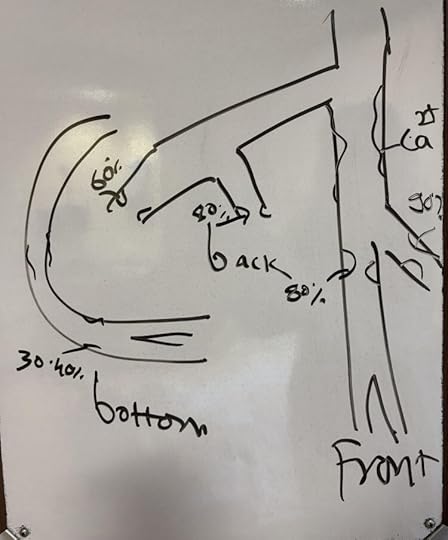
The doctor came back after the angiogram, drew this diagram on a whiteboard, and said Farmer Husband needed a surgical consult because his heart looked like this. One artery leading into the heart was ninety percent blocked, one was eighty percent blocked, and the other was sixty to seventy percent blocked. He didn’t use the stents because they don’t believe they are effective if the blockage is over seventy percent.
They recommended triple bypass surgery and scheduled it three weeks from now. The heart surgeon came in offering to answer questions, but we were too unfamiliar with the subject to know what all we should ask.
Farmer Husband was still loopy from the twilight anesthesia they’d given him for the angiogram.
Since then, we’ve availed ourselves of YouTube, which he considers to be an authority on most any subject. Please note that he has not had any symptoms other than occasional fatigue, has never smoked, but is taking meds for high blood pressure, high cholesterol and diabetes. He’s on the fence whether or not to have the surgery, now that he knows they’ll be cutting through his sternum, and extracting other veins to do the patchwork.
If you’re reading this and have had bypass heart surgery, or have opted not to have it, I’d be happy to hear from you.
January 19, 2025
Will I Succeed at Writing Suspense? I feel the tension mounting…
GOOD ARTICLE FROM MY INBOX>>>
Writing SuspenseJanuary 15, 2025 / Stephen Geez
By Stephen Geez
Most novels and stories have at least some scenes that require suspense. Others build suspense throughout the story. Your suspense scenes need to contrast with other plot elements so readers feel the emotion of jeopardy. Suspense requires periods of “relief” to re-establish a baseline. Use these techniques as you write suspense scenes:
SELECT POINT-OF-VIEW (POV): Choose one character’s POV, and stick with it. Avoid shattering suspense for the scene or chapter break that a change in POV requires. The protagonist (good guy/hero) or any “needer” are easy choices. A needer, such as the classic “damsel in distress,” can observe without revealing the hero’s strategy. The antagonist (bad guy/villian) POV can work for revealing the extent of danger while keeping the hero unaware.
ADD MYSTERY: Build layers of unknowns. Being tracked by a familiar beast is suspenseful; being tracked by an unknown something is scarier. Unfamiliar settings dispel assumptions and cause discomfort. Establish setting, props, and characters in advance; then worry us with the unexpected. Lock that door in Scene I so when it’s ajar in Scene III, we have to wonder why.
ADD TWISTS: Surprises make readers jump. New complications push the goal further out of reach. Clearing a hurdle only to be denied achievement causes frustration. Two hours tunneling toward the getaway route—then finding it collapsed or flooded—adds to the suspense. Paint into a corner so readers see no solution. Beware: If you make the twists too silly or unbelievable, readers will stop caring. Loss of caring kills suspense.
USE SENSES: Characters feeling suspense enhance their awareness. They rely more on senses. They might hear strange sounds, fear that odd smell, taste the unfamiliar, feel cold or cobwebs or crawlies, or see shapes in the mist. It’s hard to focus when sensory overload keeps turning your head. Great writers use this to stretch the suspense.
SLOW THE MOTION: Manipulate the pace of the writing. When urgent, shorten sentences and paragraphs, spread text down the page, move eyes fast. As suspense returns, go slow-motion. Take it a step at a time. Wait. Keep using senses. Add frustration. Surprise us! Wait… Describe details, searching for clues, mystery… Beware: Don’t break tension with too much information.
STRETCH, DON’T BREAK: Great suspense stretches us taut. It strains to the breaking point. It barely leaves us able to snap back. Set a time limit, a ticking bomb, an antidote beyond reach, but don’t keep extending it. Be careful not to stretch too far, or readers will stop caring. You can withhold the promised payoff only so long. Don’t cheat readers, but do make them wait.
Taut suspense scenes are impossible to stop reading. They engage readers and keep them alert. They add intensity to every kind of story.
Would you like another suspense tip?
Oh my, I’m almost out of time to tell you, and there’s a spider on the keys, something cold crawling up my back…
What’s that mysterious clicking?
I sure hope it’s you, writing suspense…
August 10, 2024
LETTER FROM A WWII WAR ZONE
We see images and reports of wars in foreign lands daily on the TV news. It has desensitized us somewhat to the actual horrors the participants experience, but I’m sure those on the scene are forever affected.
Like many men of his generation, my father fought in World War II. He spoke to us very little about his wartime activity, but I found a letter that he wrote to my grandmother, his mother-in-law, in October of 1942. Dad would have been twenty-one.
Here’s what he wrote:
Been some little time since I received your most welcome and enjoyable letter. Sorry to have been so long in answering. Beg forgiveness on the old alibi grounds of being too busy.
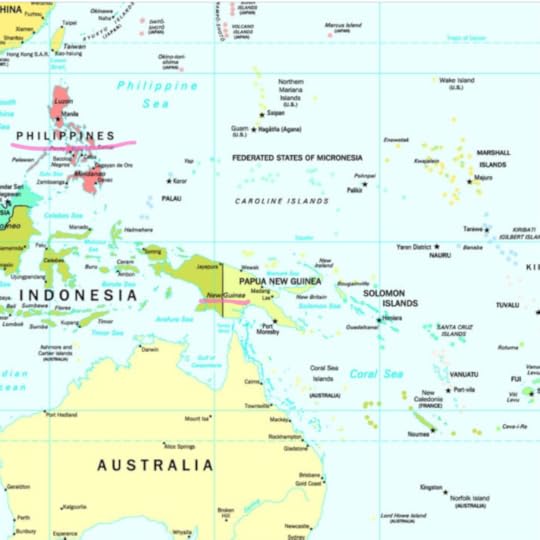
Had a nice old problem to occupy our time, and believe me at this, the rainy season being in New Guinea’s jungle is no privilege. Makes one appreciate the small comforts of our little camp.
Here’s what he probably meant:
It’s wet here. We are not occasionally wet, it’s constant. Wet, muddy day and night for weeks on end. The trees drip eternal moisture, the ground oozes endless rivulets, clothes, food, and equipment, all are at the near saturation point. Just finding a dry piece of paper or a working typewriter was a challenge. The sun might be visible for a few misty minutes every two weeks.
And hot. Feels like 120 degrees in the shade. The mud is ankle-deep, and we’re fording streams constantly. In the jungle, the gas cape is a necessity, like a water-proof poncho, or more like a personal tent and blanket rolled into one. To sleep, we lie on a bed of wet leaves with our heads on our packs, and cover ourselves with the gas cape, hoping not to be discovered by a poisonous snake.
Food consists of rations. We go months without fresh meat, milk, vegetables, eggs, butter, or any of the niceties that are taken for granted where we hail from. On the rare occasion that we are given bread, it is prized like a delicacy.
The army keeps us busy with the business of war. The Australian forces have trapped the Japanese at the Sepik River on the east as we move in on the west. For the most part, we only have to cut off their supplies and many of the enemy soldiers are dying of starvation or disease.
He wrote this:
The big news of the Philippine invasion here did not set nearly as well as the European one. We were all planning on opening that deal. However, have not completely given up hope of seeing both the Japanese and the Philippines. Would be a welcome diversion after seeing nothing but the Fuzzy Wuzzy who are becoming a bore.
He meant this:
We’re stuck in the jungle while the Allied Forces landed in Normandy a few months ago. At least the 151st wants to get in on the action when we return to the Philippines. We’re bored of this place and don’t speak their languages. What’s next?
Later in the letter, Dad wrote this:
Life seems to be pretty disconcerting for post-war planners. Not much one can do about it until this is all over. Think most of us give it a lot of thought, perhaps too much. Have had a couple of boys go whacky worrying about it. Rather a surprise to find out the weakness of some of the people’s mental makeup.
If he’d read this passage later in life, he might have said this instead:
Combat stress is a real thing. PTSD wasn’t treated widely in 1942. Now researchers know that military training makes your responses as automatic as possible, because you may not have time to think in a combat scenario. Reflection and critical thinking are discouraged as a result. Even mental health experts are sometimes mystified by how PTSD affects a soldier or veteran’s psyche.
Note: Within six months of the date of this letter, Dad’s unit was sent to the Philippines, where he received a silver star for assuming command when his commanding officer collapsed, and he reorganized his unit while under attack. He fought on the Zig Zag Trail in Bataan. He also was awarded a Purple Heart when a bullet grazed his temple.
Claudia Severin August 2024
October 15, 2023
THE MYSTERY OF THE GERMAN WEDDING CUP
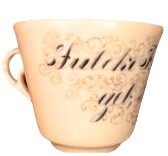
Dirk Hikken Baumfalk married Folka Freese in Norden, Germany, on April 26, 1862. He was twenty-eight, she was twenty-six. I have a porcelain teacup with a painted inscription that looks like “Fuleke Baumfalk geb, Freese.” When we inherited this item through my husband’s family, I assumed it was used at this wedding. Since then, I have been unable to trace any mention of a personalized teacup being used such as this at a wedding.
Today for the first time, I looked at the bottom of the teacup. There is an off-center blue stamp with the letters KPM and what looks like a blue vertical line over the letter P.
That was much easier to trace. The Royal Porcelain Factory in Berlin, Königliche Porzellan-Manufaktur (abbreviated as KPM) was founded in 1763 by King Frederick II of Prussia. KPM is still making porcelain four centuries later. According to Mayfair Gallery, Blog – KPM Porcelain: Guide to Berlin’s Royal Porcelain Factory | Mayfair Gallery 6 September 2018, KPM specialized in porcelain dinner services during the eighteenth and nineteenth centuries, among other things.
King Frederick granted his factory the use of its now-famous emblem, his royal scepter. Although the markings on the KPM pieces have changed from time to time, after 1837 the letters KPM were added underneath the scepter mark. The KPM factory has produced a vast amount of porcelain for a wide variety of clients, including some one-off commissions.
So, it is possible that there was a group of KPM artists who did “made-to-order” pieces for special occasions, such as weddings. This could have been an expensive keepsake, which may explain why it they took special care to insure its survival despite the fact that Dirk and Folka had eleven children and relocated from Germany to southeastern Nebraska.
While searching for more information, I did chance upon a few other interesting tidbits of German wedding history. First was the legend of the wedding cup. These were made of pewter or other metal, not porcelain. The legend dates back to fifteenth-century Nuremberg. A wealthy nobleman didn’t want his daughter to marry a goldsmith, so he had the prospective groom thrown in the dungeon. Instead of the daughter abandoning her love, she became deathly ill. Her father told the goldsmith if he could fashion a chalice that two people could drink from separately without spilling a drop, the couple could wed.
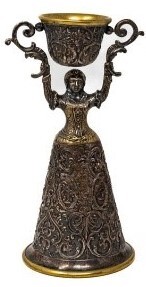
The goldsmith came up with a goblet that had a skirt for the bottom and a swivel basket on the top so the bride and groom could each drink at the same time. This has become a wedding cup tradition in Germany.
Then there was the other pre-nuptial activity, Polterabend, which involved porcelain. Supposedly the wedding guests thought it would be a nice gesture to visit the home of the bride and/or groom the night before the wedding ceremony bringing breakable dishes to smash. The racket made by the breaking plates and cups was meant to ward off unwelcome spirits. Then the lucky bride and groom got to sweep up the mess symbolizing their team effort should continue into married life.
Did this tradition keep KPM in the porcelain business all these years? I wish I knew. If anyone reading this has any more insight into the personalized wedding teacups made by KPM, drop me a DM. Danke.
July 7, 2023
The Story Behind The Love Genes

I’m sure many of you have done a DNA test now that they have become widely available for matching up relatives. Even if you haven’t, many television programs focus on how detectives can use DNA to identify suspects in crimes, and how genealogists use genetics to trace the guest stars’ roots. The science becomes more precise every day.
As I reviewed my familial matches from my DNA testing, which was loaded onto two different family tree websites, it reminded me of a story that had been passed along by an elderly relative. She told us that her aunt confessed to giving up twin babies for adoption in California although she lived in Nebraska. This must have been in the 1920s or early 1930s. This woman had no other children, and she was in her forties when she married.
Was there a way to trace the descendants of these children who had been adopted? I had no idea what their names would have been. I doubted that the mother provided her true name on the birth certificate. Even if I could narrow down the location within California, my understanding was that adoptions were sealed about the time these births occurred.
I have had distant relatives contact me through my public family trees. What if some descendants did have some information tying the adopted babies to our family? We have the same surname as the mother had nearly one hundred years ago, and we are living on the land where her family broke sod in the 1800s. Could DNA testing tie up the loose ends of that story?
So, this book is that “what if.” And then I added another. What if I could make it a romance?
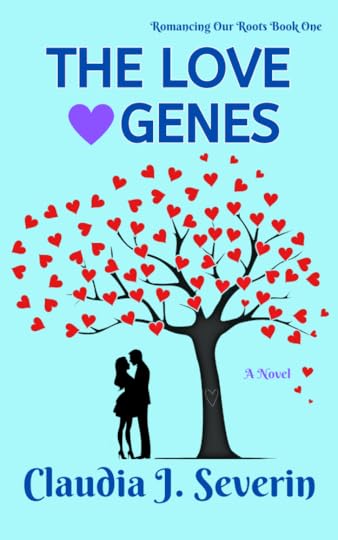 Available now for pre-order on amazon
April 23, 2023
Who’s Writing Now?

It was inevitable that there would be artificial intelligence programs capable of creating essays, novels, and all sorts of written material. Robots can vacuum your floors and drive a car. I’m still holding my breath for that hover car they had in the Jetsons. But I decided it was time to test drive ChatGPT, an automated language model. I asked it how I should attribute its work, as I didn’t want to plagiarize.
The response was,
“If you want to attribute a quote to ChatGPT, you can simply write ‘ChatGPT said,’ followed by the quote in quotation marks. Since I am an AI language model and not a human being, you don't need to provide a full name or any other personal information.”As a demonstration, I wanted to see if ChatGPT could create a story for my Time Travelers Writing Group. We’re not talking about SciFi; it’s related to writing about ancestors. So, I asked it, Can ChatGPT write stories about my ancestors?
“Certainly! I'd be happy to write a story about your ancestors. Please provide me with some information about your ancestors such as their names, where they were from, and any significant events or achievements that you would like me to include in the story. Additionally, please let me know if you have a specific type of story in mind, such as a fictional tale based on your family's history, or a more factual account of their lives.”Here’s the command I put in the text box: Write a story about Ellen Hotopp McCracken’s life, based on these facts:
born in Elk Grove, Illinois in 1857Saw Abraham Lincoln’s funeral train procession.Family moved to Marshall, IA probably due to father’s job as a railway mail carrierMarried John Robert McCracken in 1879 at her parent’s homeBought 160 acres near Kingsley, IA, and moved to a farm there in 1885Had 11 childrenFay, Clifford, and Grover, all preceded her in deathShe put on a black dress and went out to work as a midwifeSuffered from a type of dementia at the end of her life(This ancestor was my great-grandmother, but she died before I was born.)
Within a second, ChatGPT started spitting this out, one word at a time, as if I was watching an old teletype machine back in the 1970s—
“Ellen Hotopp McCracken was born in Elk Grove, Illinois in 1857. As a young girl, she witnessed history when she saw Abraham Lincoln's funeral train procession pass through her hometown. Ellen was in awe of the solemn procession and the respect shown to the fallen president.“When Ellen was still a child, her family moved to Marshall, Iowa, likely due to her father's job as a railway mail carrier. It was here that Ellen grew up and received her education.“In 1879, Ellen married John Robert McCracken in her parents' home. The couple moved around quite a bit during their early years of marriage, but eventually settled down in Kingsley, Iowa, in 1885. There, they bought 160 acres of land and started their family.“Over the years, Ellen gave birth to eleven children, though sadly three of them - Fay, Clifford, and Grover - preceded her in death. Ellen was a devoted mother and wife, but she also found time to pursue her interests outside the home.“In fact, Ellen put on a black dress and went out to work as a midwife in the surrounding towns. Her knowledge of botany and chemistry came in handy when she helped women during childbirth. Ellen was a comforting presence during a time when many women did not have access to medical care.“As she grew older, Ellen began to suffer from a type of dementia. It was a difficult time for her and her family, but they remained by her side and cared for her until the end of her life.“Ellen Hotopp McCracken was a woman ahead of her time. She pursued higher education, worked as a midwife, and ran a farm alongside her husband. Her love for learning and her dedication to her family and community inspired those around her. Even in her final years, Ellen's legacy continued to live on, and she is remembered as a remarkable woman who made a lasting impact on her community.”This all reflects the information I fed the AI except for the part about botany and chemistry. I wasn’t sure where that came in. I decided to give the ChatGPT free reign. Did it have an imagination?
So, then I requested—Write a story about Ellen Hottop McCracken born in 1857 in Elk Grove, IL. Not a lot to refer to there. Here’s what it came back with:
“Ellen Hottop McCracken was born in 1857 in Elk Grove, a small town in Illinois. Her parents were farmers and Ellen grew up with a love for the land and a deep appreciation for hard work.“As a young girl, Ellen was quiet and reserved, preferring to spend her time reading books and learning about the world around her. She was particularly fascinated by science and the natural world, and would spend hours exploring the fields and forests around her home.“Ellen's love of learning eventually led her to pursue higher education, something that was still rare for women in the late 1800s. With the support of her family, Ellen enrolled in the University of Illinois, where she studied biology and chemistry.“After graduation, Ellen began working as a researcher at a small laboratory in Chicago. She quickly made a name for herself in the field of botany, and her work on plant genetics and breeding earned her international acclaim.“Ellen's research took her all over the world, from the rainforests of South America to the deserts of Africa. She was known for her tireless work ethic and her passion for discovering new things.“But despite her success, Ellen remained humble and grounded. She never forgot her roots in Elk Grove, and she always made time to visit her family and friends there.“As Ellen grew older, her health began to decline. But even in her final years, she never lost her love of learning and her curiosity about the world. She passed away in 1929, but her legacy lived on through the countless scientists and researchers who were inspired by her work.“Today, Ellen Hotopp McCracken is remembered as a pioneer in the field of botany and a trailblazer for women in science. Her passion, dedication, and love of learning continue to inspire generations of researchers and scientists around the world.”Well, that settles it. ChatGPT, you are writing my eulogy.