A Word About Those Great Genes
You’ve probably heard discussions about American Eagle’s jeans advertisement that states Sydney Sweeney, their celebrity model, has great genes. You can read about that story from other sources. I’m just talking about genetics here, as my eighth romance novel, Lucky Genes, is about to launch.
Your high school biology class probably lauded Gregor Mendel, an Austian monk, who is widely credited with the discovery of genetics back in the mid-1800s. He conducted controlled crossbreeding experiments with pea plans, focusing on traits like flower color and seed shape. His experiments tracked how traits appeared across multiple generations, and that “factors,” which we now know as genes, determined these traits. Much later, in 1953 James Watson and Francis Crick uncovered the double helix structure of DNA, which was a revolutionary view of heredity. Then the Human Genome Project beginning in the 1990s mapped all human genes, which got us to the place where genetic medicine and biotechnology took off.
I won’t try to explain the whole concept of the laws of segregation and assortment when it involves alleles and genes, but while genes exist on the same chromosomes, they are inherited independently of each other due to the process of meiosis. In a nutshell, while you receive half of your genes from each parent, you may be sneaking in specific traits from your grandmother or grandfather, or more distant ancestors, due to the constant resorting of genes when producing what ultimately becomes the embryo.
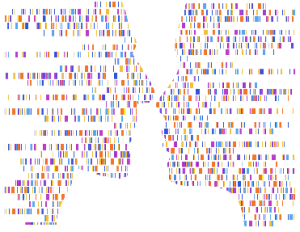
So, the genes you get are a matter of luck. Spin the wheel, roll the dice, procreation is a random mix. This makes genetics so interesting. It’s fun to look at just a small segment of genes passed down such as the ancestral regions associated with our genes. I believe this is determined by a concentration of similar genes in certain locations of the world. My husband and I and our three daughters took DNA tests. Farmer Husband had genetic links mostly to Germanic Europe (52%), not surprising since nearly all his ancestors came from Germany. Not so much on my side, only 19% from Germanic Europe. But the middle child has 68% Germanic Europe, and the youngest has 57%, both more than either parent, so a throwback to a previous generation.
In the Lucky Genes book, Cheyenne, wants to avoid having children because she’s concerned about passing along her father’s volatile temper, and her mother’s addiction issues. She worries she doesn’t have great genes. Some evidence shows that there is an association between a specific gene called the monoamine oxidase A (MAOA) gene and aggression in humans. This gene regulates neurotransmitters such as serotonin and dopamine, and several studies have shown that men with a weakness in this gene were more likely to be violent. Similarly, substance use disorders can be partially traced to genetics, and partly to environmental factors.
Genetics aside, the characters in Lucky Genes can consider themselves lucky for several reasons. Archer, the male main character survived a near-fatal attack. Eddie, his best friend and employee, graduated from law school despite struggling with learning disabilities. Jacinda, a police officer, arrived at the scene of the crime after the damage had been done. Darcy, Archer’s sister, was able to detangle herself from a relationship with a career criminal. And Cheyenne, the female main character, discovers her worrisome genes are not as expected. Her genetic discoveries are the driving point of the book, and she accepts her new reality.
If you’d like to read more about Lucky Genes, it will be released on August 11, 2025.