Becky Robison's Blog
August 13, 2026
Cemetery Detectives
I solved a mystery this week!
Last month, my friend Amy Shea, author of the book Too Poor to Die: The Hidden Realities of Dying in the Margins, came to visit me in Louisville. We went to visit a few of the city's indigent burial cemeteries—that is, where Louisville buries those who can't afford disposition themselves and whose families can't afford or refuse to claim them.
At River Valley Cemetery, we noticed something odd: While the Parks Department website said the cemetery had reached capacity in 2008, we found several new burials from 2026. Where did the extra space come from?
To be clear, Amy and I didn't think anything nefarious was happening. We figured it was probably a bureaucratic issue. And we were right!
Here's how I found out:
I asked my librarian friend if she could look up local property records pertaining to the cemetery, but those didn't turn up anything unusual.
I emailed the Parks Department. Nothing.
I emailed the city's Cemetery Board. Their email didn't work.
Finally, I attended one of the Cemetery Board's bimonthly public meetings—at 11 a.m. on a Tuesday. Good thing I get to make my own schedule!
I really hit the jackpot at this meeting. Not only were the members of the Cemetery Board in attendance, but there were also representatives from the Parks Department and the Coroner's Office. With all the necessary stakeholders at hand, I easily got an answer to my question.
Initially, the Parks Department had thought that a certain section of land adjacent to River Valley Cemetery belonged to the Port Authority. As it turns out, the Parks Department owned that land all along. That means they were able to use the extra space for additional burials.
Mystery solved!
The moral of the story? You can advocate for the dead when they can't advocate for themselves.


August 4, 2026
The Columbarium: Skogskyrkogården
The Columbarium is a free, weekly newsletter where the history of death and dying meets practical advice about the same. Enjoy this issue from the archive—and if you like it, consider signing up!
Whenever I travel, I love to visit historic cemeteries. Shocker.
I figured I might tell you about a few of the most remarkable in this newsletter. And since my 35th birthday trip to Stockholm was exactly two years ago, I’ve decided to start with Skogskyrkogården.
Okay. That’s a whole ass word, isn’t it? Skogskyrkogården. It literally means “the woodland cemetery” in Swedish. Skog = forest, and kyrkogård = churchyard, or cemetery. The -en at the end of the word means “the,” because in Swedish the article “the” gets tacked onto the ends of words, but not the article “a,” which goes in front the same way it does in English.
There’s your Swedish grammar lesson for the day.
In the early 1900s, Stockholm had a lot of dead people and not enough graveyards. Tale as old as time. In addition to expanding other cemeteries, the city decided to hold a design competition for a new cemetery.
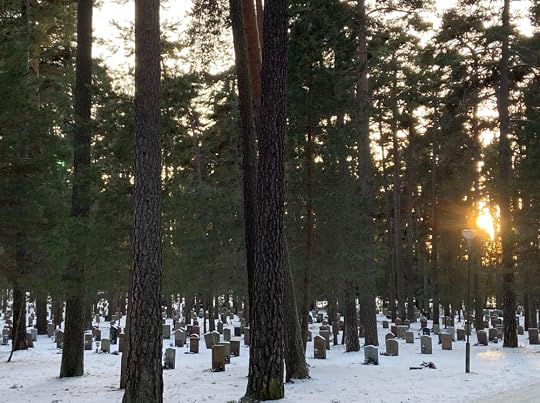
Enter the young architects Gunnar Asplund and Sigurd Lewerentz, who won the competition in 1915 at age 30. The land set aside for the new cemetery was a series of old gravel pits overgrown with tall pine trees. Asplund and Lewerentz had the radical idea to just…keep the pine trees.
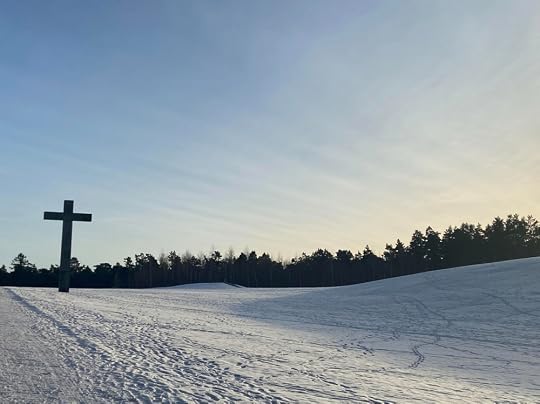
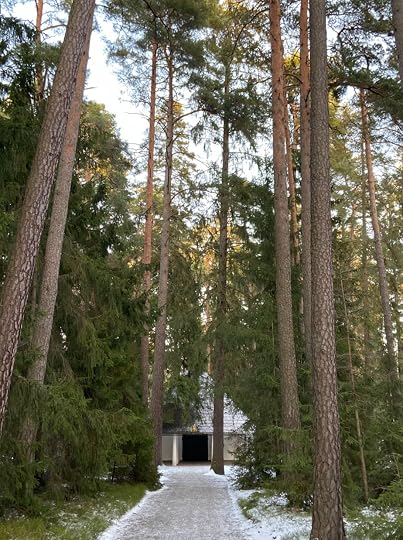
Aside from the open field at the entrance, Skogskyrkogården is in a forest. The graves aren’t in neat little rows the way you might find in more traditional cemeteries—they’re laid out wherever the landscape allows. And the monuments marking each grave are typically smaller and simpler. Even Greta Garbo’s isn’t too flashy. Asplund and Lewerentz designed the cemetery’s chapels and other buildings to be relatively minimalist. Nature is the star of the show.
Skogskyrkogården was initially built from 1917-1920, and in 1994 it was named a UNESCO World Heritage site. I visited in February 2023 after a light snowfall. It was gorgeous.
Photographic evidence:
Pro tip: don’t walk to Skogskyrkogården and back immediately after getting a tattoo. I made it to my hotel before I collapsed, but it was a close thing.
If Sweden is too far to go for your parents’ burial, you can find cemeteries in your area (and lots of other state-by-state resources) here.
Sources: Stockholms stad - Skogskyrkogården , UNESCO World Heritage Convention
Subscribe to The ColumbariumJuly 28, 2026
My dead parents are in the media again
Writing is a funny thing; for months nothing will happen, and then a lot happens all at once. Which is to say, I’ve had two big media moments recently:
An abbreviated version of my “To-Die List” was featured in Gray Monster, a (funny) weekly newsletter that aims to make caregivers feel more connected and better resourced.
The Courier Journal published my op-ed about how Mitch McConnell (and other politicians like him) are embodying terrible attitudes toward aging and death, and harming average Americans in the process.
Many thanks to both publications for giving me a shot!
July 8, 2026
My dead parents are on Culture Study
For MONTHS I’ve been keeping a secret from you: I got to speak with millennial writer icon Anne Helen Petersen on her Culture Study podcast! This was a pretty big deal for me, because I’ve been reading her work for years.
Naturally, we talked about parental death and post-death bureaucracy. I also got to answer listener questions, which was very special. Thank you for trusting me!
I also want to thank producer Melody Rowell for making me sound so good, and my agent Clare Mao, who simply cold-emailed the podcast to make this happen. It’s a good reminder that if you want something to happen, you should try asking. Can’t hurt, anyway.
You can listen to the episode wherever you get your podcasts. I’ll link to Apple Podcasts and Spotify here, but it’s all over the place. I appreciate you listening!
June 30, 2026
Fire alarm
I try to write a memory of my parents each year on the anniversary of their deaths, and I just realized I missed my mom’s deathiversary on June 16. Sorry, Mom!
When I was maybe 5 or 6 (it had to be earlier than third grade, because we hadn’t yet moved to the new house), I asked my mom what would happen if I slept through the fire alarm. I was sitting on the top bunk of the bunk beds that I did not share with my sister—I just really wanted a bunk bed, and my parents had kindly obliged. I had bunk beds to myself until I was well into high school.
Mom assured me that the fire alarm was much too loud to sleep through. Then she decided to demonstrate. She opened her mouth wide and began droning like a cursed banshee doomed to spend eternity on a cold rock in the middle of an endless, choppy ocean, her arms held above her head, fingers splayed, as if her body couldn’t contain the sound.
I screamed.
She was trying to help, of course, but bellowing at your small child is probably not the most comforting approach.
No permanent harm done. I’m not afraid of fire alarms—though I am still somewhat concerned I might sleep through one. Mom was always a light sleeper, but the apple fell miles from the tree in that regard.
June 24, 2026
The Columbarium: Splatter Platters at the Sock Hop
The Columbarium is a free, weekly newsletter where the history of death and dying meets practical advice about the same. Enjoy this issue from the archive—and if you like it, consider signing up!
In last week’s newsletter, I selected The Shangri-Las’ morbid classic “Leader of the Pack” for Dirge of the Day. You may remember I asked a question: “Why were teenagers in the 1960s so obsessed with songs about their boyfriends and girlfriends dying?”
This week, I decided to find out.
In the 1950s and 1960s, there was indeed a trend of death-related teen hits. Officially known as teenage tragedy songs, they often go by “death discs”—or the even grislier “splatter platters.” Gross, teens of yore! Gross!!
Widely regarded as the first death disc, “Black Denim Trousers and Motorcycle Boots” by The Cheers was released in 1955—one week before actor James Dean died in a car crash. The IRL tragedy propelled the song about an ill-fated young biker and the girlfriend he left behind to number 6 on the Billboard charts.
When Buddy Holly, Ritchie Valens, and The Big Bopper died in a 1959 plane crash, Eddie Cochrane wrote a tribute called “Three Stars.” A few months later, Cochrane himself died in a car crash.
Many critics think teenage tragedy songs became popular because teen heroes of the era were regularly dying in horrible accidents. Others attribute their popularity to the folk revival happening around the same time. Murder and prison ballads were everywhere, and splatter platters cover similar themes.
The genre really hit its stride when Johnny Preston’s “Running Bear”—a racist Romeo & Juliet narrative about a teenage Native American couple from warring tribes who drown in the river that separates them—and Mark Dinning’s “Teen Angel”—the tale of a young couple whose car stalls on the railroad tracks—both hit number 1 on the Billboard charts back-to-back in 1960.
The next time someone tells me I’m obsessed with death, I’m going to point them to The Shangri-Las’ catalog. They made splatter platters their whole deal! Besides “Leader of the Pack,” they also sang “Give Us Your Blessings,” in which a couple die together in a car crash after their parents disapprove of their relationship, and “I Can Never Go Home Anymore,” in which a girl’s mother dies of a broken heart after she runs away.
Teenage tragedy songs inspired parodies like “I Want My Baby Back” by Jimmy Cross, and many radio stations banned them over parental concerns, which made them even more popular. But then the British Invasion happened, and they went out of style.
So if you find splatter platters particularly macabre, thank The Beatles for getting rid of them.
Sources: Ultimate Classic Rock , uDiscover Music , Wikipedia
Subscribe to The ColumbariumJune 16, 2026
My dead parents are starting a podcast
That would be a good short story prompt. In reality, two white women in their thirties are starting a podcast.
Meet Emmy-nominated comedian Alison Zeidman. She wrote a standup show called “Ready to Die?” about post-death logistics. Meet me, author Becky Robison. I wrote a book called My Parents Are Dead: What Now? about post-death logistics. Between the two of us, we have zero parents.
That’s why we’re launching Bitching & Mourning, a podcast that got stuck in the anger stage of grief and stayed there. Our inaugural episode drops this Father’s Day, June 21st. It’s not like we had any other plans.
Listen to the trailer now. Then like/subscribe/follow wherever you get your podcasts so we continue to pop up in your feed. Catch you this weekend!
May 26, 2026
Lend me your ears
You may remember that a few months ago, I recorded an audiobook version of My Parents Are Dead: What Now? A Panic-Free Guide to the Practicalities of Death.
I’m pleased to report that said audiobook is now out in the world! 🎉
Download a copy and listen to me give you dead parents tips for nearly seven hours. It’s a blast.
May 19, 2026
The Columbarium: Who Died First?
The Columbarium is a free, weekly newsletter where the history of death and dying meets practical advice about the same. Enjoy this issue from the archive—and if you like it, consider signing up!
Throughout the research process for my dead parents book, learning about various aspects of death and dying hasn’t really shocked me. But estate law? That’s another story. Sure, the laws and statutes themselves are dull—but the cases that got us those laws and statutes are wild.
Take, for example, simultaneous deaths. Or, rather, “simultaneous” deaths.
My parents died in relatively quick but hardly simultaneous succession—mom in 2020, dad in 2023. But what would have happened to their estate if they had died at the same time? I don’t like to imagine my parents in horrible accidents, so let’s pretend they died tragically in…the Great Spaghetti Incident of 1987. So many lives were lost that day beneath the marinara.
Married couples typically have similar wills, but that doesn’t mean their wills are the same–and they probably contain provisions leaving their estate to another person or institution in the event of their spouse’s death.
The Great Spaghetti Incident of 1987 took place before my sister and I were even born—we’re out of the picture. So let’s say my dad’s will left all his money to one of his golf buddies in the event of his wife’s death. And let’s also pretend that in the event of my dad’s death, my mom left all her money to her alma mater, University of Florida. Go Gators!
If the spaghetti got them simultaneously, then dad’s golf buddy would get his money and the Gators would get mom’s. No problem. But surely they didn’t die at exactly the same time. One must have outlived the other by a few minutes at least. So whose will takes precedence?
There used to be lots of grisly court cases like this. My client was on life support for a whole hour longer than his spouse, etc. Understandably, the courts got sick of this—probably literally. In 1993, the Uniform Law Commission amended the Uniform Simultaneous Death Act to state that any “heir, devisee, or life insurance beneficiary who fails to survive by 120 hours (5 days) is deemed to have predeceased the decedent.”
That is to say, any deaths within 120 hours are considered simultaneous for legal purposes.
Hopefully simultaneous deaths are not something you have to consider when it comes to your parents. If you want to learn more about wills and trusts, you can do so here.
Source: Robert H. Sitkoff & Jesse Dukeminier, Wills, Trusts, and Estates , eleventh edition.
Subscribe to The ColumbariumMay 12, 2026
Emptying the gun safe
When my dad died, he left behind a collection of both handguns and hunting rifles. I had never fired a gun in my life. I was afraid to even pick up these firearms, let alone sell them. It was one of the most stressful aspects of post-death logistics for me.
Story time: I’m a regular listener of the Behind the Bastards podcast, and on a few episodes they’ve had Karl Kasarda as the guest. Karl is a leftist gun expert who runs the InRangeTV YouTube channel. A few months ago I reached out to him and asked whether he’d done a video about inheriting firearms.
He replied to say that he had not made a video about that topic, but that he’d like to do one with me.
And now here I am, talking about guns on the internet. Not the way in which I imagined I’d make my dad proud, but here we are! Many thanks to Karl, who also created the greatest thumbnail in the history of thumbnails for the video.