
Benjamin Haymond's Blog
February 17, 2024
A Wish
I’ll see you in the future
When the sun has set
And night is passing over the horizon
When the sun’s warmth rises into the night.
We’ll embrace, chat, and speak of lives past
You, me, dad, and all the other’s we’ve loved
We’ll feel young, our bodies new
With pain a distant memory
We’ll stand together and give thanks
For that chance again.
I’ll see you in the future
When darkness covers the horizon
And the eternal night is ours
When daylight is just a memory
Fading into the past.
We’ll ascend into the starlit sky
Never again to part
And watch the earth below
Seeing life pass eternally.
[image error]

January 16, 2024
Book Review: East West Street by Philippe Sands
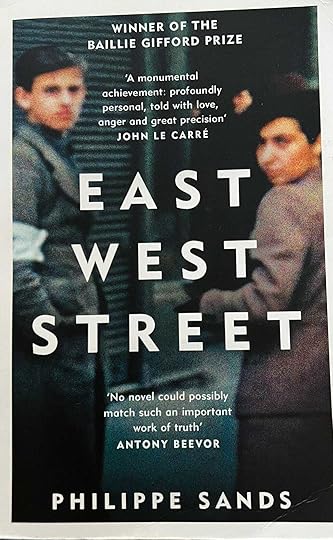 A photo of the cover of my copy of the book
As we enter the first months of 2024, two wars are raging 2131 kilometers apart: one in eastern Europe and the other in the Middle East. In both conflicts, a fog has descended, and crimes have taken place against civilians on all sides. Needless killing has left noncombatants in camps in Gaza and strewn across countries in Europe. It now seems just as appropriate as it was nine months ago to write this review about Philippe Sand’s book, East-West Street.
I bought this book on the recommendation from a journalist friend of mine in South Africa. He referenced it in one of our conversations and I was intrigued. I bought the book and read it over Easter.
At its heart, this story is about two influential Jewish legal thinkers (Hersch Lauterpacht and Raphael Lemkin) on international human rights law who lived on the same street in Lviv, west Ukraine, at different times. They studied law at the same university and had the same professor, Maurycy Allerhand, again, at different times. But adding to the complexity is the addition of two other characters in this story: Leon Buchholz and Hans Frank. Buchholz was the grandfather of the author, Philippe Sands. He lived in Lviv for a time. Frank was a lawyer and governor of the Polish territories. He gave a speech at the University of Lviv in 1941 calling for the destruction of the Jews.
This book is a reflection on the origins of human rights law. The story culminates at Nuremberg in 1946, where the Allies prosecuted the remaining Nazi leadership for their role in the destruction in Europe. The trial was the first attempt for an international body to hold a rogue nation responsible for the attempted destruction of a people or group of peoples.
Lauterpacht coined the term ‘crimes against humanity.’ He fled the Ukraine via Vienna and found his way to England where he earned his PhD at the London School of Economics. He assisted the English delegation at the Nuremberg trials.
Lemkin became a prosecutor in Poland and later fled to the United States. He was also at Nuremberg in 1946 pushing for the American delegation to include in their indictment, the charge of ‘genocide’, a term, which he coined to describe the actions taken by the Germans towards the Jews in Europe. Ultimately, he was unsuccessful, and the Americans only mentioned it in a speech.
The book is a very strong read. It reads like a novel but one in which readers are exposed to the history of these ideas in a way that both subtle and compelling. It is subtle in the sense that Sands was able to present these ideas and their complex nuances with ease. Because of that, I have a better understanding of the terms: ‘genocide’ and ‘crimes and against humanity’ and understand their use in the news differently. Prior to reading this book, I knew of these terms, but did not understand nuances of the ideas. Sands does a stellar job of building the background of each and issues with their application in international law.
For anybody wanting to understand the genesis of these ideas, this book is a must read. But the book is more than that. It is a page turner. It is a story that will absorb the reader in the lives of these characters and the times they lived. This is a must read for history buffs and for anyone interested in international law. It is a beautiful addition to the corpus of work documenting Jewish story.
[image error]November 8, 2023
Remember, Remember the Ides of November

It is my sincere pleasure to announce the release of The Last Train to Milan on November 13th. It is now available on all Amazon sites for preorder.
Love is an adventure. It’s passion. It’s pain. Sometimes it’s purgatory. The Last Train to Milan explores the life of Freddie Rollins. He’s living in Switzerland trying to get by and lead a peaceful life. Everything is going well except for his personal life. Finding love was never easy for him.
Then his life changed. He started sleeping with Sofiy, who was secretly involved with organized crime.
Later, he met Lana. She told him to beware.
Sofiy left and Lana arrived. From then on, Freddie’s life was never the same.
Sometimes, the rescued need rescuing again.
[image error]November 6, 2023
These People
As a writer and author, one of the more challenging tasks is creating characters. It’s important they are somehow relatable and have depth.
In early drafts of chapters in Shadows in the Fog, I found Katie too happy and too positive. Her good cheer was almost inappropriate for the story. Her character, in that form, limited the story and needed changing. When I finally understood her and made the necessary changes, I found her even stronger than at first. Lewis, on the other hand, stayed true to form and through the story developed an inner strength I didn’t see at first. His change was natural and developed well. The other characters in the novel didn’t change much from my initial idea.
While I found personality of Lewis to be, at times, unbearable; I still liked something about him. Were he a real person, I might like meeting him … occasionally. In that novel, I liked something about all of the characters and their personalities.
In my newest novel, The Last Train to Milan, which is available around November 14th, the characters bother me a little bit. They are not people I would personally choose to associate with. These are flawed people. Freddie reminds me of guys I met early on the English teaching circuit when I first arrived in Germany back in 2006. He also reminds me of people I knew back in college who bragged of their exploits the night after. Lana would be someone who would catch men’s eye and be interesting to meet but would be unbearable to close to. Sofiy, on the other hand, would probably end up being entertaining. She is the coolest of all of them. She would probably be that woman rolling joints at a party. But even now, I still do not know who she really is.
I once wrote a 30 thousand word start to a novel last year that will not make it to print anytime soon. In that story, based in West Virginia, I hated the characters, the location, and the storyline. It was a trifecta of irritating points. The setting was in rural Appalachia. The characters were mostly rednecks, and the storyline followed a Ragged Dick and weak male narrative. I hated it, but still wrote 30 thousand words in hopes of finding a way to redeem it.
Characters matter. Tbey drive the story more than the plot itself. They can even change the plot at times. In Last Train, I like the story. The characters have since grown more on me and they make the story work. In many ways, this book is about them. I think there’s potential!
[image error]October 30, 2023
Lessons Learned (thus far)

This week I am rereleasing an updated version of Shadows within the Fog. This new version will incorporate improvements in the layout and appearance. After a year of learning, I realize there are a lot of considerations involved with publishing and self-publishing- Since first publishing Shadows within the Fog in August of 2022, I’ve learnt a lot about writing and publishing. This blog will post will look at some of the lessons I’ve learned in the past 14 months.
EditingEditing is incredibly challenging especially as an author. A book can undergo an infinite number of variations and edits and still have typos, misspellings, and other ungrammaticalities. In the best-case scenario, the work can receive a look over from a professional editor or agent. While this will help, a work can still have errors. Using KDP, is helpful because of print on demand and it’s easy to fix the mistake and republish it.
One tool that has developed over the last year is generative AI. As an editor, it is quite useful. I’ve used it to edit both Shadows and my second novel. It is a good tool. It’s not perfect, but it is good for finding mistakes and suggesting improvements. But bear in mind, the machine still does not think.
Typeface and Font SizeOne of my biggest mistakes involved font size. I used 12 pt font in my first edit. With the book size, it was too small and barely readable. Now I use 14 pt font. This helps with the legibility of the work.
The next lesson involves font type. From what I’ve gathered, non-serif fonts are best practice. My new go to font is Garamond. It improves the reading experience. I learned this from a marketer I know.
MarketingIn an ideal world, a book goes up on Amazon and sells a million copies. It’s a beautiful idea, but preposterous. For a work to succeed, it needs to sell. People need to buy it. The book needs reviews and media coverage. I’ve not mastered this yet. I’m still learning. Perhaps, the most important tool is word of mouth marketing. Getting people to discuss and praise the work is the best way to sell the book. It is also important to find a niche and garner more reviews. The more activity a work receives, the greater its profile on Amazon. As I understand Amazon’s algorithm, interaction increases visibility.
I’ve experimented with Amazon click marketing and have broken even — meaning I’ve not lost money. I will continue to try improving marketing using keyword searches and hopefully gain further sales.
I’ve also checked into message boards. Message boards sound good. It’s getting a name out, but the only people who read them are other writers if even then. In my opinion, they are a waste of time.
The main goal is to grab the awareness of potential readers. Other writers matter less. What’s important is to find those people who read for all the reasons we write.
ServicesThere are a lot of services available. If a write is willing to pay, someone is willing to offer a proofreading and editing service. Perhaps they might offer marketing and claim to have 50K followers. Personally, I’m skeptical of these offers. There are some very legit operations but there are also some questionable ones too.
Print vs. ebooksEbooks have the greatest profit margin. There are no printing costs involved meaning higher royalties with reference to the price. Still, I like the feel of a proper book in my hand. I like looking onto my bookshelf and seeing my books with my name on them. It’s something special.
For more information or to purchase Shadows within the Fog, go to Amazon.com or Amazon.de.
[image error]October 25, 2023
Freddie’s Got Girl Problems
Soon, I will release my second novel on Amazon. Originally, my intention was to write another love story, but I got this instead. The goal was to write another emotional bomb of a story that tugged at the heart strings. But the characters led me to a different conclusion.
The main character, Freddie R. is an average heterosexual male who grew up outside of Tampa, Florida. His mother is a conservative Catholic who often goes to mass and prays to the saints. His father is a philanderer who lives 11 months a year in Thailand with a string of girlfriends 20 years younger than him. In the story, Freddie is living in Switzerland after following a college girlfriend across the Atlantic. That relationship was short-lived, and he decided to stay. He’s not the greatest partner and tend to target ‘foreign’ women. Then, he meets Sofiy and his life takes a difficult turn.
His character took inspiration from several people out of my past. I once met a US soldier while living in Bamberg, Germany. He told me a story about his father, who lived in Vietnam with his girlfriend and complained how his mother tolerated his father’s infidelities. He bragged of getting a vasectomy and visiting bordellos on every continent. Freddie’s story and behavior reminds me a lot of guys I knew from college who used to brag about their exploits.
Freddie’s main nemesis is Sofiy. She has mixed origins. She says she’s Ukrainian but spends a lot of time with Slovaks and Russians. Her origins are never clarified except for her Slavic roots. They meet online and rendezvous a few times. Later they move in together and do a lot of drugs and engage in acts that would shame someone’s mother. Sofiy claims to have a degree from the University in Wittenberg in Germany, but it is hard to say if it is true. She’s is involved with some shady shit that puts Freddie in danger.
Sofiy developed out of a few people I crossed paths with. I considered changing her nationality after the start of the Russian invasion but decided against it. Her convoluted origins fit well with the character.
As Freddie’s problems start, Lana appears. She blasts into his life and changes it. In my opinion, she is the most fascinating of all the characters. She believes in destiny and of a foretold love. She fiercely holds on to her partners dominating their lives and relationships before driving them away. She reminds me of a gentle version of Annie Wilkes in Stephen King’s Misery. Lana has her own traumas arising from her past that include losing her mother and attempting suicide.. She comes from a tragic but loving family who view her with a degree of weariness. Lana forces herself into Freddie’s life as his drama with Sofiy begins.
Lana’s character arose out of stories I’d heard from various people. But her personality developed organically. I found in her, a strong go-getter type that morphed into someone possessive and controlling. Though I wanted a love story, her possessiveness and Freddie’s life choices clash to create the current drama.
The Last Train to Milan will be available on Amazon starting mid-November.
[image error]August 5, 2023
Why Write

With the recent developments in artificial intelligence and generative AI, several educational assumptions have had to face scrutiny. These new technologies can produce poems, stories, and documents in a thousandth of the time necessary for an individual to produce the same length text. Questions have arisen that were never necessary to ask in the past. Why are we doing the things we do and why should we demand our students follow suit? As a writer and a lecturer, and somebody who cares about the demands I set on others, these developments have forced me to justify in my own mind why I do the things I do, especially in demanding students write essays, academic papers, and other related activities.
So why write? With good prompting, a machine could generate a workable standard paper. Using a series of prompts and refinements, it’s possible to generate a 3000-word paper in a few minutes. With the proper scaffolding of prompts and revisions, it is very possible to produce a measured paper with some success. Thus, with this technology, a student has the possibility to use a machine to create a text generated by probability and statistics. The student does not in fact write the text but with some inputs, receives one that likely is a reasonable mathmatically accurate response to their prompt. So with these fantastic developments, why write? People are busier than ever. Isn’t it unfair to demand they engage in and utilize an outdated educational approach? Wrong! This isn’t about the argument; students have always written essays and papers. This isn’t about tradition or prestige or any other institutional argument. Rather, it’s about reinforcing the value of writing in learning.
Writing is the concentrated expression of thought. To write about a particular idea, one needs to think a particular idea. In the case of academic writing, a writer sets the stage to consider a particular problem and articulate it. In the case of literature reviews, summarizing a text allows for demonstrating their understanding of the material they read. With methodologies, a writer can clarify the process they are using to solve or analyze a particular problem. With discussion sections, it’s about analyzing the results and concluding lessons learned from the research. It’s also about considering future applications for the research or weaknesses in the methodology.
But writing is also about refining ideas and arguments. An idea and an argument may seem good until someone expresses it. After its initial presentation, it can still be refined through grammar and choice vocabulary. Revision is a never-ending process. There is almost always a better way of expression. There are always opportunities to boil down the message to a bare essence of the idea and develop it further. In doing so, the message is easier to read and clearer.
Writing is a process of discovery. It can be the case that a writer gains insight into a separate problem by expressing another. The time involved in understanding something well enough to express it allows for insight into related topics. In education, this quality is important for students and learning. It demands concentration and time. It means experimenting with a problem until the answer is clear. Learning can be inefficient, but here in this case, efficiency is irrelevant. People are not machines. We should never strive to imitate them, or act like them.
Through concluding this argument, I feel like a horse standing before an automobile justifying my own reasons to live. Still, I remain firm in my belief these recent developments in machine learning are not so valuable as to demand a complete replacement of all our traditional educational methods.
[image error]July 26, 2023
Author’s Notes: Rejected Scenes
For Shadows within the Fog, I spent six months developing a series of scenes for another location. With most of them, it was possible to adapt the ideas to a new location. But as I worked through them, a new ending began to take shape, and these two passages were cut.
Passage One:To say I followed my stars would be cliché. But it’s true. I was on my way to see a quartet play in the open air. It was supposed to be an evening with Philipp Glass. The venue was outside of town on a large converted farm whose owners placed the land in a a private trust and made it available for classical and folk concerts. On this particular night, it was a chilly evening in November and the sky clear and in the darkness along the dimly lit trail, Orion’s belt illuminated the night sky.
I stopped for a second while enroute and looked up. The Orion constellation was special to me. I remember stopping with my father on the way back from a Saturday evening mass on some deserted country road and looking up into sky and listening as he pointed out the different constellations in the sky. When it came to Orion, he paused and said:
“There: those three stars. They are Orion’s belt.”
“Who is Orion?” I asked.
“He was a great hunter of the night.”
“Are there any animals in the night for us to find?”
“Look into sky. Can you connect the stars to find his prey?”
I looked and pointed my finger at the different stars trying to imagine a constellation for Orion to hunt. I must have looked for maybe five minutes but I found nothing. He watched me with an expression of amusement.
“Dad, I can’t find his prey.” I said.
My father bent down and looked me in the eye. “Someday, you will desire something so deeply that your soul will hurt. The pain of want will grip you intensely. If you look into night and see Orion’s belt, he might lead you to your destination.”
I thought of this as I looked up at the sky that night. I wondered for a second what he meant when he said that. I couldn’t imagine anything on my heart that left me desperately yearning for anything. Maybe he said that to add mystery to the moment. Who knows.
After pausing and reflecting for a second, I continued on the concert venue. I could see the glare of tiki torches in a thick grove of pine trees in the distance. The venue was a small stone amphitheater dug into the ground. It could fit maybe two or three hundred people.
At the bottom, It had a stone and brick stage with grand piano on the far right end of the stage. (End of passage one)
In this next scene, an early version of the Diana character joins the story. She has some of the same core characteristics from the final version of the character but I picture her differenly here. I liked this passage a lot but I could not make it work with the plot line I chose to go with.
Passage Two: Columbus, Ohio: Three months later:… A friend of mine, Diana, was there waiting for me. She had texted me a few minutes earlier asking where I was.
It was nothing romantic — just a relationship. I was not ready for romance. I knew Diana from college, We had been friends for a long time and ours was a comfortable friendship... without benefits.
From the parking lot at the edge of the property, I had to walk 15 minutes along a path through hilly pastures of wheat and spelt. At the edge of the pastures stood a mixed forest. The path meandered through the forest for another two or three hundred yards. As the path entered into the forest, I could see the glare of tiki torches illuminating the trees in the distance. The venue was new and only recently completed. It was a stone amphitheater built into the ground. It could fit maybe two or three hundred people.
At the bottom sat a stone and brick stage with grand piano on the far-right end of the stage. The rest of the ensemble
That night an ensemble played a selection of Glass’s dance pieces. With the acoustics of the amphitheater, the music became overpowering. It shook my body and visually affected other members of the audience. The music played for more an hour and held on all of us. I could see people with their eyes closed gently swaying back and forth with the music. The final piece was a solo piano piece titled Mad Rush. The pianist, a thin silver-haired man sat alone at the piano in the now darkened corner of the stage and began playing. He began playing that became more dramatic as piece progressed. His dramatic play between the two sections of the piece with an understated opening was subdued before exploding in all-out drama in the rapid passages of the music. The intensity of the emotion was overwhelming.
I looked around the audience at the different people listening to the music. It was there that I saw her sitting alone across from me on the other side of the theater, maybe 80 feet away. How had I missed her? In the dancing light of the torches, she seemed to radiate with the music. She had black hair and resembled Katie. She sat with her elbows on her knees holding her head in deep concentration as the music pulsed through the amphitheater and into the surrounding forest. She wore a black cardigan covering a white blouse and dark grey pants and the sight of her left me stunned. I sat enthralled by the music watching that woman in the audience and I thought of Katie. Were her eyes open? Did she see me? I don’t know. But for the entirety of the piece, I was occupied by my vision of her.
The piece ended and the audience applauded. Two more encores were played followed by another round of applause and then the audience stood to leave. I was ready. I had my eyes on her. She stood, looked around and quickly weaved through the departing crowd and exited into the surrounding forest. I looked at Diana. Excusing myself, I took off in the same direction. There was a crowd and the passages were blocked. It took me a few minutes to break free. I ran through the forest and back into the field but I saw nothing except for those stars. There was nobody as far as I could see. It seemed that she had disappeared. By the time I reached the pathway through the field, I had lost her. A gentle murmur of voices arose from the people coming from behind. I looked up and saw the Orion constellation glimmering in the cloudless sky and I wondered. Could it have been Katie?
Diana caught up with me. “What the hell happened? You took off as if you were possessed by something.” she asked.
“I don’t know. I saw someone.” I answered.
“You saw someone? Who?” She asked.
“I swear to God. It looked like Katie.” I answered.
“Did you notice her at the end of concert? Around the middle of one of the final pieces, I noticed you were somewhere else. You gazed in some distant direction. I even whispered something to you but you didn’t answer. I thought it was the music but when the concert ended, you fled.” She said.
“Yea, I know. I really felt like I knew that woman.” I said.
“But you lost her?” She asked.
“Was that meant metaphorically?” I asked.
“No, I meant that you actually lost sight of that woman.” She retorted.
“I mean she must have taken off to clear that distance.” I said.
“Weird. Well, you didn’t catch her. Let’s get a drink.” She suggested.
“And you really didn’t see her?” I said.
“I have not seen pictures of Katie for a long time. I never met her and don’t have enough of an idea about what she looks like.” She answered.
“Alright then, Let’s just get a drink and chill for a bit.” I said.
We walked back to the bar at the venue and bought two beers and talked about the concert and Katie. Diana seemed oddly mum about it. She was never one to miss chance at giving her opinion. But tonight, she said nothing. (End of passage two)
The real pity is I like these passages enough to share. They just never made it into the novel.
[image error]Author’s Notes: Locations in Shadows within the Fog
 Image Credit: JoeLena, An old church graveyard in the fog. 2010 License purchased on July 29, 2022
In Shadows within the Fog, the story takes place in Germany mostly, but Switzerland and the US are also important destinations.
With every attempt at avoiding spoilers, here is a list of the locations in the story.
Germany locationsNebeldamm, Germany
Nebeldamm is a fictional location that lies somewhere in between Boltenhagen and Klütz, Germany. Hildegaard is from this village. It is central location in the book because three of the main characters have their origin stories in or around this village. The village witnesses two Viking raids. The second of which razes the village. It is never rebuilt.
In the book, the area around Nebeldamm surrounded by a dark forest. It has a communal hall, a blacksmith, and a barracks. Beyond those buildings, Hildegaard mentions farms and a harbor.
In one of the later chapters, Lewis visits the area and encounters some strange happenings.
I never actually visted this area. The closest I got was seeing Heiligdamm (70km) and Schwerin (50 km) in 2007. But seeing the Baltic Sea was part of the inspiration. In 1995, I took a ferry across the Baltic Sea. It was a stormy trip and I still remember the experience.
Also some of the descriptions for the region took inspiration from Tom Holland’s description of Germany in his book, Dynasty.
Halberstadt, Germany
Halberstadt is an important location for this story, Without giving a spoiler, the city has a rich historical record in Christianizing of the Saxons.
Katie is from Halberstadt and Lewis visited the city often.
I remember meeting someone from there in 2006. She invited me to visit the city and see its cathedral. That line made its way into the book. The other reason I chose it for the story is because I remember Tom Holland mentioning the region in which the city was is located in his book Dominion. The idea inspired me to include it in my own writing.
Aschersleben, Germany
Aschersleben recieves brief mention. Lewis travels there for work and texts Katie. They talk about it briefly later in the chapter and that’s it.
I visited city a few times for work in 2006. It was during my first two months in Germany. At the time, I couldn’t speak or understand German that well. I remember seeing some of the city, walking around and observing some of the sites. I may even seen some of its medieval architecture. But few memories of the city, really stick out with me except for one.
I was walking around looking for something to eat and found a little bistro-type place that was run by this large woman with a friendly face. I was first American who’d ever set foot in her locale. They treated me like a celebrity. I was charmed.
Magdeburg, Germany
Magdeburg is central to the story. Lewis travels there to visit Katie. He revisits the city towards end of the book and Hildegaard lives there for a time during outbreak of the bubonic plague.
Hildegaard enters into a Norbertine order when she arrives in the city. It was pure chance. From my research, I discovered the Norbertine’s had a white habit. I liked the idea of Hildegard having that habit. By pure luck, Magdeburg had a Norbertine branch for a time.
I don’t remember if this order was in Magdeburg during the bubonic plague. I took some historical liberties.
I lived there from 2006 to 2008. I consider that period in my life as one of my happiest. I made some very good friends there and gained of work experience teaching English. In some ways, it will always remain special to me because of the experiences I had there.
Some but not all the experiences Lewis has outside of Germany were inspired by my own life in Magdeburg.
Leipzig, Germany
Lewis moves to Leipzig early in the story. He and Katie live there for a time. Katie also lives in the city alone. I used the city as a setting because it managed to flourish post-GDR. I also used it because of its historical and cultural richness.
I visited the city often during my nearly five years living in Germany. It’s been nearly 12 years since I was last there, but I walked through the place a number of times and partied there too.
Bamberg and Zeil am Rhine, Germany
I know Bamberg well. I lived there for nearly two years from 2008 to 2010. Professionally, my time there was key. It led me to getting the job in Switzerland that I still hold. It is a city, which is dear to me.
I chose it as a location because it was the sight of one of most intense series of witch burnings in Germany.
In the book, Lewis has family there and Katie visits a clinic in Thuringia not far from the city. Hildegaard spends time there in the middle of the story as well as towards the end of her story.
Radnica and Gostchorze Poland
In the book, these areas are known by their German names: Rädnitz and Goskar. Hildegaard lives her for a time.
The stories in the book from this region are a combination of different anecdotes I picked up from friends and extended family. I can’t possibly describe the suffering encountered by those Germans fleeing the Russians. I know the Germans started that war and their government committed countless atrocities. Still, the suffering the lowest levels of society underwent is simply too intense to imagine.
Berlin, Germany
Hildegaard passes through Berlin on her way Radnica. It was mentioned briefly. I read something interesting recently. The origins of the word Berlin mean swamp and do not relate to bears.
Berlin is one those cities that has seen immense grandeuer and immense poverty. There is something in the city’s DNA that make it fascinating.
Rostock, Germany
Hildegaard lives in Rostock and works as a maid later in the story. I visited Rostock in 2007. The choice as a location in the book had more to do with the locality. It’s a few days walk from Nebeldamm. Much of the novel takes place in the eastern reaches of Germany and the location fits.
Swiss LocationsOlten, Switzerland
Katie’s brother Aleksander lived in Olten for a time. Her’s parents spend two week’s waiting to meet his fiancé, but they never meet her.
Lewis dispises Aleksander calling him a “Casanova of the underclasses.”
I chose the city as a location because of its geography. It is in the north center of Switzterland and imagined it being be a good base for working contstruction in northern and central Switzerland.
Zurich, Switzerland
Lewis passes through Zurich later in the book. The main station and airport are mentioned in the story. He doesn’t spend a lot of time in the city, only a few hours. I’ve traveled to Germany from Switzerland often and it was mostly through Zurich.
The story mentions a bus trip from Zurich to Munich. I took the same trip at least twice.
U.S. locationsMarietta, Ohio
I spent a little over three years in Marietta, Ohio. For a time, I knew the place well. Like Lewis, I graduated from Marietta College.
In the story, Lewis was born in Marietta. He has two sisters who live in the area. I see the location as mostly a prop adding depth to the character development. How much does the location shape his experience? I can’t say. I don’t have the feeling that Lewis has much of attachment to the area. I can relate to that sentiment. It was a stop on life’s autobahn. Like a meal at a gourmet restaurant, it was nourishing but seconds were unnecessary.
Columbus, Ohio
Why Columbus? I put Lewis there because Diana was living there. In the late 90’s, I traveled often to Columbus upwards of three or more times per year and I had enough of a feeling for the city and its life that I include it as a location.
Pittsburgh, Pennsylvania
Pittsburgh is included in this book albeit briefly. It is part of the triangle of locations that comprise my past experiences growing up. I still have some contacts in the region.
My character Diana grew up in the city. I imagined her attending high school at one of the elite academies. Through my research for this and another story, I explored the region quite a bit. Lewis lives here for about six months in some of his darkest days. But it is only coincidence.
For this first story, I choose many of these places from own experience.
[image error]July 25, 2023
Considering Stories: Outlines, Plots, and Endings
With each passing year, I continue to accumulate masses of story ideas that seldom survive an internal critical process. There’s even a 34,000-word unfinished manuscript that will probably never see published form. Why? Because halfway through the story, I realized I disliked all the characters, the setting, and the story itself. There was nothing I liked about it beyond the first scene.
Story development uses many processes. Some writers create outlines. Some have a vague sense of the plot, and some just let chance go and write something. In an interview, George RR Martin describes two opposite storytellers: the architect and the gardener. Architects plan and gardeners develop the story as part of a process. I am more of a gardener, though my stories start as concepts, an idea I want to explore that takes shapes over time.
In Shadows within the Fog, the story developed away from my original plot. Originally, Katie was supposed to find Lewis in Marietta, Ohio. His sister would arrange it all, and they would grow together starting a new life. In another blog post, I share rejected scenes that were apart of this development. In that original version, there was one major problem. I imagined his sister as a control freak, who didn’t care for foreigners or any other woman who broke her brother’s heart. I can see her as someoene who does not approve of her brother’s foreign escapades. How would she invite Katie to meet her brother in these circumstances? The other problem was that such an ending was too predictable. It was uninteresting and uninspiring. The third problem involved Lewis himself. I got sick of Lewis living the life as a psychological invalid. As much as I admire strong women, I did not want Katie riding into Ohio like some Valkyrie and carrying his broken soul to the promised land. For these reasons, my ending changed. Lewis grew tired of being weak and decided to take action.
In my latest as of yet unpublished novel: The Last Train to Milan, I had lots of ideas how to end the story. But the story kept changing, which kept forcing me to alter my ending. The first idea for the story was a perfect love story. I was somewhere near 65,000 words when I realized that I could not reach the goal. Those characters were incapable of living happily ever after. Then ChatGPT hit world like a sledgehammer crushing a watermelon. Over six months, I grew tired of hearing about generative AI and that helped inspire the ending of the story. I imagined my main character growing tired of the circumstances of his life and acting on it, just as I’ve grown tired of hearing the wonders of generative AI and the end of the human race as we know it.
All I had to do then was reshape and cut the chapters I’d written. And I think it worked. Of those 65,000 words, I managed to cut it down to 57,000 words, while reshaping the characters and fine tuning some of the scenes.
The point is for a writer to remain open. Stay open to the circumstances offered by the situation. Changing with the circumstances can allow for a natural form of storytelling. Most writers have an idea for an ending. Whether the idea survives is another matter.
For more insight into Lewis and Katie, check out my debut work on Amazon.com and Amazon.de. It is also available on the other Amazon sites.
[image error]

