Sierra A. Elliott's Blog
April 13, 2023
7 Biblical Reasons for Fasting
Ever since the beginning of the year, I’ve felt that still, small voice calling me to fast from food in order to focus on prayer. But I kept making excuses as to why I shouldn’t or why it was bad timing—fear of eating disorders, needing energy for work, a desire to eat Easter desserts. (Yes, that crossed my mind! XD)
Finally this week, I couldn’t ignore that still, small voice any longer, and I did a 24-hour food fast. The first thing I did to prepare my heart was to look up every verse on fasting in the Bible.
After reading through 40 different examples of fasting, I noticed 7 reasons to fast:
Decision MakingCommitment / DedicationPetition / Prayer RequestsRepentance / MourningProphecyHumbling OurselvesFreedom From SinDecision Making
One of the most common reasons Christians fast is to hear from God about what to do. God is always available to us, but sometimes we distract ourselves so much we can’t hear his voice. Fasting allows us to get rid of earthly distractions so that we can tune in to what God has to say.
In the Bible, Moses miraculously fasts from food and water for 40 days while he is receiving the 10 Commandments (Exodus 34:28). We also see the church at Antioch fasting and worshiping when the Lord identifies Barnabas and Saul as His chosen ones for a task (Acts 13:2).
Commitment / Dedication
The second biblical reason to fast is to commit ourselves or to dedicate something to the Lord. This is frequently done at the beginning of a ministry season, such as going on a missions trip or beginning a new job. Fasting allows time to pray over that thing and show God we are serious about it as well as to hear His guidance on the new season or project.
In the Bible, Daniel abstains from unacceptable foods and eats a vegetarian diet to keep his covenant with the Lord (Daniel 1:8-16). John the Baptist’s disciples fast as they wait for the Messiah (Luke 5:33-35). Jesus begins his earthly ministry with 40 days of fasting in the wilderness (Luke 4:2-4). And Paul and Barnabas fast and pray to commit newly appointed elders to the church (Acts 14:23).
Petition / Prayer Requests
The third biblical reason to fast is to present prayer requests to God or to petition for someone else. It is clear that in this life, there will be many kinds of hardship, but the Bible instructs us that prayer is powerful, even prayer for someone else’s healing, salvation, or deliverance. Fasting is a way to show God we mean business! And God is known for listening to those who call upon Him.
In the Bible, we see Esther call her people to a nationwide fast before she bravely goes to the king to plead mercy for her people (Esther 4:16). Daniel also abstains from meat and wine later in his life after receiving a troubling revelation about war (Daniel 10:3). Finally, in the New Testament, Paul warns married people: “Do not deprive each other except perhaps by mutual consent and for a time, so that you may devote yourselves to prayer” (1 Cor 7:5).
Repentance / Mourning
The fourth biblical reason to fast is to repent of sin. We know that sin breaks the heart of the Lord, and it should break ours too! Fasting is a great way to show sorrow for sin and allow God to heal us and take away the stronghold we’ve allowed into our lives.
Frequently in the Old Testament, we see a call to fast after the Hebrew people have completely broken their covenant with God and turned to the surrounding culture (Joel 2:12, Nehemiah 1:4, 1 Kings 21:25-27, Ezra 8:21, Jonah 3:5). In 2 Samuel 1:12, we see the people of Israel fasting after the death of King Saul and his son Jonathan. And we also see David fasting to plead for God to save his dying newborn son, the product of his sin with Bathsheba (2 Samuel 12:15-17).
Prophecy
The fifth biblical reason to fast is to hear prophecies from the Lord. This isn’t to say that every time we fast, we will receive a prophetic word, but it is clear throughout many of the Scriptures we’ve already looked at that prophecy is many times preceded by fasting.
A curious passage from Jesus’s childhood discusses an 84-year-old widow named Anna who practically lived at the temple, worshiping day and night, fasting and praying. When Jesus’s parents bring Him to the temple, Anna prophesies that Jesus is Messiah (Luke 2:36-38). If she hadn’t been fasting and praying, she may not have received this revelation.
Humbling Ourselves
The sixth biblical reason to fast is to humble ourselves and admit we need God. Fasting is frequently, but not always, done alone and in secret so that it doesn’t become a source of pride. While Jesus is fasting in the wilderness, Satan tempts Him with food (Matt 4:1-4). In response, Jesus quotes Deut 8:3 which says, “Man shall not live on bread alone, but on every word that comes from the mouth of God.” By this, Jesus is showing that food alone cannot keep us alive, but fasting to hear from God humbles us and sustains us.
In the New Testament, we see Jesus frequently admonishing the Pharisees for fasting with impure motives. Because of this, He teaches his disciples about fasting: “For all those who exalt themselves will be humbled, and those who humble themselves will be exalted” (Matthew 6:16-17). Even if no one knows that we are fasting, what we are doing is to be close to the Lord and pride gets in the way of that. Next, Jesus promises, “Your Father, who sees what is done in secret, will reward you” (Matthew 6:18).
Freedom From Sin
The seventh biblical reason to fast is to break strongholds of sin. Jesus tells his disciples that some sin is broken only through the power of prayer and fasting (Matt. 17:21). So if there is a stronghold of sin, we might need to fast and pray to get rid of its power over us.
Isaiah 58:6 says, “Is not this the fast that I choose: to loose the bonds of wickedness, to undo the straps of the yoke, to let the oppressed go free, and to break every yoke?” Sin is a heavy yoke to bear. It is wickedness. It is oppression. God’s chosen fast calls for us to break sin. There is power over sin when we fast!
Conclusion
Many times in Scripture, fasting is accompanied by prayer and worship. Fasting is not simply a diet. It’s giving up something we are extremely dependent upon to realize our dependence on God.
If you’re thinking about fasting, don’t feel like you need to meet all of these criteria. For me, I focused on 4 reasons for my 24-hour fast. But for you, only 1-2 of these might apply. God could even call you to fast for an unknown reason!
Whatever the case, a spiritual fast—whether it be from food, desserts, alcohol, meat, TV, or social media—is an amazing way to show God how serious we are about refining our lives and growing deeper with Him.


October 18, 2022
What’s So Great About Communion?
For some reason, I’m really passionate about the topic of communion (eating the bread and wine in remembrance of Jesus). If you don’t understand it fully, it is easy to halfheartedly take communion at church on Sunday. But it’s so deeply rich in symbolism, and I hope you fall in love with it like I have!
Let’s start at the beginning… no, I’m not talking about da Vinci’s image of Jesus and his disciples at the Last Supper (we’ll come back to that). In order to understand communion, we need to go further back—to the second book of the Bible—Exodus.
We have to understand that the Last Supper occurs during the celebration of Passover. That is the dinner Jesus and his disciples are having when he breaks the bread and pours the wine.
So what is Passover?
Briefly, Passover celebrates the night when the Spirit of God passed over the Hebrew homes (those that painted the blood of the lamb over their doors) and spared every firstborn son from death, which was the fate of every firstborn Egyptian son.
But this final plague in Egypt foreshadows a greater biblical truth, one that connects the Jesus of the New Testament with Moses’s laws in the Old Testament. Hebrews 9:22 says, “In fact, the law requires that nearly everything be cleansed with blood, and without the shedding of blood there is no forgiveness.”
Sound familiar? Jesus’s blood was shed on the cross so that those who believe in him might be cleansed with blood and forgiven—we need the blood of the lamb to save us from eternal death just like the ancient Hebrews needed it to save them from death.
That is the scene Jesus and his followers were remembering when he commanded his disciples to eat the bread, which is his body, and drink the wine, which is his blood of the covenant poured out for the forgiveness of sin.
With that in mind, let’s take a deeper look at the bread and the wine.
Jesus took bread, and when he had given thanks, he broke it and gave it to his disciples, saying, “Take and eat; this is my body.”
-Matthew 26:26
There are a couple amazing points here:
Jesus relates his own body to broken bread. Most obviously, it foreshadows that he is going to be physically beaten. It draws attention to the fact that he is Emmanuel (God in flesh). But amazingly, it also foreshadows the torn curtain in the temple. At the moment that Jesus dies on the cross, the curtain that previously separated God from humanity was torn from top to bottom, symbolizing that his Spirit was no longer confined to the temple and that he is no longer separated from us. His Holy Spirit lives inside our hearts. We are the new temple.Seeing the bread, the disciples no doubt remembered the times Jesus miraculously fed the crowds with a few loaves of bread and a couple fish. Though they didn’t understand it at the time, Jesus had told them that he was the bread of life, that whoever goes to him will never be hungry. He told them that just as manna was sent from Heaven to give life to the Israelites in the desert, he was sent from Heaven to give life to the world. Jesus not only provides for our physical hunger, he provides for our spiritual hunger too.
Then he took a cup, and when he had given thanks, he gave it to them, saying, “Drink from it, all of you. This is my blood of the covenant, which is poured out for many for the forgiveness of sins.
-Matthew 26:27-28
A couple amazing points here as well:
Blood was not a novel idea to Jesus’s Jewish disciples. They were under the Mosaic covenant, which required blood to atone for the sins of humanity, because sin requires death and blood represents life. As previously stated, the wine Jesus is pouring is supposed to represent the blood of the lamb from the Exodus Passover. Jesus was making it clear to the disciples that his blood shed on the cross would fulfill every sacrifice ever needed. He is the ultimate and final lamb. He says that because of his blood, God is forging a new covenant with humanity, making the Mosaic covenant void.The disciples were probably also reminded of Jesus’s first miracle: turning water into wine at a wedding. This being his first miracle highlights the importance of Jesus as the husband of the church. And the whole point of marriage is to parallel the oneness/intimacy we are to have with God. Every time we drink communion wine, Jesus’s blood becomes one with our body, and we remember we are one with Christ (Holy Spirit in us).When you look at all these symbols behind communion, it shows the true beauty behind our relationship with Christ, who is God in flesh. He is our husband who sacrificed himself to die in our place so that we could live with him forever.
I hope that the next time you take communion, you think about some of these images, and it helps you gain a deeper understanding of what Jesus did on the cross and that you appreciate the depth of his love for us.
“Their sins and lawless acts I will remember no more. And where these have been forgiven, sacrifice for sin is no longer necessary. Therefore, brothers, since we have confidence to enter the holy places by the blood of Jesus, by the new and living way that he opened for us through the curtain, that is, through his flesh and since we have a great priest over the house of God, let us draw near to God with a sincere heart and with the full assurance that faith brings, having our hearts sprinkled to cleanse us from a guilty conscience and having our bodies washed with pure water.”
-Hebrews 10:16-22
June 15, 2022
6 Things God Wants From Your Quiet Time
I recently completed a Bible reading plan and was looking for something new to study when it struck me… is a new Bible reading plan what God really wants from my quiet time?
As I began Googling verses about this, what I found challenged me and really started to shift my perspective to what we modern Christians do every day.
Here are 6 things scripture talks about that we should practice during our quiet time with God:
Prayer
This is an obvious one, but so very neglected. Of course reading the Bible is important, more to come on that next, but scripture tells us that Jesus’s quiet time was spent communicating with the Father in prayer. So shouldn’t that be our number one goal too? CS Lewis, in The Screwtape Letters, says that a lack of prayer is the goal of our enemy because he knows that prayer is our most powerful offense.
In Matthew 6:9-13, Jesus taught us to pray in reverence to God and to align ourselves with his will, to pray for what we need as well as for forgiveness and deliverance from sin and Satan. That kind of prayer can only be prayed out of a heart of humility, reliance on God, confession and mercy.
Key verses: Jesus frequently went to pray (Luke 5:16). Draw near to the Father and he will draw near to you (James 4:8). Pray without ceasing (1 Thess 5:17).
Conclusion: A goal for our quiet time is not only to read the Bible but also to communicate directly with God in prayer.
Scripture
All that said, scripture is literally God speaking to us, giving us instruction on how to live. When we feel silence from God during prayer, we should go to the Word for direction, not ourselves, not others. It is our plumb line, reference point. The Word is where we receive wisdom for life, correction if we’re wrong, plus the hope and endurance to continue.
Traditionally, Jewish boys around 10 years old had the entire Torah memorized. So when Jesus was being tempted by Satan in the desert, he used his knowledge of scripture against the enemy. Satan will try to entice us into pride, selfishness, hate or else make us ineffective to God with depression, fear, and shame. Our best defense is scripture.
Key verses: Scripture is breathed out by God for our teaching, correction, and training that man may be equipped for good work (2 Tim 3:16-17). We have hope through endurance and scriptural instruction (Romans 15:4).
Conclusion: A goal for our quiet time is to read the Bible for direction, encouragement, and power against Satan’s attacks.
Meditation
I’m not talking about crystals and deep breathing. I’m talking about dwelling on God, his Word, his Creation, and what he’s done for us. To drive it home, here are some synonyms for meditate: muse, study, think, consider, ponder, ruminate, dwell, imagine.
The word picture is to be with something for a long time. Think of an artist or poet with a muse, a student with books, a human in a dwelling, a child’s imagination, a cow chewing cud. That repetitive thinking on is what we do with God and scripture so that we might do what the Word says.
Key verses: I will meditate on your statutes (Psalm 119:48). His delight is in the law on which he meditates day and night (Psalm 1:2). I meditate on all you have done; I ponder the work of your hands (Psalm 143:5). You shall meditate on it day and night so that you may do what is written (Joshua 1:8). I have stored up your Word in my heart, that I might not sin against you (Psalm 119:11).
Conclusion: A goal for our quiet time is to think on scripture/God until it changes our behavior.
Distractions
James 4:8, below, tells us that we are sinners and double-minded. We stumble into prayer and God’s presence with our baggage from the day: bitter thoughts and worldly distractions. Only when we cleanse and purify our mind can we fully appreciate and tune into God’s presence and will, not because of his inability to be in the presence of sin or his weakness, but our own.
Key verses: Cleanse your hands your sinners and purify your hearts, you double-minded (James 4:8).
Conclusion: A goal for our quiet time is to optimize our prayers by first purifying and centering our thoughts on Christ.
Solitude
There are a few reasons why solitude is a command that Jesus gives during his Sermon on the Mount: first, he’s asking us to walk away from the pride we get at other seeing us pray; and second, he’s asking us to give our full attention to him. We must cut out the distractions as well as the unholy vanity and come before our maker.
Key verses: When you pray, go into your room and shut the door (Matt 6:6). Jesus prayed on the mountain by himself (Matt 14:23), in secluded places (Mark 1:35), in the wilderness (Luke 5:16), alone (Luke 9:18).
Conclusion: A goal for our quiet time is to be alone with God, in humility and with our full attention on him.
Positioning
The Bible mentions a couple postures of prayer: bowing, kneeling, prostrate, lifted hands and eyes. But that doesn’t mean we have to do this to pray. Like with solitude, there’s a reason we should do it, but it doesn’t mean we always have to be alone or kneeling to pray because we know we’re supposed to pray without ceasing.
Taking up a posture of prayer simply helps us to focus, humble ourselves, and position our hearts to receive from God. Imagine a knight kneeling to offer his sword and life to his king, bowing to symbolize the respect towards an elder, or the eyes and hands of a child seeking help from its parent.
Key verses: Moses and David bowed down (Exodus 34:8 and Psalm 5:7). Solomon knelt down (2 Chron 6:13). Every knee will bow before Christ (Phil 2:10). Daniel had his windows open to Jerusalem and was on his knees three times a day (Daniel 6:10). Ezra and Jesus put their faces to the ground (Neh 8:6 and Matt 26:39). Lifted hands and eyes (1 Tim 2:8 and John 11:41 and Luke 9:16).
Conclusion: A goal for our quiet time is to position our hearts to receive from God by positioning our bodies to show reverence and servitude.
Final thoughts…
These six purposes for our quiet time invite us to answer the question… what is the purpose of a quiet time? Instead of thinking of it as something to check off the list every morning, we should think of it as a time to set our intention for the day. That is… to align ourselves with God and his will as well as to sacrifice both our desires and the 10, 30, 60 minutes of our day that we devote to him out of love and a desire to discipline our spirit.
So what does God really want from our quiet time? It’s not a simple formula of pray, read, meditate, repeat. I’m sure you’ve felt that on certain mornings too: spouting off prayer requests without any emotion behind them, forcing yourself on to the next chapter in your reading plan unrelated to what you’re going through, feeling guilty every time you find yourself distracted by a Facebook birthday notification.
It’s all about the heart. The next time you go to pick a Bible reading plan, devotional, or as you go into your quiet time tomorrow, ask yourself: Am I doing this out of love for God? Am I putting all my heart into this? Am I ready to receive from God and cut out areas he reveals to me? Am I doing this to discipline my spirit in the practice of reverence, humility, servitude, and cutting out distractions?
If the answer has been no, it’s okay. Luckily, we serve a merciful God who keeps chasing after us when we walk away, continues to knock on the door of our heart even after we closed that door in his face yesterday, and who gave us the simple answer over 3,000 years ago in the first two Commandments.
Jesus told them: “The most important Commandment is to love the Lord with all your heart and with all your soul and with all your mind. This is the first and greatest Commandment. And the second is like it: Love your neighbor as yourself” (Matt 22:37-40).
May 26, 2022
10 Things God Wants From Your Bible Study
Let’s just have a moment of real honesty because we’ve all been there… sometimes bible study just sucks. There are times it feels like it’s another box to check, people aren’t opening up, you can sense that no one has that fire or passion for God.
It happens.
And I know… my husband and I have led or been a part of bible studies for years. Some weeks, it’s great. The Holy Spirit is there, and you can feel it. Everyone leaves encouraged. Other weeks, it just feels dead.
Something needs to change. We need to return to the basics… what the bible teaches about what God wants when we meet as a church body.
So I did some research. Here are 10 purposes God has for our meetings:
Philia Love
The greatest of these is love (1 Cor 13:13). So of course, that’s where the list starts. Jesus taught that everything boils down to loving one another, even when we point out sin in a brother, it’s to be done out of a heart of love for that person. Our meetings should be marked with love and encouraging one another to do God’s work.
Key verses: Stir one another up to love and good works… encouraging one another (Hebrews 10:24-25). Dwell in unity (Psalm 133). Our love for one another should show non-believers that we are Christ’s disciples (John 13:35).
Conclusion: When we leave bible study, we should be so filled that we go out into the world and spill that love onto others.
Spiritual Learning
When we first become Christians, we have to learn so much about Christianity; the bible says we’re like babies. Bible study should be to teach about the scriptures so that we can learn about God, grow in righteousness, and be encouraged to continue carrying our cross and fighting against our true enemy.
Key verses: Though by this time you ought to be teachers, you need someone to teach you again. Solid food is for the mature, who have trained themselves to distinguish good from evil (Hebrews 5:12-14). They examined the scriptures every day to see if what Paul said was true (Acts 17:11).
Conclusion: When we leave bible study, we should know more than when we came in and be excited to learn more on our own.
Gospel Sharing
Bible study sometimes feels like preaching to the choir, and that’s why it’s so important to continue sharing the gospel so that we are making more disciples and teaching new believers about Jesus. The last command that Jesus gave before he ascended to Heaven was to go and make disciples, baptizing and teaching them to obey his commands (Matt 28:19-20). We should inspire one another to continue with fervor.
Key Verses: Day after day, in the temple courts and from house to house, they never stopped teaching and proclaiming the good news (Acts 5:42). They devoted themselves to the apostles’ teaching (Acts 2:42-47).
Conclusion: When we leave bible study, we should have taught someone about Christ’s transformational love and leave inspired to share the gospel.
Sharing Reports
There’s something about hearing what God is doing in others that inspires us to do more. Sometimes we speak of God like a historical figure who did this, that, and the other long ago, but God is actively working today! He wants us to tell about what he’s doing. Everyone who is growing in Christ should have something to share. There’s no room for timidity or laziness or taking a back seat.
Key Verses: They gathered and reported all that God had done through them and how he had opened a door of faith to the Gentiles (Acts 14:27). Each of you has a hymn, or a word of instruction, a revelation, a tongue or interpretation (1 Cor 14:26).
Conclusion: When we leave bible study, we should be so encouraged by the testimony of what God is doing in others’ lives that we can’t help but do more for him ourselves.
Perfecting Ourselves
Hearing criticism can be one of the hardest things, but the bible is clear that when we sin, we are actually harming the entire body of Christ. Frequently, we are blind to our sin. That’s why we need to submit ourselves to the reproof of our brothers and sisters, knowing they want the best for us. We are all working towards sanctification after all; no one is without sin.
Key Verses: If someone is caught in sin, you should restore that person gently (Gal 6:1). Speaking the truth in love, we will grow to become the mature body of Christ (Eph 4:15). See to it that none of you has a sinful heart, but encourage one another, so that none of you may be hardened by sin’s deceitfulness (Hebrews 3:12-13).
Conclusion: When we leave bible study, we should be able to identify the sin in ourselves and be encouraged to turn away from that sin.
Breaking Bread
Communion is something we do in corporate worship but less often in bible study. Jesus clearly gave this as a command, however. If there’s food at your group, that could be a time to work in this practice of prayer and remembrance.
Key Verses: They devoted themselves to fellowship and the breaking of bread and to prayer (Acts 2:42). Do this in remembrance of me. For whenever you eat this bread and drink this cup, you proclaim the Lord’s death until he comes (1 Cor 11:25-26).
Conclusion: When we leave bible study, we should have remembered Christ’s suffering for our salvation, thanking God for this new covenant and the gift of the Holy Spirit.
Singing Songs
Like David, we should sing and dance unashamed before the Lord with other believers. Bible study should be a time to worship God and give thanks for what he’s done because he is the one who fills us with joy.
Key Verses: Speak to one another with psalms, hymns, and songs from the Spirit. Sing and make music from your heart to the Lord, giving thanks (Eph 5:18-21).
Conclusion: When we leave bible study, we should have encountered the Spirit, and unashamed praise should flow from us to bless the name of Jesus.
Using Gifts
God has made each person unique with important gifts they must develop and use. During bible studies, we should be using these gifts, opening up space for others to share wisdom, healing prayers, encouraging words from God, etc.
Key Verses: To some people, the Spirit gives a message of wisdom… knowledge… faith… healing… miracles… prophesy… distinguishing spirits… tongues… interpretation of tongues. He gives gifts to each person as he decides (1 Cor 12:8-11).
Conclusion: When we leave bible study, we should feel that the body of Christ has worked as one, giving each person space to use their gift.
Meeting Needs
While we are on earth, there are some very physical needs that we experience. In the early church model, none went without food or shelter. They opened up their homes and dining tables to others selflessly. When people were sick or injured, they prayed for each other and found healing.
Key Verses: The believers sold property and possessions to give to anyone who had need (Acts 2:42-47). Pray for one another that you may be healed (James 5:16).
Conclusion: When we leave bible study, we should have given all (whether it be prayer, money, etc.) that the Spirit asks us to so that we can meet the physical needs around us.
Brotherly Help
Along with physical needs, there are spiritual needs that we have, whether it be an unanswered prayer, emotional crisis, or sin struggle. Christ taught us that love means sacrifice. And that’s what brotherly help looks like. Sacrificing our time and energy to come alongside another. In fact, God gives us a church family so that no one gets left behind in faith. Look around and see if there are people who have unmet spiritual needs.
Key Verses: Bear one another’s burdens (Galatians 6:1-2).
Conclusion: When we leave bible study, we should feel the strength of a spiritual family backing us.
Final Thoughts…
This is by no means a comprehensive list. The purpose of this is to breathe new life into your bible study with things you may not be doing already.
Pray over these items, and let the Holy Spirit reveal where your group is lacking and how you can improve it. If you don’t like something about your group, don’t just take a back seat or complain about it to others. You are a part of this body that we so desperately need! Take an active role within your church body to get involved, and work privately to develop your spiritual gifts for the betterment of the kingdom.
Peace and Love 
February 24, 2022
All Is Well
Recently, I’ve found myself struggling with my prayer life. I want so badly to go deeper in my discussions with God. But it seems like when I do, I either get distracted or give up because I lack the belief that what I’m asking for will happen.
During my bible reading this week, I was blessed by 2 Kings 4 when I learned about a rich Shunammite woman who was alive during the time of Elisha. Her story is fascinating in a number of ways, but her faithful prayer greatly encouraged me.
When this woman was alive, there was a great struggle in Israel to get rid of idols and only worship God. Elisha was one of the only godly prophets, and it seems he wasn’t very popular among his peers. But the rich Shunammite woman sees him frequenting her town and creates a place for him to stay. She is actually going against her culture that has largely rejected Elisha’s authority, and has chosen to support God’s prophet. We too must go against culture today.
Obviously, she is very generous allowing him to live at her house (we all know someone who is stingy with their money), but she also displays incredible discernment for spiritual things. What I find most incredible is that she sees Elisha, a rare prophet of God, and knew he was Godly, without much reference to what that would be like.
Because of her generosity and faith, Elisha blesses her with the one thing she doesn’t have: a son. Remember she is already wealthy, so she has all she would ever want or need. But God chooses to bless her anyway. God’s blessings are so abundant to those who do good.
Things seem great for a while, but then disaster strikes. Her son dies.
She’s dreamt of having a son and now that dream is dead. But she doesn’t fall over and die with it. She believes that God gave life once, and he can do it again.
Likewise, in our own lives, he can breathe life into anything: our marriage, children, work, faith, emotions, whatever! We just need to ask specifically and persistently.
So she seeks out Elisha. As she’s getting ready to go, her husband comes to her and asks why she is going because the boy is dead. Sometimes those around us will try to deter us from doing what we believe is the right, but maybe radical, thing to do.
But her response is, “All is well.” She says this to Elisha’s servant too because she believes that God will restore her son before it even happens!
Finally, after she insists that Elisha sees her son himself, he goes with her. Ultimately, we cling to Jesus (not his servants) for healing. Like the persistent widow and the bleeding woman, our faith can heal us.
I know I’m not the only person to ever struggle with lack of faith during prayer. If you’re in the same boat as me, I pray that God would strengthen our faith and allow us to be bold in our faith and say “All is well.”
December 15, 2019
The Hill He Created
You know when you’re listening to a song that you’ve heard a million times and then a lyric just stands out to you that you’ve never noticed before? This happened to me when I was listening to the song So Will I by Hillsong.
The song marvels at the power and creativity that God expressed during creation (click here to watch on YouTube). In the song, there is a line that says:
On a hill you created
the light of the world abandoned in darkness to die
 The song is obviously referring to the death of Jesus, who was taken to a hill outside of Jerusalem to be crucified. That hill is called Golgotha, which means skull. From the photos here, you can see what looks to be a skull etched into the rock wall.
It’s important that the hill was outside the city of Jerusalem because #1 historically, unclean things were dealt with outside the city (Number 5:1-4) and #2 we are supposed to recall the Old Testament practice of taking the unclean parts of a sacrifice outside the city, which symbolizes the removal of sin from the people (Leviticus 4:12). Today, we sometimes use the term scapegoat in reference to a person who is being blamed for something they are not responsible for. It’s the same idea. Jesus is the sacrifice that took on our sin so that we could be at peace with God.
 But remarkably, the thing that struck me as I heard this is that God, who created every nook and cranny on the earth, foreknew that this would be the place he would later send his son to die.
This struck me so suddenly and with force. It’s an emotional discovery to realize that God created the spot where he would die. And to take this further, he created every place that memorializes the sin in our own lives: the places we were wronged or wronged others. He sees those places and that pain. He knows what that feels like. He can empathize with us in our pain.
The song goes on to say that Jesus was abandoned in darkness. This idea comes from the final moments of Jesus’s life found in Matthew 27: “Now from the sixth hour, there was darkness over all the land until the ninth hour… Jesus cried out, ‘My God, my God, why have you forsaken me?'” It is debated and the bible doesn’t literally say that Jesus was abandoned, but the darkness (which lasted for 3 hours from noon to 3pm) as well as Jesus’s words point to the fact that God does turn his face from his son because of the sin.
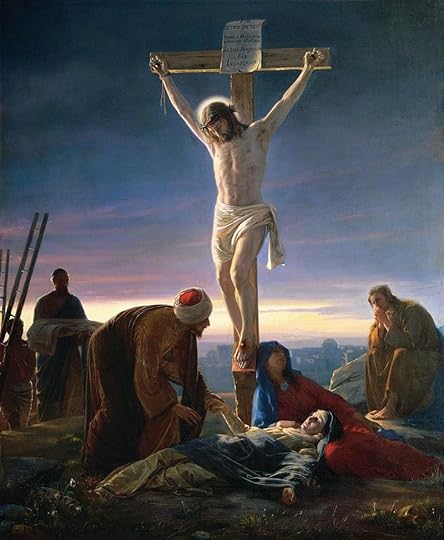 In Isaiah, there’s a similar verse: “It’s your sins that have cut you off from God. Because of your sins, he has turned away” (Isaiah 59:2). So it was at this time that Jesus was bearing the weight of our sin, which caused God to turn away in judgement. And it is because Jesus died and was judged in our place that we are now seen as righteous.
Another key point is that Jesus is quoting Psalm 22, which begins with the same words. Though the Psalm begins in this dark way, if we read on, we come to read prophesy about Jesus’s death. It predicted that he would be mocked, poured out like water, thirsty, pierced, and that they cast lots for his clothes. He says these final words so that the Jewish priests who murdered him would remember the Psalm and realize they had just killed the Christ.
But the Psalm ends with hope: “he has not hidden his face from him” (verse 24). In the end, we know that God restored Jesus to his rightful place of honor and that we who accept Jesus into our hearts will also be freely granted that place of honor.
Ultimately, the death of Jesus on the cross at Golgotha is steeped in symbolism and begs us to recall not only the Old Testament sacrifice practices that point to Jesus as the ultimate sacrifice but Psalm 22 as well. We should have confidence in that Jesus was Christ, son of God. That he was killed in our place as a sacrifice so that we could be right with God!
September 4, 2017
He Goes Before Us
You know how it’s nearly impossible to wrap your mind around the fact that God is limitless and unconstrained by time? Well, I’m about to give you something along those lines that might be impossible to wrap your mind around… but bear with me.
As many of my readers know, I was at a Christian horse camp the summer of 2017, serving as a camp counselor. The experience challenged me in unexpected ways, but was such an amazing experience. Looking back on it, I wish I had served there more than just that one summer after college. Though it was A LOT of work, I don’t think I would ever take it back.
The week or two leading up to my departure, I was freaking out for many reasons. I had just had surgery, and I couldn’t straighten my arm past a 90 degree angle; I worried irrationally that my dog would get hit by a car while I was gone; I hadn’t ridden horses in a while; I was doubting my abilities when it came to faith; and I was just nervous to be away from home for 10 weeks (missing my mom’s birthday, father’s day, the fourth of July, my birthday, and it would be the last summer I’d spend with my sister before she left for college).
Not only was I questioning my spiritual readiness, but with the pain I had in my arm from surgery, I was really close to calling my boss and telling her I couldn’t do my job because I truly wouldn’t be able to lift a saddle or anything!
With all this running through my head, I can now remember one night where God just sat me down and said, “Stop worrying.” It was Deuteronomy 31:8 that gave me hope. It says, “Do not be afraid or discouraged, for the LORD will personally go ahead of you. He will be with you; He will neither fail you nor abandon you.”
Read that back.
The Lord will personally go ahead of me. AND He will be with me?
What??
Again, it’s one of those moments where He shows His omnipresence. He is both by my side as well as where I am going. I found so much comfort in that statement because I felt like I was climbing an impossible mountain alone. I needed him to both coach me through the hike and set up camp ahead.
As I grew my faith in the weeks before I was supposed to leave, I prayed daily for healing in my arm. Without fail, just days before I was supposed to leave, the nerves in my arm were healed. I had no pain and was able to straighten my arm like normal.
Needless to say, I left and spent the summer serving God as best as I could. He did prepare a way, in the hearts of my campers, the other counselors, and within myself. I grew in faith alongside the campers.
No matter where you are in your faith, you are never alone. God is always mowing a path for you to move more easily through the wilderness.
“The Lord of Heaven’s Armies has spoken—
who can change his plans?
” -Isaiah 14:27 (NLT)
“You go before me and follow me.
You place your hand of blessing on my head.” -Psalm 139:5 (NLT)
“The Lord keeps watch over you as you come and go,
both now and forever.” -Psalm 121:8 (NLT)
Miracles Today
The other day, something really cool happened. I was playing my Christian songs album on shuffle as I usually do while cleaning my apartment, and I was praying, “God, I really want to hear some Kari Jobe right now.” I passed it off thinking, “Its shuffle. It’s controlled by iTunes. There’s no way God can even control that.”
The particular song I was listening to lasted a few more minutes, and I had totally forgotten about that fleeting thought. But believe it or not, the next song that played was a Kari Jobe song!! I laughed and was completely shocked while it started to play.
Whether or not it was God or an iTunes shuffle algorithm, it was a really cool moment.
I pictured God laughing with me.
I think today, we are quick to assume that nothing is God’s doing. It’s all random. That is a terrible lie that we have bought into.
As I go through life, I need to (and I think we all need to) understand that God is moving around us and that He loves us no matter what we’ve done or what we think about ourselves as Christians. If we become blind to his miracles, we lose our sense of thankfulness.
“I am the Lord, the God of all the peoples of the world. Is anything too hard for me?” -Jeremiah 32:27 (NLT)
The Voice of God
Hearing God’s voice is something that many are skeptical of today. People think you are crazy if you tell them you hear voices, but it happened to me.
There are two specific times that I remember hearing from God. Once, I was on my swing set thinking on a beautiful day. I looked up to Heaven and asked, “What’re you doing up there?”
And as clear as day, I heard His voice say, “Watching you.”
It came out of nowhere, but I heard it. I hadn’t even had time to think about what He would be doing up there. And if I had, I don’t think I would come to the conclusion that He is watching me.
It was an amazing moment.
The other time, I was praying at church. It was my junior year of high school in the fall. I was trying to decide what to do with college, where to go, what to major in.
I questioned, “God, what do you want me to do?”

And instead of words, I saw a vision in my head of a hand writing with a quill. It looked like this photo.
Now, you may say that was me projecting what I wanted to do, but that wasn’t what I was planning at the time. In fact, for a few months, I defied that voice and majored in business. During that semester, I never had peace. When I finally switched to the English major my second semester, I found peace.
It happens when we least expect it and when we ask for Him to speak. Sometimes, He doesn’t speak, and that is okay. It doesn’t mean He doesn’t hear you. It just means He is waiting to reveal His plan to you.
“God’s voice is glorious in the thunder.
We can’t even imagine the greatness of his power” –Job 37:5
Dreaming Big
As a college graduate, I know how hard it is to trust God when the future is unclear. It can be very difficult distinguishing between what others want, what you want, and what God wants. Recently, I finished Sadie Robertson’s book Live Original, which gives practical advice about how to live as a young, Christian female. The book really struck a chord with me and has since challenged me to dream big and be bold, always trusting God with the future. One of the chapters is about allowing God to use the talents He gave us to impact the world.
We not only need to pray and ask what He wants for us in our lives but also to trust that whatever He tells us to do will be good.
There are three verses that specifically come to mind, which I want to share and build upon.
“For I know the plans I have for you…plans for good and not for disaster, to give you a future and a hope.” -Jeremiah 29:11 (NLT)“Keep on asking, and you will receive what you ask for.” -Matthew 7:7 (NLT)“With God everything is possible.” -Matthew 19:26 (NLT)First, God has plans for us that we should try and listen to. He has given us talents that will help us on our paths. For me, He has allowed me to succeed at writing, and that is where I feel him pulling me to go, even though the world says it’s unwise.
Second, we need to know that God is in control of our futures, but that He listens to our prayers. He may say no, or not now, but God is always in control when things do get scary (like when we hear silence on His end or are stepping onto His path for our lives).
And third, we need to know that when we ARE on His path, anything is possible.
Live Original has reminded me why I chose to be an English major. It reminded me of my purpose in life. And it has reminded me that God is not done with my life.
Many people would not agree that English is a “smart” major to choose because it can be difficult to find a job. But that’s where I have to trust God and know He will make a way.
Senior year, when I was at the breaking point for decisions about college, God gave me a vision of a hand writing. Ever since, I knew I had to do something with writing. So I chose to be an English major. Before that, I didn’t have peace.
And that’s how God speaks to me.
Now, I know He wants me to write a novel like C.S. Lewis—fantasy but with morals built in and for a different age group. I don’t know what He wants me to write exactly, only a faint sketch. But I have to hold on to the answers He has given me. Though the path ahead is dark, the next foothold is visible.
Maybe going to graduate school for creative writing is what the world would warn me against, but maybe that’s also where God is leading me. And that’s okay.
This summer, I met a wonderful friend whose boyfriend is majoring in acting. At first, I was doubtful. Acting is a risky career. But God pulled at my heart and questioned me: “And what about you, wanting to write the novel I told you to?” He asked.
We serve a big God, and if He says to step out in faith and publish my novel, I better do it. And stop ignoring His words to me, His plan for me.
Where does the Lord lead you… even if it seems crazy? What skills has He equipped you with? The lyrics to for KING & COUNTRY’s “O God Forgive Us” hold some inspiration for me.
“We can make our plans, but the LORD determines our steps.” -Proverbs 16:9 (NLT)