Baxter Clare Trautman's Blog
March 31, 2023
The Kindness of Strangers
 Good news: I’m staying at a cabin in the mountains with my two dogs.
Bad news: We parked at a trailhead to go for a hike and when I got out I saw I had a perfectly flat tire.
Good news: I was able to find a level spot in the adjacent campground and put the spare on.
Bad news: The spare was flat.
Good news: There was a gas station just a couple miles down the road so we drove there and they had a working air hose!
More good news: The spare held!
Better news: We drove back to the trailhead and took our hike.
Bad news: While I was changing the tire at least half a dozen people cruised past me, and about the same number of rubberneckers watched from the nearby dog park, yet not one slowed to ask if I was okay, or strolled less than two hundred feet over to see if a 63-year old needed help changing a tire.
Good news: I’m a 63-year old healthy and smart enough to fix her own flats.
Bad news: What happened to kindness, to caring about a stranger? Circumstances permitting I always stop and ask a distressed motorist if they need help. Usually they’re fine but a couple times I’ve been able to jump a dead battery with my nifty deli-sandwich size charger and once I helped a teen who had no idea how to change his flat. None of the stops took more than 15 minutes and each was a huge help to a stranded stranger.
Good news: I didn’t need the help but a little moral support is always welcome. I’m going to keep being kind to strangers and hope it spreads.
(PS – go check your spare tire and if I’m around I’ll help you change it.)
The post The Kindness of Strangers appeared first on Baxter Clare Trautman.


November 17, 2021
Misery in Yellowstone
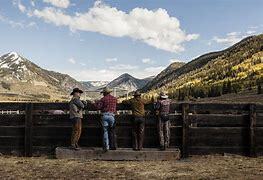 I so-o wanted to like the Yellowstone TV series. Great premise about a modern day rancher fighting all the pressures around him. Well, the rancher, played woodenly by Kevin Costner, ends up being richer than Croseus and an absolute shit, to boot. It’s hard to feel sorry for a greedy land baron owning a sizeable chunk of Montana, and I spit out my ice cream when he actually had the balls to call the Native American chairman who stole some of his cattle a thief. Psst – remember? Your venerated ancestors stole this land from his venerated ancestors who were here first?
Said rancher has three sons and a daughter. Spoiler alert – one son dies early on and seems like a decent enough guy, but we never get to know. The second son, the ranch lawyer, is a Daddy’s boy and as slimy as one would expect for a TV lawyer. The daughter is damaged goods and rather than trying to rectify her life she wallows in her “Mommy didn’t love me” victimhood. The youngest son is trying to be a nice guy, in between murdering people. He’s the only character who’s at all sympathetic but even in just the four shows I watched he just keeps making abysmal choices.
Excepting him, there is not one character who isn’t all about me-me-me. Ostensibly the patriarchal (in the worst connotations of the word) rancher and his spawn are saving the ranch for their family. Ostensibly the tribal chairman and his henchmen are trying to reclaim it for their people. Let’s not even get into the creepy land developer who almost seems nice in comparison. There isn’t a redeeming character in the whole show and after cringing through four episodes my wife said, “I don’t like any of these people. Why are we spending time with them?”
We’re not. I wish this had been a show about a small rancher trying to survive against modern-day odds – that may have truly invoked sympathy. But it’s hard to feel sorry for a cowboy who runs around in his own helicopter blowing up rivers and siccing his hitman on people who stand in his way. What made me even sadder is that so many people I know and love really dig this show. And that hurts because I think “Yellowstone” is a reflection of where we are as a society. Everyone in the show is concerned with their individual rights and justice, not societal justice. The characters only care about their tribes and what their tribes want. Everyone else is expendable, literally — I’ve already lost count of the bodies piling up. In “Yellowstone” as in modern culture, problems are solved with guns and explosives, rather than dialogue, compassion and a willingness to compromise. It is a troubling show because it is sad, soulless, and superficial. And I fear that may be where we are as a nation.
The post Misery in Yellowstone appeared first on Baxter Clare Trautman.
December 27, 2020
The Wee Winged Ones
I don’t think there’s an easier way to connect to another living being than to look out your window and see what birds are there. Even if you’re in a city, you will have the ubiquitous pigeons, house sparrows, starlings, and at night even owls. Just as gazing at a fish tank reduces stress and lowers blood pressure, so does watching birds at a feeder. There’s something about nature that soothes the soul and calms the human heart. Maybe it’s something as fundamental and simple as having a relationship with something else that’s alive.

Cedar waxwings
Unlike captive fish in a tank, part of the fun of birds is never knowing which will show up at your window. The natives will of course always be there, but almost half the world’s birds are migratory; there’s no telling who might be passing through your neighborhood and spy that inviting tray of food or much-needed pan of water. Also unlike a fish tank, you don’t need specialized equipment. A cracked plate filled with seed and an old skillet with water will work (never a bowl or deep dish they can’t get out of). Of course you can get all fancy but the birds won’t care.
I recently moved from country to town and what I missed most (other than silence and privacy!) were “my” birds, the regulars who showed up at feeder and fountain every morning while I spied over coffee. Once we sort of got settled in the new place I got some seed and put out a feeder. It took a while but eventually old favorites came to it, first the big birds like jays and thrashers, then the towhees and titmice. That was when I began to make friends with my new surroundings and not miss the old so much . It took the comfort of friends to make the new house a home.
But not all birds are seed eaters – some prefer bugs or berries, so they won’t come to a feeder, preferring as they do to lurk in bush and tree. For Christmas my wife got me a good but inexpensive pair of binoculars and in the ancient tangle of roses outside my bedroom window I saw two types of birds that will spend the winter here but never come to a feeder. Hence the beauty of a shallow dish of water, for while I watched both species took a turn sipping from it. Later one of those birds came back to splash around for a quick and seemingly joyful bath. Then, like a quiet mist, a flock of cedar waxwings settled into a nearby pyracantha hedge, just passing through but stopping along the way for a quick feast of lush red berries.
Birds are fragile creatures, yet so resilient and full of life. Their lives are short and filled with peril but they carry on with huge and valiant hearts. They are a constant reminder to me that all life passes, but until it does it should be lived boldly and beautifully.
So offer up some food and water. See who you can attract into your life, for the little winged ones are wise and faithful companions, and which one of us can’t use more of them?
The post The Wee Winged Ones appeared first on Baxter Clare Trautman.
December 18, 2020
Christmas for the Big Kids
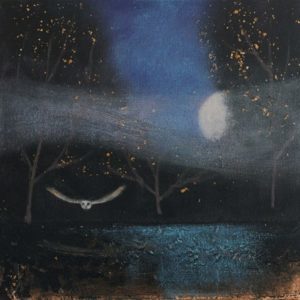
As The Moon Rose – Catherine Hyde
They say that Christmas, with all its hope, wonder, and magic, is a time for children. I say, more now than ever before, that Christmas is for adults.
We big ones have lived through an unprecedented year of challenges, personal, global, and planetary. I don’t have to list the challenges, you know them already or are just coming out of a deep coma. Yet here we are, on the brink of a new year, and isn’t it full of hope and wonder? (And deep in our hearts don’t we wish for it to have just a little magic, too?) The days are almost at their darkest and shortest. Its time to tuck in, stay warm, and consider the year that was. No, don’t turn from it and wish it away. Look at this year head-on and thank it for exposing so much darkness to the light, for darkness can only be banished when it is held up to the light. Undoubtably the year held challenges for all of us, yet we have come through or are coming through these challenges and light is appearing at the end of this long, dark tunnel. We may have gotten through clawing and screaming but by the grace of all the gods we are here, alive and breathing. Isn’t that cause enough for wonder?
If not, step outside. No matter where you live, city, town or farm, seaside, desert, or forest, step outside tonight. It doesn’t have to be for long, but do step outside and look up. Consider the moon if you can see it, if not, the brightest star. If clouds are all you see, consider them too, condensing and puffing up to deliver rain or snow. Consider the fleeting life of a cloud in relation to your life, then consider the moon or that bright star in relation to your life. That’s the same moon that looked down on Jesus and Mary, Buddha, Abraham and Muhammad, dinosaurs and mastodons, dodo birds and passenger pigeons, your great-great grandparents and aunts and uncles. Yet here YOU stand under that same moon or star, as temporary as a cloud but just as important. For just as a cloud carries the moisture that nourishes the world, your one beating heart carries the love that feeds the world. Can you feel the wonder, dare I even say magic, of your oh-so tiny but oh-so important singular life?
Now go back inside and envision if you will, a Christmas tree, decked out just the way you like it. Under that tree is a single present, a great big, gaily wrapped box. What do you think is in the box? What do you want to be in the box? Well, start to unwrap it. Bow first, then the ribbon, then all the pretty paper. Pull the flaps away and what do you see inside?
Do you know want to know what I got? I got a great big box of hope, and surprise! so did you! Yes, it has been a dark, dark year, but as Desmond Tutu says, “Hope is being able to see that there is light despite all of the darkness.”
So these are the gifts I wish for all adults at this, the darkest, most profound time of year – the willingness to look for magic, the ability to feel wonder, and the profound comfort of hope. May you find them all and hold them close.
The post Christmas for the Big Kids appeared first on Baxter Clare Trautman.
February 22, 2019
Forget the superficial explanation of geomancy as divinat...
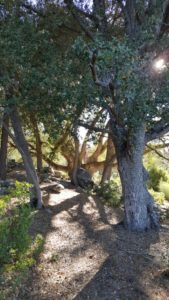 Forget the superficial explanation of geomancy as divination; this is geomancy as necessary and critical healing that applies to us each and every one. Thank you Lorian Association and Susan Beal for permission to repost this.
February 15, 2019
A LORIAN PRIEST EXPLORES GEOMANCY
Susan Beal
I learned to dowse nearly forty years ago from a dowser named Herb, whom my father hired to locate where to drill a well. Herb’s dowsing rod was a modern version of the traditional forked stick – two white nylon rods duct-taped together at one end. He told the well driller exactly where to drill, how deep the water source was, and how many gallons per minute they’d find, and he was right.
In addition to finding underground water for wells, Herb also dowsed for something he called geopathic stress, places where energies in the landscape have a negative effect on human health. He was particularly interested in places where two or more underground streams intersected. As he explained it, spending a lot of time over such spots, like sleeping or working at a desk, could cause all kinds of problems – sleep disturbances, weakened immunity, arthritis, cancer, and more. Fortunately, he said, this kind of problem could be addressed in surprisingly simple ways, and he told me stories of people he’d helped.
As far as I was concerned, Herb was a magician. I was utterly enchanted, so he handed me a rod and showed me how to dowse. It turned out I had a knack for it. I was hooked, not only on dowsing, but on the very real and practical benefits of working with subtle energies in the landscape. A whole new world opened up to me, beyond what could be apprehended by the physical senses.
Although I didn’t realize it until years later, this encounter was my introduction to geomancy, a form of earth healing with variants in traditional cultures around the world. Geomancy takes into account that there is more to the world than we can perceive with our five senses. Just as with mind/body medicine, geomancy addresses not only the physical causes of distress or imbalance in a home or a landscape, but the energetic ones, as well.
The physical environment is interlaced with and supported by a sort of energetic scaffolding of currents, grids and vortices, like the meridians and chakras within our own bodies. These lines and grids can be distorted by psychic and noetic residues that accumulate in the landscape. Activities in the physical world leave an imprint in the subtle world. Historical events, especially traumatic or strongly emotional ones, can have a big impact and create static place memory that can keep a place energetically stuck in the past, endlessly recirculating patterns that inhibit health and evolution. And, of course, there are ghosts and other non-physical beings, human and otherwise, whose presence can have all kinds of effects, for good or ill.
A few years ago I began apprenticing with a master geomancer, Patrick, a third-generation practitioner of spiritual and psychic healing. For the past 25 years, he has traveled the world tending to unbalanced and traumatized places. What Patrick accomplishes through his practice of geomancy is magical—crop yields increasing manyfold, dry springs and sandy creek beds suddenly flowing with water, debt-ridden businesses starting to thrive, long-standing illnesses and conflicts resolving. Using various tools, including dowsing, in collaboration with spiritual, angelic and other non-physical partners, he works miracles that defy science and logic.
A geomancer is part wizard, part custodian, part mediator, and part Greenpeace activist, practicing in the in-between places where the material, subtle and spiritual worlds meet and mingle with the light of consciousness. Geomancy, essentially, is about clearing, blessing and enhancing the energy in our homes and landscapes to bring about greater harmony and wholeness. Even more, it is about cultivating a conscious, loving relationship with the collective intelligence of the living Earth. To me, geomancy is applied Incarnational Spirituality.
Our relationship with place – home and community – is one of our most important and primary relationships. In these scary times, facing the horrors of climate change, mass extinctions, and endemic pollution, it’s hard not to feel as if our relationship with Earth is irreparably broken. Unfortunately, a lot of environmental activism is fueled by fear and anger. Scientific predictions are grim, suggesting that much of the damage is irreversible, which adds a layer of hopelessness to the anxiety and shame many of us already struggle with. The irony is that such emotions are toxins in the subtle worlds, where they can create even more imbalance. Many people believe Earth would be better off without humans at all. How can we have come to a point of such estrangement from the world that gave birth to us? How do we deal with the overwhelming consequences?
That’s where the real magic of geomancy comes in. We do not have to deal with this alone. In fact, no matter what knowledge and skills we may bring to the task, far greater transformation is possible when we join forces with helpers in the unseen realms. In truth, a geomancer is mostly just a general contractor, the boots on the ground for the non-physical members of the team, sizing up what might be needed, and then calling in the right healers or contractors, so to speak, especially for the heavy lifting.
Traditional and contemporary cultures around the world have held great reverence and love for the spirit of place. The Romans called Spirit of Place the Genius Loci, Loci being the place or location, and Genius referring to the spirit that governed or tended to it. While today we think of genius as meaning intelligence or talent, originally it meant a protective spirit, the guardian angel of a person or an area. Any one of us can call upon the Genius Loci of our own places—our homes, our neighborhood, the woods and lakes and landscapes around us, and ask them for help.
While I get anxious about my abilities as a geomancer, and often am drained by the challenge of mediating between such different energies, I am awed, humbled and uplifted by this work. I am constantly learning to expand my sense of what is possible, to trust and believe more and more in the reality of this partnership and the help that is there for the asking.
This is not easy in the world we live in. In the face of hard science and front page headlines, it’s hard to trust that there is more hope for healing the world than we are led to believe. Even those of us who read blogs like this, who are members of organizations like Lorian, often have quiet doubts, if not about the reality of numinous helpers, then with our worthiness to take our place alongside them and accomplish necessary miracles. It takes courage to defy the disenchantment of our world. I keep stumbling upon all the limits I’ve placed on what seems possible, and discovering just how bereft of magic I feel.
But geomancy gives me evidence of what I long for most. It re-enchants the world. It opens my heart to wonder. It gives me healing tools that seem just this side of magic. Mostly, it gives me glimpses of the luminous presence of Love in all its emanations and incarnations, waiting under the heavy layers of despair to help us heal the Earth.
Original link found here: https://lorian.org/community/2019/2/1...
Have you ever gone somewhere, to some place, where for no logical reason you just hated it, it just felt bad to you? Or the opposite, you felt you belonged in a place that was a complete surprise to you, you loved it inexplicably?
For whatever reason, there are places on earth that either feel very off-putting to us or very nurturing. Everything has energy, some of it fast moving (corn, hummingbirds) and some of it slow (redwoods, rocks). You have your won energy and I mine, and though similar, they are all different – think of the extremes between a talkative, impulse person and a quiet, thoughtful one. As a result of these subtle differences we will each pick up the energies of the world around us differently – some love the hum and thrum of the city, others the silence and solitude of nature.
The post appeared first on Baxter Clare Trautman.
February 1, 2019
The Trunnel
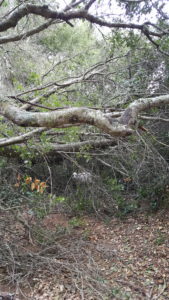 I walk the dogs on a dirt access road beside the railroad tracks. It’s one of the few places left in this county where my dogs can run free while I wander without worrying about them. A dry creek overgrown with willow and coyote bush separates the road from the tracks. The other side sprawls off into an old California rancho still home to oaks and cattle.
The road is shaped like a lollipop; straight like the stick until it becomes the round candy, looping around a stand of oaks to rejoin itself. The dogs and I park at the railhead, the bottom of the stick, and skirt the locked gate. I usually stroll, hands in pockets, while they race ahead smelling rabbits, bobcats, and the occasional other dog, but today I am gloved and carry loppers.
During the first storm of the year an oak trunk snapped and fell across the road, right across the middle of the candy. Now, instead of completing the loop we have to turn around and retrace our path down the lollipop stick. The candy is the best part of the lollipop, not the stick, so I am determined to cut a tunnel through the downed branches.
When we get to the fallen oak I study the tangled limbs. They seem too inaccessible from this side so we run through poison oak to the other side of the loop and come up on the back side of the deadfall. Here there is an easier place to start lopping and I clear a space from one gap amid the branches to the next. The tunnel grows crookedly but far more easily than if I forced a straight line. It seems I must be about halfway through when I get to a limb too thick to lop. Instead I trim the branches over it so I can stand and step across the limb. I can’t see how far I have to go so the dogs and I dash back through the poison oak and start tunneling in from the opposite side. I snip bough, branch, and limb into tiny pieces, making a carpet of leaf and wood.
I’m deep under the tree, the dogs lying behind single file, when I get scared. Over our heads is at least half a ton of dying tree. If it shifts… If a supporting limb suddenly snaps…
I squat in the leafy tunnel and consider what I’m doing.
Is it really dangerous? Yes. The tree is newly cracked and though it appears stable the trunk is still attached to the base of the tree about ten feet up, supported only by two stout limbs jammed into damp ground.
Is this reckless? Unequivocally.
Is it necessary? Not in the least. I can turn back to finish our walk or twist past the poison oak to get to the other side of the loop. But that shortcuts the loop. Its like only eating half the lollipop. The dogs couldn’t care less but to me the complete circuit is integral. The oaks are thickest here along the loop. In summer they are cool and shady; in winter, dark and mysterious. The loop completes our journey, and marks as all circles do, a simultaneous start and end. Without completing the circle the walk is lifeless and lacks symmetry.
I look at the snarl of twig and leaf before me. I’m pretty sure if I can just get through the next six feet or so I’ll get to the other side of the tunnel. But this is undoubtably stupid. The snarl unnerves me and I back out.
But I can’t quit. The dogs and I run through the poison oak again. I crawl through what I’ve already cleared and from here I can see where I stopped on the other side. It only needs a couple more feet to be complete. I stand over the uncuttable limb and see the route to take. Clip, clip, clip and I am through!
I crouch and emerge victorious on the other side of my “trunnel” — the victory not in reestablishing the loop, but in the lessons of the task. As I walk back to the car, loppers over my shoulder, I hope some kids find the trunnel and scramble through. I hope they are a little scared but even more intrigued and delighted, for it’s only in risking that we are truly alive.
The post The Trunnel appeared first on Baxter Clare Trautman.
September 29, 2018
Why Women Love Donald Trump
 In 1980 I was a gun-toting, chain-smoking, bourbon swilling, diehard Ronald Reagan supporter. I got my whole family to vote for him. But when I got into the polling booth, I pulled the trigger for Jimmy Carter. I was surprised, shocked, and not a little embarrassed, but in my heart of hearts I understood he was the better man. Whether or not he was the better candidate is for political historians to decide, but he was decidedly the better human being. It took a long time before I could admit to anyone I voted for him and even longer to understand my sea change.
There’s a quote attributed to Margaret Atwood that I’ve heard a number of times but never truly felt until Gillian Anderson quoted it in an episode of The Fall: “Men are afraid women will laugh at them. Women are afraid men will kill them.”
It is so chillingly simple. Women exist in a world dominated by men. No matter the country or continent, men make and enforce the rules and religions all women must live by. We are like pets in their homes – sometimes welcomed, sometimes not. Daily we are assaulted, raped, and murdered. By men.
Historically, women have been men’s chattel. When we displease or confront them, we are expendable. Look at Salem. Look at the Inquisition. Look next door – in 2017 the CDC released a report citing that 55% of all female homicides in the US were committed by boyfriends or husbands. Is it any wonder we don’t tell, we don’t report, we don’t make a fuss, for who would we tell but other men? If we can’t trust the ones that supposedly love us how can we possibly trust a strange man to help us?
Men are usually bigger and stronger then women. They can kill us very easily. Often they control the purse strings. For most of us, especially if children are involved, it’s easier to go along to get along. We stay silent. Our silence leads to denial. Most of the women reading this post will have had at least one unwelcomed and uninvited physical encounter with a man. Many have had more more. It’s a lot easier in the short term to brush these encounters off. We tell ourselves it wasn’t a big deal, to not be such a baby. When questioned we explain, “He didn’t mean it.” “He was just drunk.” “He’s usually not like that.”
We explain away our fear so that we can keep living with it, so we can keep placating those who control our lives. If we explain the fear away long enough it becomes denial. We start believing our own stories. We become unwitting victims of the Stockholm Syndrome – so afraid of our kidnappers we start sympathizing with them in order not to upset them, and resenting anyone who tries to rescue us from their good intentions. It’s a common and completely subconscious survival instinct.
Trump is our collective kidnapper, the alpha male in control who can kill or reward on a whim. Alpha males recognize him as one of their own. Lesser males want to be him. Therefore the women affiliated with these men better love Trump too. Or else.
Again, this isn’t any kind of conscious decision, and while admittedly simplistic, women support the Trumps and Kavanaughs out of a purely primal need for survival. We are conditioned to molding themselves to meet men’s expectations. Our mothers did it, our grandmothers, and their grandmothers. There were few options and role models for women not under the care and protection of a dominant male.
For most of my life I have been a blustering, bullshitting, get along with the good old boys kinda gal. It wasn’t until a few years ago, in a sudden rush of rage and shame, that I realized I wanted to be like the men around me so I could fit in. So they wouldn’t eat me. My livelihood, maybe even my life has depended on fitting in and playing by their rules. I’ve always gone along to get along. It’s been easier than raising a fuss, easier than risking rejection/ridicule/violence.
Ronald Reagan was my Trump. You were either with him or against him and I certainly did not want to be outside the pale. I wanted to fit in, to have a comfortable place in the middle of the herd. But in the privacy of that voting booth, my heart understood who was the better man even if my head hadn’t yet caught up.
I’m lucky. It only took me 57 years to understand my fear. Some women never will. They are not emotionally or psychologically capable of acknowledging it. For some, even if they do, the resulting rage may be so potentially destructive it’s not worth chancing. They tamp the fear back down, cover it up. They have to keep going along to get along. The alpha male is both captor and savior. To admit otherwise, to challenge that established order, might well result in death.
Instead, we die in little increments, never fully owning our lives. We go along to get along and Trump is just another in a long line of males directing how women should be and what we should do. For many, there is comfort in being told how to behave, a sense of security in blindly following our alpha male. Even as he leads us over the edge of a cliff.
The post Why Women Love Donald Trump appeared first on Baxter Clare Trautman.
September 28, 2018
Maggie Terry by Sarah Schulman
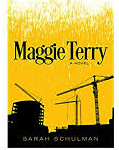 (Reprinted from The New York Journal of Books)
Ex-cop and newly recovered addict Maggie Terry is utterly shattered when we meet her on the first day of her new job as detective at a small law firm. Maggie is desperate to rebuild herself, yet despite 18 months of rehab, she isn’t prepared for life outside a halfway house. Her apartment remains barren, without even a shower curtain, and with no towels Maggie must dry off with dirty old clothes. She can’t even remember to buy tea bags. She’s a mess, still furious at her ex-girlfriend’s intervention, still bitter she’s not allowed to see their child, and certain she’s going to screw up her new job.
The novel is billed as a mystery, but Schulman doesn’t get to it until 40 pages in when the strangling death of a minor actress is grandly announced to the law firm by a famous though aging co-star. From there, in classic Schulman style, she ricochets around the plot like a bullet in a drive-by.
Opening with the collapse of American politics and community, Schulman weaves disintegration throughout the novel, from the destruction of Maggie’s old self, to the loss of the corner grocer, the deaths of her ex-partner, her boss’s son, an unarmed street hustler, and the nameless actress, to the disappearance of her beloved city’s diversity, now a bland homage to homelessness and white gentrification.
Maggie works her new case in between trying to remember to get tea bags, reflecting petulantly on her ex-lover’s flaws, missing their child, attending 12-step meetings, despairing over the death of her old partner, refusing blame for her predicament, and wondering when in her lost and drunken years the city has changed so much. Amid all this, and despite herself, Maggie inches back to life. She begins trusting others instead of blaming and judging. She even surprises herself by starting to accept responsibility for the hash she’s made of her life.
Accountability, and the lack of, is stressed throughout: Maggie’s boss didn’t want to hear his son was a junkie, and now his son is dead; her ex-partner refused to accept that his son, also a cop, shot an unarmed black man, and in attempting to help his son evade punishment was himself killed; Maggie and all her fellow 12-steppers denied their addictions and lost great parts of their lives; the aging superstar denies her past and pays the price; a city that isolates itself behind wealth and mediocrity kills its vibrant essence, and a citizenry that doesn’t think elects leaders who selfishly encourage their ignorance and despair. Shulman spares no one.
For genre mystery fans Maggie Terry may disappoint. Minimal sleuthing is involved in the case of the dead actress, and what detective work there is involves Maggie leaping from one snap judgment to another. For readers interested in the deeper mysteries of human relationships, Maggie Terry delivers, with Schulman addressing the more trenchant mystery of how people and communities rebuild themselves after ruin.
As Schulman makes clear, our relationships are never perfect, but the imperfections are what make us human, and like Maggie Terry, so very fragile and hopeful. It is only in the pretense of perfection, in failing to acknowledge our flaws, that we fail each other and ultimately ourselves. In Maggie Terry the eponymous heroine learns not just “how to be accountable and survive” but how to be accountable and thrive.
The post Maggie Terry by Sarah Schulman appeared first on Baxter Clare Trautman.
June 15, 2018
Verge – by Z Egloff
 Claire McMinn’s trying to get her life in order. She’s given up drinking. She’s stopped sleeping with her best friend. She’s working hard at college, hoping to get into film school. But she really shouldn’t have slept with her film instructor’s wife. Or made a video of it. Or drunkenly left it in his desk drawer.
When Claire’s beloved instructor kicks her out of class, she bikes home through her “cheap, empty, dust-engorged” Central Valley town, to find her best friend Shelly has been beaten up by her husband. Claire accompanies Shelly to a Catholic community center which provides counseling and a place to stay but it’s a short-term solution. Shelly’s plan is to move in with Claire “just for a bit.”
While waiting with Shelly at the community center, Claire mentions she’s been kicked out of class and needs to find equipment to finish her project. The intake nun overhears and volunteers the film equipment stashed at their outpost center.
Claire is nonplussed by the nun who greets her at the Bearley Community Center. Young and striking, Sister Hilary is like no nun Claire has ever envisioned. When Claire tells her she is there to borrow the film equipment Sister Hilary tells her there has been a mistake, the equipment cannot leave the center. Seeing Claire’s disappointment, Sister Hilary suggests a compromise – in exchange for letting Claire use the equipment, Claire can volunteer at the center and film her project there. Desperate to complete a project that will get her into film school, Claire reluctantly agrees.
Thus begins Claire’s slippery, sometimes painful, often funny, descent into love with a nun. The developing romance is certainly the focus of the novel but the plot is elevated into first-class story-telling by creating a complete and vulnerable character out of Claire; not only is she trying to not “corrupt” a nun (“Do you have any idea how seriously you’d go to hell for something like that?”), she’s also attempting to stay sober, patch it up with her old instructor, remain celibate with Shelly, and all this while coping with her marvelously dysfunctional family.
Egloff has created an endearing character, full of foibles and promise. Verge bolts into action and Egloff sustains the pace with fresh, creative writing. The romance is above average, taking time to develop amid reasonable setbacks which are never maudlin or neurotic. Egloff’s secondary, and even minor characters are fleshy and fully developed. Verge is a mature and refreshing tale of falling in love not just with another woman, but with one’s self.
The post Verge – by Z Egloff appeared first on Baxter Clare Trautman.
June 7, 2018
Goodbye old website, hello new
Some of you remember how fun my first website was – desk drawers opened, a raven cawed, the dog woke up, mountain lions ran outside the window, and if you clicked the clock my office would change from day lit to moon lit. Then tablets and smartphones made the site unwieldy and hard to open. The designer updated it, making it accessible and taking all the fun out. It lost all its soul. I’ve lived with it until now. The new Baxter Clare Trautman website isn’t playful but it is crisp, elegant, and has reclaimed a little of its soul. Go have a look. I’d love to hear what you think.
The post Goodbye old website, hello new appeared first on Baxter Clare Trautman.